Posted in Blogging, crafting, creativity, Cricut, goal setting, Health and Nutrition, Home cooking, intentional living, life hacks, lifestyle, manifestation, mindset, personal development, Planning and journaling, reflective journalling, Setting goals and intentions, watercolour painting

Setting up my 2025 Vision Board

Last year, for some unknown reason, I think I must have decided against making a 2024 vision board. I’m not sure why, but maybe I didn’t feel up to it or perhaps I had a variety of commitments at the beginning of January and decided it was too late in the month to work on one.

For 2025, I decided that, for me personally, it’s not really important to have the board finished in super quick time and it doesn’t matter if I’m still working on it towards the end of January. I wanted to have a slow start to the first month, really pondering over what I would like the year to look like. I found it helpful to revisit a couple of old blog posts of mine in which I’d talked about key questions you could ask yourself to prepare your mind and what to actually do to improve your chances of manifesting everything you’ve visualised for the year.

I decided to create a larger display, rather than using two pages in my bullet journal as then I can have it on my craft room / office wall to look at all year round. I also chose to combine images, motivational sayings, affirmations and a few cute decorative elements to make it visually appealing. I’ve spend days thinking about what I truly want this year, flicking through a huge stash of Psychologies magazines, answering deep questions from my previous vision board posts, journalling my thoughts and closing my eyes to visualise things. I’m so glad I put lots into the preparation as my 2025 vision board is now complete and turned out exactly how I wanted it. I can’t wait to share a photograph of the finished product!

And here it is…
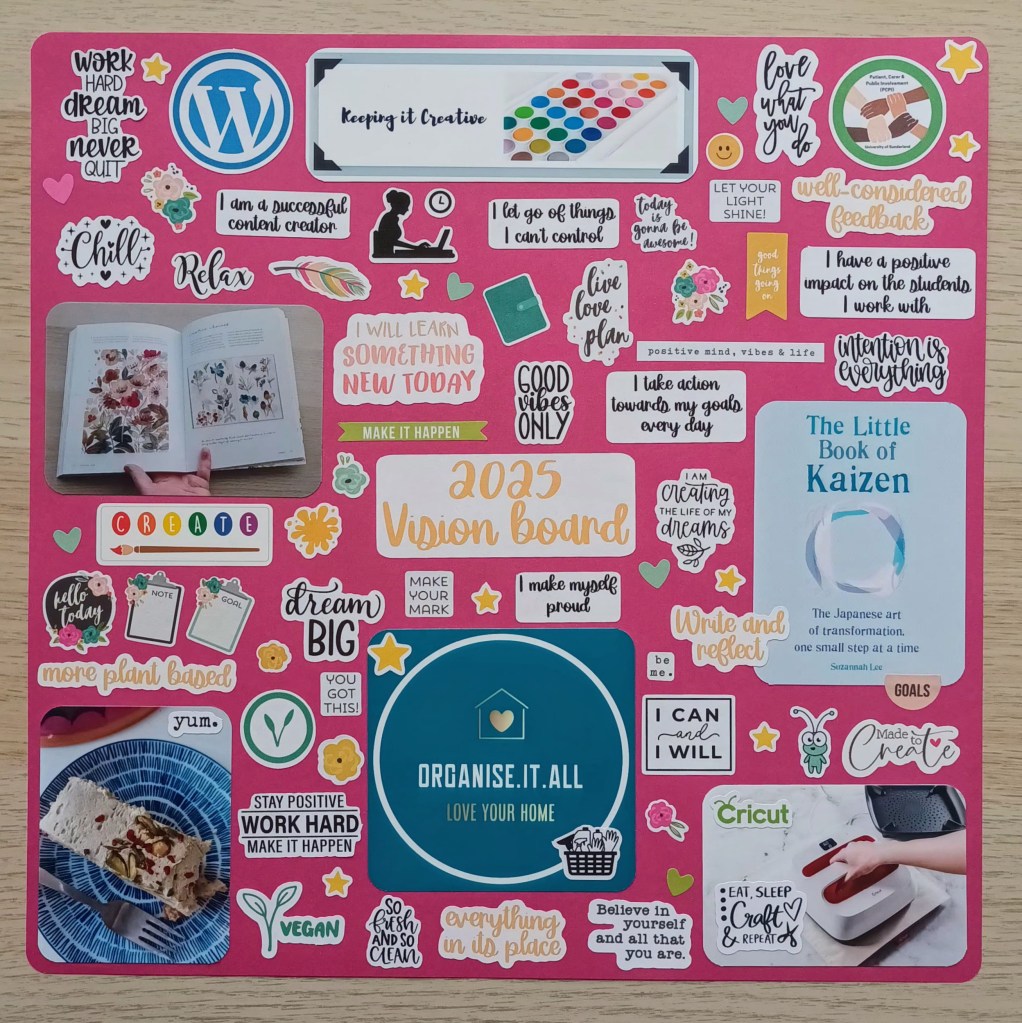
Photo credit: Laura Jones for Keeping It Creative

My main categories

Diet – The plan this year is to eat more plant-based goodies than ever before. We’ve made so many healthy and delicious vegan dishes this Veganuary and we’ve also found a cafe that has a range of vegan friendly cake options. It’s getting easier and easier to eat a plant based diet and my husband and I have already made a number of changes over the years such as soya milk on our cereal and oat milk in our hot drinks, vegan spread on our bread, lots of plant based alternatives to meat such as soya mince, veggie sausages, VLTs etc.

Creativity – I want to develop my watercolour skills even further this year, whilst also engaging in mindful and calming activity after busy days. I got a gorgeous book for Christmas which provides exploratory activities and projects with a nature theme. I want to incorporate a weekly slot of time to experiment and develop a range of techniques.

Blogging – I want to spend more time promoting my blog posts so that I develop a wider readership. I used to consistently post pins on Pinterest but I’ve let this slide over the last few years. I get plenty of readers but I want to reach individuals who do not have their own blog as well as those who are keen bloggers.

PCPI work – I thoroughly enjoy my work at the university but it’s really important to me that I’m making as much of a difference as I can to the students. I particularly want to develop my feedback skills for medicine sessions, particularly with young adults who are in the initial stages of their uni course.

Kaizen – I recently started a short book called The Little Book of Kaizen – The Japanese art of transformation, one small step at a time. I’m enjoying reading it and doing the exercises at the beginning. The idea really appeals to me, so, to make sure it’s a focus for me this year, I’ve added a photograph of the mini book on my vision board with a view to working through all of the chapters. I’ve even pick out a cute notebook to use to jot things down and I’m using my fountain pen to write beautifully inside.

Cricut – As you probably already know, I’m obsessed with making stickers and cutting them using my Joy Xtra. However, I also have the smaller Joy machine and also invested in the EasyPress 2 when it was on offer at a discount. I have lots of vinyl and HTV as well as some iron on papers so I want to spend time this year getting creative and using them all up. I have so many ideas but I now need to schedule time to actually get making things. I added a Cricut bug sticker to watch over me and remind me to have more fun playing with my machines.

Getting organised – We have a lot of stuff in our house and some of it needs purging. As well as trying to use up craft materials before buying any more, I also want to re-organise our home so it’s easy to clean and keep tidy.

Final words…

That’s everything on my vision board for this year and to ensure that everything on the display comes into fruition, I will be checking in with it at the beginning of each month and using the different aspects to set mini monthly goals. I’ve developed pages in my bullet journal to list my goals and I’ll make sure at least some of them relate to things I want to manifest throughout the year.

I hope you enjoyed seeing my board and that it’s inspired you to have a go at creating your own. It doesn’t matter if you don’t get around to it for a few weeks – there’s still plenty of days left in the year to take action.

Good luck!

Posted in bullet journal, Bullet journaling, exercise, fitness, goal setting, Health and Nutrition, lifestyle, wellbeing

Setting up my Bullet Journal for July 2024: Health and fitness theme

This time, I’m coming to you with what might be considered a bit of a random BuJo theme for summer. My original idea was to do wildflowers and grasses, but, as my current personal goals are mainly focused on weight loss and body toning, I thought why not choose a theme related to these, so I opted for health and fitness. I wrote lots of ideas on mini post-it notes and then decided which ones I’d actually go ahead and do (with the limited time I had left to be ready for July). Here’s what I have to show you so far:

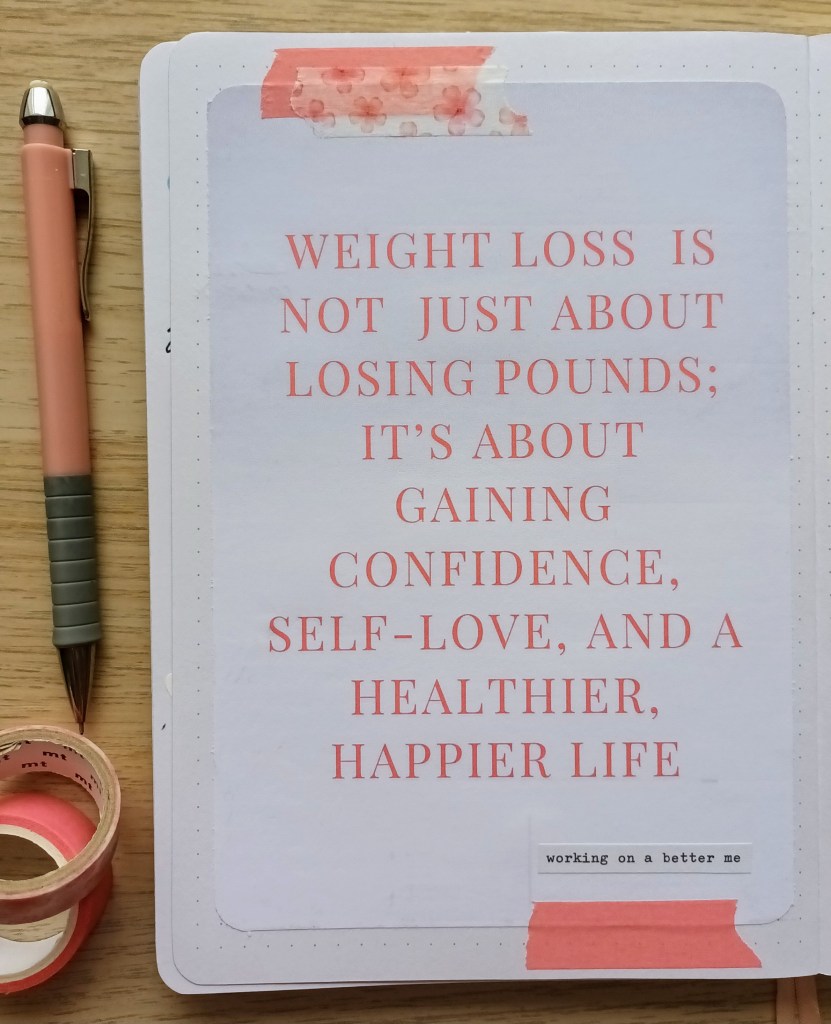
Quote page

Photo credit: Laura Jones for Keeping It Creative

This was created using Canva (none pro version), an A5 size portrait size design and a lovely peachy pink colour font. I then added a couple of bits of washi and a little sticker from a page of health and fitness related phrases from my Carpe Diem booklet.

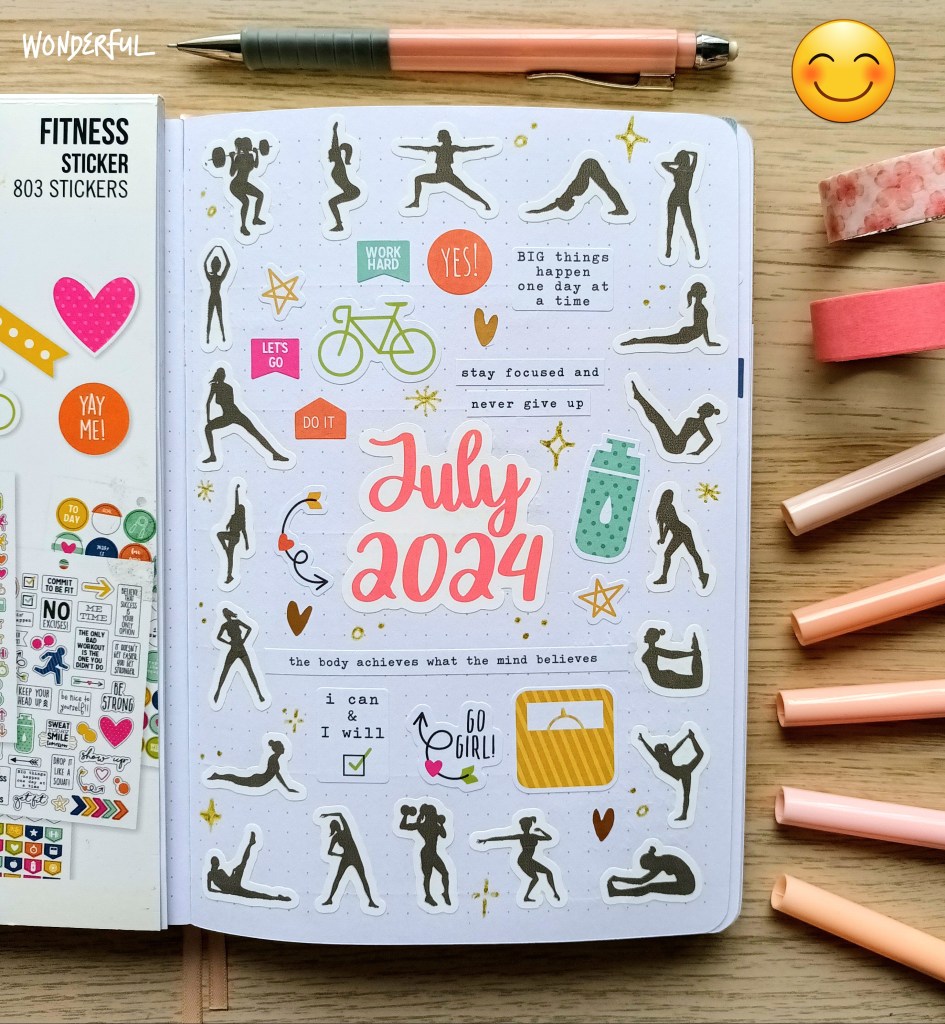
July Cover Page

I had so much fun setting this up and it was nice to make use of some Carpe Diem stickers I already had in my stash. The solid black images of women exercising were made in Cricut Design Space.

Photo credit: Laura Jones for Keeping It Creative

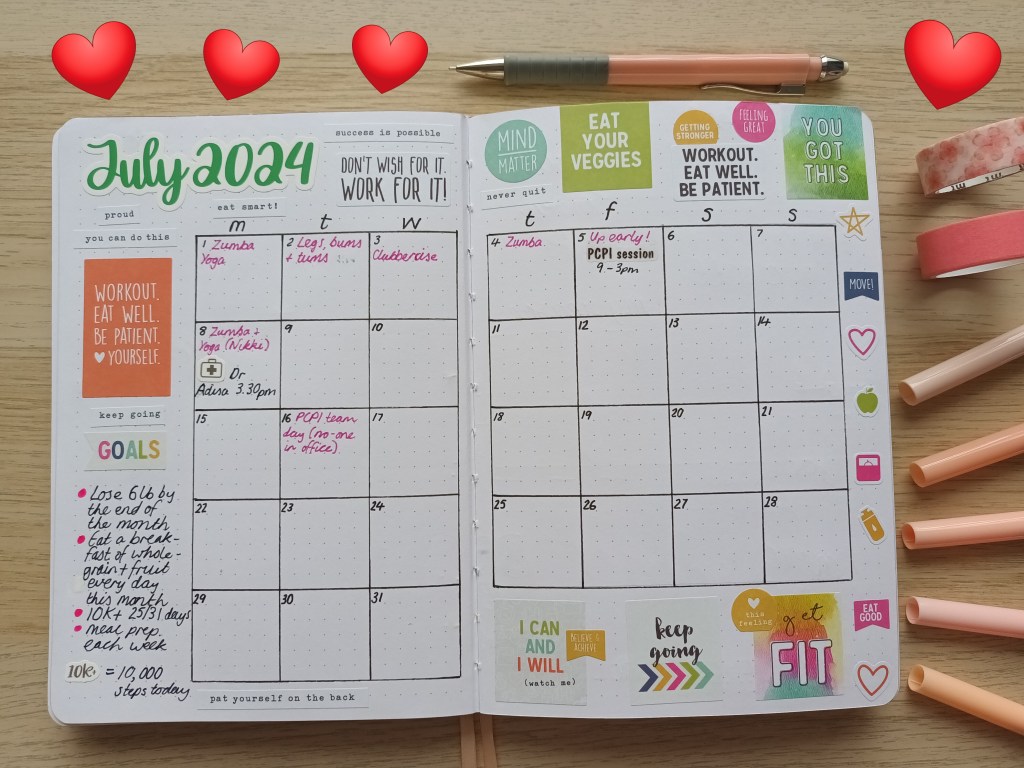
July Calendar

I shifted the boxes on my usual calendar one place to the right so I could add my goals for the month on the left hand side. I’ve now decided that a better target than 10K steps most days would have been 2400+ calories burnt but I can always create a habit tracker for the above instead.

Photo credit: Laura Jones for Keeping It Creative

My reasons why…

I got the idea for this page and a few others from Planning Annie on YouTube. She has lots of ideas for health related spreads and I really recommend watching her ‘health and fitness planner spreads’ video if you need some further inspiration. The ‘reasons why’ I’ve chosen are very personal to me, so, for example, my GP has advised that my blood pressure is at the high end of normal and that my cholesterol levels are slightly elevated from the normal range so related reasons why have, as you can see, been added to the spread.

July Finances

I almost forgot to do my financial tracker as it isn’t something related to the aspects of health I’m focusing on (financial health aside). I’ve been really good at spending no more than I have coming in each month for quite a while now but it’s still interesting to see where my money is going.

Photo credit: Laura Jones for Keeping It Creative

Another motivational quote page

With 9lbs lost so far in a relative short frame of time, I’m feeling really motivated to lose more weight. The second part of this popular quote, from Jim Rohn, will hopefully be related to my new and improved eating habits which will join with my regular fitness class habit that I’ve had for a fair few years now.

Photo credit: Laura Jones for Keeping It Creative

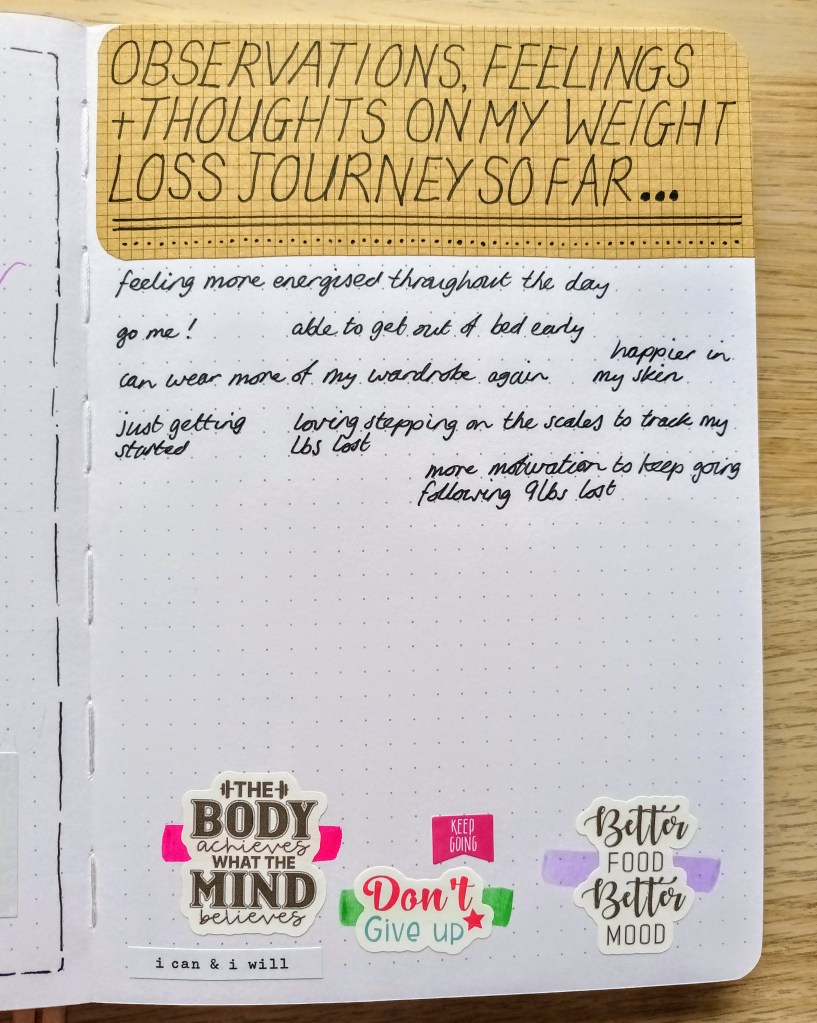
My weight loss journey so far…

I thought this spread might help keep my motivation high until eating healthily becomes a habit. I also think it will become useful for making dietary tweaks. Basically, I’m going to record observations (e.g. a particular piece of clothing fits better), thoughts (e.g. this is just the beginning, am I drinking too much water? etc) and feelings (I always feel super hungry before Clubbercise so I need to plan is a filling snack two hours before, I feel much more confident in my new top etc) throughout the coming months to monitor my progress to good health.

Photo credit: Laura Jones for Keeping It Creative

Final words…

That’s all of my spreads so far, although, as I said, I might create a habit tracker page ready for the new month. I’ve also decided to go back to a rapid logging style of creating daily pages as I’m finding that my week on two pages layout just doesn’t give me enough room. I will, however, need to record events taking place that week at the top of the page so I know what’s happening and when but this can be done on a Sunday night ready for the week ahead.

However you plan to spend the month of July, I wish you a good one,

Posted in Health and Nutrition, lifestyle, self care, wellbeing, wellness

Monday Matters: Wheel of Wellness – Physical – Part 3: Diet

For the final part of the ‘physical’ segment of The Wheel Of Wellness, I’ll be focusing on diet and the impact it can have on our physical and mental wellbeing. As part of this, I’ll be considering how the way we feel can impact our dietary choices and how what we eat and drink can directly affect both our mood and our energy levels.

What do we mean by the term ‘diet’?

Many people believe that the term diet refers to a specific eating plan where an individual eats less food because they want to lose weight / be thinner or only eats specific kinds of food e.g. those which are considered good for you, and cuts out bad or unhealthy foods. However, the simplest definition of diet is the food or drink which is typically eaten or drunk by a person or group of people. A diet can be incredibly healthy, extremely unhealthy or somewhere in-between the two. Personally, I prefer a happy medium where my diet is generally nutritious and balanced but still includes some treats and a moderate amount of alcohol. In fact, ‘moderation’ is very much a key word when it comes to a balanced diet.

Eating a healthy and balanced diet

There’s no shortage of information and guidance online about eating healthily to maintain good physical health but the most reliable place to look in the UK has to be the NHS website, specifically these pages and those found through the hyperlinks. Today, however, I’d like to focus on how what we eat and drink can have an impact on how we feel and also consider how making small changes to our diet can help us manage our mental health better by improving our mood, giving us more energy and helping us to think more clearly.

Mental health conditions, mood and our diet

How we feel can greatly influence what we choose to eat and drink. For example, if we’re struggling with anxiety, stress, depression or feeling down, our appetite can be affected and our daily routine might change, which could impact on our eating patterns. During periods of difficulty, some people won’t feel like preparing or eating food at all, whereas others will find comfort in doing so and may overeat or binge eat.

What we choose to eat or drink at different times has been shown to affect our mental functioning and can potentially worsen symptoms of conditions such as anxiety disorders, depression and bipolar disorder. Eating too much of some foods and not enough of others can contribute to ongoing or worsening of our emotional state. Certain drinks, particularly if consumed to excess can also cause problems too.

Keeping a food and drink diary

I’ve previously written a post about keeping a food journal to help with diet and weight loss but recording what you eat and drink, how much you consume and when can also help you to notice the effect on your emotions particularly if you record how you feel afterwards. Over time you might work out which foods and drinks make you feel good or better and which make you feel worse. You might also learn which keep you awake, help you sleep or give you gut problems. If you do make improvements to your diet, you can also measure your progress over time.

Some tips for making positive changes to your diet to improve your mood

As well as using a food and drink diary to find out what helps or worsens your mood, the following tips can be really useful if you want to improve your diet with a view to being more healthy and regulating your emotional state.

Eating regularly

Even if you don’t feel like it or you’re really busy, it’s important to try to make sure you eat regularly. If your blood sugar drops it can make you feel tired, irritable and depressed. Eating regularly throughout the day and choosing foods that release energy slowly will help to keep your sugar levels steady.

Try to avoid food and drinks which cause your blood sugar to rise and fall rapidly such as sweets, biscuits, sugary drinks and alcohol and instead, go for complex carbohydrates and protein rich foods. Also, make sure you don’t miss meals. Eating breakfast gets the day off to a good start, particularly if you choose wholegrain cereal, protein rich eggs or low fat yogurt and fruit such as berries, apple or fresh mango. If you’re struggling with lack of appetite, try eating smaller portions of food spaced out more regularly throughout the day.

Stay hydrated

The most vital substance for a healthy body and mind is water. If you don’t drink enough during the day, you will likely find it difficult to concentrate or think clearly. You might also suffer from headaches, fatigue or constipation which are not great for your mood either.

It’s recommended that you drink at least eight glasses of fluid a day and this can include tea, juices and squash and smoothies. Coffee can also count towards your daily intake, but you should also be wary of the effects of too much caffeine.

Managing caffeine consumption

Caffeine is a natural stimulant which gives you a quick burst of energy and can make you feel more mentally alert and attentive. On the other hand, it can also cause you to feel anxious, depressed, nervous, restless or irritable. It can also give some people an upset stomach if they have too much or prevent much needed sleep, especially if you consume it before bed.

Caffeine is found in a range of beverages including coffee, tea, cola, some chocolate drinks and a range of manufactured energy drinks. Also, despite its name, decaffeinated coffee still contains a small amount of caffeine. If you regularly drink a lot of the above each day, there’s a very good chance you will become dependent on them and display withdrawal symptoms if you cut down a lot or stop consuming caffeine altogether.

Although many people enjoy caffeinated drinks, there are quite a few benefits of reducing your intake. These include:

  • better gut health
  • fewer headaches
  • easing of anxiety and panic
  • better quality sleep
  • improved skin tone, less signs of aging
  • lower blood pressure
  • healthier and whiter teeth
  • better able to naturally regulate your energy levels

Remember though, that suddenly stopping caffeine isn’t a good idea as this can result in short term symptoms of withdrawal. It’s best to cut down slowly if you want to experience the above benefits.

Managing alcohol consumption

Regularly drinking more than 14 units of alcohol each week is known to cause problems relating to your physical health making you at greater risk of a variety of cancers, heart disease, stroke, high blood pressure, gastric issues, liver damage and memory loss. Consumption of alcohol can also negatively impact on your mental health, but, despite this, many people turn to excessive drinking during periods of difficulty and/or mental illness.

Alcohol is known to have a depressant effect which can lead to fluctuations in mood and signs of deteriorating mental health. It is also associated with disrupted sleep which can result in poor energy levels, and worsening fatigue or exhaustion.

Avoiding alcohol altogether at times of difficulty would be the most beneficial, but even cutting down can significantly help with mood.

Planning ahead

Finding time to eat well can often be quite difficult, particularly if you’re struggling with one or more aspects of your mental health. Planning ahead when you’re feeling well and enjoying preparing and eating food can help. This can include batch cooking and storing healthy and nutritious meals in the freezer for times when you can’t face cooking. Creating a list of quick and easy meals to refer to can also be useful when you are struggling for ideas.

Final thoughts…

If you think you would benefit from making some changes to your diet to improve your physical and mental health it’s best to start slowly and take small steps towards where you want to be. Changing your whole diet suddenly is likely to leave you feeling overwhelmed and can cause you to go back to the bad habits that you are used to. Making one change at a time can also help you measure the effect on your mood and your general wellbeing.

We can often put a lot of pressure on ourself to eat a healthy diet but it’s important to enjoy the food and drinks you consume and not be too hard on yourself. Try to recognise any achievements large or small, and give yourself credit and praise for any improvements made. Also, remember that other factors can help your mental health and emotional state as well including getting plenty of fresh air and sunshine, doing some physical activity each day and getting a good quality sleep.

I hope you’ve found today’s blog post helpful and it’s given you some ideas on how to make small improvements to your diet. If you think that you need to make some dramatic changes to your food and drink consumption, it’s best to seek help from a professional. The first step would be to see your GP who can make some suggestions or refer you to a dietician. A specialist can then help you identify specific issues with your diet or identify or manage any eating disorders or food intolerances you may have.

Posted in Health and Nutrition, life hacks, lifestyle, meditation, mental health, self care, wellbeing, wellness

Monday Matters: Wheel Of Wellness – Physical – Part 2: Sleep

For the second part of the Physical element of The Wheel Of Wellness I will today be looking at the importance of quality sleep to maintain good physical and mental health. I’ve previously published a couple of blog posts on the topic of sleep namely 5 ways to get better sleep tonight and 5 things to do in the evening to ensure a restful night’s sleep and a productive next day which you may like to have a read of as well. Many people have issues with their sleep for one reason or another and if you’re one of them, you might want to prioritise this area of the wellness wheel and spend some time learning about the effect that sleep (or lack of) affects your body and your life and pick up some tips on how to manage this aspect of your physical health.

Why is sleep so important?

Sleep has a huge impact on our health and wellbeing throughout our lives. Anyone who has ever had difficulty sleeping will know that the quality and quantity of our slumber dramatically affects our mind, body, general quality of life and our safety. While you are sleeping, your body is actively working and preparing you for the next day.

The following is a list of the basic functions of sleep which illustrate the importance of a good night’s kip:

  • physical restoration
  • mood regulation
  • cleaning the brain of toxins
  • information processing and memorization (committing things to memory for later recall, the storing of visual, auditory or tactical information)
  • strengthening the immune system

In children and teens, sleep also supports growth and development.

In addition, further benefits of quality sleep include:

  • better heart health
  • stress reduction
  • generally makes you feel more alert throughout the day
  • can help you lose weight (you’re less likely to crave high sugar or junk foods)
  • reduced risk of anxiety and depression
  • improved appearance – healthy, glowing skin (versus dark circles under eyes, dehydrated complexion, breakouts and redness from lack of sleep, plus comments from friends and family along the lines of “you look like ****)
  • better concentration (hopefully leading to improved productivity)
  • better decision making
  • stronger immune system (so less likely to get ill / feel run down etc)
  • boosted creativity (better ideas and use of imagination)
  • better motoric response (including quicker reactions)
  • enhanced sporting performance
  • reduced risk of high blood pressure, coronary heart disease, stroke and obesity
  • better emotional regulation (meaning amongst other things that you’re more likely to get along with others and less likely to become overwhelmed by your feelings)

Sleep and wakefulness is controlled by two biological processes: Sleep Homeostasis, commonly known as ‘sleep pressure’ and The Circadian rhythm, otherwise known as ‘the body clock’.

What is sleep pressure?

Sleep pressure is basically, the brain’s desire and need for sleep. The more time you’ve been awake for, the greater the sleep pressure. When you wake up in the morning, you should have very little need for sleep (if you’ve had a good night) so sleep pressure is very low. As we get on with our day, the sleep pressure begins to grow so that by evening time sleep pressure is much higher, making us feel sleeping and in need of our beds! By morning, following a good night’s sleep, our sleep pressure will have reset and be back to little or no desire for further sleep.

In order to make sure that we have the right amount of sleep pressure present by bed time, we should really make sure that we get up and go to bed at the same time each day. However, I know that a lot of people will have a lie in on a weekend, which tends to make it difficult to switch off and sleep on a Sunday night (especially if Sunday night dread is at play). Taking naps should also be avoided as this can reduce sleep pressure too. If you absolutely must have a nap, tried to take it before 3pm and make sure it lasts for less than one hour.

What is meant by the term Circadian rhythm AKA our ‘body clock’?

Like all living things, humans have a circadian rhythm which is the brain’s way of aligning the body with the environment. Our sleep/wake cycle follows this 24 hour rhythm. During the day, exposure to light helps us to feel alert, awake and active. As night/darkness falls our internal body clock starts to produce melatonin, a hormone which promotes sleep.

You can help promote a healthy circadian rhythm by seeking natural light (sunshine) during the day, getting some daily exercise, avoiding caffeinated drinks after mid-day, limiting light before bed and having a set bed time / wake up routine which prepares the body for sleep at night and encourages wakefulness first thing in the morning. I’ll discuss some of these in more detail later.

Creating the right bedroom environment

It’s really important to create a comfortable and relaxing environment in your bedroom to help you fall asleep quickly and easily. We invested in a ‘posturepedic’ mattress which is pocket sprung with a latex top. We’ve had it for years and it’s still completely supportive and so comfortable. Every time we go on holiday, we always look forward to being back in our own bed! The best sheets and pillowcases we’ve found for softness and durability are bamboo ones. An added bonus for us is that they’re breathable and hypoallergenic too.

Your bedroom should also be nice and dark as the absence of light sends a signal to your body that it’s time to get some rest. A nice thick pair of curtains or light blocking blinds are essential for this (we have blinds and lined curtains which allow just enough morning light to help us wake up). Some people also like to wear a sleep mask to block out light and these are also good for shift workers who are in bed during the day.

Other essentials for a calm and relaxing space include as little clutter as possible and a quiet environment to minimise distractions. Just the right room temperature – not too hot and not too cold is also helpful for inducing sleep (experts recommend around 18.3 degrees Celsius / 65 degrees Fahrenheit is ideal). Some people also swear by lavender as a soothing and sedating scent but I find it sets my allergies off which is certainly not sleep inducing!

Sleep experts also suggest that your bedroom should be strictly for two purposes only – sleeping and sexual activity. This means it should not be used for:

  • eating, drinking or smoking
  • dealing with bills, reading letters or any form of paperwork
  • using technology or looking at screens e.g. TV, mobile phone, laptop, tablet etc.

I also like to read fiction books on my Kindle Paperwhite in bed but I do find that as long as the screen is pretty dim, I become really sleepy after a couple of chapters. If you feel that reading certain books stimulate your brain too much, bedtime reading may be best avoided.

Diet and sleep

Most people know that caffeine isn’t good for sleep due to the stimulants it contains so if you have trouble sleeping, it’s best not to drink coffee or other caffeinated drinks such as cola, sports and energy drinks for at least 4 hours before bed. Having a large meal before bed is also likely to keep you awake as your body will still be digesting the food. Also, you may find yourself suffering from indigestion or acid reflux if you eat or drink too late. If you do find yourself craving a late evening snack a small amount of nuts, a banana or a small bowl of oatmeal with berries should be safe to eat.

Alcohol is well known to cause a slowing of brain activity and make you feel relaxed and sleepy but beware that the consumption of alcoholic beverages, especially in excess has been shown to cause poor quality sleep and shorter duration so you may find yourself waking up repeatedly in the night or not feeling very refreshed in the morning. Night-time drinking may also result in acid reflux too!

A good daily routine to help you sleep

Throughout the day, it’s important to get as much natural light as you can. This could include working next to a window, taking regular outdoor breaks during the day e.g. sitting in the garden with your morning cuppa and having an al fresco lunch. Obviously this is more difficult during the Winter months but even short walks outside, maybe with a nice, hot drink can make all the difference.

Exercise (or being active) including aerobic workouts, resistance training and yoga during the day can also help with sleep. Just make sure you don’t do anything which elevates your pulse rate for at least 3 hours before bed.

In the evening time, it’s a good idea to do relaxing activities which can calm the body and the mind. This could include listening to some soothing music, reading a book, doing some meditation, writing in your journal to help put the day to rest (see my 5 ways to get better sleep tonight for an explanation of how), enjoy a warm bath or hot shower.

If you regularly struggle to sleep, something you should definitely try is avoiding using electronic devices for at least an hour before bed. This is helpful for two reasons – one, a lot of online content can be mentally or emotionally stimulating (including emails) and two, the light that these devices emit can affect your body clock by increasing alertness and delaying the release of melatonin. If you must use your phone, at least set the blue light filter or night time mode to come on after around 7pm.

What if I find myself wide awake in bed?

After approximately 20 minutes of lying awake (estimate this, do not use your clock), you should get up out of bed and leave the bedroom. Either do something boring or something really relaxing (not something stimulating (no looking at your phone!) until you start to feel tired, and then go back to bed. If you’re not asleep after another estimated 20 minutes, get up again and repeat the process. If this happens regularly, spend some time during the day assessing what you think might be causing the problem and try making some changes to your routine.

A word about sleep disorders

There are a number of sleep disorders which can seriously affect the quality of your sleep. Some of the common ones are:

  • Sleep walking / talking
  • Nightmares / night terrors
  • Sleep apnoea (obstructed airway)
  • Sleep paralysis (a temporary inability to move that occurs right after falling asleep or waking up)
  • Hypnogogia / Hypnopompia (hallucinations occurring as you wake up or fall asleep)

If you suspect that you may be struggling with any of the above, it’s really important to speak to your GP who can offer medical advice or make a referral to a sleep specialist.

Final thoughts…

If you are struggling with your sleep right now you have my completely sympathy as I’ve had real issues with insomnia in the past. However, it’s usually quite easy to identify the contributing factors which are preventing a good night’s sleep. Finding solutions to the problems is a little more difficult but I hope this blog post has given you some ideas. Remember that quality sleep is vital to your wellbeing and it’s worth investing time and energy into this aspect of your physical health.

Posted in Bullet journaling, goal setting, Health and Nutrition, Planning and journaling, Setting goals and intentions

Monday Matters: A mini guide to keeping a food journal to help with diet and weight loss

Earlier this month, I talked about how I might start a food journal to help me track my eating and drinking. Before starting, I researched the benefits of this practice and spent time learning about what I should include. A number of studies have shown that people who keep a food journal or diary are more likely to be successful in losing weight and keeping it off. According to my reading, the simple act of recording everything that you eat and drink each day can help you consume less calories and make healthier choices which aids weight loss.

What are the benefits of keeping a food journal?

Writing down what you eat and drink and how you feel at regular points during the day can help in a number of ways including:

  • Increased awareness of what you eat
  • Shows you how much you eat and drink in a typical day
  • Highlights reasons why you eat and drink e.g. boredom, stress, mid-afternoon slump, feeling sad etc
  • Begin to see if you’re eating too little or too much
  • Able to roughly track your calorie consumption and make comparisons between this and calories burnt each day
  • Able to check hydration levels – some people mistake thirst for hunger
  • Increased mindfulness i.e. awareness of eating, drinking and any patterns
  • Able to see where you could tweak your diet to make it more healthy and balanced

What do I need to start a food journal?

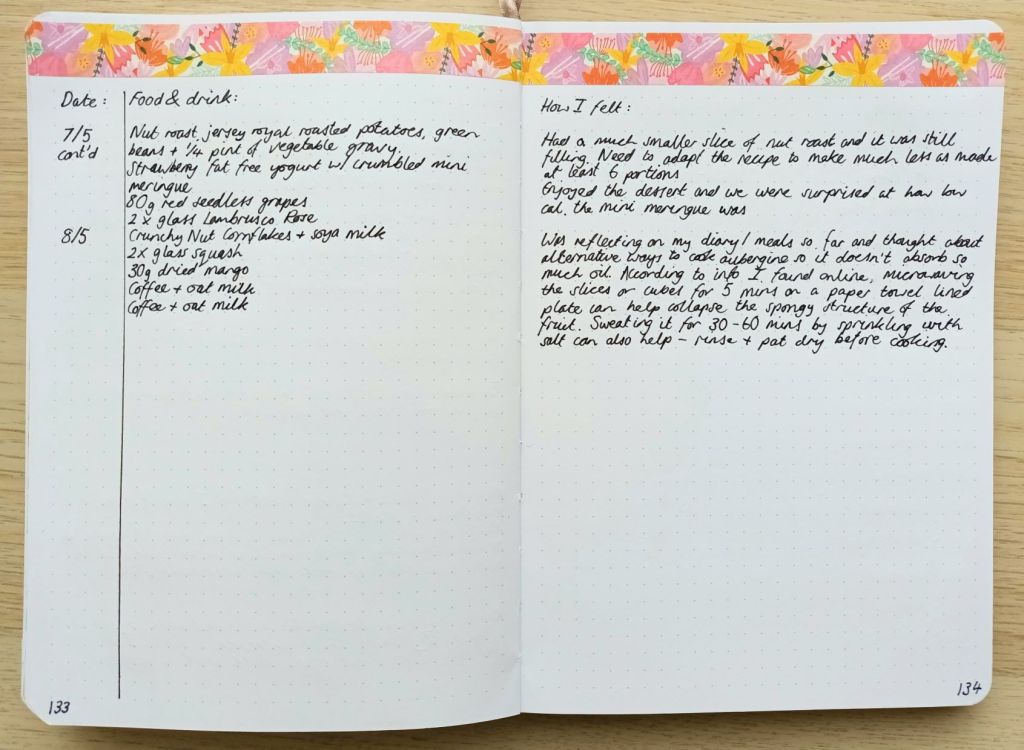
As many of you will know, I prefer pen and paper methods so I decided to use my bullet journal to record everything. I kept it simple with a title and a bit of washi tape and I used double page spreads to give me plenty of writing room. Any notebook and pen will do but it’s helpful if it’s something you can take out with you in your bag so you can record on the go – recording everything at the end of a long and busy day is quite an onerous task!

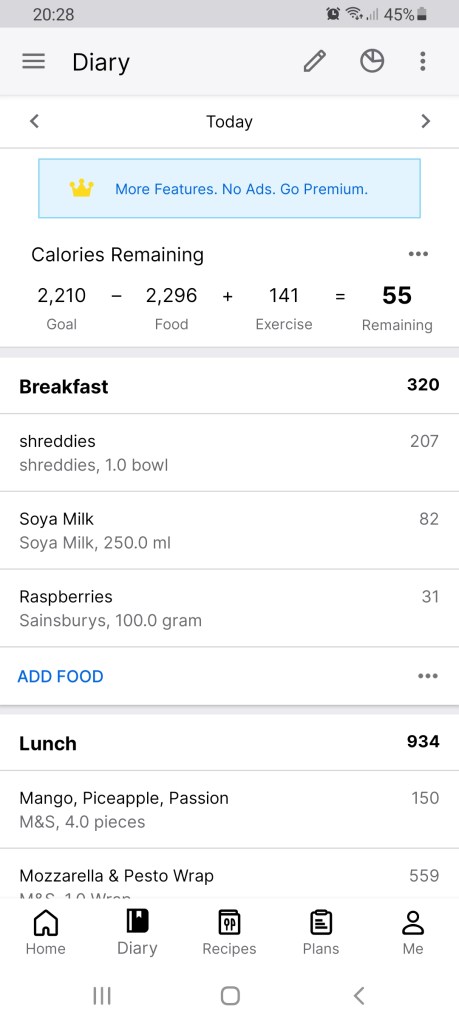
If you prefer to keep digital records you could create journalling pages in Notion or MS Word on your phone or tablet. You could also set up a simple spreadsheet to include date, time, foodstuff and how you’re feeling. Another option is to use an app like My Fitness Pal which can help you measure calorie consumption – beware though that it will keep trying to persuade you to sign up for a free trial or pay a monthly fee! I tried logging things on My Fitness Pal to see if I liked it and I found it really quick and easy. You can scan the barcode on your food packets and it shows the calorie content. You can also see and record other nutritional information but some details are only accessible on the paid for premium version.

Tips for getting the most out of your food journal

  • Log absolutely everything you eat and drink even if it’s something small or very low in calories e.g. one biscuit, a square of chocolate or a single boiled sweet. In doing this, you’ll have a full picture of your current diet.
  • When you log a food or drink, consider why you are eating and how you’re feeling e.g. a glass of wine to wind down after a long and busy day, feeling shattered etc.
  • Make sure you record how specific foods are cooked e.g. boiled, fried, roasted, steamed etc.
  • Include information about dressings, sauces and toppings and the amount e.g. 2 tsps of French dressing on salad.
  • Think about adding information about where you’re eating / drinking and who you are eating with e.g. at the dining table with family, at my desk, in XX restaurant, in a café with my partner etc.
  • Jot down what you are doing at the time e.g. watching TV, at the computer, having a catch up with a friend etc.
  • Be really specific about the type of drinks e.g. half a pint of beer, caramel macchiato, small mug, 200ml of orange juice etc.
  • Don’t forget to include alcoholic beverages and the amount e.g. one shot glass of vodka with 100ml of coke etc.
  • Think about logging the calories of meals at a restaurant if this information is on the menu, or check out the packaging of foodstuffs and drinks consumed at home.
  • Write down if you get any cravings and if you gave in to them or distracted yourself with an activity.
  • Note down how hungry you are when you eat.
  • Record your food and drink as soon as possible after eating/drinking so you don’t forget things. If you use a notebook or paper and don’t want to take it out with you, try making a quick note on your phone to transfer to your journal when you get home.

Analysing your food and drink log

Once you’ve recorded your food and drink for 5 days or so, consider what it tells you. So, for example:

  • Am I getting my five portions of fruit and veg each day?
  • How healthy is my diet overall?
  • Does my diet include wholegrains?
  • Does my mood affect my eating and drinking habits?
  • How balanced is my diet – am I eating too much or too little of something?
  • Do I have snacks and how healthy are they?
  • Am I paying full attention when I eat or am I often busy doing something else? (how mindful am I?)
  • Which areas of my diet could be improved upon? e.g. I could eat more vegetables, I could cut down on takeaways and try to do more cooking from scratch, I could eat a piece of fruit as a snack instead of a chocolate bar in the afternoon etc.

Setting some healthy eating goals

When you’ve identified areas for improvement, you could have a go at setting a couple of healthy eating goals for yourself. I recommend using the SMART framework for this so you can measure your progress easily. So, for example, when I was depressed, I struggled to eat breakfast and got into the habit of having a bowl of Crunchy Nut Cornflakes each morning as they’re easy to eat. When I started to feel better, I continued to eat this cereal as it had become a habit and one which I enjoyed. My husband suggested I try eating a healthier cereal every other day so I’m now having a portion of Shreddies four days a week. Here’s how it looks using the SMART goal system:

S = specific. Eat a wholegrain cereal every other day – a portion of Shreddies (or possibly Weetabix as an even better alternative according to someone in the know about healthy eating)

M = measurable. Does my food journal show that I’m doing this consistently?

A = achievable. Start small, do it every other day for the time being. Eating wholegrain cereal every day will make it a lot harder and I might start craving the Crunchy Nut Cornflakes and give up!

R = relevant. Does it fit with what I want in my life? Yes, I want to break the habit of eating a sugary cereal each day. I also want to tweak my diet to make it more healthy.

T = timely. Do the above consistently for two weeks to meet the initial goal and then increase to wholegrain cereal 5 days + a week.

Other goals include breaking the habit of having a packet of sweets every Friday / Saturday and finding alternative and less calorific desserts for during the week. I intend to work towards a couple of goals at a time so that I don’t feel that I’m denying myself too much.

Final words…

Although keeping a food and drink journal can be really helpful for improving your diet and eating more healthily, I wouldn’t recommend keeping records in the long term as it can be a time consuming habit to continue and you don’t want to feel like it’s a huge chore with no benefit. After 3 or 4 days, you should start to see patterns and be able to identify a few tweaks you could make to your diet to aid weight loss and ensure better balance between the different food groups and recommended consumption of foods in the different groups such as fruit and vegetables, protein and carbohydrates. For further information about your daily eating and drinking habits, you might want to consider logging things for a couple of weeks and setting yourself some mini goals to work towards.

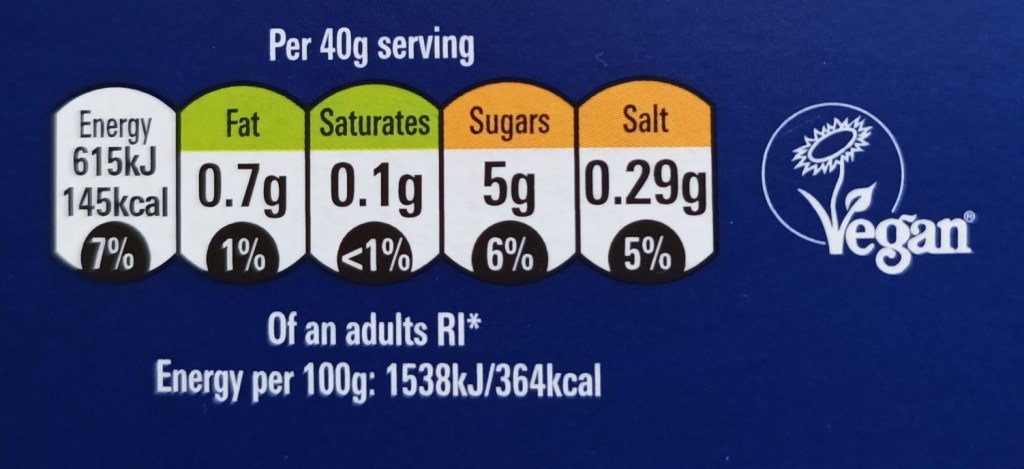
I had a meeting this week with one of the weight management team ladies and she suggested some ideas for tweaking my diet to increase my success. She also mentioned that she didn’t advocate calorie counting or weighing food in the long term, instead she suggested educating myself about different foods and drinks using the traffic light system on packets and developing better understanding about portion size.

Nutritional information on the Shreddies packet

Let me know in the comments if keeping a food and drink log is something you’ve done in the past, considered doing or something you definitely want to try. If you’ve given it a go, I would love to hear about your experiences whether positive or negative.

In the end, I decided that I actually prefer using the My Fitness Pal app for recording as it’s much quicker than writing it all down. I’m still learning how to use all the features but so far I’ve managed to sync my Fitbit with the app and I’ve found that you can search for recipes you found online and retrieve the nutritional information (although you can’t include any changes you made to the ingredients.

Screenshot of my diary on My Fitness Pal

Thank you for reading,