Posted in exercise, fitness, physical health

Why I’m incorporating regular balance board sessions into my fitness routine and what I’ve learnt so far

Photo credit: Laura Jones for Keeping It Creative

Over the past few years, I’ve been having intermittent issues with ankle pain and stiffness. Six months ago, I finally sought medical advice and had an x-ray which came back as normal, and an MRI which showed mild arthritis in my right ankle. As part of my treatment plan, I’ve also been seeing an MSK (Musculoskeletal) specialist and he performed basic examinations, made the MRI referral and offered his advice going forward. I learned that my general ankle strength was very good, but my balance was quite poor for my age which is he suggested might be contributing to the issues I’m experiencing.

I was advised to keep going with my current workout routines (phew!) but add in a range of basic standing on one leg exercises to work on my balance. I have been doing this consistently for a while now but when I asked the specialist if there was anything else I could try, it was suggested that, as a way of keeping it fun and interesting, I could invest in a balance board. I ordered one that same afternoon and have enjoyed using it daily.

Today, I thought I’d share what a balance board is, how an individual can benefit from its use and my own experiences of adding a mini session on mine as a (mainly) consistent daily habit. If this is something that would interest you or it’s made you think about how good or bad you are at being able to balance, I hope you enjoy the post!

What is a balance board?

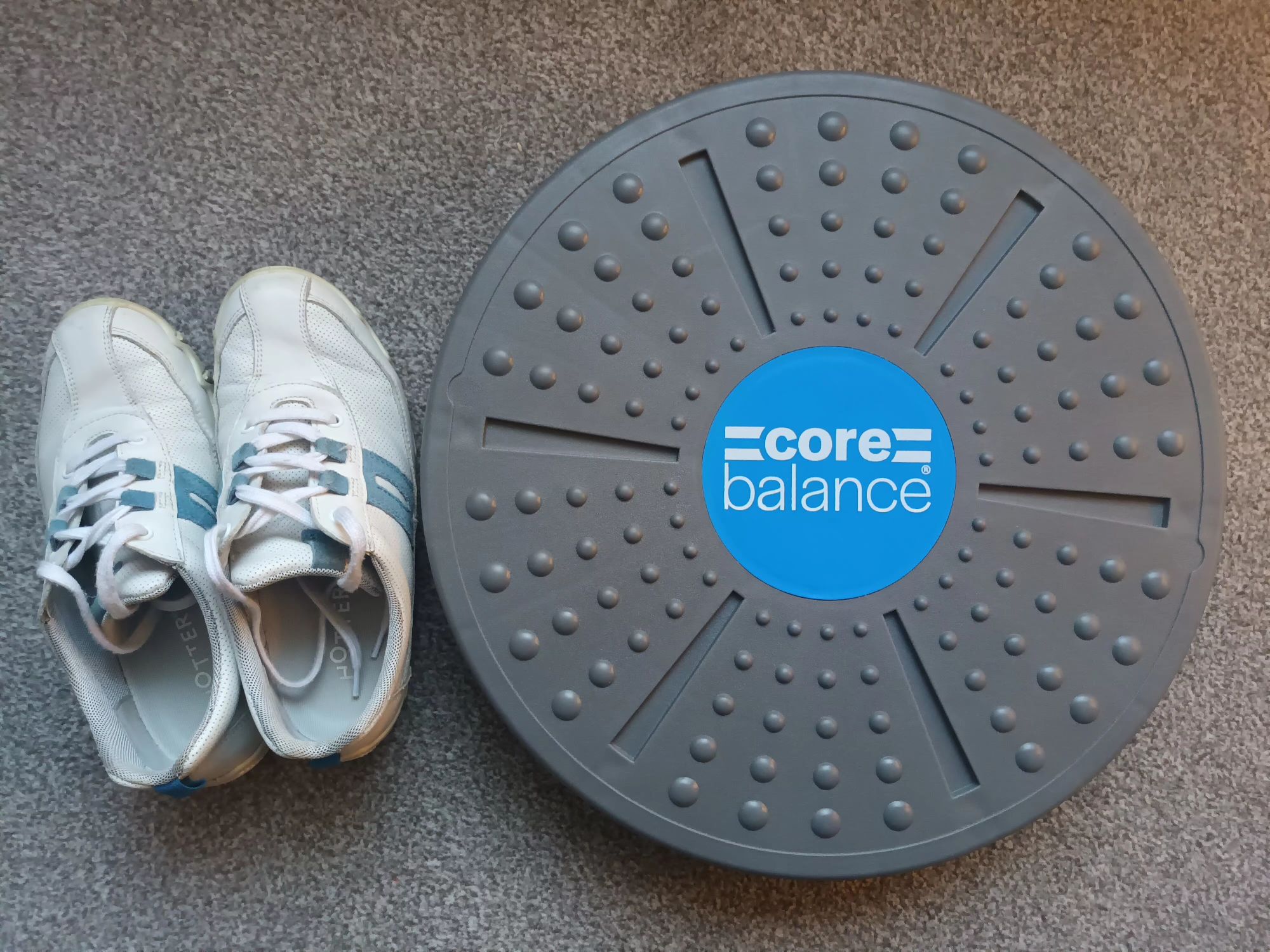
A balance board (AKA a wobble board) is an inexpensive piece of exercise equipment made from wood or plastic, which typically consists of a circular top with a non-slip textured surface, mounted on a spherical base. When stood on, it allows you to move side to side, forwards and backwards or tilted in a circle (AKA around the world).

The benefits of using a balance board

After purchasing my balance board, I decided to do a little more research into the benefits of regular use both in terms of improving balance and working on other aspects of fitness and general wellbeing.

Improved balance

This is obviously what I purchased mine for and my online reading suggests that it is considered its primary use. Not only does it help to improve your ability to balance, it can also work on your stability, coordination and proprioception which in a nutshell means the internal system responsible for spatial awareness and balance – sounds good to me and that they were originally developed for rehab following ankle injuries.

Better core strength

I already do a Legs, Bums and Tums class at the gym and my regular Pilates and yoga sessions are good for my core too but I was pleased to read that using a balance board can help in this area too. I’ve found that I automatically suck my tummy in whilst using the board and even 10 minutes of this is bound to increase muscle tone!

Better posture

As well as improving core muscles, standing up as tall and straight as possible aids my ability to balance on the board so, along with my Pilates classes and advice from MSK, my mini workout is helping me to develop better posture. This is good news for my back as I no longer slouch in my chair or hunch over, so I’m getting much less back pain that I have in the past.

Enhanced coordination

As we age, coordination becomes more difficult and can result in difficulties with every day movements, including walking. Better balance and co-ordination can help to prevent injuries caused by slips, trips and falls. It can also help with gross and fine motor movements associated with every day living.

Better ankle strength

Balance boards were originally developed for rehab following ankle injuries as they’re great for strengthening your ankle muscles, which a quick Google and a little help from A.I. informs me that we have ten of – you learn something new every day and all that! The MSK specialist said that my ankle strength is good but there’s no harm at all in making it even better! Poor ankle strength is associated with easily going over on one of your ankles (something which used to happen to me quite regularly), chronic discomfort in the area, swelling, pain and tenderness, plus load bearing difficulties. Ankle instability is often apparent in individuals who are overweight, take part in sporting activities such as competitive ballet or dancing, running or other athletics. It’s also often an issue for the elderly.

It’s fun!

This one, I can confirm (for me anyway), is definitely true. I haven’t got board (ha ha – spelling error intended) of it yet and I’ve been mainly doing a few minutes each day – except when I was away at Christmas (I would have needed a roof rack to transport it!) and when my Covid sickness was at its worst. If you want to give this piece of workout equipment a go, I can recommend it wholeheartedly. There are loads of other ways to use the board too and you can find a wealth of different exercises online. However, for now at least, I’m sticking with the basics!

Final words…

I’m really enjoying using my balance board and it has now become a key part of my daily routine. I tend to spend about five to ten minutes using it each time as I’ve found that if I use it for too long, it can aggravate my ankles and cause pain or discomfort. I may be able to do more as my ankles get used to it but I’m pretty sure just a mini workout is going to be beneficial.

Posted in Bipolar disorder, mental health, mental illness, physical health, relationships, wellbeing, wellness

The Good, the Bad and the Ugly of Hypomania in Bipolar Disorder, including my personal experience

Right now, I’m going through a period of hypomania as part of my bipolar disorder. It seems to have been brought on by Covid-19 because, despite feeling awful physically, my mind was racing and I was getting less than 4 hours sleep in total. Desperately craving some calm to help myself recover from my temporary illness, I turned to a packet containing medication I was given when I was getting used to my bipolar meds namely Diazepam. I thought as I recovered from the virus, things would settle down but so far, as I write this post, they haven’t. I’m trying desperately to do mindful activities to help myself get back to a stable state (what I would usually describe as my ‘normal’) but it’s proving difficult and I’m worrying that I’m going to get worse.

As part of my hypomanic episode, I’ve got literally hundreds of ideas for blog posts, creative pursuits, ways to improve my life and things I absolutely need to start doing. In some ways this is good as, before Christmas, I was struggling with tiredness and didn’t want to do as much with my day and worries that I was becoming depressed filled my mind. However, being ‘high’ means I’m constantly adding to my to do list (or my ‘must do’ list as it feels) and I find myself working on ‘projects’ until late evening and not wanting to stop. And then, surprise surprise, my mind is full of stuff and I’m struggling to switch off when my husband and I settle down to watch TV and I’m finding sleep just will not come.

My husband is still feeling tired from Covid and by the end of the working day, he’s exhausted and finding it difficult to listen and pay attention to my constant witterings. You see, when my mind is full of thoughts and ideas, I get verbal diarrhoea which is not good news for me or my husband – I can’t stop talking and I talk so fast that he can’t keep up. Even my text messages become long and waffly! And if my husband asks a question that has already been answered or he’s failed to compute something I’ve said, I’ll become irritated and short with him.

Talking of being irritated. I’m getting annoyed with all kinds of people and things. A slow driver in front of me on the way to the supermarket. Someone who doesn’t say thanks when I let them pull out. Ink on my hand because of being a leftie. The queue at the post office meaning I have to wait to collect my Amazon order. Having a headache because I’ve failed to drink enough water during the day. The list goes on, and on, and on!

I’ve also noticed that I’m buying more ‘stuff’ in a bid to improve my life. Luckily, I don’t struggle with mania (as I have bipolar 2) so I won’t make huge purchases like a brand new car or an expensive holiday, but things become much more attractive when I’m high. I was in TKMaxx a few days ago, and the more I looked around, the more I wanted things and so I made my purchases (a new pen pot, a cute bird mobile phone holder and 2 gorgeous sky blue matching chopping boards) and swiftly left the shop. My husband will never say no to something that I really want and it makes me feel guilty afterwards when I’m back to my ‘normal’ stable self and our expenses for the month are way more than usual.

These are a few of the difficulties I face which could be described as ‘bad’, but what about the ugly? By ugly, I don’t of course, mean that I turn into a grotesque monster who people can’t stand to look at. I’m really referring to the effects that hypomania can have on character, traits or behaviour. For example, I can have a short temper and might raise my voice to my husband in frustration for being too slow to answer a question, forgetting something, not getting ready to go out fast enough or for asking me to repeat something I’ve said (when talking at speed and not stopping). I might also make comments about someone that I would consider to be nasty at any other time. Or my inflated ego might make me believe that I’m superior to others and that I could do a better job than them. Although I may or may not say things out loud, I don’t want to be someone who voices or thinks horrible things.

In the past, when I was on a high dose of antidepressants and no mood stabiliser, I would sometimes believe I was better than every teacher in the school and that they weren’t as dedicated as me because they took a proper lunchbreak or left before the school closed at 6pm. I would also often speak in a way which to others, might sound like I was full of my own self-importance. Then, I would rush around trying to do everything at once in a bid to maintain the illusion that I was the best! Needless to say, after trying to keep going and going like a Duracell Bunny, I would inevitably crash and either become physically unwell, mentally exhausted or depressed.

Before my diagnosis, I would go through lengthy periods of depression where I had no confidence in myself and got anxious and cried on a daily basis. I also sought reassurance from my husband constantly. However, when going through a period of hypomania, I genuinely believed that I didn’t need anyone’s help and support and that I no longer needed a husband / family / friends for encouragement, support or just to be there. Especially as everyone and everything seemed to irritate or anger me.

Over the years, I’ve learn to apply strategies to calm myself down and the medication I take helps immensely. However, I will never be cured so I am learning to live with my relatively recently diagnosed illness (even though I believe I’ve had the condition since my late teens) and my husband is incredibly patient with me and supports me in any way he can. Whether I listen to his advice or not depends on my mood! However, I’m grateful to have found someone so wonderful to share my life with and put up with my changing moods.

Final words…

I’m hoping that today’s post has given you an insight into the effects that hypomania can have on an individual. I believe it’s important for everyone to know a little bit about it as it’s likely that most people will know someone who is bipolar, even if they’re not aware of an individual’s diagnosis. If any of the writing doesn’t make sense, it will be because most of the above was written at 4am on my phone whilst I sat downstairs frustrated that my mind wouldn’t rest!

It’s taken me at least a week to finish and publish the above and I’m pleased to say that things are starting to settle down. I’m no longer taking diazepam for sleep and my mind has started to calm down a little. I still have lots of ideas and projects but I’m trying to make sure I only work on those which add value to my life. I’m also adopting the done is better than perfect way of doing things. Hopefully, I’ll continue to head in the right direction towards ‘stable’ a term I’m trying to use to describe my state rather than ‘normal’.

If you would like to know more about bipolar disorder and how it affects individuals or you suspect a love one may have the condition, the NHS website has pages of really useful information, including more detail about its presentation . Although symptoms different from person to person, there are set list of signs which are likely to be visible.

Thanks for reading!

Posted in Anxiety management, Bipolar disorder, compassion, depression management, grief, life hacks, mental health, productivity, Uncategorized, wellbeing

Monday Matters: How writing a ‘done list’ can improve your wellbeing during periods of physical and/or mental illness

Welcome to my first blog post of 2025. Happy New Year to you all, and a special hello to my new followers! I hope you had a wonderful Christmas and are excited for what this year will bring.

My husband and I both enjoyed the festive period, which this year (make that last year!) was a double celebration as my brother and his partner got married a few days after Santa had been. The wedding was a joyous occasion and a great a chance to chat with family I hadn’t seen in a while too.

Whilst on the way back home, and with my husband doing the driving, I made the most of being in the passenger seat by reflecting on 2024 and thinking about what I would like to achieve in 2025. I also started to mentally compose a to-do list full of chores and more pleasurable activities to make the most of the remaining three days of the holiday. Little did I know that something would scupper my plans…

Bloody COVID-19 strikes again!

By the time we got back, we both had a bit of a sore throat, which I assumed was just a bit of dehydration from the long car journey. By New Year’s Eve, we felt absolutely dreadful, and so my husband did a test (just in case), and I’m sure you can all guess how that turned out! Needless to say, we’ve barely had the energy for basic self care, nevermind any chores, fun activities or creative pursuits.

We did, however, manage to  psych ourselves up enough to take a quick shower each day, despite how exhausted we were and, despite the fact that the powerful water raining down and massaging in my shampoo and conditioner brought actual pain to my scalp! – random covid symptom or what?????? And I’m so glad we did because this idea for a blog post was born – in fact, some of my best content and general epiphanies come to me whilst showering (anyone else??). 

Basically, I was busy thinking about how annoying it was that I was too exhausted to do anything and that being ill was a giant waste of time, and then I recalled that during my worst bipolar depressions, I still achieved a few things each day and tried my best to be kind to myself and celebrate small wins. To help me do this, I created something that I call a ‘done list’ and, although my illness was physical rather than mental on this occasion, I realised the same technique could be used to make myself feel better.

As everyone goes through ups and downs in life, I thought I’d share how my done list works. You might not need to apply the technique now, but it’s a lovely, self compassionate activity which you can store in your physical or metaphorical toolbox to use when needed such as when you’re sick or struggling with low mood. It can also be used when you’re not feeling under the weather, as a celebration of how productive you’ve been in general or as you work towards your goals for the week / month / year and so on.

In fact, as I sat on the sofa (on day 3 of COVID-19), soothing my throat with a warm drink, I actually started mentally creating one to help my husband and I feel a sense of achievement because I realised we actually did something that day despite feeling like crap.

So what’s a done list?

A done list, as the name suggests, is basically a list of things you’ve achieved that hour / day / week / fortnight / month / different time frame of your choosing, which can be tailored to how you’re feeling – both physically and mentally. So, for example, your list could look something like this:

Today’s done list

  • got out of bed (before 10am too!)
  • got dressed
  • brushed my teeth and washed my face
  • planned 3 things to do
  • made and ate a sandwich (even though I didn’t feel hungry)
  • worked on my jigsaw
  • watched TV for 1 hour (and managed to follow the storyline of the drama)

Or, if you’re not feeling too bad (in a bit more pain than usual, or a little tired maybe and not 100%), could include more taxing items such as those found in the list below:

Things I’ve done this week

  • washed the car
  • tidied my craft room
  • decluttered 20 items from craft room!
  • made 3 meals from scratch
  • 5 gentle workouts (2 x 20 mins yoga and 3 x 30 mins Pilates)
  • created a journalling page using my crafting stash

As you can see from the above, you can include super-minute achievements (or what would considered to be when well) or more ambitious ‘done’ items at other times. These ‘done’ tasks make a good record of how you’ve spent your time and can help you realise that, yes, you might be on top form, but you did make some progress or make a dent in your mental to do list (or physical one if you wrote a list when feeling productive and then things changed e.g. illness, upsetting life event, overwhelm etc).

If you’re still at work, but it’s been a struggle not to phone in sick, you could even include things that you achieved as part of your job, like biting your tongue at a comment made by a colleague or being assertive and saying no to your boss or team leader!

What are the main benefits of creating a ‘done list’?

These are the main benefits I’ve found of creating a done list, but you may be able to come up with more:

  • a visual reminder of what you’ve achieved in the chosen timeframe – the smaller the items are, the longer your list can be!
  • boosts your motivation to do more things (be careful not to do too much though as the last thing you want to do is make yourself feel worse)
  • acknowledges your small wins during difficult times

Final words…

I apologise if this is not new content and I’ve already written about a ‘done list’ before – I did trail through my posts in a bid to find out, and couldn’t pinpoint anything but I still have ‘COVID brain’. Hopefully I’ve shared something helpful which has given you a new string to your ‘wellbeing bow’, particularly if you have recurrent issues with your physical or mental health like I do. Doing a ‘done list’ can also be a great record of what you’ve achieved over a period of time, so can be a really useful tool for measuring productivity too. However you use it, I’m pretty sure it’ll make you feel a little more upbeat about things and your lists may even bring a smile to your face at a later date if you keep them in your planner and happen to flip back!

Thank you for reading and I wish you and your loved ones a happy and healthy 2025,

Posted in bullet journal, Bullet journaling, Christmas, planner girl, planner lifestyle, Planning and journaling, watercolour painting

Setting up my Bullet Journal for December 2024: Winter foliage theme

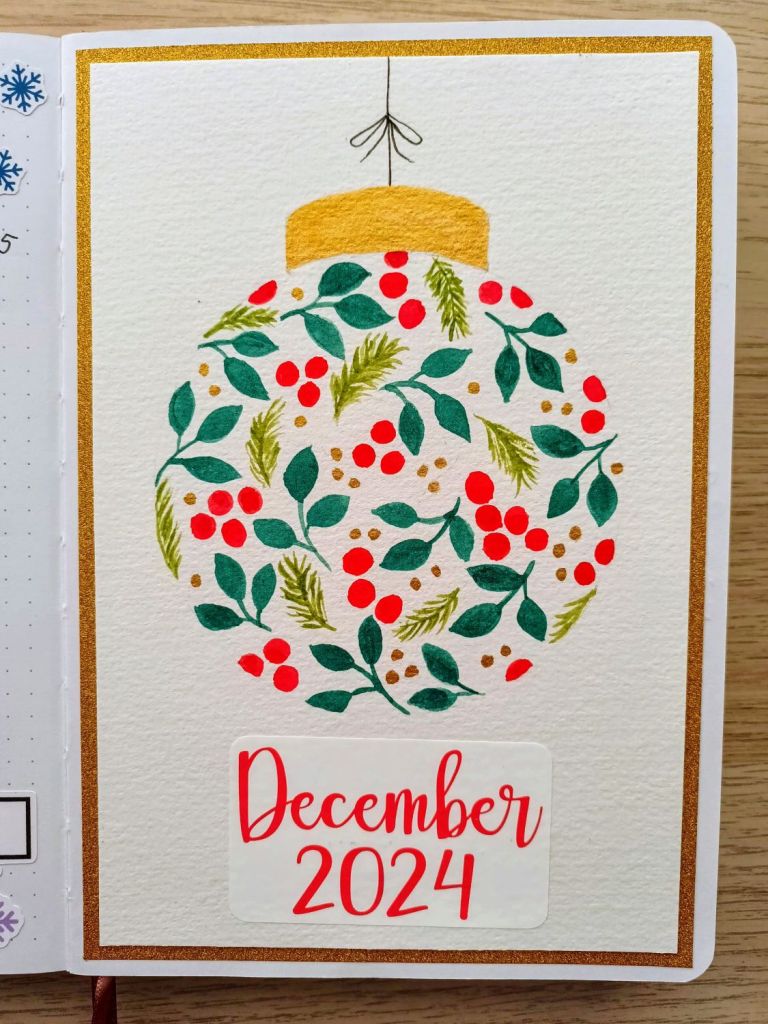
This month, rather than doing a full on Christmas theme, I’ve taken inspiration from an artist whose content I follow on YouTube. In a recent video, she shared some easy watercolour cards featuring winter foliage, and one of the designs was a bauble shape decorated with red berries, leaf stems and pine branches. I had a go at creating my own on watercolour paper and loved how it turned out so I used it for my front cover (even gluing in the thick paper directly into my notebook). For the rest of my spreads I used felt tip pens and foliage stickers using designs found on Cricut Design Space, plus gold paint to create shine. I can’t wait to share the results with you.

Front cover

Usually, I scan and print my watercolour designs but, on this occasion, the finished result was so disappointing that I decided to stick the original straight in. It’s made my journal super bulky, and I’m only on my second month, but I’m so happy with how it looks. I added some gold sparkly paper behind it and I think it makes it really festive (unfortunately, it doesn’t show up too well in the photograph).

Photo credit: Laura Jones for Keeping It Creative

Monthly calendar

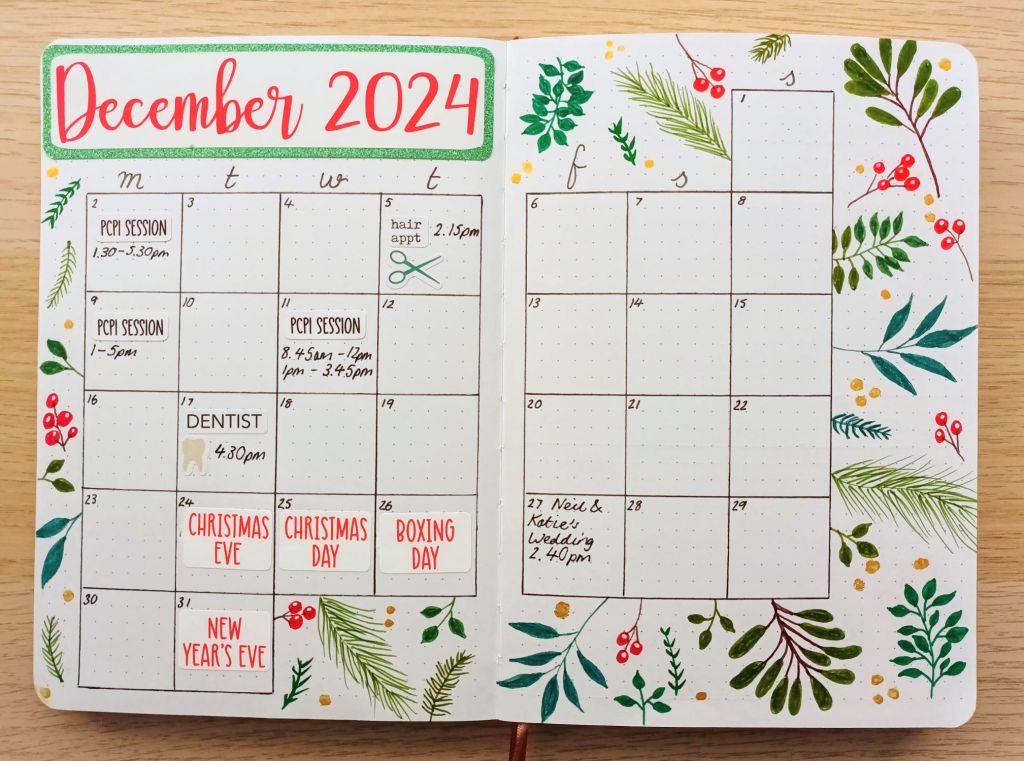
This is my usual calendar with leafy sprigs, berries and pine pieces created using an array of pens including my Tombow dual tips, Papermate flairs, Pentel brush pens and a couple of American Craft precision pens. Rather than sketching the designs, I went straight in with the colour and I think the pages turned out okay. The December title is backed with another glitter paper, this time in a lovely green colour.

Photo credit: Laura Jones for Keeping It Creative

Finances

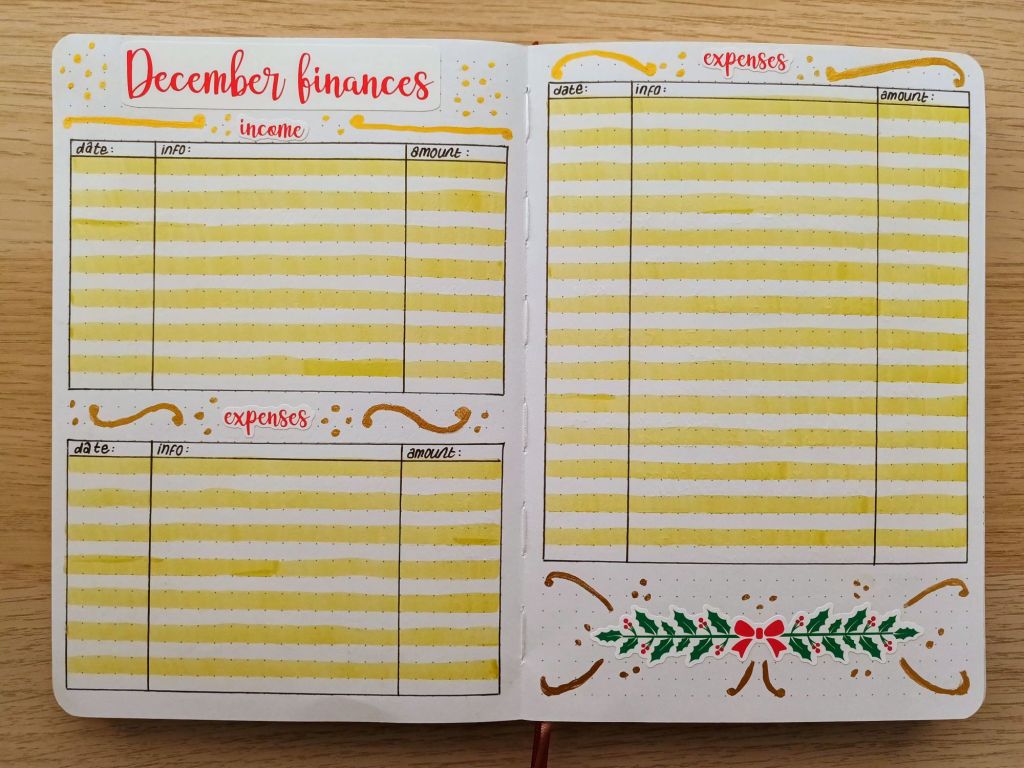
For some reason, the camera on my phone has made the grid appear a horrible yellowy colour, but it is, in fact and a pale green with just a hint of yellow to it. I would love to know how to correct this so if anyone has any ideas, please let me know in the comments. I might have a play with the photograph settings and see if I can improve it at all.

Photo credit: Laura Jones for Keeping It Creative

Monthly goals

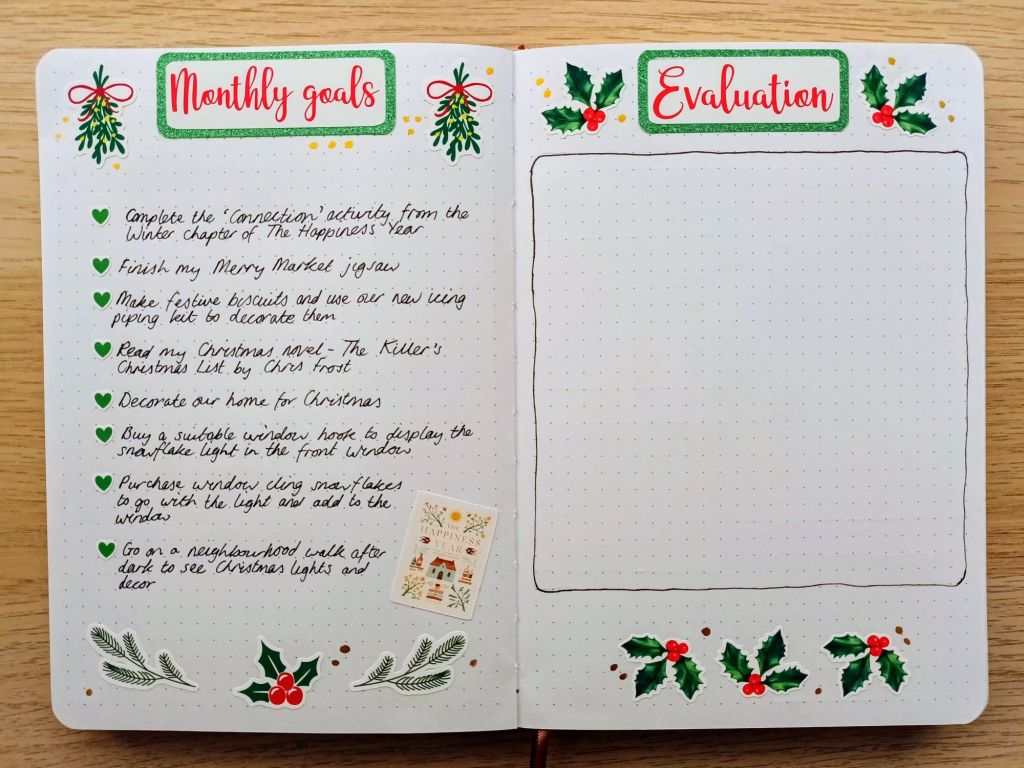
Most of my goals for this month are taken directly from my winter bucket list and relate to Christmas. The stickers were made in Cricut Design Space and I used vinyl sticker paper which really easily ripped so I had to be super careful.

Photo credit: Laura Jones for Keeping It Creative

Christmas related pages

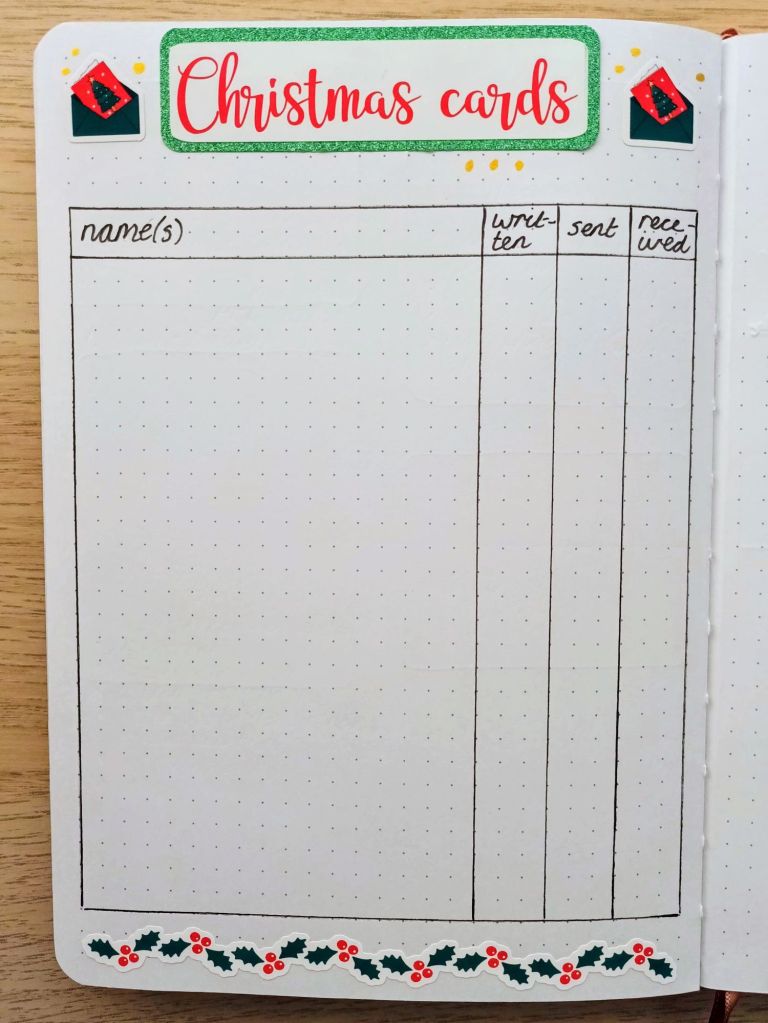
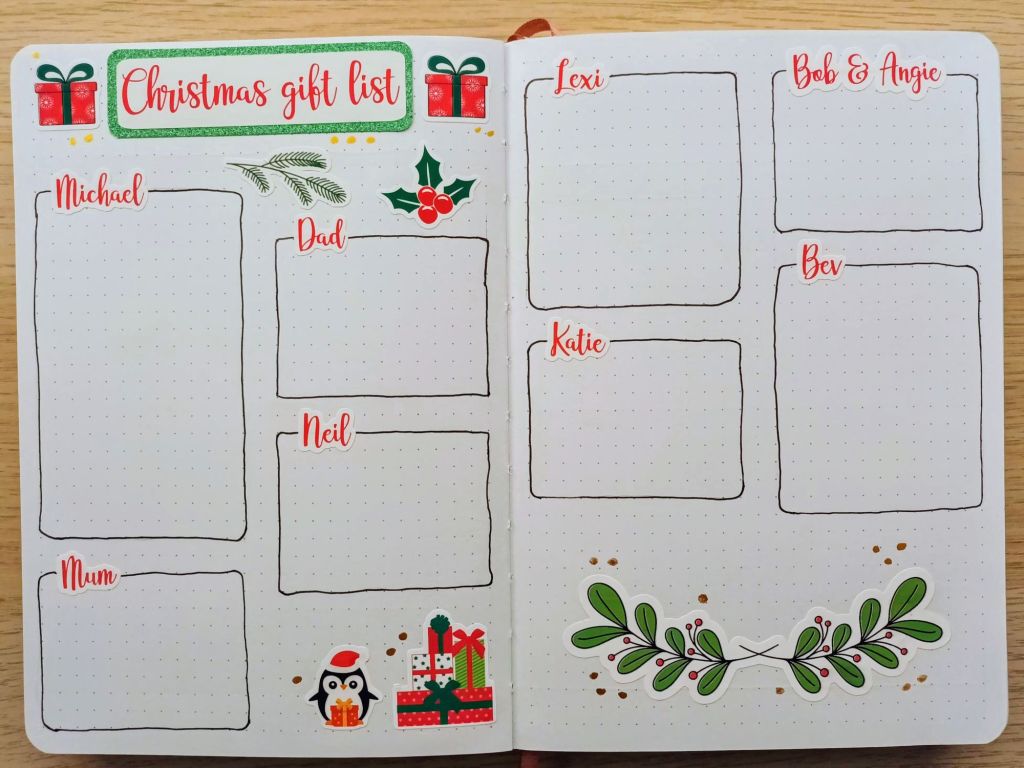
I created pages like these last Christmas and found them really useful so I’ve done the same again this year. Now that I’ve shared them on here, I can start filling them in!

Photo credit: Laura Jones for Keeping It Creative

I also have a Christmas packing list page to set up nearer to the time too.

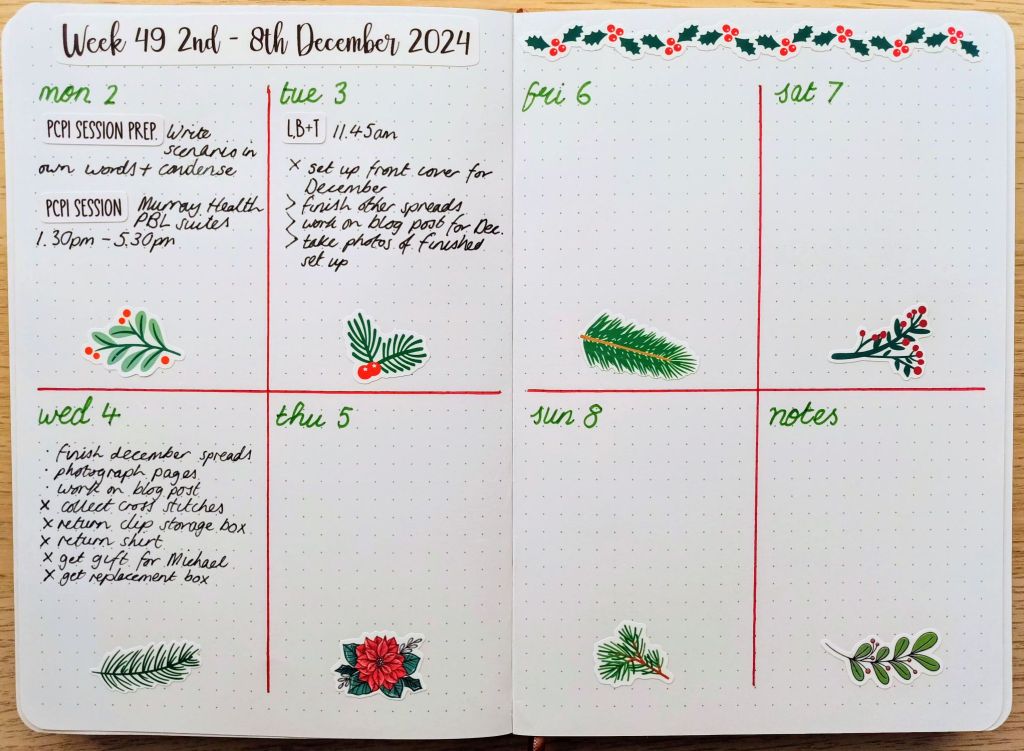
My first weekly plan

Photo credit: Laura Jones for Keeping It Creative

Final words…

Thank you for visiting my blog to look at my Christmas bullet journal pages, I would love to know what you think to them, especially the front cover which I had great fun painting. If you like playing with watercolour, I would definitely recommend checking out the YouTube video that I drew inspiration from.

Wishing you a wonderful Christmas time and all the best for 2025,

Posted in Bullet journaling, goal setting, intentional living, lifestyle, planner girl, planner lifestyle, Setting goals and intentions, sticker making

My Winter 2024-25 Bucket List: Maximizing the Season’s Potential

I started creating seasonal bucket lists in autumn 2023 and earlier this year I shared a short guide to them in a blog post, where I discussed exactly what a bucket list is, the benefits of making one and some tips for deciding what to include so it is tailor made to you. Over the last week, I’ve been working on my winter 2024/5 bucket list and it’s quite different to my previous winter season one which I’m really pleased about because I want to make sure I plan new opportunities for myself and my husband.

Today, I’m sharing the two page spread I created in my bullet journal where I add the bucket list items, small illustrative stickers to go with each and a few snowflakes and sparkles to fill the gaps. Although it was quite time consuming, I had so much fun making most of the stickers using Cricut Design Space, my Cricut Joy Xtra and a couple of sheets of matte sticker paper and then planning their positions over thew two pages with an icy blue background. I also found a few extra tiny stickers in my mini Carpe Diem ‘Season’s sticker book.

My finished bucket list pages

Photo credit: Laura Jones for Keeping It Creative

I think the result is so aesthetically pleasing that I’ll be sure to keep checking in with pages, selecting goals for each of the winter months (obviously doing the Christmas ones in December), then deciding on one or two to complete or start to work on for each week across the season. As I finish them, I’ll be adding little tick stickers that I also made with my Cricut Joy Xtra.

Final words…

Creating a seasonal bucket list is a great way to maximize the potential of the coming months and it’s so much fun too. As you can see, I love getting creative with mine in my bullet journal but you could simply make a list and tape it to your fridge or add your own cute little doodles to show what you want to achieve.

And, if you don’t achieve it all, it doesn’t matter. You may find that your priorities change or that other opportunities present themselves that you want to do instead. You might run out of time or decide that you simply don’t want to do one or more of the items. For example, I had on my list for this season to create an autumnal quote page in my bullet journal with hand drawn elements, but, by the third week of November, I’ve still not done it and it seems pointless to spend the time drafting one out and decorating it when my focus in now on winter and what I want to do over the next three months.

I hope that seeing my bucket list for this winter has inspired you to have a go at creating your own. You’re quite welcome to use some of my ideas if you have similar interests to me and Pinterest has a good number of lists too, but I recommend taking your time and really thinking about what you love about the season, activities you’ve done before and want to make time for again, or things you’ve always wanted to try, either on your own or with loved ones. Let me know in the comments what your top three are!

Wishing you a fun filled winter season,