
I’ve seen a lot of YouTube vlogs recently about creating your own personal curriculum, and, as I consider myself very much as a lifelong learner, I was eager to give it a go. However, with limited free time, a variety of goals in progress, and a vision board that identifies my priorities for 2026, I wanted to start really small by focusing on just one subject and a particular element I want to learn more about. If, like me, you already have a busy life but want to carve out some time to learn something new (and enjoy benefits such as enhanced brain function, improved emotional and mental wellbeing, personal growth and increased life satisfaction) read on to find out how I designed my personal curriculum for Summer 2026. Also, if you’re not sure what a personal curriculum even is, I’ve also covered this below too.
What is a personal curriculum?
A personal curriculum is a self-designed and self-lead learning plan that enables you to create your own educational journey, developing your skills and knowledge in an area which interests you. Unlike at school, college or university, you play the role of teacher, selecting your own subjects, assignments and, if you wish, learning objectives. You also get to choose how many topics you will cover (I would suggest no more than two or three to get you started), your methods of learning (e.g. books, videos, movies, podcasts, trips, experiences etc.) and the time scale for completion (e.g. one month, one season, one term or one semester). You can also plan study times around other commitments and think about how deep an understanding you wish to have by the end of your ‘module’.
The topics of your personal curriculum can vary greatly but could include academic subjects such as environmental sciences, philosophy, British Classics, Fine Art or Creative writing, hobbies such as baking, photography, knitting or watercolour painting, practical skills such as budgeting, gardening, basic car maintenance or computer literacy, or personal development such as time management, mindfulness, communication skills, learning a new language, emotional resilience or goal setting.
Choosing my focus for my learning plan
I have many, many hobbies an interests which made it difficult to decide where to start and what I wanted to work on. So, I figured that it might be a good idea to make a list of things I enjoy doing in my spare time. These are what came to mind straight away:
- Creative journalling and memory keeping
- bullet journalling
- walking in nature
- vegan cookery
- drawing
- watercolour painting
- photography
- blogging
- fitness related including yoga, Pilates and Zumba
Some of these topics, I feel like I know quite a lot about already and so I’m happy with my current explorations of them and how much time I dedicate to them. Others, I want to learn more about but tend to explore them every now and then when I feel like getting creative (e.g. watercolour painting and drawing. The topic that I decided that I really want to focus on learning about right now was DSLR photography. However, as I’ve done a beginners course focusing on basic techniques and Photoshop, I wanted to explore a very specific type of photography which would uplevel my skills. I know I would love to concentrate on wildlife photography but I’m very aware that suitable zoom lenses and a camera upgrade would be required and I don’t have the finances for this at the moment (if ever!). What I do have though, is a macro lens which I really haven’t got the hang of yet and a love of photographing insects and flowers so I’ve opted for a module on Macro Photography as a good starting point.
What do I want to learn?
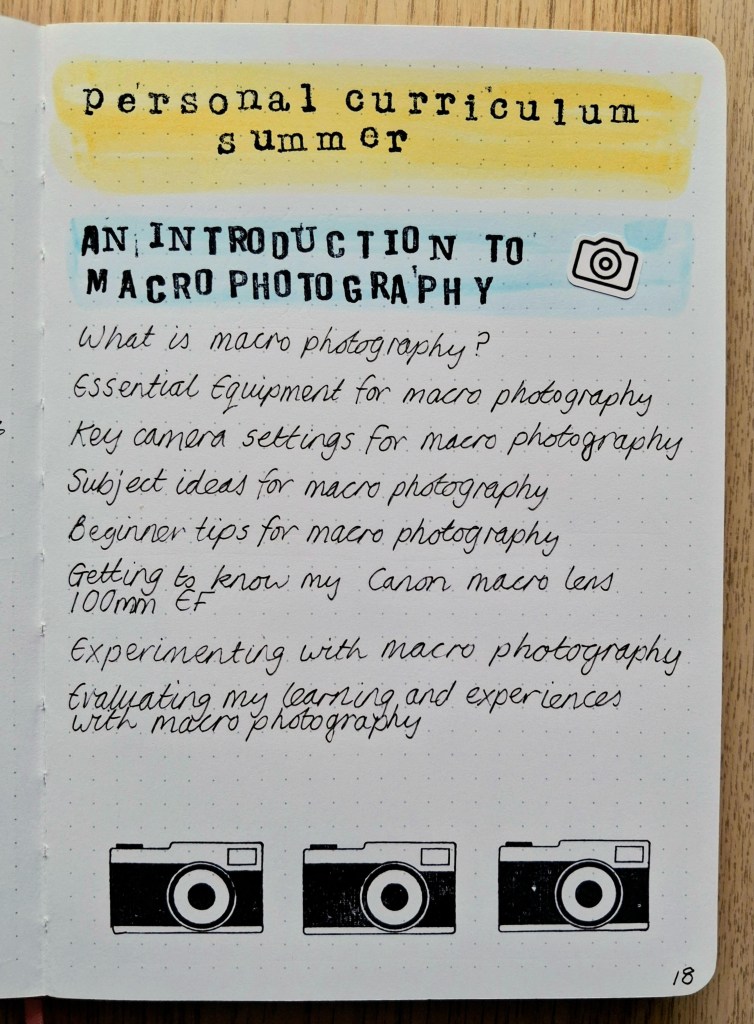
I grabbed a piece of paper and brainstormed all of the things I wanted to learn about the topic of macro photography. Then I worked in my bullet journal to made a spread called An Introduction to Macro Photography finalising my ideas by identifying a rough order of action points. I started with the theory behind this style of photography, including tips and tricks, then moved on to practical experiences and opportunities to evaluate my learning and progress. I kept it pretty simple, using stamps and black ink, but if you wanted to, you could set out learning objectives or expected outcomes at each stage and go to town with the decor.
Finding resources to support my learning
There are plenty of resources online about macro photography so I made the decision to stick with web-based information for the whole of my ‘module’. I don’t want to buy books on my chosen topic as these can quickly become outdated or might involve equipment which I haven’t got (e.g. the newer mirrorless cameras) and, although I could go to the library, I like the idea of dipping in and out of online resources when I have a spare few minutes and don’t want to carry heavy books around with me.
To ensure I (almost) always have access to the wealth of webpages, blog posts and YouTube videos I’ve come across, rather than writing them down in my bullet journal, I’ve opted to paste the links into Notion so I can click on them whenever I want, and as long as I have my phone or my computer accessible (which is pretty much all of the time), I can do some self study. Now, I’m not an expert on Notion, so it’s not a fancy set up with items pertaining to different aspects of my curriculum but the titles in the links are enough for me to gauge what the pages or videos are about helping me to establish when they might be useful, and that’s enough for me!
When choosing your resources, it’s important to firstly establish what type of learner you are. Learners can be broadly categorised into the following (bear in mind that you’re likely to be more than one type):
- visual learner – prefers images, diagrams and charts
- auditory learner – learns best through lectures, discussions and audio materials such as podcasts and audiobooks
- kinesthetic learners – prefers hands on learning through physical experiences and practical activities
- linguistic learner – excels in reading, writing and verbal communication
- logical learners – enjoys solving problems and logical reasoning
- social learners – thrives in group settings and prefers to learn through collaboration
- solitary learners – prefers to study alone and is self-motivated to learn, keen to independently reflect on own learning
Should I record my learning?
Whether you take notes on what you read or explore is entirely up to you, but for me, writing and journalling is part of the fun, so I absolutely want to do plenty of recording even if it’s just me writing that I spent ages trying to get the perfect shot of a butterfly and just as I fully depressed the shutter it flew off to pastures new and left me feeling a tad frustrated. Also, as a stationery lover, it was the perfect excuse to go notebook shopping! I got three slim notebooks for £3.50 and as long as I ignore (or get over) the fact that the word ‘notes’ is slightly off centre (grrr), I’m sure I’ll enjoy using one of them for my Macro Photography learning!
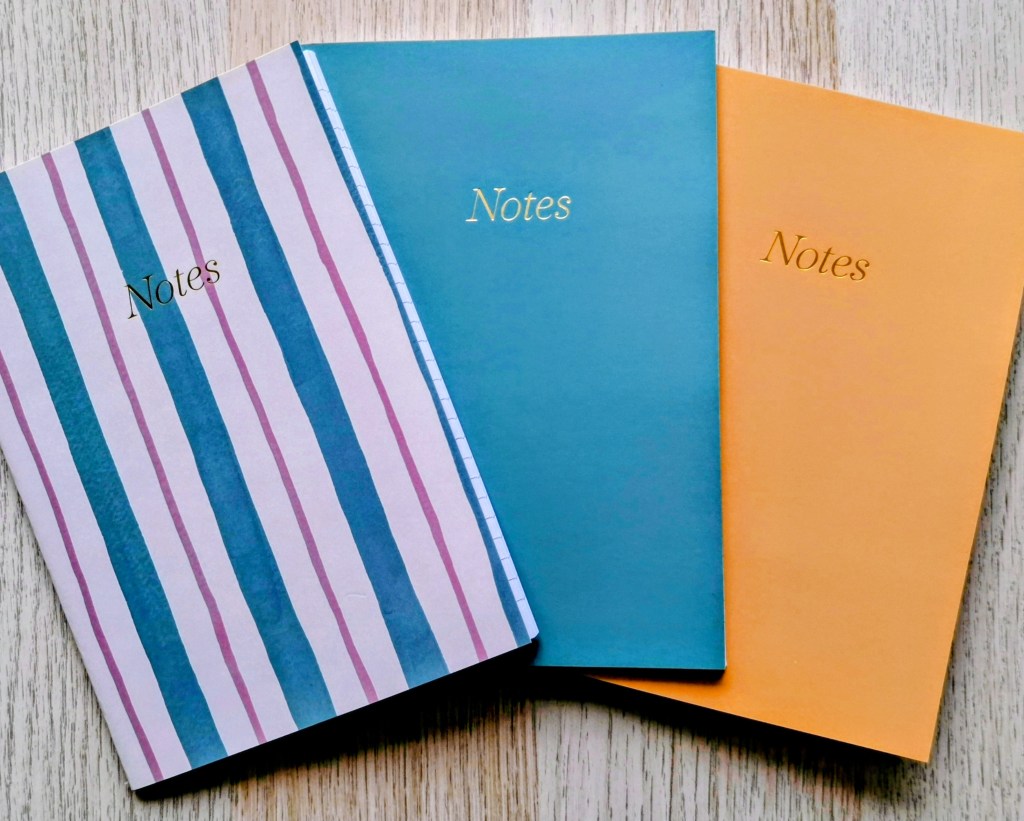
Now I just need to decide which design to use. I’m thinking the bright and sunny yellow colour?
Top tips for keeping it fun and interesting
Now you’re no longer studying at school or college, you get to choose exactly what you focus on and the pace of your learning. To ensure you have fun and maintain interest in your personal curriculum, I have the following suggestions and tips which should help:
embrace fluidity Whether your employed, run your own business, or are currently not working, there will be times when you have lots on your plate, times when you have a lighter schedule, times when you’re full of energy and times when you simply need to rest rather than adding more to your to do list. For your personal curriculum to be successful, I think it’s really important to ‘go with the flow’, accepting that your learning can and should flow with the rhythms of life rather than being a rigid set of actions to be completed at a set time or by a set date.
give yourself grace Similarly, if you do carve out a specific time to do a specific activity such as reading a chapter from a book, watching a video or making notes on your learning, if it doesn’t get done, don’t be hard on yourself, instead, spend time considering and questioning why. Maybe you got distracted by social media. Perhaps a more exciting opportunity presented itself that you didn’t want to miss. Or maybe you had low energy that afternoon and didn’t think it was a good time for you.
release perfectionism Strive to do your best with your personal curriculum study rather than demanding flawless results. When you were at school or college, you had particular grades to aim for and may have felt like other people were placing high expectations on you. However, you were probably also told that ‘as long as you try your best, that is all that matters’. Embrace the present and recognise that you are doing the best you can with the energy and resources you have available and that is totally okay.
avoid comparision The term ‘personal curriculum’ is a bit of a buzz word or phrase at the moment and there seem to be plenty of people talking about developing one and often sharing theirs on social media. I’ve seen examples where individuals have picked about four or five topics in a single month and set around six learning objectives or foci for each. Just the thought of doing this, my part time work, housework and spending time with family and friends (which is also a big priority of mine) stressed me out. But, then I came to realise that, although looking at what others are up to can get your creative juices flowing or give you ideas about the scope for your self study, it can also be pretty dangerous for your own wellbeing to compare yourself to others. If, like me, you want to start slowly and dip your toe into setting yourself a personal curriculum, you could try picking a single topic of study and a small part of what might be a vast and open-ended subject. It’s also worth remembering, that these same people who have been sharing their in depth curriculums, might not have done half of what they set out to do, and might be drowning in their own self-directed learning program behind the scenes and wishing they hadn’t set themselves such lofty goals! Remember, learning in your adulthood should be fun and light-hearted and if it stops being these two things, it might be time to reconsider your choices.
Ultimately, when designing your personal curriculum, ‘you do you’ as the saying goes, choosing your own resources and learning styles rather than adopting ideas from others that you’ve seen on social media. And remember, the beauty of learning as an adult, is that you can always tweak bits along the way or completely miss out parts where you feel like you’re not enjoying yourself or that it’s all getting a bit too academic (or formal) for your liking!
Wishing you lots of happiness in your learning, whatever you choose to do,


 Keeping it creative
One thought on “Monday Matters: Creating a personal curriculum by starting small (with just one topic)”