Hi all! It’s been a while since I last shared my monthly BuJo pages, but, as I’ve finished my July spreads super early (I actually finished the last few bits over a week ago!), I thought I’d get the various pages photographed and uploaded to my blog so you could see my finished designs and chosen theme. Obviously I’ve used stickers but you could quite easily simplify the pages and hand draw and colour different strawberry (or other fruit) themed images.
The front cover
Photo credit: Laura Jones for Keeping it Creative
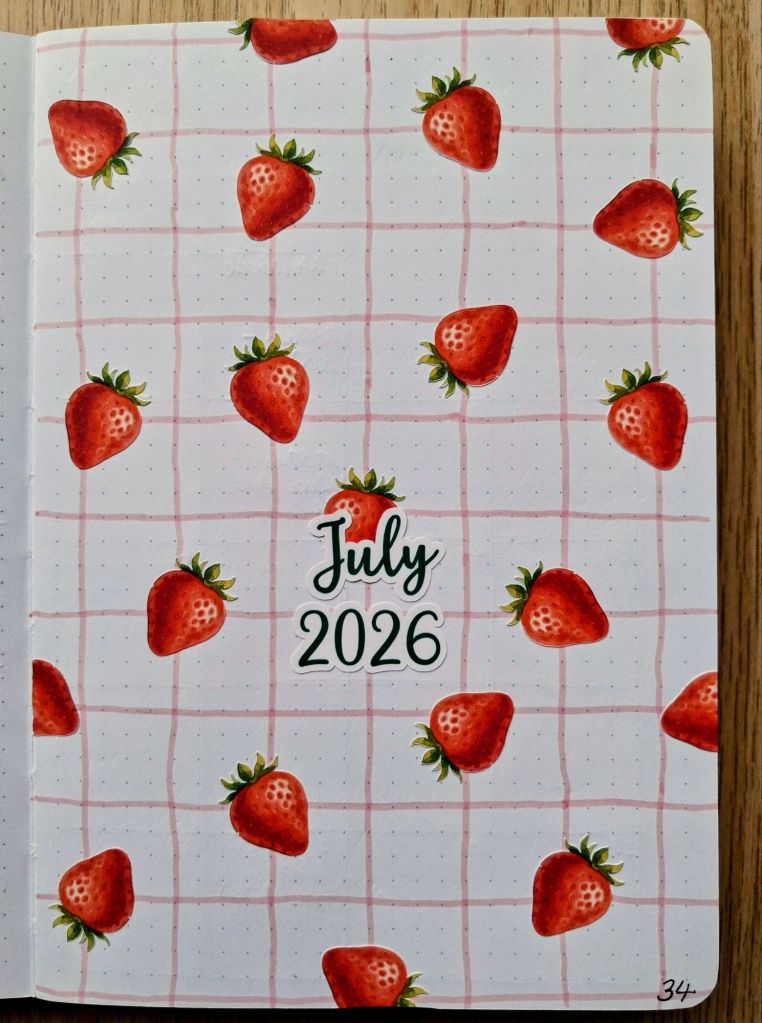
I wanted to create a slightly thicker grid than the one above but I only had a Tombow pen in the colour I wanted so I used the bullet tip for it. I created strawberry stickers with no white border for a clean look and I was pleased with how well my Cricut Joy Xtra cut out the images. Overall, I think the page looks quite cute!
Monthly calendar
Photo credit: Laura Jones for Keeping it Creative
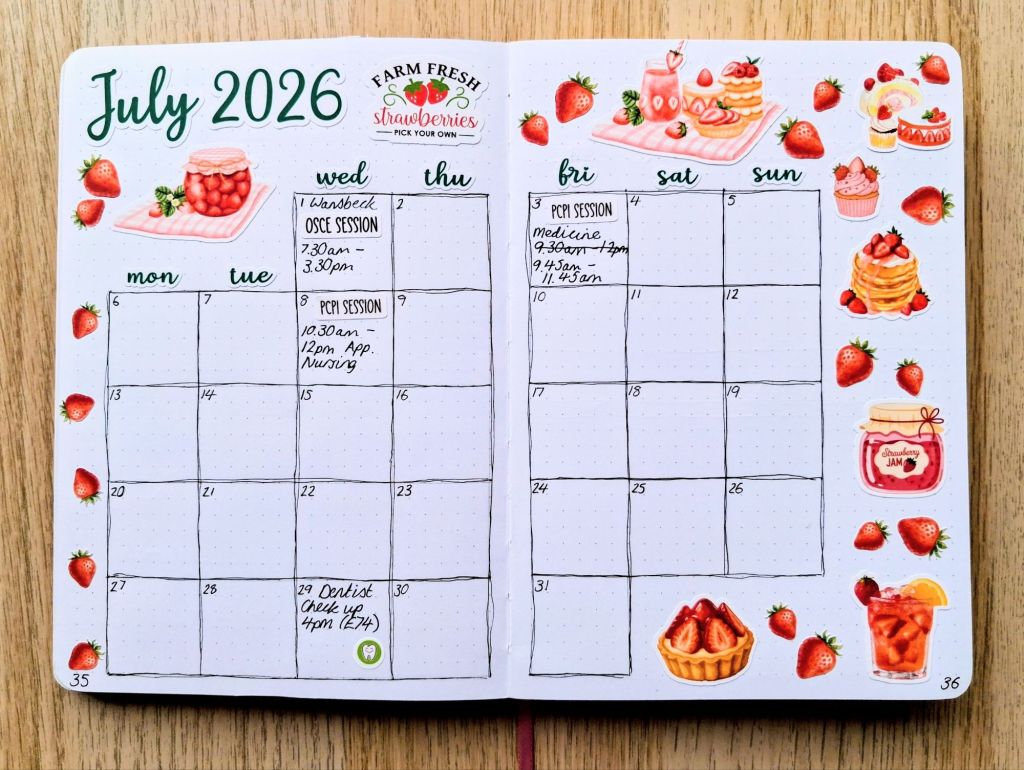
I already have quite a few things happening in July so I was glad to have my calendar ready early so I had a space to put them after initially adding them to my future log. I love how bright and colourful the spread turned out and, if you’ve been following me for a while, you’ll know that strawberries are my absolute favourite fruit and so this theme was a great option for me this month.
The calendar is the usual six by six dot grid spaces as I find I have just enough room to write in all (or most) of whst I need to add.
Finances – income and expenditure
Photo credit: Laura Jones for Keeping it Creative
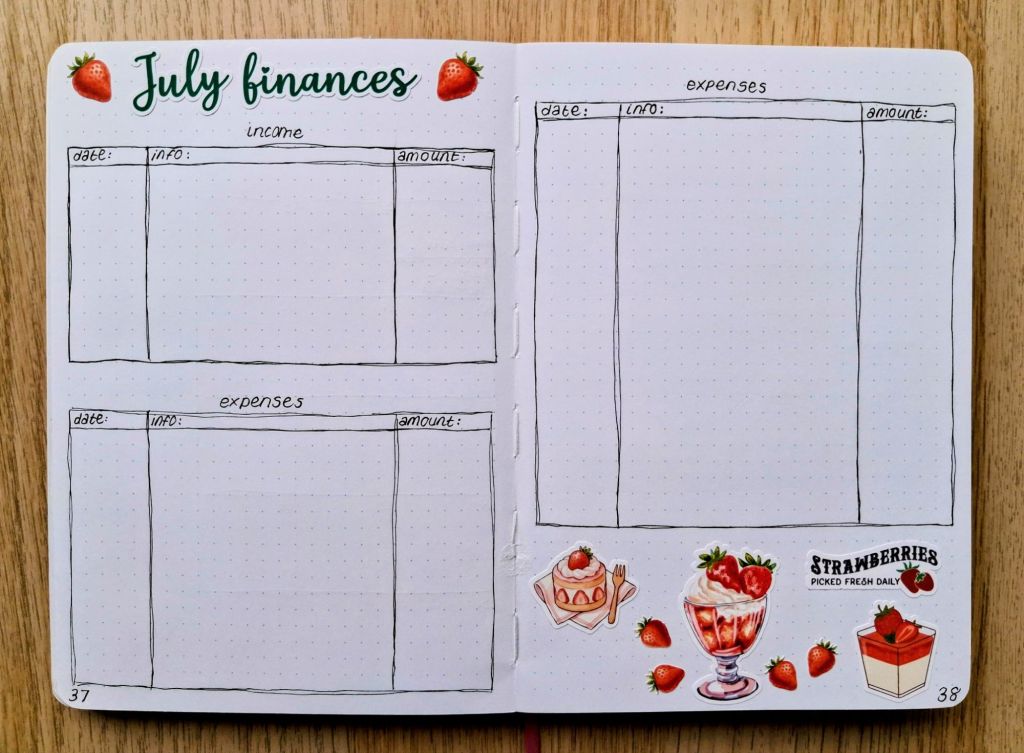
This month, you may have noticed that I appear to have forgotten to use a ruler. Actually, I did it on purpose and it made it sooooo much quicker to do the grid for my calendar and the finances log. And, to be honest, I think it looks okay, and I might do it again and again for the rest of 2026! I saw a tip on a YouTube video (might have been Shayda Campbell) about using two hand drawn lines to show that the wobbly bits are intentional and it certainly doesn’t look as messy if you’re ruler accidentally smudges things or if you accidentally move the ruler.
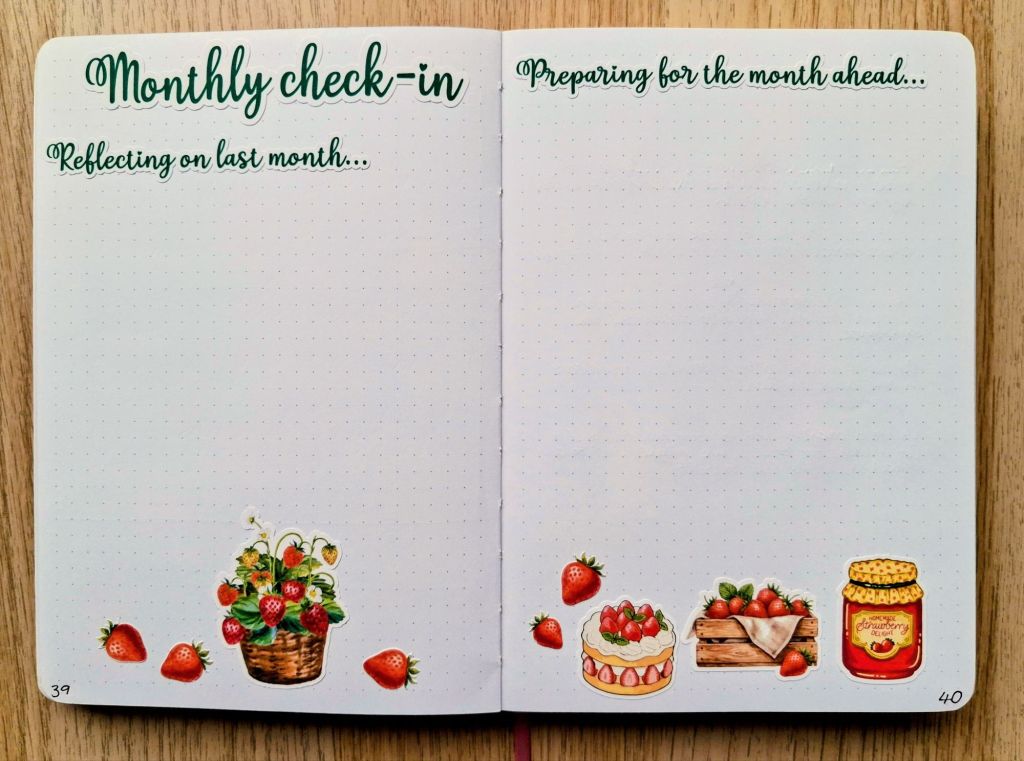
Reviewing the previous month and getting ready for July
Photo credit: Laura Jones for Keeping it Creative
I started creating this spread as a way to think about how things went the previous month including what went well, what didn’t go as planned, changes I might make the next month and anything that I needed to look into to help me going forwards. It’s also a space where I can record any actions I want to take before I start to work towards my monthly goals. For example, this month, I need to read information on the Brockbushes website to find out when the strawberry picking is, how much it costs, what’s on the lunch menu at the cafe there (we can’t just eat strawberries all day), how long it takes to get there and what photos I might want to take so I have a nice record of what we did and any displays they have.
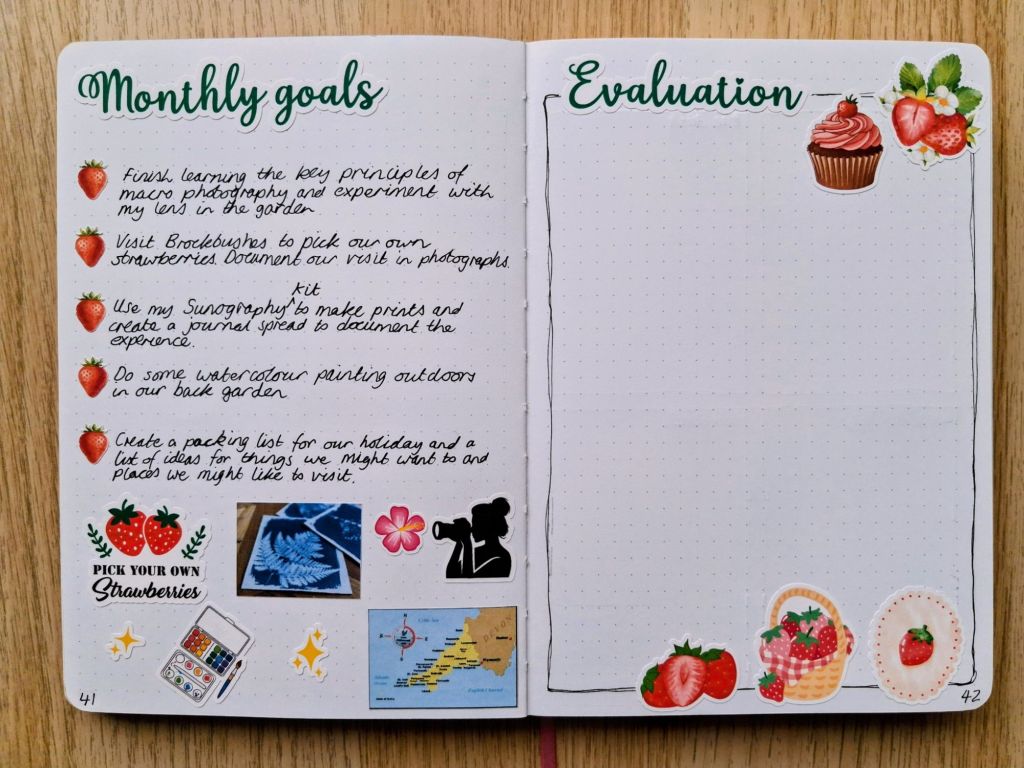
Monthly goals and space for evaluation
Photo credit: Laura Jones for Keeping it Creative
I tend to choose about 4 or 5 goals each month, sometimes related to hobbies or experiences I want to have, usually at least one related to my blog or Etsy shop (not included this time as I did a lot of work in June and now, a personal curriculum aim. These fall outside of the time I spend at work and I’m mindful of how much time I will have depending on my hours. In July, I have quite a lot of commitments and I’m getting sessions through regularly (2 since I photographed my spreads) so realistically, I can’t made my goals too lofty or I’m setting myself up to fail.
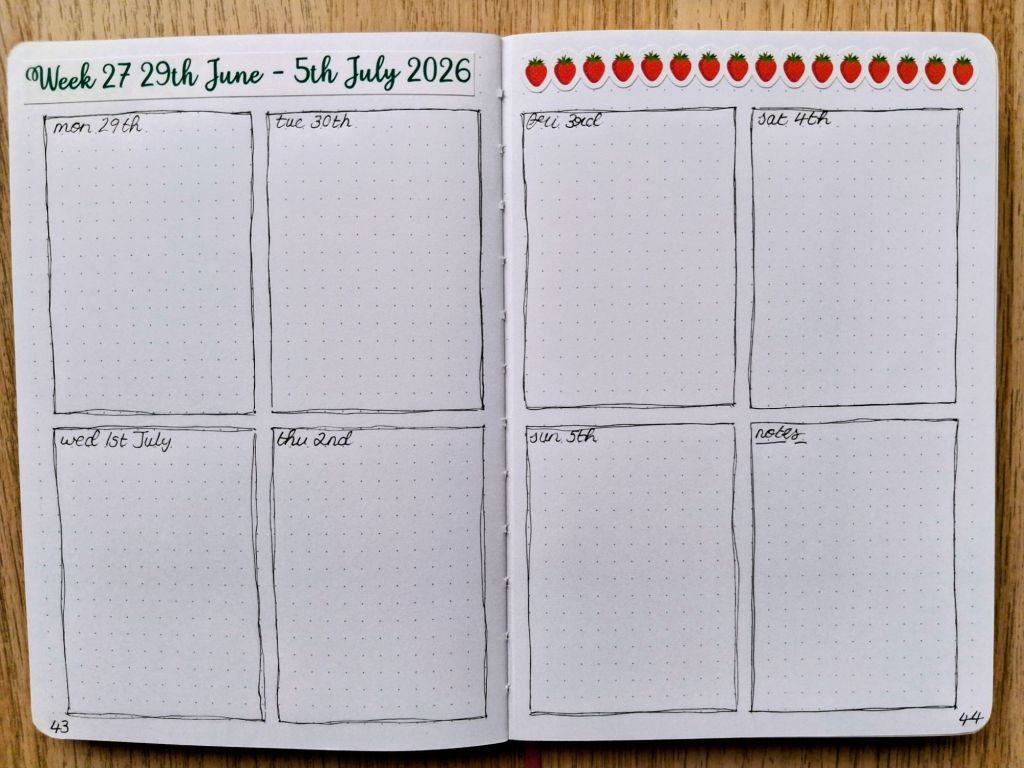
Weekly plan
Photo credit: Laura Jones for Keeping it Creative
I made all of my weekly plans the same for July so I’m just sharing one of them as an example. I kept the decoration very minimal but I do have some spare strawberry stickers if I want to add some later.
Final words…
I hope you’ve enjoyed seeing my pages for the month of July and are suitably impressed with how early I’ve got them finished (ha ha!). I appreciate that not everyone has the time and inclination to create such highly decorated spreads but for me, it’s really one of my hobbies and something I find a fun, relaxing and mindful activity. I also think I’m more likely to use my planner functionally if it looks pretty! I check in with my bullet journal every day, and throughout the day if I’m at home, and it really works to keep me organised and on track to succeed in creating a life I love.
I’ve seen a lot of YouTube vlogs recently about creating your own personal curriculum, and, as I consider myself very much as a lifelong learner, I was eager to give it a go. However, with limited free time, a variety of goals in progress, and a vision board that identifies my priorities for 2026, I wanted to start really small by focusing on just one subject and a particular element I want to learn more about. If, like me, you already have a busy life but want to carve out some time to learn something new (and enjoy benefits such as enhanced brain function, improved emotional and mental wellbeing, personal growth and increased life satisfaction) read on to find out how I designed my personal curriculum for Summer 2026. Also, if you’re not sure what a personal curriculum even is, I’ve also covered this below too.
What is a personal curriculum?
A personal curriculum is a self-designed and self-lead learning plan that enables you to create your own educational journey, developing your skills and knowledge in an area which interests you. Unlike at school, college or university, you play the role of teacher, selecting your own subjects, assignments and, if you wish, learning objectives. You also get to choose how many topics you will cover (I would suggest no more than two or three to get you started), your methods of learning (e.g. books, videos, movies, podcasts, trips, experiences etc.) and the time scale for completion (e.g. one month, one season, one term or one semester). You can also plan study times around other commitments and think about how deep an understanding you wish to have by the end of your ‘module’.
The topics of your personal curriculum can vary greatly but could include academic subjects such as environmental sciences, philosophy, British Classics, Fine Art or Creative writing, hobbies such as baking, photography, knitting or watercolour painting, practical skills such as budgeting, gardening, basic car maintenance or computer literacy, or personal development such as time management, mindfulness, communication skills, learning a new language, emotional resilience or goal setting.
Choosing my focus for my learning plan
I have many, many hobbies an interests which made it difficult to decide where to start and what I wanted to work on. So, I figured that it might be a good idea to make a list of things I enjoy doing in my spare time. These are what came to mind straight away:
Creative journalling and memory keeping
bullet journalling
walking in nature
vegan cookery
drawing
watercolour painting
photography
blogging
fitness related including yoga, Pilates and Zumba
Some of these topics, I feel like I know quite a lot about already and so I’m happy with my current explorations of them and how much time I dedicate to them. Others, I want to learn more about but tend to explore them every now and then when I feel like getting creative (e.g. watercolour painting and drawing. The topic that I decided that I really want to focus on learning about right now was DSLR photography. However, as I’ve done a beginners course focusing on basic techniques and Photoshop, I wanted to explore a very specific type of photography which would uplevel my skills. I know I would love to concentrate on wildlife photography but I’m very aware that suitable zoom lenses and a camera upgrade would be required and I don’t have the finances for this at the moment (if ever!). What I do have though, is a macro lens which I really haven’t got the hang of yet and a love of photographing insects and flowers so I’ve opted for a module on Macro Photography as a good starting point.
What do I want to learn?
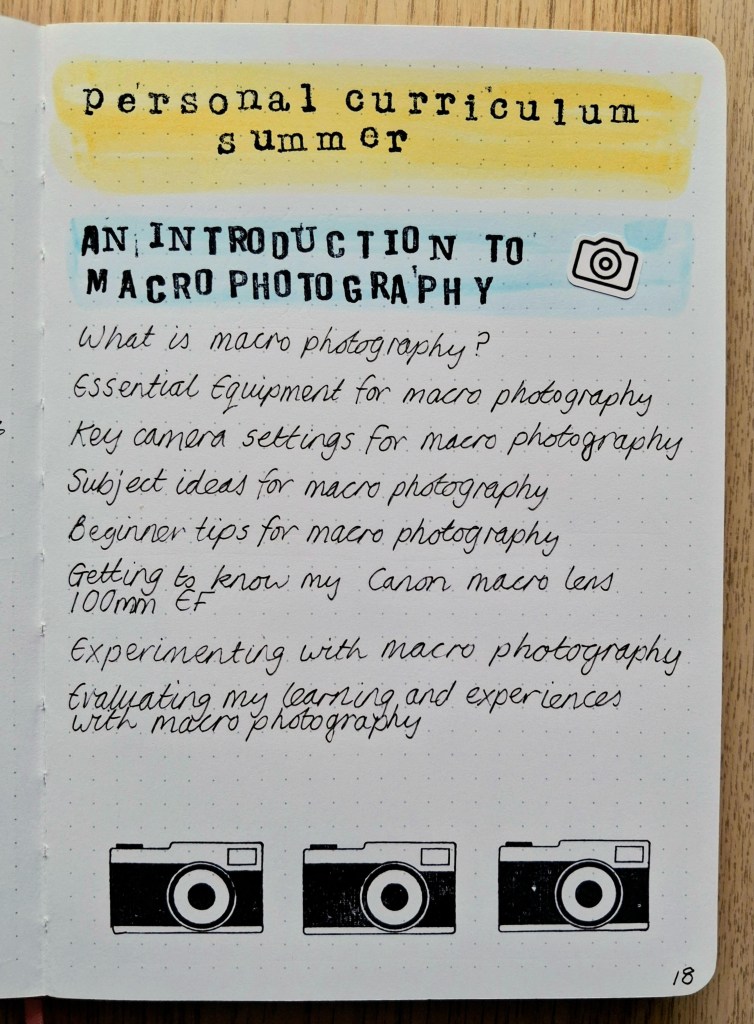
I grabbed a piece of paper and brainstormed all of the things I wanted to learn about the topic of macro photography. Then I worked in my bullet journal to made a spread called An Introduction to Macro Photography finalising my ideas by identifying a rough order of action points. I started with the theory behind this style of photography, including tips and tricks, then moved on to practical experiences and opportunities to evaluate my learning and progress. I kept it pretty simple, using stamps and black ink, but if you wanted to, you could set out learning objectives or expected outcomes at each stage and go to town with the decor.
Photo credit: Laura Jones for Keeping It Creative
Finding resources to support my learning
There are plenty of resources online about macro photography so I made the decision to stick with web-based information for the whole of my ‘module’. I don’t want to buy books on my chosen topic as these can quickly become outdated or might involve equipment which I haven’t got (e.g. the newer mirrorless cameras) and, although I could go to the library, I like the idea of dipping in and out of online resources when I have a spare few minutes and don’t want to carry heavy books around with me.
To ensure I (almost) always have access to the wealth of webpages, blog posts and YouTube videos I’ve come across, rather than writing them down in my bullet journal, I’ve opted to paste the links into Notion so I can click on them whenever I want, and as long as I have my phone or my computer accessible (which is pretty much all of the time), I can do some self study. Now, I’m not an expert on Notion, so it’s not a fancy set up with items pertaining to different aspects of my curriculum but the titles in the links are enough for me to gauge what the pages or videos are about helping me to establish when they might be useful, and that’s enough for me!
When choosing your resources, it’s important to firstly establish what type of learner you are. Learners can be broadly categorised into the following (bear in mind that you’re likely to be more than one type):
visual learner – prefers images, diagrams and charts
auditory learner – learns best through lectures, discussions and audio materials such as podcasts and audiobooks
kinesthetic learners – prefers hands on learning through physical experiences and practical activities
linguistic learner – excels in reading, writing and verbal communication
logical learners – enjoys solving problems and logical reasoning
social learners – thrives in group settings and prefers to learn through collaboration
solitary learners – prefers to study alone and is self-motivated to learn, keen to independently reflect on own learning
Should I record my learning?
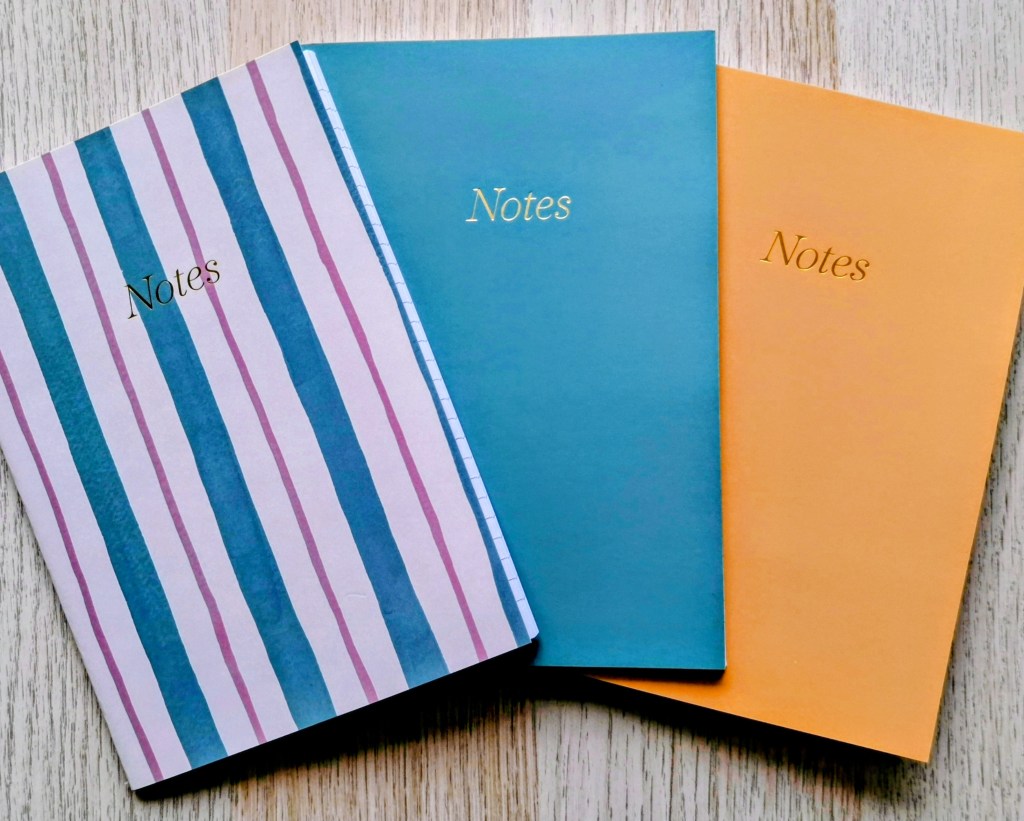
Whether you take notes on what you read or explore is entirely up to you, but for me, writing and journalling is part of the fun, so I absolutely want to do plenty of recording even if it’s just me writing that I spent ages trying to get the perfect shot of a butterfly and just as I fully depressed the shutter it flew off to pastures new and left me feeling a tad frustrated. Also, as a stationery lover, it was the perfect excuse to go notebook shopping! I got three slim notebooks for £3.50 and as long as I ignore (or get over) the fact that the word ‘notes’ is slightly off centre (grrr), I’m sure I’ll enjoy using one of them for my Macro Photography learning!
Photo credit: Laura Jones for Keeping It Creative
Now I just need to decide which design to use. I’m thinking the bright and sunny yellow colour?
Top tips for keeping it fun and interesting
Now you’re no longer studying at school or college, you get to choose exactly what you focus on and the pace of your learning. To ensure you have fun and maintain interest in your personal curriculum, I have the following suggestions and tips which should help:
embrace fluidityWhether your employed, run your own business, or are currently not working, there will be times when you have lots on your plate, times when you have a lighter schedule, times when you’re full of energy and times when you simply need to rest rather than adding more to your to do list. For your personal curriculum to be successful, I think it’s really important to ‘go with the flow’, accepting that your learning can and should flow with the rhythms of life rather than being a rigid set of actions to be completed at a set time or by a set date.
give yourself grace Similarly, if you do carve out a specific time to do a specific activity such as reading a chapter from a book, watching a video or making notes on your learning, if it doesn’t get done, don’t be hard on yourself, instead, spend time considering and questioning why. Maybe you got distracted by social media. Perhaps a more exciting opportunity presented itself that you didn’t want to miss. Or maybe you had low energy that afternoon and didn’t think it was a good time for you.
release perfectionism Strive to do your best with your personal curriculum study rather than demanding flawless results. When you were at school or college, you had particular grades to aim for and may have felt like other people were placing high expectations on you. However, you were probably also told that ‘as long as you try your best, that is all that matters’. Embrace the present and recognise that you are doing the best you can with the energy and resources you have available and that is totally okay.
avoid comparision The term ‘personal curriculum’ is a bit of a buzz word or phrase at the moment and there seem to be plenty of people talking about developing one and often sharing theirs on social media. I’ve seen examples where individuals have picked about four or five topics in a single month and set around six learning objectives or foci for each. Just the thought of doing this, my part time work, housework and spending time with family and friends (which is also a big priority of mine) stressed me out. But, then I came to realise that, although looking at what others are up to can get your creative juices flowing or give you ideas about the scope for your self study, it can also be pretty dangerous for your own wellbeing to compare yourself to others. If, like me, you want to start slowly and dip your toe into setting yourself a personal curriculum, you could try picking a single topic of study and a small part of what might be a vast and open-ended subject. It’s also worth remembering, that these same people who have been sharing their in depth curriculums, might not have done half of what they set out to do, and might be drowning in their own self-directed learning program behind the scenes and wishing they hadn’t set themselves such lofty goals! Remember, learning in your adulthood should be fun and light-hearted and if it stops being these two things, it might be time to reconsider your choices.
Ultimately, when designing your personal curriculum, ‘you do you’ as the saying goes, choosing your own resources and learning styles rather than adopting ideas from others that you’ve seen on social media. And remember, the beauty of learning as an adult, is that you can always tweak bits along the way or completely miss out parts where you feel like you’re not enjoying yourself or that it’s all getting a bit too academic (or formal) for your liking!
Wishing you lots of happiness in your learning, whatever you choose to do,
This is my second year of making seasonal bucket lists and, so far, I’ve managed to make them all quite different. I’ve been looking back at Summer 2024’s spread in my bullet journal and quite a few elements of it were related to our holiday in Wales. This year, however, we’ve had our main trip last month and we haven’t decided where we might go for my birthday in August yet. Today, I’m sharing my finished Summer 2025 bucket list spread in my current BuJo. I’m starting to work on the items already as I follow the meteorological times, beginning on June 1st and finishing on August 31st rather than the astronomical calendar. And, although we had a bit of rain earlier, it’s bright sunshine and blue sky out there now so it certainly feels like the summertime has arrived.
Creating my bucket list and turning it into a bright and colourful spread in my BuJo
Last year, I went into detail about how I develop my list and then turn it into a double page board in my bullet journal and you can read all about my process here. This time, as I’ve noticed there tends to be quite a bit of ink transferal, if I use lots of black, I opted for a lovely, bright pink for the bucket list items. It’s still really easy to read and hopefully, I won’t spend the season erasing smudges!
A couple of items that I chose are common to most of my bucket lists, such as doing a seasonal jigsaw and reading a book set in the particular season but the rest are all something new and different.
Final words…
I hope you’ve enjoyed seeing my Summer Bucket List spread and it has inspired you to create your own. You don’t necessarily have to make it a creative exercise – just writing one on plain paper and putting it up somewhere prominent such as on a cupboard in your kitchen will be enough to help you make the most of the season. You could even turn it into a family activity where you each contribute some ideas of seasonal favourites or things you’ve always wanted to try. And if you get a bit stuck, you can always turn to AI to generate ‘Fun things to do this Summer’ or your own show me phrase.
I would love to see your finished lists if you would like to share, so feel free to upload it to Instagram and tag me in your post with @ljdesignsne
Hope your Summer is great fun and you create lots of happy memories!
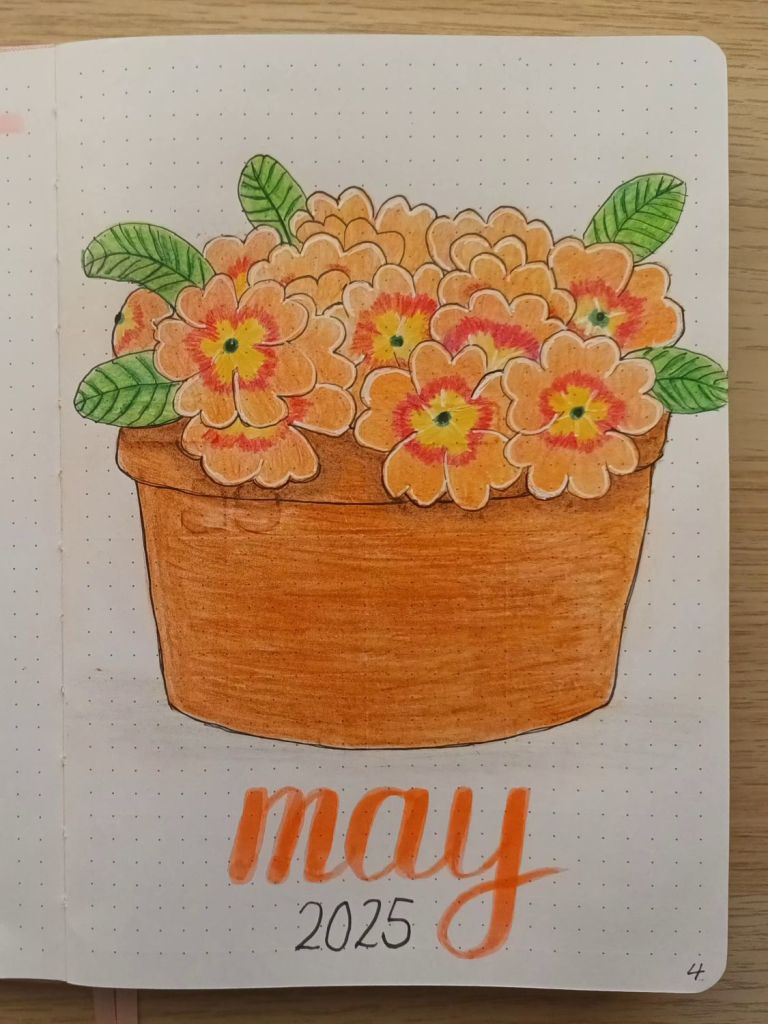
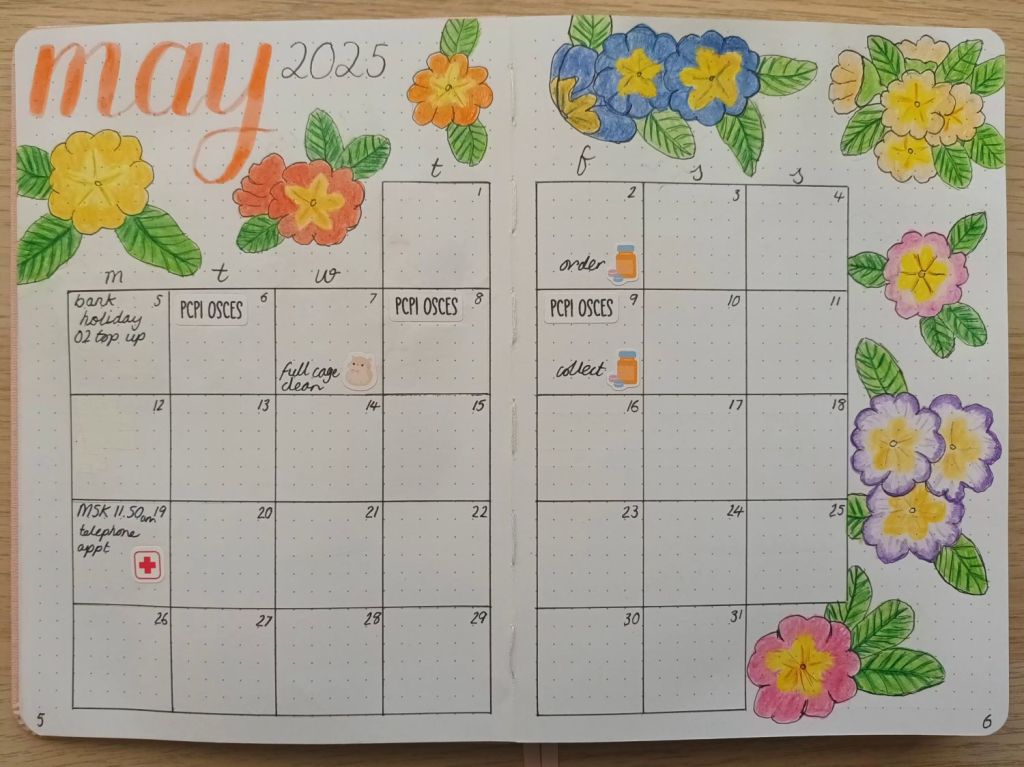
This month, I’ve again taken inspiration from our garden. A few weeks ago, I decided that I wanted to add more colour out the front of the house, so we went to the garden centre to look for a set of six bedding plants that should come back year after year. I opted for primroses (AKA primula) as there was already one out there which pops up each spring and was obviously set before we moved in over a decade ago. After the flowers had settled in – they went a bit floppy when we first installed them – I took some macro photos to use as inspiration for my spreads. It’s taken me ages to sketch out, draw and colour in all of the images but it was such a lovely, mindful activity that I found it really therapeutic. As I write this, it’s the 2nd May and I still haven’t finished all of the decor but I have drawn up my calendar, finances, goals and first weekly so I can actually fill in events and tasks. I hope you like my finished pages and they inspire you to give florals a go to practise your drawing, colouring or maybe painting skills.
Front cover
The calendar was the last page I finished and took me a long while to complete. I used a photograph of a plant pot of primroses for reference which I found on Google. I used mainly my Staedtler Ergosoft coloured pencils and blended a few shades together to get a nice peachy colour. I also used my blending pencil to mix up the colours and to create a smooth appearance. I also used my Sakura Gelly Roll pen in a size 10 to draw lines inside of the Pigma Micron as the actual primroses had a very thin white trim.
Photo credit: Laura Jones for Keeping It Creative
Monthly calendar
I added the decor to my calendar second, after I did the image for my finances record, and, as it had taken me such as long time to finish that one, I opted for a more sketchy appearance to the primroses you see here. I held my fineliner really lightly and tried to create a slightly wobbly appearance so the plants looked more natural. I’m really happy with how they turned out and the colours look so cheerful. I made good use of lots of my coloured pencils and also used my blending pencil to blend out any harsh lines.
Photo credit: Laura Jones for Keeping It Creative
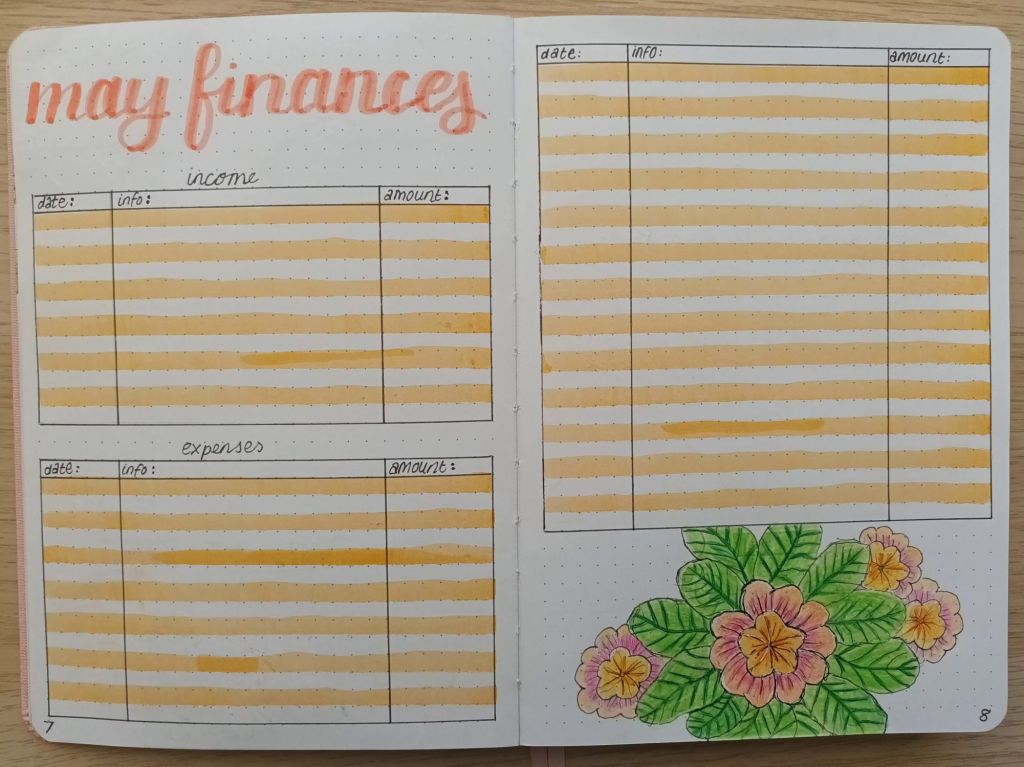
Finances record
As well as the pack of six small primrose plants, we also purchased a much larger one for our back garden. The flowers are a lovely, pale pink but I didn’t have a coloured pencil which matched so I’ve gone for more of a peachy colour. I initially did just the flower in the centre but decided there were too many leaves and not enough floral bits so I added the other two and made them a little more washed out so the central one stood out.
Photo credit: Laura Jones for Keeping It Creative
Monthly goals
Last month I (yet again), picked far too many goals to be in with any chance of achieving them all. So, for May, I’ve really, really restricted myself and opted for just 5 (go me!). And, I’ve already achieved one of them as I made bread for the very first time yesterday!
Rather than adding some more primrose illustrations, I opted to add some stickers to make the set up much quicker. Some, I’ve made myself and others are from my ever increasing stash (you can never have too many stickers – right?). However, I have just started a new BuJo this month and a not to do goal of mine is to add plenty of my own illustrations straight into my notebook rather than overloading with stickers and making my journal super bulky (my orange one would barely close by the time I finished it!).
Photo credit: Laura Jones for Keeping It Creative
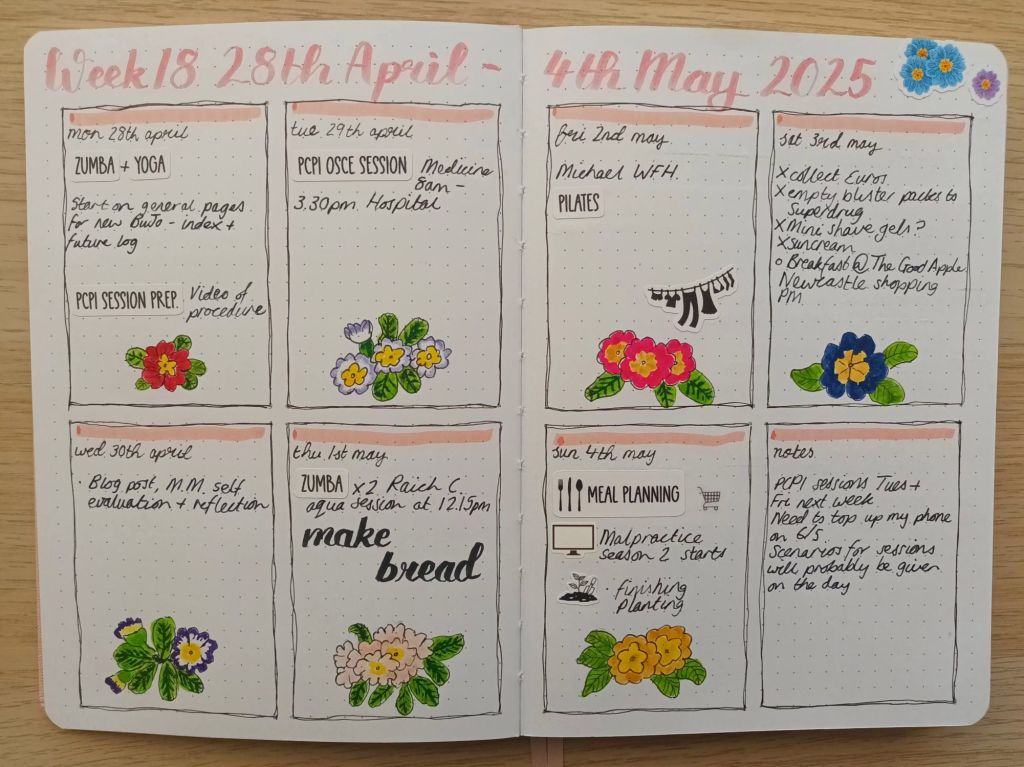
Weekly plan
I’ve been using this same style layout for quite a few weeks now and it really works for me. It gives me enough room to write events and add a few to dos underneath each day. I can then add a small illustration at the bottom if I want to, or use the full space for recording. This week, I’ve done some small primrose illustrations but I may not do any next week as I have lots of sessions at the university so I’ll be super busy.
Photo credit: Laura Jones for Keeping It Creative
Final words…
Thank you for taking the time to visit my blog today. I hope you like my finished spreads. I think they look really colourful and provide a great reminder of our new plants and all of the other bright colours of primrose which you can get. The flowers seem to be thriving at the moment but as we haven’t had any rain for weeks, they require daily watering as the soil is getting so dry. I’m hoping they’re going to stay looking good for a least another month and continue to make me smile each time I get in and out of my car!
I hope you’re all enjoying the sunshine if you have it and making the most of the warmer Springtime weather. This month, for my BuJo, I’ve opted for an April showers and umbrellas theme. It’s something I did before back in 2021 but my set up is quite different so I don’t mind repeating it. I’ve used coloured markers (Tombows, Crayola Supertips, Pentel sign brush pens and Pigma microns) for all of the doodles and I tried to stick to some kind of colour palette to make the pages cohesive, although I deviated at times! I hope you enjoy seeing my set up and don’t forget to let me know what theme you’ve chosen for April in the comment section.
Front cover
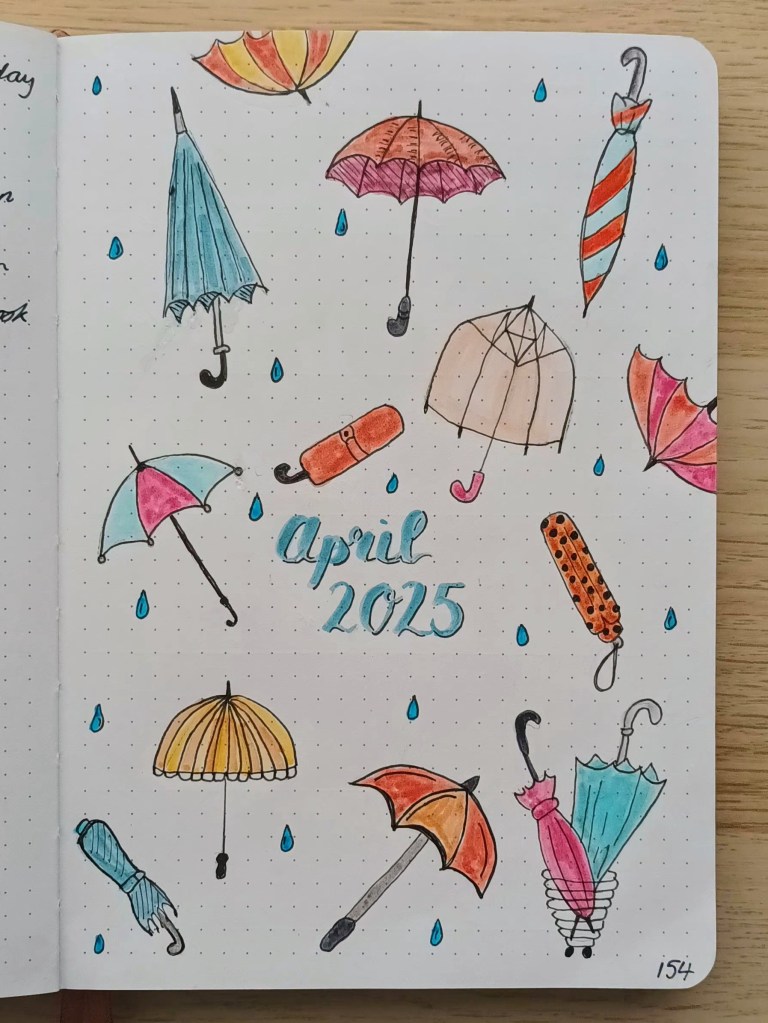
After writing a small title using a blue Pentel brush pen, I filled the page with different umbrella doodles using a combination of oranges, pinks and blues. I then added raindrops to finish things off.
Photo credit: Laura Jones for Keeping It Creative
Two Page Calendar
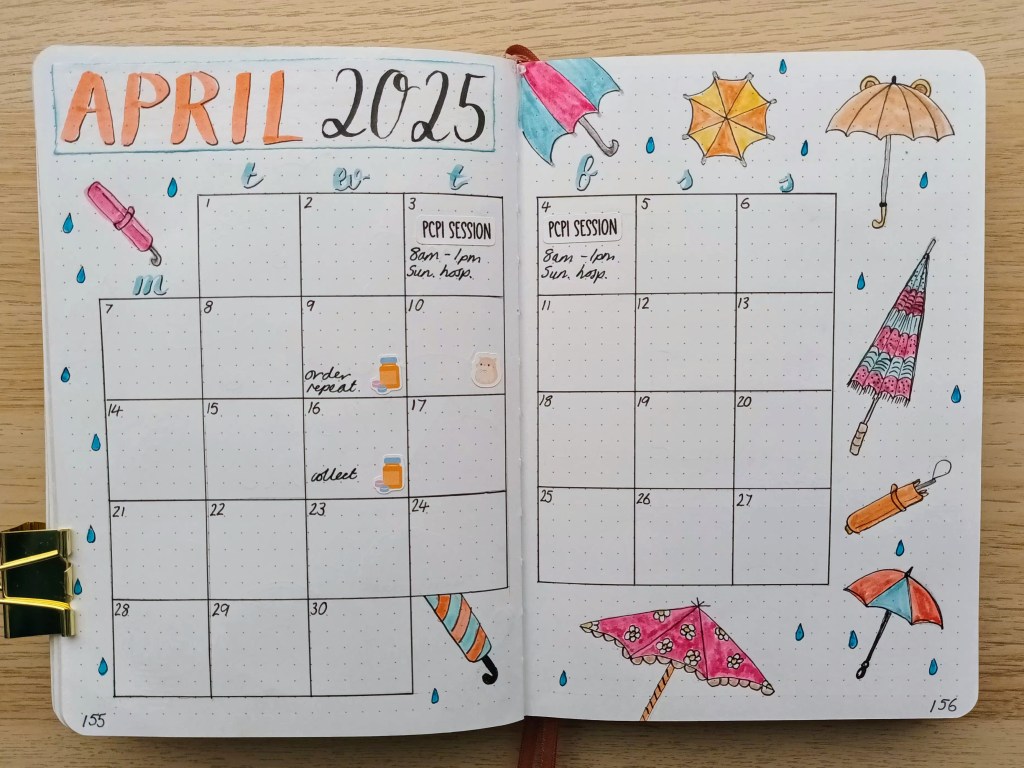
I like to draw up a nice, big calendar so I can add the main events of the month straight into it. I also like to put reminders in such as when I need to order my medication and when our hamster, Aggie will be getting her monthly full cage clean (an event that my husband and I always look forward to – not! ha ha!).
I enjoyed adding umbrella doodles in the surrounding spaces and some more raindrops.
Photo credit: Laura Jones for Keeping It Creative
Monthly finances
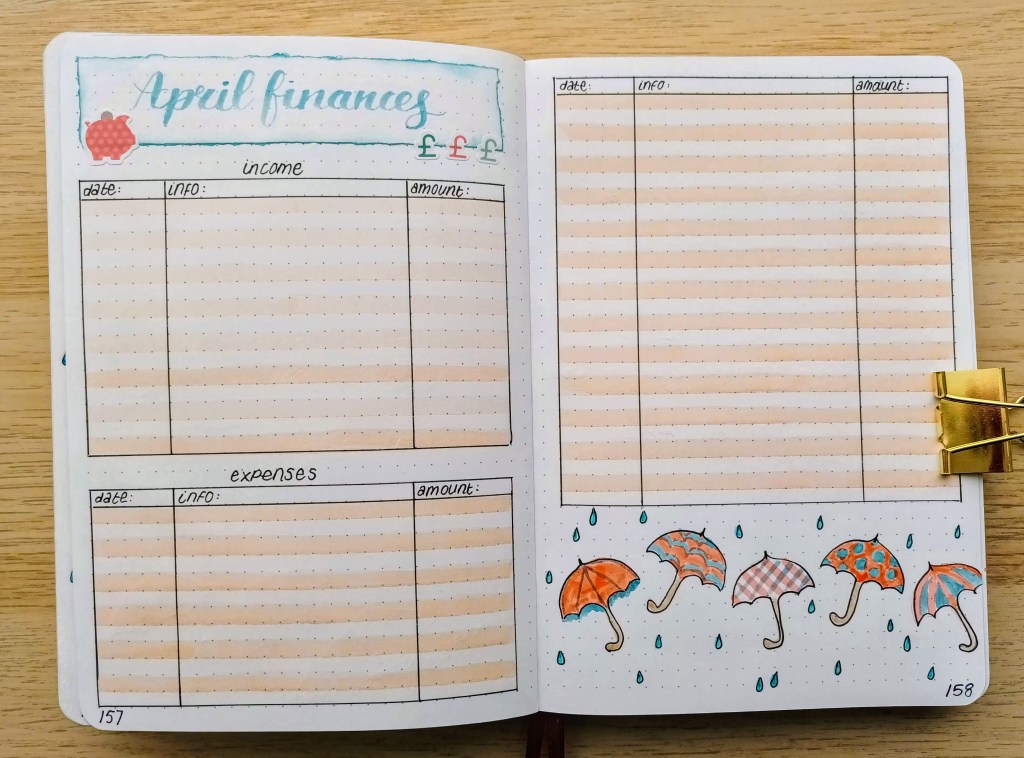
I always like to keep track of my finances each month so my outgoings don’t exceed my income. I fill in my spending each week so the task doesn’t become something too onerous. I remembered that I had a stencil sheet in my collection which had an umbrella outline as part of the shapes, so I used this to create uniform images across the bottom of the page. I used a Tombow and the Pentel sign pen to create a sketchy feel to the colouring as I didn’t want it to be too perfect.
Photo credit: Laura Jones for Keeping It Creative
April goals
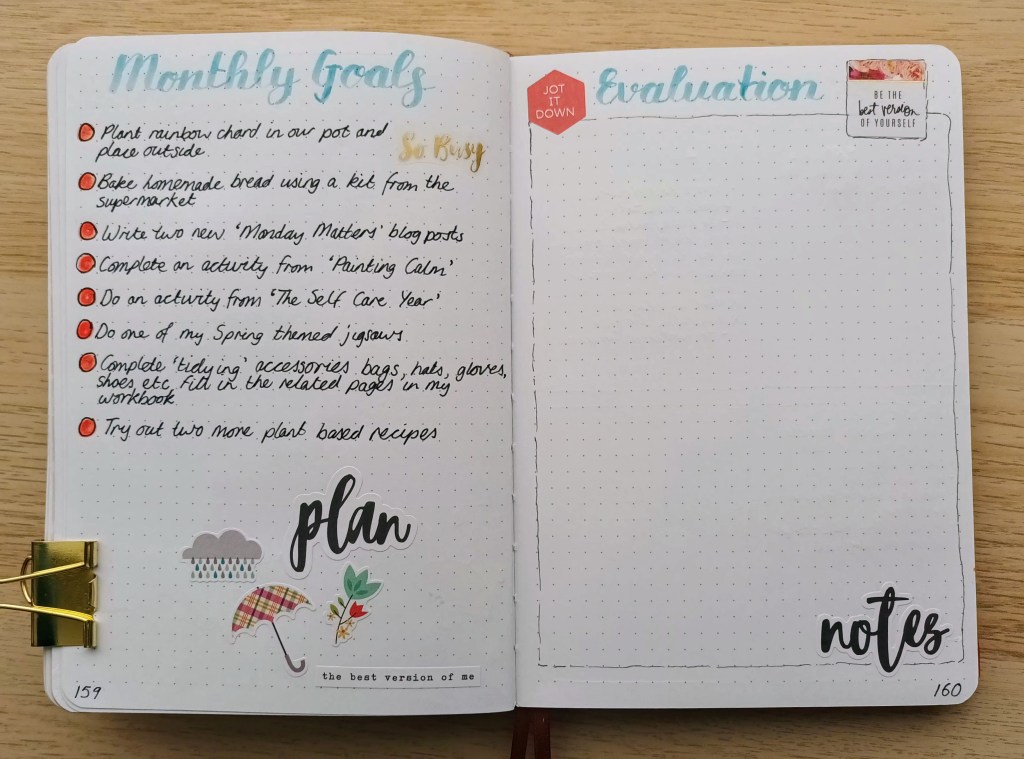
I decided to try to limit the amount of goals I set for this month as there are a few from March that I’m still working on. I picked out eight which I still think is a few too many, but some of them are relatively quick ones such as planting our chard seeds outside and trying out a couple of new plant based recipes.
Photo credit: Laura Jones for Keeping It Creative
Final words…
I would share my first weekly, but I haven’t got around to decorating it yet and I’ve added some personal information to it which would need blocking out. I might share the weekly plans on Instagram at a later date – you can find me here if you want to see my content.
I had fun doodling lots of umbrellas this month but I really must remember to be careful not to smudge the marker colours as I had to use some whiteout pen to hide a couple of smears! This is part of the joy of being left handed – can anyone relate?
That’s all for this month. Wishing you an amazing April,