Posted in Blogging, crafting, creativity, Cricut, goal setting, Health and Nutrition, Home cooking, intentional living, life hacks, lifestyle, manifestation, mindset, personal development, Planning and journaling, reflective journalling, Setting goals and intentions, watercolour painting

Setting up my 2025 Vision Board

Last year, for some unknown reason, I think I must have decided against making a 2024 vision board. I’m not sure why, but maybe I didn’t feel up to it or perhaps I had a variety of commitments at the beginning of January and decided it was too late in the month to work on one.

For 2025, I decided that, for me personally, it’s not really important to have the board finished in super quick time and it doesn’t matter if I’m still working on it towards the end of January. I wanted to have a slow start to the first month, really pondering over what I would like the year to look like. I found it helpful to revisit a couple of old blog posts of mine in which I’d talked about key questions you could ask yourself to prepare your mind and what to actually do to improve your chances of manifesting everything you’ve visualised for the year.

I decided to create a larger display, rather than using two pages in my bullet journal as then I can have it on my craft room / office wall to look at all year round. I also chose to combine images, motivational sayings, affirmations and a few cute decorative elements to make it visually appealing. I’ve spend days thinking about what I truly want this year, flicking through a huge stash of Psychologies magazines, answering deep questions from my previous vision board posts, journalling my thoughts and closing my eyes to visualise things. I’m so glad I put lots into the preparation as my 2025 vision board is now complete and turned out exactly how I wanted it. I can’t wait to share a photograph of the finished product!

And here it is…
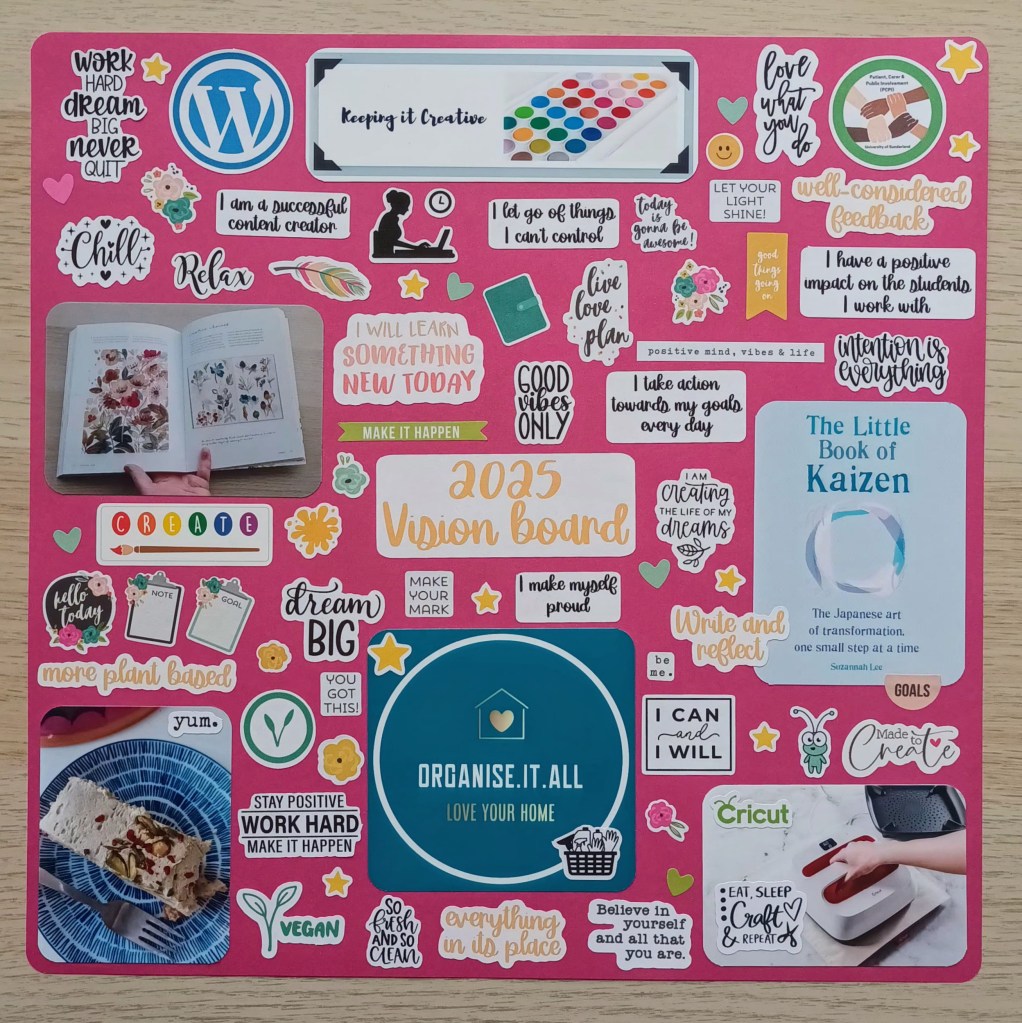
Photo credit: Laura Jones for Keeping It Creative

My main categories

Diet – The plan this year is to eat more plant-based goodies than ever before. We’ve made so many healthy and delicious vegan dishes this Veganuary and we’ve also found a cafe that has a range of vegan friendly cake options. It’s getting easier and easier to eat a plant based diet and my husband and I have already made a number of changes over the years such as soya milk on our cereal and oat milk in our hot drinks, vegan spread on our bread, lots of plant based alternatives to meat such as soya mince, veggie sausages, VLTs etc.

Creativity – I want to develop my watercolour skills even further this year, whilst also engaging in mindful and calming activity after busy days. I got a gorgeous book for Christmas which provides exploratory activities and projects with a nature theme. I want to incorporate a weekly slot of time to experiment and develop a range of techniques.

Blogging – I want to spend more time promoting my blog posts so that I develop a wider readership. I used to consistently post pins on Pinterest but I’ve let this slide over the last few years. I get plenty of readers but I want to reach individuals who do not have their own blog as well as those who are keen bloggers.

PCPI work – I thoroughly enjoy my work at the university but it’s really important to me that I’m making as much of a difference as I can to the students. I particularly want to develop my feedback skills for medicine sessions, particularly with young adults who are in the initial stages of their uni course.

Kaizen – I recently started a short book called The Little Book of Kaizen – The Japanese art of transformation, one small step at a time. I’m enjoying reading it and doing the exercises at the beginning. The idea really appeals to me, so, to make sure it’s a focus for me this year, I’ve added a photograph of the mini book on my vision board with a view to working through all of the chapters. I’ve even pick out a cute notebook to use to jot things down and I’m using my fountain pen to write beautifully inside.

Cricut – As you probably already know, I’m obsessed with making stickers and cutting them using my Joy Xtra. However, I also have the smaller Joy machine and also invested in the EasyPress 2 when it was on offer at a discount. I have lots of vinyl and HTV as well as some iron on papers so I want to spend time this year getting creative and using them all up. I have so many ideas but I now need to schedule time to actually get making things. I added a Cricut bug sticker to watch over me and remind me to have more fun playing with my machines.

Getting organised – We have a lot of stuff in our house and some of it needs purging. As well as trying to use up craft materials before buying any more, I also want to re-organise our home so it’s easy to clean and keep tidy.

Final words…

That’s everything on my vision board for this year and to ensure that everything on the display comes into fruition, I will be checking in with it at the beginning of each month and using the different aspects to set mini monthly goals. I’ve developed pages in my bullet journal to list my goals and I’ll make sure at least some of them relate to things I want to manifest throughout the year.

I hope you enjoyed seeing my board and that it’s inspired you to have a go at creating your own. It doesn’t matter if you don’t get around to it for a few weeks – there’s still plenty of days left in the year to take action.

Good luck!

Posted in goal setting, life hacks, lifelong learning, personal growth, productivity, Setting goals and intentions

Monday Matters: 7 ways to be a lifelong learner (Part 2 of 2)

Today, I’m sharing the second and final part of my mini-series on lifelong learning. In Part 1, I considered the character traits of lifelong learners and discussed the benefits of being a lifelong learner. In Part 2, I’m going to be identifying different habits to adopt for continual learning and also sharing a range of ways to be a lifelong learner. I hope you find both of my posts useful and they help you think about the value of continued learning, your preferred learning styles, plus little tweaks you could make to your daily life and schedule so that learning is both a priority and a joy.

Photo credit: Laura Jones for Keeping It Creative

1. Consider your learning styles

We all have preferred methods of learning and, as adults we can develop our understanding of the different styles, decide which of them work best for us personally, and then use our knowledge to tailor our learning experiences appropriately. Here are some of the most common types of learner:

  • auditory – learns by listening e.g. through music, lectures, podcasts, and talks
  • visual – prefers to use visual aids such as pictures, photographs, videos, charts and diagrams, they may also draw their own illustrations to help them remember key information
  • kinesthetic – learns by doing and often described as ‘hands on’ learners, likes to use different senses to take in the information
  • reading / writing – learns through seeking out written information in books and magazine articles, prefers to write things down in words rather than using pictures or graphs, also likes to underline key points, colour code information or write notes in the margin when given a handout
  • logical / analytical – learns by processing data and solving problems, often looks for patterns to connect different aspects of the information in order to make sense of what is being presented
  • naturalistic – learns through investigating the natural environment, particularly enjoys outdoor and environmental learning opportunities. Enjoys carrying out field studies, watching wildlife documentaries, keeping nature journals with own sketches, photographs, observations etc. and finding out more about different environmental issues such as climate change
  • interpersonal – this type of learner functions best when they engage in group activities like quizzing one another, becoming involved in discussions or brainstorms and forming study groups
  • intrapersonal – this type of learner prefers a solitary learning style and finds self study particularly effective

You may find that from the list above, you prefer several of the different learning styles and this can help you to explore particular approaches to learning. However, it’s also important to recognise that some types of learning are more pertinent to particular topics of study or aspects of learning than others. For example, if you want to learn how to play a musical instrument, auditory, visual and kinesthetic (hands on) activities may be more helpful than reading or writing about the skills involved.

2. Identify your passions and interests

As an adult, you have lots of choice in terms of what you’d like to learn about and the skills you’d like to develop. You’re also free to explore and follow your passions and interests in any way you choose or even decide that you’re not as interested in something as you thought you were! Here’s some ideas for identifying specific passions and interests:

  • reflect on your past experiences and activities you’ve particularly enjoyed – does anything stand out in your memory that you’d like to become involved in or try again?
  • think about your particular set of skills and abilities – are there any particular ways in which you’d like to put them to good use?
  • consider your core values – this will help you establish what matters to you in life and then you can create learning experiences which reflect this. There are lots of resources online with lists of core personal values but you might find this article particularly helpful as it adds a little detail to each item on the list
  • consider favourite topics of conversation with friends and family members or what you like to teach others about
  • try out new things and discover what sparks your curiosity and interest
  • write a list of things you’d like to get better at e.g. cooking, gardening, playing guitar, drawing, singing, applying make up – give yourself plenty of time to see what comes up!

3. Read every single day

Developing a habit of reading each and every day is a great way of learning new things. To make it stick, try habit stacking by pairing it with an existing habit of yours. So, for example, part of my morning routine is breakfast, filling in my journal and reading a book or article of my choice for 5, 10 or 20 minutes depending on the time I have available. I also always read a novel on my Kindle each night as soon as I get into bed.

Any form of reading is an opportunity to learn, but varying your reading material is the best way to gain new knowledge and different perspectives. In a month, you might read several novels (choosing different genre such as crime thriller, romance, historical fiction and fantasy), a collection of love poetry, an article in a magazine which is full of self care ideas, a few blog posts on topics that interest you such as a particular creative pursuit or easy vegetables to grow in your garden, the definition of a previously unfamiliar word in a dictionary, a newspaper article about an environmental issue and a few chapters from a non-fiction book about creating a well-organised home.

4. Set realistic and meaningful goals

A great way of setting learning goals and pursuing them is to use the SMART framework. Taking time to identify the specifics and draw up small and achievable steps is crucial if you want to make meaningful progress and enjoy the outcomes of your learning.

5. Manage your time effectively

If you want to make learning a priority, you need to dedicate time to it on a regular basis and ensure it becomes a key part of your routine. Good time management is such an important skill to develop (and might be something you want to learn about first before pursuing your passions and interests). Key ways to manage your time well so you can create opportunities for learning include:

  • keeping yourself organised – make sure your calendar is up-to-date so you know your commitments and when you might be able to carve out some time for learning
  • maintain a tidy environment where everything has its place – so you don’t spend precious minutes or hours looking for things you need but can’t find
  • prioritising – making decisions about the best use of your time today, deciding what’s important for you in your life right now and making those things a priority (don’t forget to add time for breaks too)
  • scheduling – try ‘time blocking’ by first adding in regular tasks and activities such as eating meals, sleeping, going to work etc. and then fitting in other priorities around these
  • avoiding time and energy drainers such as scrolling social media, excessively checking your email, phone notifications (especially sounds and pop ups which draw your attention straight away), negativity whether that’s from people, watching the news or doomscrolling
  • set short term goals for learning that help you take steps towards your long term goals and regularly evaluate your progress to check you’re heading in the right direction

If you want to know more about making time for your current priorities and developing time management skills, I highly recommend ‘Make Time: How to focus on what matters every day’ by Jake Knapp and John Zeratsky.

6. Make use of free online resources

Follow a small number of podcasts, blogs and vlogs on a topic of your choice, hosted by people you find interesting to hear from and schedule some time each week to check in with them and explore new content or older uploads that you might have missed. Also look for online tutorials for beginners (there’s loads to choose from on YouTube or within blogs) or introductory courses so you can give things a go before committing to them financially. Alternatively, to develop your knowledge of a subject in general, you might like to join a group (for example on Facebook) where you can follow interesting topics of conversation, start a thread to discover different opinions or ask a question of someone with a higher level of expertise in the field.

7. Don’t forget to rest

Although making time for learning is important if you want to explore your passions and interests, equally valuable is taking regular breaks for rest and relaxation. This might mean meditating, listening to a favourite album or piece of music, spending time in nature or engaging in creative activities such as drawing, painting or papercrafting. Ensuring you get adequate, quality sleep is also essential for good cognition so be sure to make this a priority too.

Final words…

I hope today’s blog post has given you a few new ideas on how to be a lifelong learner. Ultimately, you are looking to cultivate a growth mind set where you are always looking for opportunities to learn, aren’t frightened to try new and challenging things, seek out new perspectives as a way to see the world in a different way, view mistakes, failures and setbacks as learning opportunities, find value in constructive criticism and believe that, with effort, you are more than capable of developing both your knowledge and abilities in order to reach your full potential.

I wish you well on your various learning journeys and remember every day is a new opportunity to be who you want to be,

Posted in Bullet journaling, goal setting, life hacks, lifestyle, Planning and journaling, Setting goals and intentions, wellbeing

Monday Matters: A guide to creating your own seasonal bucket list for Spring 2024

For Autumn 2023 and Winter 23/24, I have thoroughly enjoyed and benefitted from creating my own personalised bucket lists and adding my seasonal ideas to a two page spread in my bullet journal for inspiration and reference. For each of the seasons, I also handmade and stitched a pretty TN wide size notebook to go in my TN journal where I added photographs, text, a variety of stickers, ephemera and tip ins to record my achievements over the months. I’ve found the bucket lists a great way to plan in some interesting and exciting activities, set some goals and ensure my husband and I make the most of each season of the year. So, today, I’m sharing my bucket list for Spring 2024, in the hope that you will be inspired to create your own and live your life to the full.

What is a bucket list?

A bucket list is a number of items that a person would like to achieve, experience or bring into fruition over a given time frame. This could be over a lifetime, a year, or, as with mine, during a specific season. There are many benefits of creating and working towards things on your bucket list including:

  • Helping you to reflect on what is important to you as an individual and what you really want from life
  • Offers you a number of things to look forward to over the chosen time frame, increases your excitement levels
  • Providing you with a visual reminder and the focus and motivation you need to move towards your goals
  • Creating a sense of accomplishment
  • Pushes you out of your comfort zone which is really good for your personal growth

You can create one which is just for you, or you could make plans with your partner, a close friend or even sit down as a family to come up with some ideas together.

My Spring 2024 Bucket List

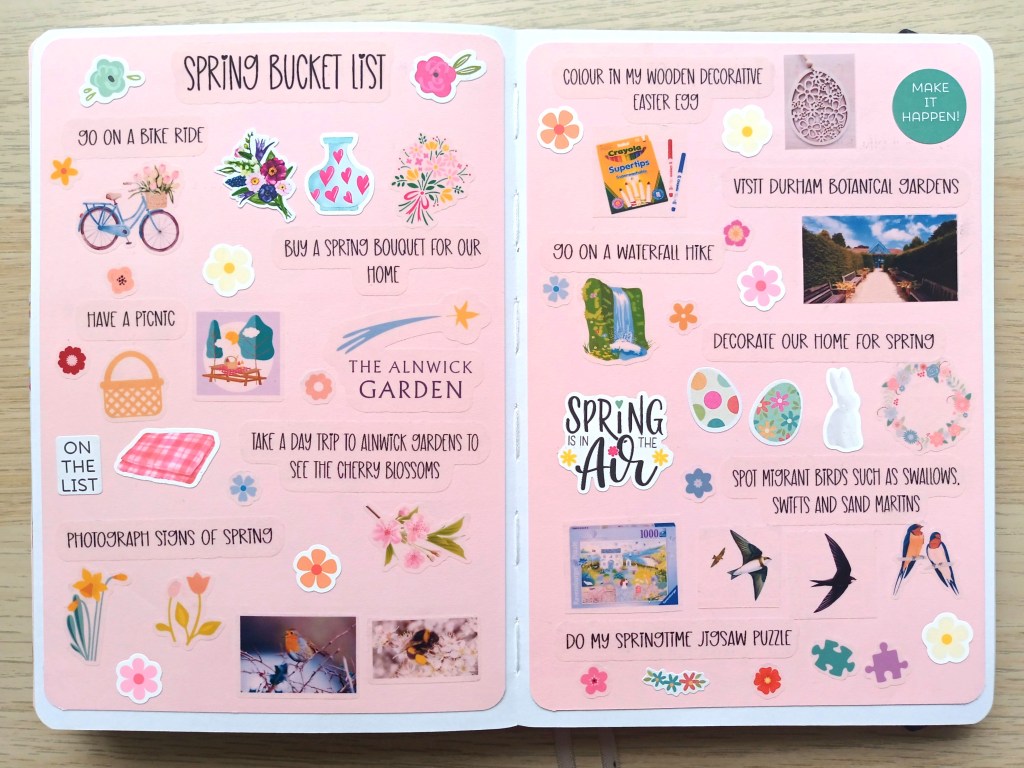
Here’s my bucket list for this season in my bullet journal. The words and images were all made into stickers using Cricut Design Space and I’m really pleased with how it turned out. I’ve included a little ceramic bunny I purchased, the wooden egg which I got in the Hobbycraft sale last year and the jigsaw I picked out which I can’t wait to get started with. I’m yet to make the handstitched notebook but I have lots of floral papers which will be suitable for the cover.

Photo credit: Laura Jones for Keeping It Creative

So, how do I get started with my Spring seasonal bucket list?

There’s plenty of seasonal bucket list inspiration online but I like to spend some time in quiet contemplation first. That way, what I add to my list is all about what I want rather than what others believe would make a good Springtime.

Consider your core values and what really matters – Spend some time thinking about what is most important to you in your life or what you wish to focus on more. You might want more fun and adventure, better balance between work, rest and play, opportunities to develop your creativity, new experiences or the chance to learn a new skill. You might want to experiment more in the kitchen, spend lots of time in nature or plan some different day trips to places in your local area. Living in alignment with your personal values is key to improved psychological wellbeing which includes your general happiness levels and outlook.

Think about the particular season you are making plans for – consider the weather associated with Springtime and any particular holidays or events which take place during the season. So, for example, in Spring, the temperature is starting to rise during the day but the evenings are still pretty cool. In Britain, the weather can be calm and dry, but, showers are also pretty common and it can often be a bit breezy. Buds and blossom begin to appear and early blooms such as snowdrops, crocuses, iris and daffodils begin to pop up in the flower beds. Spring is also the time for observing and listening to wildlife too. Bumblebees and butterflies start to make an appearance and hibernating animals such as bats and hedgehogs can be seen from dusk into the night. You might find frogspawn in ponds and watch tiny froglets appear in a matter of weeks. Birds are noisier and livelier as they pair off and start to nest and spring visitors such as swifts, swallows and house martins begin to arrive.

Mother’s Day and Easter both fall in the Springtime and there are, of course, a few Bank Holidays to look forward to. And if you want to find out about events specific to your town or city this website is a great source of information.

Write down every idea that comes to mind – Make a list of potential ideas, big and small, inexpensive and more costly, time consuming and quick. This could include a visit to Pinterest and other sites to look at bucket list ideas and inspirational images.

Refine your list – Having written a long list, it’s time to decide which items are the best fit for your values and priorities. Try to choose some activities which you enjoy each year and are somewhat traditional, but also make sure you include some which are completely new and will push you out of your comfort zone.

Choose a place to store your list – Having a finalised record of your bucket list is important if you want your aspirations to become a reality. Depending on your personal preferences, you might choose to put your list in your planner or journal or have a digital document in Notion of Microsoft Word. There’s even a website and online community dedicated to bucket lists! And, if you relish every opportunity to get creative, like I do, you can make a physical copy of your list with fancy lettering, motivational phrases, sketches, stickers and inspirational images. You might even find you’re excited to share it with your friends and family too.

Remember things can change – Your finished bucket list is a set of items that you hope to experience this Spring but, it’s not a list of commitments or things that you must do or achieve over the time period. You may find that priorities or circumstances change and that some of the items become less important or need to be put on hold for another year. You might also learn of some new opportunities as the season progresses which you want to add to your list or replace an item with.

Previous Bucket Lists

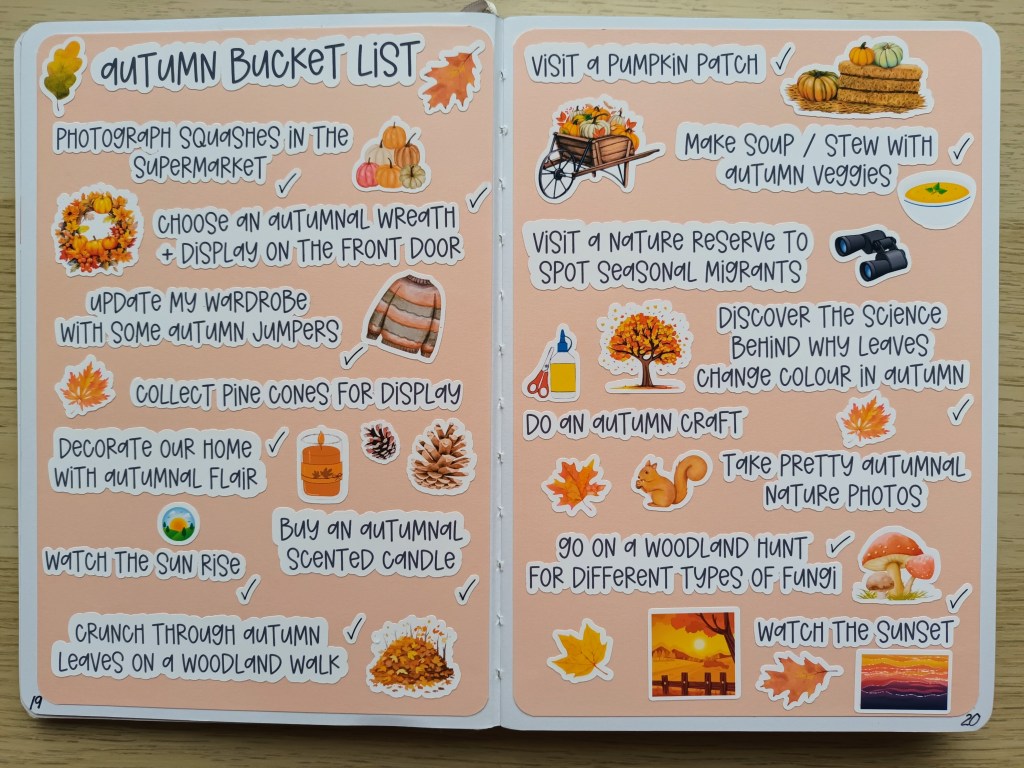
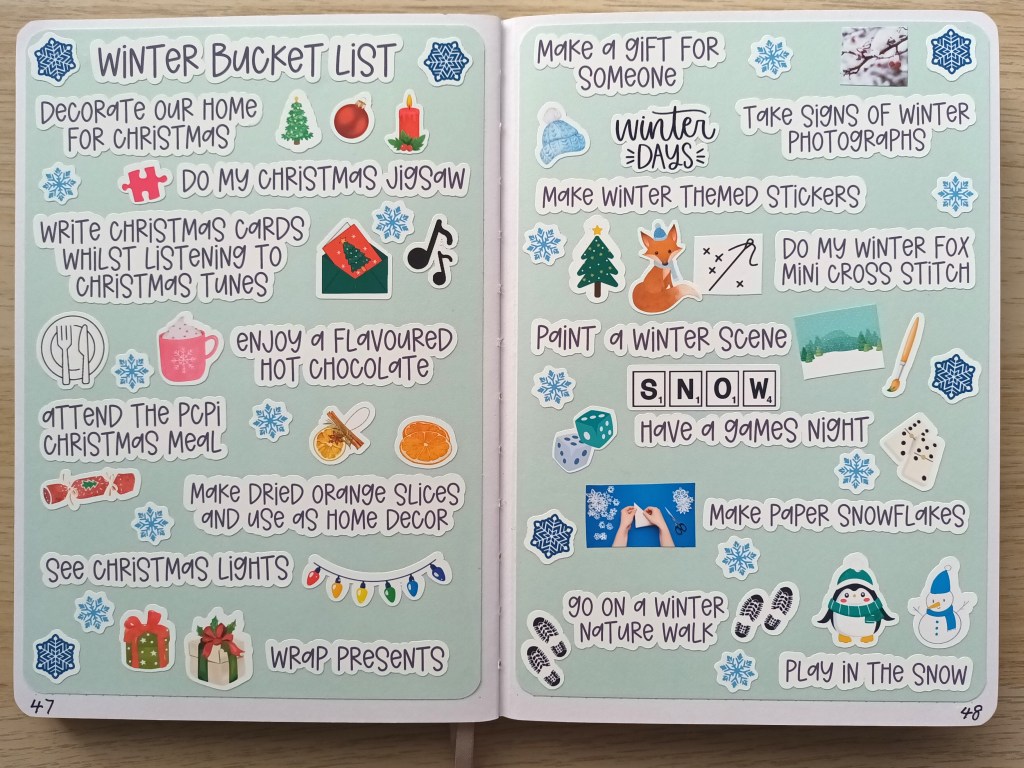
I think I’ve previously shared my Autumn and Winter bucket lists but thought readers might like to see them again for examples of the kinds of thing you could add and how you might decorate a spread in your notebook or bullet journal.

I achieved everything on my Autumn one but didn’t get to play in the snow over the Winter time as it was mostly wet and often quite mild. I still included all of the items in my Traveler’s Notebook journal. but I wrote a few lines about the weather and the impact it had on the season.

Photo credit: Laura Jones for Keeping It Creative

Final words…

Creating a bucket list for the season is a wonderful way to plan in some interesting, fun and different activities for the coming months. I also enjoyed making stickers to go with the items on my list but if you prefer, you could have a go at drawing and colouring in some little pictures instead.

Let me know a couple of items that you want to add to your list for Spring 2024. I’m looking forward to hearing your ideas and hope you thoroughly enjoy creating some new memories.

Posted in fitness, goal setting, lifestyle, mindset, Planning and journaling, wellbeing

Monday Matters: 4 tips for getting started on your fitness journey and staying motivated

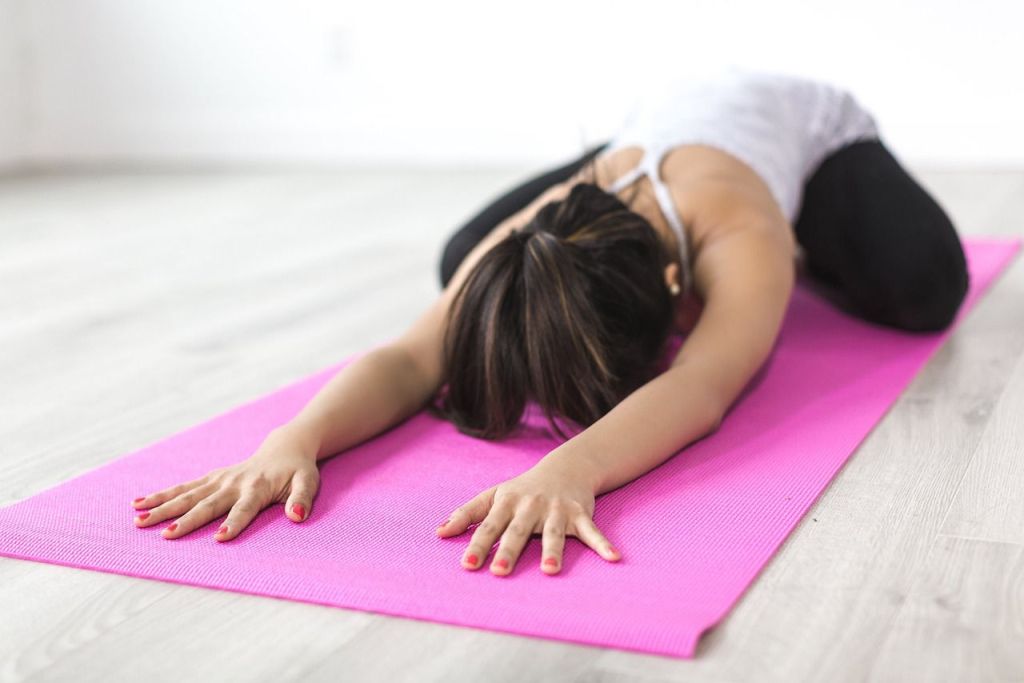
Image from Pixabay

Many of us, as part of our new year’s resolutions each year, set goals to get fit. We start off with good intentions, joining the gym or attending exercise classes but oftentimes, our motivation isn’t maintained and by February, our workouts have dwindled and other priorities have come to the fore. As someone who has been a member of a local gym for over a year and a half, with a routine that includes at least seven workouts per week, I thought I’d share a small number of tips to help you get started with your fitness journey and maintain the motivation to keep going. So, let’s get started…

Set clear goals

Some people set the vague goal ‘get fit’ without considering what that statement means to them, how they’re going to do it and why. A much better approach is to use the S.M.A.R.T. goals system. I wrote a really comprehensive blog post on this quite a while ago which includes some useful questions to consider to get you thinking about why the goal is important, what your life will look like when you reach your goal and how you will go about working towards it. I also provide an example, which, whilst not fitness related, should help you with goal setting and goal getting.

Using your bullet journal or a dedicated notebook for the particular goal or goal getting in general can provide a useful record of your intentions, how far you’ve come so far or a space to record your experiences, successes and difficulties along the way. It can also help with accountability.

Creating a vision board which focuses on your fitness goals and includes motivational images and positive phrases or quotes can also help towards manifesting the fitness lifestyle you desire. This can be created digitally and used as your screensaver on your computer or can be paper-based and maybe created using images and words cut out of health, fitness and wellbeing magazines.

Consider any clothing and equipment required

If you’re serious about increasing your fitness levels, purchasing some dedicated workout gear and some basic equipment can really help in terms of motivation. I got a number of outfits for my gym sessions and my weekend walks and I spent quite a while choosing items in my favourite colours which fit beautifully and make me feel confident and well supported. This included sports bras for my aerobic sessions, moisture wicking tops which don’t expose my skin during downward facing dog and leggings which are fitted but not too tight as to feel uncomfortable or roll down during my exercise routines. I also got several pairs of hiking shoes for winter walks and lots of layers for warmth whilst out in the countryside. I didn’t get everything straightaway but have built up my collection based on my changing needs as I try and love different forms of exercise.

As I practise Iyengar yoga, I’ve invested in a mat, blocks, bricks and a belt for my practice. I also use some of this equipment in my Pilates and legs, bums and tums classes too so figured it was a good investment. Although the gym provides bits and pieces for the sessions, I find having my own things beneficial and it also means, if I miss a class, I can find a workout on YouTube to do some exercise at home.

Create an active lifestyle

If getting fit and staying fit are important to you, you’ll need to create an active lifestyle where exercise becomes a key part of your daily routine and something which you enjoy and thrive on. Yes, there will be days when you don’t feel like it and have to push yourself to get your exercise gear on and do a session, or times when you recognise the need to have a rest if you feel under the weather or think you might have over-exerted yourself, but on the whole, you’ll feel motivated and ready to go. A huge part of this involves choosing forms of exercise that you love and make you feel good. For example, when I started exercising, I would go to the gym at least 3 times a week to work on the cardio machines and the resistance training machines. My routine gave me a good full body workout, but I much preferred the social element of going to classes, getting chatting to various others who enjoyed exercise and fitness and developing friendships over the weeks. I now go to at least one class everyday and use the gym occasionally. I still do activities which work my whole body and I have maintained my motivation for different forms of exercise over several years now.

Sometimes, on busy days, when I’m working at the university or I have other plans, I have to cancel one or more of my classes. However, I will always make time to fit in exercise, even if it’s just 20 minutes of stretching at home or a face paced walk in nature or around the block.

Having a back-up plan for when you haven’t got time to do an hour long class or your usual hour and a half in the gym can really help and writing it down in the aforementioned notebook or journal can keep you consistent. This could include having a bank of videos saved on YouTube that you dip into or a selection of infographics showing stretch routines on Pinterest. You might also schedule in an early morning walk as part of your routine for that day or plan a long hike for the weekend when you don’t have so many other commitments.

Cultivate a positive mindset

A positive mindset can help you celebrate your progress and achievements, assess and overcome any setbacks and maintain motivation. Rather than focusing on what you didn’t achieve in a given week, celebrate the workouts you did do and how you felt afterwards. Look for signs of improved strength, flexibility and stamina and write down these wins in your notebook or journal. Draw up a list of rewards such as new fitness gear, a fun activity that you haven’t done for ages or have been meaning to try e.g. canoeing, surfing, bowling, kite flying, frisbee etc. or a pretty decorative item for your home.

“Studies have shown that if you have a ‘growth mindset’ – the belief that your abilities and skills can be improved – then you will have more effective workouts.

Put simply – it’s positive thinking. Believe you can, and you will.” (Why your mindset matters article on Metro.co.uk.)

Final words…

I hope you’ve found today’s blog post beneficial and it has given you some beginner friendly ideas for starting out on your fitness journey and keeping up the good work. When you begin, you might like to try out lots of different exercise options and then modify your routine based on your preferences. I’ve found I love dance based aerobic classes like zumba and clubbercise, but also enjoy more mindful practices like yoga and Pilates too. In the future, I would like to include more targeted upper body exercises to increase my strength in this area, but for now, I’m happy with the way things are progressing in terms of my general fitness and core strength.

Let me know in the comments if you plan on working on fitness and exercise related goals for 2024 and what you’ve taken away from today’s article to help you on your journey. Alongside your plans, you might like to consider dietary tweaks too in a way which compliments your fitness lifestyle and ensures better physical and mental health overall, for now and in the future.

Posted in goal setting, lifestyle, Planning and journaling

Monday Matters: A guide to SMART goals + an example of how I’m using the framework

Last week, my blog post focused on vision boards and how you can create one in your bullet journal. As part of this, I mentioned that as well as using pictures and words to establish what you want, you also need to identify steps you can take towards achieving your goals/dreams. Today, I’m going to deep dive into SMART goals and give an example of how I’m using the framework to help me achieve success towards a specific goal of mine which features on my current vision board.

What are SMART goals?

SMART is a mnemonic acronym that can help you with both goal setting and goal getting. It stands for:

  • S – Specific
  • M – Measurable
  • A – Attainable / Achievable
  • R – Relevant
  • T – Time-bound

Sounds great in theory but how can I set SMART goals?

To enable the setting of SMART goals, you need to create a detailed break down of each of your personal goals using the SMART framework. Your goals need to be Specific, Measurable, Achievable, Relevant and Time bound.

Specific

It’s important to be clear about what exactly it is that you want to achieve. To make your goals really specific, it can help to ask yourself a few questions to identify the detail:

  • What exactly do I want to accomplish?
  • Why is this really important to me right now?
  • Who will I need to help me achieve the goal and what will their role be?
  • Where will I work on my plan to achieve my goal?
  • Which resources will I need to help me?
  • Does my goal have financial implications?
  • What will my life look like when I have achieved my goal?
  • How will achieving my goal make me feel?

Measurable

Your goals should all be measurable so that you are able to see progress and know when you have achieved success. This can increase motivation as you start to see results from your efforts. Key questions to ask yourself could be:

  • How will I know when I have achieved my goal?
  • What will success look like?
  • What’s the best way of measuring my success?

Achievable

A vision board can sometimes contain ideals and big hopes and dreams, to make these visions into goals, you need to set more achievable targets to work towards.

  • On a scale of 1-10, how likely do you think it is that you’ll achieve your goal (1 being completely unlikely and 10 being absolutely certain)?
  • Is it completely within my power to achieve the goal?
  • Is the goal realistic?
  • Are there any obstacles which may present themselves?
  • Will I be able to achieve my goal in a given timeframe?
  • Do I have the resources or financial means to work on and achieve my goal?

Relevant

Your goals should be relevant to what matters the most to you right now. They should also align with your life values and current beliefs.

  • Is this a worthwhile goal and does it meet my current needs or desires?
  • Is this goal a priority for me right now?
  • What will achieving the goal especially mean to me?
  • How does this goal fit in with my values?

Time bound

It’s best to have a specific time frame in mind for meeting your goal. Setting a deadline or a date to assess if you have made significant progress can help keep you on track to success. You should try to decide on a realistic amount of time that is neither too long or too short. If the deadline is too far in the future, you will likely lose momentum or feel no sense of urgency. If the time frame is too short, you may become overwhelmed or stressed. A good idea might be to identify mini steps and assign an achieve by date for each.

An example of how I’m using SMART goals to achieve success

In last week’s Monday Matters blog post, I shared my current vision board. In order to increase my chance of successfully meeting my goals (or vision), I’ve been applying the SMART system to really break things down. To help you see how this works, I thought I’d take just one of my goals and look at it in depth using SMART.

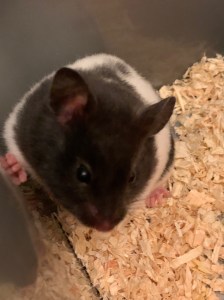
On my vision board, I have a picture of a hamster and the word pampered. My goal is to treat our new pet in a way that gives her everything she wants and needs. We’ve been keeping hamsters for years and each time we have a new addition to the family, I try even harder to make sure she has a good life. Obviously I can’t ask Millie if she feels like she is a pampered pet but I can put things in place to ensure she is completely spoilt and receives the best treatment I can offer. Here’s my real life example of how I’ve broken my goal down :

Specific: I want Millie to be a happy and well pampered hamster so that I can be sure I’m giving her the best life I can. It’s important to me that my pet is treated well as part of our family. Both my husband and I will play a big part in working towards and achieving my goal. We’ll use our knowledge of keeping Syrian hamsters to help us as well as learning from guidance found online from reputable sources. Meeting my goal will have financial implications but we’re happy to spend a reasonable amount of money on both her cage and accessories within. When I have achieved the goal Millie will appear happy and content with her home and should show signs that she feels safe when we get her out of her cage each evening. She should look healthy and well cared for and my husband and I will be satisfied that we are good hamster parents!

Measurable: We will measure our progress using a checklist of things which need to be in place to ensure Millie is happy and healthy.

  • Extra large cage with floor space beyond the recommended size for Syrian hamsters.
  • Cosy house which is large enough for Millie to sleep in and also has room for snacks.
  • Large wheel which adult Millie can run in without concave back.
  • Water bottle to be refilled daily and scrubbed weekly.
  • A good quality diet consisting of dry food and small quantities of fresh fruit and vegetables.
  • Treats provided in line with feeding guidelines.
  • Plenty of bedding to be provided for nesting and digging.
  • Wooden chews provided for gnawing.
  • Sand provided for bathing.
  • Digging tower provided for out of cage play.
  • Cage spot cleaned regularly with full clean once a month.
  • Eating and drinking to be monitored.
  • Weight checked weekly.
  • Dedicated time with Millie outside of the cage every evening (minimum 10 minutes)
  • Basic health check performed each time Millie is handled.
  • No signs of distress or boredom displayed e.g. biting cage bars all of the time, excessive grooming, aggression, repetitive behaviours etc.

The goal will be considered achieved when all of these are in place and standards are maintained over the time period stated below.

Achievable As we are experienced hamster owners (Millie is my ninth hammy) we have very good understanding of what Syrian hamsters need for a happy and healthy life. Therefore, the goal should be achieved in a relatively short time. We’ve already ticked off some of the criteria as we’ve purchased an extra large cage, a wooden house and digging tower. We also have plenty of dry food, treats, warm bedding and a sand bath as well as a good sized wheel. Fresh water is provided although we need to get better at changing it each day.

Relevant Obviously the goal is relevant as we have a pet hamster and we wish for her to be well cared for and pampered. This is in line with my beliefs about how animals should be treated.

Time bound At least a couple of weeks for Millie to get used to us will be required as she is currently a little bit nervous and wary of us but progress is being made each day. I will assess and evaluate the situation at the end of this month and I expect that everything will be in place by 15th April as we will have had Millie for one month by then.

Millie at 9 weeks old and a little camera shy!

The need to be even SMARTER…

Although the SMART approach does not offer any guarantees of success, it does provide a useful system to help with setting and working on small goals with a view to you achieving your bigger hopes and dreams. Some authors have expanded on SMART to include two extra letters, namely E and R to make SMARTER, where E stands for Evaluated and R stands for Reviewed. In this longer acronym, it is suggested that further success will be achieved if the individual takes time to evaluate progress and reviews and reflects on how things are going in order to identify any issues and make adjustments where necessary. This certainly makes sense to me and so I’ve chosen a specific time and date to do some reflective journaling on my progress towards all of the goals displayed on my vision board. I’ve written it into my Bullet Journal Future Log so I don’t forget and I’ve allotted two hours for the process, which might seem a lot but I think it’s important to set aside a big chunk of time if the session is going to be useful.

Final thoughts

I’m feeling really motivated to work towards my goals and it helps that I know my what, why, where, who, when and how. I may meet with obstacles or setbacks along the way, but by evaluating my progress and making small changes, I’m in with a good chance of success.

Let me know in the comments if you’re a fan of setting SMART (or SMARTER) goals or if you think it’s something you might like to try in the future. I would love to hear about what you’re working on right now and if you are meeting with success.