Posted in Habit formation, life hacks

Monday Matters: Utilising habit stacking to establish consistency in forming new routines and instilling habits

I’ve been using habit stacking for years, and I find it extremely successful in ensuring consistency whilst I work on adding a new, positive habit to my daily, weekly or even monthly routine. Today, I’m sharing some definitions of the terms habit, a quick introduction to habit stacking, plus explaining why habit stacking is so helpful, and, of course, providing a few examples of the technique in action within my own life.

When I Googled ‘habit definition’ and checked the items related to the noun (as oppose to the traditional item of religious clothing worn by nuns!), I came across a number of different examples and thought it would be pertinent to share some of them here:

Cambridge Dictionary: something that you do often and regularly, sometimes without knowing you are doing it

Oxford Languages Dictionary: a settled or regular tendency or practice, especially one that is hard to give up

Merriam-Webster Dictionary: an acquired mode of behavior that has become nearly or completely involuntary

Collins Dictionary: established custom, usual practice, etc

So, the above explain what a habit is, but what’s habit stacking?

There have been a whole host of non-fiction books on the art of habit stacking but the idea was originally coined by James Clear in his best selling book Atomic Habits. In brief, it’s the practice of attaching a new action that you want to become a regular habit, to one or more habits which are already deeply ingrained in your current daily life. The idea is that the old and well-established habit will provide a cue for performing the new action which you want to add to your current number of habits. So, for example, if you wanted to start flossing your teeth each evening, you could attach this action to your nightly routine of brushing your teeth, maybe by getting the floss out when you pick up your toothpaste and brush from wherever they reside in your bathroom, and then flossing your teeth prior to brushing them. Over time, you would start to automatically get your floss out at the same time as your other teeth cleaning tools and the habit of flossing would (hopefully) be instilled.

The habit you choose to stack your new action with would depend on such things as how often you want to engage in the action (daily, weekly, monthly etc.), when you want to do it (morning, evening, night time etc), where you want to perform it (in bed, in the car, on the sofa whilst watching TV, in the kitchen whilst waiting for the kettle to boil etc.) and, of course, when and where would be most appropriate. You should also consider if there’s time available before or after the established habit in your routine as this will of course, increase the likelihood of success in habit formation.

How I’m currently using habit stacking

I’m not sure if I’ve mentioned this before on here, but back in September 2024, I headed for the coast with my DSLR camera and long range lens and walked along the beach at low tide to the rock pools to take lots of photos of wading birds. To cut a long story short, I got some lovely bird photos but heading back along the sand, I slipped over, presumably on a large smooth stone and fell forward. As I had my camera, I wrapped my arm around it and twisted, landing on my flattened right wrist. My wrist has now been very painful for months and I recently sought advice from an MSK (Musculoskeletal) specialist. The clinician gave me some physio exercises and advised me to do them each day so I’ve been deciding when to fit them in and how I can be sure I do them regularly. As this is something that needs to become a habit that I do daily, I’ve used habit stacking to increase the likelihood of this being achieved.

I decided that I would like to do the given exercises morning and evening and I’ve also thought about how many reps I want to do each time. For the morning repetitions, I decided to stack the exercises with my The Five Minute Journal writing habit. So now, I fill in the day time prompts in my journal and then I remove my book from the arm of the sofa and do my exercises. Finishing my writing reminds me that it’s time to do my physio session for my wrist and so far, I’ve consistently remembered to do them. The second set of exercises is performed straight after filling in my journal evening prompts. This routine is proving to be more difficult to establish as I’m tired and ready for bed! However, as I perform the first set consistently in the morning after journalling in the same book, I’m hoping that it will be enough of a prompt eventually. The other thought I’ve had is that doing them once a day is better than not doing them at all so I’d be happy if I just developed the morning habit.

The second new action that I’ve just started to implement is completing a double page journalling spread as a summary of what happened each month throughout the year. This project, which I hope to do for the whole of 2025, but, if I enjoy it, continue with beyond this year, involves collecting appropriate resources throughout the month for my pages and working on the spread in a single session at the beginning of the next month. I only started the journal in January so it’s definitely not a habit yet, but I don’t want to get behind with creating the spreads or collecting ideas and bits and pieces for them.

I chose to do this monthly journalling project as I was trying to keep up with journalling about all kinds of experiences such as purchases, days out, holidays, nights out etc and it was becoming very overwhelming and half of my spreads were staying barely completed or barely started as their creation was far too time consuming. Doing two pages each month will be much more manageable, and, if there’s anything I want to do a little more documenting on, I can still do this whilst only creating between 2 and 4 pages a month. This is my reason why I want to instill this particular habit and you can probably see how it would help me to document my life but at the same time, not go overboard with the journalling and accompanying spreads.

So, with that all said, how am I going to make collecting resources and doing the actual journalling a habit? Here’s my initial ideas for habit formation:

  • closely follow the YouTube channel and Patreon pages of KelseyLeigh @ MyAbidingJournal who introduced me to the idea of monthly summary journalling pages.
  • make notes of effective ways she’s found of collecting materials and memories
  • schedule times for collection of resources and ideas
  • schedule a time each month for creating and finishing my pages

For this, I needed to attach the new actions to existing habits, one which occurs weekly and one which already occurs monthly. I decided that the collection of resources and ideas to include would take place on a Sunday evening when I set up next week in my bullet journal. This typically happens around 7pm although if something prevents me doing it at this time, I always schedule time early Monday morning to fill in my double page spread. As this process could potentially take up to an hour – half an hour for filling in my weekly and half an hour to gather supplies and record ideas, I would need to time block the event to be sure it gets done. However, because filling out my planner is essential for me to know what’s happening that week, I believe that stacking my journalling prep session would be a good fit.

With regard to me creating my journal spread, I have stacked this with my habit of filling in the evaluation of my monthly goals. Realistically, the process for both can take me up to 3 hours and again I would need to make use of time blocking and section off a big enough section of time to ensure everything got finished. Obviously, this requires a big commitment but as it’s something I really want to establish as a habit, I’m hoping that the filled in pages with look so great that I’ll be so excited by the finished product that I’ll want to do it time and time again!

This brings me on to another question which you may have…

Does habit stacking always work?

In my opinion, habit stacking can be really useful in helping you to develop a routine for performing a desired action or routine but you still need to apply motivation and discipline if it is to work. Going back to my wrist exercises, if I didn’t believe that doing them was going to help me get better by improving my muscle strength, I might consider it a waste of time doing them. In that case, I would be unlikely to keep up with the habit, even if I did stack it with my morning and evening journalling work. Also, if I didn’t make time in my schedule to perform the exercises, I could still end up skipping them or only doing them on less busy days which wouldn’t help me to develop better strength and less pain in my wrist.

Final words…

In summary, habit stacking, the process of attaching a new action that you hope to make a habit to one or more of your long established habits, is a great way of ensuring consistency in developing new routines. However, you still need to have the motivation and disciple to perform the action, so it’s worth spending some time thinking about how this brand new intention and would be habit would make a difference to your life or your day. Personally, I think doing a little bit of reflective journalling on the subject can be a really useful way of establishing your why or reasons for.

I hope you’ve found today’s Monday Matters useful and it has helped you see how using habit stacking would fit into your life when creating new habits. Let me know in the comments one thing you are working on at the moment and which current habit you plan on attaching it to so you can successfully embed it into your routines, or if you’re struggling to develop a habit, why not reply to today’s blog post and hopefully either myself or one of my readers can offer some useful advice.

If you particularly enjoyed today’s topic, you might be interested in reading one of my previous posts on forming positive habits.

Posted in life hacks, psychology, relationships

Monday Matters: A beginners guide to ‘pebbling’ to strengthen your relationships

Up until an hour ago (well as I write this anyway), I had never even heard of the term ‘pebbling’, which, according to an online article, is a very commonly used social media hashtag and a popular practice among us all (I must live under a rock which has no WiFi!). Despite this, as I perused the online article, I realised that I’ve engaged in pebbling with colleagues, friends, family and my husband many times, without knowing there was an actual name for it. If you’re unfamiliar with pebbling or the associated hashtag which is (apparently) currently flooding TikTok along with other social media platforms, or if you’d like to know more, I encourage you to read on…

The word pebbling was, in fact, originally used to described a romantic gesture that has been happening for decades, amongst gentoo penguins. During the breeding season, as part of their courtship ritual, male penguins carefully select and present a perfectly shiny and beautiful pebble to their prospective mate as a sign of their worthiness as a love interest and suitability to lifetime commitment (gentoos are usually monogamous). If the female is impressed by the aforementioned, she will place the gifted item as the foundation stone of her nest. Then, in return, she will present her own carefully chosen, smooth and highly polished specimen to her mate as a form of non-verbal communication.

Photo from a selection of free images on Unsplash curated by Derek Oyen

Now, I’m not about to suggest that you head off to the beach in a bid to find your own perfect little stone to woo potential partners with, but you can certainly apply the principles of pebbling by offering a small, inexpensive (or free) gift to demonstrate your feelings towards someone or to simply show them that you care, whether that’s as a family member, a friend, a colleague or as evidence that you like or admire them. I’ve written before on my blog about love languages with one of them being focused on receiving gifts, but, to be honest, I can’t think of anyone who wouldn’t appreciate a little, thoughtful something-or-other from someone else (as long as they consent to it or it would be considered a nice surprise anyway!).

The thing with the gentoo penguins and their pebble giving is that there’s no financial cost, and the emphasis is wholly on spending quality time carefully selecting something that they feel that the recipient would really appreciate. And this act of ‘pebbling’ can be applied to human gift giving as well – including the non-verbal element if you so wish. Think inexpensive or free items that will bring a little spark of joy to both the giver and the receiver, and you can’t go wrong.

So, what kind of things could you give as a token gift?

What you choose will completely depend on your chosen recipient but, here’s some ideas for you to consider:

  • A virtual gift with a ‘saw this and thought of you’ message attached e.g. their favourite pet or animal doing something amusing, a meme that just says it all or says it better than you possibly could (pebbling is very popular with neuro-divergent individuals who may struggle to say something heartfelt or thoughtful in words).
  • A link to an article you’ve read online (or a newspaper / magazine cutting) that you think would interest them or is on a topic which you think they would love to learn more about.
  • Some flowers picked from your garden which you think would cheer them up or make their day.
  • A photograph of you and a friend that you found from a while back as you were scrolling through your Google albums on your phone. This could be forwarded somehow, shared on social media e.g. their ‘wall’ on Facebook or printed and delivered in some way.
  • A pretty greetings card in which you let the person know that you are thinking about them or really appreciate them
  • Something to represent an ‘inside joke’ that you reckon would bring a smile or make someone giggle
  • A multipack of chocolate or sweets that you share with a couple of your closest colleagues.
  • Pass on a book (or a personal recommendation of one) that you’ve read and think they would enjoy too.
  • Pop out to your local bakery on a Sunday morning to get pastries for a leisurely breakfast with your partner, flat mate or kids
  • Buy a subject specific magazine for your significant other e.g. computing, gardening, crafting, wildlife etc
  • Pick up a little personalised item for them e.g. pen, pencil, keyring etc e.g. from a garden centre or gift shop (or, if you have a Cricut machine, add their name to an inexpensive plain or patterned notebook)
  • Bake some biscuits or cupcakes and bring them to the office to share with your colleagues (sometimes the recipient might be more than one person)
  • Buy a small box of individually wrapped chocolates (e.g. Cadburys Heroes, Celebrations, Roses or Quality Street) and let everyone you work closely with choose their favourite to enjoy with a coffee at breaktime.
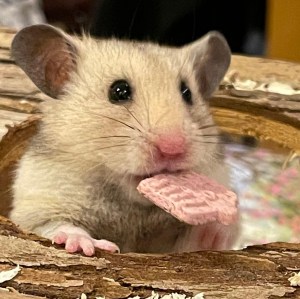
  • Visit your local pet store to find a treat for your pet or pets – who says that penguins should be the only non-human animal to perform loving acts! Or, if you don’t have your own pet, why not pick up a treat to give to someone you like who does have their own cherished animal (thanks to my husband’s ex work colleague who provided the inspiration for this one – Aggie the hamster was very grateful for the cupcake shaped biscuits!)
Aggie in her digging tower where her treat was hidden!

Final words…

I hope you’ve enjoyed reading today’s post and it’s given you a good overview of the origins of ‘pebbling’ and examples of different small gifts you can give to show affection or care. I’m sure most of us have engaged in the act pebbling many times in the past and I would love to hear some of your favourites in the comments.

Happy pebbling!

Posted in Blogging, crafting, creativity, Cricut, goal setting, Health and Nutrition, Home cooking, intentional living, life hacks, lifestyle, manifestation, mindset, personal development, Planning and journaling, reflective journalling, Setting goals and intentions, watercolour painting

Setting up my 2025 Vision Board

Last year, for some unknown reason, I think I must have decided against making a 2024 vision board. I’m not sure why, but maybe I didn’t feel up to it or perhaps I had a variety of commitments at the beginning of January and decided it was too late in the month to work on one.

For 2025, I decided that, for me personally, it’s not really important to have the board finished in super quick time and it doesn’t matter if I’m still working on it towards the end of January. I wanted to have a slow start to the first month, really pondering over what I would like the year to look like. I found it helpful to revisit a couple of old blog posts of mine in which I’d talked about key questions you could ask yourself to prepare your mind and what to actually do to improve your chances of manifesting everything you’ve visualised for the year.

I decided to create a larger display, rather than using two pages in my bullet journal as then I can have it on my craft room / office wall to look at all year round. I also chose to combine images, motivational sayings, affirmations and a few cute decorative elements to make it visually appealing. I’ve spend days thinking about what I truly want this year, flicking through a huge stash of Psychologies magazines, answering deep questions from my previous vision board posts, journalling my thoughts and closing my eyes to visualise things. I’m so glad I put lots into the preparation as my 2025 vision board is now complete and turned out exactly how I wanted it. I can’t wait to share a photograph of the finished product!

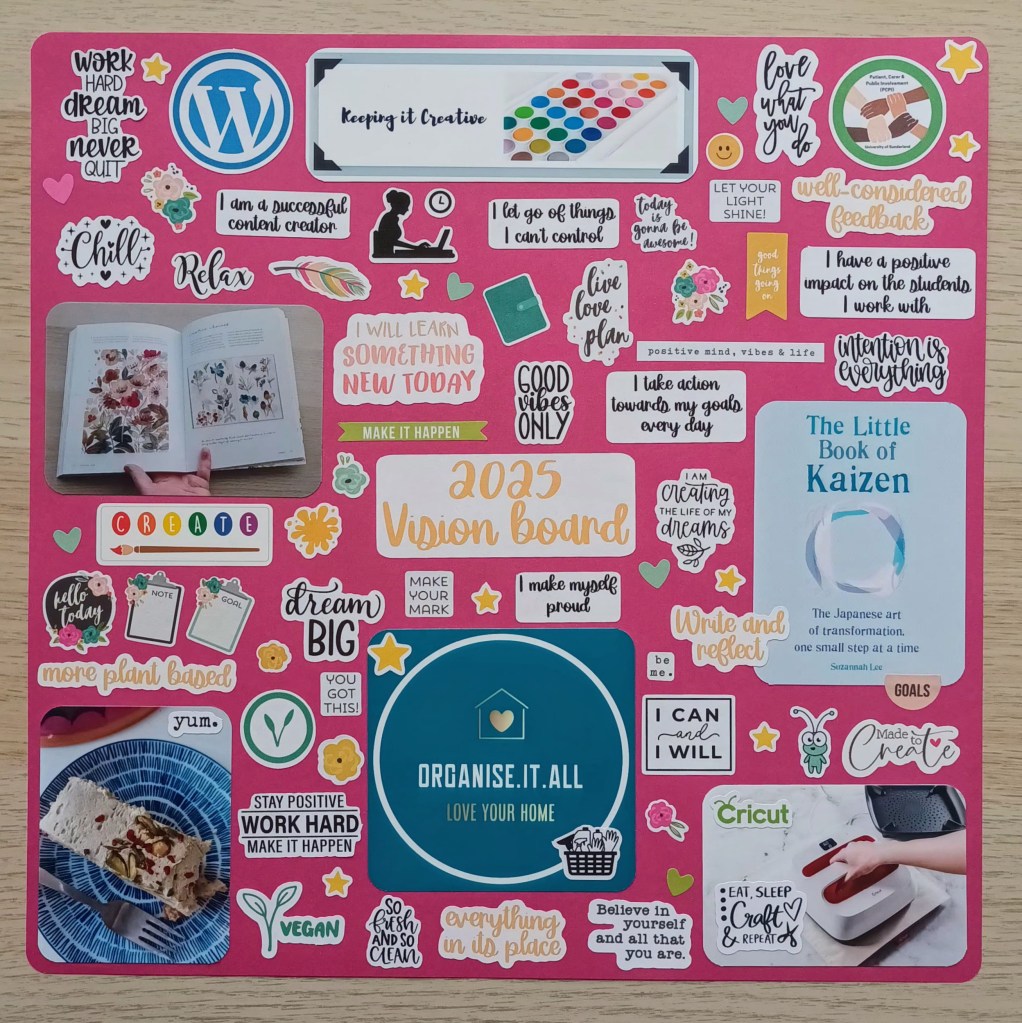
And here it is…

Photo credit: Laura Jones for Keeping It Creative

My main categories

Diet – The plan this year is to eat more plant-based goodies than ever before. We’ve made so many healthy and delicious vegan dishes this Veganuary and we’ve also found a cafe that has a range of vegan friendly cake options. It’s getting easier and easier to eat a plant based diet and my husband and I have already made a number of changes over the years such as soya milk on our cereal and oat milk in our hot drinks, vegan spread on our bread, lots of plant based alternatives to meat such as soya mince, veggie sausages, VLTs etc.

Creativity – I want to develop my watercolour skills even further this year, whilst also engaging in mindful and calming activity after busy days. I got a gorgeous book for Christmas which provides exploratory activities and projects with a nature theme. I want to incorporate a weekly slot of time to experiment and develop a range of techniques.

Blogging – I want to spend more time promoting my blog posts so that I develop a wider readership. I used to consistently post pins on Pinterest but I’ve let this slide over the last few years. I get plenty of readers but I want to reach individuals who do not have their own blog as well as those who are keen bloggers.

PCPI work – I thoroughly enjoy my work at the university but it’s really important to me that I’m making as much of a difference as I can to the students. I particularly want to develop my feedback skills for medicine sessions, particularly with young adults who are in the initial stages of their uni course.

Kaizen – I recently started a short book called The Little Book of Kaizen – The Japanese art of transformation, one small step at a time. I’m enjoying reading it and doing the exercises at the beginning. The idea really appeals to me, so, to make sure it’s a focus for me this year, I’ve added a photograph of the mini book on my vision board with a view to working through all of the chapters. I’ve even pick out a cute notebook to use to jot things down and I’m using my fountain pen to write beautifully inside.

Cricut – As you probably already know, I’m obsessed with making stickers and cutting them using my Joy Xtra. However, I also have the smaller Joy machine and also invested in the EasyPress 2 when it was on offer at a discount. I have lots of vinyl and HTV as well as some iron on papers so I want to spend time this year getting creative and using them all up. I have so many ideas but I now need to schedule time to actually get making things. I added a Cricut bug sticker to watch over me and remind me to have more fun playing with my machines.

Getting organised – We have a lot of stuff in our house and some of it needs purging. As well as trying to use up craft materials before buying any more, I also want to re-organise our home so it’s easy to clean and keep tidy.

Final words…

That’s everything on my vision board for this year and to ensure that everything on the display comes into fruition, I will be checking in with it at the beginning of each month and using the different aspects to set mini monthly goals. I’ve developed pages in my bullet journal to list my goals and I’ll make sure at least some of them relate to things I want to manifest throughout the year.

I hope you enjoyed seeing my board and that it’s inspired you to have a go at creating your own. It doesn’t matter if you don’t get around to it for a few weeks – there’s still plenty of days left in the year to take action.

Good luck!

Posted in Anxiety management, Bipolar disorder, compassion, depression management, grief, life hacks, mental health, productivity, Uncategorized, wellbeing

Monday Matters: How writing a ‘done list’ can improve your wellbeing during periods of physical and/or mental illness

Welcome to my first blog post of 2025. Happy New Year to you all, and a special hello to my new followers! I hope you had a wonderful Christmas and are excited for what this year will bring.

My husband and I both enjoyed the festive period, which this year (make that last year!) was a double celebration as my brother and his partner got married a few days after Santa had been. The wedding was a joyous occasion and a great a chance to chat with family I hadn’t seen in a while too.

Whilst on the way back home, and with my husband doing the driving, I made the most of being in the passenger seat by reflecting on 2024 and thinking about what I would like to achieve in 2025. I also started to mentally compose a to-do list full of chores and more pleasurable activities to make the most of the remaining three days of the holiday. Little did I know that something would scupper my plans…

Bloody COVID-19 strikes again!

By the time we got back, we both had a bit of a sore throat, which I assumed was just a bit of dehydration from the long car journey. By New Year’s Eve, we felt absolutely dreadful, and so my husband did a test (just in case), and I’m sure you can all guess how that turned out! Needless to say, we’ve barely had the energy for basic self care, nevermind any chores, fun activities or creative pursuits.

We did, however, manage to  psych ourselves up enough to take a quick shower each day, despite how exhausted we were and, despite the fact that the powerful water raining down and massaging in my shampoo and conditioner brought actual pain to my scalp! – random covid symptom or what?????? And I’m so glad we did because this idea for a blog post was born – in fact, some of my best content and general epiphanies come to me whilst showering (anyone else??). 

Basically, I was busy thinking about how annoying it was that I was too exhausted to do anything and that being ill was a giant waste of time, and then I recalled that during my worst bipolar depressions, I still achieved a few things each day and tried my best to be kind to myself and celebrate small wins. To help me do this, I created something that I call a ‘done list’ and, although my illness was physical rather than mental on this occasion, I realised the same technique could be used to make myself feel better.

As everyone goes through ups and downs in life, I thought I’d share how my done list works. You might not need to apply the technique now, but it’s a lovely, self compassionate activity which you can store in your physical or metaphorical toolbox to use when needed such as when you’re sick or struggling with low mood. It can also be used when you’re not feeling under the weather, as a celebration of how productive you’ve been in general or as you work towards your goals for the week / month / year and so on.

In fact, as I sat on the sofa (on day 3 of COVID-19), soothing my throat with a warm drink, I actually started mentally creating one to help my husband and I feel a sense of achievement because I realised we actually did something that day despite feeling like crap.

So what’s a done list?

A done list, as the name suggests, is basically a list of things you’ve achieved that hour / day / week / fortnight / month / different time frame of your choosing, which can be tailored to how you’re feeling – both physically and mentally. So, for example, your list could look something like this:

Today’s done list

  • got out of bed (before 10am too!)
  • got dressed
  • brushed my teeth and washed my face
  • planned 3 things to do
  • made and ate a sandwich (even though I didn’t feel hungry)
  • worked on my jigsaw
  • watched TV for 1 hour (and managed to follow the storyline of the drama)

Or, if you’re not feeling too bad (in a bit more pain than usual, or a little tired maybe and not 100%), could include more taxing items such as those found in the list below:

Things I’ve done this week

  • washed the car
  • tidied my craft room
  • decluttered 20 items from craft room!
  • made 3 meals from scratch
  • 5 gentle workouts (2 x 20 mins yoga and 3 x 30 mins Pilates)
  • created a journalling page using my crafting stash

As you can see from the above, you can include super-minute achievements (or what would considered to be when well) or more ambitious ‘done’ items at other times. These ‘done’ tasks make a good record of how you’ve spent your time and can help you realise that, yes, you might be on top form, but you did make some progress or make a dent in your mental to do list (or physical one if you wrote a list when feeling productive and then things changed e.g. illness, upsetting life event, overwhelm etc).

If you’re still at work, but it’s been a struggle not to phone in sick, you could even include things that you achieved as part of your job, like biting your tongue at a comment made by a colleague or being assertive and saying no to your boss or team leader!

What are the main benefits of creating a ‘done list’?

These are the main benefits I’ve found of creating a done list, but you may be able to come up with more:

  • a visual reminder of what you’ve achieved in the chosen timeframe – the smaller the items are, the longer your list can be!
  • boosts your motivation to do more things (be careful not to do too much though as the last thing you want to do is make yourself feel worse)
  • acknowledges your small wins during difficult times

Final words…

I apologise if this is not new content and I’ve already written about a ‘done list’ before – I did trail through my posts in a bid to find out, and couldn’t pinpoint anything but I still have ‘COVID brain’. Hopefully I’ve shared something helpful which has given you a new string to your ‘wellbeing bow’, particularly if you have recurrent issues with your physical or mental health like I do. Doing a ‘done list’ can also be a great record of what you’ve achieved over a period of time, so can be a really useful tool for measuring productivity too. However you use it, I’m pretty sure it’ll make you feel a little more upbeat about things and your lists may even bring a smile to your face at a later date if you keep them in your planner and happen to flip back!

Thank you for reading and I wish you and your loved ones a happy and healthy 2025,

Posted in goal setting, intentional living, life hacks, mindset, productivity

Monday Matters: How writing a Not to-do list can revolutionise your days

We’re all familiar with the concept of a ‘to-do’ list and have likely used them many times in a bid to make our day super productive. We’ve probably tried to make ourselves feel like we’re winning by adding a few things we’ve already finished or got started on so we can quickly tick them off. However, sometimes, we’ll have felt disheartened when we’re approaching bedtime and discover that most of our list needs migrating to tomorrow’s to-dos because we weren’t productive enough, have too much to do, or, we got distracted by other things.

Creating a ‘not to-do list’ can be a wonderful tool to help us identify and eliminate tasks, habits and distractions which prevent us from focusing on what really matters and stop us from being as productive as we would like to be. In a nutshell, a ‘Not to-do list’ is a list of activities you choose to avoid doing so that you can manage your time effectively. This might include things like the following:

  • anything which distracts you on a regular basis
  • things which drain your energy
  • bad habits that you want to remove from your working time
  • things which don’t currently add value to your life
  • unnecessary tasks i.e. things which don’t need to be done
  • other people’s responsibilities

Ideas for items to add to your not to-do list

Your Not to-do list should be highly personalised depending on your own wants and needs but here are some ideas to get you started.

  • Checking your emails repeatedly throughout the day
  • Mindlessly scrolling social media
  • Checking your phone in bed – either last thing at night or before you get up
  • Drinking coffee after 3pm (when you have work the next day)
  • Going to bed later than 11pm (Sunday – Thursday)
  • Spending time thinking about / stressing over things which are out of your control
  • Reading negative news
  • Things that are not my responsibility
  • Doing tasks which would be best delegated to someone else
  • Multi-tasking (or attempting to)
  • Saying yes to tasks or events that aren’t a priority right now
  • Working whilst eating lunch
  • Spending time with individuals who drain your energy
  • Forgetting to take regular work breaks
  • Doing work after 5pm
  • Procrastinating by watching lots of productivity videos (binge watching) on YouTube
  • Keeping ideas, thoughts and must dos in your head instead of writing them down and scheduling time to deal with them
  • Not identifying your top priorities for the day
  • Eating unhealthy snacks which make you feel sluggish
  • Making excuses to avoid / put off difficult tasks
  • Aiming for perfection – forgetting that done is better than perfect
  • Setting too many goals at once

Final words…

I hope you’ve found today’s post useful and it’s helped you to consider tasks, habits and distractions which prevent you from being as productive as you could be. I would really appreciate it if you took time out from your busy schedule to drop me a comment sharing your top three things to add to your ‘Not to-do list’.