Posted in health, lifestyle, psychology, self care, wellbeing, wellness

Monday Matters: 9 signs you’re approaching burnout (and how to avoid it)

When I was teaching, I would regularly feel completely wiped out physically and mentally, and, for the first days of any holiday, whether it was half term, Easter, Christmas or the summer break, I would end up either ill or sleeping most of the time as my body and my mind couldn’t take any more.

The other week, I was listening to a group of pharmacy students at the University as they discussed their workloads and lifestyle choices because of how much they had to do. It reminded me of that feeling of never having enough time and the pressure and stress that came with it. So, today, I thought I’d talk about the signs which suggest you may be heading towards burnout (or are already there), and, perhaps more importantly, what you can do about it before you reach that stage.

What is burnout?

Burnout can be defined as a state of physical, mental and emotional exhaustion which can result from long-term or repeated bouts of stress. This could include, but is not limited to, working in a stressful or high pressured job, doing an intense amount of studying (e.g. for a degree course or post graduate qualification, or having a particularly demanding life circumstance such as being a single parent, caring for a loved one (such as a young person with special needs or an aging relative), having financial difficulties or worries related to job security, being involved in a house move, divorce or separation or trying to juggle too many responsibilities at once.

What are the main signs of burnout?

The signs of burnout differ depending on the individual but common signs to look out for include:

  • fatigue – constantly feeling tired, drained or exhausted
  • sleep issues e.g. insomnia, panicked night time waking, regularly getting less than 6 hours a night etc
  • frequent feelings of cynicism, anger, irritability and a pessimistic life outlook in general
  • poor immunity – resulting in regularly feeling under the weather or having frequent coughs, colds, sore throats etc
  • gastro-intestinal issues such as IBS, stomach upsets, sickness and diarrhea or unexplained abdominal pains
  • recurring headaches
  • poor concentration levels which may result in reduced efficacy or success at work, making careless mistakes, being easily distracted, struggling to maintain attention, trouble thinking clearly or making decisions, forgetfulness and poor working memory.
  • depressed mood which may cause tearfulness, sadness, feelings of emptiness, loss of interest or pleasure in things you once enjoyed, feeling worthless, suicidal ideation, a sense of isolation and inability to relate to others
  • feelings of anxiety such as restlessness, agitation, irritability, having a sense of dread or fearing the worst

How can I prevent burnout?

Educate yourself Learn about your current stresses and your coping strategies using ‘the stress bucket model’ that I discovered on Mental Health UK. You can download your own to fill in here. Make a list of helpful activities (known as taps in the example) and plan to do some of them each day to help you destress and unwind.

Prioritise self care You might not be able to remove the sources of stress you are dealing with right now, but you can make sure that self care becomes a non-negotiable part of each day. Try writing two lists – everyday (basic) self care that keeps you functioning each day e.g. keeping yourself hydrated, eating regular and nutritious meals, getting some exercise and taking regular work breaks, and ‘me time’ self care activities you find calming or relaxing e.g. having a walk in nature, quiet reading, taking a bubble bath, having some time away from your phone and social media, listening to music with your eyes closed, doing a mini meditation etc.

Learn to say no If you feel like you’re taking on too much to cope with, could it be that you are agreeing to requests or feeling obligated to doing things that are further adding to your stress? Although easier said than done, learning to say no can really help you to prioritise what matters to you or what you consider is absolutely essential for your health and wellbeing.

Accept that perfection is unachievable Perfectionism and the impossibly high standards that go with this trait can become overwhelming and will almost certainly lead to burnout. To manage this, take time to think about your current situation realistically and try to think positively about how well you are doing under the circumstances. Mantras such as ‘I can only do my best’, ‘done is better than perfect’, ‘nobody is perfect’ and ‘I don’t have to do things perfectly’ can help if said regularly.

Show some self-compassion If a friend was having to juggle all the commitments and responsibilities you’re currently facing, what would you say to make them feel better? A helpful exercise I learned in one my compassion group sessions is to write a letter offering sympathy, advice and support and post it to yourself or read it regularly. It might feel a little strange writing at first but it can really help.

Take a break from your devices After a particular busy or stressful day, you might be inclined to sit (or lie) on the sofa and mindlessly scroll through your phone or tablet. This might seem like a good way to relax at the time, but studies show that being addicted to our digital devices has a seriously negative impact on our mental and physical health, not to mention our productivity levels. Rather than constantly reaching for your phone, why not try a screen free hobby, for example, doing a mindful craft such as painting, drawing, sewing or knitting, doing puzzles such as jigsaws, crosswords, wordsearches or Sudoku which stretch your brain and help you relax at the same time or losing yourself in a good book or your favourite magazine.

Get organised Use your planner or calendar to map out your day and manage your schedule. Being organised can help you feel more in control and can also be a useful tool for identifying and planning for your priorities.

Practise mindfulness and meditation Mindfulness is a technique that involves paying attention to the current moment with non-judgmental awareness of our thoughts and feelings. Click here to read about five simple ways of incorporating mindfulness into you daily routine. Meditation, which is a key aspect of mindfulness practice, has been shown to combat potential burnout by lowering stress and anxiety levels, helping us to build resilience and coping skills, improving self- awareness and self-esteem, cultivating positive thoughts and emotions and boosting our ability to focus and concentrate on tasks. For ideas on how to get started, you might like to read this blog post which has beginner friendly suggestions and tips.

Reach out to others Sometimes, when struggling to cope with everything life is throwing at us, we start to believe we’re the only one who’s finding things difficult. Our thoughts and feelings can then lead us to withdraw from loved ones or isolate ourselves from others. However, this is the time when seeking out your support network can be most useful. Positive social interaction such as meeting a friend for coffee, taking a full lunch break with work colleagues or fellow students, or doing something fun with family members can help in a range of different ways such as providing a listening ear, support, sympathy and useful advice, taking your mind off your sources of stress or giving you the chance to do something enjoyable or relaxing.

Take steps to manage your sleep routine High stress levels can have a profoundly negative effect on your sleep. It’s really important to take steps to develop a relaxing evening routine which sets you up for a good night’s sleep. This wonderful article discusses the relationship between sleep and burnout and includes lots of useful tips for your day, evening and bedtime routine.

Final words…

For many of us, avoiding burnout isn’t easy and there are commitments in our busy lives which we can’t avoid or say no to. However, actively taking steps to combat the daily stresses in our lives by using some or all of the coping strategies above can really help. I think filling in the stress bucket would be a good first step in boosting self- awareness prior to making small lifestyle changes with a view to preventing burnout and generally improving health and wellbeing in the future. Let me know in the comments if you try out some of the ideas above and you find them beneficial.

Posted in life hacks, productivity

Monday Matters: Nine super easy ways to improve your concentration and focus when working

Last week, I caught up with a lot of pages in my creative traveller’s notebook journal. I’d had photos and bits and pieces printed for a while and wanted to get them stuck in with typed and handwritten sections of memory keeping and decorative stickers. I’m impressed with how much I got done and for today’s Monday Matters, I’ve decided to share some simple ways in which I ensure I stay focused on the task in hand, concentrate well and improve my productivity levels. So, here’s some tips for better concentration which you can apply today:

Keep hydrated

Throughout the day, I make sure I always have a large bottle of water or squash on my desk to sip from. Keeping myself hydrated helps to prevent headaches, lethargy and decreased alertness – all of which can negatively affect mental performance and workflow. Having a large drink container means I only need to refill during longer breaks and I don’t get thirsty in the middle of tasks.

Eat a healthy diet

We all know that too many junk foods (those which lack nutrients, vitamins and minerals and are high in salt, sugar and fat), are bad for your general health but did you know that they can play havoc with your energy and concentration levels too?

According to my research, the best types of food for improved concentration are:

  • foods high in omega -3 (I’m trying to snack on chopped walnuts whilst working but I really don’t like them! haha)
  • foods high in antioxidants e.g. berries, tomatoes and vegetables such as broccoli, cauliflower and cabbage are particularly good and help improve brain function
  • foods which provide a dopamine boost such as bananas, avocado, spinach, tomatoes, nuts, seeds and chickpeas are great for increased motivation, better mood and improved attention levels
  • a moderate amount of caffeine, for example from green tea, a small amount of dark chocolate or one or two cups of coffee per day (maximum) can increase mental alertness
  • foods high in Vitamins B6 and B12 which improve cognitive function – I get my B6 and B12 from fortified oat and soya milk, wholegrain cereal, eggs, nuts and seeds but none vegetarian sources include lean meat and oily fish.
  • foods high in fibre such as veggies, fruits, whole grains, nuts, seeds and beans which all help to keep blood sugar levels stable preventing spikes and dips in energy

Get some exercise

Exercise is a great stress buster, mood improver and mindful activity, all of which can help with concentration. After a good workout (following the initial tiredness), our mind feels sharper and our cognition improves too. I do yoga, Pilates, Legs, Bums and Tums and Zumba each week but I also make sure I fit in a walk each day, preferably in nature as I find it really calming. I also take mini exercise breaks between working sessions which might involve dancing to a favourite upbeat tune, doing some basic stretches or completing a five minute low impact fat burning exercise such as high knees, modified jumping jacks and oblique crunches.

Work to improve your sleep

At the moment, I generally enjoy a really good night’s sleep and wake up feeling refreshed and ready to start my day. However, in the past, I’ve really struggled with insomnia and know the effect that tiredness can have on both the body and mind. Sorting your sleep out takes commitment but is vital if you want to stay alert and productive during the day. A good place to start is to ensure you find a restful and relaxing activity to do just before bed. However, if you’re really struggling with poor sleep this in depth post should help too.

Take regular breaks

I’ve shared before how I use The Pomodoro Technique to help me take regular breaks during my working day. Taking a short break enables you to rest and recharge ready to continue your task or start a new one. Just make sure that what you do during your break isn’t something just as taxing and mental exhausting as your work related task. Here’s a few ideas:

  • stretch your legs
  • grab a refreshing drink
  • re-fuel with a healthy snack
  • do a mini meditation
  • close your eyes and listen to a favourite piece of music (I prefer classical)
  • tend to your houseplants
  • declutter your workspace
  • read a few pages of a book or magazine
  • close your eyes and do some deep breathing
  • go outside and explore your environment using your senses
  • do some doodling
  • find a new recipe to try (extra points if it’s a healthy one!)

Identify your priorities for the day

Each evening, I like to sit down with my bullet journal and evaluate my day. I then take five minutes to decide what my priorities should be for tomorrow. This could be particular tasks such as shop orders or preparation for a session at the university, but equally, might be wellbeing activities such as enjoying a brisk walk after breakfast or spending some time tending to the garden to get me motivated to do some focused work.

Eliminate distractions

Modern life and technology provide constant sources of distraction which can seriously affect our concentration levels and work rate. However, most of these things are completely within our control and we can choose to do something about them. Here’s a few ideas to get you started:

  • turn off your email notifications
  • choose a time (after lunch) to check and deal with emails
  • put your phone in another room
  • leave your laptop turned off and adopt pen and paper methods for a while
  • create a work plan for the next day in the early evening
  • remember your priorities for the day – work on them first and exclusively at the beginning of your working day
  • adopt a social media ban habit between set hours of the day
  • tidy your desk up each evening and between task so you have a tidy environment to work in

Slow down

It might seem counter-intuitive, but slowing down can really help you focus better and get more done. My favourite way to do this is through my morning routine, where I get up early, have a leisurely and mindful breakfast whilst curled up on the settee and then fill in my Five Minute Journal. After that, I do some quiet reading, usually of some kind of self-help type of book but sometimes I choose a beautifully descriptive memoir that I’m currently reading called Twelve Moons. Other ways of intentionally slowing down include:

  • leaving gaps in your plan for the day to do something relaxing such as sitting out in the garden and feeling the sun or a gentle breeze on your face, working on a puzzle such as a wordsearch or jigsaw, or reading a magazine.
  • making time for a hobby or a special interest each day, for example, you might read, paint, draw or learn how to play a musical instrument
  • eating at the dining table and be really mindful of what your eating and how it smells and tastes (leave your phone in another room)
  • having ‘tech free’ time each day – no phone, laptop, tablet, TV or radio. Enjoy the break and use the time to think or journal about how things are going for you right now
  • practicing gratitude – this could be as part of your morning routine or something to do before bed

Remember multi-tasking is a myth

It’s a modern belief that being able to multi-task (doing two or more tasks at once) is a desirable quality that leads to better results through an increase in productivity. However, various studies by psychologists have found that our brains are not capable of working on multiple tasks at the same time and what we actually do is quickly switch our attention and focus from one task to another. The negative effects of this include higher stress levels, lack of focus, mental blocks which hamper progress, fatigue, poor problem solving skills and mistakes. The better option, is to select one task at a time, eliminate distractions and cultivate ‘deep work’ which science professor Cal Newport defines as peak concentration that lets you learn hard things and create quality work quickly.

Final words…

I hope you’ve found today’s tips useful and they’ve given you some ideas for simple changes you could make to your working day to aid your concentration and focus. Some of the points may resonate with you more than others and I would suggest you give one or two of these a try first. You should also know, that even though I have good awareness of strategies for aiding productivity, I do have days where I break my own rules and consequently get much less done. However, if I feel like I haven’t achieved a great deal, I will usually sit down in the evening to reflect on why and make plans to do better tomorrow. And, even more importantly, I’ll remember to be kind and self-compassionate by not berating myself for the lack of progress with my to-do list.

What’s your best strategy for improving your focus and concentration? How does it help? Let me know in the comments.

Posted in goal setting, life hacks, lifestyle, Planning and journaling, productivity, Setting goals and intentions

Monday Matters: A guide to the Pomodoro Technique and how it’s helping me to increase my productivity

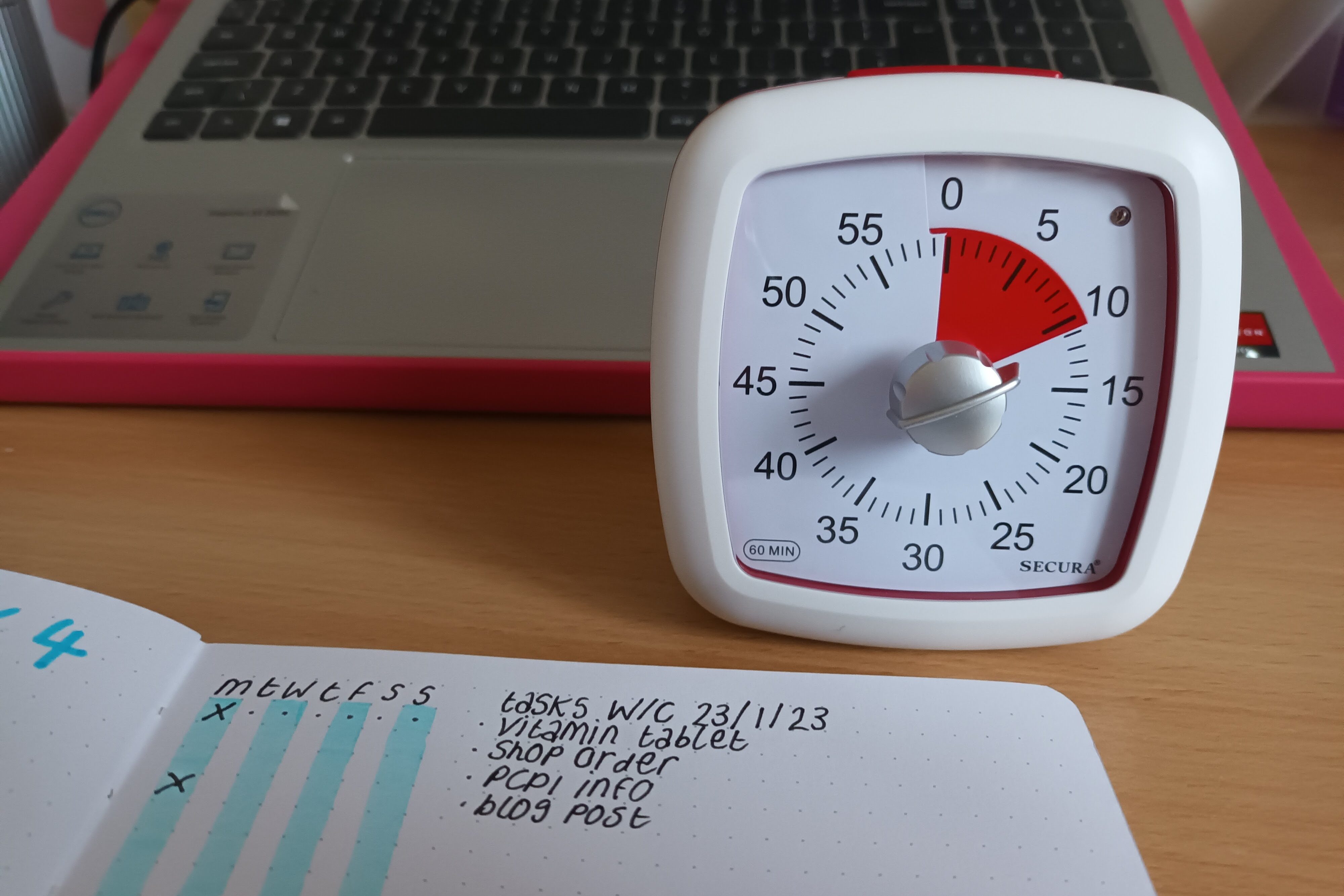
It’s been over two months now since I bought a countdown timer from Amazon to use for the Pomodoro Technique which aims to increase productivity. I already felt that I got plenty done each day but I loved the idea of breaking down work into intervals, having regular breaks and knowing how long I’d been hard at it for. I’ve been consistently using the time management method, apart from a week off for Christmas and I thought I’d share what it is and how I feel it’s helping me.

Those of you who have never heard of this technique may be wondering if it is named after a particular person, but you might be surprised to know that pomodoro is actually Italian for tomato. What does a tomato have to do with productivity? Read on and you’ll find out!

What is The Pomodoro Technique?

The Pomodoro Technique is a time management method which was developed by Italian Francesco Cirillo in the late 1980s. At this time, Cirillo was a university student and was struggling to stay focused on his studies. He challenged himself and posed the question ‘Can you stay focused for two minutes without distraction?’. To check if he could, he grabbed his countdown timer from the kitchen which was red and shaped like a pomodoro, or, in English, a tomato. He set the timer, and after two minutes of focused activity, the timer rang and he had achieved his mission. After this, he considered why the use of a timer had worked and he experimented with gradually upping the time and reducing it when it became too much. In the end, he decided that 25 minutes was perfect and that a short break (5 minutes) was required before continuing.

Cirillo carried on experimenting and came up with some basic principles. The timer was an important part but only one element of the method. He suggests the following:

  • Pick one task you want to work on.
  • Set your timer for 25 minutes and place it somewhere highly visible (so you can see how much time remains).
  • When the buzzer goes off, have a 5 minute break.
  • Repeat this with 3 more periods of 25 minutes and 5 minute breaks.
  • Mark each pomodoro with an X when you’ve completed it (this could be on a mini whiteboard, a post-it note or in your planner.
  • After 4 ‘pomodoros’ (work periods of 25 minutes and 5 minute breaks), take a longer break of 20-30 minutes.
  • Once your longer break is finished, go back to step 1.

But what if I have a really long project or lots of short tasks to do?

For complex projects, you should break things down into smaller actionable steps. This will help you avoid overwhelm and ensure you make good progress towards your end goal.

Any tasks which will take less than one pomodoro should be combined with other quick tasks. This might include a range of admin such as book a hairdressers appointment, reply to an email, making a shopping list for the supermarket and reviewing your bank statement.

If you finish your chosen task before the pomodoro timer rings, you should continue to use the rest of your time in a productive manner e.g. by going over what you’ve just learned, making a list of next steps, reading up on a related topic etc.

What should I do during my 5 minute breaks?

When the timer goes off, it’s sometimes tempting to continue working, especially if you’re in a flow state. However, taking breaks is really important if you want to stay productive. What you do during your short breaks is up to you but here are some suggestions that you might find helpful. For me, taking time away from screens such as my computer or my phone is super important and gives my eyes a good rest.

  • Do a short guided meditation
  • Get out in the garden and reap the benefits of fresh air
  • Do some stretches
  • Put on an upbeat track and dance about your kitchen / living room or anywhere with some space to move
  • Take a quick walk for a serotonin hit
  • Drink some water, squash or a flavoured tea
  • Sit in a comfy chair and read a good book
  • Do a mindful activity such as a spot of doodling, a word puzzle, jigsaw or some colouring in.
  • Listen to some music – trying closing your eyes so you really tune in.
  • Watch birds in your garden.

How is the Pomodoro Technique working for me so far?

So far, I’ve found the method to be incredibly effective. I bought my timer hoping that it might help in some small way but I didn’t realise how beneficial it would be as it’s such a simple idea. Here are some of the advantages I’ve experienced so far:

  • Makes it easy for me to get started. When you have a big project to do, it’s easy to get overwhelmed by its size and this can often lead to procrastination AKA putting things off. Contrary to popular belief, for most people, procrastinating is less about laziness and lack of self control, and more about fears of failure or feelings of self doubt. Knowing that I can do things in baby steps where I only have to do 25 minutes before being allowed a break is all the encouragement I need to get started.
  • Increasing my awareness of time. Using the timer makes you really aware of time going by and this encourages you to really focus in on your chosen tasks.
  • One thing at a time. The method encourages you to work on one specific task or a group of related tasks at one time and this helps to prevent the urge to multitask or context switching (where you jump from one task to another) which studies show is detrimental to productivity.
  • Great for avoiding distractions. In some ways, 25 minutes feels like plenty of time but if you don’t use it wisely, it can soon be gone. Because of this, I’ve taken steps to avoid anything which might interrupt my work flow. Depending on the type of work I’m doing, this might include putting my mobile phone in another room, adopting pen and paper methods for recording, switching off notifications and playing background music to block out other sounds.
  • Encourages me to plan my day. Before you start work, you’re encouraged to plan your tasks in advance. This helps you to decide what you want to get done, at what time and how long you think an activity is likely to take. At the end of your working day, you can evaluate your progress and consider if you overestimated or underestimated how much time tasks took. This can then inform your future planning.
  • Ensures I take regular breaks. Taking regular mental breaks from your work helps you to stay focused and remain efficient and productive during your 25 minute time blocks. If you’re working at a desk, it’s really beneficial to get up and move around as this improves your circulation and helps to combat fatigue.
  • Helps me maintain motivation. Seeing the time counting down on the timer in front of you is great for ensuring you work at a good pace. Also, after each session, I mark my progress in my bullet journal and this in itself makes me feel good and gives me the encouragement I need to keep going.
  • Encourages me to be self-evaluative. On days when I feel like I haven’t been super productive, despite using the Pomodoro Technique, I always question why. Common culprits include distractions from notifications or social media (especially if I’m researching something online), working in an untidy environment (meaning I can’t find things I needed) not taking my 5 minute break (or unconsciously extending them), deviating from my plan when I get back to work (because I found something else much more appealing, or when taking a break, engaging in something which didn’t allow me to relax and recharge (e.g. reading news articles online). When I’ve established what the issues are, I can develop strategies to combat them.

Final words…

I hope you have found today’s blog post useful, especially if you are looking for ways to beat procrastination, become more time savvy, and generally work more productively each day. If you want to know even more about the Pomodoro Technique you will find Francesco Cirillo’s book available in e-book format or paperback on Amazon. Also, feel free to ask any questions you may have in the comments and if you already use the Pomodoro Technique, let me know how it’s working out for you.

Posted in art, bullet journal, Bullet journaling, creativity, Planning and journaling, watercolour painting

Setting up my Bullet Journal for October 2022: Moon phases theme

For my BuJo theme for next month, I took inspiration from an article I read in one of my magazines which focused on awareness of the lunar cycle and how you can use the various stages of the moon to transform your life and become more in touch with your spiritual side. I read with interest and wanted to learn more so I bought a book called Lunar Living by Kirstie Gallagher.

Photo credit: Laura Jones for Keeping it Creative

Every morning, I spend about 20-30 minutes reading, highlighting and learning about the magic of The Moon. Today, I’m going to share the spreads that I’ve created and when I’ve finished reading, I hope to create a series of blog posts which begin to touch on some of the many things I’ve learnt. For now, here’s what I’ve currently got set up for October.

My cover page

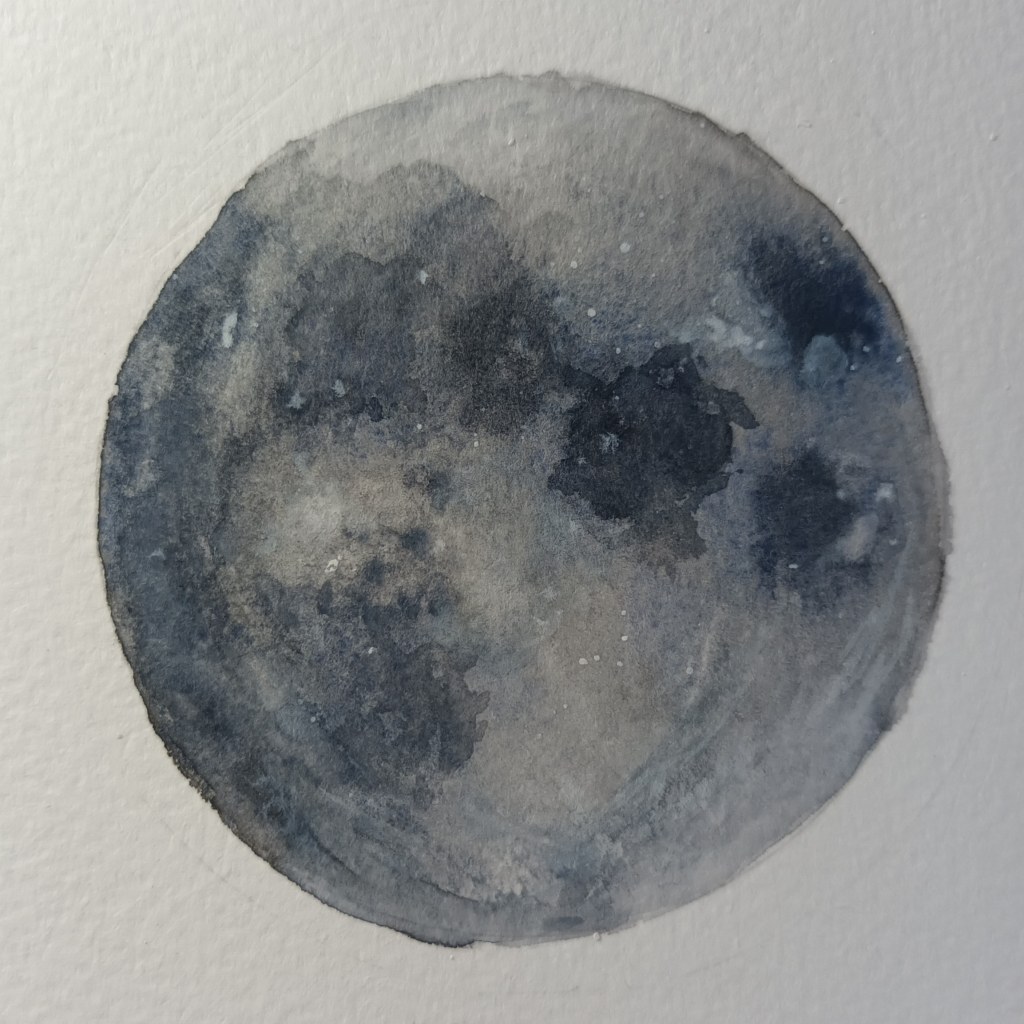
It’s been a while since I did any watercolour painting so I decided to have a go at doing the full Moon. I found several tutorials on YouTube and decided to follow one which involved using the wet-on-wet technique. This was my second attempt and I’m really pleased with how it turned out.

Watercolour full moon

As watercolour paper is really thick, I didn’t want to stick the actual painting into my bullet journal so I photocopied it and glued it in, inside a diagram of the moon cycle (which was inspired by Amanda Rach Lee’s October 2019 YouTube video). I added the quote ‘Stay wild, moon child’ which as well as referencing this month’s theme, basically means keep being you and doing what you’re doing.

Photo credit: Laura Jones for Keeping it Creative

Calendar pages

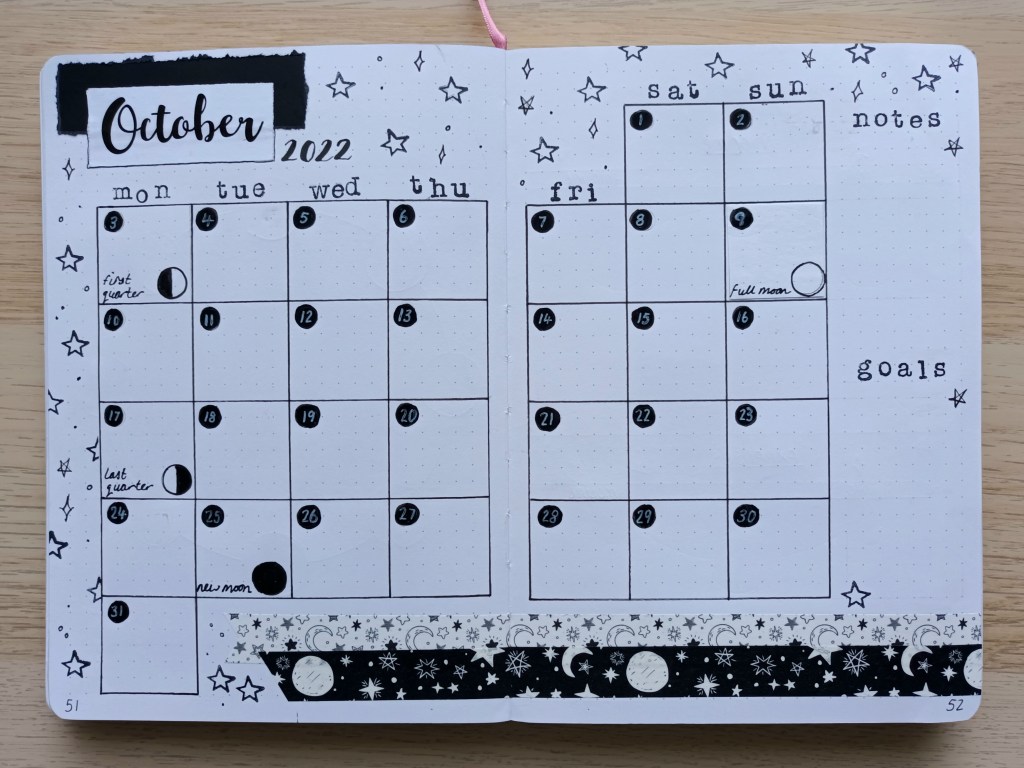
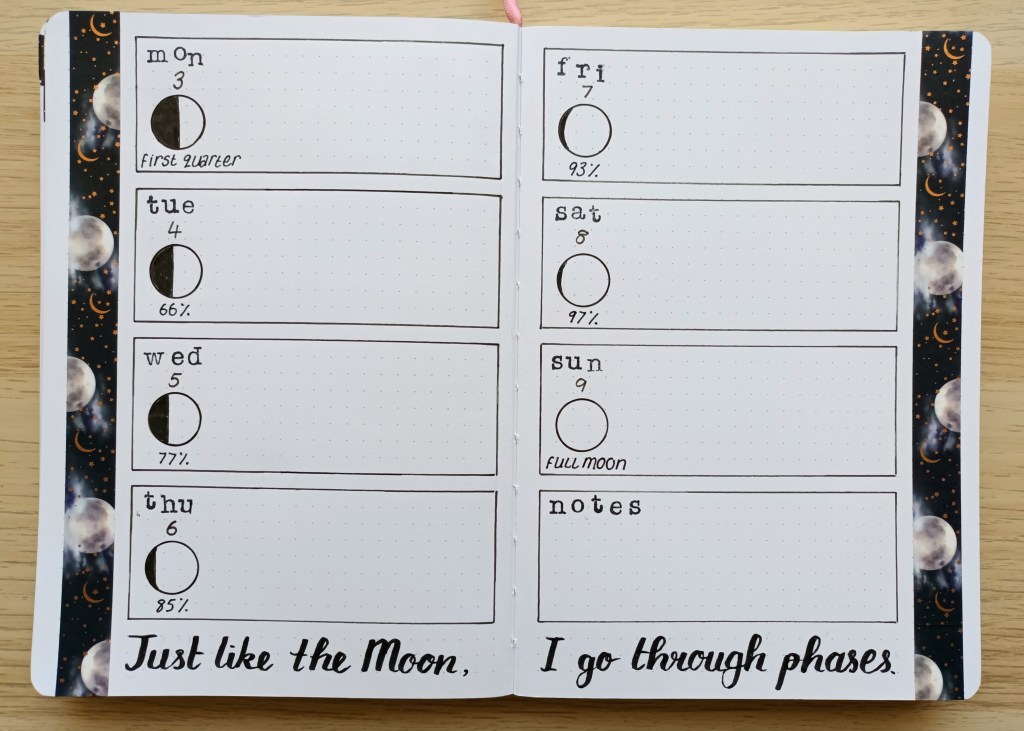
I originally planned to draw the changing moon for each day of the calendar and use black fineliner or white gel pen to add the dates. However, this wasn’t easy and in the end I just did black circles and use my white Gellyroll in 0.8 to add the numbers. I then added 4 of the 8 monthly phases of the moon to the appropriate boxes for reference. I’ve also downloaded an app which shows the % of visible moon each day on a calendar and contains information which explains when there is a new moon, full moon and also when the waxing (growing bigger) and waning (getting smaller) period is.

Moon Phase Calendar app

For this month I added a small notes section and a space for goals. I’ll then work on some actionable steps to achieve my goals throughout the month in keeping with the teachings of the lunar cycle. I printed a brush letter title for the page and used black paper to add some interest behind it. Mini letter stamps from Hobbycraft were used to create the days of the week headers and other titles. A mini star stamp and my own doodles added interest to the white spaces and I also used some moon and stars washi tape I got on Etsy a few weeks ago.

Photo credit: Laura Jones for Keeping It Creative

Finances – income and outgoings

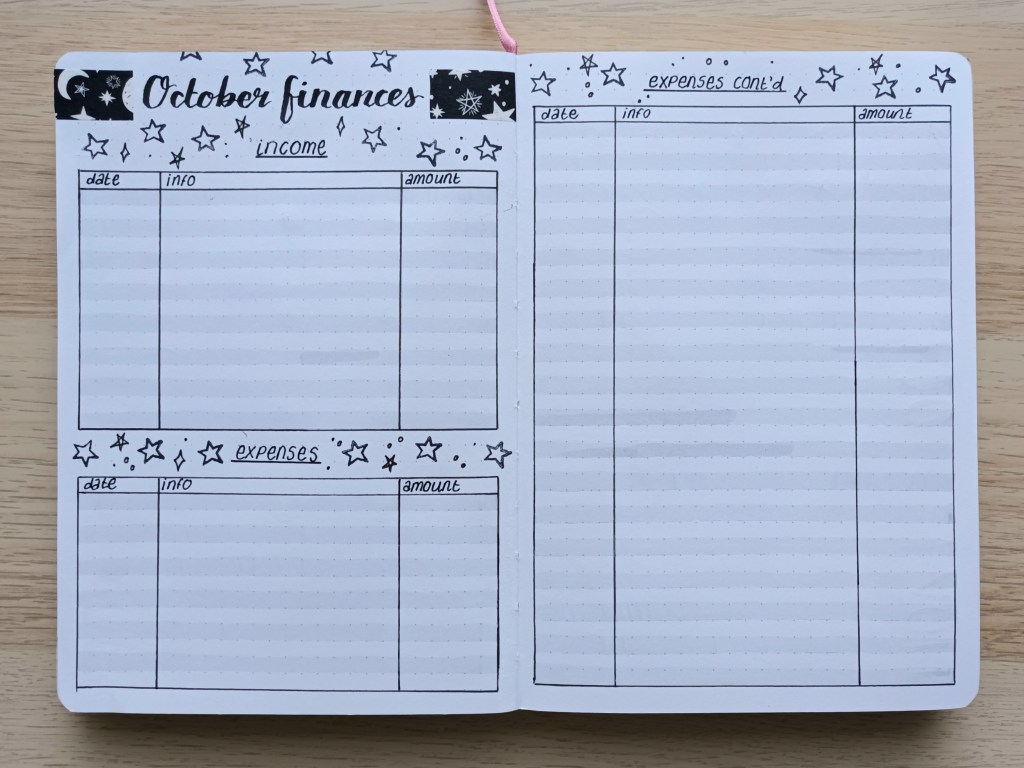
I’m continuing to keep track of my finances next month and I’m finding this set up really useful. I wanted to stick with mainly black and white for my theme but light grey Tombow pen was useful for these pages.

Photo credit: Laura Jones for Keeping it Creative

Reading Log

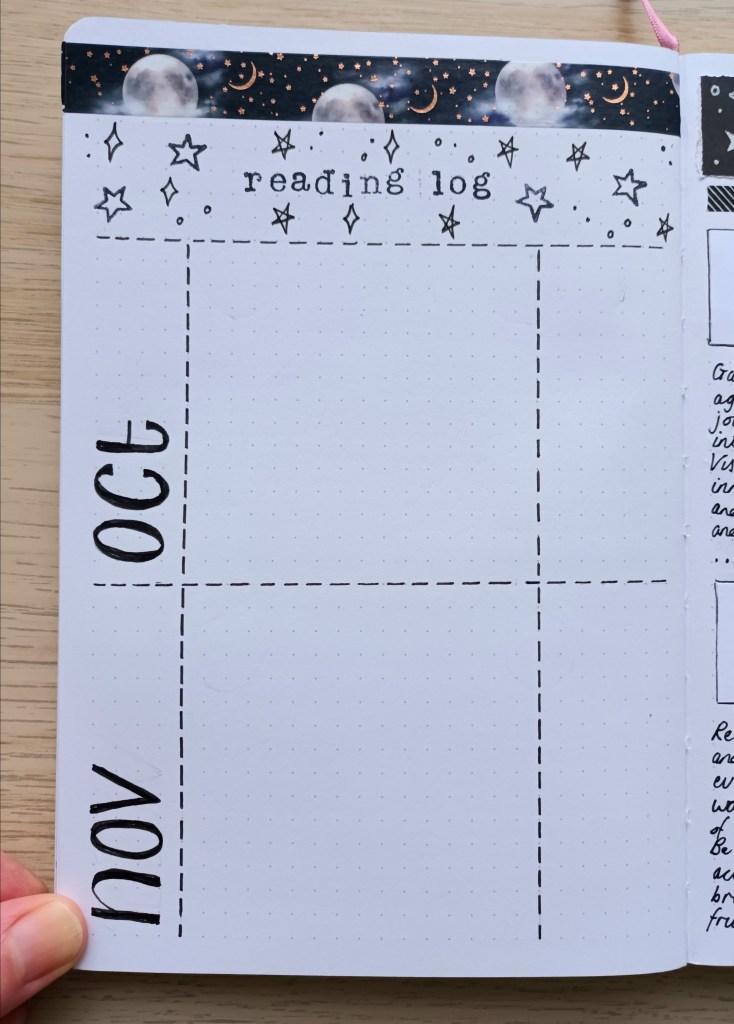
On this page I keep a record of fiction and non-fiction reading and also add a hearts rating for how much I enjoyed a novel or how interesting or helpful I found that particular non-fiction book.

Photo credit: Laura Jones for Keeping it Creative

Manifesting with the moon

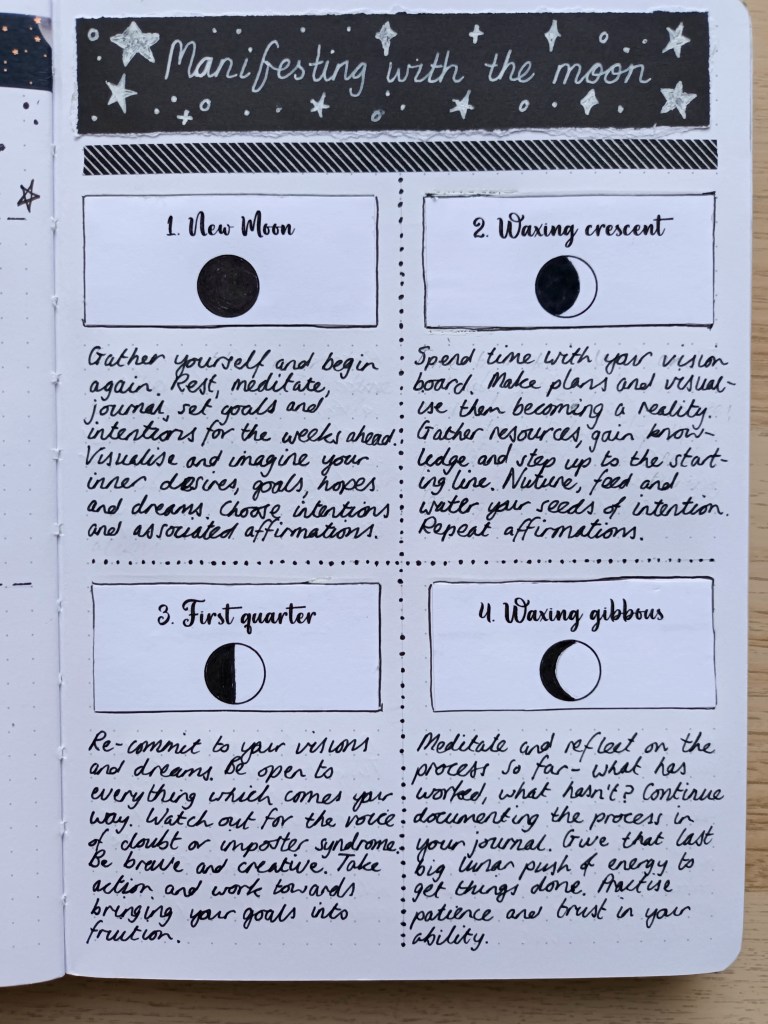
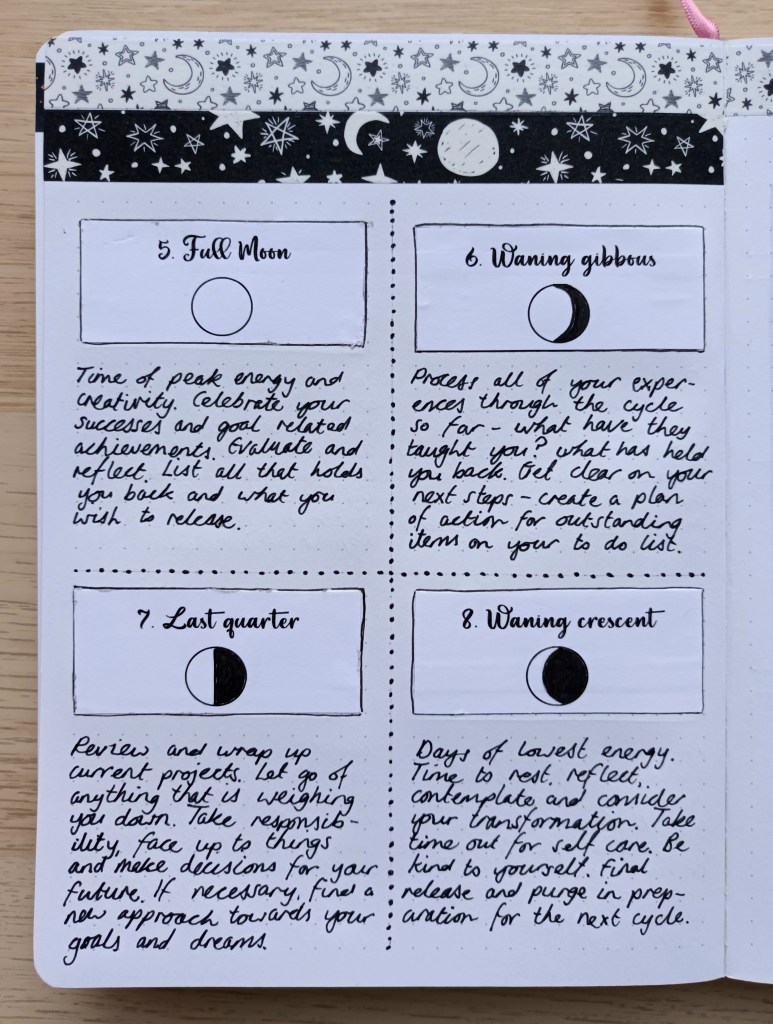
On these pages I created a mini guide to each of the eight phases of the lunar cycle and how they can be used, according to Kirstie, ‘for self awareness, self care, nourishment, empowerment, manifestation and purpose’. I found it difficult to create circles that looked good, so in the end, I printed titles and mini circles, which I coloured in and cut out to stick in. Even getting the crescent moons right was a source of difficulty but I got there in the end and my perfectionist self was happy!

Photo credit: Laura Jones for Keeping it Creative

Rolling weekly

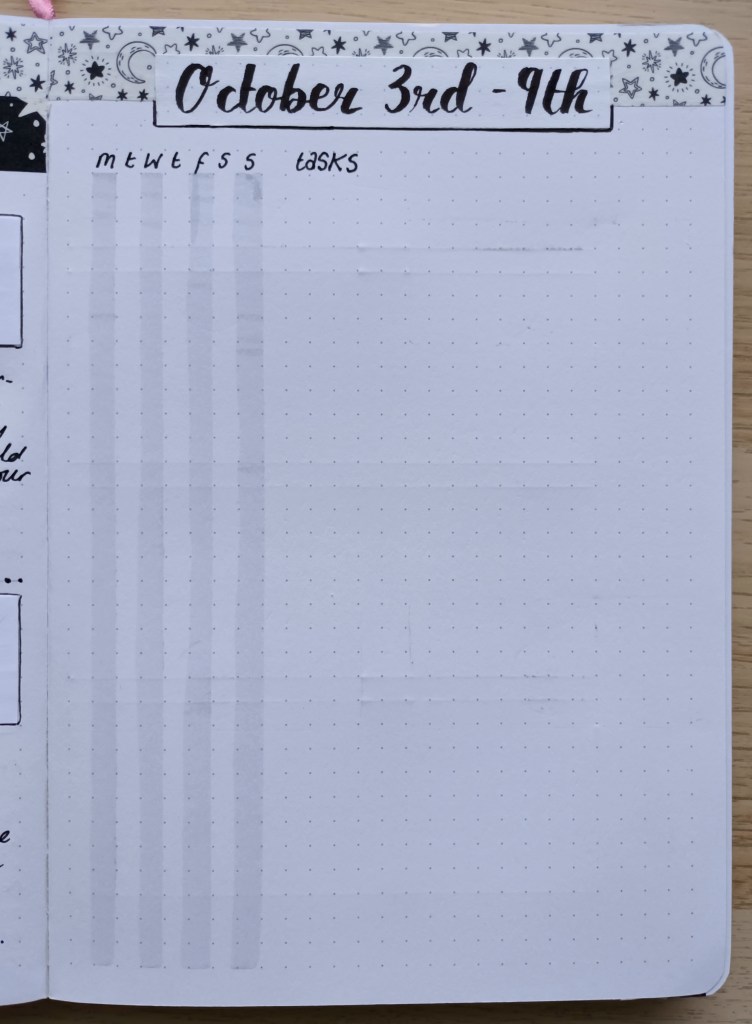
This is a set up which I’ve recently started using. Basically, it’s a list of tasks for the week and you assign them to specific days using task bullets. It means you can keep your weekly to dos separate from your weekly event calendar and you can add tasks as and when you think of them and then choose a days or days to work on them whenever you like. If you want to know more about this system, I recommend checking out Plant Based Bride’s video on YouTube.

Photo credit: Laura Jones for Keeping it Creative

Week 1 set up

These pages are pretty self-explanatory. A place to record events and appointments plus make notes about anything that I’m getting delivered or that I’m waiting on to arrive. I might also do a little bit of journalling at the bottom of each box if I have room left.

Photo credit: Laura Jones for Keeping it Creative

I hope you have enjoyed looking at my spreads and like the way they’ve turned out as much as I do. If you have any questions or comments I would love to hear them. I always get a warm feeling inside every time someone shares their thoughts or experiences on one of my posts.

Posted in Bipolar disorder, depression, depression management, lifestyle, mental health, wellbeing, wellness

Monday Matters: Wheel Of Wellness – Occupational

For today’s blog post on The Wheel Of Wellness I’ll be focusing on the Occupational segment. This section is all about finding meaningful ways to occupy your time whether that be doing a job you enjoy and get personal satisfaction from, volunteering your time and services for a particular cause such as a charity, helping the community in some way (either in person or online), raising a family or simply being a good partner / friend / mum or dad / sibling / pet owner etc.

When we think of the term ‘occupation’, our thoughts tend to turn to our job or the way we earn a living. However, some of us, myself included, are currently classed as unemployed (for whatever reason), in education, or are retired, but we still occupy our time in a number of useful ways. So, throughout today’s article, I’ll be talking about occupation in the broadest sense i.e. as a way of spending time, particularly in a manner that is useful for ourselves, our family and friends or our wider community.

Occupational wellness

To maintain occupational wellness, it’s important to consider how what we do impacts on our general health – both physically and mentally. Does your work leave you feeling good about yourself and as though you’re really making a difference or do you dread each and every week, feel constantly exhausted, dissatisfied and undervalued? If you volunteer your time for a good cause, does your line manager thank you regularly and encourage you to recognise the impact you’re are having both on yourself and the organisation or do you feel unappreciated and as though it is a struggle to think of the benefits? If, like me, you’re a blogger, do you get a buzz when someone likes your post, follows you or leaves a nice comment or do you feel like you invest too much time on your writing and have lost your spark? For those of you who are retired, have you adjusted to your circumstances, and are you happy with how you structure your days, or do you feel like you would benefit from making changes which support both your physical and mental health? Whatever you current situation, do you feel well motivated, happy and purposeful or is there room for improvement in this area of your wellness?

My own experience of occupational wellbeing (and lack of)

(N.B. these paragraphs may be triggering for individuals who are currently struggling with their mood in some way or have a diagnosis of Bipolar Disorder)

Before my diagnosis of Bipolar disorder, when I was teaching, there were periods of time in my work when I felt on top of the world, superior to most of my colleagues and as though I was making such a difference to the pupils and the school as a whole that I was a complete asset. At other times, I felt demotivated, dreaded each week, struggled to get out of bed and get things done and found my work-life completely unbalanced and unmanageable – drowning both at home and at work. For the rest of the time, I was satisfied with the way my career was going, felt I was becoming better and better at my job and was, along with most of my colleagues making a real difference. I also felt that I was able to manage my workload and had the ability to say ‘no’ when necessary. The swings in mood I was experiencing were exacerbated by occupational / work-related stress but were also heavily affected by a mental health condition that I was unaware I had.

At the time, during a period of severe depression, I was convinced the solution was to give up my job and career and that following handing in my notice, everything would be perfect. I was devastated that this was the answer as I’d wanted to be a primary school teacher from my early childhood but, I was making myself ill and it just couldn’t continue. However, I soon realised that although some aspects of my situation had improved (less stress, better work-life balance, more time for self care for example), my mood swings (although not as severe) continued and I had highs, extreme lows and periods of balance. When I was stable, I would set goals for myself and filled my time in productive ways. I would wake up feeling good and ready to get on with things. When I was depressed, I completely lost my confidence, had extreme anxiety and felt like I was a waste of space and no use to anyone. When I was high (shortly after a depressive episode), I slept very little, was brimming with ideas for what I wanted to do and achieve, flitted from project to project often leaving them half unfinished, spent money on all sorts of items as everything looked attractive and definitely on my want/need list and basically felt like I could take on the world. This eventually caused burn out and resulted in another bout of depression or physical unwellness.

Fast forward a good few years and, although I still have mental health difficulties, a correct diagnosis, medication for my illness, a range of therapies and help from my support worker have put me in a much better place and I’m currently able to manage my moods more easily and occupy my days in useful ways that leave me satisfied and feeling like I’m making a difference (however small). I’m also able to add in mindful and calming activities into my day and can recognise when I need to take breaks and when I might be doing too much.

As some of you who read my blog posts regularly will know, I’m continually working on my physical and mental health in a number of effective ways and I even have paid work lined up with my local university for next month which will make full use of my skillset whilst offering me the opportunity to take a break during any future periods of mental ill health. I also have the chance to work and socialise with other individuals who have physical and/or mental health difficulties so I will feel less alone. For the first time since I resigned from teaching, I feel like my occupational wellness is getting to where it should be.

Asking yourself questions to consider your occupational wellness

I think it’s really important to reflect on the different aspects of your life regularly and consider how things are going. Asking questions can be hugely beneficial. Of course, the assessment questions you ask yourself will differ depending on your current life situation but below I’ve shared some examples which you can pick and choose from depending which are most relevant. You might want to spend some time thinking and considering your answers but another good idea is to make notes or do some journalling so you can deep dive into how things are for you, and evaluate if your needs are being met. This kind of activity is great for self care and building self awareness.

Again, I’ve tried my best to include everyone here but I apologise in advance if you feel like most or all of the questions aren’t relevant to you. If this is the case, you are more than welcome to drop a comment explaining why and I’ll rack my brains and see if I can create a few tailor made question ideas.

  • How would you rate your current happiness and life satisfaction? Why?
  • What is it about your current role or the way you occupy your time that makes you want to get up in the morning?
  • What does an average week / work week look like to you? Does this support your physical and mental health? Why? Why not?
  • Do you feel like your current employment / routine offers opportunities to expand your skills and use your strengths? Why? Why not?
  • If you are a student, do your chosen subjects interest you and are you learning well? Does your degree choice suit you and are you getting the help and support you need to learn? Are you able to study independently? Have you found the right balance between studying and enjoying life?
  • What are your career / life aspirations?
  • What do you feel is important in your life right now? Does your occupation / lifestyle reflect this? If there are areas for improvement, what changes do you think you could make?
  • Do you feel that you’re currently achieving balance between your work and leisure time? Are there any ways you could tweak things?
  • What opportunities do you currently have to use your individual gifts, skills and talents (try making a list of them first if you’re unsure what they are) in order to gain purpose, happiness and enrichment in your life?
  • Does how you currently occupy your time support your physical health? Why? Why not?
  • Does how you currently occupy your time support your mental health? Why? Why not?
  • Can you identify one change you could make to your life right now that would have a positive impact on your physical or mental health? (this could be asking for help rather than taking on all of the responsibility yourself, or simple putting your foot down and saying no!)
  • Social connection is considered important for wellbeing (even during periods of low mood). Can you name the ways you connect with others on a regular basis? Do these connections help or hinder your mental health? Are there any changes you’d like to make in this area to improve your wellbeing? Do you shy away from social situations during periods of depression / anxiety or low mood? Can you think of ways to remain socially connected that seem management during difficult times?
  • How do you manage your work related / family stress and responsibilities? If you struggle in this area, can you think of ways to improve?
  • What’s your current attitude towards life / work? Does this support your health or not? Why?

What about if I’m struggling with depression right now and feel pretty useless?

As someone with bipolar disorder, I have plenty of experience of depressive episodes and recognise the daily struggles. However, what I’ve learnt is that, if you feel like you’ve achieved nothing with your day, it tends to make you feel much worse. For this reason, creating a structure or plan for your time can really help. This might include going to your local recovery college to learn something new, identifying small and achievable tasks to do on each day of the week or planning activities which you know (either now or in the past) have given you a little mood boost such as going for a walk in nature, meeting a friend for coffee or doing something mindful such as colouring in, working on a jigsaw or doing some word puzzles. Then, by bedtime, you can celebrate all of your achievements no matter how tiny they are. And don’t forget, even something like getting out of bed and getting dressed shouldn’t be dismissed! Check out my post on Behavioural Activation if you want more help with making a daily plan.

Final words…

I hope you’ve found today’s blog post interesting or helpful in some way and it has made you think about your occupational wellbeing. I’ve tried to include something for everyone no matter what your current situation as I know my readers are all individual and at different stages of their lives. Let me know in the comments if a question or idea has particularly resonated with you as I love to hear the opinions and thoughts of others.

Until next time, take care.