Blog

Posted in Bipolar disorder, lifestyle, mental health, Planning and journaling, wellbeing, wellness

Monday Matters: Being a Highly Sensitive Person (HSP) and tips for coping day-to-day

I was introduced to the highly sensitive personality type several years ago when I started a discussion on the Bipolar UK charity website. My reading since then has helped me learn more about being a HSP and the associated traits and characteristics. Much of my research has resonated and I feel that being sensitive is part of my bipolar disorder and something which requires day-to-day management, particularly during periods of mental illness. So, today, I thought I’d share some of the main signs of being a HSP and discuss ways of managing the condition.

What is a Highly Sensitive Person?

A highly sensitive person (HSP) is an individual who is thought to have an increased or deeper central nervous system sensitivity to physical, emotional and social stimuli. These are normal and perfectly healthy character traits which brings about a number of strengths and challenges for the individual.’ HSPs often excel creatively and can be incredibly empathetic. They also often tend to notice things that others may miss or make connections that many individuals do not see.

The term was coined by psychologist Doctor Elaine Aron in the 1990s and her research has suggested that around 15-20% of the population have the personality type. She is continuing to study Sensory-Processing Sensitivity (SPS) now and as well as having a website dedicated to her findings, she has written a number of books and developed a self-test which can help you decide if you’re a HSP.

Signs you are a Highly Sensitive Person

  • Throughout your childhood, parents or teachers saw you as shy or sensitive.
  • At school, you became extremely anxious when taking part in timed quizzes, tests and exams. This probably caused pressure to perform and might have caused enough stress to make you perform badly or fail to achieve the expected results.
  • As an adult, you try to avoid potentially upsetting or overwhelming situations.
  • You tend to become stressed or overwhelmed when you have lots to do.
  • You’re generally really good at reading the emotions of others (even those you’ve never met before) e.g. when you walk into a room, you can sense the atmosphere and are able to use subtleties such as facial expressions, body language and tone of voice to establish how individuals are feeling.
  • After a really busy or long day, you find yourself desperate for some quiet/alone time to lower your stimulation levels, soothe your senses and to help you relax and recharge
  • Unexpected or loud noises really startle you and you may consider yourself to be ‘jumpy’ in general
  • You’re a deep thinker and spend a lot of time ‘in your head’ reflecting on anything and everything. This also means you are often prone to negative thinking and rumination (going over and over things in your head).
  • You always choose your clothing super carefully. Rough or restrictive items irritate you. For example, I can’t stand anything with a high neckline such as jumpers with turtle, rolled or polo neck and will always need to leave the top button of a blouse undone. I’ve also had to give away three of my jumpers recently as they were a little bit scratchy on the inside and caused me irritation.
  • Other sensory stimuli can cause overwhelm. This could include bright light, noisy or crowded places.
  • You tend to have less tolerance to pain than others.
  • You prefer to work in a very quiet environment which is free from distractions e.g. you have found working alone from home to be preferable to working in an open plan office.
  • You find any sort of change difficult or upsetting whether it is positive or negative e.g. being in a new relationship or getting a job promotion can cause extreme amounts of stress. HSPs tend to find a lot of comfort in routine and anything new or different can cause overstimulation.
  • Raised voices and an angry tone can cause tension and upset even if the rage isn’t aimed at you.
  • You tend to be a people pleaser as you don’t want to let people down. This may lead to you saying yes when you really want to say no.
  • When you’re feeling really hungry, you might find your emotions are affected quite strongly resulting in you getting ‘hangry’, irritable and moody. I think most people have experienced being in a bad mood when they’re haven’t eaten for ages but in a HSP, this might happen more regularly or felt more strongly. According to Dr Aron, this is because HSPs are more sensitive to spikes and dips in blood sugar levels.
  • Stimulants affect you more than others. You might find caffeine gives you a real buzz even if you consume very little. Alcohol may have the same effect.
  • You hate conflict and tried to avoid it as much as possible. This may result in you doing or saying whatever you can to keep the other person happy.
  • You may avoid TV shows and films which contain lots of violence because they feel too intense and leave you unsettled. As someone who loves watching crime dramas and anything psychological, this one doesn’t really apply to me but if you find yourself being triggered you will definitely want to choose your evening viewing with great care.
  • Any form of criticism can be distressing and often completely devastating. This can result in people pleasing, criticizing yourself first before anyone else gets the chance or simply avoided the source of criticism. This is certainly one of my main triggers and something I have struggled with from childhood and right through my adult life. It doesn’t matter if the criticism is meant to be constructive or falls in the middle of a number of compliments – I will nearly always be deeply upset and often go over things in my head again and again. Praise can leave me on a high all day but even a slight criticism can make my mood plummet in seconds and completely spoil my day or the rest of my week if I let it.
  • You may find yourself being deeply moved by music and other creative pieces such as works of art, poetry, drama and writing.

Ways to manage your sensitivity on a day-to-day basis

Create a set morning and evening routine Set routines provide an element of control even when everything around you is changing. For me, my morning routine includes a short journalling session, a healthy breakfast of wholewheat cereal and a piece of fruit, 15 minutes of non-fiction reading (with a cup of coffee), stretches, stepping outside to listen to the birds and check on how the garden is doing, and setting my intentions for the day. In the evening, I’ll get my PJs on, do something mindful like my jigsaw or playing a game on my tablet, then my husband and I will watch something on TV. My phone is set to automatically transition to night mode at 8.00pm and I tried to avoid using my electronic devices after this (very much a work in progress at the moment!). Just before bed, I’ll think about how my day has gone and do some reflective journalling. I’ve just bought The Five Minute journal to make my sessions more structured and I hope to write a blog post on how this is going very soon.

Make sure you get a good night’s sleep We all know that quality sleep is essential for our physical and mental health and it is especially important for HSPs. If you know that this is an area of your life you could benefit from working on, check out this post which contains an in-depth look into the topic.

Plan in some downtime HSPs can become easily overwhelmed so it’s important to schedule in regular times each day for resting and recharging. As I’ve shared in a previous post, I use the Pomodoro Technique during the day and I consider the five minute breaks to be vital for preventing overwhelm. I also schedule in longer breaks with plans for relaxing or mindful activities such as drawing or painting, listening to music or going for a walk in nature.

Create a sanctuary space in your environment which feels calm and safe This could be a comfortable chair in your living room, an outdoor location at the bottom of your garden or a spot in your conservatory. If you share your home with others, let them know how important this sanctuary is to you and why you find time and space beneficial. You might also want to consider making your home a more pleasant place to be as a whole by keeping rooms clutter free and well-organised. This is something I’m working on right now, especially in my craft room as this is where I often spend most of my day.

Eat a healthy diet and make sure you eat regularly through the day Try to include plenty of fresh fruit and vegetables each day and use the balanced plate to ensure you get enough of the different food groups. Make sure you eat regularly to avoid feeling hangry. Check out this blog post for more information on maintaining a healthy diet.

Consider trying mindful exercise Good choices of mindful exercise include Tai Chi, yoga and Pilates. I also try to stay in the moment during gym sessions by really focusing on how my body feels during each exercise. I try to schedule my gym visits when I know that it is relatively quiet (mid afternoon is a good time for me) as even with ear plugs in, I tend to get over stimulated if there’s lots going on around me. Fitting in a daily peaceful walk in nature is also really beneficial, especially if you choose spaces and times that are less busy.

Use soft lighting in your home When you’re out and about during the day, the type and strength of lighting is generally out of your control. However, in your home, you can choose soft lighting such as candles, lamps, less powerful bulbs and dimmer switches to make things more comfortable.

Identify your triggers When reading the above list, some of the points are likely to have resonated with you more than others – perhaps you found noisy crowds really difficult to cope with or maybe too much social media creates information overload or feelings of inadequacy. Whatever you particularly struggle with, make notes and then work on finding ways to combat them e.g. going shopping when it’s quieter, limiting your time online, carrying snacks for if you start to feel hungry, taking regular mind breaks etc.

Talk to a therapist Working with a therapist, specifically to develop strategies for managing your particular difficulties can really help. Try to choose someone who knows about HSPs so they can offer more specialist advice and support.

Celebrate your positive qualities Although being an HSP comes with its difficulties, it also provides gifts and real strengths which should be celebrated and put to good use. Awesome traits of the HSP can include creativity, conscientiousness, being deeply intuitive, having excellent problem solving skills being and being empathetic.

Final words…

I hope you have found today’s post interesting and informative. With approximately 15-20% of the general population being considered as Highly Sensitive, it’s likely that even if you don’t recognise yourself as a HSP, a loved one, family member, friend or work colleague may have some of the difficulties presented above and would benefit from developing strategies to manage day-to-day life. Personally, I find that I struggle a lot more during periods of low or high mood and things don’t affect me as much at times of stability. I also think that increased stress and pressure can also make things much more difficult and this is when it becomes even more important to apply the above coping strategies.

I would love to hear your thoughts on today’s topic so feel free to leave a comment below if you wish to do so.

Posted in lifestyle, mental health, reflective journalling

Monday Matters: Positive daily reflection using the Three Good Things (3GT) exercise

Over the last week, I’ve been doing some decluttering in my craft room. The place is overflowing with stuff and I feel like quite a few of the bits and pieces will never get used and would be better off going to a new home. Whilst sorting out some trays, I found an old magazine that I purchased last year. Flicking through it, I found a box of information about a reflective exercise that can help inject some positivity into your day. I already feel grateful for a lot of things in my life and have previously carried out a daily gratitude practice in my bullet journal each evening. This particular exercise though, takes things a little further and asks you to consider three positives and why they happened. I haven’t yet tried this out (as I was so excited to share the ideas behind it in this blog post) but I have a feeling that it will be really useful in helping me (and you if you try it out) to realise how many of the positives in my life are directly linked to my own actions and thoughts.

The Three Good Things exercise

The 3GT exercise was co-created by Martin Seligman, one of the leading experts in positive psychology. He designed the activity as a tool to really highlight the good in your life in a simple, easy and scientifically backed way that helps to boost your happiness.

How it works

  1. Every evening, at least an hour before bed, think of three good things that happened that day. These could be big or small things – anything positive counts. Maybe you particularly enjoyed a meal you cooked or you found the perfect neutral t-shirt you’ve been looking for whilst out shopping. Perhaps you managed to carve out some time to work on a creative project or a task that you’ve been putting off was easier and quicker than you thought.
  2. Write these things down on paper. Don’t just think about them. Journalling about them is a very important step in the process.
  3. Reflect on what brought about these events i.e. why they happened. For example, you might have spent a chunk of time last week searching online resources for recipes to try, picked one which sounded nice and chose good quality ingredients for the dish to make it extra special.
  4. Do the above each night for six weeks and then think about the effect it has had on your happiness levels.

An example

My 3GTs for today:

  1. Finding an interesting idea in an old magazine. I found the information as I flicked through the pages during a mini declutter of my craft room.
  2. Two lovely comments on my blog post which made me feel so happy. I took the time to photograph and share my bullet journal spreads for February and provided a short explanation for each page. I try really hard to be consistent with my posting and share content which my readers will enjoy. I also spend time making sure my posts read well and are informative as the quality of my articles is really important to me.
  3. My Amazon order just popped through the letterbox a day earlier than expected. I now have two more books of gorgeous stickers and a new good quality washi tape to add to collection for use in my bullet journal and traveler’s notebook. The work I do at the uni plus other sources of funds enable me to treat myself to journalling supplies which are a joy to use. I’m so pleased that Nichola suggested getting in touch with Lesley as I really love doing PCPI sessions and I know the students appreciate what we do too.
Photo credit: Laura Jones for Keeping It Creative

Why it works

By carrying out the exercise on a regular basis, you’re training your brain to find a number of positives in each day and begin to recognise what went before to cause these things to happen. This helps to change the focus from stressful or negative aspects of our lives, encouraging us to be more thankful for what we currently have (even those things which we tend to take for granted) and more optimistic and hopeful about our future.

Final thoughts

The Three Good Things exercise sounds to me like a wonderful way of digging deeper into gratitude so that you look at what came before positive events and thoughts in your day. I’m definitely going to give it a go and I’m pretty sure the thirty minutes or less that I dedicate to the practice each evening will have a huge impact on my life. Let me know in the comments if it sounds appealing to you and if it’s something you would like to try.

Posted in art, bullet journal, Bullet journaling, creativity, Gouache painting, Planning and journaling

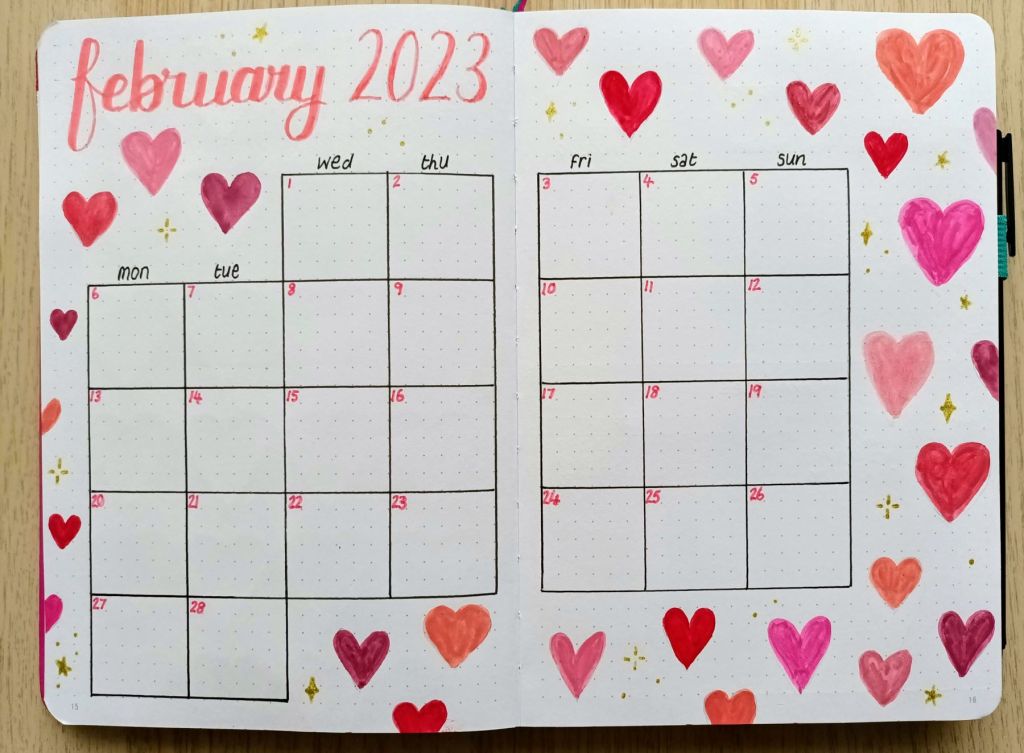
Setting up my Bullet Journal for February 2023: Valentine’s Love Heart theme

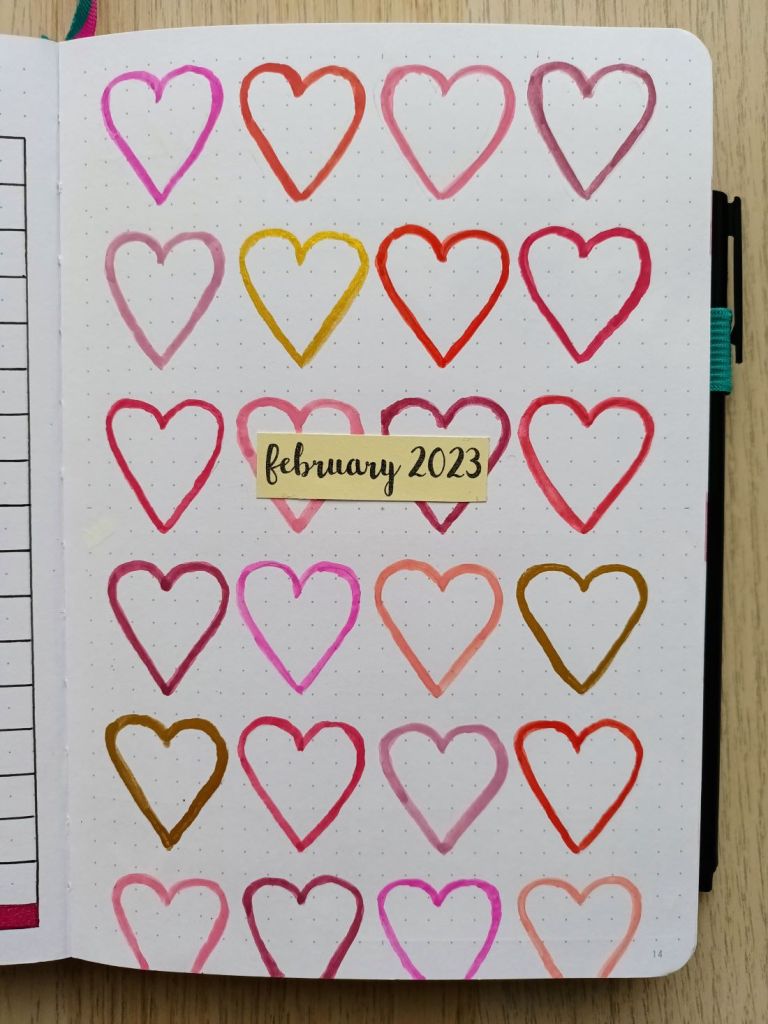
January seems to have flown by and we’re now into February. I’ve only just got my spreads for the month finished as I’ve been busy setting up my new STM notebook and have also had quite a few sessions at the university this year so far. I did a hearts theme before (back in Feb 2021) and I enjoyed using my watercolours to mixing various shades of red and pink so I thought I’d give it another go but this time I used gouache for a more opaque finish. The design for the front cover was inspired by a Caroline Gardner mirror compact that I got for Christmas which features heart outlines.

My pretty compact mirror from Caroline Gardner

The front cover

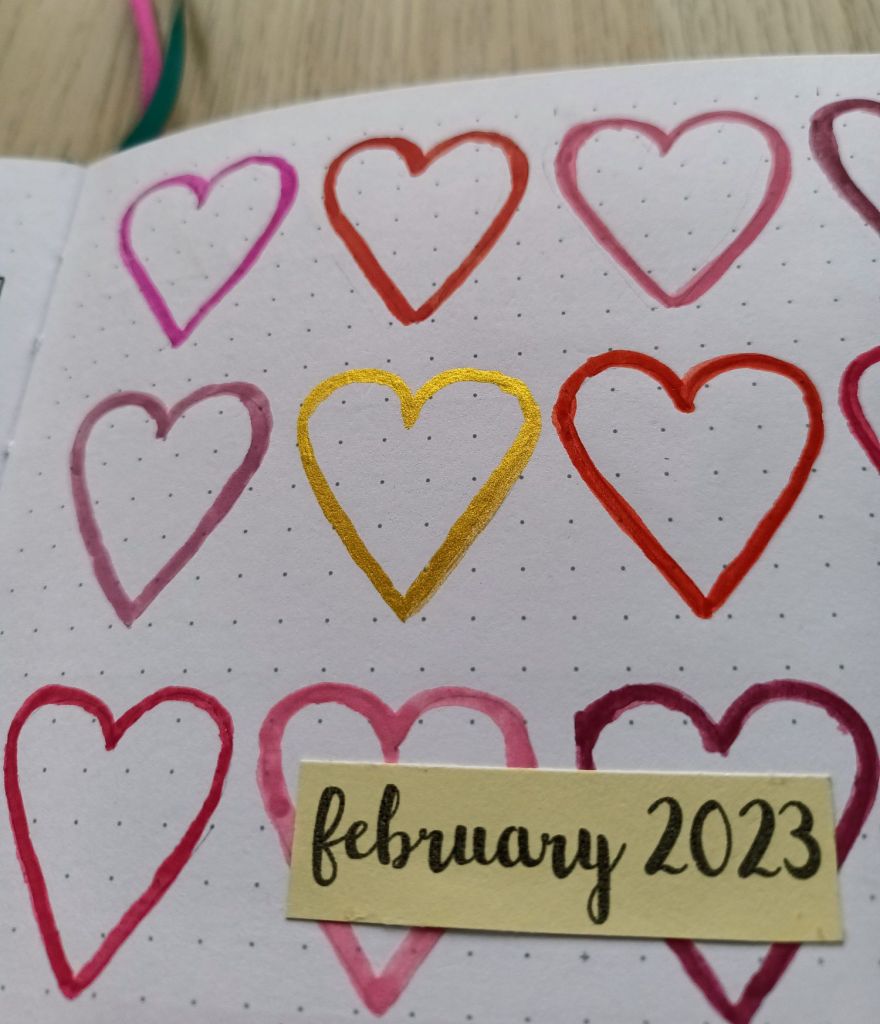
After practicing painting heart shapes in the back of my old bullet journal, I created a template and lightly sketched the outlines with a pencil. I then mixed a shade of pink and then used a number 2 round brush to paint a small number of hearts. I repeated the process with various reds and pinks and also added 3 gold hearts using my Finetec metallic watercolour paints. After leaving the paint to dry thoroughly, I created a small cream label for the month and the year using a gorgeous brush letter font which I recently downloaded called Northern Lights Script.

Photo credit: Laura Jones for Keeping It Creative

Calendar page

For the month on two pages calendar, I mixed similar colours and painted a range of filled hearts in different sizes. This time I used a size 0 round brush as the shapes were smaller. This time I very lightly hand sketched the heart shapes with a 2H pencil. When I’d finished, I realised that I hadn’t done any gold hearts so I decided to add some sparkle using a Uniball Signo gold gel pen creating dots, stars and curved diamond shapes.

Photo credit: Laura Jones for Keeping It Creative

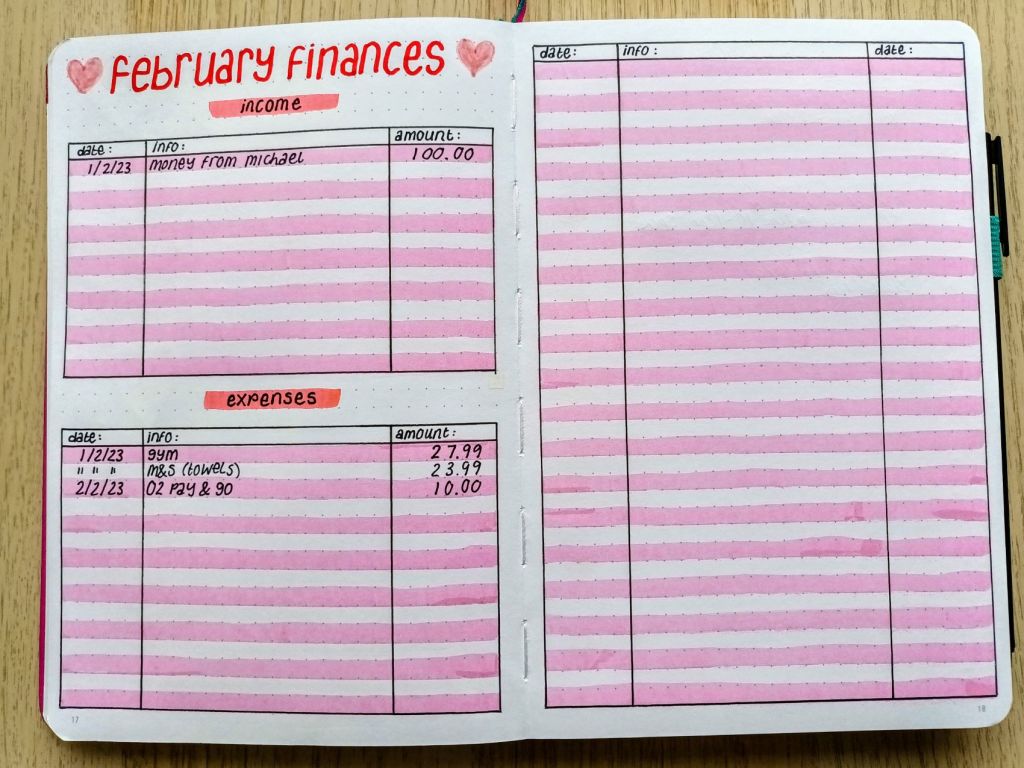
Finances

I’ve been enjoying using this format of financial tracker for a while now and I just change up the colours each month.

Photo credit: Laura Jones for Keeping It Creative

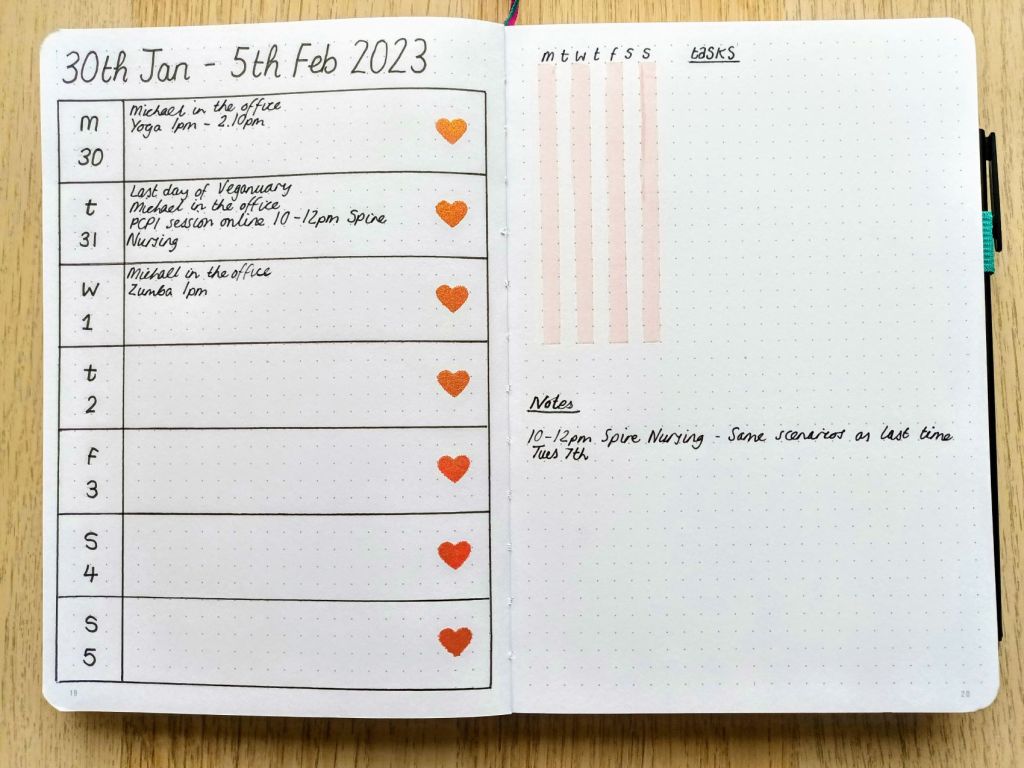
Weekly plan and rolling weekly

This is the first time I’ve done a week-on-one-page spread but now I do a rolling task list for the week I don’t need as much room as I’m only recording events, gym sessions and days out. The hearts for each day were inked using a heart outline (made using a punch), a gorgeous red/gold ink and a mini finger sponge. You can’t really see the iridescence in the photo but it looks really pretty when the hearts catch the light.

Photo credit: Laura Jones for Keeping It Creative

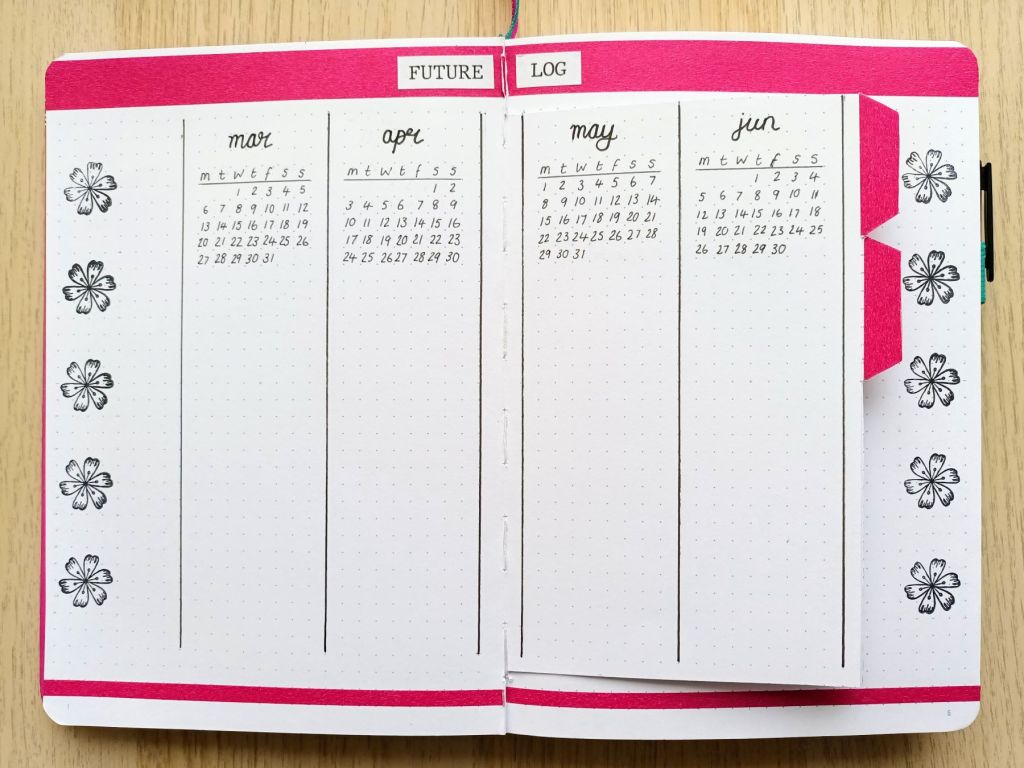
My future log for my new Bullet Journal

I created my future log for 12 months, starting in March 2023 and I’m really pleased with how simple and effective it is so I thought I would share here. It makes use of a Dutch door set up and I added little tabs for ease of use. Using a Dutch Door means that you create one title which can be seen from a number of pages.

Photo credit: Laura Jones for Keeping It Creative

Final words…

I’m really pleased with how my pages turned out and I hope you like them too. Doing some painting in your bullet journal is a super relaxing and mindful activity which I really enjoy. As long as your pages are a good weight and you don’t use too much water or add too many layers of paint there should be no bleed through or page wrinkling.

Wishing you all a wonderful February,

Posted in bullet journal, Bullet journaling, Planning and journaling

Moving in to a new bullet journal for February 2023: Scribbles That Matter notebook mini review

Earlier this month, I ordered a beautiful Notebook Therapy journal that has black linen covers and a falling star pattern to the front. Unfortunately, despite ordering over two weeks before February, it is yet to be dispatched. A few days ago, my husband suggested I should order a BuJo from the UK as I have just a few pages left in my current one. I did lots of research, and in the end, I went back to a brand which I have previously used, namely Scribbles That Matter. Since my last experience of using a STM journal, they’ve made some changes to their dot gridded notebooks so I thought I’d share the one I chose and discuss some improvements that have been made.

My new notebook in ‘Pink’ colourway with teal as a contrast

Ordering, delivery and packaging

I checked out both the STM website and the stock which they hold on Amazon, both offered free delivery but I decided that Amazon might dispatch slightly quicker, so I ordered from there. My notebook arrived within a few days and, due to minimal packaging, it fit through the letterbox (which was great as it arrived when we were both out).

As before, there were several choices of faux leather cover (AKA vegan leather), the iconic which has an embossed design and the plain pro version. Since I last ordered, they’ve also added other options such as a vintage version which it looked like they were selling off.

Over the years when I purchased STM notebooks, they seemed to often be changing the GSM (thickness and weight) of the paper to try to suit different customers needs. Now, I’m pleased to say, they offer 120gsm if you prefer thinner paper, and 160gsm if, like me, you like thicker paper with no bleed through and the ability to lightly use watercolours.

Various sizes of notebook are also offered including A5, B5, A6 and B6 but I have only ever order the A5 size. I’m pretty sure the quality would be the same but I noticed that the A6 and B6 are only available in the lower (and therefore thinner) GSM paper. The company also offer a large array of colours so there’s plenty of choice. However, I’ve come to like the little subtle motifs on the front of the Notebook Therapy branded journals so I shall miss that.

When I ordered a few years ago, STM were packaging their notebooks in ridged plastic and I believe a thin shrink wrap as well. Now, I’m pleased to say they come in a cardboard sleeve which I presume could be recycled. This is obviously much better for the environment.

The cover

I’ve always gone for the plain cover of the pro version of the notebook so I can only comment of the features of this one but I noticed that the only slight change is that it now says STM. at the bottom of the spine, whereas before it said SCRIBBLES THAT MATTER in the centre. This makes the branding much more discreet. The quality of the faux leather is still, in my opinion, great and, although it will probably get a few marks on it with use, this does not detract from the product. It’s also easy to wipe off any smudgy marks with soapy water.

The notebook stays closed with a vertical elastic band and there is a handy pen loop to the right hand side. A 0.4mm nib fineliner is included in the pen loop but I haven’t tested the quality of it yet. This size nib is new to me as I currently use 0.2, 0.3 and occasionally 0.5 Pigma Microns.

Interior design features

The notebook still has two ribbon bookmarks in colours which match the cover and elastic closure and as I’ve never had any of them become detached, they must be pretty secure (unlike my Notebook Therapy ones which have both come out this time!). There is again an expandable pocket to the reverse which I like to put stickers and receipts in, plus a sheet cut from the back so I can cut bits to cover larger mistakes.

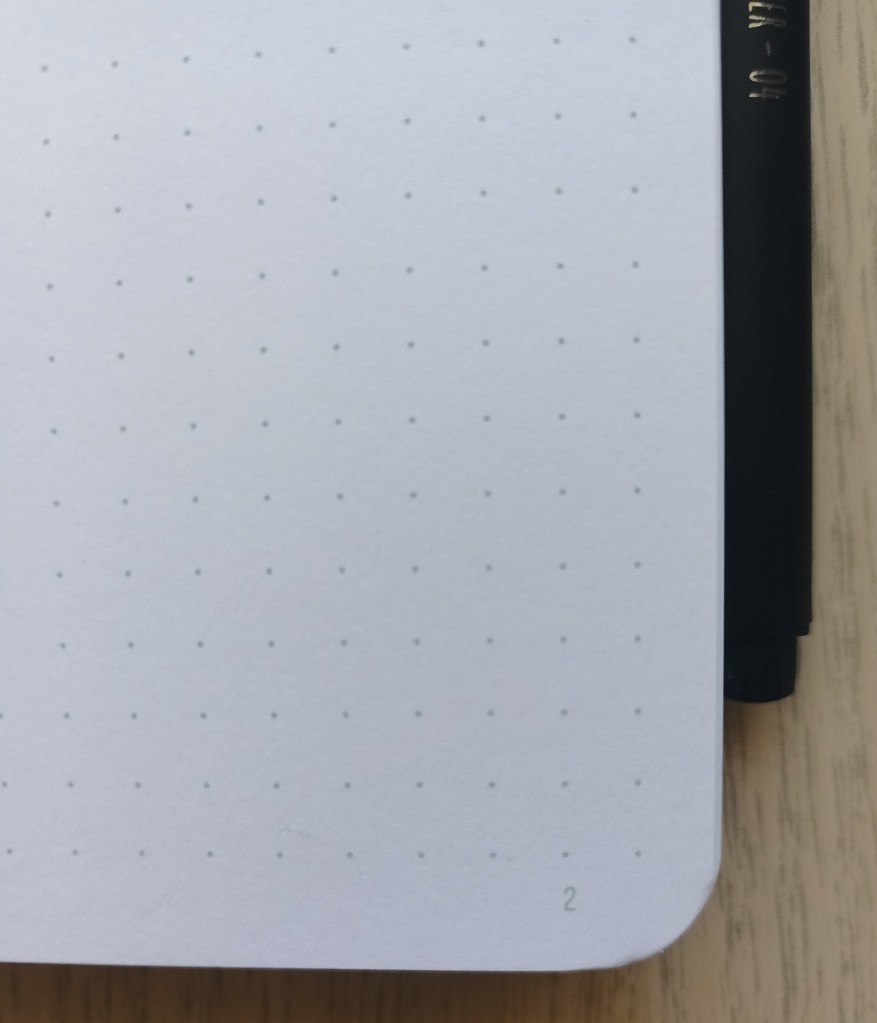
The page numbers are still small and subtle and I like the fact that the pages are numbered as this is not a feature of the NT journals. The dots go right up to the left and right of the page and are a subtle grey. There’s a slightly larger blank space at the top of the page and larger again at the bottom so the page number isn’t in the dot grid space.

5mm dot spacing with subtle page numbering

The paper is white in colour which I prefer to some other brands which have cream or off white pages. This is obviously just my personal preference but it is worth noting. STM say that there should be no ghosting or bleed through on the thicker GSM paper which suits my needs, but again you may prefer a thinner, lighter journal with thinner paper if neither of these issues bother you.

On the inside of the front cover, there’s a pre-printed bullet code page which is useful if you’re new to bullet journalling and need a hand reference. Or, if you want to change up your system. I’ve been using the same ones for years so I will probably cover it over with a motivational quote or something. Next is the name plate page with just has three relatively short lines on which you could write your full name and the date you started your notebook. There’s then a double page which is blank except for a footnote explaining the notebook style and size – A5 dotted and the paper thickness – 160 GSM. There are then 4 indexing grid pages with a blank space for you to write your own title. At the end of the book, there are two pen test pages, although one leaf is much thicker than the other so it’s not really a fair test to explore ghosting and bleed through. Personally, I would prefer the journal to be without these printed pages but they’re ideal for those who are new to bullet journal planning.

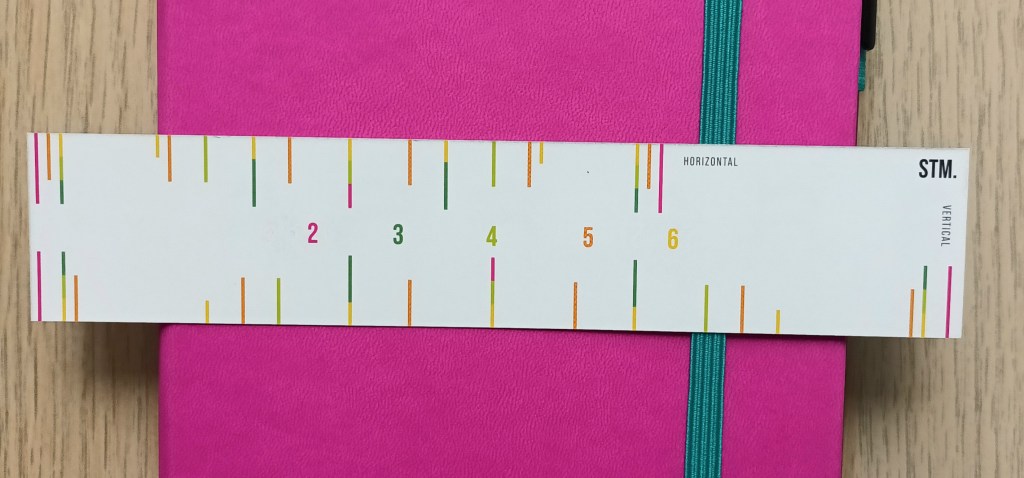
Inside the notebook is a little grid spacing ruler which is new. You can use it horizontally or vertically and it splits the page into 2, 3, 4, 5 and 6 using colour coded divisions. This will probably prove to be a useful addition which just fits in the back pocket.

Handy grid spacing ruler

Final words…

Overall, I’m really pleased with my new journal but I am disappointed that I had to source another notebook as I was looking forward to receiving my Notebook Therapy one. I have emailed them to enquire about what is taking so long but I received a standard reply advising that it may take up to three days for them to get back to me with a personal response. If you’re new to bullet journalling and looking for a quality, mid-price notebook which is made in the UK, then I totally recommend Scribbles That Matters. Any issues I had or questions have been responded to straightaway and I know they have a 100% satisfaction guarantee so that they continue to have very happy customers.

If you have any further questions about the A5 Pro Version journal, feel free to drop them in the comments and I will try my best to answer them.

Posted in goal setting, life hacks, lifestyle, Planning and journaling, productivity, Setting goals and intentions

Monday Matters: A guide to the Pomodoro Technique and how it’s helping me to increase my productivity

It’s been over two months now since I bought a countdown timer from Amazon to use for the Pomodoro Technique which aims to increase productivity. I already felt that I got plenty done each day but I loved the idea of breaking down work into intervals, having regular breaks and knowing how long I’d been hard at it for. I’ve been consistently using the time management method, apart from a week off for Christmas and I thought I’d share what it is and how I feel it’s helping me.

Those of you who have never heard of this technique may be wondering if it is named after a particular person, but you might be surprised to know that pomodoro is actually Italian for tomato. What does a tomato have to do with productivity? Read on and you’ll find out!

What is The Pomodoro Technique?

The Pomodoro Technique is a time management method which was developed by Italian Francesco Cirillo in the late 1980s. At this time, Cirillo was a university student and was struggling to stay focused on his studies. He challenged himself and posed the question ‘Can you stay focused for two minutes without distraction?’. To check if he could, he grabbed his countdown timer from the kitchen which was red and shaped like a pomodoro, or, in English, a tomato. He set the timer, and after two minutes of focused activity, the timer rang and he had achieved his mission. After this, he considered why the use of a timer had worked and he experimented with gradually upping the time and reducing it when it became too much. In the end, he decided that 25 minutes was perfect and that a short break (5 minutes) was required before continuing.

Cirillo carried on experimenting and came up with some basic principles. The timer was an important part but only one element of the method. He suggests the following:

  • Pick one task you want to work on.
  • Set your timer for 25 minutes and place it somewhere highly visible (so you can see how much time remains).
  • When the buzzer goes off, have a 5 minute break.
  • Repeat this with 3 more periods of 25 minutes and 5 minute breaks.
  • Mark each pomodoro with an X when you’ve completed it (this could be on a mini whiteboard, a post-it note or in your planner.
  • After 4 ‘pomodoros’ (work periods of 25 minutes and 5 minute breaks), take a longer break of 20-30 minutes.
  • Once your longer break is finished, go back to step 1.

But what if I have a really long project or lots of short tasks to do?

For complex projects, you should break things down into smaller actionable steps. This will help you avoid overwhelm and ensure you make good progress towards your end goal.

Any tasks which will take less than one pomodoro should be combined with other quick tasks. This might include a range of admin such as book a hairdressers appointment, reply to an email, making a shopping list for the supermarket and reviewing your bank statement.

If you finish your chosen task before the pomodoro timer rings, you should continue to use the rest of your time in a productive manner e.g. by going over what you’ve just learned, making a list of next steps, reading up on a related topic etc.

What should I do during my 5 minute breaks?

When the timer goes off, it’s sometimes tempting to continue working, especially if you’re in a flow state. However, taking breaks is really important if you want to stay productive. What you do during your short breaks is up to you but here are some suggestions that you might find helpful. For me, taking time away from screens such as my computer or my phone is super important and gives my eyes a good rest.

  • Do a short guided meditation
  • Get out in the garden and reap the benefits of fresh air
  • Do some stretches
  • Put on an upbeat track and dance about your kitchen / living room or anywhere with some space to move
  • Take a quick walk for a serotonin hit
  • Drink some water, squash or a flavoured tea
  • Sit in a comfy chair and read a good book
  • Do a mindful activity such as a spot of doodling, a word puzzle, jigsaw or some colouring in.
  • Listen to some music – trying closing your eyes so you really tune in.
  • Watch birds in your garden.

How is the Pomodoro Technique working for me so far?

So far, I’ve found the method to be incredibly effective. I bought my timer hoping that it might help in some small way but I didn’t realise how beneficial it would be as it’s such a simple idea. Here are some of the advantages I’ve experienced so far:

  • Makes it easy for me to get started. When you have a big project to do, it’s easy to get overwhelmed by its size and this can often lead to procrastination AKA putting things off. Contrary to popular belief, for most people, procrastinating is less about laziness and lack of self control, and more about fears of failure or feelings of self doubt. Knowing that I can do things in baby steps where I only have to do 25 minutes before being allowed a break is all the encouragement I need to get started.
  • Increasing my awareness of time. Using the timer makes you really aware of time going by and this encourages you to really focus in on your chosen tasks.
  • One thing at a time. The method encourages you to work on one specific task or a group of related tasks at one time and this helps to prevent the urge to multitask or context switching (where you jump from one task to another) which studies show is detrimental to productivity.
  • Great for avoiding distractions. In some ways, 25 minutes feels like plenty of time but if you don’t use it wisely, it can soon be gone. Because of this, I’ve taken steps to avoid anything which might interrupt my work flow. Depending on the type of work I’m doing, this might include putting my mobile phone in another room, adopting pen and paper methods for recording, switching off notifications and playing background music to block out other sounds.
  • Encourages me to plan my day. Before you start work, you’re encouraged to plan your tasks in advance. This helps you to decide what you want to get done, at what time and how long you think an activity is likely to take. At the end of your working day, you can evaluate your progress and consider if you overestimated or underestimated how much time tasks took. This can then inform your future planning.
  • Ensures I take regular breaks. Taking regular mental breaks from your work helps you to stay focused and remain efficient and productive during your 25 minute time blocks. If you’re working at a desk, it’s really beneficial to get up and move around as this improves your circulation and helps to combat fatigue.
  • Helps me maintain motivation. Seeing the time counting down on the timer in front of you is great for ensuring you work at a good pace. Also, after each session, I mark my progress in my bullet journal and this in itself makes me feel good and gives me the encouragement I need to keep going.
  • Encourages me to be self-evaluative. On days when I feel like I haven’t been super productive, despite using the Pomodoro Technique, I always question why. Common culprits include distractions from notifications or social media (especially if I’m researching something online), working in an untidy environment (meaning I can’t find things I needed) not taking my 5 minute break (or unconsciously extending them), deviating from my plan when I get back to work (because I found something else much more appealing, or when taking a break, engaging in something which didn’t allow me to relax and recharge (e.g. reading news articles online). When I’ve established what the issues are, I can develop strategies to combat them.

Final words…

I hope you have found today’s blog post useful, especially if you are looking for ways to beat procrastination, become more time savvy, and generally work more productively each day. If you want to know even more about the Pomodoro Technique you will find Francesco Cirillo’s book available in e-book format or paperback on Amazon. Also, feel free to ask any questions you may have in the comments and if you already use the Pomodoro Technique, let me know how it’s working out for you.