The Summer is here bringing sunshine and blue skies plus my three monthly life check in and a short update. I encourage all of my readers to give this a go, either as a blog post or handwritten in a journal. They’re great to look back on over the months and years to see how life changes.
Currently reading…
… 5 books at the same time! This is unusual for me as I usually read a fiction book on my Kindle in bed on a night and a non-fiction self development style book in the morning with my coffee but my Five Minute Journal weekly challenge last week was to revisit a previously loved book and I’ve been dipping in and out of two of Amy Tan and Abbey Sy books over the last couple of months. I’m enjoying all of my current reads:
The Midnight House by Amanda Geard
Walk: The Path to a More Mindful Life by Sholto Radford (re-read)
The Art of the Travel Journal by Abbey Sy
Twelve Moons: A Year Under a Shared Sky by Caro Giles (a beautifully poetic memoir)
Craft a Life You Love by Amy Tangerine
Currently creating…
… helpful BuJo spreads for our trip to Norfolk. So far, I have a map showing our route and estimated journey time (a screenshot from Google), information about our accommodation, a list of places to visit such as National Trust properties, wetland centres and the broads, plus veggie and vegan cafes and restaurants nearby. Next to create is my packing list which I hope to get done this afternoon.
Currently journalling…
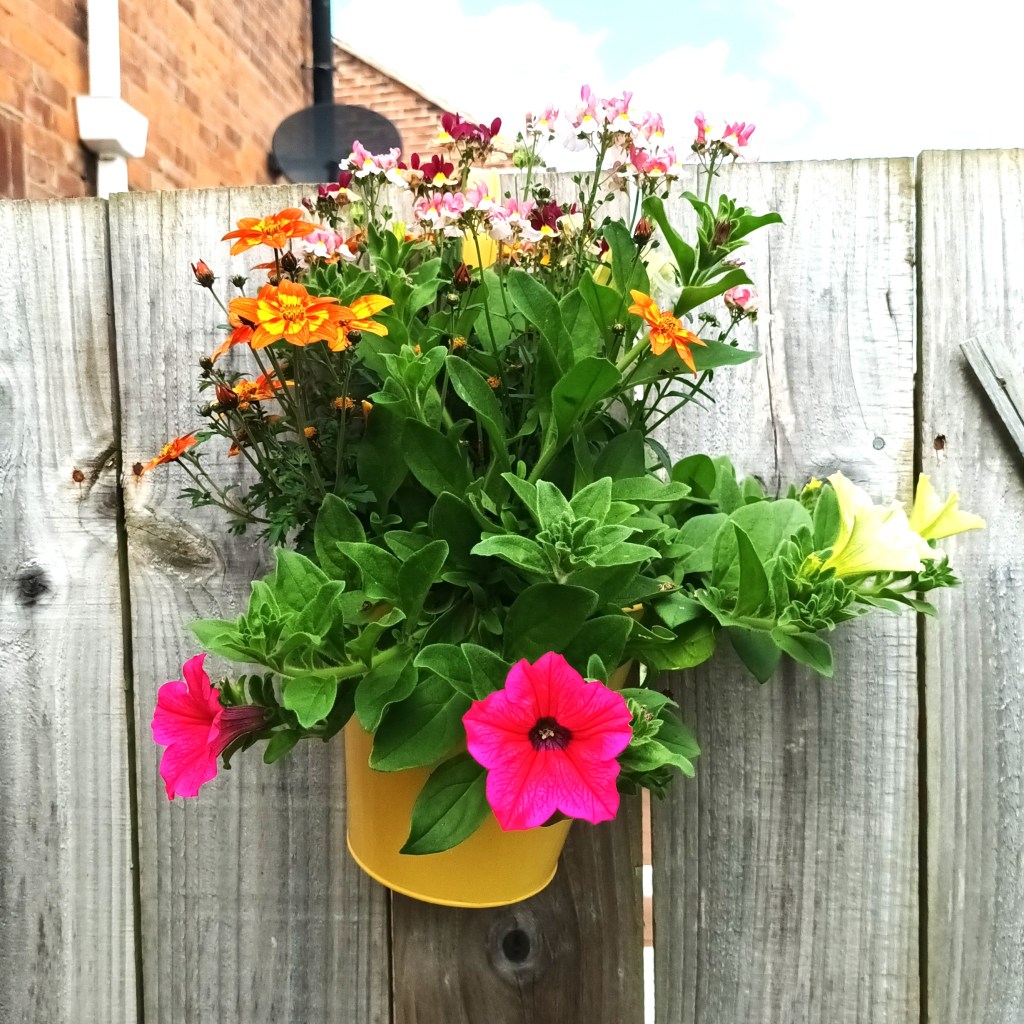
… in my handmade TN insert of a recent trip to Raby Castle for a walk around the grounds and deer park, photos of our new hanging basket and cute yellow hanging tin container, plus a bit about the sun and star necklace that I treated myself to with some of my wages from my uni work (I might have purchased it three weeks before I actually got paid!).
Currently enjoying…
… watching the wildlife in our back garden. Yesterday, there was a huge party of about 15 juvenile starlings on our lawn dipping their beaks in the grass searching for tasty morsels. Out new sunflower hearts seed feeder is very popular with the sparrows and the fat balls are a firm favourite with all of the birds. After dark, I love sitting on our bench, watching a pair of bats hoovering up months and occasionally I catch a glimpse of a visiting hedgehog crunching on his nightly saucer of biscuits. If the hog comes late, we can always check our wildlife cam footage the next day too.
Currently learning…
… more about gardening. So far, I’ve read up on plants for shady areas, how to deal with green and black fly without chemicals, how to grow my own rainbow chard and more about our recent plant purchases. There’s always lots more to learn and websites like the Gardeners’ World and RHS ones are full of helpful information. Also, my mum has been a keen gardener for many years now so has a wealth of experience to draw on to help us.
Currently eating…
… lots of salads and vegan poke bowls as it’s too warm to have the oven on. We had our first poke (pronounced poh-kay) bowl in Vienna and they’re amazing. Plus you can add a rainbow of veggies which makes them super healthy as well.
Currently drinking…
… Pimms and lemonade with fresh strawberries and pineapple mint from our garden. Well, when I say currently, I don’t mean I have a glass on the go right now at 2pm but later in the evening sat outside in the garden is perfect. I also love flavoured cider at this time of year and my favourites are Brother’s Toffee Apple and Strawberry & Lime from Aldi.
Final words…
That’s it for my life update. I hope you enjoyed reading what I’m currently up to. Let me know in the comments if you give this kind of journalling a go and where you choose to write your lists.
Last week, I caught up with a lot of pages in my creative traveller’s notebook journal. I’d had photos and bits and pieces printed for a while and wanted to get them stuck in with typed and handwritten sections of memory keeping and decorative stickers. I’m impressed with how much I got done and for today’s Monday Matters, I’ve decided to share some simple ways in which I ensure I stay focused on the task in hand, concentrate well and improve my productivity levels. So, here’s some tips for better concentration which you can apply today:
Keep hydrated
Throughout the day, I make sure I always have a large bottle of water or squash on my desk to sip from. Keeping myself hydrated helps to prevent headaches, lethargy and decreased alertness – all of which can negatively affect mental performance and workflow. Having a large drink container means I only need to refill during longer breaks and I don’t get thirsty in the middle of tasks.
Eat a healthy diet
We all know that too many junk foods (those which lack nutrients, vitamins and minerals and are high in salt, sugar and fat), are bad for your general health but did you know that they can play havoc with your energy and concentration levels too?
According to my research, the best types of food for improved concentration are:
foods high in omega -3 (I’m trying to snack on chopped walnuts whilst working but I really don’t like them! haha)
foods high in antioxidants e.g. berries, tomatoes and vegetables such as broccoli, cauliflower and cabbage are particularly good and help improve brain function
foods which provide a dopamine boost such as bananas, avocado, spinach, tomatoes, nuts, seeds and chickpeas are great for increased motivation, better mood and improved attention levels
a moderate amount of caffeine, for example from green tea, a small amount of dark chocolate or one or two cups of coffee per day (maximum) can increase mental alertness
foods high in Vitamins B6 and B12 which improve cognitive function – I get my B6 and B12 from fortified oat and soya milk, wholegrain cereal, eggs, nuts and seeds but none vegetarian sources include lean meat and oily fish.
foods high in fibre such as veggies, fruits, whole grains, nuts, seeds and beans which all help to keep blood sugar levels stable preventing spikes and dips in energy
Get some exercise
Exercise is a great stress buster, mood improver and mindful activity, all of which can help with concentration. After a good workout (following the initial tiredness), our mind feels sharper and our cognition improves too. I do yoga, Pilates, Legs, Bums and Tums and Zumba each week but I also make sure I fit in a walk each day, preferably in nature as I find it really calming. I also take mini exercise breaks between working sessions which might involve dancing to a favourite upbeat tune, doing some basic stretches or completing a five minute low impact fat burning exercise such as high knees, modified jumping jacks and oblique crunches.
Work to improve your sleep
At the moment, I generally enjoy a really good night’s sleep and wake up feeling refreshed and ready to start my day. However, in the past, I’ve really struggled with insomnia and know the effect that tiredness can have on both the body and mind. Sorting your sleep out takes commitment but is vital if you want to stay alert and productive during the day. A good place to start is to ensure you find a restful and relaxing activity to do just before bed. However, if you’re really struggling with poor sleep this in depth post should help too.
Take regular breaks
I’ve shared before how I use The Pomodoro Technique to help me take regular breaks during my working day. Taking a short break enables you to rest and recharge ready to continue your task or start a new one. Just make sure that what you do during your break isn’t something just as taxing and mental exhausting as your work related task. Here’s a few ideas:
stretch your legs
grab a refreshing drink
re-fuel with a healthy snack
do a mini meditation
close your eyes and listen to a favourite piece of music (I prefer classical)
tend to your houseplants
declutter your workspace
read a few pages of a book or magazine
close your eyes and do some deep breathing
go outside and explore your environment using your senses
do some doodling
find a new recipe to try (extra points if it’s a healthy one!)
Identify your priorities for the day
Each evening, I like to sit down with my bullet journal and evaluate my day. I then take five minutes to decide what my priorities should be for tomorrow. This could be particular tasks such as shop orders or preparation for a session at the university, but equally, might be wellbeing activities such as enjoying a brisk walk after breakfast or spending some time tending to the garden to get me motivated to do some focused work.
Eliminate distractions
Modern life and technology provide constant sources of distraction which can seriously affect our concentration levels and work rate. However, most of these things are completely within our control and we can choose to do something about them. Here’s a few ideas to get you started:
turn off your email notifications
choose a time (after lunch) to check and deal with emails
put your phone in another room
leave your laptop turned off and adopt pen and paper methods for a while
create a work plan for the next day in the early evening
remember your priorities for the day – work on them first and exclusively at the beginning of your working day
adopt a social media ban habit between set hours of the day
tidy your desk up each evening and between task so you have a tidy environment to work in
Slow down
It might seem counter-intuitive, but slowing down can really help you focus better and get more done. My favourite way to do this is through my morning routine, where I get up early, have a leisurely and mindful breakfast whilst curled up on the settee and then fill in my Five Minute Journal. After that, I do some quiet reading, usually of some kind of self-help type of book but sometimes I choose a beautifully descriptive memoir that I’m currently reading called Twelve Moons. Other ways of intentionally slowing down include:
leaving gaps in your plan for the day to do something relaxing such as sitting out in the garden and feeling the sun or a gentle breeze on your face, working on a puzzle such as a wordsearch or jigsaw, or reading a magazine.
making time for a hobby or a special interest each day, for example, you might read, paint, draw or learn how to play a musical instrument
eating at the dining table and be really mindful of what your eating and how it smells and tastes (leave your phone in another room)
having ‘tech free’ time each day – no phone, laptop, tablet, TV or radio. Enjoy the break and use the time to think or journal about how things are going for you right now
practicing gratitude – this could be as part of your morning routine or something to do before bed
Remember multi-tasking is a myth
It’s a modern belief that being able to multi-task (doing two or more tasks at once) is a desirable quality that leads to better results through an increase in productivity. However, various studies by psychologists have found that our brains are not capable of working on multiple tasks at the same time and what we actually do is quickly switch our attention and focus from one task to another. The negative effects of this include higher stress levels, lack of focus, mental blocks which hamper progress, fatigue, poor problem solving skills and mistakes. The better option, is to select one task at a time, eliminate distractions and cultivate ‘deep work’ which science professor Cal Newport defines as peak concentration that lets you learn hard things and create quality work quickly.
Final words…
I hope you’ve found today’s tips useful and they’ve given you some ideas for simple changes you could make to your working day to aid your concentration and focus. Some of the points may resonate with you more than others and I would suggest you give one or two of these a try first. You should also know, that even though I have good awareness of strategies for aiding productivity, I do have days where I break my own rules and consequently get much less done. However, if I feel like I haven’t achieved a great deal, I will usually sit down in the evening to reflect on why and make plans to do better tomorrow. And, even more importantly, I’ll remember to be kind and self-compassionate by not berating myself for the lack of progress with my to-do list.
What’s your best strategy for improving your focus and concentration? How does it help? Let me know in the comments.
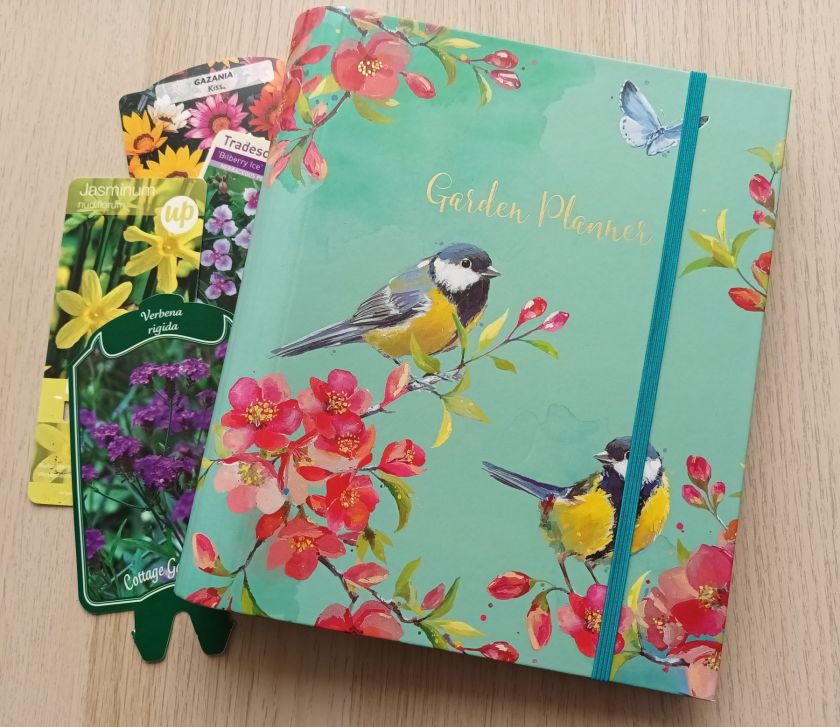
Over the years, I’ve kept various records of plants we’ve put in our garden, and I’ve saved all of the plastic information cards that come stuck in the pots when you buy them. I’ve also made notes in my bullet journal and even drawn plant ID cards for some of my favourite purchases. However, these resources are in an array of different folders and notebooks and often I can’t locate what I need when I want to check something. So, I decided I would like to keep a garden planner / journal and I found the perfect folder when I visited one of my local garden centres and asked my husband if he would like to buy it to give me for Christmas. Of course, any notebook or file would have done, but as someone who adores beautiful stationery, this one provides the motivation to use it regularly and has lots of different papers and pockets to put things in.
I’ve been using the folder since the very beginning of Spring 2023 and so far I’m finding it a really useful record keeping tool. I’m also hoping that by documenting everything garden related, it will help me to feel a real sense of achievement and begin to recognise that all of our efforts are paying off (even when I feel like it’s a constant battle to keep on top of the weeds or a few of our plants aren’t looking their best).
What is a garden planner and journal?
A garden planner and journal is a paper based or electronic place to store everything related to your outdoor spaces and even your houseplants if you so wish. As well as making you super organised it can provide, for example, a place to keep track of what you’ve planted and where, journal space to evaluate what has worked and what hasn’t, pages to record and plan seasonal tasks, list of to dos (AKA jobs for the weekend!), photo showing different parts of your garden over time so you can see and celebrate your achievements over the months and years. You can customise your records to suit your needs but you might include details of your soil in different parts of the garden, information about your various plants and notes on how well they have done depending on their location, ideas you have collected from magazine and online articles, issues you’ve had with some of your plants such as garden pests or poor growth, labelled sketches of flower beds or the garden as a whole, lists of your seed purchases and even a garden wishlist – the possibilities are endless.
Why should I keep a garden planner and journal?
In a nutshell, keeping a garden planner and journal, which you regularly write in, will make you a better and more efficient gardener and enable you to get so much pleasure from your space no matter whether it’s a few containers on your balcony, a tiny plot or a vast amount of land which keeps you constantly busy. Here are my top seven reasons why you should start a garden planner and journal today:
It helps you remember what’s where
Drawing a labelled sketch of the different parts of your garden such as flower beds, vegetable sections, corner plots, rockery etc helps you to remember exactly what you’ve got and where things are located. It can also provide information such as the particular colour or variety of plants.
I’ve also created a list of containers (size, colour and location helps here), what’s in each and when the plant grows and flower so that I know what’s going to pop up when and also, if it doesn’t come back, I can record and evaluate accordingly.
It’s a good idea to sketch your garden each season so you can see what’s in flower at particular times, which veggies are currently being grown and where your evergreen / deciduous shrubs and trees are. Then you can add in your annuals and assess whether there are any gaps which you want to fill.
You can create and maintain weekly and monthly plans
If you love your garden and want it to look good, you need to regularly dedicate time and energy to gardening. My planner contains weekly overviews for each season where you can record particular jobs that need doing each year and also ‘Jobs for the Weekend’ pages for running task lists. It’s really satisfying ticking them all off and it helps us to see what we still need to do and estimate how long each job will take. These task lists can then be revisited next year.
I like to go on reliable websites like Gardener’s World and RHS plus other UK based sites to look at what I should be doing each month and then handpick jobs specific to our garden. I also follow a few UK YouTube accounts for ideas too. You could even keep a list of useful websites in your journal somewhere too.
A place to log new additions to your garden spaces
All gardeners love going to local garden centres and nurseries to choose new perennials plus annual bedding plants for instant colour. You can record all of these in a list, stating where they were purchased and how much they cost, plus key information front the plant labels. getting new bits and pieces for their garden whether it’s a perennial plant, a new pot, a comfortable bench or chair and cushions, so And your new additions list doesn’t just have to be a space for greenery, you can also record new pieces of furniture such as a gorgeous new bench and bright cushions or a little potting bench, atmospheric solar powered or mains operated lights, new paths or replacement gravel, patio slabs, hanging baskets, rockeries, storage spaces such as a little shed or a box to put soft furnishings over winter, and wildlife friendly pieces such as a pond, bug hotel, hedgehog house or toad abode! Then, when you can’t recall how long you’ve had raised bed, you can check your records instead of trying to establish how long it’s lasted from memory.
A good chart to have in your planner is a record of seeds which you plan to set, when and where e.g. in trays indoors or directly into prepared veg beds or outdoor pots, how many to set (usually dependent on size and desired crop), date to set and germination times. You can also include a section for any notes, so, for example we find that our two courgette seeds for the two large plants we want don’t always germinate so we tend to put a couple in each plug or create more plugs.
You can find examples of seed charts on Pinterest for you to draw up (preferably on gridded paper), or, if you’re pushed for time, you can purchase printables on Etsy.
Helps you track progress over time
The other week I found some photographs of my husband sitting out in our back garden a couple of years after we’d moved into our house. I decided to print them out as there’s a huge difference between how the space looked then and what it looks like now less than 10 years later. The transformation is amazing and if we didn’t have a photographic record, I don’t think we would be able to fully appreciate all that we’ve achieved. You might not have photos from a decade ago (or maybe you do?) but why not start recording now and see how your space has changed in one, two or even ten years?
A useful spot to record successes, challenges + complete failures and reflect on why
We’ve been developing our garden for over ten years now and have had many successes but probably just as many failures. Some of the failures are permanently stuck in my memory, like the fact that every time we have tried to grow lupins, no matter where we got the plants from, the ended up covered in aphids which made my skin crawl! Likewise, some of our complete successes still take pride of place in our flowerbeds such as the beautiful, long lasting and colourful geums. However, there are many more triumphs and disappointments that I wish I’d written down and reflected on. Here’s a list of aspects of gardening which you might like to make a few notes on:
garden pests – what specific plants they’ve eaten, when they eat (daytime, night time, particular times of year, following particular weather etc), thoughts about why they eat e.g. slugs and snails love to munch on our dahlia so this year we’ve potted one up, covered the soil in grit and placed it in the front garden porch away from other plants and it’s doing much better
plant diseases and treatment e.g. our hollyhocks get rust every year so I inspect them early on and removed infected leaves quickly and dispose of them
plants which don’t like the conditions – too dry, too wet, hate clay soil, not enough sun/shade etc and whether they are to be moved or just dug up
weather related challenges (e.g. storms, continuous rain, dry spells etc.) and how specific plants coped
seed germination failures – dates planted and when replacements set or when new seeds purchased and set
weed related issues e.g. we have a huge problem with celandine and it’s a constant battle to get rid of them, I spend 10 minutes every day on their removal and I’m glad when they die back by mid May
I’m sure you probably have many more ideas but hopefully these are enough to get you started.
A place to dream, make wishlists, include inspirational images, identify your short and long term goals and make plans of action
If, like me, you have a beautifully, colourful and well maintained garden on your vision board for the future, it’s a good idea to have a section in your journal to include wishlists, inspiring photographs, goals and action steps and maybe even a written explanation of what you want your dream garden to look like and how you want to feel when in it. You can then check in regularly with this section of your journal and see how well you are progressing with your goals. You can also note down things from your wishlist to look for next time you go shopping to one of your local garden centres.
Final words…
As you start your record keeping, remember that your file doesn’t need to be perfect and will most certainly evolve over time. You might want to start by simply taking a few photos of how your space looks now and then making a few notes of some of the plants which are located in each section. Or, if you like drawing and creating diagrams, you might take some squared paper to draw different parts of your plot and label the names of plants currently growing there. I can also recommend colouring in the plants that are currently in flower so you can see the balance across your plot.
Then, on another occasion, you might make a basic to do list (try Googling garden jobs for June and your specific location) for the month and tick tasks off as you complete them. You could even add a few jobs that are already complete or underway to get some easy and satisfying ticks by the end of the week.
I hope you’ve found today’s post useful and it has inspired you to give this form of planning, record keeping and journalling a go. Let me know what you choose to do first and how you get on.
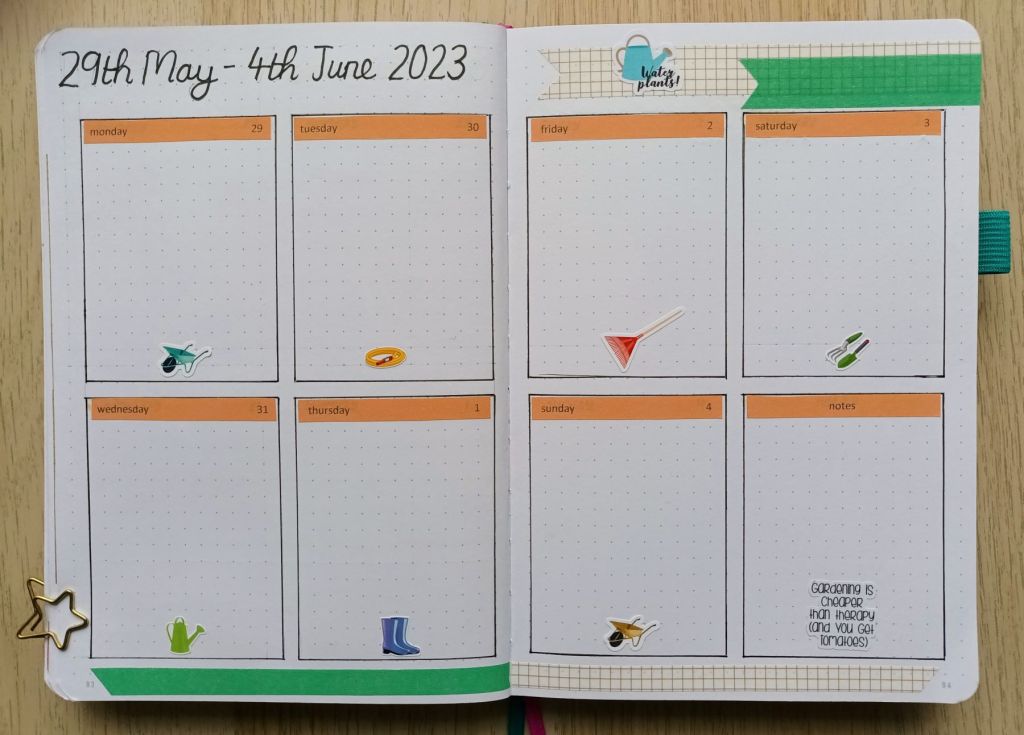
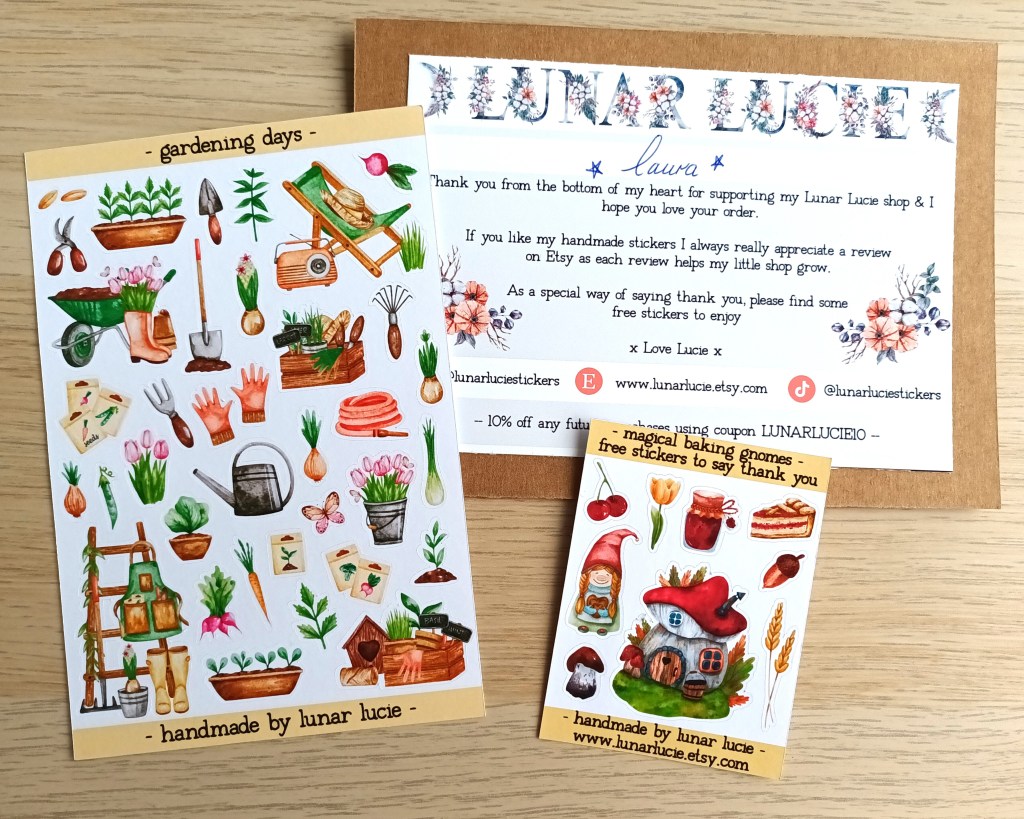
At the moment, my husband and I are busy working on our garden to get it looking neat, tidy and full of colour for the summer. I’ve recently started keeping a gardening journal which includes before photos of the front and back gardens, lists of jobs for the weekend, planting plans and records of seeds set and plants added to the borders. I wanted my theme for June to be bright and cheerful, with easy to set up pages so I decided to order some deco stickers from Etsy for the month. So far, I’ve picked out one sheet of watercolour garden related images and have used them to decorate the cover page and my calendar. I also used some icon stickers for my first weekly spread and will decide if I want to order further stickers to decorate or if I want to do some basic sketches for the rest of the weeks.
If you’re looking to create decorative but quick pages for your bullet journal, stickers and washi can be great options but obviously do incur an extra cost. They’re also great choices if you’re not keen on drawing or need to save time. You can literally type your chosen theme into Etsy, filter to UK sellers only if you need the sticker sheets quickly, select a design sheet which suits your personal style, and then, as soon as they arrive you can get to work planning out where to put them in your spreads. I found that the most frustrating part was creating my grids and lettering and then having to wait for what felt like ages for delivery but the sheet was made to order so had a lead time of two weeks.
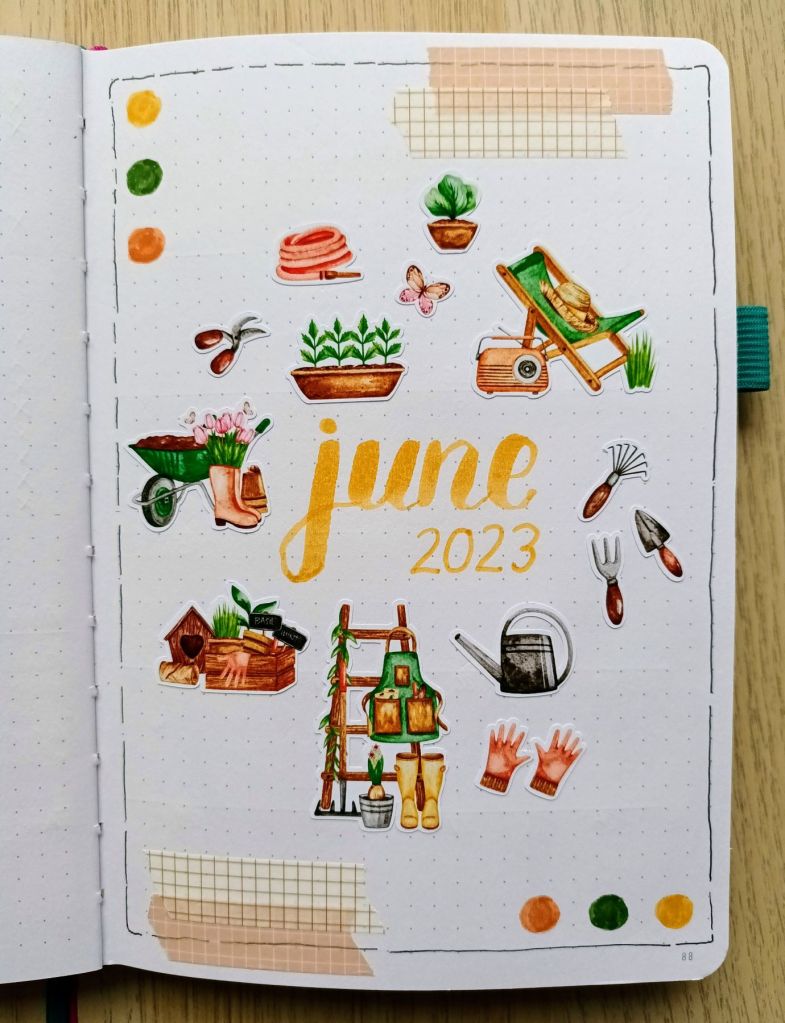
My front cover
I used one of my new Tombows in 991 to add the title to the centre of the page and then created a loose border using a 0.4 pigma micron pen. I then added stickers around the title and placed washi plus some circles to fill in the spaces at the top and bottom.
Photo credit: Laura Jones for Keeping It Creative
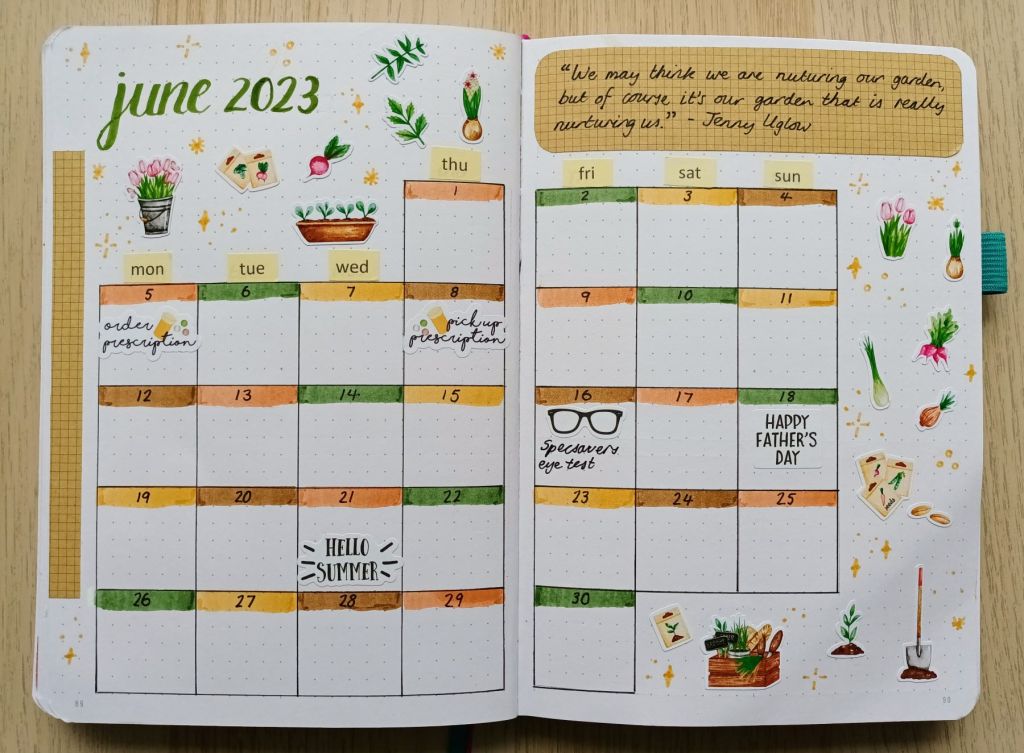
Calendar pages
This is my usual 6×6 grid space calendar layout and I chose four Tombow Dual Tip pens which I tried to match to the stickers. I knew that the colours might not be exact as they can differ on your screen to IRL but I didn’t mind as long as they were close. As I was running short on stickers by the time I’d finished the cover page I added a quote on some kraft grid sticker paper and matched it with a strip on the edge and then used various sparkles to fill in the gaps.
Photo credit: Laura Jones for Keeping It Creative
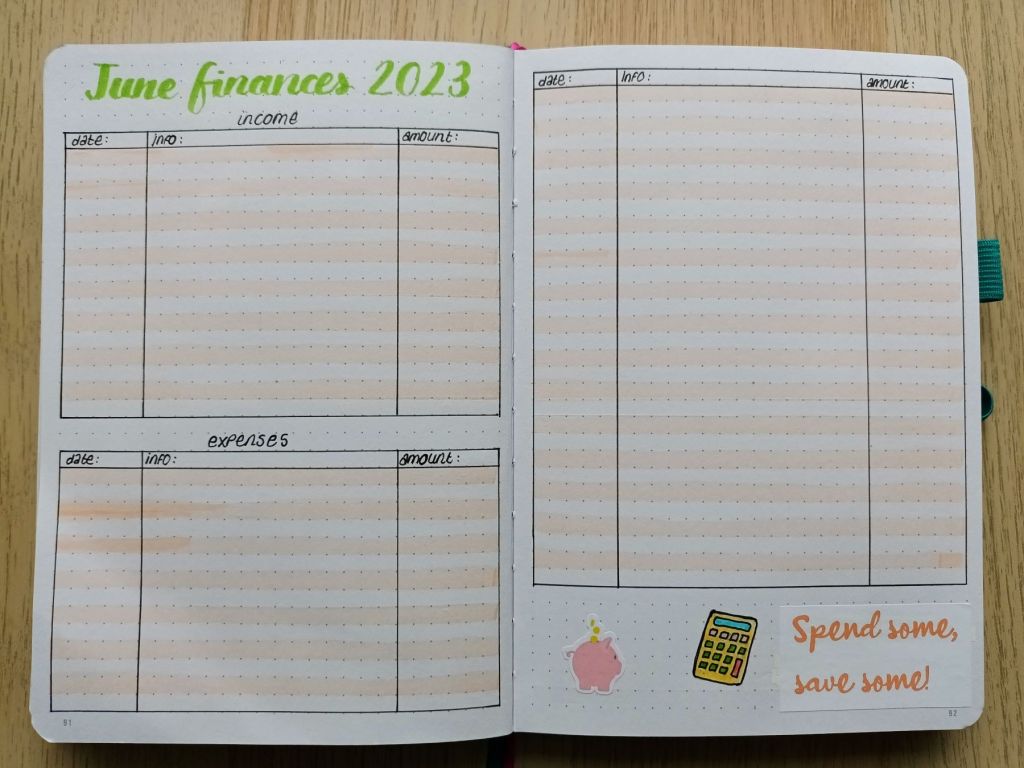
Finances
The layout of my finances spread works really well for me so I use the same design each month. There was a little space at the bottom to add a small amount of decoration using a piggy bank sticker from EllenBeeMakes on Etsy, a hand drawn little calculator and some words which I printed on sticker paper.
Photo credit: Laura Jones for Keeping It Creative
Weekly calendar and rolling weekly to do list
I decided to do a double page weekly for the first calendar page as I have quite a lot planned and needed more room to write. This means that my rolling weekly task list is over the page but I don’t mind flipping back and forth.
Photo credit: Laura Jones for Keeping It Creative
Final words…
I hope you’ve enjoyed looking at my spreads for the month of June. I don’t regularly use stickers to decorate my pages as it would be fairly costly but it is an effective way of setting up quickly and painlessly. I still managed to mess up a few times – once by smudging pen (the joys of being a leftie) and again by dripping cherries and berries squash on one of the pages (planning is thirsty work!) but my white Posca paint pen and some washi fixed those pretty well. Overall, I’m pleased with how everything turned out and I’m looking forward to using my pages.
This blog post first appeared here in March 2019 when my chosen word of the year was resilience and I was spending a good deal of time reading articles and books to help me improve mine. I hope my updated post proves useful to anyone looking for a few ideas on the topic to support their good mental health.
What do we mean by the term ‘resilience’?
Resilience can be defined as the ability to cope with and rise from all of the challenges, problems and set-backs that life throws at us and come back stronger. When we develop our skills and personal strength in this area, we are able to handle our difficulties more easily and this can improve our overall mental health.
The following ideas were collected at a time when I was in a good place and have helped me during periods of depression and low mood. I hope you find them useful too. Even if you are in a period of good mental health right now, it can be useful to learn ways to develop your resilience for times in the future when you may need a boost.
Try to remain optimistic
It can be difficult to remain optimistic when faced with challenges in life but maintaining a hopeful outlook is an important part of resilience. Try to have a positive mindset and encourage thinking such as ‘it’s not the end of the world’ and ‘things will get better’. Remember that set backs are temporary and remind yourself that you are strong and that you have the skills and abilities to face your difficulties.
When negative thoughts pop into your head, try to replace them with something more positive such as ‘I have lots of friends who will support me through this’, ‘I am good at solving problems’, ‘I never give up’, ‘I am good at my job’ etc. Also, choose to see challenges and bad experiences as an opportunity to learn. Ask yourself ‘What can I learn from this situation?’, ‘What is this trying to teach me?’ ‘What positives can I take from my experience?’.
Mindfulness
Mindfulness is all about awareness in the present moment – our thoughts and feelings and the world around us. It involves the use of techniques such as meditation, breathing and stretching exercises and can help you to stay calm and in control of your emotions.
When practising mindfulness you begin to notice how thoughts come and go in your mind. You learn to accept these thoughts without judgement and develop your ability to let them go. In addition, you are able to tune in to what your body is telling you and notice signs of stress and anxiety so that you can release tension as you meditate.
Support Network
It’s really important to have people who you can turn to at times of need. Building and nurturing constructive relationships with positive and supportive friends, family and colleagues is an essential part of wellbeing and staying resilient. They can provide a listening ear, positive encouragement, advice or help you celebrate your achievements. Having a good support system in place has also been shown to boost self esteem, confidence and better self image.
If you feel you need to widen your support network, there are many opportunities to do so either in your local community or through online groups. Try your local library, community centre or college for clubs and classes or try to find out about volunteering opportunities in your fields of interest.
A resilient body
We’ve all heard the expression ‘healthy body, heathy mind’ and keeping yourself well is another key part of resilience. Try to eat regularly and make sure you get plenty of good for you fruit and veggies in your diet. Find a type of exercise that you enjoy (personally, I love countryside walks and dancing), and schedule in a time for this each day. Also, remember to take time out to relax and recharge. It’s not self indulgent to schedule in some me time each day, it’s a key part of coping with our busy and stressful lives.
Good sleep is also vital for a healthy lifestyle and better mental health. Try to develop a good relaxation routine each evening – listen to some calming music, dim the lights, meditate or have a warm bath. Many people recommend writing in a journal as a way of putting the day to rest so that you don’t have lot of thoughts buzzing around in your head when you climb into bed. If you want to learn more about this technique click here.
Ideas to try in your bullet journal
Create a positive affirmations page and read them every morning. Examples of affirmations include ‘I am strong’, ‘I see the bright side in all situations’, ‘I radiate positive energy’.
Add some of your favourite positive quotes to your weekly plan.
Write a list of ways to reward yourself for your achievements such as ‘have a relaxing bubble bath’, ‘paint your nails’, ‘buy yourself some planner stickers’, ‘treat yourself to your favourite bar of chocolate’ etc.
Practise gratitude by keeping a ‘one line a day’ log where you write in something you are grateful for on that day. You can include anything you want such as ‘the helpful magazine article I read yesterday’, ‘a kind text from my friend’, ‘3 new shop orders today’, ‘the lovely feedback I received’ etc
Make a ‘Things That Make Me Happy’ page and use it to remind you of all the good things in your life.
Produce a list of creative activities that you enjoy and find the time to schedule at least one of them into your busy week. Getting involved in art and creative tasks has been proven to reduce stress and it’s another mindful activity which can provide a welcome distraction from negative thoughts or anxieties.
Keep a daily journal in which you evaluate your day. It will help you to focus on the positives and any challenges that you met. You can also use your journaling as a space to assess your issues and any ideas you may have for solving them.
Final words…
I hope you have found these tips useful and will try out some of the ideas in your notebook or bullet journal. Of course sometimes, during periods of depression, it is really difficult to see a way forward back to better mental health and it may be that if you’re really struggling, the help of a trained therapist might be the best form of help. I have found CBT style therapy particularly useful in the past and still apply what I’ve been taught over the years. Skills associated with resilience take time to develop but I believe that everyone has the capacity to learn.