This blog post first appeared here in March 2019 when my chosen word of the year was resilience and I was spending a good deal of time reading articles and books to help me improve mine. I hope my updated post proves useful to anyone looking for a few ideas on the topic to support their good mental health.
What do we mean by the term ‘resilience’?
Resilience can be defined as the ability to cope with and rise from all of the challenges, problems and set-backs that life throws at us and come back stronger. When we develop our skills and personal strength in this area, we are able to handle our difficulties more easily and this can improve our overall mental health.
The following ideas were collected at a time when I was in a good place and have helped me during periods of depression and low mood. I hope you find them useful too. Even if you are in a period of good mental health right now, it can be useful to learn ways to develop your resilience for times in the future when you may need a boost.
Try to remain optimistic
It can be difficult to remain optimistic when faced with challenges in life but maintaining a hopeful outlook is an important part of resilience. Try to have a positive mindset and encourage thinking such as ‘it’s not the end of the world’ and ‘things will get better’. Remember that set backs are temporary and remind yourself that you are strong and that you have the skills and abilities to face your difficulties.
When negative thoughts pop into your head, try to replace them with something more positive such as ‘I have lots of friends who will support me through this’, ‘I am good at solving problems’, ‘I never give up’, ‘I am good at my job’ etc. Also, choose to see challenges and bad experiences as an opportunity to learn. Ask yourself ‘What can I learn from this situation?’, ‘What is this trying to teach me?’ ‘What positives can I take from my experience?’.
Mindfulness
Mindfulness is all about awareness in the present moment – our thoughts and feelings and the world around us. It involves the use of techniques such as meditation, breathing and stretching exercises and can help you to stay calm and in control of your emotions.
When practising mindfulness you begin to notice how thoughts come and go in your mind. You learn to accept these thoughts without judgement and develop your ability to let them go. In addition, you are able to tune in to what your body is telling you and notice signs of stress and anxiety so that you can release tension as you meditate.
Support Network
It’s really important to have people who you can turn to at times of need. Building and nurturing constructive relationships with positive and supportive friends, family and colleagues is an essential part of wellbeing and staying resilient. They can provide a listening ear, positive encouragement, advice or help you celebrate your achievements. Having a good support system in place has also been shown to boost self esteem, confidence and better self image.
If you feel you need to widen your support network, there are many opportunities to do so either in your local community or through online groups. Try your local library, community centre or college for clubs and classes or try to find out about volunteering opportunities in your fields of interest.
A resilient body
We’ve all heard the expression ‘healthy body, heathy mind’ and keeping yourself well is another key part of resilience. Try to eat regularly and make sure you get plenty of good for you fruit and veggies in your diet. Find a type of exercise that you enjoy (personally, I love countryside walks and dancing), and schedule in a time for this each day. Also, remember to take time out to relax and recharge. It’s not self indulgent to schedule in some me time each day, it’s a key part of coping with our busy and stressful lives.
Good sleep is also vital for a healthy lifestyle and better mental health. Try to develop a good relaxation routine each evening – listen to some calming music, dim the lights, meditate or have a warm bath. Many people recommend writing in a journal as a way of putting the day to rest so that you don’t have lot of thoughts buzzing around in your head when you climb into bed. If you want to learn more about this technique click here.
Ideas to try in your bullet journal
Create a positive affirmations page and read them every morning. Examples of affirmations include ‘I am strong’, ‘I see the bright side in all situations’, ‘I radiate positive energy’.
Add some of your favourite positive quotes to your weekly plan.
Write a list of ways to reward yourself for your achievements such as ‘have a relaxing bubble bath’, ‘paint your nails’, ‘buy yourself some planner stickers’, ‘treat yourself to your favourite bar of chocolate’ etc.
Practise gratitude by keeping a ‘one line a day’ log where you write in something you are grateful for on that day. You can include anything you want such as ‘the helpful magazine article I read yesterday’, ‘a kind text from my friend’, ‘3 new shop orders today’, ‘the lovely feedback I received’ etc
Make a ‘Things That Make Me Happy’ page and use it to remind you of all the good things in your life.
Produce a list of creative activities that you enjoy and find the time to schedule at least one of them into your busy week. Getting involved in art and creative tasks has been proven to reduce stress and it’s another mindful activity which can provide a welcome distraction from negative thoughts or anxieties.
Keep a daily journal in which you evaluate your day. It will help you to focus on the positives and any challenges that you met. You can also use your journaling as a space to assess your issues and any ideas you may have for solving them.
Final words…
I hope you have found these tips useful and will try out some of the ideas in your notebook or bullet journal. Of course sometimes, during periods of depression, it is really difficult to see a way forward back to better mental health and it may be that if you’re really struggling, the help of a trained therapist might be the best form of help. I have found CBT style therapy particularly useful in the past and still apply what I’ve been taught over the years. Skills associated with resilience take time to develop but I believe that everyone has the capacity to learn.
This month, we’re finally going on our long awaited holiday to Vienna in Austria. It was originally planned for August 2020 but in March of that year, obviously COVID-19 hit and our flights were cancelled. My husband re-arranged for May 2021 but restrictions were still in place, so we made the decision to wait for another year. Everything is now booked (including an overnight stay in a hotel in Manchester as our flight is from there) and during the last month we have again started to think about what we’re going to take with us in the hold and in our hand luggage and what we want to see and do over the 5 days.
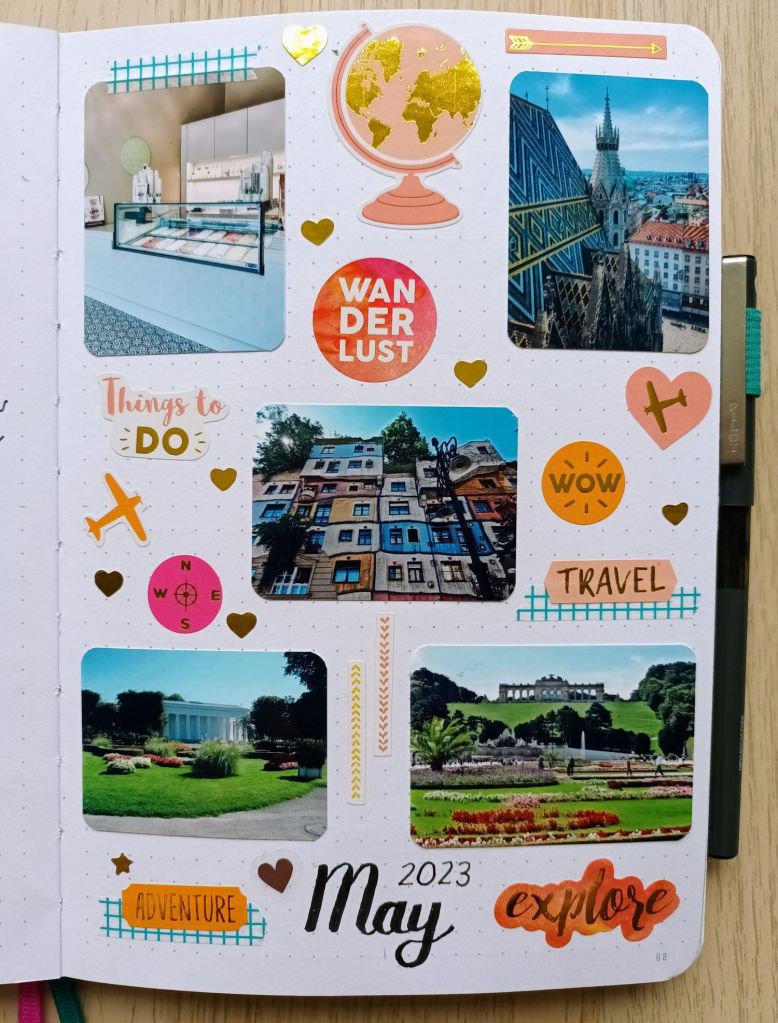
As we were making our plans, I decided it would be nice to create scrapbook style spreads with photographs of our hotel, plus must visit locations including parks, buildings and attractions. I’ve not finished all of my travel planning spreads yet but I’m making good progress and I’m happy with everything I’ve done so far.
My cover page
After printing mini photographs on my Canon Selphy printer, I chose 5 of them to include on the front cover. Whilst searching through my journalling supplies, I found a small travel themed sticker book with mini word and icon stickers plus some tiny hearts to fill in the spaces. I also treated myself to some new washi tapes from Stationery Pal and they arrived just in time for me to use one of them in my spreads.
Photo credit: Laura Jones for Keeping It Creative
Monthly calendar
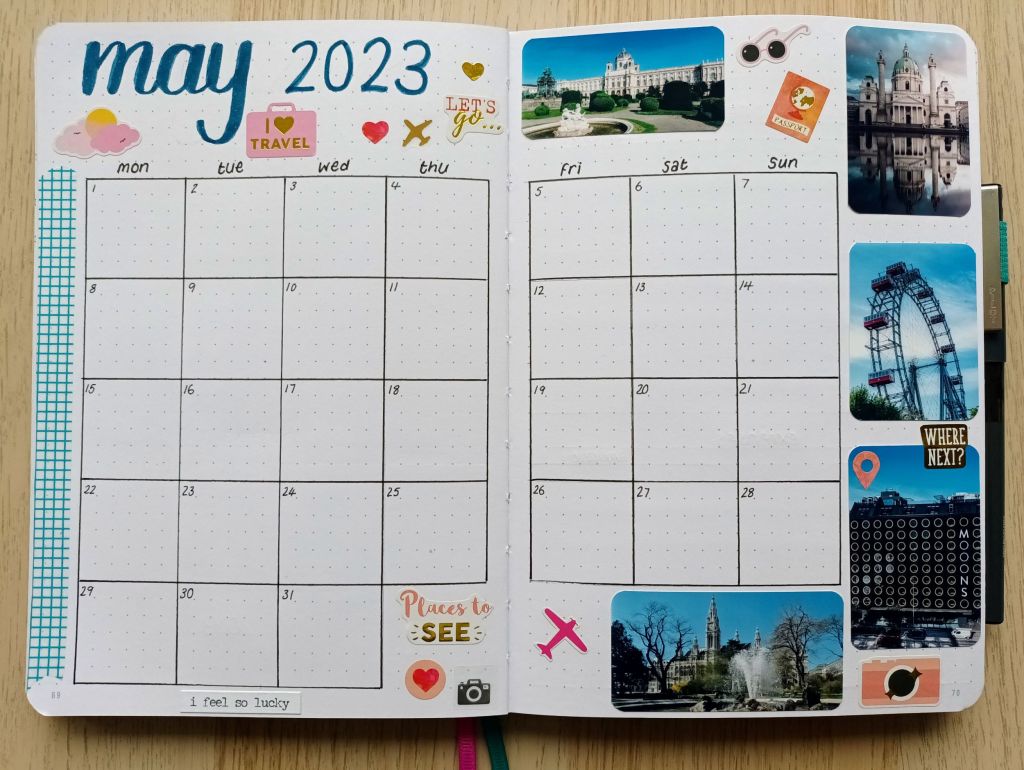
I’ve gone back to the slightly larger boxes for this month so I have plenty of room to record my university work, fitness classes and travel plans. Again, I’ve included mini photos of popular places in Vienna to visit and then filled in the spaces with more of the little stickers from by booklet. I didn’t really come up with a colour scheme but I wanted to go for different shades of blue to match with the bright blue skies in some of the photos.
Photo credit: Laura Jones for Keeping It Creative
May finances
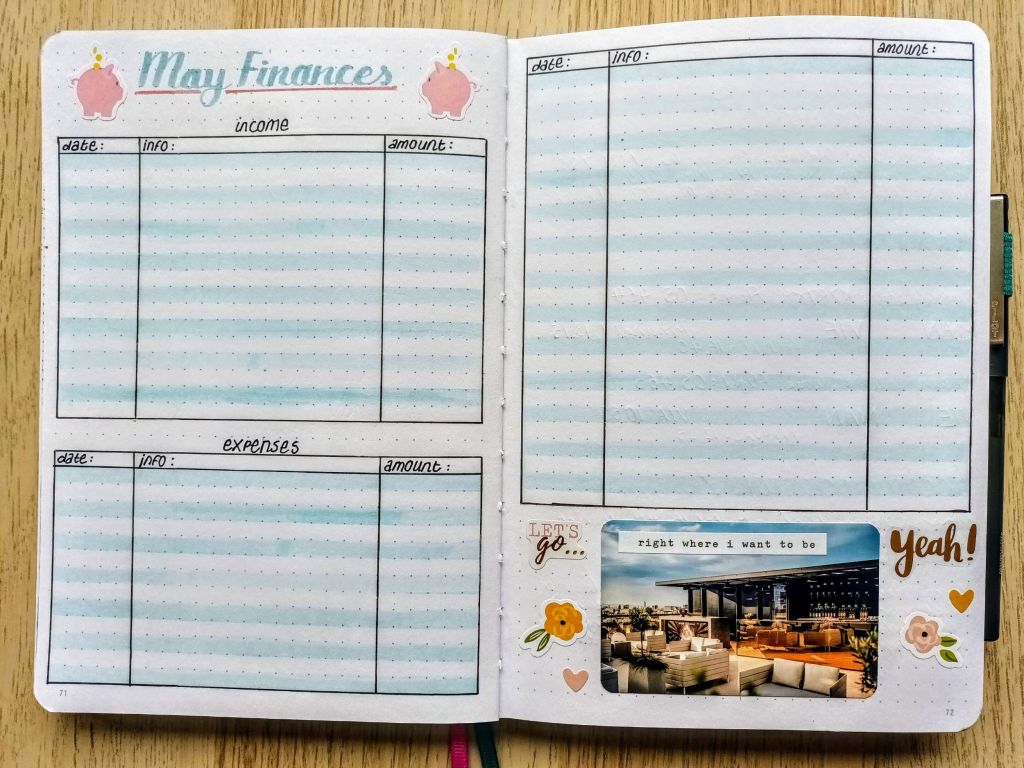
I’m sure we’ll be spending lots in May with all the bank holidays and our trip do I’ve made my expenses section a little bigger than last month. I decided to include a photograph of the amazing rooftop bar in our hotel as I reckon we’ll be spending time and money there relaxing with a cocktail or two!
Photo credit: Laura Jones for Keeping It Creative
Travel information spreads
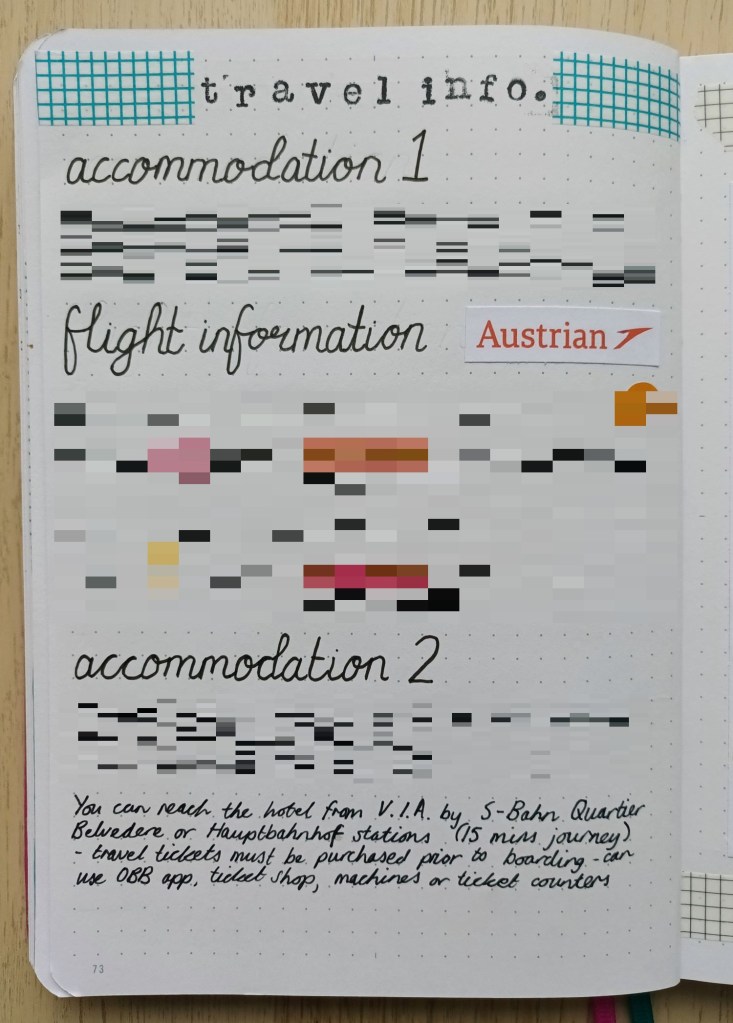
I want us to be super prepared for our trip as it helps to keep travel anxiety at bay. The booking information is all in various emails so I asked my husband to forward everything to me so I could add everything to my bullet journal. I understand why everything is done electronically now but I used to like paper copies so that I could stick things into my Traveller’s notebook as part of my scrapbooking.
So far, I’ve got our Manchester hotel booking information, the outbound and return flight details and our hotel booking information for Vienna. I’ve also written details of the train we can catch from airport and the stations we can alight at. I’ve pixelated the specifics for privacy reasons!
Photo credit: Laura Jones for Keeping It Creative
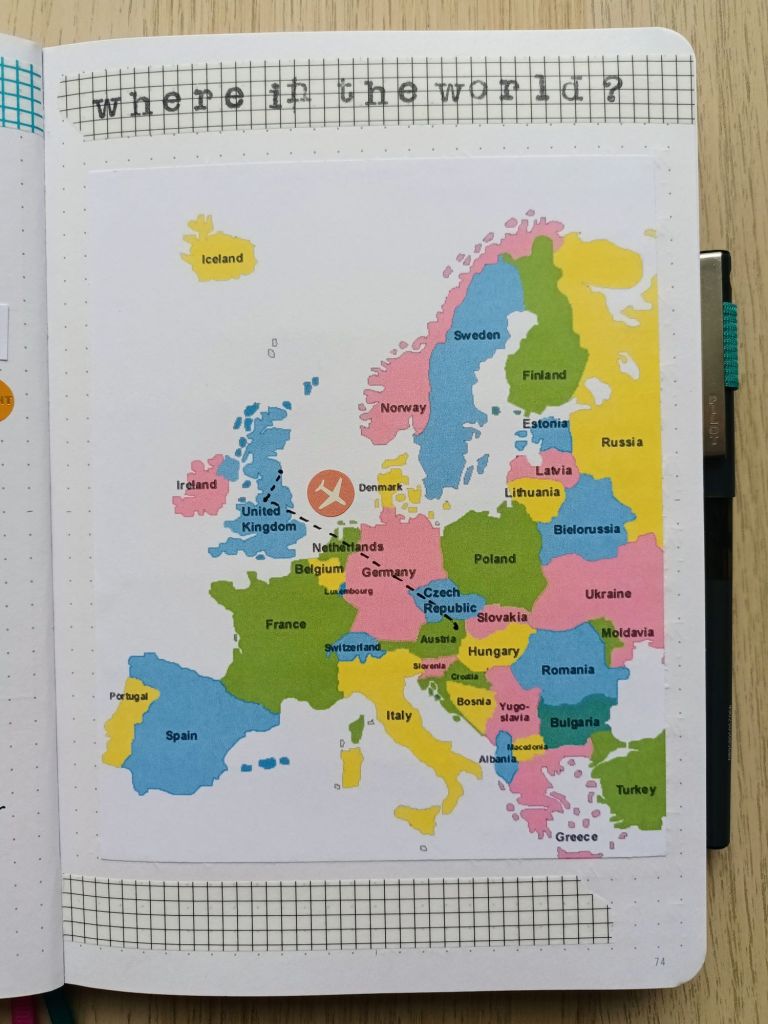
On the next page, I’ve included a map of Europe which shows Sunderland to Manchester (as the crow flies!) and the route from Manchester Airport to Vienna International Airport. It was also good to learn more about the countries which border Austria too. The ink I used for the stamping is Stazon which claims to allow you to use it on any surface so I tried it out on the top of one of my grid washis and it printed and dried really well.
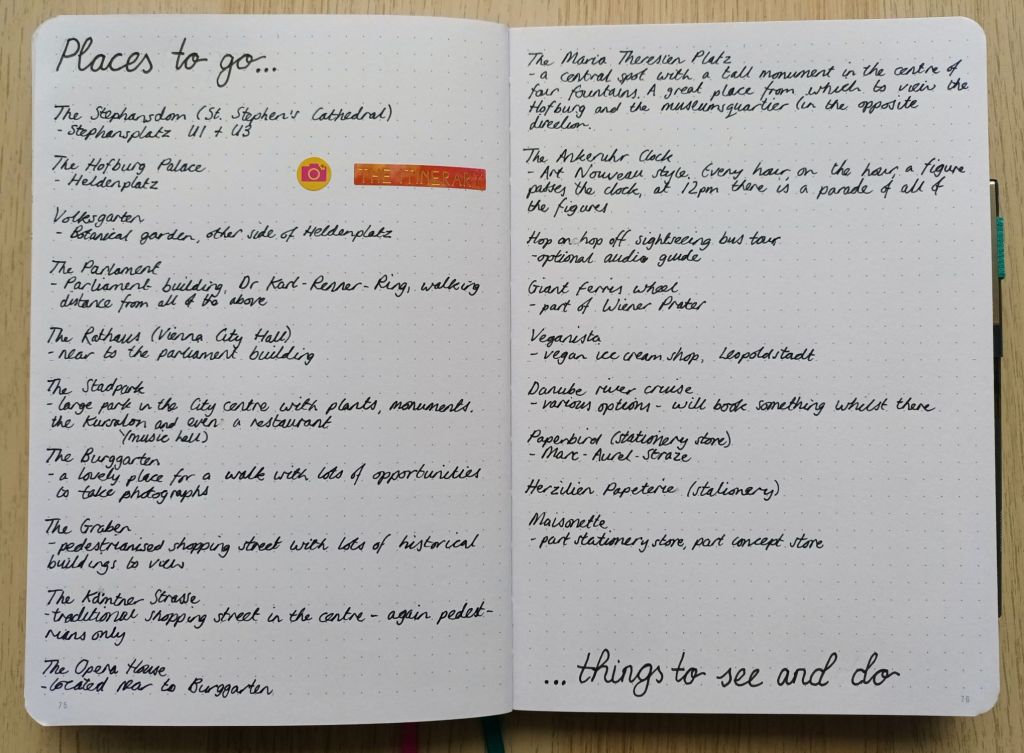
Over the page, I’ve listed the must see and must visit places on a double page spread. This has helped me to create an itinerary for the first full day we are there.
Photo credit: Laura Jones for Keeping It Creative
The next spread I have planned is a list of veggie / vegan cafes and restaurants which we might go to. I’ve tried looking at the menus for various places but most of them seem to be in German. I hope they have English menus as well as I can only speak / read about five words and none of them are food names.
My final travel spread will be my comprehensive packing list. I always do one of these no matter where we are headed and for how long as it ensures I remember everything and helps me to stay calm during the packing process. In the past, sorting everything out for a trip has made me really stressed out so I now do whatever I can to make the process easier and less fraught. Does anyone else find packing and organising for a holiday stressful?
Final words…
I hope you’ve enjoyed seeing my spreads for this month and that they’ve given you some ideas for travel planning and preparation. Obviously, for privacy reasons, I haven’t shown the exact dates for our trip or any specifics related to our journey or accommodation but I’m sure you get the idea and I may share my filled in pages on social media when we return.
Wishing you a wonderful May, whatever your plans are for the month,
This week, as my craft room is very chaotic due to my decluttering, I decided to bring my laptop downstairs and work at the dining table. This has given me the chance to open the patio doors on warmer days and listen to the birds in the garden. As well as it being milder, we’ve also had sun and rain creating rainbows and quite a few windy days. Just outside, we have a bright windmill stuck in a plant pot and it’s currently spinning round so fast the colours are merging! Although the wind here tends to be cold, at the moment, it’s not too bad – making me think that it’s perfect weather for kite flying. It’s this thought that gave me inspiration for my bullet journal theme for April. I’m excited to share my pages super early – it was certainly time consuming to create them so I hope you like them!
My cover page
Before designing my spreads, I like to have a look on Pinterest, YouTube and Google to see if my chosen theme has been done before. I found relatively few examples but my pages were inspired by the beautiful work of Claudia Joseph and her set up video. I’ve made it my own by choosing a different colour palette of primary and secondary colours, an alternative combination of art supplies and a number of pages which I know I’ll make use of next month.
I had the idea of creating a mixed media cover page with a pale watercolour wash and inked kites filled in with felt tip pens. For this, I decided to use my masking fluid on the kite shapes and then create a pale blue using cerulean blue and chinese white watercolour. Ask I hadn’t used masking fluid in my bullet journal before, I decided to test it out in the back of my notebook. I’m glad I did, as, although the watercolour itself looked good, the masking fluid pulled the coating off my page in several places and looked a mess. I also tried using my Tombows to colour in the kites and wasn’t happy with the results of that either!
In the end, I decided not to colour the background as sky and settled for ink and coloured pencils for the kites. I had used them in the past in my bullet journal to good effect with the only problem being colour transfer to the opposite page when completing later spreads. In an attempt to solve this, I popped to The Range and picked up a small can of Winsor & Newton Fixative to spray on my pages. This seems to have worked well and although it has an awfully strong chemical smell to it which permeates the air, I’m glad I purchased it.
Here’s the result using Staedtler Ergosoft Coloured Pencils, a Derwent colourless blending pencil, a 0.1 Pigma Micron (which broke on me halfway through but luckily I had a spare in my stash), a grey Zebra mildliner and the small tipped end of a Tombow dual pen for the writing.
Photo credit: Laura Jones for Keeping It Creative
To make sure my kites were neat and symmetrical, I folded a piece of thick paper and cut out designs in different sizes. I then drew around the stencils lightly in a 2H pencil. I’ve always used a HB to sketch out my designs but a 2H is much lighter – you just have to make sure you don’t press on too hard and it easily dents the paper (I’ve realised to my cost!).
My double page calendar page
I decided to try out a slightly different set up for my calendar boxes this month with individual 5×5 squares. I drew it up lightly in pencil first and then used the bullet pointed end of some of my Tombows. Creating the squares was made much easier by using a Helix metric squares template which I remembered I had as part of my supplies. I mostly love how the double page has turned out – it’s so bright and colourful and I think it will be a joy to see each day. The only thing that’s annoying me about it is that I pressed on a little too hard with the colouring in on front cover and it has dented the paper and caused it to be raised on the left hand side of the spread. I tried ironing it flat but it didn’t work as the paper has been stretched. Looking at it positively, I’ve certainly learnt something and hopefully I’ll remember this next time.
Photo credit: Laura Jones for Keeping It Creative
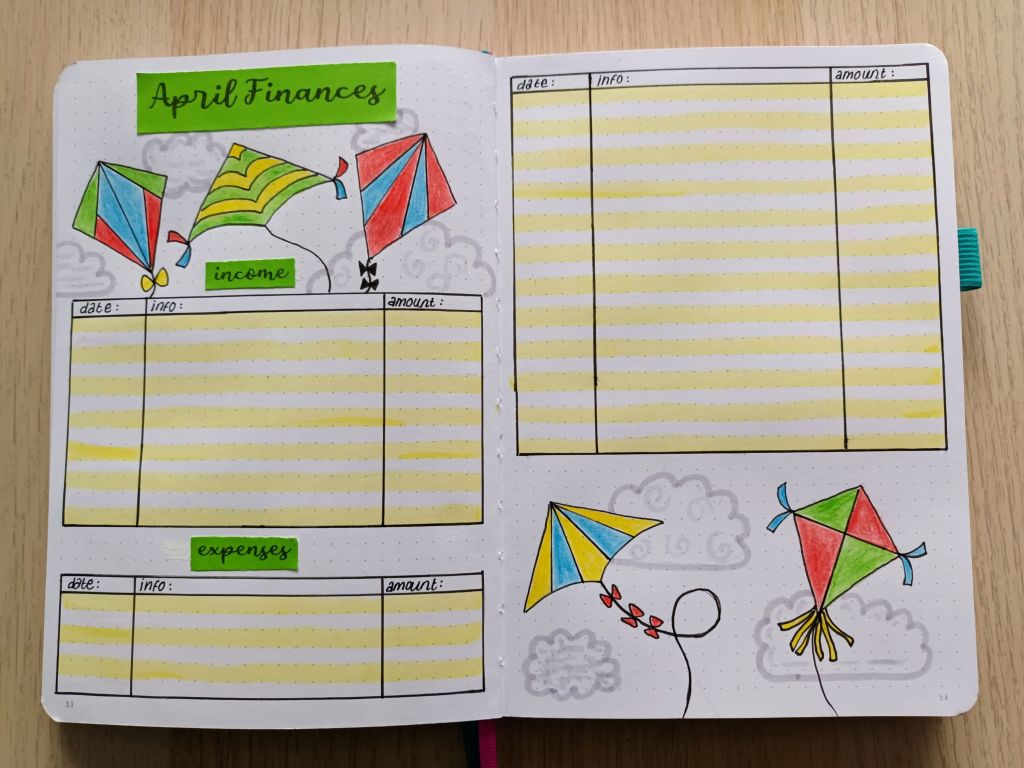
Finances for April
If you’re a regular here on my blog, you might notice that I’ve made the expenses section shorter for April. This is because I’ve had very little work at the university in March so my income will be a lot less. For this reason, I hope to have a low spend month. This has also meant that I had some space to do a little more decoration.
Photo credit: Laura Jones for Keeping It Creative
Final words…
Just like watercolour painting, drawing and colouring in is are great mindful and meditative activities and both provide a wonderful way to relax and de-stress. Although the pages for April were quite time consuming, it was nice to try something a little different and I like the way they’ve turned out. I might even use the bright coloured Tombows to draw out my weekly plan for the first full week of the month, rather than the usual fineliner.
I hope you’ve enjoyed seeing my spreads and I look forward to seeing the work of other bullet journalists on social media over the next week or so.
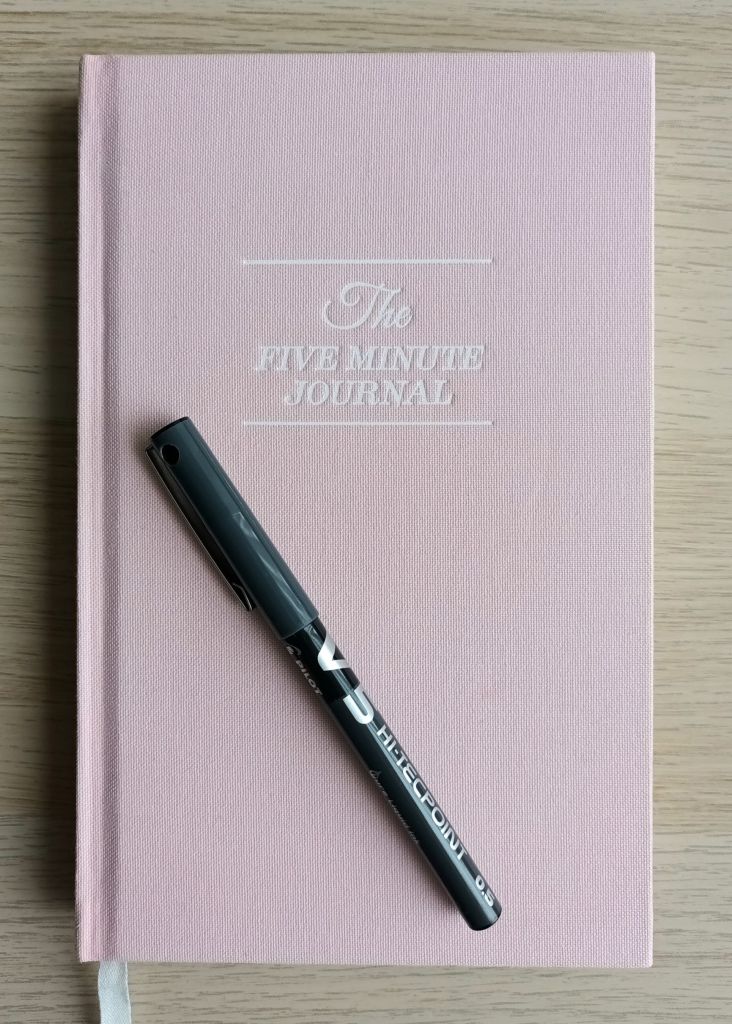
I first came across The Five Minute Journal when watching YouTube vloggers sharing their relaxing yet productive morning routines. I was interested to find out more about the journal, so I checked out a few video walkthroughs and found that many people were saying it was a life changing practise for them and one which really helped improve their mental health.
As someone who will try anything to improve my health and wellbeing, I decided to give it a go (even though I felt that the journal was quite expensive). I’ve been using it for nearly two weeks now, and I’m really enjoying it and benefitting from the quiet thinking time it provides first thing in the morning and last thing at night. So, today, I thought I’d share my thoughts on The Five Minute Journal, my experiences of using it and ways in which it’s helping me.
Photo credit: Laura Jones for Keeping It Creative
What is The Five Minute Journal?
The Five Minute Journal is a product created by Intelligent Change and is one of a small number of tools which promises to positively change your life in just five minutes a day. The company claim that you will love the journal for five very particular reasons:
It’s the simplest thing you can do to be happier – due its focus on positivity, structured approach whilst keeping it simple and easy to stay consistent
It’s built on proven psychology – it’s better to focus on positive behaviour traits and creating simple but effective routines
It’s a journal for people who don’t write journals – it takes just five minutes a day and so is ideal for time pressed individuals who have always loved the idea of keeping a journal but have, in the past, tended to make excuses for not doing so.
It’s a snapshot of your positive experiences – it’s a wonderful record of all things positive in your life and just flipping back to a certain day should help evoke the feelings that accompanied the memories.
It’s a commitment you can stick to – as well as the five minute promise, the book is also full of tips and ideas at the beginning which help you to get started and stay committed to the process
Key features of the book
The Five Minute Journal is a hard back book with a linen cover and comes in an original natural linen covered or a choice of five other colours namely royal blue, earth green, blush pink, bold black and sunshine yellow. I opted for the pink colour but from my research, it looks like the original colour is the most popular choice.
The book consists of over 260 pages, with approximately 30 pages explaining how the journal works at the beginning, 6 months worth of daily journalling pages and 11 ruled pages for notes at the back. The pages are a cream colour and feel like good quality. Having used a ball point pen and not being happy with my handwriting, I have since tried a few different pens out on the note pages at the back with no bleed through so I will be converting to a finer nibbed liquid ink which I use in my bullet journal.
As part of the introductory pages, you are invited to create a written commitment which encourages you to think about your reasons for wanting to keep the journal, a reward which you could give yourself if you stick with writing for 5 days, a promise to yourself if you don’t manage 5 consecutive days and your own ideas of how you can ensure you practise daily. In addition to this, you identify one of your biggest current challenges in life, an identity statement that remedies the challenge, major obstacles to writing on a daily basis and actions you can take to overcome these obstacles.
Each page in the daily journalling section of the book consists of a space to write the date, followed by a motivational quote or a weekly challenge (once every seven days or so) and then a section for morning and night time entries. In the morning, you are advised to write as soon as you wake up as it is the perfect opportunity to set a positive tone for the day. The day time section prompts you to write 3 things you are grateful for, 3 things that would make the day great and one daily affirmation
My thoughts on the process so far
I found the introductory pages to be really useful and made sure I read them all before starting to fill in the daily entries. As well as an explanation of how the journal should be used, it gave tips including:
write your morning entry as soon as you wake up, even if you can think of excuses not to (e.g. feeling sleepy, might make you late for work etc)
write your evening entry just before you go to sleep (even if you’re feeling super tired, have a headache or need to get up really early in the morning and should be having an early night etc)
write things that you are grateful for, even if you don’t yet have them in your life (e.g. I’m grateful to be in a loving and healthy relationship with my perfect partner – law of attraction style)
try choosing different areas of your life to focus on each day or week if you get stuck e.g. relationships, an opportunity that you have, something great that happened or you saw yesterday, something simple nearby you e.g. the pen you’re holding, your comfortable bed, your cosy pajamas etc.
get specific with your gratitudes e.g. I’m grateful for my friend x as she encourages me to eat healthily and take some daily exercise etc.
when writing about things that would make your day great, choose things you have control over, e.g. rather than writing ‘a warm and sunny day’ you could write ‘wearing warm clothes and taking a walk in nature’ or ‘finding time to exercise’
use the daily affirmation to re-affirm something you already know or repeat something you really want for yourself e.g. I listen to my body and give it what it needs, I take time for rest and relaxation after a busy day, I have the power to create the life I want, I hold the key to my own happiness etc
use the highlights of the day section to find the positives and special moments you experienced e.g. listening to the birds sing in the garden, coffee, cake and catch up with a good friend, enjoying a brisk walk on the beach, trying out a recipe you found in your magazine and really enjoying the dish etc
use the ‘What did I learn today?’ section as an opportunity for reflection e.g. ‘taking five minutes to do some stretches first thing helps to wake up my body’ ‘I sleep much better if I avoid social media after 8pm’, ‘I get so much more work done if I keep my desk neat and tidy’ etc
When I first started the journal, I did exactly what it said in the guidance and filled in the morning section whilst still in bed. However, now, I like to take my journal downstairs sometimes (usually during the week) so I can look in my bullet journal to see what commitments I have that day. This makes it easier for me to fill in the ‘What would make my day great?’ section. For example, I might put ‘taking some time to rest and recharge after working on a blog post all morning’ or ‘keeping myself hydrated throughout the day whilst talking to the students’ etc. Things I might not have thought of if I hadn’t taken some time to think.
In terms of my night time entries, where it suggests completion just before going to sleep, I find it better if write mine in bed prior to reading my Kindle. This is because quiet reading whilst lying down often makes me feel incredibly tired (even to the point of dropping off and whacking myself in the face with my Kindle), so I’d rather fill it in when I’m still properly awake. This is working really well for me and I still drift off with a mind relatively empty of thoughts.
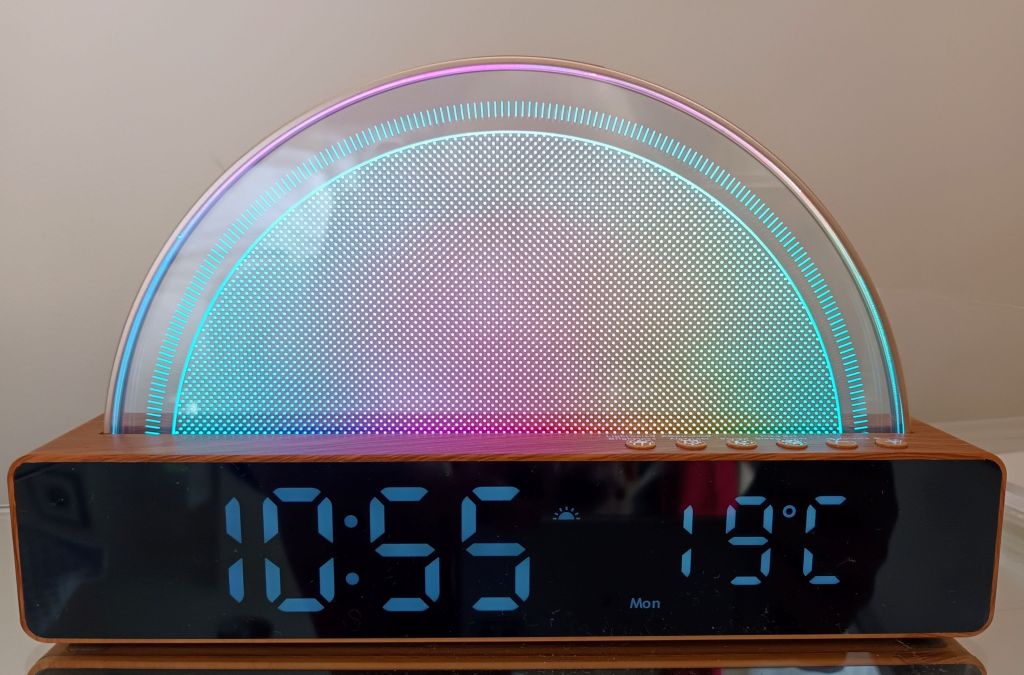
At the beginning of the journal, it invites you reward yourself if you manage to write for 5 consecutive days. I really wanted a sunrise alarm clock/lamp so I researched them online and picked one out on Amazon that was relatively inexpensive but had really good reviews. I’m pleased to say I now have the item on my bedside cabinet and I absolutely love it. Plus, it stops me needing to use my phone as my alarm (or as a light if I get up to pop to the loo) which, in turn, means I don’t get tempted to check the various notifications which have appeared overnight before even getting out of bed.
Afexoa Sunrise Alarm Clock
Although I managed to keep up the practice for 5 full days, I’m now on Day 13 and I’ve forgotten to fill in my night time entry a couple of times already. Once, I was drifting off to sleep and remembered and filled it in straightaway but last night, when I got up, I realised I hadn’t done yesterday’s night time section. Rather than chastising myself for forgetting, I simply filled last night’s in first thing this morning and reflected on possible reasons why I’d not remembered to do it – it was on my bedside cabinet under my Kindle but we went to bed quite late and I was very tired (and feeling a little under the weather).
I’m so far really enjoying using my journal but I have found parts of it more challenging to fill in. For me, the gratitude part is easy as I’ve previously done a daily gratitude pages in my bullet journal. I’m also used to identifying activities to fit in to my day that are focused on ‘me time’ so I always have plenty of ideas for this. Creating a daily affirmation is often quite difficult so I’m in the process of creating a page full of encouraging mantras which I’ve found on Pinterest to help me. Writing three highlights for the day is my favourite part of the journalling progress and I always have plenty to write – sometimes I find there’s not enough room here! Finally, jotting down something I’ve learnt that day (the original journal had the question ‘How could I have made today better?’) is probably the hardest part as I’m not used to doing this kind of reflection. I do get something written each time but it takes me quite a while.
Although it’s known as ‘The Five Minute Journal’, I reckon it currently takes me a lot longer to complete – probably at least 10 minutes in the morning and another 10 just before bed. I’m sure as I continue with the process, ideas will pop into my head during the day which I could incorporate into my entries and this will things quicker and easier. If not, I think the process is still really beneficial and well worth persevering with.
I also found that it was a good idea to refer back to my journal throughout the day to re-check my daily affirmation and to remind myself of my three ideas for what would make my day great. I might try making a quick note of these in my BuJo in future to see if that helps further.
The Main Benefits of keeping The Five Minute Journal for me so far
Having used The Five Minute Journal for nearly two weeks now, I can really see how beneficial it is for my health and wellbeing. Here’s what I’ve found so far:
it helps me set the tone for the day and encourages me to end it on a high note
it allows me to think about ways in which I can bring more joy to my day rather than focusing wholly on my ever expanding to-do list
it helps me to set some intentions for the day and then check back in with myself to see how I got on with them
it helps me find the good in every day, even if I have a super busy (and exhausting) or particularly stressful day, there are plenty of positives if you dig deep to find them
it’s great for personal development as I spend time reflecting on what I’ve learnt and how this can help me live an even better life
the ‘what have I learnt today?’ section has helped me reflect on good and bad habits – for example, doing a mindful activity such as my jigsaw helps me to relax and unwind after a busy day (plus it helps me to rest my voice after talking to different groups of students), whereas ruminating over the feedback I gave and ways in which I could have made it even better is pointless and unhelpful
the daily emails that I signed up for have help me learn different ways to approach filling in the pages so that it doesn’t become a repetitive process
some of the daily quotes really resonate with me and they all make you think or are a good reminder of things you can do to control your own happiness levels
the weekly challenge was a really great way of trying something new and exploring how it made me feel – I’ve only completed one so far but I enjoyed it and it made me feel really good afterwards. I’ve flicked forward to see what’s next and I can’t wait to try it!
daily affirmations are helping me to feel better about myself as a person and also increase my confidence, resilience and motivation to take on new challenges
although it takes me a bit longer than 5 minutes to fill it in, I do find that it is an incredibly worthwhile practice and that my entries will get better and faster with time
Final words…
I hope you’ve enjoyed finding out about The Five Minute Journal and reading my initial experiences of using it to promote happiness and personal growth. Let me know in the comments if it sounds appealing of if you’ve given a similar style of journalling a go before.
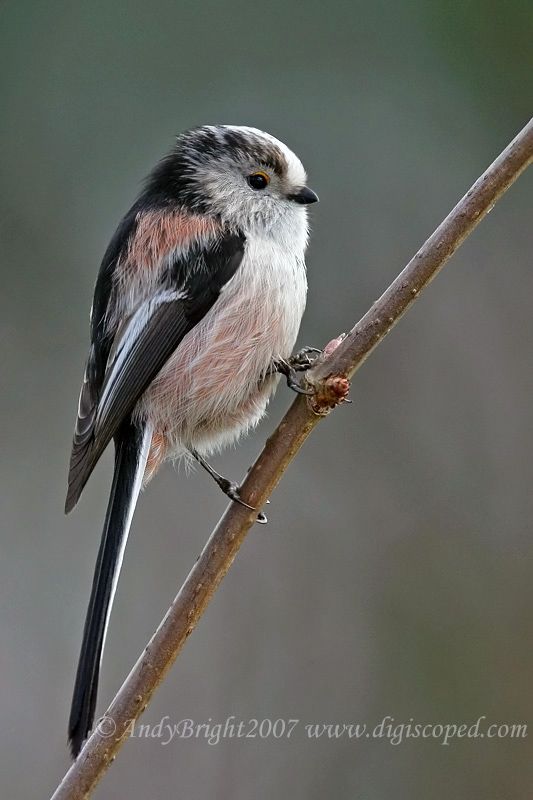
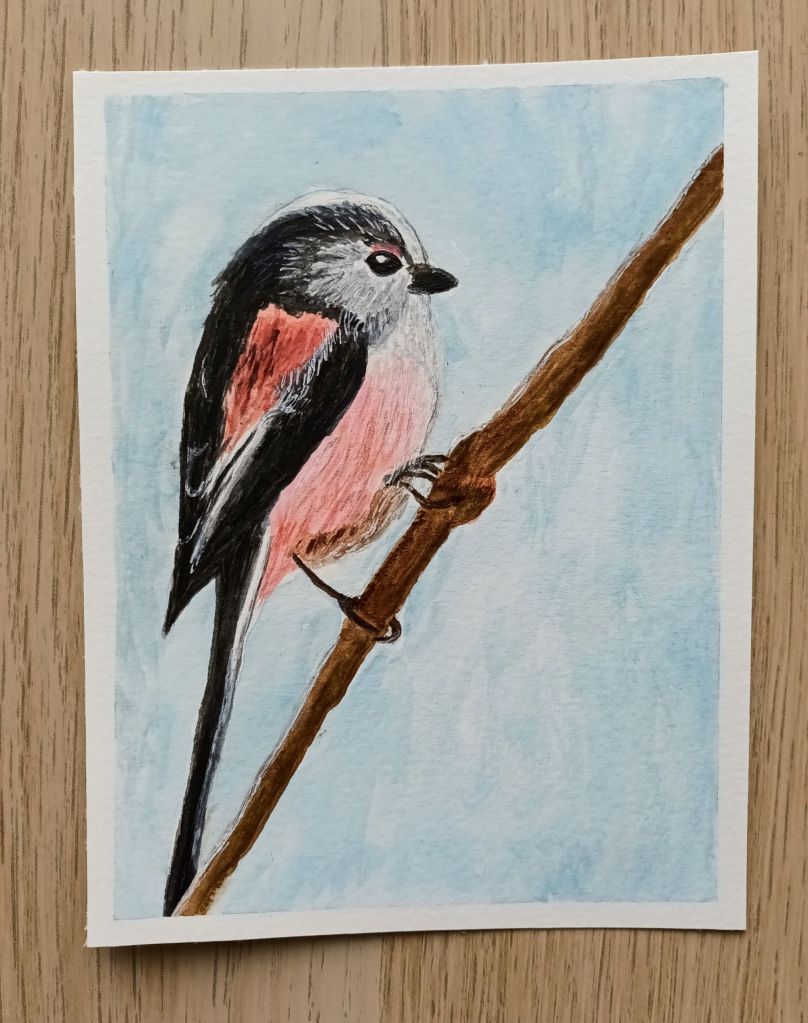
My idea for my March theme came from a walk my husband and I took at Rainton Meadows which is a stunning nature reserve situated in Houghton-Le-Spring in Sunderland. Whilst heading down the path next to one of the many ponds, we heard the unmistakable twittering of a group of long tailed tits. It was easy to spot them amongst the bare branches of a nearby tree and we stood watching them flitting around, presumably collecting tiny insects. As one of my favourite little woodland birds, I enjoyed observing their busy behaviour and I commented to my husband that I would love to have a go at drawing and painting one. When we got home, I searched for photographs of these cute birds and was excited to give it a go. I decided that if I was pleased with the result, I would incorporate my painting in my March set up. Needless to say, I’m over the moon with how my watercolour turned out so it became the image for my cover page.
Front cover
My painting was based on a reference image I found online (thanks for sharing Andy Bright) and the photograph features a long tailed tit gripping on to a single branch. I’m surprised the bird stayed still enough for such a stunning portrait as I’ve never managed to take a decent photo of this sweet but flighty bird!
For my art piece, I used a combination of Winsor & Newton Cotman watercolours, a cheap white gouache, a bright white Sakura gelly roll pen and a couple of coloured pencils to sharpen a few details. I worked on a small piece of Daler Rowney Aquafine smooth watercolour paper using the wet on dry technique. It took me a while to get the two pinky colours the way I wanted them but I’m developing my colour mixing skills as I experiment. Overall, it took me about three hours to complete my work and I think it was time well spent!
Original art work by Laura Jones
As the watercolour paper is very thick, I didn’t want to paste it directly into my bullet journal so I scanned it on my printer and printed it out. The results weren’t as good as I would have liked (my printer was relatively cheap), so I experimented a bit to see if I could get something that showed the colours in their true form. In the end, I printed the painting on a 4×6 inch glossy photograph paper which I could stick into my bullet journal. I’ve now got my painting underneath a large and heavy book hoping to flatten it out a bit as it’s started to curl!
Monthly Calendar
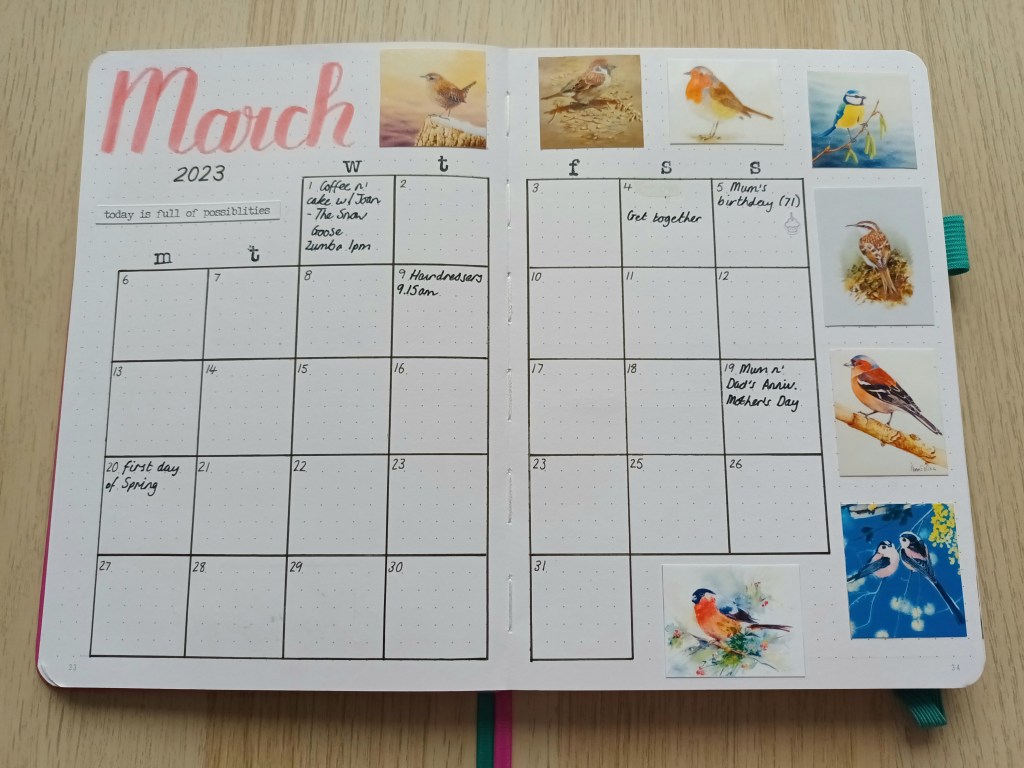
I wanted to continue with the woodland birds theme but knew that I would struggle to draw quick and simple birds and get my pages completed in good time, so I decided to search Google images for some watercolour paintings that I liked and then printed out mini versions on photo paper. I wish I could credit all of the original artists here but as I couldn’t always find them I will encourage my readers to search for the works online should they wish to find out who they were painted by.
Photo credit: Laura Jones for Keeping It Creative
Finances
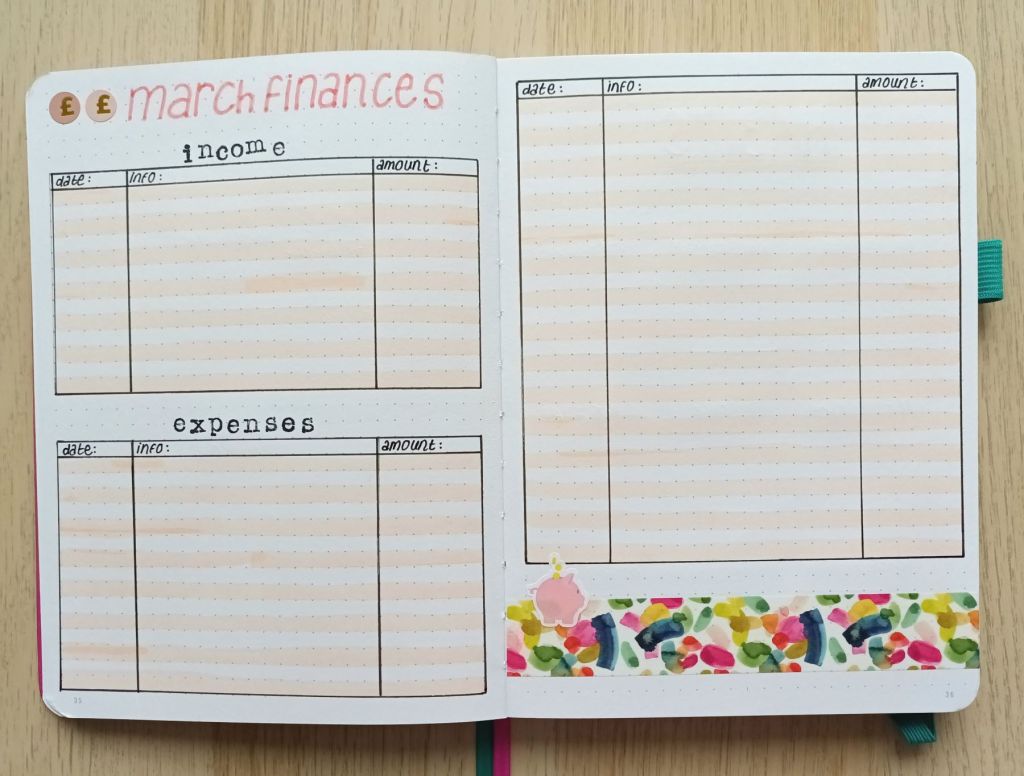
I’m still benefitting from keeping a record of my income and expenses so I’ve done another financial tracker this month. I also found some little piggy bank stickers in my stash so I decided to add one as decoration to go with some new watercolour washi I got from Amazon.
Photo credit: Laura Jones for Keeping It Creative
Habits trackers
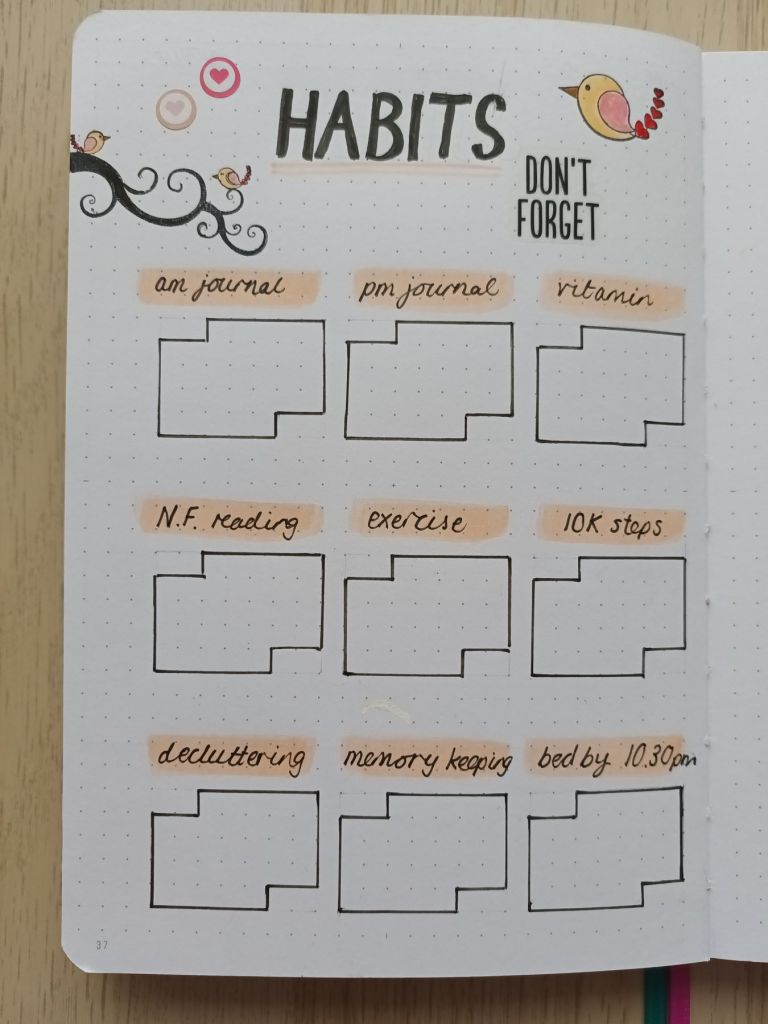
I’ve been tracking some of my habits as part of my rolling weekly but decided I want to keep a better record, so I created a whole spread for them. The plan is to add a dot or a cross each day I complete my habit. I knew I had some little bird stamps in my stamping supplies so I added these as some quick decoration.
Photo credit: Laura Jones for Keeping It Creative
Final words…
I hope you’ve enjoyed looking at my spreads for the month of March. I’m so pleased with how my watercolour painting turned out and I’m enjoying mixing different colours and trying out a range of techniques. I think I should also celebrate getting my pages done before the end of February, photographing and uploading my images as well as typing up a quick blog post to share them.