This week, as my craft room is very chaotic due to my decluttering, I decided to bring my laptop downstairs and work at the dining table. This has given me the chance to open the patio doors on warmer days and listen to the birds in the garden. As well as it being milder, we’ve also had sun and rain creating rainbows and quite a few windy days. Just outside, we have a bright windmill stuck in a plant pot and it’s currently spinning round so fast the colours are merging! Although the wind here tends to be cold, at the moment, it’s not too bad – making me think that it’s perfect weather for kite flying. It’s this thought that gave me inspiration for my bullet journal theme for April. I’m excited to share my pages super early – it was certainly time consuming to create them so I hope you like them!
My cover page
Before designing my spreads, I like to have a look on Pinterest, YouTube and Google to see if my chosen theme has been done before. I found relatively few examples but my pages were inspired by the beautiful work of Claudia Joseph and her set up video. I’ve made it my own by choosing a different colour palette of primary and secondary colours, an alternative combination of art supplies and a number of pages which I know I’ll make use of next month.
I had the idea of creating a mixed media cover page with a pale watercolour wash and inked kites filled in with felt tip pens. For this, I decided to use my masking fluid on the kite shapes and then create a pale blue using cerulean blue and chinese white watercolour. Ask I hadn’t used masking fluid in my bullet journal before, I decided to test it out in the back of my notebook. I’m glad I did, as, although the watercolour itself looked good, the masking fluid pulled the coating off my page in several places and looked a mess. I also tried using my Tombows to colour in the kites and wasn’t happy with the results of that either!
In the end, I decided not to colour the background as sky and settled for ink and coloured pencils for the kites. I had used them in the past in my bullet journal to good effect with the only problem being colour transfer to the opposite page when completing later spreads. In an attempt to solve this, I popped to The Range and picked up a small can of Winsor & Newton Fixative to spray on my pages. This seems to have worked well and although it has an awfully strong chemical smell to it which permeates the air, I’m glad I purchased it.
Here’s the result using Staedtler Ergosoft Coloured Pencils, a Derwent colourless blending pencil, a 0.1 Pigma Micron (which broke on me halfway through but luckily I had a spare in my stash), a grey Zebra mildliner and the small tipped end of a Tombow dual pen for the writing.
Photo credit: Laura Jones for Keeping It Creative
To make sure my kites were neat and symmetrical, I folded a piece of thick paper and cut out designs in different sizes. I then drew around the stencils lightly in a 2H pencil. I’ve always used a HB to sketch out my designs but a 2H is much lighter – you just have to make sure you don’t press on too hard and it easily dents the paper (I’ve realised to my cost!).
My double page calendar page
I decided to try out a slightly different set up for my calendar boxes this month with individual 5×5 squares. I drew it up lightly in pencil first and then used the bullet pointed end of some of my Tombows. Creating the squares was made much easier by using a Helix metric squares template which I remembered I had as part of my supplies. I mostly love how the double page has turned out – it’s so bright and colourful and I think it will be a joy to see each day. The only thing that’s annoying me about it is that I pressed on a little too hard with the colouring in on front cover and it has dented the paper and caused it to be raised on the left hand side of the spread. I tried ironing it flat but it didn’t work as the paper has been stretched. Looking at it positively, I’ve certainly learnt something and hopefully I’ll remember this next time.
Photo credit: Laura Jones for Keeping It Creative
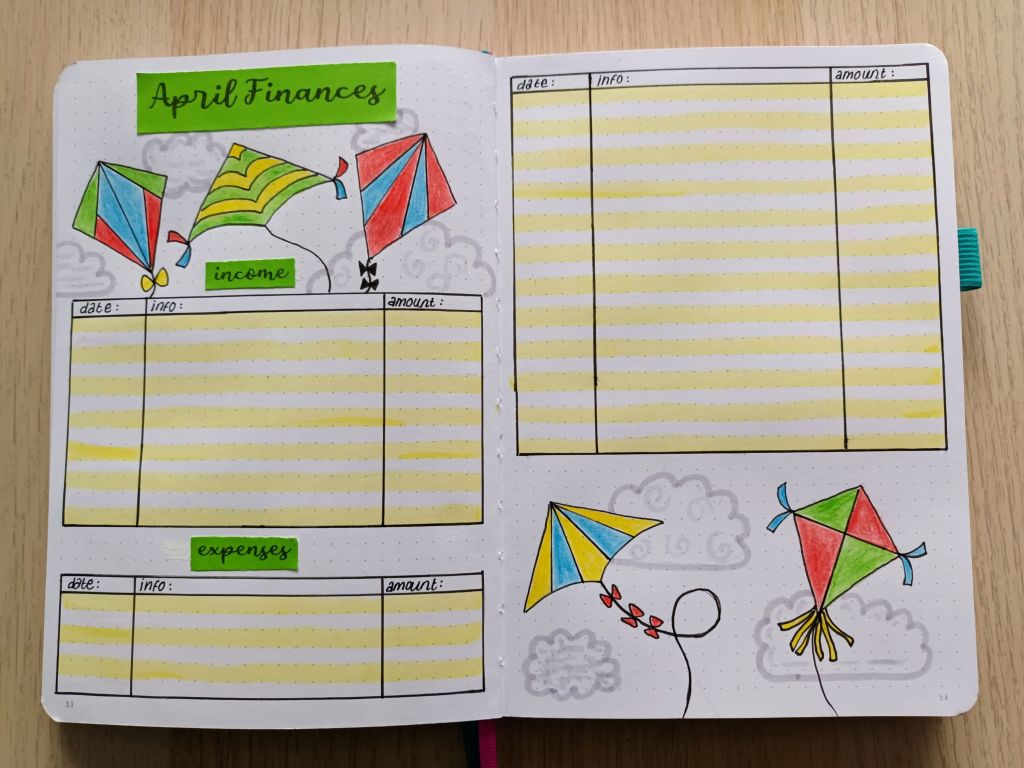
Finances for April
If you’re a regular here on my blog, you might notice that I’ve made the expenses section shorter for April. This is because I’ve had very little work at the university in March so my income will be a lot less. For this reason, I hope to have a low spend month. This has also meant that I had some space to do a little more decoration.
Photo credit: Laura Jones for Keeping It Creative
Final words…
Just like watercolour painting, drawing and colouring in is are great mindful and meditative activities and both provide a wonderful way to relax and de-stress. Although the pages for April were quite time consuming, it was nice to try something a little different and I like the way they’ve turned out. I might even use the bright coloured Tombows to draw out my weekly plan for the first full week of the month, rather than the usual fineliner.
I hope you’ve enjoyed seeing my spreads and I look forward to seeing the work of other bullet journalists on social media over the next week or so.
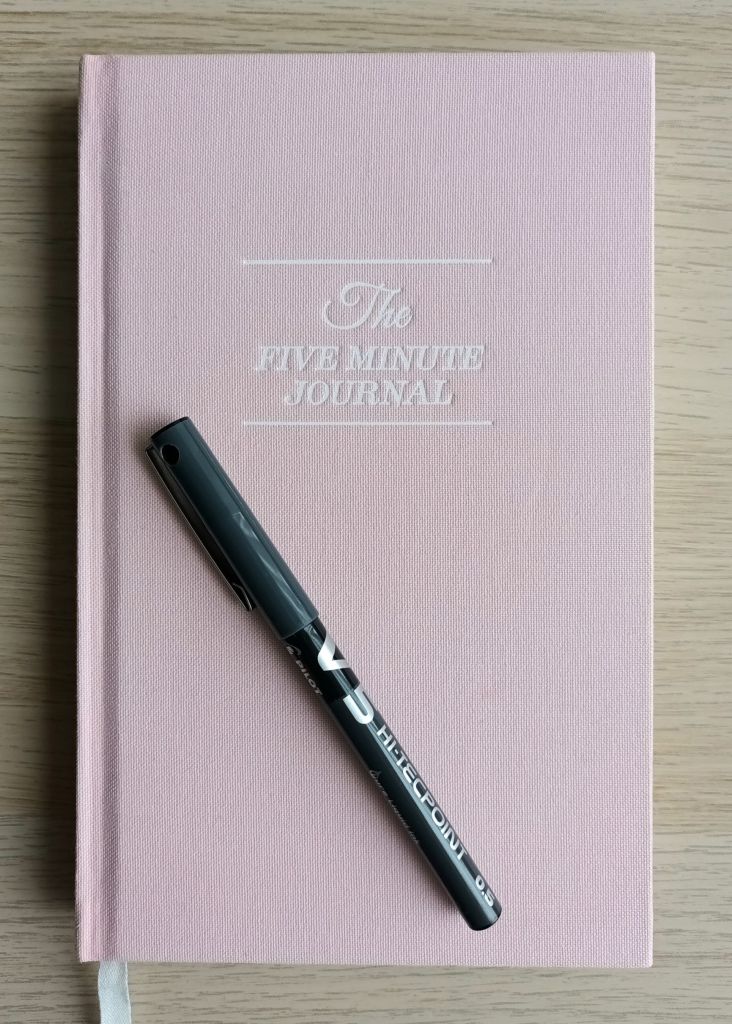
I first came across The Five Minute Journal when watching YouTube vloggers sharing their relaxing yet productive morning routines. I was interested to find out more about the journal, so I checked out a few video walkthroughs and found that many people were saying it was a life changing practise for them and one which really helped improve their mental health.
As someone who will try anything to improve my health and wellbeing, I decided to give it a go (even though I felt that the journal was quite expensive). I’ve been using it for nearly two weeks now, and I’m really enjoying it and benefitting from the quiet thinking time it provides first thing in the morning and last thing at night. So, today, I thought I’d share my thoughts on The Five Minute Journal, my experiences of using it and ways in which it’s helping me.
Photo credit: Laura Jones for Keeping It Creative
What is The Five Minute Journal?
The Five Minute Journal is a product created by Intelligent Change and is one of a small number of tools which promises to positively change your life in just five minutes a day. The company claim that you will love the journal for five very particular reasons:
It’s the simplest thing you can do to be happier – due its focus on positivity, structured approach whilst keeping it simple and easy to stay consistent
It’s built on proven psychology – it’s better to focus on positive behaviour traits and creating simple but effective routines
It’s a journal for people who don’t write journals – it takes just five minutes a day and so is ideal for time pressed individuals who have always loved the idea of keeping a journal but have, in the past, tended to make excuses for not doing so.
It’s a snapshot of your positive experiences – it’s a wonderful record of all things positive in your life and just flipping back to a certain day should help evoke the feelings that accompanied the memories.
It’s a commitment you can stick to – as well as the five minute promise, the book is also full of tips and ideas at the beginning which help you to get started and stay committed to the process
Key features of the book
The Five Minute Journal is a hard back book with a linen cover and comes in an original natural linen covered or a choice of five other colours namely royal blue, earth green, blush pink, bold black and sunshine yellow. I opted for the pink colour but from my research, it looks like the original colour is the most popular choice.
The book consists of over 260 pages, with approximately 30 pages explaining how the journal works at the beginning, 6 months worth of daily journalling pages and 11 ruled pages for notes at the back. The pages are a cream colour and feel like good quality. Having used a ball point pen and not being happy with my handwriting, I have since tried a few different pens out on the note pages at the back with no bleed through so I will be converting to a finer nibbed liquid ink which I use in my bullet journal.
As part of the introductory pages, you are invited to create a written commitment which encourages you to think about your reasons for wanting to keep the journal, a reward which you could give yourself if you stick with writing for 5 days, a promise to yourself if you don’t manage 5 consecutive days and your own ideas of how you can ensure you practise daily. In addition to this, you identify one of your biggest current challenges in life, an identity statement that remedies the challenge, major obstacles to writing on a daily basis and actions you can take to overcome these obstacles.
Each page in the daily journalling section of the book consists of a space to write the date, followed by a motivational quote or a weekly challenge (once every seven days or so) and then a section for morning and night time entries. In the morning, you are advised to write as soon as you wake up as it is the perfect opportunity to set a positive tone for the day. The day time section prompts you to write 3 things you are grateful for, 3 things that would make the day great and one daily affirmation
My thoughts on the process so far
I found the introductory pages to be really useful and made sure I read them all before starting to fill in the daily entries. As well as an explanation of how the journal should be used, it gave tips including:
write your morning entry as soon as you wake up, even if you can think of excuses not to (e.g. feeling sleepy, might make you late for work etc)
write your evening entry just before you go to sleep (even if you’re feeling super tired, have a headache or need to get up really early in the morning and should be having an early night etc)
write things that you are grateful for, even if you don’t yet have them in your life (e.g. I’m grateful to be in a loving and healthy relationship with my perfect partner – law of attraction style)
try choosing different areas of your life to focus on each day or week if you get stuck e.g. relationships, an opportunity that you have, something great that happened or you saw yesterday, something simple nearby you e.g. the pen you’re holding, your comfortable bed, your cosy pajamas etc.
get specific with your gratitudes e.g. I’m grateful for my friend x as she encourages me to eat healthily and take some daily exercise etc.
when writing about things that would make your day great, choose things you have control over, e.g. rather than writing ‘a warm and sunny day’ you could write ‘wearing warm clothes and taking a walk in nature’ or ‘finding time to exercise’
use the daily affirmation to re-affirm something you already know or repeat something you really want for yourself e.g. I listen to my body and give it what it needs, I take time for rest and relaxation after a busy day, I have the power to create the life I want, I hold the key to my own happiness etc
use the highlights of the day section to find the positives and special moments you experienced e.g. listening to the birds sing in the garden, coffee, cake and catch up with a good friend, enjoying a brisk walk on the beach, trying out a recipe you found in your magazine and really enjoying the dish etc
use the ‘What did I learn today?’ section as an opportunity for reflection e.g. ‘taking five minutes to do some stretches first thing helps to wake up my body’ ‘I sleep much better if I avoid social media after 8pm’, ‘I get so much more work done if I keep my desk neat and tidy’ etc
When I first started the journal, I did exactly what it said in the guidance and filled in the morning section whilst still in bed. However, now, I like to take my journal downstairs sometimes (usually during the week) so I can look in my bullet journal to see what commitments I have that day. This makes it easier for me to fill in the ‘What would make my day great?’ section. For example, I might put ‘taking some time to rest and recharge after working on a blog post all morning’ or ‘keeping myself hydrated throughout the day whilst talking to the students’ etc. Things I might not have thought of if I hadn’t taken some time to think.
In terms of my night time entries, where it suggests completion just before going to sleep, I find it better if write mine in bed prior to reading my Kindle. This is because quiet reading whilst lying down often makes me feel incredibly tired (even to the point of dropping off and whacking myself in the face with my Kindle), so I’d rather fill it in when I’m still properly awake. This is working really well for me and I still drift off with a mind relatively empty of thoughts.
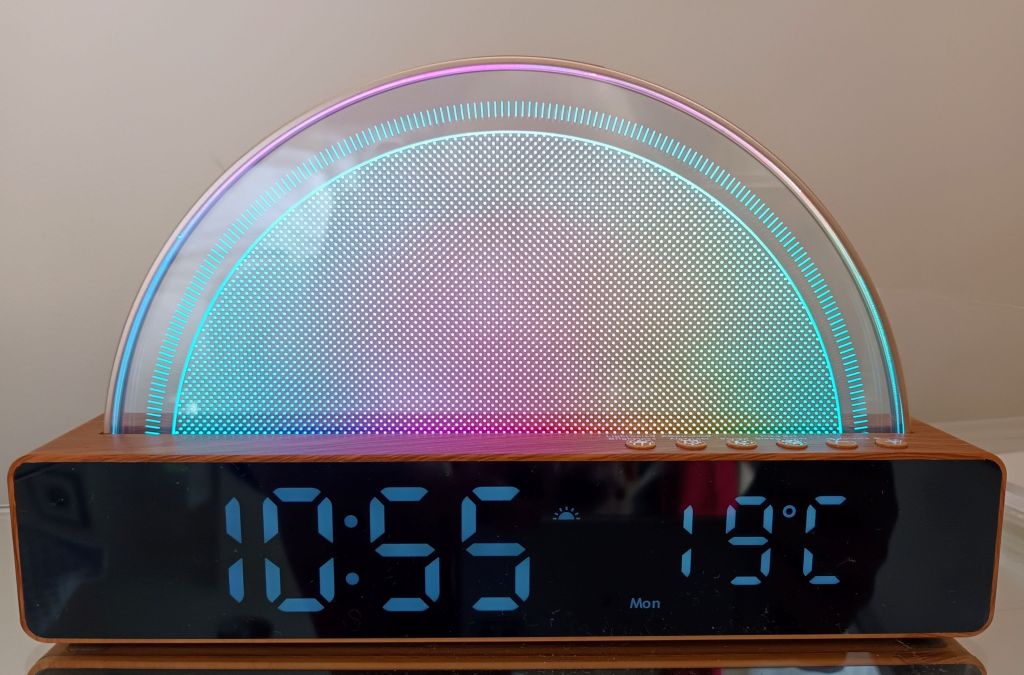
At the beginning of the journal, it invites you reward yourself if you manage to write for 5 consecutive days. I really wanted a sunrise alarm clock/lamp so I researched them online and picked one out on Amazon that was relatively inexpensive but had really good reviews. I’m pleased to say I now have the item on my bedside cabinet and I absolutely love it. Plus, it stops me needing to use my phone as my alarm (or as a light if I get up to pop to the loo) which, in turn, means I don’t get tempted to check the various notifications which have appeared overnight before even getting out of bed.
Afexoa Sunrise Alarm Clock
Although I managed to keep up the practice for 5 full days, I’m now on Day 13 and I’ve forgotten to fill in my night time entry a couple of times already. Once, I was drifting off to sleep and remembered and filled it in straightaway but last night, when I got up, I realised I hadn’t done yesterday’s night time section. Rather than chastising myself for forgetting, I simply filled last night’s in first thing this morning and reflected on possible reasons why I’d not remembered to do it – it was on my bedside cabinet under my Kindle but we went to bed quite late and I was very tired (and feeling a little under the weather).
I’m so far really enjoying using my journal but I have found parts of it more challenging to fill in. For me, the gratitude part is easy as I’ve previously done a daily gratitude pages in my bullet journal. I’m also used to identifying activities to fit in to my day that are focused on ‘me time’ so I always have plenty of ideas for this. Creating a daily affirmation is often quite difficult so I’m in the process of creating a page full of encouraging mantras which I’ve found on Pinterest to help me. Writing three highlights for the day is my favourite part of the journalling progress and I always have plenty to write – sometimes I find there’s not enough room here! Finally, jotting down something I’ve learnt that day (the original journal had the question ‘How could I have made today better?’) is probably the hardest part as I’m not used to doing this kind of reflection. I do get something written each time but it takes me quite a while.
Although it’s known as ‘The Five Minute Journal’, I reckon it currently takes me a lot longer to complete – probably at least 10 minutes in the morning and another 10 just before bed. I’m sure as I continue with the process, ideas will pop into my head during the day which I could incorporate into my entries and this will things quicker and easier. If not, I think the process is still really beneficial and well worth persevering with.
I also found that it was a good idea to refer back to my journal throughout the day to re-check my daily affirmation and to remind myself of my three ideas for what would make my day great. I might try making a quick note of these in my BuJo in future to see if that helps further.
The Main Benefits of keeping The Five Minute Journal for me so far
Having used The Five Minute Journal for nearly two weeks now, I can really see how beneficial it is for my health and wellbeing. Here’s what I’ve found so far:
it helps me set the tone for the day and encourages me to end it on a high note
it allows me to think about ways in which I can bring more joy to my day rather than focusing wholly on my ever expanding to-do list
it helps me to set some intentions for the day and then check back in with myself to see how I got on with them
it helps me find the good in every day, even if I have a super busy (and exhausting) or particularly stressful day, there are plenty of positives if you dig deep to find them
it’s great for personal development as I spend time reflecting on what I’ve learnt and how this can help me live an even better life
the ‘what have I learnt today?’ section has helped me reflect on good and bad habits – for example, doing a mindful activity such as my jigsaw helps me to relax and unwind after a busy day (plus it helps me to rest my voice after talking to different groups of students), whereas ruminating over the feedback I gave and ways in which I could have made it even better is pointless and unhelpful
the daily emails that I signed up for have help me learn different ways to approach filling in the pages so that it doesn’t become a repetitive process
some of the daily quotes really resonate with me and they all make you think or are a good reminder of things you can do to control your own happiness levels
the weekly challenge was a really great way of trying something new and exploring how it made me feel – I’ve only completed one so far but I enjoyed it and it made me feel really good afterwards. I’ve flicked forward to see what’s next and I can’t wait to try it!
daily affirmations are helping me to feel better about myself as a person and also increase my confidence, resilience and motivation to take on new challenges
although it takes me a bit longer than 5 minutes to fill it in, I do find that it is an incredibly worthwhile practice and that my entries will get better and faster with time
Final words…
I hope you’ve enjoyed finding out about The Five Minute Journal and reading my initial experiences of using it to promote happiness and personal growth. Let me know in the comments if it sounds appealing of if you’ve given a similar style of journalling a go before.
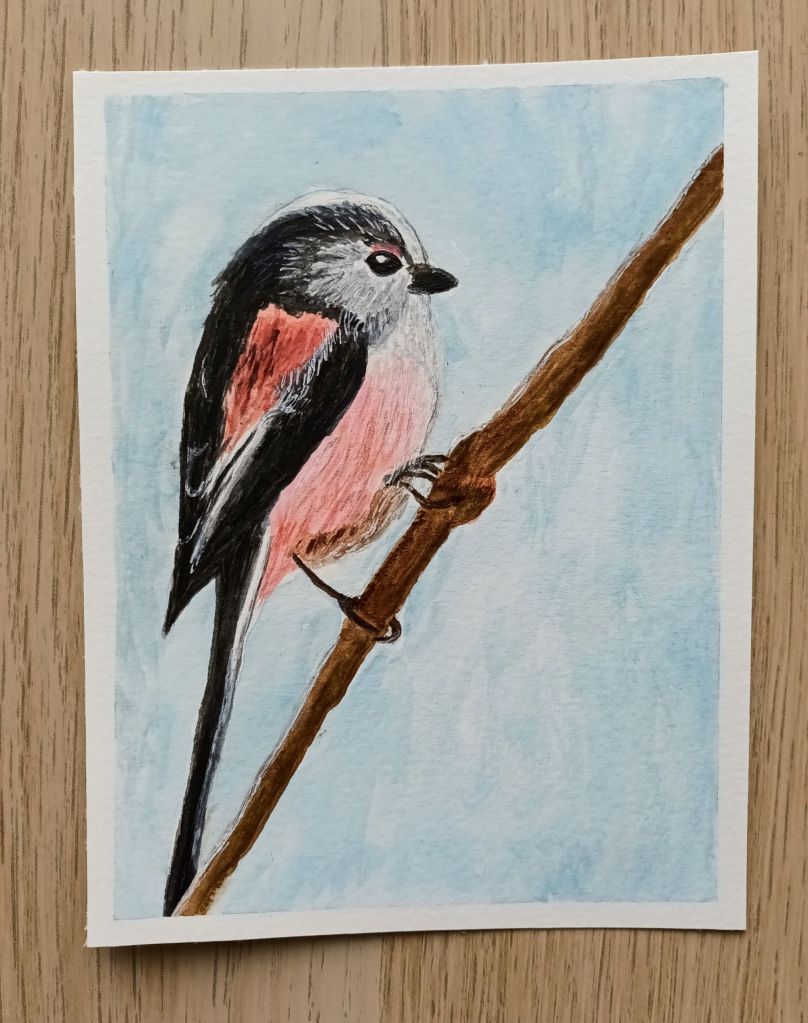
My idea for my March theme came from a walk my husband and I took at Rainton Meadows which is a stunning nature reserve situated in Houghton-Le-Spring in Sunderland. Whilst heading down the path next to one of the many ponds, we heard the unmistakable twittering of a group of long tailed tits. It was easy to spot them amongst the bare branches of a nearby tree and we stood watching them flitting around, presumably collecting tiny insects. As one of my favourite little woodland birds, I enjoyed observing their busy behaviour and I commented to my husband that I would love to have a go at drawing and painting one. When we got home, I searched for photographs of these cute birds and was excited to give it a go. I decided that if I was pleased with the result, I would incorporate my painting in my March set up. Needless to say, I’m over the moon with how my watercolour turned out so it became the image for my cover page.
Front cover
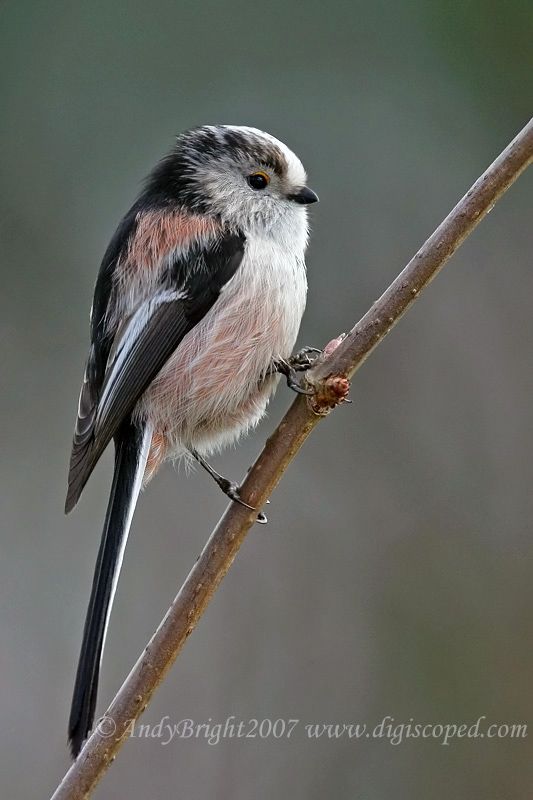
My painting was based on a reference image I found online (thanks for sharing Andy Bright) and the photograph features a long tailed tit gripping on to a single branch. I’m surprised the bird stayed still enough for such a stunning portrait as I’ve never managed to take a decent photo of this sweet but flighty bird!
For my art piece, I used a combination of Winsor & Newton Cotman watercolours, a cheap white gouache, a bright white Sakura gelly roll pen and a couple of coloured pencils to sharpen a few details. I worked on a small piece of Daler Rowney Aquafine smooth watercolour paper using the wet on dry technique. It took me a while to get the two pinky colours the way I wanted them but I’m developing my colour mixing skills as I experiment. Overall, it took me about three hours to complete my work and I think it was time well spent!
Original art work by Laura Jones
As the watercolour paper is very thick, I didn’t want to paste it directly into my bullet journal so I scanned it on my printer and printed it out. The results weren’t as good as I would have liked (my printer was relatively cheap), so I experimented a bit to see if I could get something that showed the colours in their true form. In the end, I printed the painting on a 4×6 inch glossy photograph paper which I could stick into my bullet journal. I’ve now got my painting underneath a large and heavy book hoping to flatten it out a bit as it’s started to curl!
Monthly Calendar
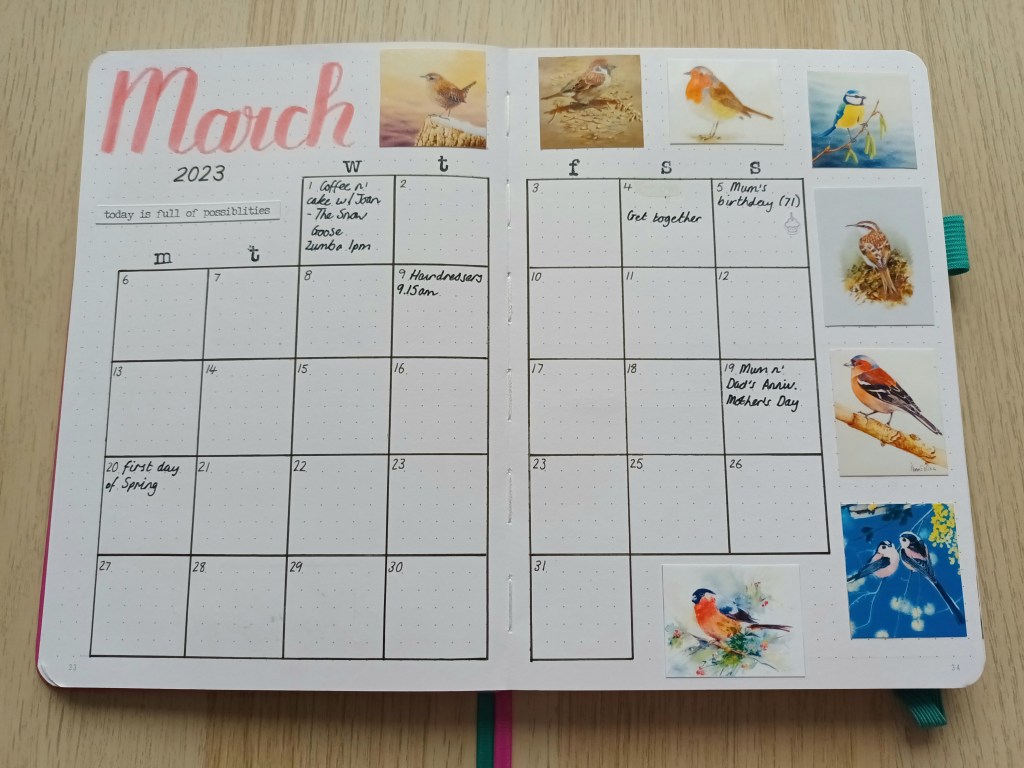
I wanted to continue with the woodland birds theme but knew that I would struggle to draw quick and simple birds and get my pages completed in good time, so I decided to search Google images for some watercolour paintings that I liked and then printed out mini versions on photo paper. I wish I could credit all of the original artists here but as I couldn’t always find them I will encourage my readers to search for the works online should they wish to find out who they were painted by.
Photo credit: Laura Jones for Keeping It Creative
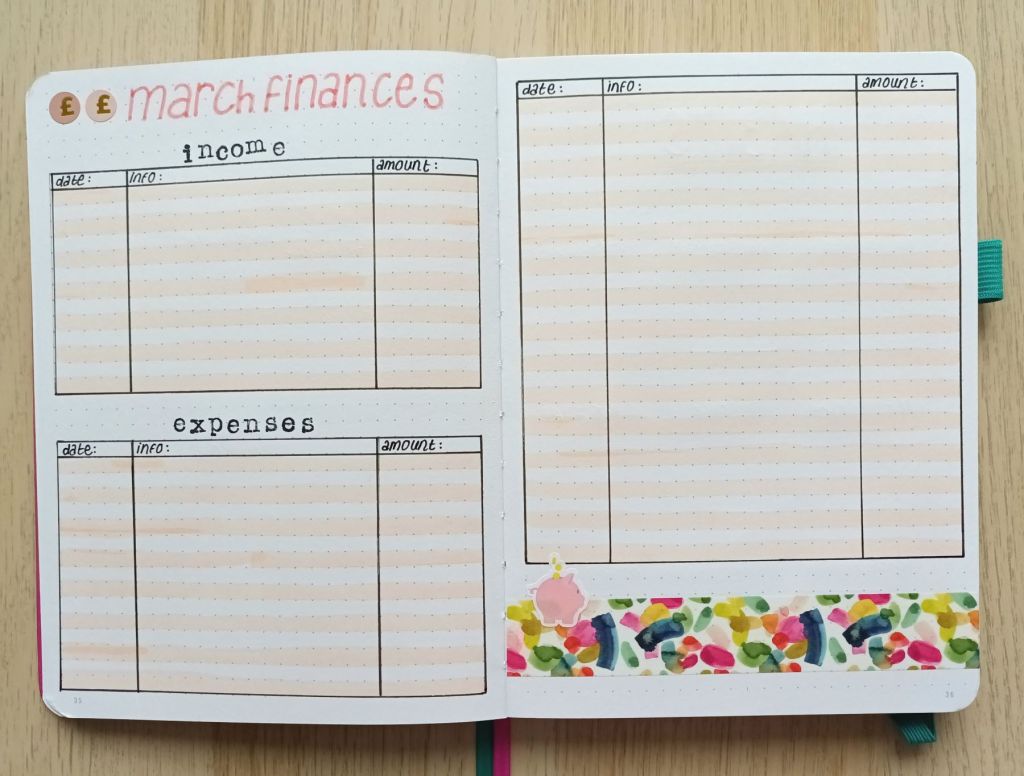
Finances
I’m still benefitting from keeping a record of my income and expenses so I’ve done another financial tracker this month. I also found some little piggy bank stickers in my stash so I decided to add one as decoration to go with some new watercolour washi I got from Amazon.
Photo credit: Laura Jones for Keeping It Creative
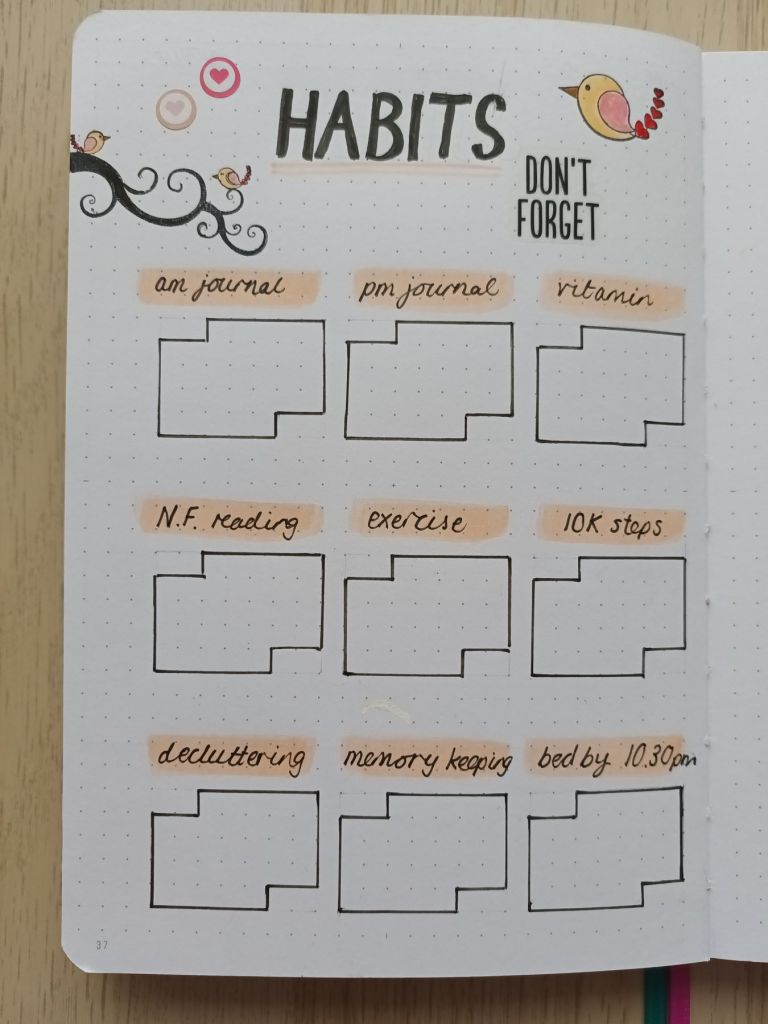
Habits trackers
I’ve been tracking some of my habits as part of my rolling weekly but decided I want to keep a better record, so I created a whole spread for them. The plan is to add a dot or a cross each day I complete my habit. I knew I had some little bird stamps in my stamping supplies so I added these as some quick decoration.
Photo credit: Laura Jones for Keeping It Creative
Final words…
I hope you’ve enjoyed looking at my spreads for the month of March. I’m so pleased with how my watercolour painting turned out and I’m enjoying mixing different colours and trying out a range of techniques. I think I should also celebrate getting my pages done before the end of February, photographing and uploading my images as well as typing up a quick blog post to share them.
I was introduced to the highly sensitive personality type several years ago when I started a discussion on the Bipolar UK charity website. My reading since then has helped me learn more about being a HSP and the associated traits and characteristics. Much of my research has resonated and I feel that being sensitive is part of my bipolar disorder and something which requires day-to-day management, particularly during periods of mental illness. So, today, I thought I’d share some of the main signs of being a HSP and discuss ways of managing the condition.
What is a Highly Sensitive Person?
A highly sensitive person (HSP) is an individual who is thought to have an increased or deeper central nervous system sensitivity to physical, emotional and social stimuli. These are normal and perfectly healthy character traits which brings about a number of strengths and challenges for the individual.’ HSPs often excel creatively and can be incredibly empathetic. They also often tend to notice things that others may miss or make connections that many individuals do not see.
The term was coined by psychologist Doctor Elaine Aron in the 1990s and her research has suggested that around 15-20% of the population have the personality type. She is continuing to study Sensory-Processing Sensitivity (SPS) now and as well as having a website dedicated to her findings, she has written a number of books and developed a self-test which can help you decide if you’re a HSP.
Signs you are a Highly Sensitive Person
Throughout your childhood, parents or teachers saw you as shy or sensitive.
At school, you became extremely anxious when taking part in timed quizzes, tests and exams. This probably caused pressure to perform and might have caused enough stress to make you perform badly or fail to achieve the expected results.
As an adult, you try to avoid potentially upsetting or overwhelming situations.
You tend to become stressed or overwhelmed when you have lots to do.
You’re generally really good at reading the emotions of others (even those you’ve never met before) e.g. when you walk into a room, you can sense the atmosphere and are able to use subtleties such as facial expressions, body language and tone of voice to establish how individuals are feeling.
After a really busy or long day, you find yourself desperate for some quiet/alone time to lower your stimulation levels, soothe your senses and to help you relax and recharge
Unexpected or loud noises really startle you and you may consider yourself to be ‘jumpy’ in general
You’re a deep thinker and spend a lot of time ‘in your head’ reflecting on anything and everything. This also means you are often prone to negative thinking and rumination (going over and over things in your head).
You always choose your clothing super carefully. Rough or restrictive items irritate you. For example, I can’t stand anything with a high neckline such as jumpers with turtle, rolled or polo neck and will always need to leave the top button of a blouse undone. I’ve also had to give away three of my jumpers recently as they were a little bit scratchy on the inside and caused me irritation.
Other sensory stimuli can cause overwhelm. This could include bright light, noisy or crowded places.
You tend to have less tolerance to pain than others.
You prefer to work in a very quiet environment which is free from distractions e.g. you have found working alone from home to be preferable to working in an open plan office.
You find any sort of change difficult or upsetting whether it is positive or negative e.g. being in a new relationship or getting a job promotion can cause extreme amounts of stress. HSPs tend to find a lot of comfort in routine and anything new or different can cause overstimulation.
Raised voices and an angry tone can cause tension and upset even if the rage isn’t aimed at you.
You tend to be a people pleaser as you don’t want to let people down. This may lead to you saying yes when you really want to say no.
When you’re feeling really hungry, you might find your emotions are affected quite strongly resulting in you getting ‘hangry’, irritable and moody. I think most people have experienced being in a bad mood when they’re haven’t eaten for ages but in a HSP, this might happen more regularly or felt more strongly. According to Dr Aron, this is because HSPs are more sensitive to spikes and dips in blood sugar levels.
Stimulants affect you more than others. You might find caffeine gives you a real buzz even if you consume very little. Alcohol may have the same effect.
You hate conflict and tried to avoid it as much as possible. This may result in you doing or saying whatever you can to keep the other person happy.
You may avoid TV shows and films which contain lots of violence because they feel too intense and leave you unsettled. As someone who loves watching crime dramas and anything psychological, this one doesn’t really apply to me but if you find yourself being triggered you will definitely want to choose your evening viewing with great care.
Any form of criticism can be distressing and often completely devastating. This can result in people pleasing, criticizing yourself first before anyone else gets the chance or simply avoided the source of criticism. This is certainly one of my main triggers and something I have struggled with from childhood and right through my adult life. It doesn’t matter if the criticism is meant to be constructive or falls in the middle of a number of compliments – I will nearly always be deeply upset and often go over things in my head again and again. Praise can leave me on a high all day but even a slight criticism can make my mood plummet in seconds and completely spoil my day or the rest of my week if I let it.
You may find yourself being deeply moved by music and other creative pieces such as works of art, poetry, drama and writing.
Ways to manage your sensitivity on a day-to-day basis
Create a set morning and evening routine Set routines provide an element of control even when everything around you is changing. For me, my morning routine includes a short journalling session, a healthy breakfast of wholewheat cereal and a piece of fruit, 15 minutes of non-fiction reading (with a cup of coffee), stretches, stepping outside to listen to the birds and check on how the garden is doing, and setting my intentions for the day. In the evening, I’ll get my PJs on, do something mindful like my jigsaw or playing a game on my tablet, then my husband and I will watch something on TV. My phone is set to automatically transition to night mode at 8.00pm and I tried to avoid using my electronic devices after this (very much a work in progress at the moment!). Just before bed, I’ll think about how my day has gone and do some reflective journalling. I’ve just bought The Five Minute journal to make my sessions more structured and I hope to write a blog post on how this is going very soon.
Make sure you get a good night’s sleep We all know that quality sleep is essential for our physical and mental health and it is especially important for HSPs. If you know that this is an area of your life you could benefit from working on, check out this post which contains an in-depth look into the topic.
Plan in some downtime HSPs can become easily overwhelmed so it’s important to schedule in regular times each day for resting and recharging. As I’ve shared in a previous post, I use the Pomodoro Technique during the day and I consider the five minute breaks to be vital for preventing overwhelm. I also schedule in longer breaks with plans for relaxing or mindful activities such as drawing or painting, listening to music or going for a walk in nature.
Create a sanctuary space in your environment which feels calm and safe This could be a comfortable chair in your living room, an outdoor location at the bottom of your garden or a spot in your conservatory. If you share your home with others, let them know how important this sanctuary is to you and why you find time and space beneficial. You might also want to consider making your home a more pleasant place to be as a whole by keeping rooms clutter free and well-organised. This is something I’m working on right now, especially in my craft room as this is where I often spend most of my day.
Eat a healthy diet and make sure you eat regularly through the day Try to include plenty of fresh fruit and vegetables each day and use the balanced plate to ensure you get enough of the different food groups. Make sure you eat regularly to avoid feeling hangry. Check out this blog post for more information on maintaining a healthy diet.
Consider trying mindful exercise Good choices of mindful exercise include Tai Chi, yoga and Pilates. I also try to stay in the moment during gym sessions by really focusing on how my body feels during each exercise. I try to schedule my gym visits when I know that it is relatively quiet (mid afternoon is a good time for me) as even with ear plugs in, I tend to get over stimulated if there’s lots going on around me. Fitting in a daily peaceful walk in nature is also really beneficial, especially if you choose spaces and times that are less busy.
Use soft lighting in your home When you’re out and about during the day, the type and strength of lighting is generally out of your control. However, in your home, you can choose soft lighting such as candles, lamps, less powerful bulbs and dimmer switches to make things more comfortable.
Identify your triggers When reading the above list, some of the points are likely to have resonated with you more than others – perhaps you found noisy crowds really difficult to cope with or maybe too much social media creates information overload or feelings of inadequacy. Whatever you particularly struggle with, make notes and then work on finding ways to combat them e.g. going shopping when it’s quieter, limiting your time online, carrying snacks for if you start to feel hungry, taking regular mind breaks etc.
Talk to a therapist Working with a therapist, specifically to develop strategies for managing your particular difficulties can really help. Try to choose someone who knows about HSPs so they can offer more specialist advice and support.
Celebrate your positive qualities Although being an HSP comes with its difficulties, it also provides gifts and real strengths which should be celebrated and put to good use. Awesome traits of the HSP can include creativity, conscientiousness, being deeply intuitive, having excellent problem solving skills being and being empathetic.
Final words…
I hope you have found today’s post interesting and informative. With approximately 15-20% of the general population being considered as Highly Sensitive, it’s likely that even if you don’t recognise yourself as a HSP, a loved one, family member, friend or work colleague may have some of the difficulties presented above and would benefit from developing strategies to manage day-to-day life. Personally, I find that I struggle a lot more during periods of low or high mood and things don’t affect me as much at times of stability. I also think that increased stress and pressure can also make things much more difficult and this is when it becomes even more important to apply the above coping strategies.
I would love to hear your thoughts on today’s topic so feel free to leave a comment below if you wish to do so.
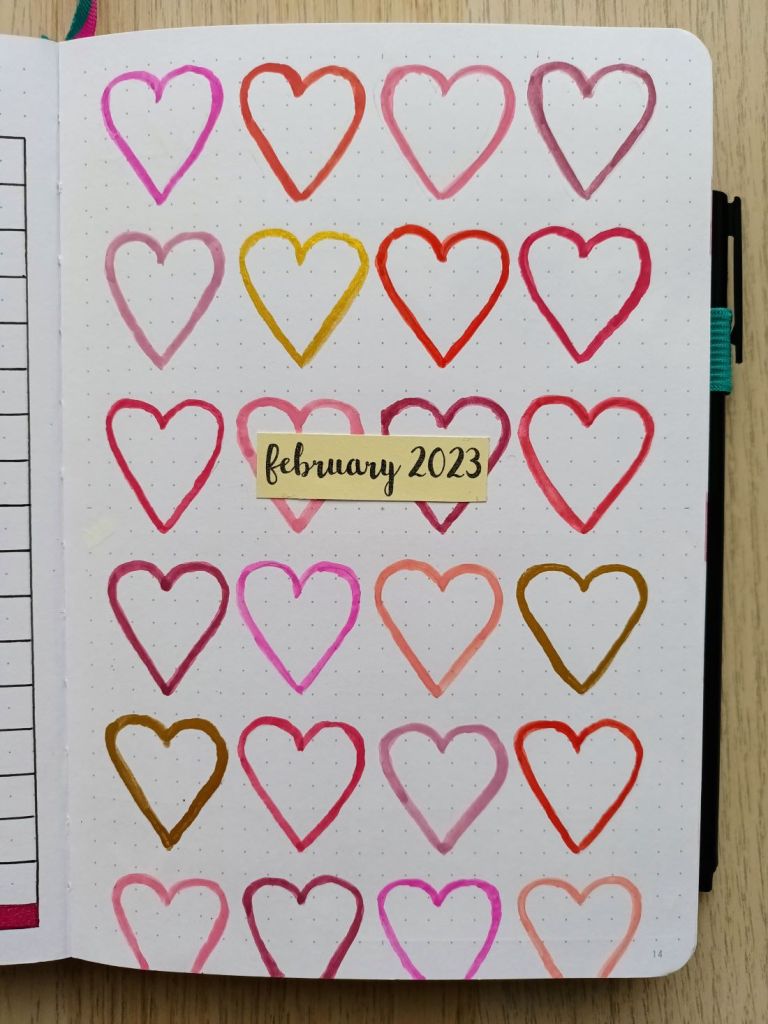
January seems to have flown by and we’re now into February. I’ve only just got my spreads for the month finished as I’ve been busy setting up my new STM notebook and have also had quite a few sessions at the university this year so far. I did a hearts theme before (back in Feb 2021) and I enjoyed using my watercolours to mixing various shades of red and pink so I thought I’d give it another go but this time I used gouache for a more opaque finish. The design for the front cover was inspired by a Caroline Gardner mirror compact that I got for Christmas which features heart outlines.
My pretty compact mirror from Caroline Gardner
The front cover
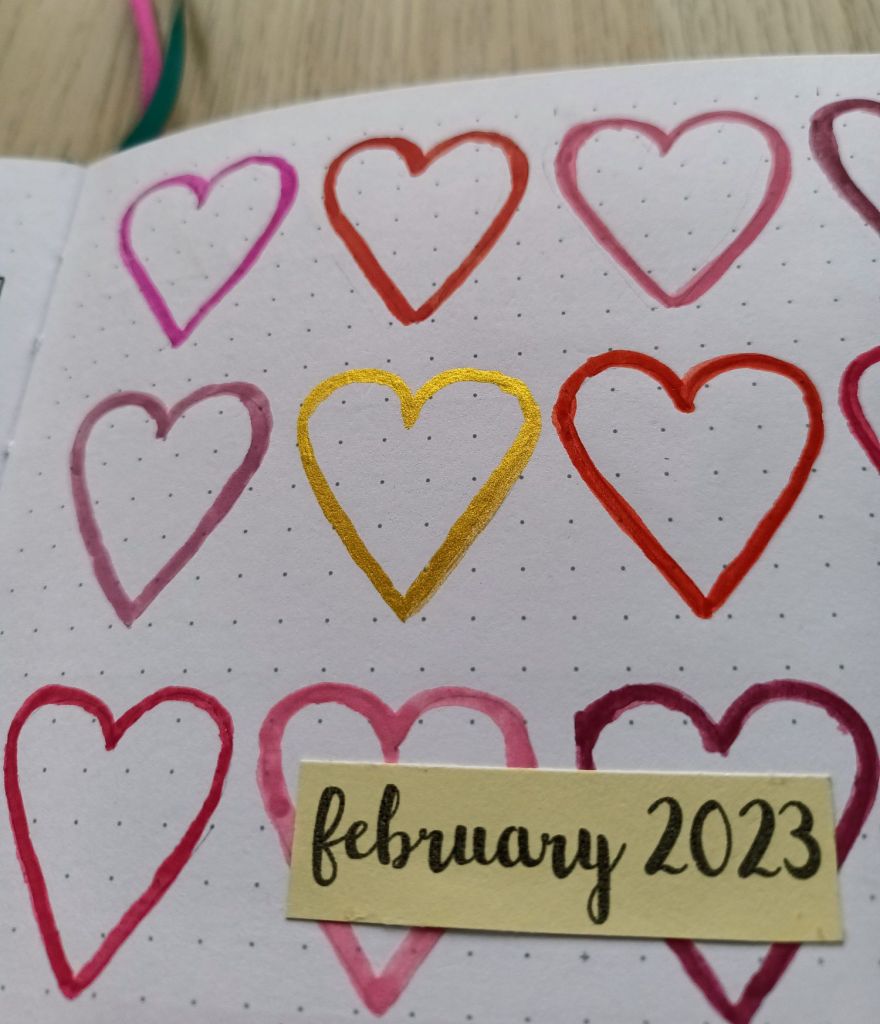
After practicing painting heart shapes in the back of my old bullet journal, I created a template and lightly sketched the outlines with a pencil. I then mixed a shade of pink and then used a number 2 round brush to paint a small number of hearts. I repeated the process with various reds and pinks and also added 3 gold hearts using my Finetec metallic watercolour paints. After leaving the paint to dry thoroughly, I created a small cream label for the month and the year using a gorgeous brush letter font which I recently downloaded called Northern Lights Script.
Photo credit: Laura Jones for Keeping It Creative
Photo credit: Laura Jones for Keeping It Creative
Calendar page
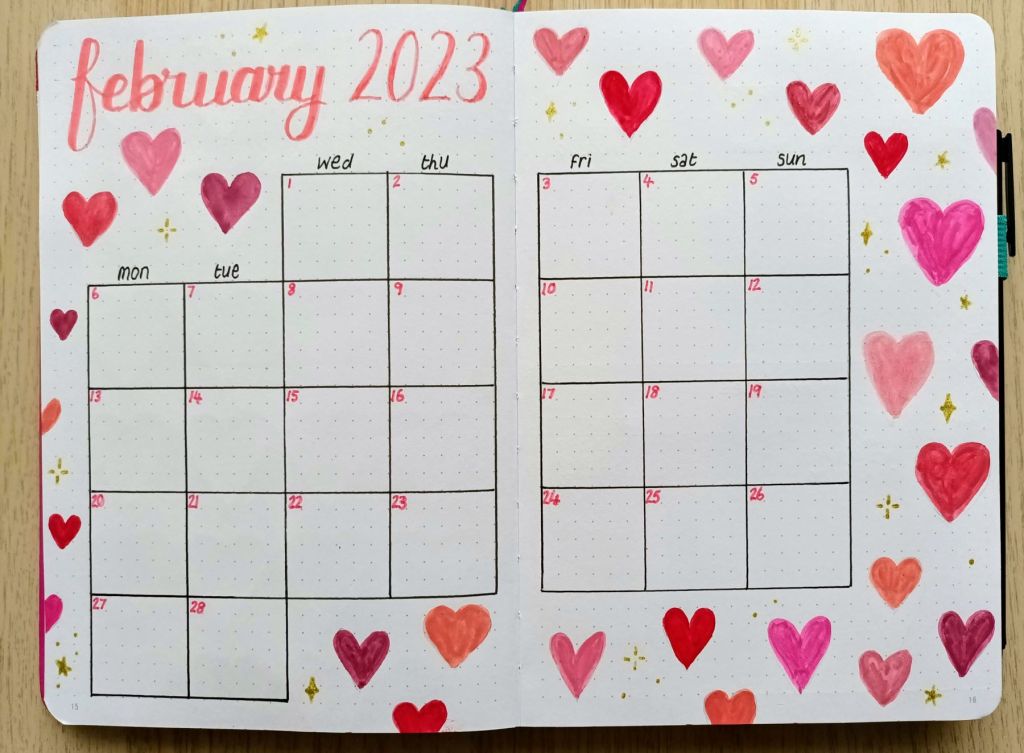
For the month on two pages calendar, I mixed similar colours and painted a range of filled hearts in different sizes. This time I used a size 0 round brush as the shapes were smaller. This time I very lightly hand sketched the heart shapes with a 2H pencil. When I’d finished, I realised that I hadn’t done any gold hearts so I decided to add some sparkle using a Uniball Signo gold gel pen creating dots, stars and curved diamond shapes.
Photo credit: Laura Jones for Keeping It Creative
Finances
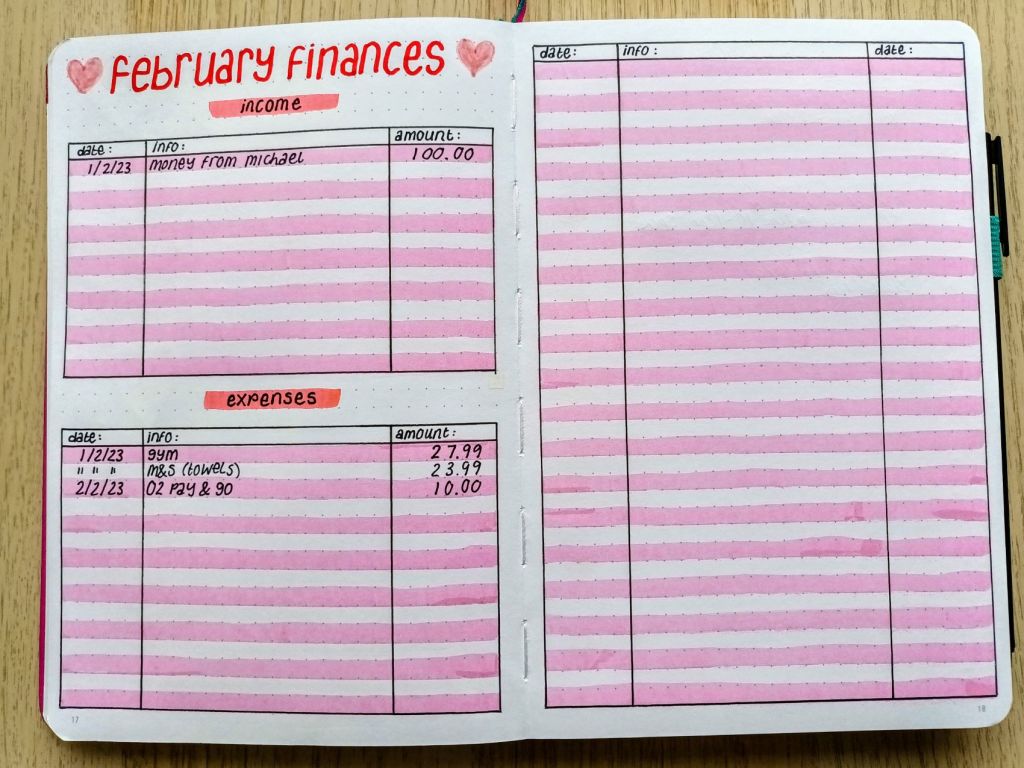
I’ve been enjoying using this format of financial tracker for a while now and I just change up the colours each month.
Photo credit: Laura Jones for Keeping It Creative
Weekly plan and rolling weekly
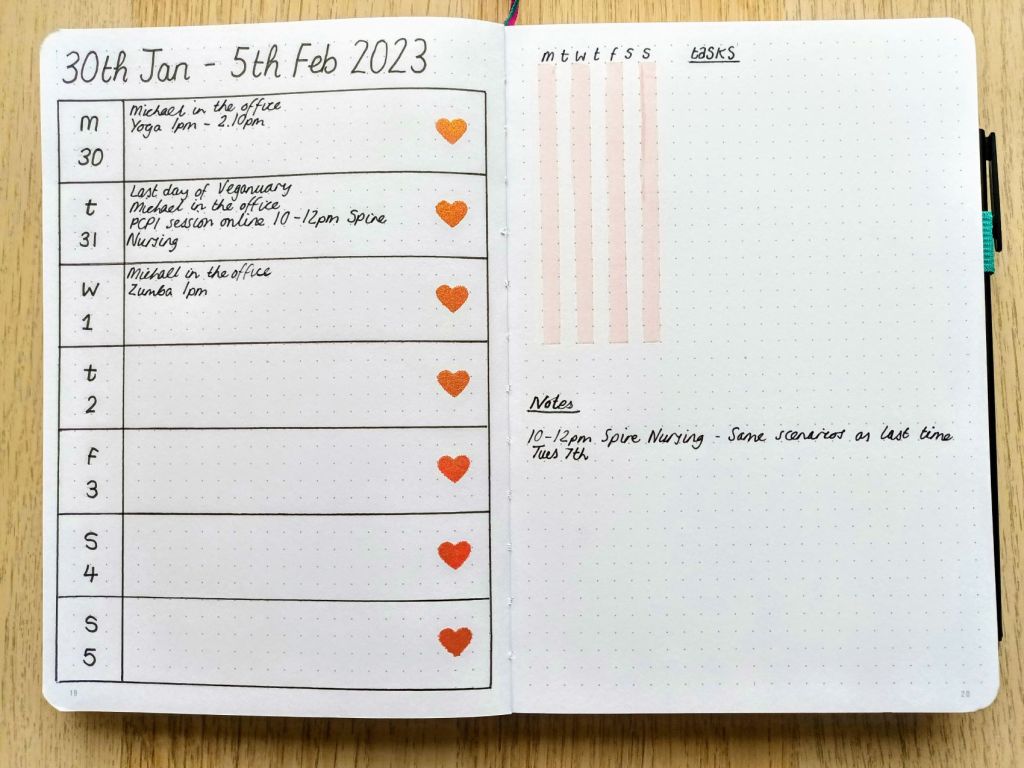
This is the first time I’ve done a week-on-one-page spread but now I do a rolling task list for the week I don’t need as much room as I’m only recording events, gym sessions and days out. The hearts for each day were inked using a heart outline (made using a punch), a gorgeous red/gold ink and a mini finger sponge. You can’t really see the iridescence in the photo but it looks really pretty when the hearts catch the light.
Photo credit: Laura Jones for Keeping It Creative
My future log for my new Bullet Journal
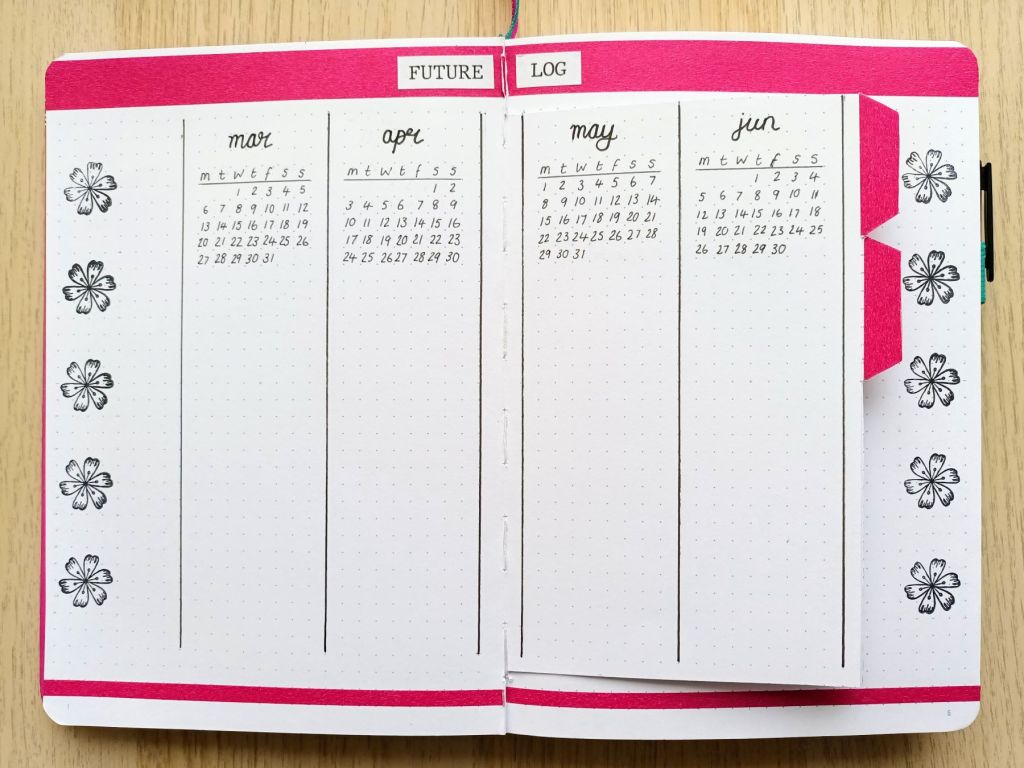
I created my future log for 12 months, starting in March 2023 and I’m really pleased with how simple and effective it is so I thought I would share here. It makes use of a Dutch door set up and I added little tabs for ease of use. Using a Dutch Door means that you create one title which can be seen from a number of pages.
Photo credit: Laura Jones for Keeping It Creative
Final words…
I’m really pleased with how my pages turned out and I hope you like them too. Doing some painting in your bullet journal is a super relaxing and mindful activity which I really enjoy. As long as your pages are a good weight and you don’t use too much water or add too many layers of paint there should be no bleed through or page wrinkling.




 Keeping it creative