Posted in crafting, creativity, lifestyle, Mindfulness

Monday Matters: 5 mindful creative activities to try this winter

Those of you who have been following my blog for a while will know that I love doing a range of creative arts and crafts and find them really beneficial for my mental health due to the mindfulness aspect of the activities. So, today, I’m sharing 5 quick and easy ways to get creative during the winter season. Let me know which one you fancy giving a try.

Mini cross stitch

Doing a large cross stitch can be a very time-consuming activity and generally takes months to complete. However, if you’re new to counted cross stitch or want something that you can make in a short time frame, I recommend the mini kits that you can pick up in places like Hobbycraft. This winter fox design, which is just 3×3 inches, is perfect for the season. They also offer plenty of other more Christmassy ones too. If you’re a complete beginner, I highly recommend Mouseloft kits as they’re great quality and have a decent set of instructions on how to get started.
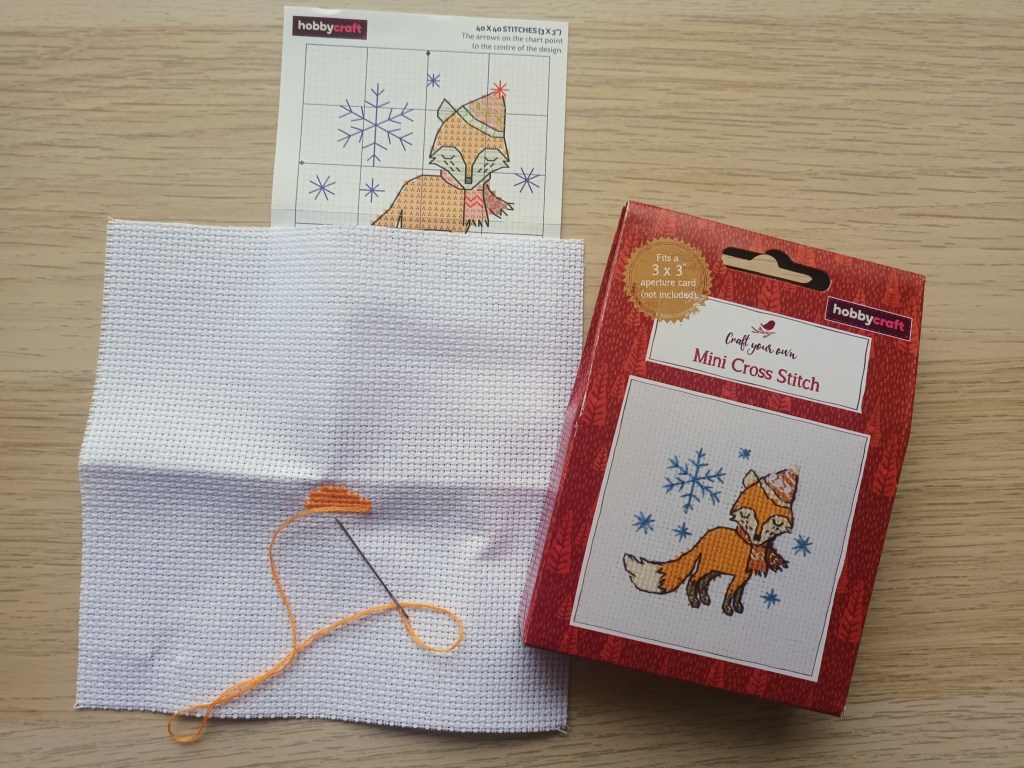
Just getting started…

Festive biscuits

Homemade biscuits are fun to do and make your kitchen smell delicious. I’m planning on creating some snowflake and Christmassy shapes using cookie cutters and I’ll be personalising them with icing patterns, edible bits and pieces such as metallic balls and tiny shapes like holly and stars. If you want to make the activity even easier and would like to avoid having to purchase lots of different ingredients, there are plenty of kits on offer in the supermarkets or places like Lakeland. I’ve also seen DIY gingerbread houses whilst out shopping too.

Dried orange slices

I’ve seen dried orange slices in various festive decorations for sale in garden centres and you can buy packets of pre-made ones in craft shops but I think it would be much more fun and rewarding to make your own. I’m going to put mine with all of the pine cones I’ve collected and add fragrance to create my own winter pot pourri. There are lots of tutorials on You Tube and various ideas on how to display your dried oranges such as hanging them from your Christmas tree branches, stringing them as a simple garland attaching to a branch of fir or, making pot pourri. These instructions show how to dehydrate them and string them but there are many more helpful videos around.

Holly felt garland

I found a lovely online tutorial for making a holly garland out of felt which doesn’t involve any sewing and simply uses a hot glue gun to attach the pieces. As well as the glue, you need two shades of green felt (preferably as A4 sheets), plus some red pompoms. Again, you can buy pre-made but some I’ve seen to purchase online are in the region of £30-£50! If you create your own, you can enjoy the benefits of mindful activity as you cut and glue, plus you can see the fruits of your hard work for the whole of the winter period, not just for Christmas.

Paper snowflakes

I used to make these as a child and I also taught the kids in my classes when I was teaching. This YouTube tutorial from Martha Stewart, shows a version where you fold a square diagonally twice and then fold into thirds for a six pointed snowflake. Once you get the hang of them you can make more intricate designs and even use sparkly paper or add glitter to the edges after you open out your flake.

Final words…

I hope these ideas for crafting projects have inspired you and you’ll give at least one of them a go over the winter period. I’ve already started my fox cross stitch (which I purchased last year and didn’t get around to due to December Daily taking up so much of my time) and I have two cute Christmas Mouseloft designs on display in my living room already. My oranges are purchased too and I can’t wait to give the pot pourri a go when I’ve found a suitable fragrance for it. I’ll be sure to let you know how it turns out if it’s a success.

Happy crafting!

Posted in lifestyle, Mindfulness, self care, wellbeing

Monday Matters: 15 Relaxing things to do this Summer

The summer is finally here bringing with it longer and warmer days, sunshine and gentle breezes. Today, I’m sharing fifteen relaxing activities for you to try over the next few months. Why not create a bucket list (maybe with little doodles for each item) in your notebook or planner as a visual reminder?

Enjoy a picnic in your local park

One of my favourite things to do in the summer is to fill our cool bag with lots of tasty lunch items to enjoy al fresco in a park or at a local picnic spot. Must haves for me are juicy strawberries and a nice cold bottle of fresh orange but you can tailor make a menu of your favourite cold foods.

Take a hike

There are so many different options for a long summer walk – ambling through shady woodland, following a riverside path, taking a coastal route, heading for the hills or following a trail at a nature reserve are just some ideas that come to mind. If it’s a hot one, pace yourself and take plenty of water to keep yourself hydrated. After I got bitten repeatedly whilst on holiday in Norfolk, I would also recommend a good application of insect repellant too! Often, there’s little or no phone signal out there so you get a tech break too.

Make lemonade

Nothing beats a refreshing lemonade on a hot summer’s day and it’s even better if it’s homemade. Check out this easy recipe to make your own from scratch and then enjoy as part of a picnic or in your back garden.

Watch the sunset

I’ve seen and photographed some spectacular sunsets over the years and each time it’s an amazingly calming and restful way to end my day either alone or with someone special. All you need is a view to the west, a good spot to sit or stand such as a park, a hill or somewhere else high up such as a rooftop bar, the beach or even a window in your house, and maybe a blanket if it’s become a little chilly outside.

Sit outside after dark and stargaze

This one takes a bit of planning as you need to choose a clear night but free apps like Nightshift tell you what the forecast is like and StarTracker or similar identifies the constellations you can see if you point your phone up to the night sky. It also helps if you choose a location which is high up or somewhere that gives you a wide view of the sky with limited light pollution. Hills and beaches are particularly suitable.

Go somewhere quiet and read a summer themed novel

Nothing beats sitting in the sunshine or under the shade of a tree in a quiet spot to read a lighthearted summer novel. Popular authors who have written some great seasonal fiction include Phillipa Ashley, Sue Morecroft, Veronica Henry, Emily Henry, Katie Fforde and Jo Thomas.

Enjoy an iced coffee (or other iced drink if you prefer)

There are so many summer drinks options available in our local cafes at the moment – frappuccinos, refreshers, iced teas and coffees and new bubble teas. My favourite is a Starbucks Iced Brown Sugar which is made with oat milk, espresso and brown sugar syrup. And it’s less calorific than the hot caramel macchiato I choose during the colder months. Whichever drink you go for, make sure you consume it mindfully and savour every sip.

Treat yourself to a delicious ice cream

There’s nothing better than ice cream on a hot summer’s day and nowadays there’s so many flavours and styles to choose from. And if you’re dairy free or vegan, there’s often plant based options including the new vegan raspberry swirl Magnum or a nice, refreshing and tangy sorbet. We like to take our foldable chairs in the boot of our car when we go out in the summer time so we can sit and enjoy our tasty treat in comfort and relax for a while in the sunshine afterwards..

Immerse yourself in nature

Spending time outdoors in nature can improve both your physical and mental health. Some of my favourite relaxing summer activities include visiting a botanical garden, wandering through a meadow spotting bees and butterflies, visiting wetland habitats with my binoculars to observe water birds and taking my DSLR camera to photograph flora and fauna.

Make fruit salad

A cocktail of fresh fruits is a great summer dessert and is super healthy too. Seasonal choices which work well include strawberries, mango, watermelon, raspberries, papaya, pineapple, melon, blueberries and cherries (don’t forget to remove the stones). Preparing the fruit salad yourself is a wonderfully calm and mindful activity and it means you can choose your absolute favourites to include. Popping the bowl in the fridge to chill for a while before eating makes it even more refreshing.

Try earthing

Earthing is the practise of being in direct contact with the earth’s surface. This could involve walking outside barefoot, sitting or lying on the grass, paddling in the sea or outdoor swimming. Research shows that this popular summer time activity has a whole host of benefits including releasing tension, improving sleep, boosting our immune system and generally leaving us feeling calm and relaxed.

Get active

There are so many fun ways to get active outdoors such as going for a bike ride, canoeing, sea swimming, beach volleyball, tennis, cricket, rounders or even enjoying a game of frisbee. Whatever sporting activity you choose, requires a great deal of concentration which can help to take your mind off the stresses of modern life. Just remember to dress appropriately and wear sunscreen.

Attend an outdoor event

Most towns and cities offer a range of outdoor events over the summer to suit different ages and tastes. Your local newspaper and council webpages should provide all of the information you need about what’s on. This year in Sunderland there are outdoor music concerts at our football stadium, a food and drink festival, plus a dance party in the city centre featuring local DJ sets and a range of other musical artists. There’s also a pride event which includes a parade and lots of other colourful and fun activities. Slightly further afield, there are a number of open air theatre events which include Jane Austen’s Emma, A Midsummer Night’s Dream and a family friendly adaptation of The Secret Garden. The National Trust Website is a good place to find our about a range of outdoor theatrical events.

Play a lawn game

There are so many fun outdoor games you can play either in your back garden, if you have one, or on the grass at your local park. There’s giant versions of popular indoor favourites such as garden dominoes, giant Jenga and lawn darts, plus other options you might have tried out as a kid like swingball, quoits, bean bag challenges and croquet. You could even have a get together with family or friends and hold a tournament!

Make a summer scrapbook or Traveller’s Notebook journal

Creating a scrapbook or Traveler’s Notebook journal is a wonderful way to document all of the fun things you did over the summer. Each time you do something on your bucket list, take a photo or two to capture it and make a note of how you felt and anything funny or particularly memorable that happened. It’s up to you whether you dedicate a few hours to working on your memory keeping each week or spend a whole day getting creative. You can also add other souvenirs such as tickets, postcards, packaging, maps or leaflets from places you went, pressed flowers, mini printed out book covers of novels you read etc.

Final words…

So there we have it, fifteen relaxing and enjoyable activities to try this summer. Let me know in the comments which ones appeal the most and if you have any further ideas, I would love to hear them.

Enjoy your summer of happy memory making,

Posted in mental health, Mindfulness, Planning and journaling, wellness

Monday Matters: Practical ways to build resilience for better mental health

This blog post first appeared here in March 2019 when my chosen word of the year was resilience and I was spending a good deal of time reading articles and books to help me improve mine. I hope my updated post proves useful to anyone looking for a few ideas on the topic to support their good mental health.

What do we mean by the term ‘resilience’?

Resilience can be defined as the ability to cope with and rise from all of the challenges, problems and set-backs that life throws at us and come back stronger. When we develop our skills and personal strength in this area, we are able to handle our difficulties more easily and this can improve our overall mental health.

The following ideas were collected at a time when I was in a good place and have helped me during periods of depression and low mood. I hope you find them useful too. Even if you are in a period of good mental health right now, it can be useful to learn ways to develop your resilience for times in the future when you may need a boost.

Try to remain optimistic

It can be difficult to remain optimistic when faced with challenges in life but maintaining a hopeful outlook is an important part of resilience. Try to have a positive mindset and encourage thinking such as ‘it’s not the end of the world’ and ‘things will get better’. Remember that set backs are temporary and remind yourself that you are strong and that you have the skills and abilities to face your difficulties.

When negative thoughts pop into your head, try to replace them with something more positive such as ‘I have lots of friends who will support me through this’, ‘I am good at solving problems’, ‘I never give up’, ‘I am good at my job’ etc. Also, choose to see challenges and bad experiences as an opportunity to learn. Ask yourself ‘What can I learn from this situation?’, ‘What is this trying to teach me?’ ‘What positives can I take from my experience?’.

Mindfulness

Mindfulness is all about awareness in the present moment – our thoughts and feelings and the world around us. It involves the use of techniques such as meditation, breathing and stretching exercises and can help you to stay calm and in control of your emotions.

When practising mindfulness you begin to notice how thoughts come and go in your mind. You learn to accept these thoughts without judgement and develop your ability to let them go. In addition, you are able to tune in to what your body is telling you and notice signs of stress and anxiety so that you can release tension as you meditate.

Support Network

It’s really important to have people who you can turn to at times of need. Building and nurturing constructive relationships with positive and supportive friends, family and colleagues is an essential part of wellbeing and staying resilient. They can provide a listening ear, positive encouragement, advice or help you celebrate your achievements. Having a good support system in place has also been shown to boost self esteem, confidence and better self image.

If you feel you need to widen your support network, there are many opportunities to do so either in your local community or through online groups. Try your local library, community centre or college for clubs and classes or try to find out about volunteering opportunities in your fields of interest.

A resilient body

We’ve all heard the expression ‘healthy body, heathy mind’ and keeping yourself well is another key part of resilience. Try to eat regularly and make sure you get plenty of good for you fruit and veggies in your diet. Find a type of exercise that you enjoy (personally, I love countryside walks and dancing), and schedule in a time for this each day. Also, remember to take time out to relax and recharge. It’s not self indulgent to schedule in some me time each day, it’s a key part of coping with our busy and stressful lives.

Good sleep is also vital for a healthy lifestyle and better mental health. Try to develop a good relaxation routine each evening – listen to some calming music, dim the lights, meditate or have a warm bath. Many people recommend writing in a journal as a way of putting the day to rest so that you don’t have lot of thoughts buzzing around in your head when you climb into bed. If you want to learn more about this technique click here.

Ideas to try in your bullet journal

  • Create a positive affirmations page and read them every morning. Examples of affirmations include ‘I am strong’, ‘I see the bright side in all situations’, ‘I radiate positive energy’.
  • Add some of your favourite positive quotes to your weekly plan.
  • Write a list of ways to reward yourself for your achievements such as ‘have a relaxing bubble bath’, ‘paint your nails’, ‘buy yourself some planner stickers’, ‘treat yourself to your favourite bar of chocolate’ etc.
  • Practise gratitude by keeping a ‘one line a day’ log where you write in something you are grateful for on that day. You can include anything you want such as ‘the helpful magazine article I read yesterday’, ‘a kind text from my friend’, ‘3 new shop orders today’, ‘the lovely feedback I received’ etc
  • Make a ‘Things That Make Me Happy’ page and use it to remind you of all the good things in your life.
  • Produce a list of creative activities that you enjoy and find the time to schedule at least one of them into your busy week. Getting involved in art and creative tasks has been proven to reduce stress and it’s another mindful activity which can provide a welcome distraction from negative thoughts or anxieties.
  • Keep a daily journal in which you evaluate your day. It will help you to focus on the positives and any challenges that you met. You can also use your journaling as a space to assess your issues and any ideas you may have for solving them.

Final words…

I hope you have found these tips useful and will try out some of the ideas in your notebook or bullet journal. Of course sometimes, during periods of depression, it is really difficult to see a way forward back to better mental health and it may be that if you’re really struggling, the help of a trained therapist might be the best form of help. I have found CBT style therapy particularly useful in the past and still apply what I’ve been taught over the years. Skills associated with resilience take time to develop but I believe that everyone has the capacity to learn.

Posted in mental health, Mindfulness, wellbeing, wellness

Monday Matters: Practical ways to improve your wellbeing by unlocking the power of the vagus nerve

NB: This post was originally published in September 2019 and updated for April 2023

In 2019, as part of my ongoing therapy, I attended a weekly compassion group where I met up with like-minded individuals to consider different aspects of wellbeing and a variety of techniques for improved mental health. For one of the sessions, we spent time learning about the vagus nerve and its impact on overall health. I must admit, I hadn’t previously heard of this important bundle of fibres so I was really interested to find out as much as I could (I love every opportunity to learn something new). So, in today’s post, I’ll look at what the vagus nerve is, what it does and ways in which you can stimulate it to support good mental health.

Introducing the vagus nerve (a.k.a. the tenth cranial nerve)

The vagus nerve is the longest of our cranial nerves (the ones which emerge straight from our brain) and controls our inner nerve centre. It oversees a range of crucial functions, communicating motor and sensory impulses to each organ of our body – namely our heart, lungs, upper digestive tract, and other organs of the chest and abdomen. The vagus nerve is critical to our overall health and it has been scientifically proven that stimulating this important bundle of motor and sensory fibres is key to reducing our stress, anxiety and anger levels.

So, enough of the science lesson, what are the practical ways that we can get this thing working to our advantage?

breathe deeply and slowly

Slow and deep breathing stimulates the vagus nerve in a way that can help reduce our heart rate and enable us to become more relaxed. That’s why focusing on your breath during mini meditations can be so soothing for us and is a key part of compassion based therapy. You can find out more about different types of breathing in this useful post from verywellmind, especially the diaphragmatic style which is also known as deep breathing.

exercise

Regular exercise such as a gentle walk or some simple stretches stimulates gut flow which is regulated by your vagus nerve. Why not combine your walk with getting in touch with nature so you can stimulate all of your senses and enjoy some peace and quiet at the same time?

have a good laugh

There’s a reason behind the popular saying ‘laughter is the best medicine’. Proper belly laughs are thought to be great for stimulating the vagus nerve. Why not try going to a comedy show, playing some humourous videos on YouTube or TikTok (haven’t ventured onto TikTok myself but I’m pretty sure there’s some funny content on there!) or watching an episode of your favourite funny TV series tonight? There’s even a thing called ‘laughter therapy’ according to a counsellor I used to see, although I’ve never tried it myself!

try getting yourself all cold!

Apparently any type of exposure to cold will increase vagus nerve activation. That’s why some people swear by having a cold shower first thing in the morning to get going! Personally I prefer a little cold water on my face or a nice cold glass of water to wake myself up but it’s entirely up to you how you expose yourself to a little bit of coldness!

Sing or chant

As a member of a choir, I love singing and find it really helps my wellbeing. Now I know why! Why not trying putting on your favourite music and singing along (and maybe do a little boogie as well for the exercise) to activate your vagus nerve? Chanting also works too so no wonder football fans feel so good when they shout for their team at matches.

Massage

A nice neck massage is a lovely way to stimulate the vagus nerve or why not try a foot massage to help lower your heart rate and blood pressure. I love it when my husband does a firm massage of my feet after a long day when we’re sat together watching TV. If you haven’t got an obliging partner, a session with a qualified masseuse makes a fantastic pampering treat if you can afford it.

Positive social contact

Being socially connected, be it with compassionate friends, family or even our beloved pets has been shown to help with emotional regulation though vagal stimulation. Make sure that you choose to spend time with kind hearted and thoughtful people to ensure a positive experience.

Reduce your consumption of junk food

I’m sure you already know that eating too much fatty stuff is bad for you but excess consumption of ‘junk food’ has been shown to reduce the sensitivity of your vagus nerve. The occasional treat is okay but try not to indulge too often.

Yoga and Tai Chi

The benefits of practises such as yoga and Tai Chi are well documented. They have both been shown to increase vagus nerve activity and your parasympathetic (also known as rest and digest) system in general. You can find many simple yoga sequences online and beginner classes of exercises are widely available if you want to make it a social event too.

And finally, try to make time to relax each and every day

It’s up to you what form that relaxation takes, a nice warm bath, a few uninterrupted chapters of your favourite novel, craft or art activities or settling down to watch a film. Find something relaxing to do each day will have a positive effect on your wellbeing by working your vagus nerve.

Final words…

I hope you’ve found today’s post interesting and have learnt something new. Let me know if you try any of the ideas and if they have a positive effect on your wellbeing as a result. I learnt so much during my compassion group therapy and I’m continuing to work hard to put things into practice to improve my wellbeing. Updating this has encouraged me to look back over the handouts we received to remind myself of the various ideas and techniques from the ten week course.

Until next time, look after yourself.

Posted in art, bullet journal, Bullet journaling, creativity, Mindfulness, Planning and journaling

Setting up my Bullet Journal for January 2023: Winter snowflakes theme

Happy New Year to all of my readers! Wishing you a fantastic 2023. I’m a bit late sharing my bullet journal pages this time as I only just got them finished. I’ve done a snowflakes theme before, but last time, I did a monochrome version with just my Pigma micron pens. I ordered some new brush and fine nib pens to arrive just after Christmas and there are lots of lovely blues in the set of 24, so I thought I’d try out the fine tips on my January spreads. I hope you like them and as always, if you’ve shared your pages for this month, feel free to link them in the comments.

Cover page

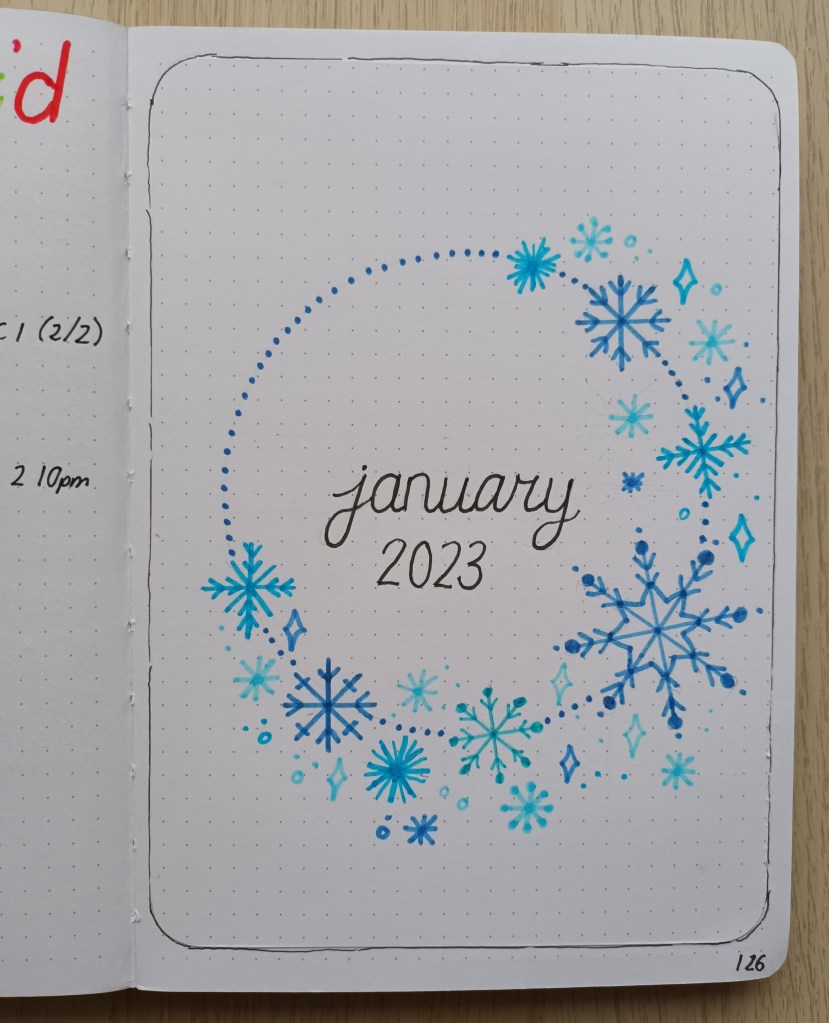
This month’s cover page is heavily influenced by a design from @createmore.se on Instagram. I’ve changed it up slightly by adding sparkles, dots and small circles but the composition is mainly the same. I used my circle drawing tool and, as I messed up the lettering in my notebook, I cut a page from the back using my X-Acto knife, trimmed it down, created the wreath and then stuck it in after I’d finished. I decided to do a rough freehand border around it to make it stand out. My new pens are from the Ohuhu brand and I ordered the mid tone range which has some lovely pastel colours.

Photo credit: Laura Jones for Keeping It Creative

Monthly Calendar

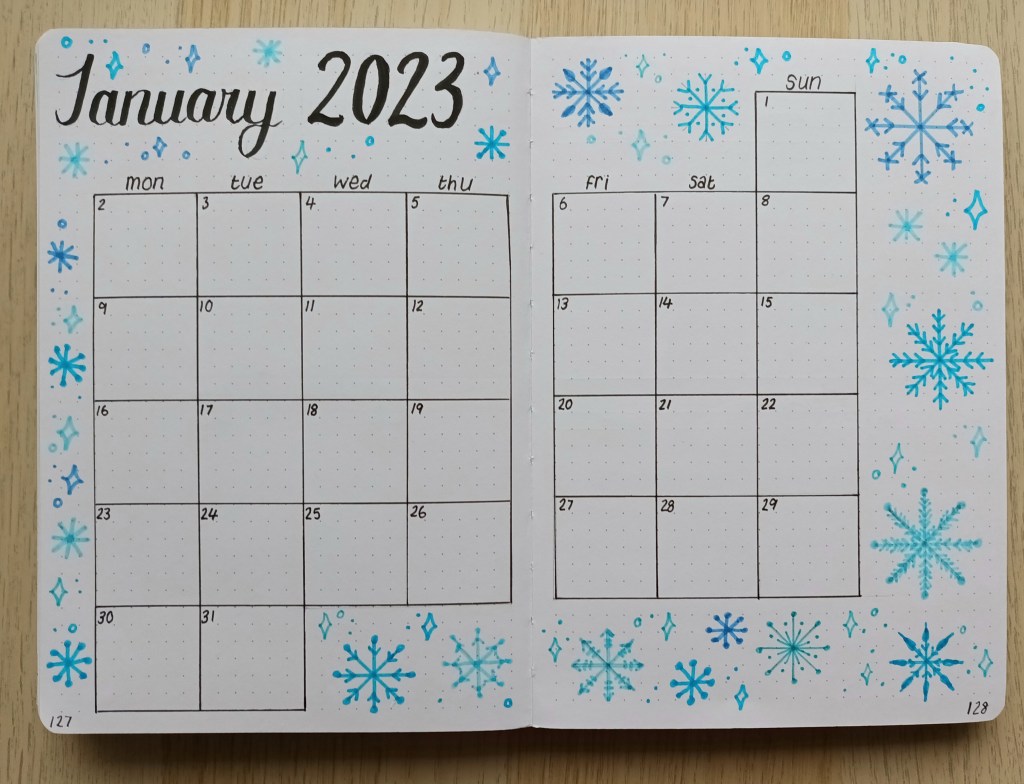
I’m really pleased with how this one turned out. It’s my usual grid layout with different snowflake designs filling the space. It took me a while but it was a nice bit of mindful drawing in the evening of the first of January,

Photo credit: Laura Jones for Keeping It Creative

Finances

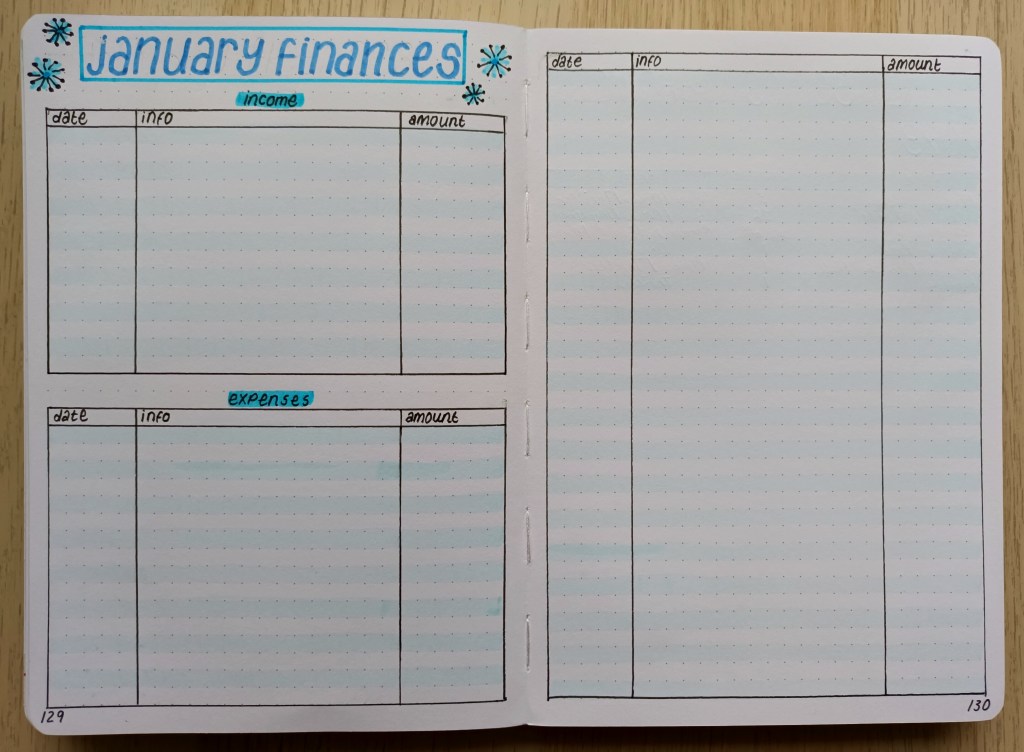
Again, this spread is self explanatory. By the end of last month, my expenses table was completely full – in fact I ran out of space! Hopefully, this month will be a lot lighter on the spending front!

Photo credit: Laura Jones for Keeping It Creative

TV series watched

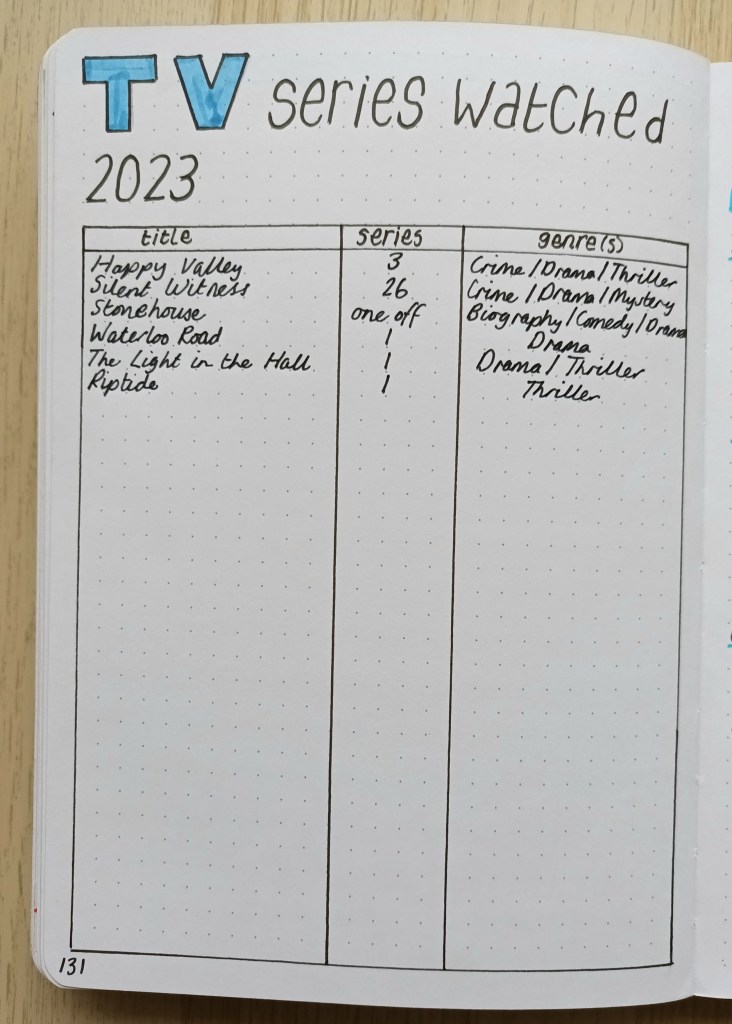
I don’t do one of these each month but my last one ran up until the end of December so I’ve just set up a new one. I like to record all of the different series we watch and the particular genres we enjoy. It’s nice to see all of the things we’ve watched and is a good reminder of what we’ve seen.

Photo credit: Laura Jones for Keeping It Creative

Veganuary Week 1 Meal Planning

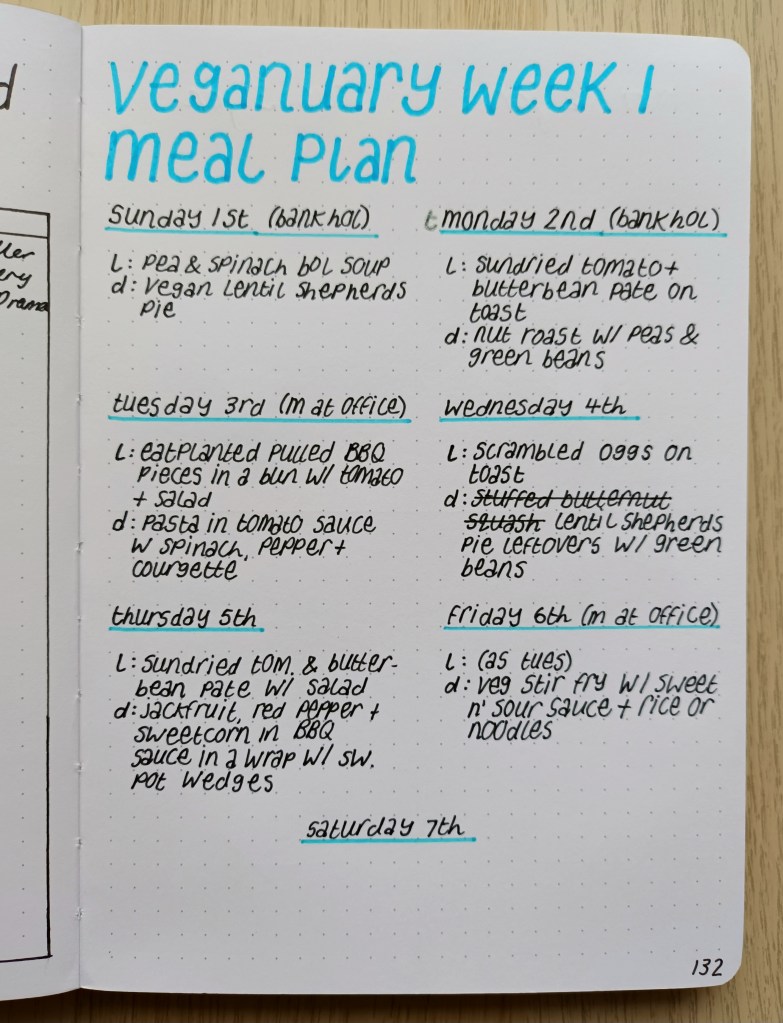
My husband and I are doing Veganuary again this year which means we’re eating vegan for the whole of January. It gets easier every year but we still need to do a meal plan each week so that we know what we’re having for lunch and dinner each day. I also find the meal planning pages from previous years really useful. Obviously, this page could be useful whatever your diet but we don’t tend to spend long thinking of meal ideas the rest of the year.

Photo credit: Laura Jones for Keeping It Creative

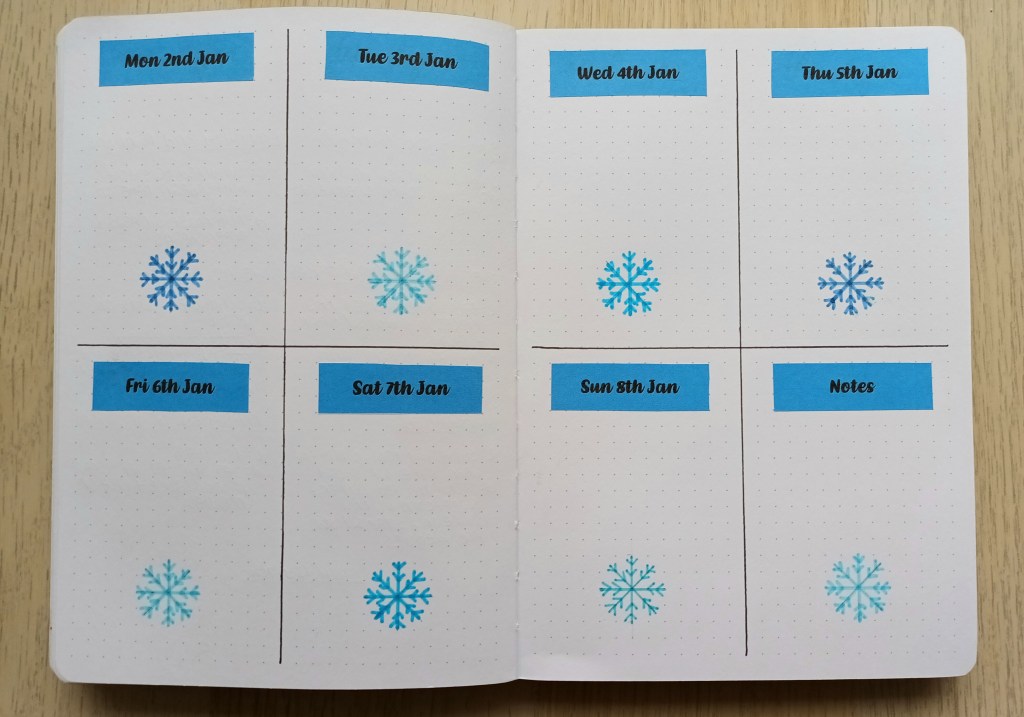
Weekly Plan

This is my first weekly of the month. I used the same snowflake design for each day because coming up with different designs is what took a lot of time for the cover and calendar. I messed up on the spacing for this spread so the bottom columns are one dot space shorter than the ones at the top but it doesn’t bother me too much as I tend to write less at the weekends anyway.

Photo credit: Laura Jones for Keeping It Creative

Final words…

That’s all of the spreads I’ve drawn up so far. I have my running task list to set up this morning which will go on the page after my weekly plan and I will of course be doing more meal planning spreads and weekly plans over the weeks. I hope you’ve enjoyed looking at my spreads for this month. We have no snow here at the moment but it is certainly cold enough to get some white stuff soon.