
Posted in lifestyle, mental health, self care, wellbeing

Monday Matters: 23 screen free ways to relax and recharge

This week, I’m sharing 23 ways to relax and recharge, which don’t involve scrolling on your phone, looking at things on your laptop, or staring at your TV screen. Why not make a list of your favourites in your bullet journal or notebook and choose one next time you need a break from modern day technology? (that’s every day for most of us!)

23 screen free activities to help you relax and recharge

  1. Try ‘Progressive muscle relaxation‘ This technique involves tensing and then relaxing your muscles one by one and is a great way to release tension. Check out this link for a straightforward explanation of how to do it.
  2. Curl up with a good book or magazine and a beverage of your choice Depending on the time of year and the weather, you might read outdoors in your garden or local park, in your favourite chair with an ice cold glass of water or under a blanket with a hot chocolate.
  3. Spend time in nature This is one of my favourite ways to relax at any time of year but the autumn months are particularly beautiful to be outdoors in a park, woodland or forest setting. Put your phone in your bag or coat pocket in case of emergencies and use your senses to explore your environment. As long as you’re suitably dressed for the weather, I can almost guarantee you’ll fall in love with the peace and quiet and feel restored afterwards.
  4. Connect with family or friends Choose to connect with people who make you feel good and whose company you enjoy. Activities could include meeting for coffee and cake, taking a walk in a scenic location, having lunch or an evening meal together in a restaurant or cafe or inviting people round for an informal dinner party (or takeaway if the thought of playing host for dinner fills you with dread!).
  5. Arrange a games evening Playing games can be great fun and are often so absorbing that you’ll completely forget about your to do lists and responsibilities for a while. My husband and I love Scrabble, Yahtzee, Rummikub and card games such as Gin rummy or Cribbage.
  6. Pamper yourself Depending on your preferences, this could involve a long soak in the bath, an invigorating shower and an all over body scrub, a face mask, a foot massage, manicure or pedicure or even a much needed lie in. See it as essential me time rather than self indulgence.
  7. Look through a photograph album My husband and I did this on our wedding anniversary last month and it brough back some really happy memories of our special day. It’s also nice to look at holiday photos through the years or albums showing your children growing up.
  8. Do some gardening Get some fresh air whilst giving your flower beds and pots some much needed attention. Even 20 minutes can make a real difference and leave you with an outdoor space to be proud of.
  9. Sharpen your mind with a puzzle Why not unwind with a word or number puzzle, a jigsaw or a brain teaser. I love wordsearches, Sudoku, 1000 piece jigsaw puzzles and letter arrangement games.
  10. Spend time with a pet Playing with or observing your furry four-legged friend is great for increasing your levels of seratonin and dopamine to calm and relax you. I love having snuggles with my hamster Millie, seeing her play in her digging tower or watching her collect treats which we hide around her cage.
  11. Make a foodie treat We often make dishes from scratch but these are generally main meals and often involve time and energy. Making something indulgent for dessert or as an afternoon snack with a cuppa is often easier and much quicker. One of my favourites is malteser tiffin and the hardest bit is leaving it in the fridge long enough to set properly!
  12. Enjoy a meal out with your partner, friends or family Letting someone else do the cooking for a change is a great way to rest and recharge. My husband and I love going for a vegetarian banquet at our favourite Asian fusion restaurant we try to make sure we focus on the food and the company by keeping our phones off the table.
  13. Make time for your hobbies Most of us have at least one hobby that we absolutely love but how regularly do you make time for yours? Doing something creative after a busy day is a wonderful way to unwind and leave you feeling relaxed and ready for bed.
  14. Focus on your breathing Have a look at this simple breathing technique (you don’t need to be feeling stressed to find it beneficial). When I first starting doing focused breathing and mini meditations, I found it really difficult to switch off, but now, after regular practise, it’s so much easier so don’t give up if your mind keeps bobbing about all over!
  15. Listen to music I love to just sit with my eyes closed and listen to my favourite classical pieces or songs. Immersing myself in the music or really tuning in to the lyrics allows my mind to switch off from everything else. The tunes don’t need to be relaxing or soothing ones – anything you enjoy will help you hold your focus.
  16. Do a meditative activity If you find sitting still to meditate difficult, doing a repetitive activity can help you reach a meditative state. Check out this post for 8 ideas to try.
  17. Journal your thoughts and feelings Journalling is a great way to clear your mind by putting things down on paper. You might want to write about how your day has gone, what you’re looking forward to in the future or how you feel you are progressing towards your current goals. If the thought of getting started seems a little taunting, journalling prompts are a great way to get ideas on what to write about.
  18. Switch to audio content Instead of scrolling through content on your phone, tablet or laptop and reading or watching videos, trying listening to audio content. This could be a podcast on a topic which interests you or an audiobook which you can listen to with your eyes closed.
  19. Do something fun which you used to enjoy as a child When I was young, phones and tablets didn’t exist and the only screen time I had each day was watching TV or playing games on our Commodore 64 (hand up if you remember this state of the art machine from the 80s!). Aside from these, we used to make our own entertainment, playing outdoor games, doing creative projects, building things out of Lego, making a den under the dining table or playing with toys such as skipping ropes, space hoppers, dolls and Transformers. Whatever you used to do as a kid, think about how adult you can do the same or similar and make some fun plans for the weekend. You might buy a stunt kite and take it to a local hill on a windy day or buy some bubble mix and have a competition to see how can make the best or biggest bubble.
  20. Sign up for an evening class A few years ago, I did a beginners photography course at my local college (which offered a qualification to go with it) and also a couple of ceramics classes where we made and glazed various clay creations. I thoroughly enjoyed all of these and it was great to meet and get to know like-minded individuals. The ceramics beginner and intermediate sessions were incredibly relaxing and it was so exciting seeing our items when they came out of the kiln. Wherever you live, there’s likely to be a range of creative classes in your local area and if not, you could get together with friends to try something new.
  21. Join a choir Group singing is a wonderful way to de-stress and feel part of the community. There will probably be a range of choirs and musical societies available to join depending on the type of music and songs you prefer. A small cost may be incurred but I know from my own experience it’s a small price to pay for something which is very therapeutic and creates a real high.
  22. Do something arty When we were young kids, most of us enjoyed art activities such as painting, drawing, making collages and constructing from junk materials. That’s because it was mainly about enjoying the creative process and experimenting with different techniques. As we get older, we tend to focus on the finished result and being happy with what we’ve made, rather than having fun as part of the process. So, get out your paints, markers, crayons, pencils and pens and simply explore and experiment.
  23. Be a tourist in your home town or city (or one nearby) You’ve probably already visited a few places and buildings in your local area but do you know their and how your town or city has developed over time? A quick check on Tripadvisor and I’ve discovered a number of ideas for places to go, activities to try and history to read up on where I live in Sunderland.

I hope you’ve found today’s blog post useful and it’s given you plenty of ideas for relaxing activities which offer much needed screen free time. I would love to know which one is your favourite and why. And if you don’t feel like you have a space in your day to fit in any of the above, is it because your diary is genuinely completely full or is it because mindlessly scrolling is taking over your life right now?

Posted in lifestyle, mental health, self care, wellbeing, wildlife

Monday Matters: 5 ways to get yourself ready for Autumn 2023

Photo credit: Johannes Plenio for Unsplash

Some of us look forward to Autumn and the prospect of wearing warm clothes, spending cosy evenings in watching great TV and snuggling up with a hot drink and a good book. For others, it is less appealing, signifying fewer daylight hours and colder temperatures. However you feel about the coming months, here are five ways to get yourself ready for the season and plan some enjoyable and mood boosting activities.

Do some seasonal meal planning

In the Summer time, we tend to opt for lighter meals such as salads and juicy, fresh fruits such as watermelon, strawberries, mango, peaches, nectarines and raspberries. However, as we head into Autumn we start to crave heartier meals and warming foods such as soups, stews, pies, risottos, curries, root veggies (e.g. sweet potato, onion, turnip, leek, swede, parsnip, carrot and celeriac) plus other wholesome favourites (e.g. squashes, cauliflower, broccoli, kale, cabbage and chard), seasonal fruits (e.g. apples, pears, cranberries, elderberries, damsons and plums) wholegrains (e.g. wholemeal pasta, brown rice, quinoa, oats, bulgur wheat and wholemeal breads) and legumes (e.g. beans, chickpeas, lentils and soybeans).

As we head towards the new season, I like to use a page in my bullet journal to make a list of warming dishes that we already enjoy and will want to make again this year. I’ll also spend some time searching recipes books and online resources such BBC Good Food, Olive Magazine, National Trust, Sainsburys Magazine and Tesco Real Food for some new ideas to try, marking pages with Post-it index tabs and sharing webpages to Notion to place in my recipes section.

Prepare your home

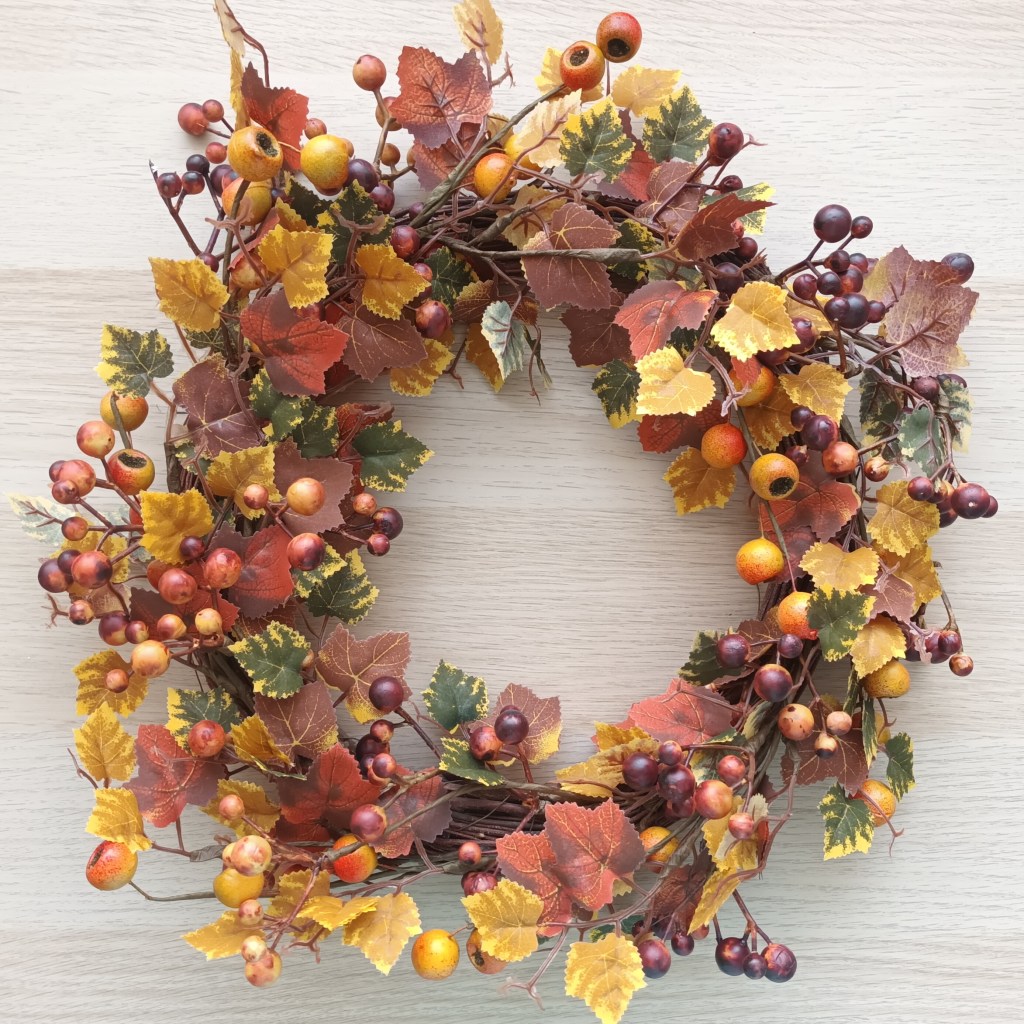
This year I’ve treated myself to a beautiful Autumn wreath for our front door and added to my little collection of decorative pumpkins with some small plush ones I found in Hobbycraft. I’m really looking forward to putting them on display.

As well as changing up your decor, here’s some other ways to get your home ready for the autumn season:

  • sort out your wardrobe and drawers -remove vest tops, shorts, cropped trousers, summer skirts and dresses, thin jackets, caps, sunhats and summer swimwear and put them into storage to make room for thicker coats, jumpers, cardigans, tights, thicker trousers, jeans, hats, scarfs and gloves. Consider donating anything which hasn’t been worn in a while.
  • deep clean your home – we often associate spring with the time to clean but the autumn season is ideal too. Search ‘fall deep cleaning checklist’ on Pinterest for comprehensive lists of what to tackle.
  • swap your thin summer duvet for a slightly thicker one and layer with a blanket at the bottom of the bed or place on a chair for chillier nights.
  • add layers of soft furnishings such as throws and blankets to your sofa and chairs. You might also like to transform your space with new cushion covers in autumnal colours such as deep oranges, rich reds, golden browns, plum tones, muddy greens and mustard yellow.
  • treat yourself to a new home fragrance such as a candle, reed diffuser, pot pourri or air freshener. Popular scents for autumn include cinnamon, apple, amber, pine, cedarwood and spiced pumpkin.

Go outside

As temperatures start to drop and it gets a bit wet out there, it can be tempting to stay indoors, but Autumn is a beautiful time of year and, as long as you dress appropriately for the weather ( e.g. layers, waterproof coat, wellies, comfortable shoes or boots etc.) nothing beats a wonderful, mindful walk, appreciating all that nature has to offer.

My husband and I try to plan to go somewhere different each weekend, choosing a scenic location such as a forest, park, garden or woodland where we can completely immerse ourselves in the atmosphere. Here’s a few suggestions for making the most of your time outdoors:

  • use all of your senses to really appreciate the environment you’re in, pause regularly to notice the sights, sounds, smells, textures and maybe even tastes if you take a warm drink or a snack with you!
  • take your camera along to record some of your nature spots such as trees changing colour, different types of fungi, squirrels collecting nuts, the sun peeping through the branches of a tree, moss and lichen, fallen leaves on the ground, flowing water, nuts and berries, different views etc
  • collect autumn things such as acorns, conkers, different shapes, sizes and colours of leaves, pine cones, sycamore seeds, feathers etc
  • find a place to rest (preferably somewhere quiet and peaceful to sit or stand depending on the weather), take a few deeper, calming breathes before closing your eyes to. Take time to really appreciate the various sounds of nature, bodily sensations such as the sun, wind or rain on your face or the feel of your clothes against you skin and how you are feeling right now
  • when you get home, try doing some reflective journalling about today’s walk and how you feel about the Autumn season – the things you love and the things you don’t

Make the most of the light

As well as scheduling in time for walks in nature, try to find other ways of soaking up as much of the autumn light as you can. This might mean slightly changing your routine and going to bed a little earlier so you can enjoy the morning sunshine, taking your lunch outside or going for a short mid-day walk, moving your chair or workspace to a sunny spot in your home or using mirrors to reflect sunlight from your windows.

Autumn is also the best season to watch beautiful sunrises and see spectacular and vivid sunsets. Plus, there are many physical and mental health benefits including better sleep, improved immune system, stress reduction, boosted mood, appetite regulation, feelings of gratitude and the chance to slow down and focus on the here and now.

Make an Autumn bucket list

This is something I did in my bullet journal a good few years ago now and it’s something I’m going to create again this year to make sure I get the most out of the season. Some ideas to add off the top of my head include:

  • photograph signs of autumn e.g. changing leaves, squirrels storing nuts for the winter, fungi in the woods, crunchy fallen leaves, squashes appearing in the supermarket
  • go on a woodland walk
  • buy or make a piece of Autumn décor for your home
  • visit a pumpkin patch (book early as it’s a popular activity)
  • learn more about the science of leaves changing colour
  • do an Autumn craft – I plan to make an Autumn leaf garland using cardstock and my Cricut Joy and hope to create some Autumn ephemera for my TN journal too
  • develop a collection of squash recipes and try out at least two of them

Final words…

I hope you’ve found today’s post useful and it has given you some ideas on how to prepare for the changing season. If you have a tendency to feel anxious or down about the advent of autumn, maybe it’s time to work on reframing your outlook and start thinking about all the things there are to look forward to like beautiful walks in nature, wonderful wildlife to spot such as squirrels collecting nuts, noisy, honking geese in a large v in the sky heading south, new arrivals to the UK including fieldfares, redwings and waxwings, plus waterbirds like barnacle geese, water pipits, pochards and pintails, starling murmurations and rutting deer, wearing warm clothes and snuggling up under blankets, creating a cosy atmosphere in your home, eating comfort foods like soups, stews, crumbles and pies, plus lots of gripping TV dramas to binge watch.

Wishing you all a fantastic and fun-filled Autumn season,

Posted in crafting, creativity, lifestyle

My new crafting tool – the Cricut Joy: first impressions and trying beginner projects

Photo credit: Laura Jones for Keeping It Creative

I’d been wanting a cutting machine for ages and always spent time looking at them during each visit to Hobbycraft. However, both the cutter itself and the materials seemed very expensive and I wondered whether it would become extremely costly. I primarily wanted to use it for making customised stickers to go in my bullet journal and to create die cuts, shapes and stencils for my traveler’s notebook journalling and figured that I could do this instead of buying things online.

When my husband asked me what I would like for my birthday, I mentioned the Cricut Joy and the starter kit I’d seen online. Again, we talked about cost but I decided I really wanted to get one so we searched for the best deal and my husband made the purchase. I set my machine up just over a week ago and I absolutely love it. I’ve also become somewhat addicted to watching YouTube videos showing beginner friendly projects too!

Today, I thought I’d share my initial impressions of my Cricut Joy and what I’ve learnt so far. I’ve already bought a few more items from Amazon – two more insert card sets, a longer standard grip mat and I put my £5 off at Hobbycraft birthday voucher towards a tool set (spatula and scraping tool) which I feel is an essential having done a few projects. I also bought another set of 5 permanent vinyl pieces which is known as the ‘Beachside Sampler’ and contains tulip pink, mint, teal, coral and tangerine colours. 

What is the Cricut Joy?

The Cricut Joy is a small cutting, drawing and writing machine that can be used to create a range of personalised items such as greetings cards, labels, decals, stickers, iron on designs for fabric, paper flowers and much more. You can work with a range of materials including cardstock, smart vinyl, paper, infusible ink, faux leather and faux suede, adhesive backed paper, iron on vinyl and foil. 

First impressions

The Cricut Joy is the first cutting machine I’ve owned and was the cheapest and smallest option so I felt it was a good one for me to try as a beginner. The Joy itself is super compact and so it doesn’t take up much storage space in my craft room which is a big bonus for me. It’s also fairly light (although heavier than I thought it would be for its size) and portable, so would be good for crafting on the go.

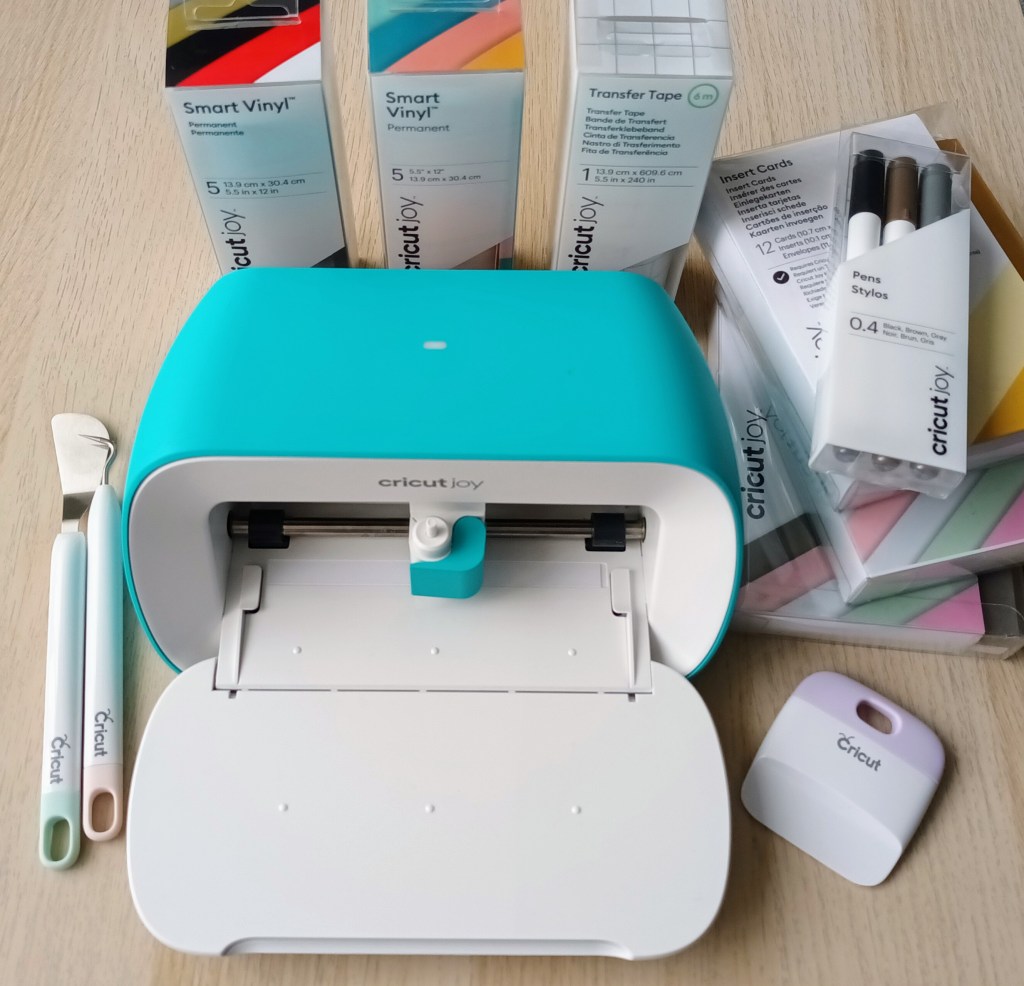
The machine itself comes with the cord, power pack and plug. You also get a welcome envelope which includes a weblink for setting up your Joy and downloading Design Space. The package also contains one standard grip cutting mat, a sample of vinyl and a piece of deluxe paper, plus one 0.4 black pen which can be used in place of the cutting blade. The instructions are very straightforward and easy to follow and I was good to go after just a few minutes and I’d created a vinyl label and a speech bubble message with the card . I was pleased that I chose the starter kit as it included a set of insert cards (plus the mat required for cutting them), a weeding tool for removing bits of paper from the cut work, a set of 5 permanent smart vinyl pieces, some transfer tape for easier aligning of designs on your products and a small set of three 0.4 pens for use in the machine. Without buying the extra bits and pieces you wouldn’t really be ready to do any projects with your new toy unless you used cardstock you already had! 

The Cricut Joy connects to your computer, tablet or phone using bluetooth and everything is done through the Cricut Design Space app. There are no buttons on the machine and as soon as you plug the Joy in the light comes on to show it’s ready to use. Having downloaded the Design Space App, I spent a few minutes looking through a range of different designs, fonts and projects. I learnt pretty quickly that if you want to make good use of your machine and use a range of designs, font and even 3D projects, you really need Cricut Access which is free for the first month and then costs £7.49 a month or £71.88 a year until cancelled. You can purchase designs separately which would be best for a light user but as I intend to use my machine regularly, I’ve opted to pay monthly.

Making insert cards

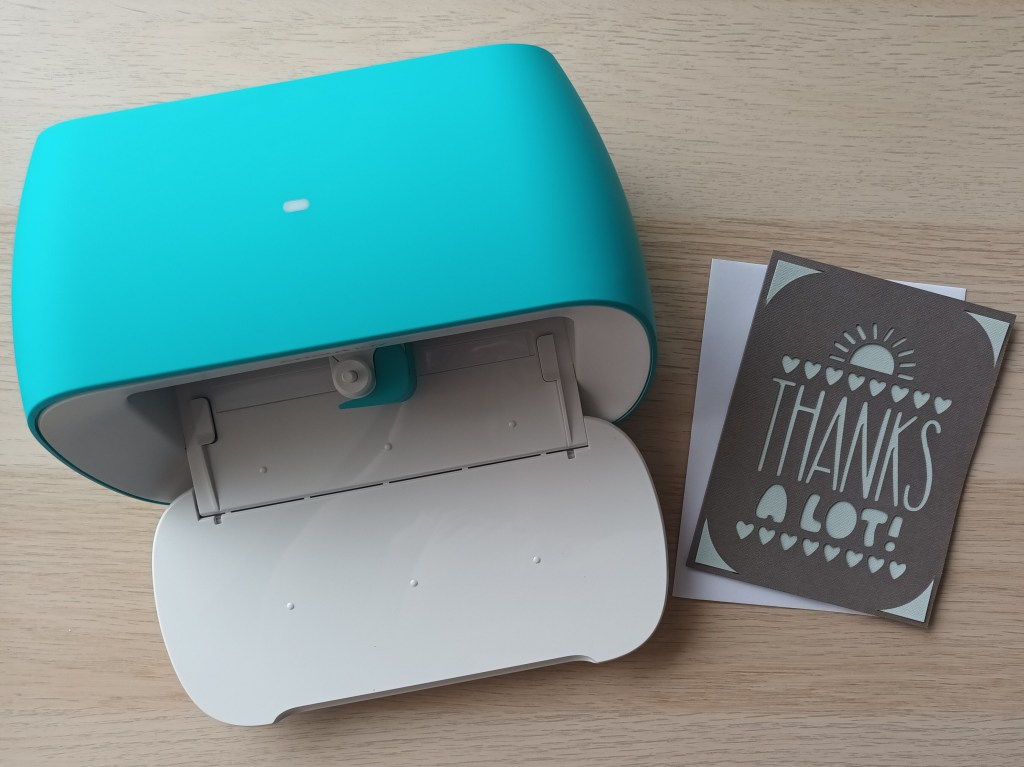
Making cards is super easy and there are so many designs to choose from. The first one I made was a thank you card for my husband in which I wrote about how much I loved both of my birthdat presents – The Cricut Joy and a simple DIY bat detector for use in our back garden where we see a small number of the cute, little creatures collecting moths at dusk.

Photo credit: Laura Jones for Keeping It Creative

I also made my friend a birthday card using the cream set with matte gold inserts. Unfortunately, it was a last minute thing and I forgot to take a photograph of the finished project.

Personalising my water bottles

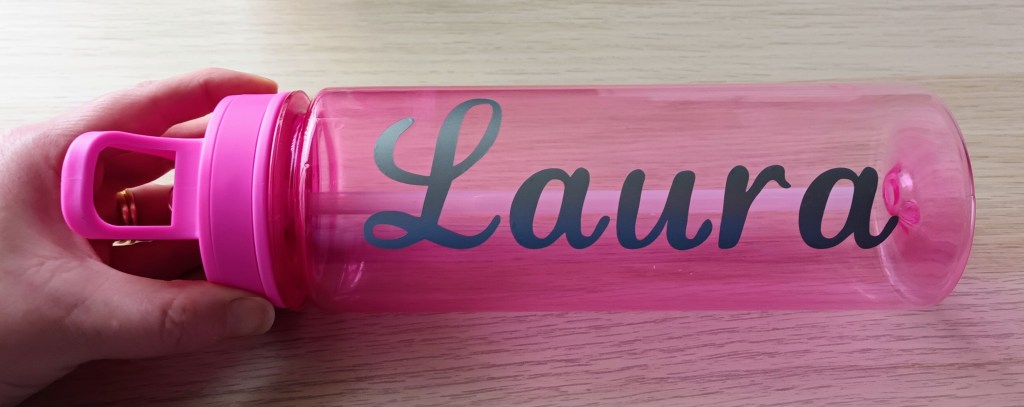
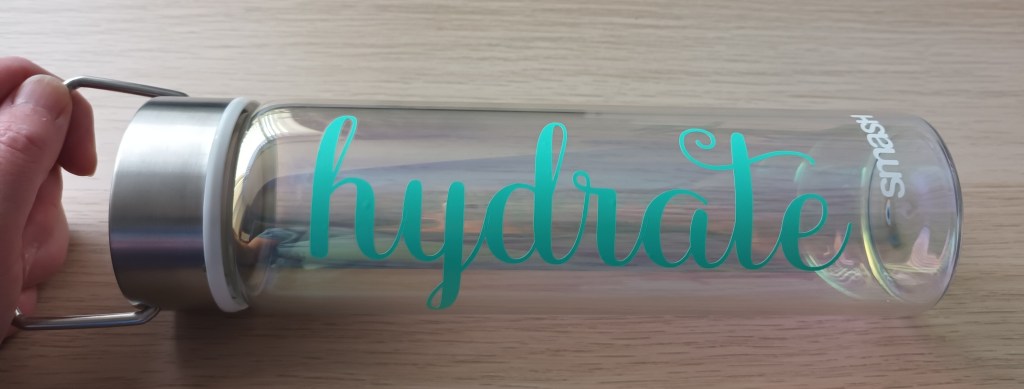
I thought a good, beginner friendly vinyl project would be to personalise the water bottles I have for the gym and on my craft room desk. I decided to put my name on my gym bottle and then add the word hydrate on my glass container. Unfortunately, when I examined them both, the plastic one had a small crack in it (probably from rolling off the passenger seat in my car) and some of the iridescent effect on the glass one had worn off so I ended up replacing them (yet more expense but I wanted them to look good when I’d finished them.

I chose a simple font for my name and decided upon silver vinyl. The Cricut Ioy was quick to cut the text out and my weeding tool was useful for removing the middle from the a letters.

Photo credit: Laura Jones for Keeping It Creative

For my glass bottle, I chose a lovely peachy colour vinyl and a cursive font. However, you’ll notice that the finished item has mint vinyl on it, and that’s because the peachy vinyl got torn when I was removing the excess where the thinner parts and flourishes were. I was really disappointed as I didn’t have enough material to try again, but I’ve learned that you need to be super careful when peeling away the surrounding vinyl. I also had issues with getting the word firmly stuck to the transfer tape and had to repeatedly go over bits of it with the scraper tool.

Photo credit: Laura Jones for Keeping It Creative

I’m thrilled with how they both turned out, and I couldn’t wait to photograph them and share them both with you. I wonder if anyone will notice my personalised gym water bottle when I go to Pilates tomorrow?

Creating stickers i.e. what I mainly wanted my cutting machine for  

At the beginning of today’s post, I mentioned that one of my main reasons for wanting a cutting machine was so that I could make stickers for my BuJo and travellers notebook journals. However, I’ve since discovered that the Cricut Joy does not support print and cut like the larger cutting machines do. There are quite a few videos on YouTube which share a hack for it but it looks like quite a lengthy process so I wanted to wait until I had more time and had become more familiar with the design software. I’ll probably share another post when I’ve got to grips with what you have to do.

Final words…

I hope today’s post has been useful for anyone who is tempted to buy a cutting machine for their crafting. Even if you’re not a craftaholic like me, hopefully you enjoyed seeing my designs. I’m really loving my Cricut Joy so far and exploring what it can do. I’m looking forward to trying out lots more projects and techniques in the near future.

Posted in bullet journal, Bullet journaling, creativity, lifestyle, Planning and journaling

Setting up my Bullet Journal for August 2023: ice cream and ice lollies theme

Today, as I write this blog post, I have the window in my craft room wide open and a large bottled of iced water on my desk to sip from. The weather has finally improved after days of rain, and the sun is peeping out from behind the clouds. I was beginning to think the summer was over but it appears to be back, for a brief time at least judging by the forecast! August is almost here and it is one of my favourite months as my niece and I share our birthdays on the 3rd (which coincides with factory shut down week so my husband can take some well earned time off from his office job), plus we celebrate our wedding anniversary (17 years on the 11th!). As we will be busy making the most of holiday time next week, I started working on my spreads super early, this time, choosing a seasonal theme of ice cream and ice lollies.

Cover page

Once I had decided on the theme, I spent some time searching Google for pictures of bullet journal spreads that others had shared, doodles of ice creams and lollies, plus photos of some of my childhood favourites and different types of cones. I then printed off lots of examples for inspiration for my spreads.

For the cover, I opted for some brush lettering in the centre of the page with just a simple hello August. I wasn’t happy with my first attempt, so I practised on my pad of dot grid paper then cut out the title when I was happy with it. The slim border around the cut out is created using mint green ink on a finger sponge dauber which I lightly pressed all around the edge. One the lettering was sorted, I then penciled in a range of ice creams and ice lollies before using a 0.2 Pigma Micron to outline and a 0.05 to create the cross hatching for the cones. Finally, I used Tombows and Mildliners in pastel colours to complete the doodles.

Photo credit: Laura Jones for Keeping It Creative

Calendar page

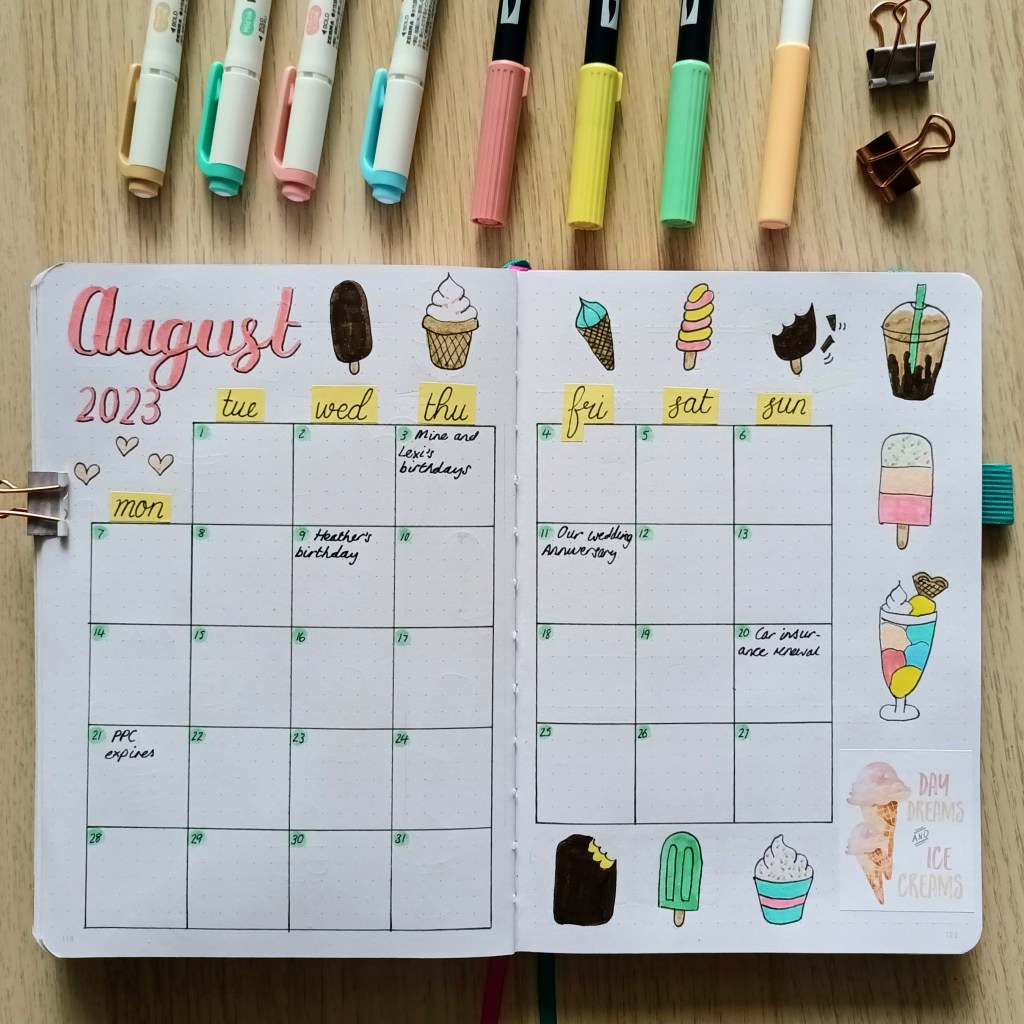
The calendar pages features my usual 6×6 grid spaces boxes with a pop of colour for the dates. I enjoyed creating the doodles for these pages and I’m pleased with how they turned out. I messed up once so I covered the mistake with a sticker I created using a Google image.

Photo credit: Laura Jones for Keeping It Creative

Finances and habits pages

Although the beginning of August is likely to be expensive for our joint finances, I’m hoping to keep my personal spending relatively low so I’ve made my outgoings table even shorter than last month. This left a big space at the bottom of the page, so I filled it with some habit trackers. Recently, I’ve started going to bed really late and by the time I’ve read my Kindle for a bit, it’s gone midnight. Because of this, I’ve been sleeping in and not getting as much done with my day. So as not to put too much pressure on myself, I’ve set myself the target of being up by 8.30am for August which will still be a bit of a challenge but hopefully doable. The rest of the habits I want to instill are related to my goals for 2023.

Photo credit: Laura Jones for Keeping It Creative

Final words…

That’s all of the pages I’ve created for August so far and when I draw up my weekly plans, I will probably keep them fairly minimal. I hope you’ve enjoyed seeing my designs and I look forward to seeing other creations and theme ideas as they are shared.

Wishing you all a fun-filled August with lots of opportunities to create happy memories,

Posted in Bullet journaling, journalling, lifestyle, memory keeping, Planning and journaling, reflective journalling, TN journaling

Monday Matters: 10 types of journalling practices to try today

Journalling is the act of writing down your thoughts, feelings, actions and experiences on paper or in digital form. There are many different types of journalling practices and for today’s Monday Matters post, I’m going to share ten popular ones, most of which I’ve tried and benefitted from myself.

What are the benefits of keeping a journal?

The particular benefits of keeping a journal depend on the style you choose but can include:

  • a reduction in stress or anxiety
  • increased productivity
  • better time management
  • a place to record daily life
  • a tool for organising your priorities, your routines or your to-do list
  • clarification of your thoughts and feelings
  • a place to think about and solve problems
  • a way to get to know yourself better (becoming more self aware)
  • a chance to see negative thought patterns and behaviours
  • a safe space to explore your emotions
  • a place to express yourself in writing and improve your writing composition
  • an opportunity to get creative
  • somewhere to track your progress or achievements over time
  • improved sleep by getting your worries down on paper and out of your head
  • a place to note down important ideas or things you want to remember

Diary / personal journal

A personal journal or diary provides a space to write each day and is usually kept private due to the nature of the content. You can include whatever you like inside such as summaries of events or places visited, how you have felt today and why, lessons learnt, relationships, thoughts or worries. Depending on how much flexibility you want in terms of how much you write, you could choose a between a range of sizes (from pocket to A4 size) with printed diary pages pages, a long term ‘line a day’ style or a completely blank lined or unlined notebook which you can add the date to and fill in with as much or as little detail as you like.

Gratitude journalling

Gratitude journalling is the practice of writing down what you’re thankful for each day and can take just five minutes first thing in the morning or last thing in the evening before bed. I used to create a double page, two lines a day spread in my bullet journal which I filled in at the end of each day, but now, I use the gratitude space in The Five Minute Journal morning section. A lined notebook would work just as well and if you choose one which is really pretty and has nice, smooth paper you’re much more likely to reach for it. It’s up to you what you write but here’s a few ideas:

  • something good that happened today / yesterday
  • a person in your life which you’re particularly grateful for
  • a challenge you’re facing which is helping you learn
  • a helpful resource – a magazine article, a podcast, a non-fiction book, a YouTube video etc
  • a positive change in your life
  • something that brightened your day
  • hobbies and interests which you’re glad to have
  • personal strengths, abilities and skills you’re grateful for
  • something in your life that you tend to take for granted
  • something new that you’ve treated yourself to

Bullet journalling

The bullet journal system (or BuJo for short) was created by Ryder Carroll and is a way of organising your life in a single notebook (either an analogue or digital version). There are so many benefits to using a bullet journal including increased productivity, better time management, tracking personal progress and growth, helping you work towards your goals, stress reduction, keeping lists which you can refer back to and use again, better self awareness, a place to get creative if you so wish, great for instilling and monitoring habits, a space to record your ideas, helps you see exactly how much you’ve achieved each day / week / month and so on. A comprehensive guide to The Bullet Journal Method is available on Amazon in paperback or Kindle and is well worth a read if the idea of becoming more organised appeals.

Morning pages

Writing morning pages is a journalling exercise which involves putting pen to paper first thing every morning and writing whatever pops into your head without editing or censoring. The idea is that, each day, as soon as you wake up, you sit down and fill exactly three A4 sheets with whatever comes into your mind. The writing doesn’t have to make sense, be correctly spelt or punctuated. It isn’t read afterwards either. and is for your eyes only. Done regularly, this type of journalling promises a cathartic and ritualistic practice which is designed to increase confidence, clear the mind and pave the way for greater creativity.

Prompted journals

If you need help with what to write in your journal, prompted journals are a great place to start. There are lots of different versions available at a range of price points. Some offer daily practices and include sections such as gratitude, self care, top priorities for your day, feelings check ins, nightly reflections and so on. Others, such as the Five Minute Self Care series, can be dipped into as and when and you can flick through and choose a prompt for your writing.

Memory keeping journal

This is one of my favourite types of journalling as you can create pages about literally anything that’s happened in your life. Looking back through one of my traveller’s notebook inserts from last year, I have journalling and photos from when we went away for my dad’s 80th and my mum’s 70th, a few pages about a National Trust property we visited, some journalling about our fancy new microwave and how smart it looked in our kitchen, an introduction to Millie the hamster and photos from when she was a little baby, photographs of my new haircut and the curls my hairdresser created, a day trip to York where we walked along the wall and had some tasty vegan and veggie foods (complete with our menu choices), and finally a trip to Brimham Rocks. I’ve been keeping this type of journal for about 6 years now and they’re so lovely to look back on and re-read. I even hand make the notebooks using my own choice of pretty paper for the covers.

Travel journal

This is another type of memory keeping journal which is used to document holidays and trips. I’ve been keeping these for a few years now and even create my own handstitched notebooks for the purpose. Whilst I’m away, I collect bits and pieces to stick in such as maps showing walks we’ve taken, business cards from restaurants, tickets from places we’ve visited, postcards to remind me of scenery, art exhibitions we’ve been to or particular historic buildings, packaging and brochures. I also spend a few minutes each evening briefly recording what we did that day, how I felt and anything amusing that happened.

What you record in your travel journal is entirely up to you but I like to start with our travel information such as dates of the holiday, modes of transport, flight numbers, journey times, hotel bookings etc. I then include photographs, memorabilia and bits of journalling for each day of the trip and then finish with a summary of the holiday on the final pages of the notebook.

Art journal

If you’re not too keen on expressing yourself in written form, another great way of articulating your thoughts and feelings or getting creative is to keep an art journal. Any size and type of notebook will work but thicker paper is best to avoid bleed through (where your work seeps through to the other side) or ghosting (where you can see your work through to the next), You can also choose any type of material to practise with such as pencil, crayon, markers, ink, paint or paper for collage style layering, or you can combine a few of the above to create a mixed media piece. There’s no right or wrong way to do it – the key is to experiment and enjoy the process.

Reading journal

If you’re a bookworm, keeping a reading journal is the perfect way to record what you read and when, your thoughts and feelings about the book as you read, chapter summaries (particularly with non-fiction), any quotes you’d like to remember, an overall evaluation when you finish and a star rating to show how much you enjoyed the book. If you use an app such as Storygraph, you can even include reading focused graphs and charts too.

Garden journal

As some of my readers will know, I started a gardening journal in the spring of this year. One of my goals for this year, with my husband’s help, is to keep on top of our back garden (weeding, deadheading, pruning, tending, planting etc) and create a bright and colourful space which is a haven for wildlife. Obviously, it’s a work in progress, but my journal has helped me with recording to do lists, planting schedules, week-by-week planning, pest control, seed setting and seedling transplanting and so on. It’s also been a place to keep printed versions of articles I’ve read and tips from the various websites I’ve visited. If you’re a keen gardener or want to become more green-fingered, a garden journal is a great support and place for recording information which reflects all of your hard work. You can find out more about the benefits here.

Final words…

I hope that today’s post has inspired you to give journalling a go and reap some of the associated benefits. I would love to know which type of journal appeals the most and why. I’m also keen to know if anyone has tried Morning Pages and found them beneficial. I like the idea but, as an experienced teacher, I’m not sure I could write something without a care for spelling, grammar and punctuation, let alone three whole pages of A4!