Posted in lifestyle, social media, wellbeing, wellness

Monday Matters: Wheel Of Wellness – Social

In today’s Monday Matters I’ll be considering the social dimension of the Wheel Of Wellness, focusing specifically on the advantages and disadvantages of social media for individuals and using a variety of media to find out what’s on in your local community with a view to improving and extending your social connections.

What do we mean by the term ‘social media’?

Social media is a range of websites and applications (apps) that enable users to create and share content (information, ideas and interests) or to participate in social networking via digital channels. Examples include Pinterest, Facebook, YouTube, TikTok, Blogs, TripAdvisor, LinkedIn, Twitter and Instagram. Social media is used by millions of people and it has brought with it a lot of positives. However, it also has its negative side for individuals and society as a whole.

What are the main advantages of social media?

Connectivity The main advantage of social media has to be the way it connects people. Individuals from anywhere can connect with anyone regardless of their location or time zone. It enables us to easily keep in touch with friends, family, work colleagues, other students during our education and people who share our interests.

Education As well as providing opportunities for students and teachers to learn online, anyone can use social media to learn from experts and professionals. For example, I learnt brush lettering techniques for free using YouTube tutorials. I even found videos that looked at difficulties facing left handed letters and it was so nice to see lefties with beautiful handlettering. You can enhance your knowledge of absolutely anything and develop a range of skills in any field. Regardless of where you live and your educational background and level you can educate yourself, often completely for free.

Help, advice and support At one time, help used to be available from a small number of individuals such as relatives, neighbours, friends and colleagues or through reading books or magazines. Now, you can quickly share your issues in online communities and get so much help and advice you might feel overwhelmed and wonder which is most valuable! If you’re after money advice, you can join the Money Saving Expert forum, if you want local advice, you can join NextDoor and consult with your local community, if you need help with something related to your hobbies, there are countless groups on Facebook which you can sign up for.

Information and updates Another main advantage of social media is that it easily enables you to keep up-to-date with what is happening around the world. Rather than reading printed literature such as newspapers which tend to place a biased slant on things, you can seek information from more reputable sources such as the BBC or compare different articles on the same subject from multiple sources.

Awareness Social media is very good at increasing awareness of new and innovative ideas and products that can enhance the way we live and work. It also plays a huge role in helping people to be more aware of current affairs.

Builds communities There are a huge range of online communities and new ones are being started all of the time. On Instagram, you can follow hashtags which suit your interests and interact with others who share your passions. For example, I follow #hamstersofinstagram and #hamster and also post pictures of my pet for others to see. I also follow bullet journal related hashtags so I can inspiration for my own BuJo. Doing this means I can easily interact with other hamster lovers and people who love bullet journaling. On Facebook, I’m a member of various planner communities and groups who enjoy playing the game Angry Birds 2. One of my favourite groups is UKPA which has over 3.8K members. Not only do we discuss planning and share our planner spreads, but we also create lots of off topic threads related to everything and anything such as housework, friendships, productivity and lifestyle. This creates a feeling of ‘oneness’, bringing together people from different places, religions and backgrounds.

Sharing with others

Although some people seem to be in the habit of oversharing on social media, places like Facebook, Twitter, YouTube and Instagram are great platforms for sharing your creativity. This might be in the form of songs, photography, poems, art work or crafts such as knitting and sewing. If others like your recordings or items, they might express an interest in buying them which could even lead to a small business venture!

What are the main disadvantages of social media?

Time wasting It is very easy to spend far too much time mindlessly scrolling through feeds on apps such as Facebook, Instagram and Twitter, watching countless funny videos on YouTube or popping online to quickly check something only to find you’ve forgotten what you were supposed to be doing and have been distracted / pulled in by the wealth of other information which pops up on the screen of your phone, tablet or computer. Before you know it, several hours have passed by and you’ve not done any of the household / personal tasks you had on your to do list for today (seriously bad news for your productivity) or spoken to anyone you know IRL (in real life), including the people you live with, or spent any quality time interacting with your pets.

Addiction Social media can be extremely addictive, sometimes to the point where it has a seriously detrimental effect on your work and personal life and your relationships with others (see above). A recent study carried out just last year, found links between FOMO (fear of missing out) and excessive use of social media. This could either mean that FOMO causes individuals to keep checking social media, or what they see on social media makes them feel as though they are missing out and exacerbates the FOMO which in turn increases feelings associated with anxiety, depression and neuroses. These emotional effects can then have negative effects on physical health too.

Cyberbullying According to information online, cyberbullying is becoming a a big issue for children and adolescents. When I was a young girl, bullying (defined as repetitious unwanted and aggressive behaviour towards an individual) generally took place during the school day. Now, with the advent of social media it can happen 24 hours a day, 7 days a week – in other words relentlessly leaving the target with no respite. This information which I found on the Unicef website was incredibly informative on the subject and is well worth reading and talking about if you have your own children or spend time with young relatives. Of course, cyberbullying can also affect adults too and UK based Cybersmile Foundation has lots of useful help and advice available on their website.

Health issues Excessive use of social media can have a negative impact on both physical and mental health. Keeping yourself active is one of the keys to good health but constant use of social media promotes laziness and can lead to issues such as lethargy, weight gain, sleeplessness and a general inertia. Overuse of social media can also exacerbate mental health conditions. For example, seeing photos of friends having fun, being all smiley and making the most of life can sometimes cause feelings associated with inadequacy, unhappiness, dissatisfaction, loneliness, anxiety and depression.

Hacking Hacking is the process of gaining unauthorised access to data in a system or computer. This can be for a number of reasons including for financial gain, identity theft or to steal information or data. Hacking is one of the most dangerous aspects of social media usage so it’s really important to keep your information safe. See this Wikihow for simple ways to do this.

How can I make sure my experience of social media is a positive one?

I’ve written a blog post about this before so I’ll link it here rather than covering old ground. In terms of keeping safe, a few suggestions are:

  • Use strong passwords and make each one different (I write them down in a little book which only me and my husband know about)
  • Be careful about what you share. Don’t reveal personal information such as your home address, phone number or financial details
  • Familiarise yourself with the privacy policies on different social media sites. Customise your settings to control who sees what
  • Install anti-virus software
  • Delete, unfollow, unsubscribe to anything which makes you feel bad
  • Try to remember that if something seems to good to be true, it probably is!

Finding out what’s on in your local community

Although it’s nice to belong to a variety of online communities related to your hobbies and interests, its also important to have face to face interactions with others. A good way you can do this is by getting involved in things that are taking place in your local area. Events could take place in community centres, local areas, churches, leisure centres, country parks, theatres, historical buildings and if you live by the coast, your local beaches. There’s a range of ways to find out what’s happening:

  • Websites – for example, there’s a site for my local area called ‘See it Do it Sunderland’ but I’m pretty sure there will be something online for your locality too.
  • Facebook – If you type in where you live plus the word ‘events’ lots of local information should hopefully pop up
  • Nextdoor – joining this online community app enables you to interact with your neighbours, find out about community events, ask questions about your local area and get recommendations for various tradesmen
  • Leaflets and magazines – you might get a leaflet pushed through your letter box or receive a local magazine. There might also been an online magazine for your area – mine is called sunderlandmagazine.com
  • Word of mouth – work colleagues, friends, family members etc might be able to recommend something. I learnt about events from the course leader and participants at my Recovery College course.
  • Newspapers – the paper version or online edition can be a good source of information, although you obviously have to pay for this if you want regular access

Final words…

I hope you’ve enjoyed reading today’s Monday Matters post and it’s made you think about your use of social media and whether it mainly benefits you or affects you in a negative way. Maybe there are some positive changes you think you’d like to make but never seem to get around to – could you perhaps work on creating a new habit for yourself? Might you be spending too much time interacting with others online instead of making real life connections and involving yourself in social interactions with friends and family or people in your local community? Only you know what’s best for you but I know that I’m really enjoying and benefiting from the social side of going to fitness classes at my local gym group where I’ve got chatting to a number of different people with a range of life experiences.

Next week, I’ll be focusing on the intellectual segment of The wheel of wellness.

Posted in art, bullet journal, Bullet journaling, creativity, fitness, lifestyle, Planning and journaling

Setting up my Bullet Journal for May: Geum flower theme

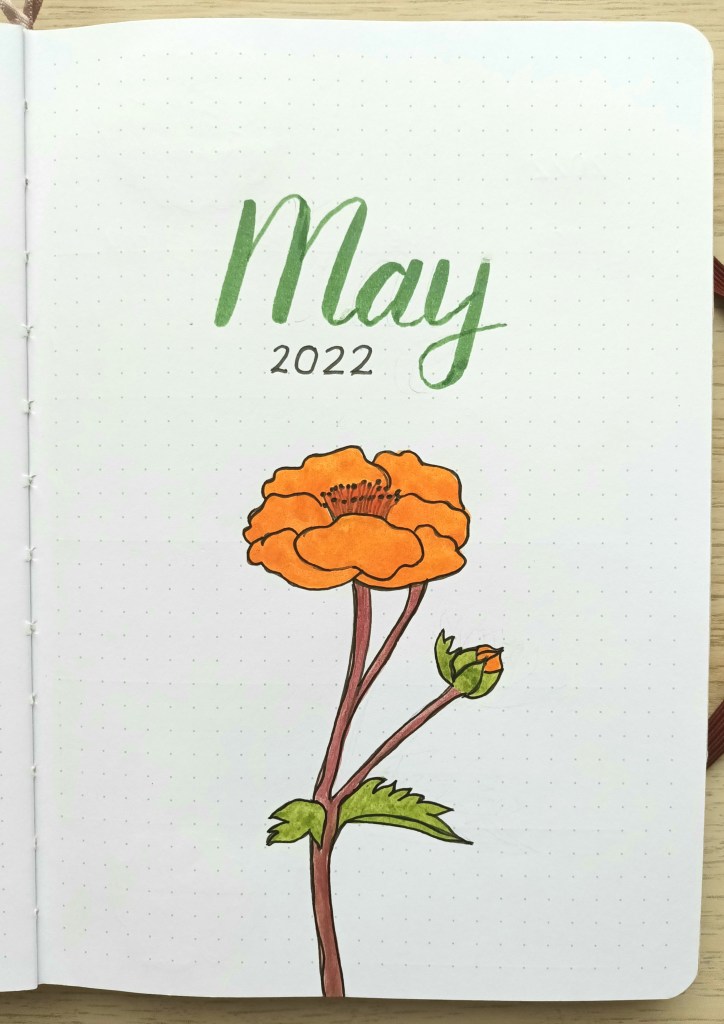
It’s the 1st of May and yesterday I finished creating my main spreads for the month in my bullet journal. Again, I decided to take inspiration from our garden and spent some time sitting with a coffee in the sunshine contemplating and idea creating. There’s lots of shades of green outside and we have a plethora of tulips in full bloom, but the flowers which caught my eye the most were the pretty and delicate geums. We have two varieties, one a semi double-headed variety in bright red called Mrs J Bradshaw and the other, a pretty orange called Totally Tangerine. I took photos of both with my new Samsung phone and was impressed with the quality of the camera. I loved the different shades of the second and decided to have a go at sketching a flower stem for my front cover. From there, I decided to create more simple flowers to use for my other pages. I hope you like my layouts and feel inspired to have a go at a floral theme in the future.

‘Totally Tangerine’ Geum looking beautiful in our garden

Front cover

Using the above photograph to help me, I sketched out the stem and flower head and added a bud and another stem. It took me a long while to get the sizing right as I needed the flower to be the focal point. I found drawing the leaves to be the most difficult bit and I’m not entirely happy with them but I eventually left them alone after erasing a few times too many! With the sketching complete, I inked in the flower using a 0.2 Pigma Micron in black. I debated whether to use watercolour paint or pencils to add the colour and in the end, I trialled both by photocopying the image onto watercolour paper and thick printer paper. The only problem was, printer ink isn’t waterproof like my Pigma pen ink so it bled into the orange watercolour paint – I thought it was such a good idea too!

May 2022 front cover Geum theme

Calendar pages / Month at a glance

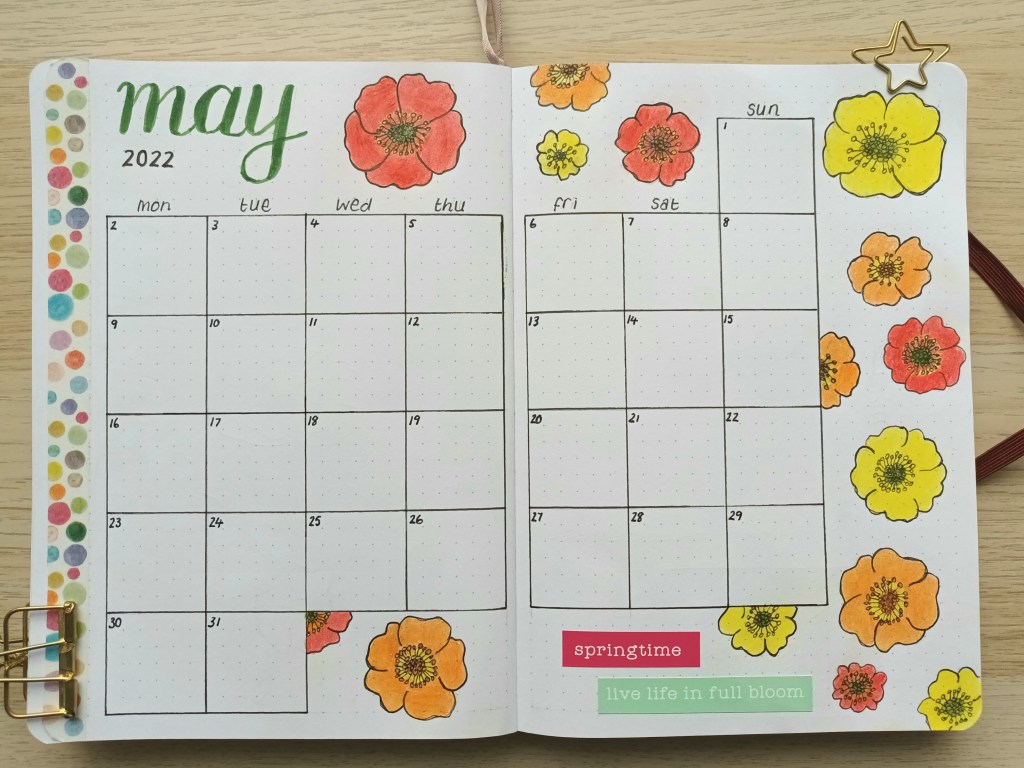
The calendar layout is my usual 6×6 dot boxes drawn using a Pigma Micron in 03 with the numbers done using a Pilot V5 Hi-Techpoint 0.5 pen in black. The brush letter May was created using a mid-green Faber-Castell Pitt Artist brush pen which I found easier to use than the Tombow ABT for this size lettering. I have no idea where I got the washi tape from but it was a great purchase as it goes with just about everything!

For the flowers, I changed to a face on view of the heads which was much simpler to draw in a larger number to fill the spaces around the calendar. My only real disappointment with these pages was due to way the spine was glued as it created an ugly crease on my title spread which spoiled the look somewhat. So far I’ve been happy with my dot grid notebook from Notebook Therapy but just a few pages do not lay flat without super annoying creasing.

May 2022 month at a glance

Fitness – Activity Tracker

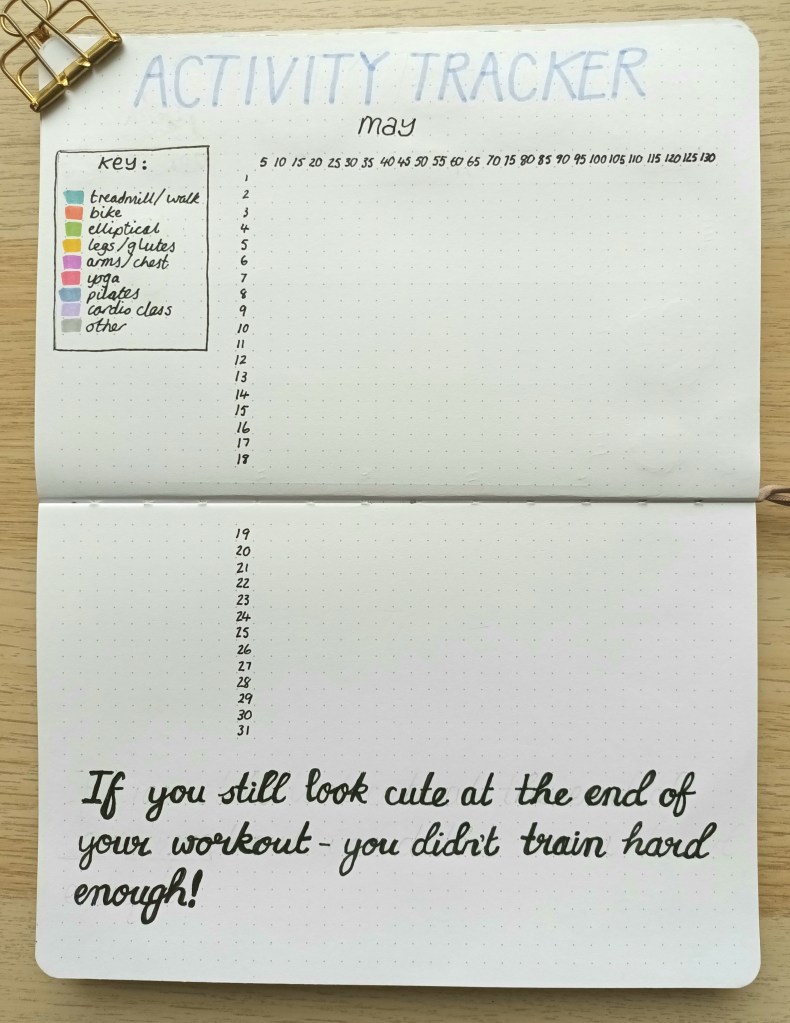
Last month, I drew up a spread which documented the kinds of workouts I was doing each day. I mentioned then, that in the future I might like to record my workout times so I can see how many active minutes I’m cramming in each day. I did a quick search on Google and discovered some simple, colourful and helpful spreads on this blog. I adapted one of them by making a double page layout with my own exercise types and a larger scale for the minutes of exercise (in April, my highest total was 148 minutes in one day but I’m going to add a plus sign on the end if I go over 130). The extra space also meant that I could include a motivational saying at the bottom. Although this one is quite American in its choice of words (the ‘cute’ bit), it’s particularly pertinent as, by the time I’ve finished a gym session or a cardio class, my face is all red and sweaty and my hair has become a frizzy mess – not a good look!

Fitness tracker / workout record

By the end of the month, I’ll be able to see how I spent my active time in a bright and colourful visual representation of all of my workouts. I’ll also be able to see how regularly I’m doing each form of exercise.

Final words…

That’s all of my initial spreads for the month of May – just 3 at the moment but I’m contemplated adding a weekly food diary so I can assess my eating as well as how active I’ve been each day. This will probably be just a very simple record of breakfast, lunch, dinner and snacks so it’s not really something to share.

I hope you’ve enjoyed seeing my pages for May. I’m looking forward to seeing other Bujo themes and have already watched quite a few plan with me videos on YouTube (I like to cast them to the TV screen in our living room so that I get a nice big view). Let me know in the comments if you have any special plans for this month or if you are working on something particular – I love to hear what everyone is up to!

Posted in goal setting, Health and Nutrition, lifestyle, Planning and journaling, self care, wellbeing, wellness

Monday Matters: 5 main barriers to eating healthily and ideas to overcome them

As regular readers of my blog will know, I’m currently signed up to a weight management programme, where, for 12 weeks, I have free access to my local wellness centre including the gym and fitness classes and also receive tips on developing a more healthy lifestyle through exercise and diet. I was already quite active and have now upped my exercise levels significantly so that I’m burning more calories due to more steps and more active minutes each day. I’ve made some changes to what I eat but I need to continue to work on this so I thought that for today’s Monday Matters, I’d consider the barriers to eating healthily and ways in which they can be overcome.

Information overload

There’s so much information online, in magazines and in books about diets and ways to lose weight that it can seem really overwhelming and leave you feeling like you don’t know what to do for the best. There are a great number of ‘fad diets’ which promise super quick results in terms of weight loss with little scientific evidence to back up their claims. They’re also often very restrictive encouraging you to only eat at certain times or to dramatically cut down or cut out certain foods. Then there are adverts for diet pills and meal replacement drinks which make all sorts of claims about awesome results and feature images of slim, smiley, glowing women to go with the emotive and persuasive language used in the words.

Realistically, your goal should not be to lose weight at a rate of knots, but instead, should be about making gradual changes to your diet to make it balanced and more healthy. Here’s some ideas to help you:

  • Ignore ‘fad’ diets and read reliable information from reputable sources such as the government or the NHS (in the UK).
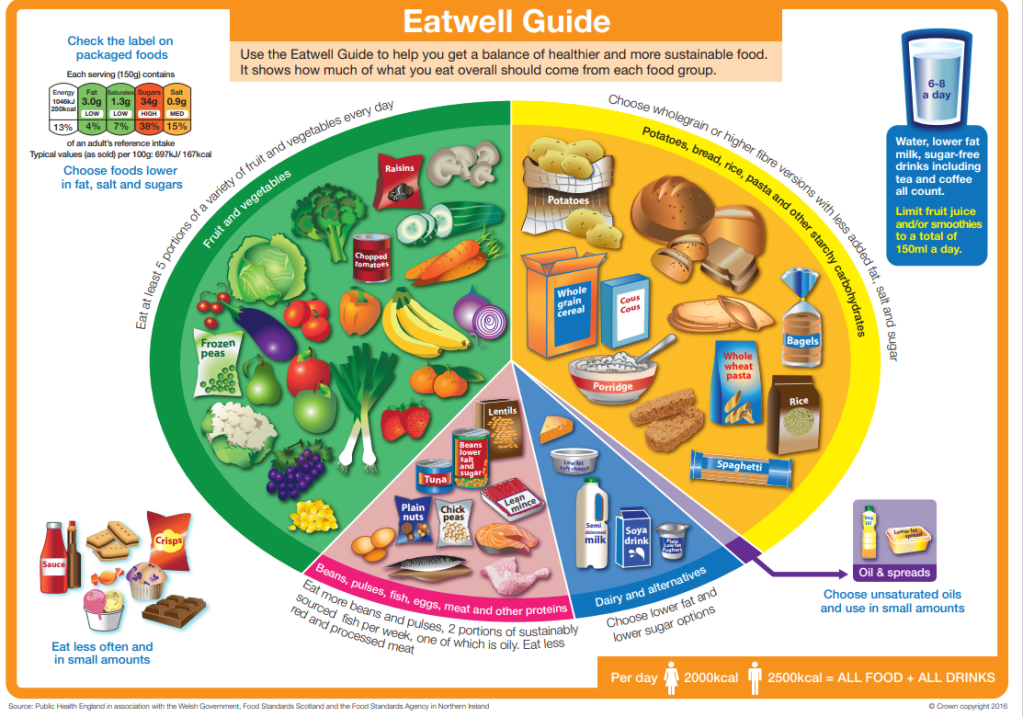
  • Check out a healthy eating plate like the one below to establish how much of each food group to should be eating.
  • Avoid listening to dietary advice from friends or family members, unless they’re a registered dietician or expert nutritionalist!
  • Remember that even diets which sound healthy, like vegetarian or vegan can still be highly calorific if certain choices are made e.g. eating lots of cheese and butter or consuming too much soya milk and other dairy alternatives.

There’s a wealth of accurate and reliable information provided by the (UK) government which includes a PDF version of the above and a comprehensive guide to eating well. Click here to go there now.

Lack of time

It takes time to develop a healthy lifestyle, including eating better and ensuring you have a balanced diet. Many people lead very busy lives and if improving your health isn’t currently one of your top priorities, you may feel that you haven’t got the time or energy to devote to making dietary changes.

The first thing I would suggest doing is spending about half an hour considering the different areas of your life and assessing which you’d like to focus on more. I use Hal Elrod’s Level 10 life sections to rate the different aspects of my life. The following aspects are given a score out of 10 (with 10 being near perfect and 1 being an area which requires lots of work):

  • Family and Friends
  • Personal growth and development
  • Spirituality
  • Finances
  • Career/business
  • Significant other/romance
  • Fun and recreation
  • Contribution/giving
  • Health/fitness
  • Physical environment (home/office)

If you figure you could make improvements in the area ‘health/fitness’ then it’s a good idea to identify some small changes you could make to your life to enable you to work on some related goals e.g. preparing a healthy packed lunch to take to work each day, cooking from scratch more often so you can enjoy the benefits of home cooked meals or creating a meal plan so that you can work on having a balanced diet with healthier snacks.

When most people say ‘I haven’t got time’, what they actually mean is that they don’t want to dedicate time to a particular venture, that they are actively making a choice to do something else or that the particular thing that they ‘haven’t got time for’ isn’t important enough to them or high enough up their agenda.

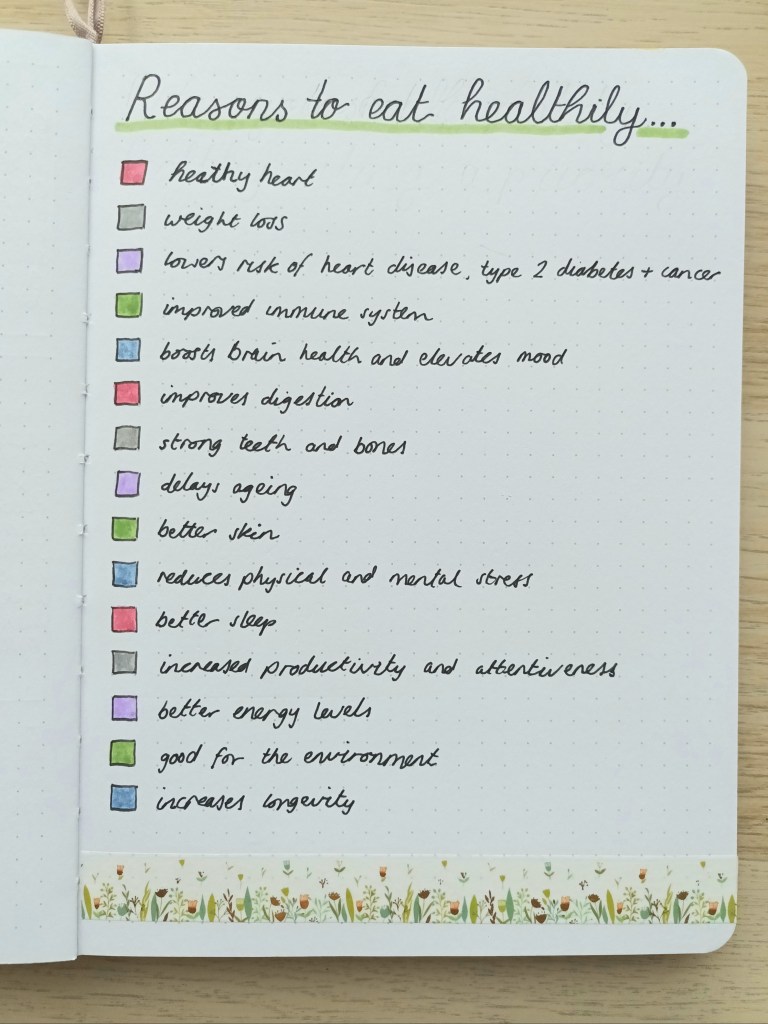
If you want to eat healthily but need help with motivating yourself to start changing your eating habits, you might want to do a little research on the benefits of a healthy diet and record your findings. I created a spread in my Bullet Journal as a great reminder of why healthy eating should be a priority.

A motivational page from my current bullet journal

A few time saving tips:

  • make twice the amount when cooking a favourite dish and save the rest to enjoy quick and easy leftovers later in the week
  • buy canned pulses so you don’t have to remember to soak them
  • have some pre-cooked packets of couscous, rice and grains to accompany your dishes
  • if you can afford it, buy pre-prepared veggies when you’re super busy
  • do a quick weekly meal plan over coffee on a Sunday morning and then make a list of groceries for the supermarket shop
  • have some frozen veggies in your freezer e.g. petit pois, spinach, green beans, mixed pre-chopped veg etc
  • batch cook and freeze soups and stews

Lack of confidence with cooking

Pre-prepared dishes or ‘ready meals’ as they are known, make it easy to enjoy a main meal but often these items are highly calorific and contain lots of sugar and salt. They’re also usually seriously lacking in vegetables which, as shown on the food plate above, should, along with fruit, make up a large portion of your daily food.

Home cooked meals might require a little more effort, but, you can find a range of simple, healthy recipes online or in cook books and if you specifically look for those which contain minimal or basic ingredients or label themselves as ‘one pot’ or ‘quick and easy’ then there’s no excuse to give it a go. You could also treat yourself to a few new tools and gadgets such as a set of cooks knives for speedy dicing of veggies, a food processor for chopping, mixing, grating and shredding, a blender for soups and smoothies or even a slow cooker for setting the dinner off at a simmer whilst you’re busy working so it’s ready to eat when you return home or get back to your kitchen.

My husband and I have found that each time we make a tasty and healthy dish we appreciate our efforts and the positive feelings it evokes prompt us to try more new recipes and boosts our confidence in the kitchen. We’re now more willing to try new ingredients and will give anything a go.

Feeling deprived

When you start working towards leading a more healthy lifestyle, you might give up some of the foods you like such as chocolate, crisps, salad dressings, sauces, ice cream and Friday night takeaways. Doing this may make you feel like you are being deprived of all of your favourites and can lead to lack of motivation to continue. Eating healthily doesn’t mean you have to stop eating everything you love. You just need to moderate the amount of sugary, fatty and highly calorific foods you have so that you eat then in small amounts and less often.

A popular way of achieving a healthy diet without feeling deprived is to apply the 80/20 mindset. This means that 80% of the time, you eat ‘clean’, choosing foods that are natural, whole and unprocessed e.g. fruit and vegetables, wholegrains such as wholemeal bread, brown rice, quinoa and wholemeal pasta, nuts and seeds, no-calorie beverages such as water, unsweetened tea. For the other 20% of the time, you can enjoy less-nutritious foods and treats. For example, on one day during the week, you might have an ice cream on a particularly hot afternoon or cake and coffee for a friend’s birthday etc. If you have several snacks a day over the period of a week, 11 or 12 of them would be healthy choices such as fruit, unflavoured nuts or low fat cheese on a wholewheat cracker, and 2 or 3 times you could enjoy a favourite treat such as a cookie or a small amount of chocolate.

Difficulty changing unhealthy or unhelpful eating habits and beliefs

Changing your eating habits to make them more healthy can be incredibly difficult, especially when many of them were established a long time ago, sometimes as far back as childhood. Some examples of unhelpful habits include:

  • eating whilst watching tv / YouTube videos etc (eating whilst performing other tasks)
  • piling your plate high with food at the buffet table (eyes bigger than your belly anyone?) because it all looks good / is free etc
  • eating a dessert even if you’re already full
  • emotional eating e.g. when bored, agitated, angry, stressed, upset etc. as a form of comfort
  • making your portion size the same as your partner who may have a much higher recommended daily calorie intake
  • believing that you have to eat everything on your plate, otherwise it’s wasteful
  • eating late at night, especially snacking just before bed
  • giving in to sugar cravings
  • believing you are hungry when really you’re actually thirsty
  • skipping breakfast
  • eating far too quickly

Even if you’ve had the same eating habits for years, it is possible to make improvements. I would suggest that the first step is to take time for some reflection. Consider what you good habits are e.g. always ensuring you get your 5 a day and your not so wonderful habits e.g. having a highly calorific dessert each evening after your main meal. If you’re not exactly sure what your habits are, try keeping a food diary, recording everything you eat and drink throughout one week. Also, think about what triggers your unhealthy eating such as a stressful day, a mid-afternoon energy slump etc.

Following your reflection and analysis, give yourself a congratulatory pat on the back for your healthy habits and then choose one of your bad habits to replace. So, for example, you might choose to focus on ‘eating too quickly’ and work on a plan to replace this with eating slowly and mindfully. Just as a bad habit does not evolve overnight, new and improved habits take time to develop too. But if you work on cementing one healthy habit at a time and continually reflect on how things are going, you can get there as long as a) you’re patient with yourself and take it one day at a time and b) you remember that there may be slip ups along the way and this does not mean that you’ve failed and should give up.

Tackling negative core beliefs about food and eating e.g. once I start eating, I can’t stop, I need to eat to make myself feel better, food is just fuel etc. can be extremely difficult. In this case, it is usually best to seek the help and advice of a trained professional such a dietician or a CBT therapist. These can be accessed via your GP.

Final words…

I hope you have enjoyed reading today’s blog post and it has helped to explain some of the main barriers to eating healthily. If you are planning on making changes to your diet, it’s best to make small changes rather than doing anything drastic. It might also be a good idea to do a little journalling and reflection on the process, for example, recording any improvements you notice such as clearer skin, better sleep and feeling more attentive when working etc. You could also reward your progress by giving yourself little treats (non-foodie ones preferably!) such as a bath bomb, a gorgeously scented hand cream, new stationery or a potted plant for your room.

Posted in goal setting, lifestyle, Planning and journaling

Monday Matters: A guide to SMART goals + an example of how I’m using the framework

Last week, my blog post focused on vision boards and how you can create one in your bullet journal. As part of this, I mentioned that as well as using pictures and words to establish what you want, you also need to identify steps you can take towards achieving your goals/dreams. Today, I’m going to deep dive into SMART goals and give an example of how I’m using the framework to help me achieve success towards a specific goal of mine which features on my current vision board.

What are SMART goals?

SMART is a mnemonic acronym that can help you with both goal setting and goal getting. It stands for:

  • S – Specific
  • M – Measurable
  • A – Attainable / Achievable
  • R – Relevant
  • T – Time-bound

Sounds great in theory but how can I set SMART goals?

To enable the setting of SMART goals, you need to create a detailed break down of each of your personal goals using the SMART framework. Your goals need to be Specific, Measurable, Achievable, Relevant and Time bound.

Specific

It’s important to be clear about what exactly it is that you want to achieve. To make your goals really specific, it can help to ask yourself a few questions to identify the detail:

  • What exactly do I want to accomplish?
  • Why is this really important to me right now?
  • Who will I need to help me achieve the goal and what will their role be?
  • Where will I work on my plan to achieve my goal?
  • Which resources will I need to help me?
  • Does my goal have financial implications?
  • What will my life look like when I have achieved my goal?
  • How will achieving my goal make me feel?

Measurable

Your goals should all be measurable so that you are able to see progress and know when you have achieved success. This can increase motivation as you start to see results from your efforts. Key questions to ask yourself could be:

  • How will I know when I have achieved my goal?
  • What will success look like?
  • What’s the best way of measuring my success?

Achievable

A vision board can sometimes contain ideals and big hopes and dreams, to make these visions into goals, you need to set more achievable targets to work towards.

  • On a scale of 1-10, how likely do you think it is that you’ll achieve your goal (1 being completely unlikely and 10 being absolutely certain)?
  • Is it completely within my power to achieve the goal?
  • Is the goal realistic?
  • Are there any obstacles which may present themselves?
  • Will I be able to achieve my goal in a given timeframe?
  • Do I have the resources or financial means to work on and achieve my goal?

Relevant

Your goals should be relevant to what matters the most to you right now. They should also align with your life values and current beliefs.

  • Is this a worthwhile goal and does it meet my current needs or desires?
  • Is this goal a priority for me right now?
  • What will achieving the goal especially mean to me?
  • How does this goal fit in with my values?

Time bound

It’s best to have a specific time frame in mind for meeting your goal. Setting a deadline or a date to assess if you have made significant progress can help keep you on track to success. You should try to decide on a realistic amount of time that is neither too long or too short. If the deadline is too far in the future, you will likely lose momentum or feel no sense of urgency. If the time frame is too short, you may become overwhelmed or stressed. A good idea might be to identify mini steps and assign an achieve by date for each.

An example of how I’m using SMART goals to achieve success

In last week’s Monday Matters blog post, I shared my current vision board. In order to increase my chance of successfully meeting my goals (or vision), I’ve been applying the SMART system to really break things down. To help you see how this works, I thought I’d take just one of my goals and look at it in depth using SMART.

On my vision board, I have a picture of a hamster and the word pampered. My goal is to treat our new pet in a way that gives her everything she wants and needs. We’ve been keeping hamsters for years and each time we have a new addition to the family, I try even harder to make sure she has a good life. Obviously I can’t ask Millie if she feels like she is a pampered pet but I can put things in place to ensure she is completely spoilt and receives the best treatment I can offer. Here’s my real life example of how I’ve broken my goal down :

Specific: I want Millie to be a happy and well pampered hamster so that I can be sure I’m giving her the best life I can. It’s important to me that my pet is treated well as part of our family. Both my husband and I will play a big part in working towards and achieving my goal. We’ll use our knowledge of keeping Syrian hamsters to help us as well as learning from guidance found online from reputable sources. Meeting my goal will have financial implications but we’re happy to spend a reasonable amount of money on both her cage and accessories within. When I have achieved the goal Millie will appear happy and content with her home and should show signs that she feels safe when we get her out of her cage each evening. She should look healthy and well cared for and my husband and I will be satisfied that we are good hamster parents!

Measurable: We will measure our progress using a checklist of things which need to be in place to ensure Millie is happy and healthy.

  • Extra large cage with floor space beyond the recommended size for Syrian hamsters.
  • Cosy house which is large enough for Millie to sleep in and also has room for snacks.
  • Large wheel which adult Millie can run in without concave back.
  • Water bottle to be refilled daily and scrubbed weekly.
  • A good quality diet consisting of dry food and small quantities of fresh fruit and vegetables.
  • Treats provided in line with feeding guidelines.
  • Plenty of bedding to be provided for nesting and digging.
  • Wooden chews provided for gnawing.
  • Sand provided for bathing.
  • Digging tower provided for out of cage play.
  • Cage spot cleaned regularly with full clean once a month.
  • Eating and drinking to be monitored.
  • Weight checked weekly.
  • Dedicated time with Millie outside of the cage every evening (minimum 10 minutes)
  • Basic health check performed each time Millie is handled.
  • No signs of distress or boredom displayed e.g. biting cage bars all of the time, excessive grooming, aggression, repetitive behaviours etc.

The goal will be considered achieved when all of these are in place and standards are maintained over the time period stated below.

Achievable As we are experienced hamster owners (Millie is my ninth hammy) we have very good understanding of what Syrian hamsters need for a happy and healthy life. Therefore, the goal should be achieved in a relatively short time. We’ve already ticked off some of the criteria as we’ve purchased an extra large cage, a wooden house and digging tower. We also have plenty of dry food, treats, warm bedding and a sand bath as well as a good sized wheel. Fresh water is provided although we need to get better at changing it each day.

Relevant Obviously the goal is relevant as we have a pet hamster and we wish for her to be well cared for and pampered. This is in line with my beliefs about how animals should be treated.

Time bound At least a couple of weeks for Millie to get used to us will be required as she is currently a little bit nervous and wary of us but progress is being made each day. I will assess and evaluate the situation at the end of this month and I expect that everything will be in place by 15th April as we will have had Millie for one month by then.

Millie at 9 weeks old and a little camera shy!

The need to be even SMARTER…

Although the SMART approach does not offer any guarantees of success, it does provide a useful system to help with setting and working on small goals with a view to you achieving your bigger hopes and dreams. Some authors have expanded on SMART to include two extra letters, namely E and R to make SMARTER, where E stands for Evaluated and R stands for Reviewed. In this longer acronym, it is suggested that further success will be achieved if the individual takes time to evaluate progress and reviews and reflects on how things are going in order to identify any issues and make adjustments where necessary. This certainly makes sense to me and so I’ve chosen a specific time and date to do some reflective journaling on my progress towards all of the goals displayed on my vision board. I’ve written it into my Bullet Journal Future Log so I don’t forget and I’ve allotted two hours for the process, which might seem a lot but I think it’s important to set aside a big chunk of time if the session is going to be useful.

Final thoughts

I’m feeling really motivated to work towards my goals and it helps that I know my what, why, where, who, when and how. I may meet with obstacles or setbacks along the way, but by evaluating my progress and making small changes, I’m in with a good chance of success.

Let me know in the comments if you’re a fan of setting SMART (or SMARTER) goals or if you think it’s something you might like to try in the future. I would love to hear about what you’re working on right now and if you are meeting with success.

Posted in bullet journal, Bullet journaling, lifestyle, Planning and journaling, Setting goals and intentions

Monday Matters: A beginner’s guide to Vision boards and how to create one in your Bullet Journal

When I start to feel better after a period of depression and anxiety, I tend to have lots of ideas for how I want my life to be now and what I want for my future. To avoid becoming overwhelmed, stressed and potentially causing a hypomanic episode (due to having bipolar disorder), I like to spend time taking a step back, really thinking about what I want for myself and asking myself some big questions. After reflecting, I like to create a visual reminder in the form of a vision board. In today’s Monday Matters I thought I’d present a beginner’s guide to vision boards and show you how I design and create mine in my bullet journal so that you can make one too.

What is a vision board?

A vision board is a collage of images and words which represent your current wishes and goals. It is used as a reminder of what you hope to achieve and aims to provide motivation and inspiration. Vision boards can be paper based or digital. They can contain as many words and images as you want but I find they work best if they’re relatively simple as then you are only working towards a small number of goals. Whereas a digital vision board works best if it fits onto your computer screen, a paper based vision board can be any size of your choosing. I created a large A1 sized board for my business and have the images and words pasted onto a black piece of card which is inside a clip frame. The vision board is on the wall in my craft room and I love looking at it regularly. My personal vision boards are usually created in my bullet journal on a double page spread and contain words and images from magazines as well as printouts from online resources like Pinterest. Click here to see an example of one I created during lockdown.

Your vision board can have a particular theme e.g. health and wellbeing, your word of the year etc, or it can be more general and include personal and/or professional related goals. Whichever style you choose, you need to spend some time reflecting on what you want your life to be like now and what you hope your life to look like in the future.

Some key questions to ask yourself:

  • What is most important to me in my life right now? (e.g. happiness, good health, work-life balance etc)
  • What are my core values? (e.g. family, creativity, self confidence, education, happiness, growth, self awareness etc)
  • What did I used to do in the past that I would like to start doing again now? (e.g. have lots of fun, meet friends for coffee, go to the gym, spend quality time with family etc)
  • What experiences would I like to have in the future? (travel the world, start a family, learn to swim, attend an art course etc)
  • What are my current interests or hobbies? (e.g. sewing, bullet journalling, watercolour painting, hiking, getting fit, baking etc)
  • Do I currently spend plenty of time engaging in things I enjoy? (e.g. I don’t feel I dedicate enough time to having fun, I always make time for my hobbies and interests etc)
  • What bad habits do I want to break? (drinking too much alcohol, going to bed late, eating unhealthy snacks, too many takeaways, spending too much time on social media etc)
  • What good habits do I want to instill? (e.g. exercise for 30 minutes 5 times a week, drink more water, eat more fruit and vegetables, starting a gratitude practice, meditating each morning, read one self help book each month etc)
  • What little things do I want to put in place right now? (e.g. daily gratitude, healthy breakfast, in bed by 10.30pm etc)
  • What are my big dreams for the future? (e.g. to write a book, to be a minimalist, to own a 3 bedroom home, to move to Australia, to travel the world, to have a family etc)
  • What can I do now to help me work towards my dreams / goals?
  • How will I feel when I achieve my goals / dreams? (proud, happy, confident, calm, successful etc)

How do vision boards work?

Vision boards only work if you do! By this, I mean that choosing representational images and words to describe your desires, goals and dreams is not enough to achieve them. You also need to identify steps to take to work towards what you want and create habits which will help you (or break habits which are not helpful). A vision board provides a useful visual reminder and, when looked at on a daily basis, can be used as a prompt to spend time evaluating and reflecting on your progress towards your specific goals and wishes, looking at any obstacles that have come up and how you will remedy problems. It can also help to motivate you into action – especially if the images and words you have chosen are exactly what you desire and spark great attraction.

What I find useful is to accompany my vision board with a page of notes. I write down what each image represents and also record what I need to do or not do to work towards achieving my vision. I can then move on to identify the baby steps I need to take to have the best chance of achieving my goals. Reflecting on your progress regularly and setting new small goals is also really important if you vision board is to have the best chance of working.

Designing your vision board

The design of your vision board should suit you and your lifestyle. If you prefer to work digitally, you could create a vision board to display on the desktop of your computer or even create a vision board on Pinterest using attractive images and motivational sayings and quotes. If you like to get creative, you might do a cut and paste from your favourite magazines – try flicking through them and see what resonates with you. You can even cut out individual letters or words to put together to make motivational phrases (a bit like a ransom note but full of positivity instead!). Use pictures which sum up exactly what you want, for example an image of someone who is smiling can represent wanting to feel happier in life, a big house in the countryside can show that you would love to live in a more rural location, a passport and pictures of key locations in a Paris e.g. The Eiffel tower and a cruise boat on the River Seine, would be good to remind you that you really want to visit the capital of France.

I like to create a double page spread in my bullet journal as this is something I look at multiple times a day and use morning and night. You can read about the process of setting up my vision board below.

Creating a vision board in your bullet journal

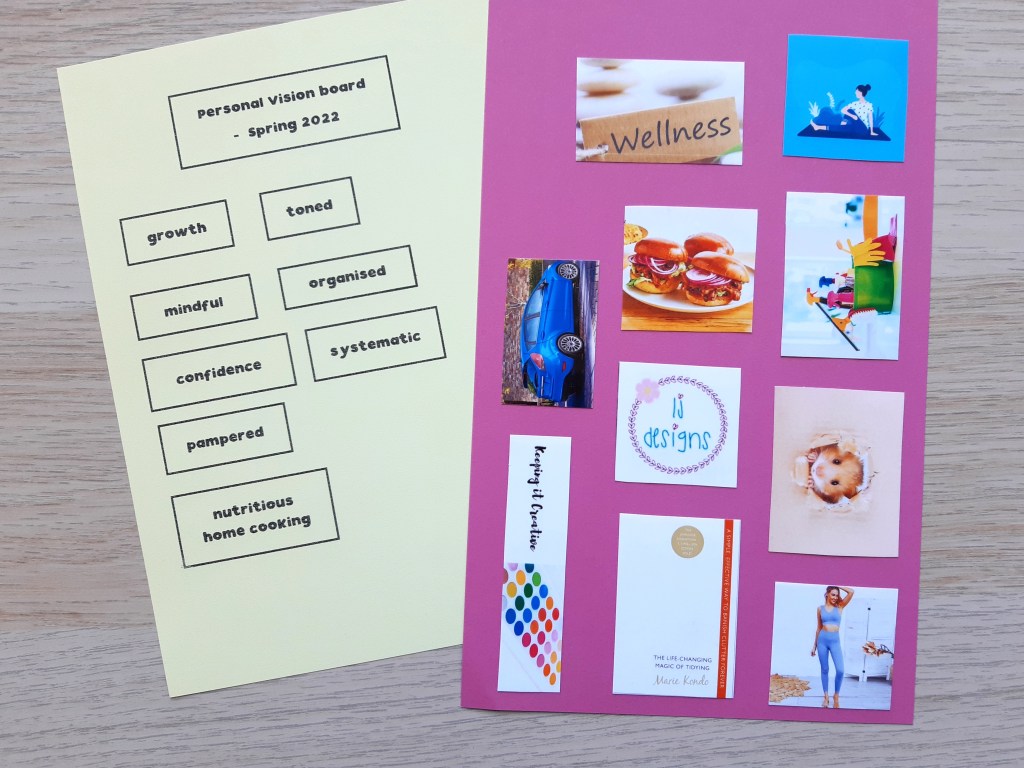
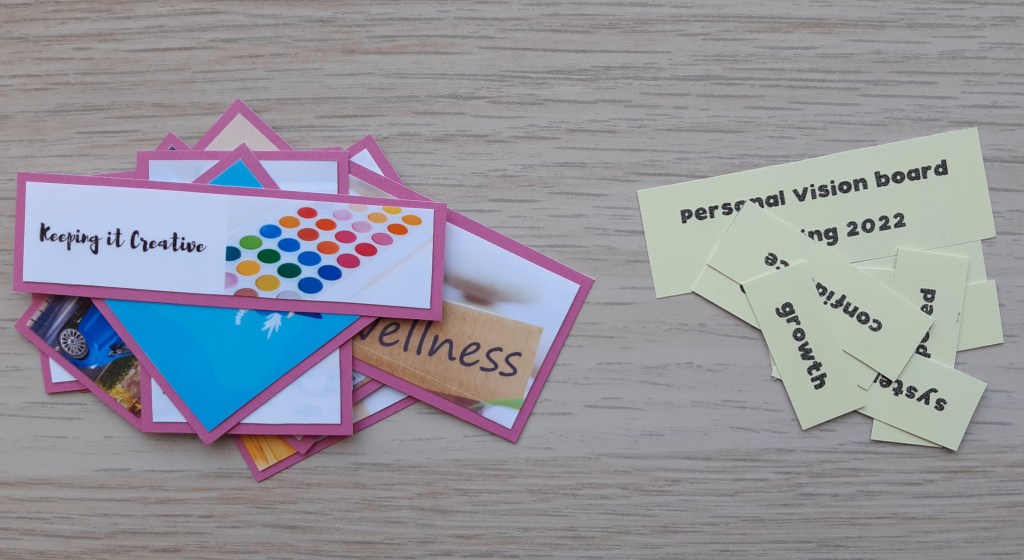
Image selection I find the best way to create my vision board in my bullet journal is to use photographs which are available online. If you use images from magazines, they may be vastly different in size. If you search chosen key words online you can spend time looking through the different pictures and find one which is suitable for what you want and then resize it to fit (I make the width of my images around 4cm – 6cm). I placed the photos into a document on MS Publisher which was 4x6in and then printed the pages out on photo paper of the same size using my Canon printer.

After that, I cut them out using my small Fiskars guillotine and backed them on mid pink coloured paper to make them stand out. The backing of the photos was rather time consuming, especially as you really need to use double sided tape for photograph paper. The process could be speeded up using a roller tape but if you’re limited for time, you could just stick the images straight in to you BuJo. I left a tiny border of pink as I wanted the photos to take centre stage.

Motivational words Again, I create the words myself in a MS Publisher document rather than looking through magazines so I can play around with the sizing, font and specific word classes e.g. verb, adjective, noun etc. I also chose to print them on coloured paper so that they stood out from the white paper just like my photos. It’s up to you how you produce your words – you could create stickers, stamp them onto paper, cut them out and stick them in or hand letter them for example.

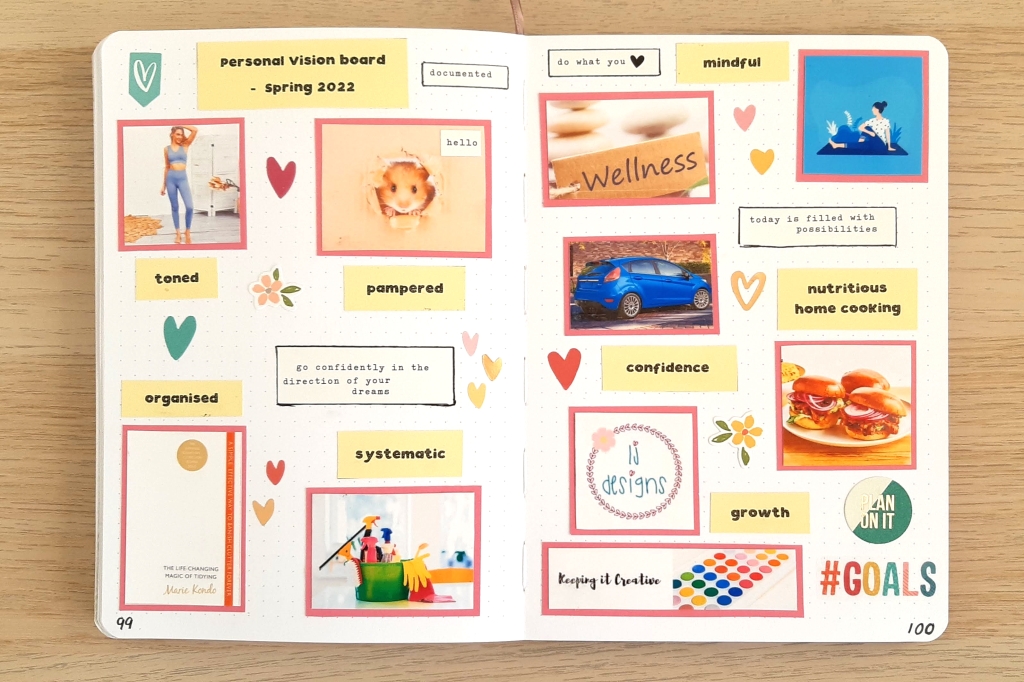
Playing around with placement Once you’ve got your images and words ready, it’s time to try out different placements until you’re happy with how they’re arranged. It’s a good idea to experiment with different layouts and then take a quick photo of your double page spread each time so you can always revert back to a previous arrangement. Once your happy you can paste everything in. You might choose to add some decorative elements to any spaces, for example, if you’re creating your vision board for the Springtime, you might add flowers, hearts in Spring colours, butterflies, motivational words etc. This could be in the form of stickers and ephemera like mine or, if you’re good at drawing, you could create something using spring coloured felt tip pens or coloured pencils.

My finished vision board in my bullet journal

Final words…

I hope today’s blog post has inspired you to create your own vision board as a motivational tool for working towards your goals and dreams. Remember that vision boards are a great way for clearly identifying what you want for yourself now and in the future but as well as creating this attractive and motivational tool, you also need to identify progressive steps going forward and also dedicate time to work on making your hopes a reality.

Do you currently use a vision board or is it something you would like to have a go at creating? What would be the most prominent image or idea on your board? Let me know in the comments below.

With love and best wishes,