My husband and I are keen birdwatchers and we love going to our local nature reserves and nearby woodland with out binoculars. Over the years, we’ve built up our knowledge of different woodland, coastal and wetland birds are able to recognise all of the most common varieties by sight. However, what we’ve always found slightly more difficult to do, certainly with woodland birds, is to identify them by sound alone. This is because, most of them have several different songs and a repertoire of calls. So, imagine our delight, when we discovered an app that was capable of recording all of the nearby birds and identifying them within seconds! Today, I thought I’d introduce you to the app we’ve been using for almost a week and explain a little bit about how it works.
Merlin Bird ID
Created by the Cornell Lab of Ornithology, Merlin Bird ID is a tool for beginner and intermediate bird watchers which uses a huge database to provide information and identification of literally thousands of different bird species. It is able to recognise birds by photograph or sound, can provide suggestions of IDs based on information you input and supplies details of species which are common to your geographical location. The basic app is free and once you’ve downloaded it and shared and confirmed your email address, then downloaded a pack specific to the country you are in, you’re good to go.
Basic Bird ID button
If you click on the Start Bird ID button, it will ask you five questions about a particular bird you observed. It asks for your location which you can either name, choose current location or select from a Google Map pop up. You then say when you saw the bird (using the calendar), how big it was, the main colours (choosing 1-3), and what it was doing from a choice of options. This particular aspect of the app is very similar to the RSPB bird identifier on their website. Having answered the questions, it will provide suggestions for you to look through and even includes a sound button too.
Photo ID
In this part of the app, you can upload a photo of take a snap of a bird and then zoom in so it fills the frame. From this information, the visual database will try to identify the particular bird. I’ve only tried this once using an image from my phone gallery of a male reed bunting. Although my photo wasn’t particularly good and includes bushes and wire fencing, the app was still able to guess correctly!
Sound ID
This is obviously the feature that I’m enjoying using the most. The instructions say to ‘get as close to the bird as you can, hold still and press record’. The pack that I’ve downloaded includes as database of 867 birds, including a number which are not native to the UK but that you might spot at a centre with bird enclosures such as my local wetlands trust site or a Birds Of Prey place.
What’s great about this aspect of the app is that it is able to identify multiple birds in one recording (it pops up on the screen as soon as it has ID’d each bird) and it highlights in yellow the specific birds it can hear at that time. Also, when you end the recording, it lists all the species that were identified and allows you to read more about them. So far, we’ve often been able to guess most of the birds ourselves but we were excited to see that one of the individuals which we struggled to identify was a nuthatch.
Another plus point of this part of the app is that it includes a red dot next to a bird which is rare in the location or an orange semi circle to identify it as being unusual. This is really cool and it’s so exciting when you spot something a bit different.
Explore birds
This part of the app is great if you want to develop your knowledge of particular types of birds. You can view a range of lists with photos such as waterfowl, shorebirds, finches, warblers etc. You can then select a species by clicking on it to find out more. I haven’t used this part of the app yet but I can imagine it’s especially good if you are a beginner birdwatcher.
Final words…
Although we’ve only been using the app for a week, we’ve both being really enjoying trying it out. It’s super easy to use, seems really accurate and includes a wealth of useful information. I imagine the sound recordings might fill your phone storage up pretty quickly but you can easily delete the recordings when you have done with them.
Let me know in the comments if this kind of app appeals and if you plan to download it to use on your phone. I would also love to hear if you find it useful during trips out in nature.
Over the last few months, I’ve read a couple of books on the topic of manifestation – ‘Make It Happen – Manifest the life of your dreams’ by Jordanna Levin and ‘Manifest – 7 Steps to Living your Best Life by Roxie Nafousi. I found both of them really interesting and learnt a lot about the theories behind manifestation and things to work on to maximise your chances of creating the life of your dreams or your best life as mentioned in the titles. Today, I hope to provide a summary of the concept and my key take aways from both books so you can use the ideas to work on your goals for 2023.
Both authors talk about the success they’ve had with manifesting everything they’ve wanted in their lives so far and the steps they’ve taken to get there. They also discuss some of the struggles they’ve had in the past and how they’ve overcome them through the power of manifestation and making changes to their thoughts, feelings and attitude.
What is meant my manifestation?
There are various dictionary definitions available online, but, in short, to manifest is to make something happen. In today’s post though, I want to explore the idea that I believe was first discussed in detail by television writer, producer and author Rhonda Byrne in her documentary film and related book The Secret back in 2006 where she explained that ‘Manifesting is about breathing life into your goals through action, emotions and belief’.
Levin adds to this in her book by introducing her ‘Manifestation Equation’ which is states that:
and is based on four laws – The Law Of Attraction, The Law Of Vibration, The Law Of Action and The Law of Rhythm.
Whilst Nafousi, in her first of two books on the subject, describes manifesting as ‘a meeting of science and wisdom’ and ‘a philosophy to live by and a self-development practice to help you live your best life’.
Finding clarity
The first step of manifesting is to get clear on what you want you want from your life. As Nafousi states ‘…you can’t get to where you want to go if you don’t know where it is you are headed’. A helpful practice for this is to create a vision board filled with your intentions. This can be done digitally on your computer, or physically as a display, and commonly includes inspiring pictures and/or words representing your dreams and aspirations. If you prefer written methods, you might like to write a list in a special manifestation journal and expand on your intentions for each. Another option to try, is following a guided visualisation meditation specifically for manifestation, where you consider what you ideal life would look like and even more importantly, what it would feel like if you already had what you desire. There’s a range available online, some for a small cost and others free. You might also want to think about the kind of person you want to be or take time to explore your core values. Jordanna has two free PDF resources for this which include a comprehensive list of core values and a long list of personality traits. I found both to be extremely useful. Finally, using a Wheel of Life to explore where you are right now and where you wish to be in the future can also help you make plans and set intentions or goals.
Whatever methods you use to set your intentions, it’s recommended that you work on a small number – a maximum of five at a time can help to keep them powerful. Also, the advice is to write them in positive language, keep them short and to the point and use present tense e.g. I am well-organised and productive, I have a happy and healthy relationship with my partner, I feel full of vitality etc.
Take action
As well as thinking about and visualising what you want in your life, you should also be prepared to take action in order to make progress towards those things. As Levin says when describing the Law Of Action – ‘you must do the things and perform the actions necessary to achieve what you are setting out to do’. You play a vital role towards creating your future so you must work to make it happen! So, for example if you want to be happy and fulfilled at work, you might start by considering you current job situation and how you feel about it. You could then take some time to journal about what aspects you enjoy and which leave you feeling dissatisfied. Having considered this, it might lead to you identify potential changes you could make or help you to realise that it is time to move on and try somewhere else or a different role. You would then have to think about and perform the necessary actions to move things on.
Raise your vibration
The scientific principle known as the Law of vibration states that everything in the universe (objects, thoughts, emotions etc.) has energy and a vibrational frequency ( from high to low). With regard to manifesting, according to this law, we need to vibrate at a similar frequency to the things we are trying to attract and the best way to do this is to work on raising our vibe. High vibration emotions include unconditional love, joy, peace, gratitude, hope and optimism, whilst particularly low vibration emotions include jealousy, anger, fear and despair. But how can we work on raising our vibration so we resonate more of these positive emotions? Here’s some of what I learnt from my reading:
Let go of fear and doubt
One of a number of ways of working on raising our vibe is to let go of fear and doubt. If you believe that you are not worthy of what you want or that you are not capable of taking action and making changes then you are unlikely to manifest those things. On the other hand, if you have faith in your abilities and are optimistic about the future, you are ready to receive everything you desire because you believe you are worthy of it. This happens because our subconscious has the power to drive us towards our dreams but also has the power to hold us back.
Our fears and doubts show up in a number of different guises including worries and insecurities, limiting beliefs, feelings of unworthiness and a lack of trust in the universe to provide for us. These can not only sabotage our chances of manifesting, they can also stop us from being aspirational with our dreams and wishes too.
Of course, ridding ourselves of fears and doubts is not something that can be done overnight, especially as many of us have been accumulating them over many years. It takes constant work and commitment (what some practitioners call deep work). Self development is achieved over time and with perseverance. It might also involve working with a therapist, life coach or mentor. who can guide you on the way and teach you new techniques for managing your thoughts and emotions and working on limiting beliefs. The main ways forward include:
exploring your thoughts and considering more realistic or alternative ways of looking at things (focusing on positive and empowering choices)
being careful about our choice of language e.g. replacing if with when, talking about what we want rather than what we don’t want, choosing positive words such as I can…, I will… etc rather than negative statements such as I can’t…, It’s too hard etc.
using positive mantras to repeat e.g. Life supports me in every possible way. I am thankful for the endless opportunities that come my way. Today I am the best version of myself. I’ll achieve everything I set out to do.
practice visualisation – imagine what it would look like and what it would feel like if you were living a life in alignment with what you desire. This can be done as a meditation or if you prefer creative writing, you could journal what your day would be like if you were living your best life.
cultivate self love and compassion – be kind to yourself and value your wellbeing. Celebrate achievements but also be patient and forgive yourself when needed. Believe in yourself and your ability to have success. Treat yourself as you would a good friend, offering support and encouragement.
Live in alignment
Another part of taking action is to align your behaviour with what you wish to manifest. It’s no good creating your vision on a board or just sitting there thinking about what you want for your like, you need to be proactive in your journey. As you work on banishing your fears and doubts, you will start to develop confidence in your abilities and this is when you can really push yourself and step out of your comfort zone. |Nafousi has this to say:
‘To manifest change, we must first create change. We must do something different, we must challenge our fears and doubts, we must act as our future self would act and we must show the universe how ready and willing we are to step into our power.’
A good way to do this is to behave the way your future self would. So, for example, if you want to be a tidy and well-organised person, you need to act like one. This could include regularly decluttering, making sure you have a place for everything and putting things away in that place when you’ve finished using them, creating a schedule for your day or writing to do lists to make sure you maximise your time, having a good sleep routine so you wake up feeling refreshed and ready to have a productive day, making tidying a priority and a habit which you see as important and of value. It could also include spending time researching and implementing habits of tidy and well-organised people and maybe asking for help and advice from friends who always have a neat and tidy home.
If you’re not sure what steps to take or changes you might need to make, Jordanna Levin’s book has chapters on different aspects of life which are full of ideas and exercises to try.
Develop an attitude of gratitude
Whilst you strive to manifest your intentions, it’s also important to be grateful for what you already have. As I’ve shared in several previous blog posts, gratitude is all about being thankful and showing appreciation for all of the things we have. Nafousi splits gratitude into three categories which I found particularly helpful – gratitude for the self, your life and the world. So, you can appreciate things about yourself such as your health, your ability to listen to others and your crafting skills. You can be thankful for what you have in your life such as a supportive partner, a beautiful home and a job you love. And, finally, you can feel grateful universal things such as good weather, connection with others and the wonder of nature.
Gratitude is a high-vibe emotion which is wonderful for your physical and mental health, your relationships, self esteem and sleep. Being grateful for things as they are now shows the world that when you do manifest something you what you want for yourself and your life, you will be super appreciative of it.
Gratitude journalling is something I do every day as part of my Five Minute Journal practice and it something that I feel really helps to develop those high vibe emotions we want to increase. I identify three things each morning to write about and then reflect on the highlights of my day (and what made these things possible) and what I’ve learnt in the evening. It doesn’t take long and it has the potential to make a huge difference to your life.
Use sources of envy to inspire you
When I was young, there seemed to be limited sources of envy. You might feel jealous of a school friend who got 10 out of 10 in her spelling test or your best mate who had pretty much every toy in the Argos catalogue / went on super expensive holidays / had a bedroom the size of the ground floor of your house or a garden full of expensive play equipment. Nowadays though, you can go on social media and be envious of the perfect lives of not only your friends, work colleagues and acquaintances, but also people you’ve never met who have the perfect Instagram feed / the energy to get up at 5 am and be super productive until 8pm / the healthiest body with flawless skin / the tidiest and most well-organised home with all the latest gadgets bought with their huge and effortless income – you get the idea. As Nafousi says in her first book ‘Social Media is a playground for comparison and a fertile land for envy to grow in’. She offers a few tips on how to manage things. One suggestion is to become more mindful of the content you engage with so that you choose only to read / explore content which you relate to, makes you feel good or inspires you in some way. You should also continue to work on removing your fears and doubts which are holding you back, some of which may present as envy and jealousy. Another potentially powerful idea is to recognise thoughts and feelings associated with low vibe emotions such as these and turn them into inspiration. So, rather than believing that they have things that you can’t have (scarcity mindset), you have the opportunity to reframe and choose to believe that you could have the same for yourself if you work hard (an attitude of abundance).
Trust that the universe has got your back
As part of your manifesting journey, you will meet challenges, difficulties and obstacles along the way. You have several choices when these tests turn up: 1) you could admit defeat, become impatient and decide you’re never going to get to where you want to be, believe you’ve failed, believe that other people have all the luck and let envy creep in basically, letting fear and doubt rule, or, 2) you could use these situations and obstacles in a more positive way to build your inner strength, resilience, courage and self belief to keep going and trust in the manifesting process. You might need to take action by do a bit of problem solving, trying different approaches, working things out by journalling how you feel, or using positive affirmations to remind yourself that you can and you will, but ultimately, if you have faith in yourself and the universe to provide for you then you can absolutely get there.
Final words…
Today’s blog post contains just a small part of what I’ve learnt about manifesting. If you want to find out more, then I particularly recommend Manifest: 7 Steps to Living Your Best Life by Roxie Nafousi as a succinct introduction and her more recent book Manifest: Dive Deeper to further your knowledge. Jordanna Levin’s book Make It Happen: Manifest the life of your dreams provides a much more indepth look into manifestation and also has lots of exercises to try. It also focuses on different aspects of life which you may want to work on as part of your manifesting journey.
I hope you have found the topic matter of manifestation interesting and something which is worth exploring further. As always, I would love to hear your thoughts or related comments.
I promised myself I would keep to a schedule of doing one of these on my blog around every six months so this one is slightly overdue – my last one was August 2022. It’s been nice to check back on my previous one, to see how things have changed, what has stayed the same or at least similar and where my priorities lay then and now. I challenge my readers who also have their own blog to do their own ‘Currently’ with their own categories.
Currently eating…
lots of vegetable rich foods in recipes we’ve found online. This week we’ve enjoyed Turkish ratatouille with yogurt dressing and flatbreads and tonight we’re making vegetarian enchiladas which we’ve made once before and had totally forgotten about! We found that the first recipe wasn’t enough without some form of protein so we’re going to try adding a Quorn Fillet, halloumi or some type of pulse.
Currently drinking…
as I do some kind of workout each day, I’m trying to drink much more water as well as my usual cherries and berries squash. I tend to have four coffees too and I find I get dehydrated if I don’t follow each mug with a large glass of water. I’m also enjoying the Summer Shine J2O which has just made its way to the supermarket – it’s been around for a few years now and I always buy myself a four pack every now and then throughout Spring and Summer.
Currently watching…
I know we’re a bit late to the party, but we’ve got really into The Handmaids Tale and watch at least one episode each week. We’re halfway through Season 2 so we’ve got plenty left to keep us entertained. We’re also enjoying Unforgotten season 5 and The Bay which I believe is now up to season 4. Grace is also back on which is based on the novels of Peter James and if you love crime dramas, this is definitely one to watch too.
Currently creating…
the final few pages of my December Daily project. I did want to be finished by now but I’ve been busy doing other stuff and kind of put it off until the end of this month. I’ve been trying out my fuse tool to make shaker pockets and after about 4 failed attempts, I’ve finally made a fully sealed and functional one! The picture is a Christmas card that I cut the front off and trimmed.
Photo credit: Laura Jones for Keeping It Creative
Currently loving…
the extra light that comes with Springtime / British Summer Time. We’ve had quite a bit of rain so far since the clocks went forward, so it’s not been super bright but I’m sure sunshine is on the way! It’s also great to see things popping up in the garden – our hyacinths are in full bloom and our tulips and late flowering daffodils should be along soon.
Currently listening…
to songs from Les Misérables. We went to see the musical last year and it was amazing. I debated buying the soundtrack but instead we’ve been listening to the tunes on my husband’s tablet whilst cooking. If you haven’t yet made a trip to see it at the theatre, I would totally recommend it if you enjoy musicals.
Currently feeling…
tired out! I’ve done 3 workouts today – two mini Pilates workouts using a resistance band and my new magic circle and then an aerobic routine with a little bit of core work on my mat afterwards. The aerobics one was a free Instructor Live one which was shared on the NHS website. I was meant to do Zumba today but I got a call last night from the gym saying that the session had been cancelled due to instructor illness. I certainly think I’ve made up for missing it and I’ll be ready for bed straight after watching The Bay!
Final words…
I hope you’ve enjoyed reading my mini life update for early 2023. If you do create a similar post yourself on your own blog, do comment and I will be sure to check it out.
I first came across The Five Minute Journal when watching YouTube vloggers sharing their relaxing yet productive morning routines. I was interested to find out more about the journal, so I checked out a few video walkthroughs and found that many people were saying it was a life changing practise for them and one which really helped improve their mental health.
As someone who will try anything to improve my health and wellbeing, I decided to give it a go (even though I felt that the journal was quite expensive). I’ve been using it for nearly two weeks now, and I’m really enjoying it and benefitting from the quiet thinking time it provides first thing in the morning and last thing at night. So, today, I thought I’d share my thoughts on The Five Minute Journal, my experiences of using it and ways in which it’s helping me.
Photo credit: Laura Jones for Keeping It Creative
What is The Five Minute Journal?
The Five Minute Journal is a product created by Intelligent Change and is one of a small number of tools which promises to positively change your life in just five minutes a day. The company claim that you will love the journal for five very particular reasons:
It’s the simplest thing you can do to be happier – due its focus on positivity, structured approach whilst keeping it simple and easy to stay consistent
It’s built on proven psychology – it’s better to focus on positive behaviour traits and creating simple but effective routines
It’s a journal for people who don’t write journals – it takes just five minutes a day and so is ideal for time pressed individuals who have always loved the idea of keeping a journal but have, in the past, tended to make excuses for not doing so.
It’s a snapshot of your positive experiences – it’s a wonderful record of all things positive in your life and just flipping back to a certain day should help evoke the feelings that accompanied the memories.
It’s a commitment you can stick to – as well as the five minute promise, the book is also full of tips and ideas at the beginning which help you to get started and stay committed to the process
Key features of the book
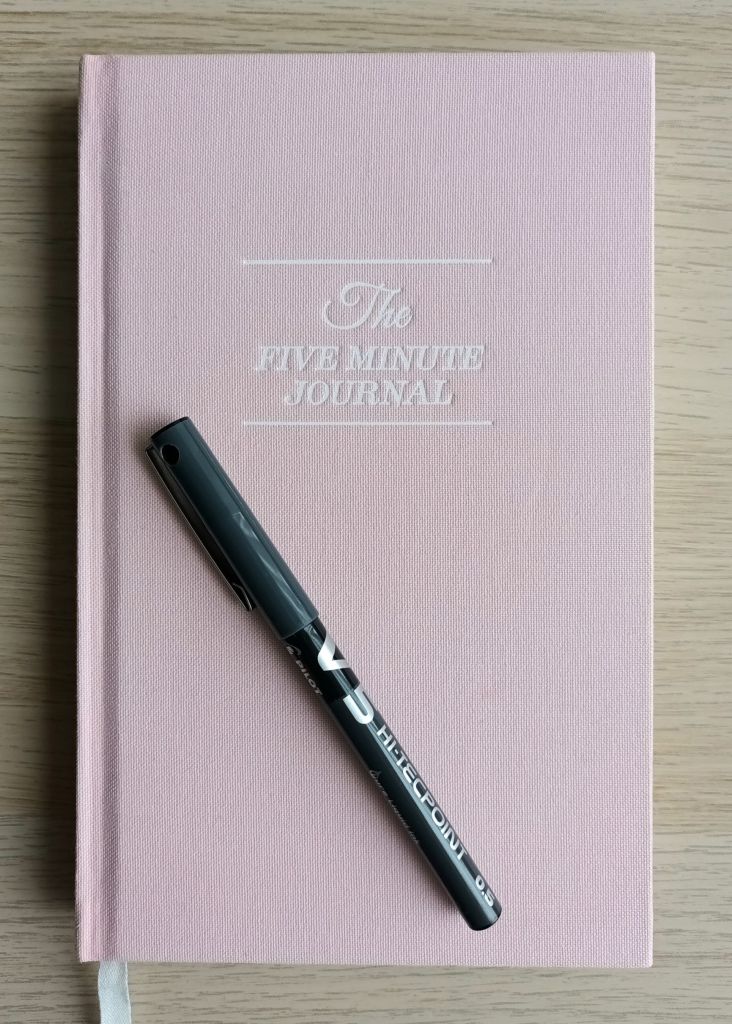
The Five Minute Journal is a hard back book with a linen cover and comes in an original natural linen covered or a choice of five other colours namely royal blue, earth green, blush pink, bold black and sunshine yellow. I opted for the pink colour but from my research, it looks like the original colour is the most popular choice.
The book consists of over 260 pages, with approximately 30 pages explaining how the journal works at the beginning, 6 months worth of daily journalling pages and 11 ruled pages for notes at the back. The pages are a cream colour and feel like good quality. Having used a ball point pen and not being happy with my handwriting, I have since tried a few different pens out on the note pages at the back with no bleed through so I will be converting to a finer nibbed liquid ink which I use in my bullet journal.
As part of the introductory pages, you are invited to create a written commitment which encourages you to think about your reasons for wanting to keep the journal, a reward which you could give yourself if you stick with writing for 5 days, a promise to yourself if you don’t manage 5 consecutive days and your own ideas of how you can ensure you practise daily. In addition to this, you identify one of your biggest current challenges in life, an identity statement that remedies the challenge, major obstacles to writing on a daily basis and actions you can take to overcome these obstacles.
Each page in the daily journalling section of the book consists of a space to write the date, followed by a motivational quote or a weekly challenge (once every seven days or so) and then a section for morning and night time entries. In the morning, you are advised to write as soon as you wake up as it is the perfect opportunity to set a positive tone for the day. The day time section prompts you to write 3 things you are grateful for, 3 things that would make the day great and one daily affirmation
My thoughts on the process so far
I found the introductory pages to be really useful and made sure I read them all before starting to fill in the daily entries. As well as an explanation of how the journal should be used, it gave tips including:
write your morning entry as soon as you wake up, even if you can think of excuses not to (e.g. feeling sleepy, might make you late for work etc)
write your evening entry just before you go to sleep (even if you’re feeling super tired, have a headache or need to get up really early in the morning and should be having an early night etc)
write things that you are grateful for, even if you don’t yet have them in your life (e.g. I’m grateful to be in a loving and healthy relationship with my perfect partner – law of attraction style)
try choosing different areas of your life to focus on each day or week if you get stuck e.g. relationships, an opportunity that you have, something great that happened or you saw yesterday, something simple nearby you e.g. the pen you’re holding, your comfortable bed, your cosy pajamas etc.
get specific with your gratitudes e.g. I’m grateful for my friend x as she encourages me to eat healthily and take some daily exercise etc.
when writing about things that would make your day great, choose things you have control over, e.g. rather than writing ‘a warm and sunny day’ you could write ‘wearing warm clothes and taking a walk in nature’ or ‘finding time to exercise’
use the daily affirmation to re-affirm something you already know or repeat something you really want for yourself e.g. I listen to my body and give it what it needs, I take time for rest and relaxation after a busy day, I have the power to create the life I want, I hold the key to my own happiness etc
use the highlights of the day section to find the positives and special moments you experienced e.g. listening to the birds sing in the garden, coffee, cake and catch up with a good friend, enjoying a brisk walk on the beach, trying out a recipe you found in your magazine and really enjoying the dish etc
use the ‘What did I learn today?’ section as an opportunity for reflection e.g. ‘taking five minutes to do some stretches first thing helps to wake up my body’ ‘I sleep much better if I avoid social media after 8pm’, ‘I get so much more work done if I keep my desk neat and tidy’ etc
When I first started the journal, I did exactly what it said in the guidance and filled in the morning section whilst still in bed. However, now, I like to take my journal downstairs sometimes (usually during the week) so I can look in my bullet journal to see what commitments I have that day. This makes it easier for me to fill in the ‘What would make my day great?’ section. For example, I might put ‘taking some time to rest and recharge after working on a blog post all morning’ or ‘keeping myself hydrated throughout the day whilst talking to the students’ etc. Things I might not have thought of if I hadn’t taken some time to think.
In terms of my night time entries, where it suggests completion just before going to sleep, I find it better if write mine in bed prior to reading my Kindle. This is because quiet reading whilst lying down often makes me feel incredibly tired (even to the point of dropping off and whacking myself in the face with my Kindle), so I’d rather fill it in when I’m still properly awake. This is working really well for me and I still drift off with a mind relatively empty of thoughts.
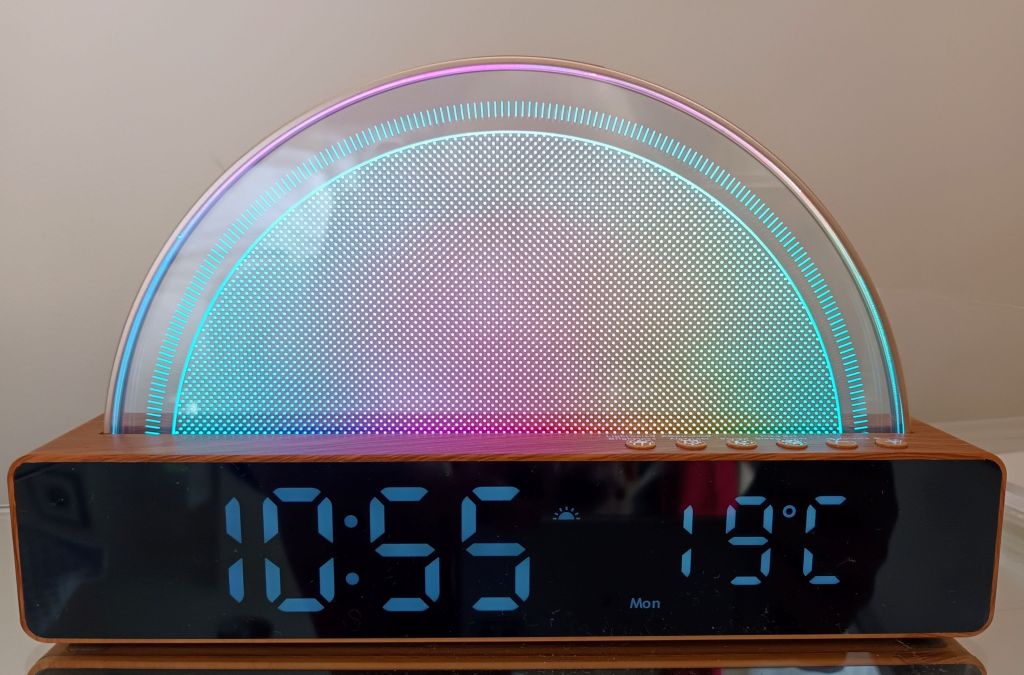
At the beginning of the journal, it invites you reward yourself if you manage to write for 5 consecutive days. I really wanted a sunrise alarm clock/lamp so I researched them online and picked one out on Amazon that was relatively inexpensive but had really good reviews. I’m pleased to say I now have the item on my bedside cabinet and I absolutely love it. Plus, it stops me needing to use my phone as my alarm (or as a light if I get up to pop to the loo) which, in turn, means I don’t get tempted to check the various notifications which have appeared overnight before even getting out of bed.
Afexoa Sunrise Alarm Clock
Although I managed to keep up the practice for 5 full days, I’m now on Day 13 and I’ve forgotten to fill in my night time entry a couple of times already. Once, I was drifting off to sleep and remembered and filled it in straightaway but last night, when I got up, I realised I hadn’t done yesterday’s night time section. Rather than chastising myself for forgetting, I simply filled last night’s in first thing this morning and reflected on possible reasons why I’d not remembered to do it – it was on my bedside cabinet under my Kindle but we went to bed quite late and I was very tired (and feeling a little under the weather).
I’m so far really enjoying using my journal but I have found parts of it more challenging to fill in. For me, the gratitude part is easy as I’ve previously done a daily gratitude pages in my bullet journal. I’m also used to identifying activities to fit in to my day that are focused on ‘me time’ so I always have plenty of ideas for this. Creating a daily affirmation is often quite difficult so I’m in the process of creating a page full of encouraging mantras which I’ve found on Pinterest to help me. Writing three highlights for the day is my favourite part of the journalling progress and I always have plenty to write – sometimes I find there’s not enough room here! Finally, jotting down something I’ve learnt that day (the original journal had the question ‘How could I have made today better?’) is probably the hardest part as I’m not used to doing this kind of reflection. I do get something written each time but it takes me quite a while.
Although it’s known as ‘The Five Minute Journal’, I reckon it currently takes me a lot longer to complete – probably at least 10 minutes in the morning and another 10 just before bed. I’m sure as I continue with the process, ideas will pop into my head during the day which I could incorporate into my entries and this will things quicker and easier. If not, I think the process is still really beneficial and well worth persevering with.
I also found that it was a good idea to refer back to my journal throughout the day to re-check my daily affirmation and to remind myself of my three ideas for what would make my day great. I might try making a quick note of these in my BuJo in future to see if that helps further.
The Main Benefits of keeping The Five Minute Journal for me so far
Having used The Five Minute Journal for nearly two weeks now, I can really see how beneficial it is for my health and wellbeing. Here’s what I’ve found so far:
it helps me set the tone for the day and encourages me to end it on a high note
it allows me to think about ways in which I can bring more joy to my day rather than focusing wholly on my ever expanding to-do list
it helps me to set some intentions for the day and then check back in with myself to see how I got on with them
it helps me find the good in every day, even if I have a super busy (and exhausting) or particularly stressful day, there are plenty of positives if you dig deep to find them
it’s great for personal development as I spend time reflecting on what I’ve learnt and how this can help me live an even better life
the ‘what have I learnt today?’ section has helped me reflect on good and bad habits – for example, doing a mindful activity such as my jigsaw helps me to relax and unwind after a busy day (plus it helps me to rest my voice after talking to different groups of students), whereas ruminating over the feedback I gave and ways in which I could have made it even better is pointless and unhelpful
the daily emails that I signed up for have help me learn different ways to approach filling in the pages so that it doesn’t become a repetitive process
some of the daily quotes really resonate with me and they all make you think or are a good reminder of things you can do to control your own happiness levels
the weekly challenge was a really great way of trying something new and exploring how it made me feel – I’ve only completed one so far but I enjoyed it and it made me feel really good afterwards. I’ve flicked forward to see what’s next and I can’t wait to try it!
daily affirmations are helping me to feel better about myself as a person and also increase my confidence, resilience and motivation to take on new challenges
although it takes me a bit longer than 5 minutes to fill it in, I do find that it is an incredibly worthwhile practice and that my entries will get better and faster with time
Final words…
I hope you’ve enjoyed finding out about The Five Minute Journal and reading my initial experiences of using it to promote happiness and personal growth. Let me know in the comments if it sounds appealing of if you’ve given a similar style of journalling a go before.
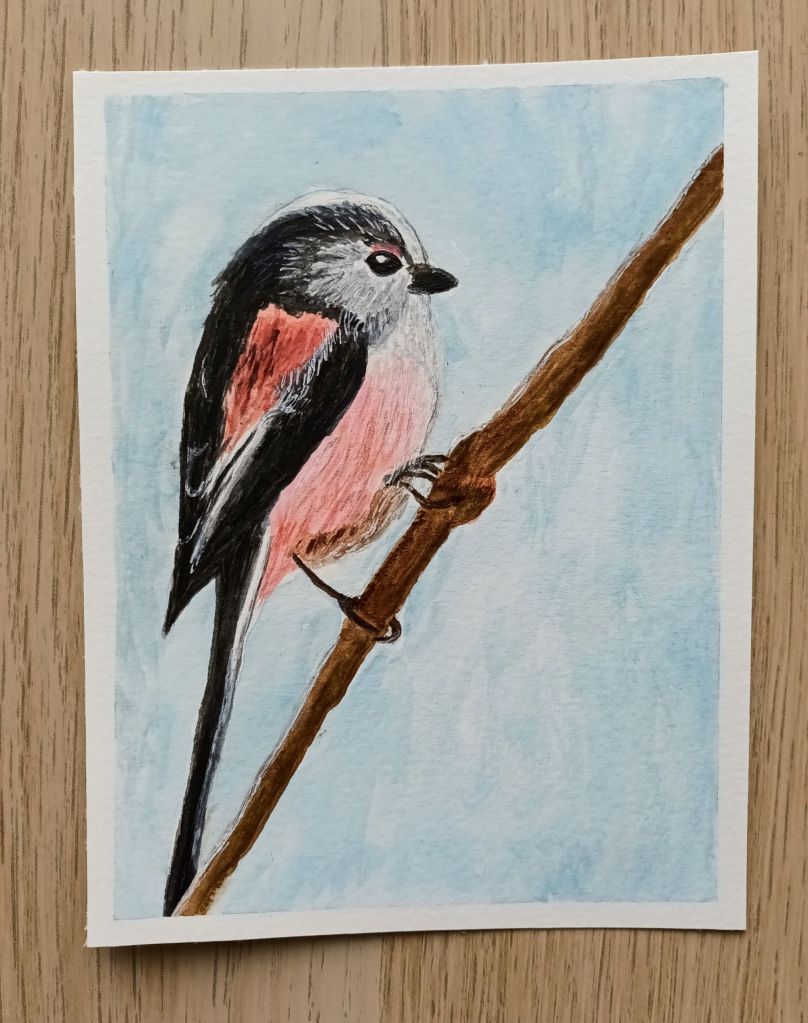
My idea for my March theme came from a walk my husband and I took at Rainton Meadows which is a stunning nature reserve situated in Houghton-Le-Spring in Sunderland. Whilst heading down the path next to one of the many ponds, we heard the unmistakable twittering of a group of long tailed tits. It was easy to spot them amongst the bare branches of a nearby tree and we stood watching them flitting around, presumably collecting tiny insects. As one of my favourite little woodland birds, I enjoyed observing their busy behaviour and I commented to my husband that I would love to have a go at drawing and painting one. When we got home, I searched for photographs of these cute birds and was excited to give it a go. I decided that if I was pleased with the result, I would incorporate my painting in my March set up. Needless to say, I’m over the moon with how my watercolour turned out so it became the image for my cover page.
Front cover
My painting was based on a reference image I found online (thanks for sharing Andy Bright) and the photograph features a long tailed tit gripping on to a single branch. I’m surprised the bird stayed still enough for such a stunning portrait as I’ve never managed to take a decent photo of this sweet but flighty bird!
For my art piece, I used a combination of Winsor & Newton Cotman watercolours, a cheap white gouache, a bright white Sakura gelly roll pen and a couple of coloured pencils to sharpen a few details. I worked on a small piece of Daler Rowney Aquafine smooth watercolour paper using the wet on dry technique. It took me a while to get the two pinky colours the way I wanted them but I’m developing my colour mixing skills as I experiment. Overall, it took me about three hours to complete my work and I think it was time well spent!
Original art work by Laura Jones
As the watercolour paper is very thick, I didn’t want to paste it directly into my bullet journal so I scanned it on my printer and printed it out. The results weren’t as good as I would have liked (my printer was relatively cheap), so I experimented a bit to see if I could get something that showed the colours in their true form. In the end, I printed the painting on a 4×6 inch glossy photograph paper which I could stick into my bullet journal. I’ve now got my painting underneath a large and heavy book hoping to flatten it out a bit as it’s started to curl!
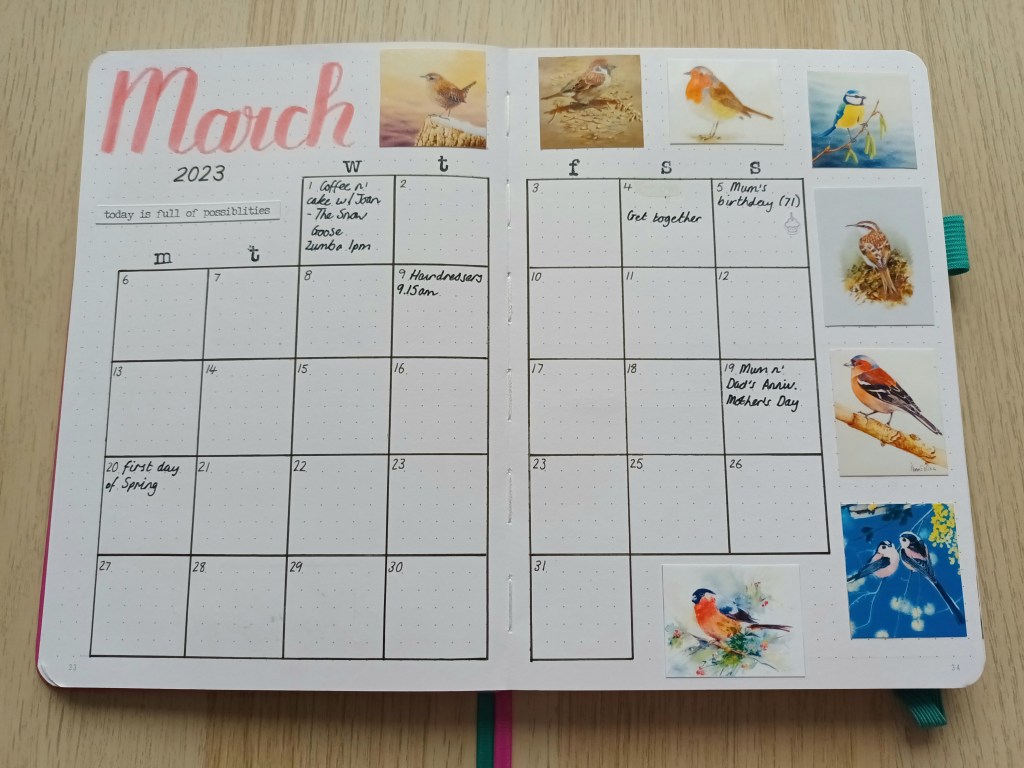
Monthly Calendar
I wanted to continue with the woodland birds theme but knew that I would struggle to draw quick and simple birds and get my pages completed in good time, so I decided to search Google images for some watercolour paintings that I liked and then printed out mini versions on photo paper. I wish I could credit all of the original artists here but as I couldn’t always find them I will encourage my readers to search for the works online should they wish to find out who they were painted by.
Photo credit: Laura Jones for Keeping It Creative
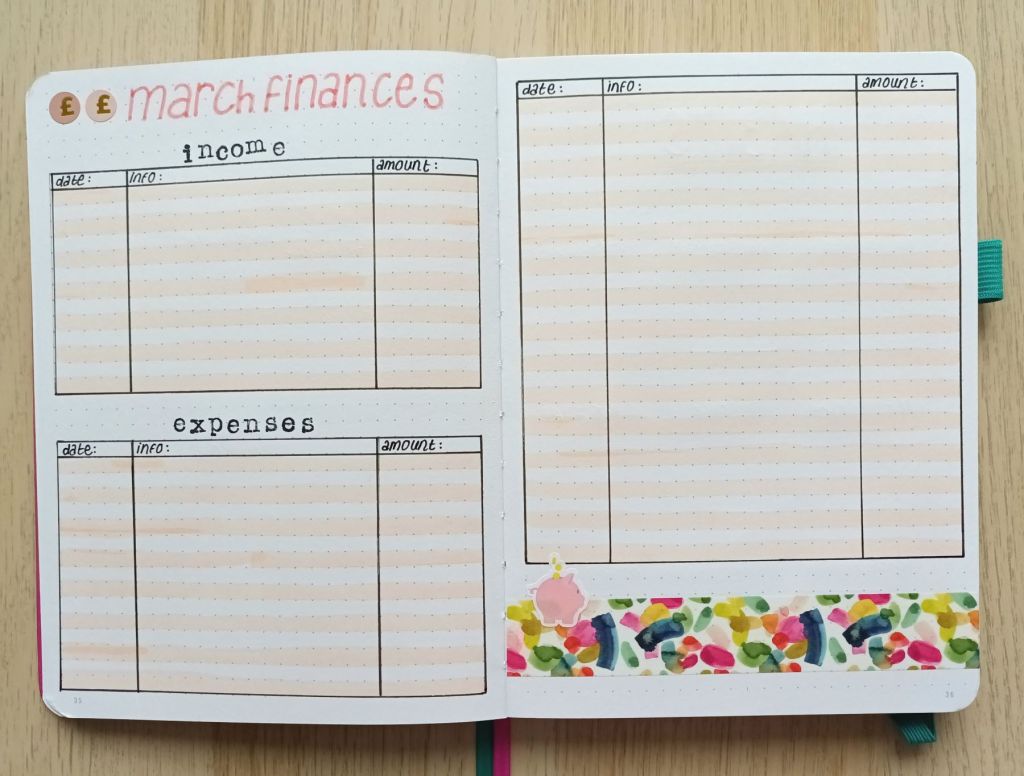
Finances
I’m still benefitting from keeping a record of my income and expenses so I’ve done another financial tracker this month. I also found some little piggy bank stickers in my stash so I decided to add one as decoration to go with some new watercolour washi I got from Amazon.
Photo credit: Laura Jones for Keeping It Creative
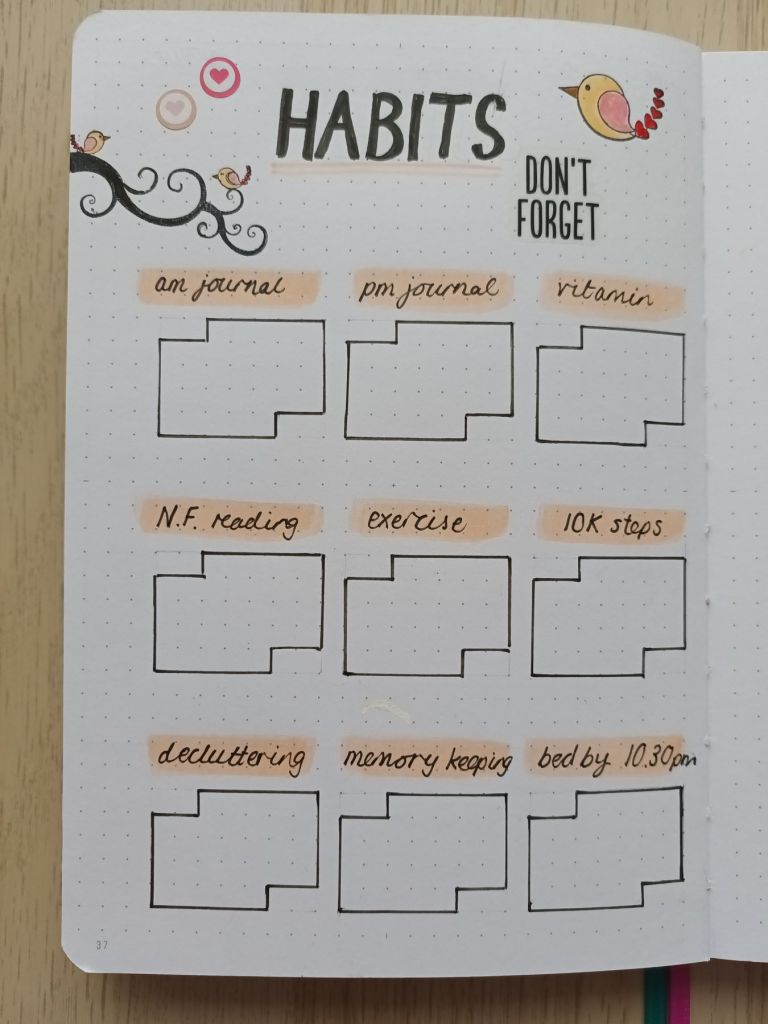
Habits trackers
I’ve been tracking some of my habits as part of my rolling weekly but decided I want to keep a better record, so I created a whole spread for them. The plan is to add a dot or a cross each day I complete my habit. I knew I had some little bird stamps in my stamping supplies so I added these as some quick decoration.
Photo credit: Laura Jones for Keeping It Creative
Final words…
I hope you’ve enjoyed looking at my spreads for the month of March. I’m so pleased with how my watercolour painting turned out and I’m enjoying mixing different colours and trying out a range of techniques. I think I should also celebrate getting my pages done before the end of February, photographing and uploading my images as well as typing up a quick blog post to share them.





 Keeping it creative