Posted in goal setting, life hacks, lifestyle, personal development, personal growth, Setting goals and intentions

Monday Matters: How I’m preparing for the Autumn season this year (2024 edition)

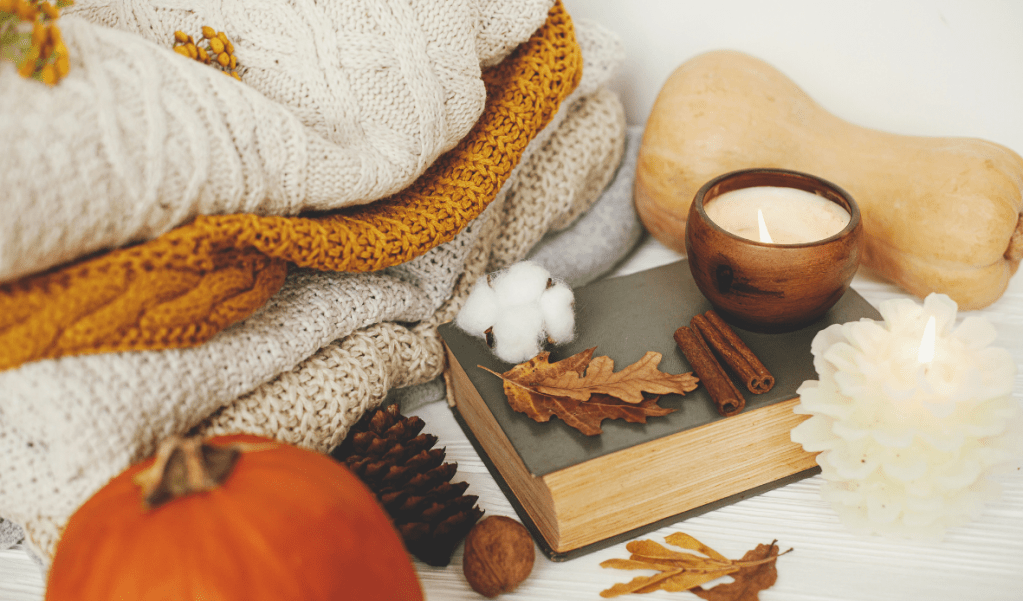
Image from a selection on Canva

Over the past week, the weather in Sunderland has cooled down and it’s been quite breezy with a few warmish rain showers. It feels like the end of summer is fast approaching and that we’re quickly heading into the autumn time. My husband reckons there are still some bright and sunny days to come and I shouldn’t pack away my shorts, vest tops and cropped trousers just yet but, although I love a nice bit of sunshine, I certainly won’t miss applying greasy sunscreen to my exposed skin before spending time outdoors and feeling hot and sweaty in bed at night despite only having a thin cotton sheet as a covering. In fact, I’m looking forward to autumn this year and will be planning lots of lovely activities for the season. Today, I thought I’d share how I’m getting ready for autumn 2024 with the intention of giving you some simple ways to prepare for what’s to come and hopefully helping you to look forward to the coming months too.

Home decor

A few months ago, I was looking at the autumnal home decor in Next and saw some really cute pieces. I was very tempted to make a purchase of yet another pumpkin but I resisted as I already have over ten in my collection. However, when I got home, I decided to look at everything on their website, as often, many of the products are not available in store. With 205 items including bedding, kitchenware and tableware, vases, fragrances, lighting, pictures and more, I found it difficult to restrict myself to just one item but I was very restrained and, for click and collect, ordered a sweet little three-dimensional autumn picture with battery operated tiny light up sections.
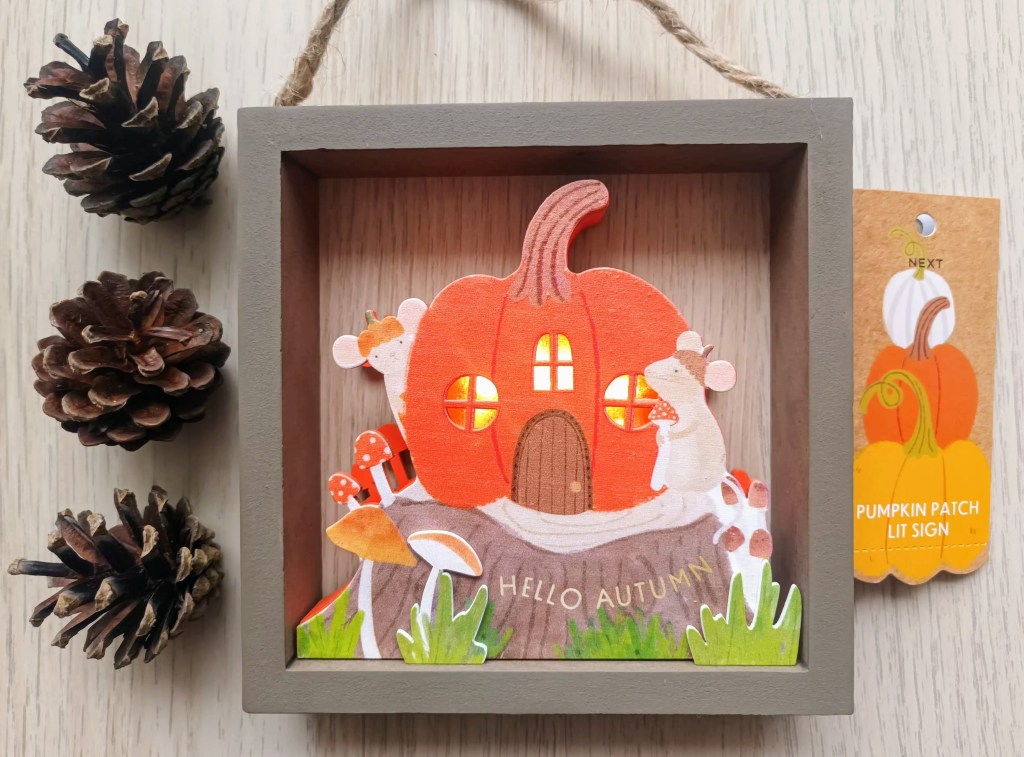
Cute little light up 3D Hello Autumn sign

Other ways I’ll be getting my home ready in terms of decor include:

  • putting away a couple of my current mugs and replacing them with my oversized autumn leaves design one (from TKMaxx)
  • adding our autumn wreath to our front door (I got ours from Lights4Fun)
  • getting out my various pumpkins to display – I have different sizes and different textures including some ceramic ones, some plush ones in velvet (including a fantastic orange doorstop with sequins on along the grooves) and a lovely handmade crocheted one which I got last year
  • bring my throws and blankets out of storage to place on the arms our settee and the chair in our living room
  • airing our thicker quilt to put on the bed as the nights get cooler
  • choosing a few new candles to scent our home to go with the ‘baked apple pie’ one I purchased late last year (unfortunately, Aggie, our hamster doesn’t react well to stronger smells so I’m having to place them well away from her cage in the hallway)
  • collecting and using pine cones, dried leaves, stems and branches to create natural centrepieces and arrangements
  • making my own autumn inspired decor using my collection of watercolours (for this, I will experiment with mixing different earthy and autumnal colours in my palette such as browns, yellows, oranges and deep reds)

Planning some fun activities for the season

Over the past year, starting in autumn 2023, I’ve been creating a seasonal bucket list and then working on a journal to record my experiences. I’ve thoroughly enjoyed creating these but making and finishing the journals has been time consuming and involved quite a lot of expense – I must have gotten through over 50 roller tape glues over the course of the year. So, now that project is almost over, I’ve decided to continue making a bucket list for each season but only record a few of our favourite and completely new experiences in journal pages. I’m yet to create my Autumn 2024 bucket list but here’s last years in case you haven’t seen it already.

Photo credit: Laura Jones for Keeping It Creative

Wardrobe changes

Although I have my shorts and crops out at the moment, as the season gets going, I’ll be laundering and putting them all away and getting all of my thin and more cosy knits out. I picked out a few new jumpers and cardigans last year and have already bought a gorgeous pale khaki green batwing jumper with metallic fibres from Love & Roses at Next so I’m pretty much set for the season already!

We’ll also be washing and vacuum packing our thinner summer weight duvet in favour of a higher tog but we won’t put the thickest one on until the really cold nights! And finally, my sandals will be heading into the loft and my walking shoes and ankle boots will be taking their place. I keep my trainers out for my gym sessions but rarely wear them out and about unless I know I’m only going to be walking on solid, open paths where they won’t get soggy or muddy.

Recipes and drinks

As I write this section, I’m enjoying an icy cold J2O Summer Shine to help me hydrate after an intense Clubbercise class. However, in the autumn time, I will crave warming coffees, creamy hot chocolates and tasty mochas. I’m also hoping that I will still be enjoying my new, very low calorie option, mint tea, which I believe only has about 2 calories per cup. I’ve long wished to develop a liking for herbal teas (to ensure I don’t drink too much coffee in the colder months) but it has taken me a long time to find something I can tolerate let alone grow to love!

As well as transitioning mainly to hot drinks, my husband and I will also be swapping light salads for heavier and warming soups, stews, pasta and risottos. Before the autumn season arrives, I like to pick out some online recipes to try using my favourite ingredients. I also like to fill our store cupboard with wholegrain rice and pasta, packets of other healthy grains such as quinoa, freekeh, bulgur wheat and oats, plus tins of pulses such as chickpeas, kidney beans, butterbeans, black beans and lentils. We also tend not to have ice cream when the temperatures drop, opting for warming desserts with lashings of custard such as treacle tart or syrup sponge. I’m also planning on having a go at making a pineapple upside down cake (complete with cherries in each pineapple ring) this year as I remember enjoying the ones my mum used to make when I was a kid. I just need to add it to my bucket list so I don’t forget!

Pumpkin everything?

Personally, I love cooking with the various squashes that are around at this time of year and love trying different varieties (interesting known as winter squashes not autumn!). However, I’m not a fan of the popular PSL (AKA pumpkin spiced latte) or other sweet pumpkin flavoured treats that become available. Also, I don’t want any of the sickly sweet pumpkin scented candles that can be found in abundance at TKMaxx already. I don’t mind the spice element, but I’d rather go for a nice warming cinnamon. What about you? Do you fully embrace pumpkin in sweet stuff or are you glad when they run out of pumpkin spiced stuff at your local Starbucks? Luckily, cinnamon flavoured items can be purchased alongside the popular gingerbread bits and pieces which come out closer to Christmas time so their warmth can be enjoyed in winter too.

Digital screens

Each season, I change the wallpaper on my laptop and my mobile phone. Last year, I remember having a photograph of a squirrel collecting nuts, surrounded by autumn leaves which I’m sure was digitally created but used to make me smile each time I logged into my computer. I’ve seen lots of background images on Canva Pro which I must choose from before my free trial ends. For the phone wallpaper, I usually just Google ‘autumn aesthetic phone screens for android’.

Enjoying the outdoors

As the weather becomes slightly chillier, there’s no need to stay inside with the heating on and complain about how cold it’s becoming. Going for walks in the autumn is, in my opinion, an absolute must, especially when the leaves begin to change to beautiful shades of red, orange, yellow and brown and then start to lace the ground. As long as you remember to layer up so you stay warm and cosy whilst enjoying the stunning scenes, there’s so much that nature has to offer. And if you struggle with cold and pain in your hands when the temperature steadily drops, my husband can recommend the rechargeable hand warmers that you can pick up on Amazon for a small (and very worth it) charge.

As you enjoy the outdoors, why not collect some nature elements to display at home or make art with such as pine cones, jewel-coloured leaves, branches and stems. Google autumn nature crafts and don’t be put off from doing something arty just because it says it for kids!

Final words…

The more preparation you put in prior to the autumn commencing, the more joy you’ll feel and the more exciting opportunities you’ll create. Each season has so much to offer us and rather than engaging in that popular British pastime of complaining about the weather, why not spend your time fully embracing autumn doing activities that you love or have always wanted to try?

Wishing you an amazing autumn,

Posted in Anxiety management, bullet journal, life hacks, lifestyle, mental health, planner lifestyle, wellbeing

Monday Matters: 5 reasons why you should make a packing list for your holiday (AKA vacation)

As my regular readers will know, my husband and I are off on a week’s holiday later in the month. Before we go on any trip, whether it’s a weekend away, a mid week trip or a longer holiday, without fail, I create a packing list in my bullet journal which includes absolutely everything that I plan to take no matter how obvious the items are – I’ll even list the contents of my handbag even though the stuff is already inside. Today, I’m going to share with you my three reasons for making the aforementioned list and why I believe is an essential part of holiday preparation.

It helps you avoid under or over-packing

Before starting my packing list, I spend time thinking carefully about the length of our holiday and how many days worth of clothing I will need. I’ll also think about whether I will need more than one outfit for any of the days or if it’s likely we will be going out for the day and then coming back in the evening and staying in. Finally, I’ll consider whether any items will be re-worn or if, for example, they might have become sweaty if it’s really hot weather. The same process will be applied to my underwear items so I know I have just the right amount of stuff. This helps me avoid over or under packing and usually means that I have the perfect amount of clothing. After careful consideration I will work on my clothing list, writing down exactly how many of items were I need multiples e.g. 15 pairs of socks, 5 bras etc.

It ensures you don’t forget any essentials

There are always a number of items which you absolutely must take on your holiday. For me, this is things like my medication, mobile phone, debit cards and cash, hairbrush and for somewhere hot, sunscreen, a cap and my sunglasses. These would go on my essentials list and are written down first when I create by bullet journal spread. Doing this ensures you don’t forget any essentials – or at least it does if you run through your list before you set off and tick off all of the items!

You can pack methodically in a (relatively) stress free way

In the past, I’ve found packing my bags for departure extremely stressful, even to the point of inducing tears. Creating a packing list makes things much easier and a hell of a lot calmer. By going down your list for each category, you can get each item folded (or rolled) and ready in a collection so all that remains is to decide where it will go in your suitcase or bag.

As part of my list, I also add a ‘last minute’ list which includes things which will be in use at home before travel e.g. my toothbrush, hairbrush and make up, and tasks which need completing before setting off e.g. emptying the kitchen bin, watering our pots in the front and back garden etc.

You can keep your lists to help you next time

As all of my packing lists are written in my bullet journals, I can flick back and find a similar holiday list to help me get started. So, for example, if we’re going down to visit my parents in the summer time, I can look back at last years list and re-write it with some tweaks such as adding new items of clothing, removing bits and pieces that I no longer own etc. This makes things super quick and easy and again contributes to packing being a less stressful event!

It stops you stressing over forgotten items

My husband always says to me in the car to the airport or on our way to our destination “have you remembered anything that you’ve forgotten yet?”. Invariably, my answer is no, unless I forgot to do my last minute check through like I did when we went to my mum and dad’s house last and I forgot my hairdryer as it was in use prior to setting off. In the past, for my husband, the answer was quite regularly “yes” when I replied “have you?” until he realised a list on his phone might be of great help!

As well as preventing you forgetting things (at least minimising the potential), it also means that you don’t have to then go searching for replacements at your destination. This is particularly helpful if you’re going somewhere remote with limited access to shops, if you prefer particular products (e.g. I only use vegan cosmetics and toiletries) or if you’re going abroad somewhere (especially if you don’t speak the language). It might not be the end of the world if you forget non-essential items but it often causes some form of inconvenience at least.

My packing list for this month’s holiday

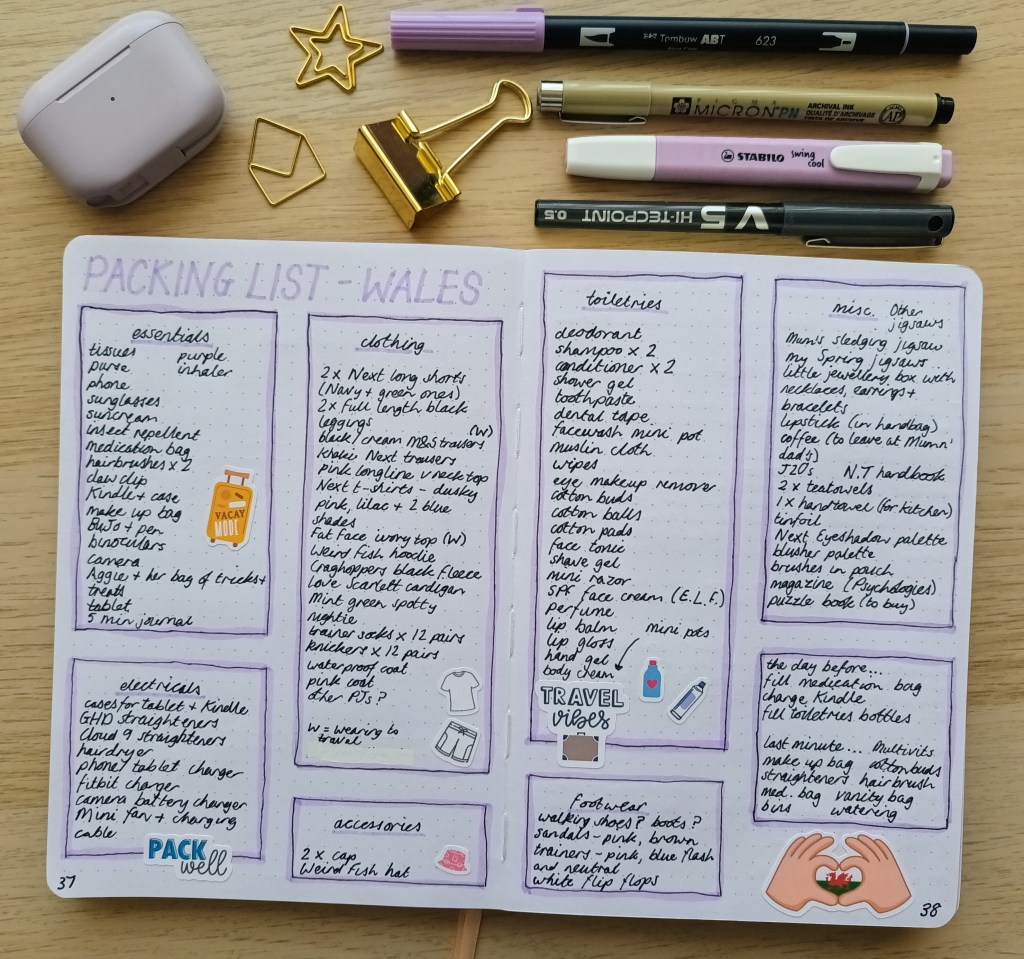
There are lots of packing lists examples available online and you can even purchase PDF versions, but personally, I prefer writing my own from scratch for each holiday. This means it’s completely personal to me and relevant to the particular destination, season and length of time I’m away for. I also take my list with me in my bullet journal when I go so that I can do a quick whizz through before we go home so I can check I’ve repacked everything. Below is my packing list for our holiday to Wales. It’s still a work in progress as we’re not heading off yet and I like to take my time with it.

Photo credit: Laura Jones for Keeping It Creative

Final words…

I hope you’ve found today’s blog post useful and can see how creating a packing list, for me, is an essential before travel task which is great for making me much more relaxed and better organised. Drawing up your own personalised list can lead to you feel less stressed and better prepared and I promise you will realise what a worthwhile activity it is. I’d love to know where you think would be the best place to write your list (analogue or digital?) and if you can see the benefits of keeping them in a safe place until your next holiday.

Thanks for reading!

P.S. Some of my readers have messaged me via email and have expressed an interest in dropping a comment or asking a question after reading a particular blog post. Unfortunately, this involves setting up a WordPress account but, luckily, it doesn’t take long and, once created, you can leave comments on any blog posts (from bloggers who use WordPress) which spark your interest. Also, you don’t need to be a blogger to set up account either. I hope this helps! I plan to paste this into each of my posts in future but have put it in post script so my regular readers and fellow bloggers can ignore!

Posted in Bullet journaling, goal setting, life hacks, lifestyle, memory keeping, planner girl, planner lifestyle, Planning and journaling

Creating a bright and colourful Summer Bucket List spread in my Bullet Journal

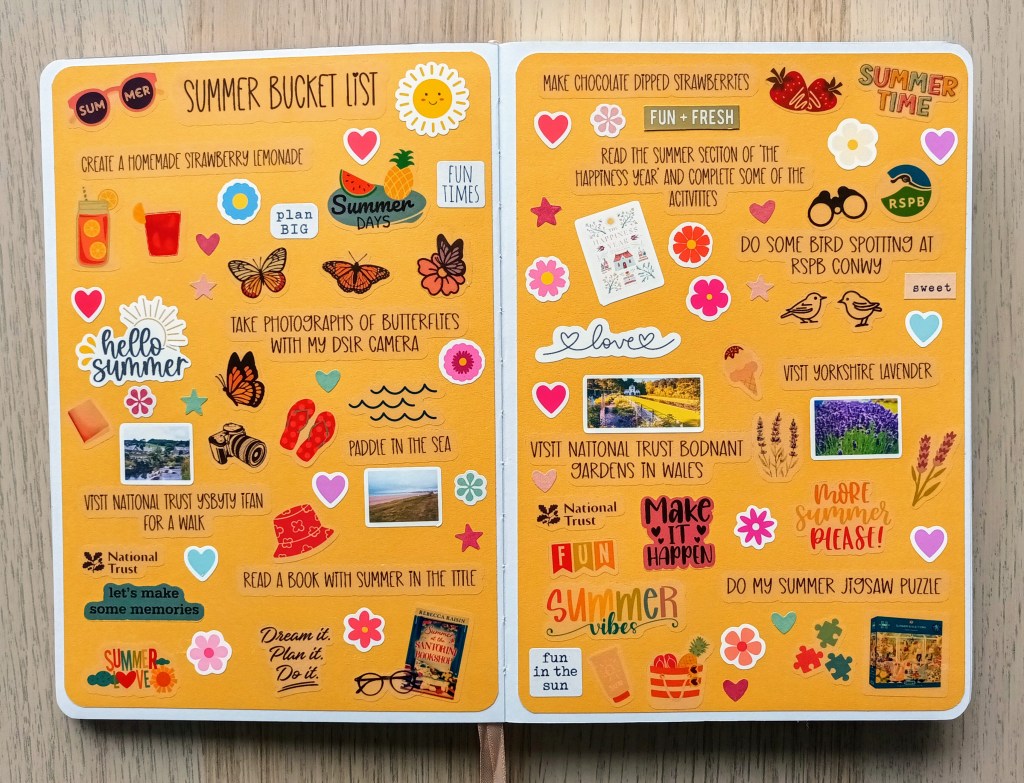
Last autumn, I set myself the challenge of creating a bucket list for each of the four seasons and making a Traveler’s Notebook journal for each in which to record all of my experiences across the year. This week, I finished setting up my final double page spread for the summer season in my Bullet Journal and I’m super pleased with how it turned out. The aim was to produce something inspirational using bright summer colours and images which embody the summer season. I enjoyed the process from start to finish and thought I’d share with you my finished product, explain a bit about how I went about setting it up and give a step by step guide to help you make your own.

Photo credit: Laura Jones for Keeping It Creative

Defining the season

The first step I took was decide on the dates for summer – I chose to base my seasons on the meteorological start and end which is June 1st to August 31st, but I could have opted for the astronomical period which cites the beginning as Thursday 20th of June to Sunday 22nd September. It’s obviously up to you which you go with and you probably already have your own idea when summer falls.

Brainstorming ideas

Initially I look at a range of bucket list ideas on Pinterest and noted down any which appealed. I also spent some time thinking about what summer means to me e.g. going to the beach and activities I enjoy doing such as birdwatching, photography, tasting summer fruits and going for walks in nature. As we’re off on holiday to Wales for a week next month, I then researched places to go and things to do in the local area which I could add to my list.

If you end up with a huge, long list of ideas, think about which activities most excite you, which fit in with your priorities for this year (e.g. relaxation, having fun, being adventurous, learning new things etc.) and which feel most realistic.

Setting some achievable goals

Whilst adding items to my list, I tried to make sure that there we’re some quick and easily achievable goals and some which will take more planning and organising. It’s also important to consider your budget, time constraints and any other commitments you have. It’s no good writing that you want to do a hot air balloon ride if you have no idea of the cost and haven’t researched locations from which these are available.

Creating a visual representation

For my bullet journal inspiration board, I selected some stickers from my stash and made some in Cricut Design Space. I even chose to add some real photographs of the places we would like to go, so I have an image of my local beach, and pictures I found online of Yorkshire Lavender and the two National Trust places we intend to visit during our holiday in Wales. I also found some tiny stickers to fill in the gaps between the bucket list items.

Of course, you don’t have to create a concrete visual representation for display. You might choose to simply close you eyes and picture yourself doing the activities and thinking about how they would make you feel or you might just write your list and put it somewhere you can regularly refer to.

Planning the details

For each activity, I’m now spending time fleshing out the details. So, for example, I’ve found what looks to be a simple and tasty recipe for strawberry lemonade and added it to Notion. I’ve written down the postcodes and travel times for the National Trust places and the RSPB reserve and have done some reading so I know what to expect when we go. I’ve also noted costs involved for different items and have purchased my summer novel on Kindle (for 99p!) and seasonal jigsaw puzzle already.

Final words…

I hope I’ve inspired you to make your own bucket list for summer 2024 full of exciting activities you’d like to try and maybe some old seasonal favourites. Creating a plan which is unique to you, is a great way to explore possibilities for the upcoming months so as to ensure you make the most of all of the free time you have available to you.

Wishing you a fun summer,

Posted in goal setting, life hacks, lifelong learning, personal growth, productivity, Setting goals and intentions

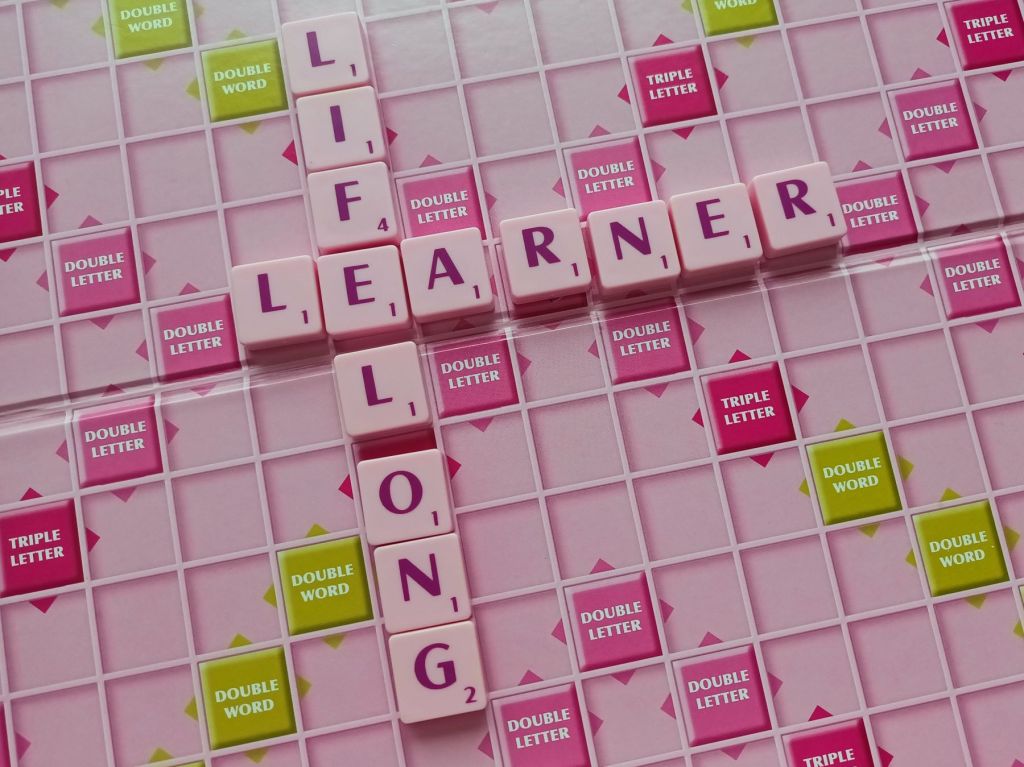
Monday Matters: 7 ways to be a lifelong learner (Part 2 of 2)

Today, I’m sharing the second and final part of my mini-series on lifelong learning. In Part 1, I considered the character traits of lifelong learners and discussed the benefits of being a lifelong learner. In Part 2, I’m going to be identifying different habits to adopt for continual learning and also sharing a range of ways to be a lifelong learner. I hope you find both of my posts useful and they help you think about the value of continued learning, your preferred learning styles, plus little tweaks you could make to your daily life and schedule so that learning is both a priority and a joy.

Photo credit: Laura Jones for Keeping It Creative

1. Consider your learning styles

We all have preferred methods of learning and, as adults we can develop our understanding of the different styles, decide which of them work best for us personally, and then use our knowledge to tailor our learning experiences appropriately. Here are some of the most common types of learner:

  • auditory – learns by listening e.g. through music, lectures, podcasts, and talks
  • visual – prefers to use visual aids such as pictures, photographs, videos, charts and diagrams, they may also draw their own illustrations to help them remember key information
  • kinesthetic – learns by doing and often described as ‘hands on’ learners, likes to use different senses to take in the information
  • reading / writing – learns through seeking out written information in books and magazine articles, prefers to write things down in words rather than using pictures or graphs, also likes to underline key points, colour code information or write notes in the margin when given a handout
  • logical / analytical – learns by processing data and solving problems, often looks for patterns to connect different aspects of the information in order to make sense of what is being presented
  • naturalistic – learns through investigating the natural environment, particularly enjoys outdoor and environmental learning opportunities. Enjoys carrying out field studies, watching wildlife documentaries, keeping nature journals with own sketches, photographs, observations etc. and finding out more about different environmental issues such as climate change
  • interpersonal – this type of learner functions best when they engage in group activities like quizzing one another, becoming involved in discussions or brainstorms and forming study groups
  • intrapersonal – this type of learner prefers a solitary learning style and finds self study particularly effective

You may find that from the list above, you prefer several of the different learning styles and this can help you to explore particular approaches to learning. However, it’s also important to recognise that some types of learning are more pertinent to particular topics of study or aspects of learning than others. For example, if you want to learn how to play a musical instrument, auditory, visual and kinesthetic (hands on) activities may be more helpful than reading or writing about the skills involved.

2. Identify your passions and interests

As an adult, you have lots of choice in terms of what you’d like to learn about and the skills you’d like to develop. You’re also free to explore and follow your passions and interests in any way you choose or even decide that you’re not as interested in something as you thought you were! Here’s some ideas for identifying specific passions and interests:

  • reflect on your past experiences and activities you’ve particularly enjoyed – does anything stand out in your memory that you’d like to become involved in or try again?
  • think about your particular set of skills and abilities – are there any particular ways in which you’d like to put them to good use?
  • consider your core values – this will help you establish what matters to you in life and then you can create learning experiences which reflect this. There are lots of resources online with lists of core personal values but you might find this article particularly helpful as it adds a little detail to each item on the list
  • consider favourite topics of conversation with friends and family members or what you like to teach others about
  • try out new things and discover what sparks your curiosity and interest
  • write a list of things you’d like to get better at e.g. cooking, gardening, playing guitar, drawing, singing, applying make up – give yourself plenty of time to see what comes up!

3. Read every single day

Developing a habit of reading each and every day is a great way of learning new things. To make it stick, try habit stacking by pairing it with an existing habit of yours. So, for example, part of my morning routine is breakfast, filling in my journal and reading a book or article of my choice for 5, 10 or 20 minutes depending on the time I have available. I also always read a novel on my Kindle each night as soon as I get into bed.

Any form of reading is an opportunity to learn, but varying your reading material is the best way to gain new knowledge and different perspectives. In a month, you might read several novels (choosing different genre such as crime thriller, romance, historical fiction and fantasy), a collection of love poetry, an article in a magazine which is full of self care ideas, a few blog posts on topics that interest you such as a particular creative pursuit or easy vegetables to grow in your garden, the definition of a previously unfamiliar word in a dictionary, a newspaper article about an environmental issue and a few chapters from a non-fiction book about creating a well-organised home.

4. Set realistic and meaningful goals

A great way of setting learning goals and pursuing them is to use the SMART framework. Taking time to identify the specifics and draw up small and achievable steps is crucial if you want to make meaningful progress and enjoy the outcomes of your learning.

5. Manage your time effectively

If you want to make learning a priority, you need to dedicate time to it on a regular basis and ensure it becomes a key part of your routine. Good time management is such an important skill to develop (and might be something you want to learn about first before pursuing your passions and interests). Key ways to manage your time well so you can create opportunities for learning include:

  • keeping yourself organised – make sure your calendar is up-to-date so you know your commitments and when you might be able to carve out some time for learning
  • maintain a tidy environment where everything has its place – so you don’t spend precious minutes or hours looking for things you need but can’t find
  • prioritising – making decisions about the best use of your time today, deciding what’s important for you in your life right now and making those things a priority (don’t forget to add time for breaks too)
  • scheduling – try ‘time blocking’ by first adding in regular tasks and activities such as eating meals, sleeping, going to work etc. and then fitting in other priorities around these
  • avoiding time and energy drainers such as scrolling social media, excessively checking your email, phone notifications (especially sounds and pop ups which draw your attention straight away), negativity whether that’s from people, watching the news or doomscrolling
  • set short term goals for learning that help you take steps towards your long term goals and regularly evaluate your progress to check you’re heading in the right direction

If you want to know more about making time for your current priorities and developing time management skills, I highly recommend ‘Make Time: How to focus on what matters every day’ by Jake Knapp and John Zeratsky.

6. Make use of free online resources

Follow a small number of podcasts, blogs and vlogs on a topic of your choice, hosted by people you find interesting to hear from and schedule some time each week to check in with them and explore new content or older uploads that you might have missed. Also look for online tutorials for beginners (there’s loads to choose from on YouTube or within blogs) or introductory courses so you can give things a go before committing to them financially. Alternatively, to develop your knowledge of a subject in general, you might like to join a group (for example on Facebook) where you can follow interesting topics of conversation, start a thread to discover different opinions or ask a question of someone with a higher level of expertise in the field.

7. Don’t forget to rest

Although making time for learning is important if you want to explore your passions and interests, equally valuable is taking regular breaks for rest and relaxation. This might mean meditating, listening to a favourite album or piece of music, spending time in nature or engaging in creative activities such as drawing, painting or papercrafting. Ensuring you get adequate, quality sleep is also essential for good cognition so be sure to make this a priority too.

Final words…

I hope today’s blog post has given you a few new ideas on how to be a lifelong learner. Ultimately, you are looking to cultivate a growth mind set where you are always looking for opportunities to learn, aren’t frightened to try new and challenging things, seek out new perspectives as a way to see the world in a different way, view mistakes, failures and setbacks as learning opportunities, find value in constructive criticism and believe that, with effort, you are more than capable of developing both your knowledge and abilities in order to reach your full potential.

I wish you well on your various learning journeys and remember every day is a new opportunity to be who you want to be,

Posted in goal setting, journalling, life hacks, lifestyle, meditation, Mindfulness, mindset, self care, Setting goals and intentions, wellbeing, wellness

Monday Matters: Discovering joy in every season of the year using The Happiness Year by Tara Ward

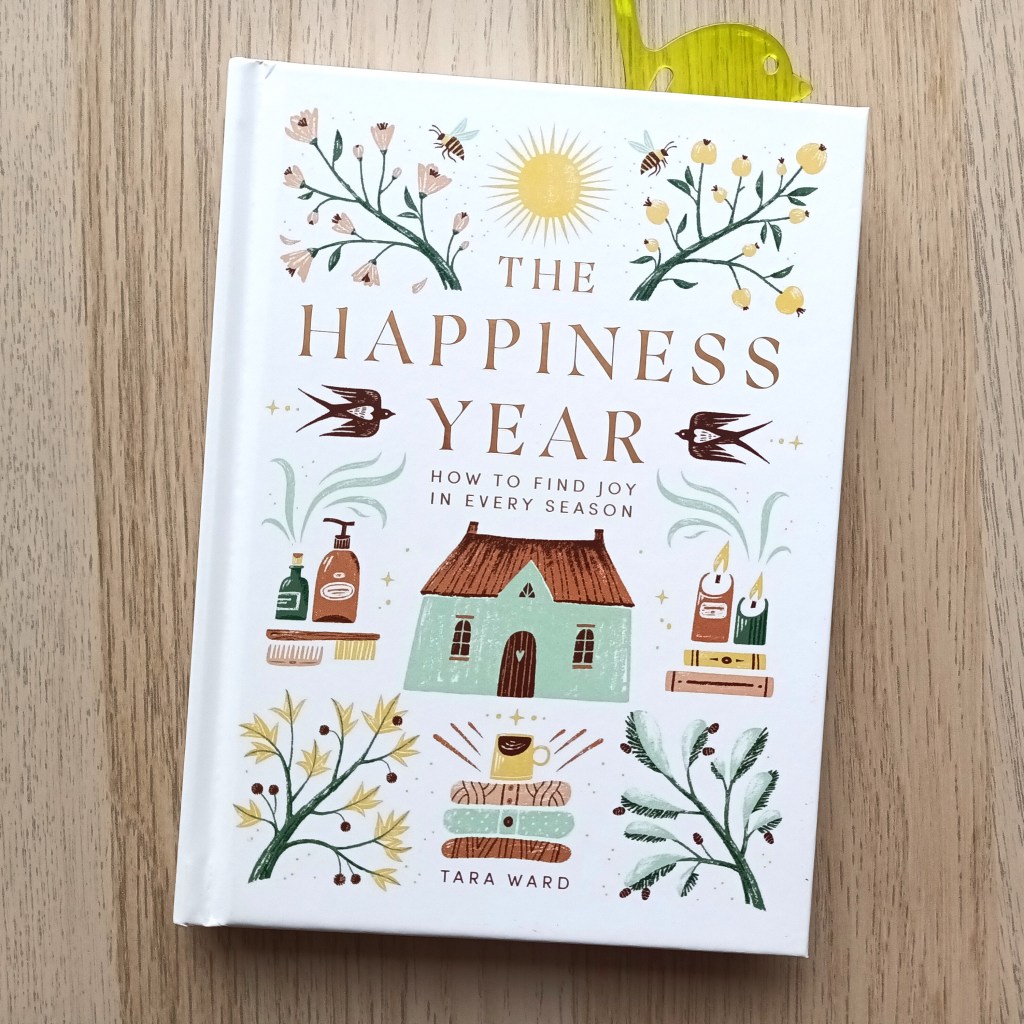
A few months ago, I was looking in the health and wellbeing section at Waterstones and came upon a beautifully illustrated book about finding joy throughout the year by trying out different seasonal activities. At the time, I didn’t purchase it, but I regretted my decision so I ordered it from an online retailer. When it arrived, I added it to the bookcase in my craft room as I was already in the process of reading about 8 different books which is a few too many even by my standards. I pulled it out a few days ago and there are some lovely activities inside in the section which I started with – Spring. I tried out the first exercise this morning and really enjoyed it so I thought I would give a short summary of the book and share that first prompt with you today.

The Happiness Year: How to Find Joy In Every Season by Tara Ward

In the introductory section of the book, Tara discusses the aims of The Happiness Year and also talks about the emotion of happiness and the four positive chemicals that are released into your body when you’re happy – dopamine, oxytocin, serotonin and endorphins (referred to as DOSE throughout the book). She then goes on to explain how to use and enjoy the book.

The remainder of the book is split into four sections – Spring, Summer, Autumn and Winter and there are a collection of exercises provided in each which you can pick and choose from. In combination, they promise to help you in an holistic way – physically, mentally, emotionally and spiritually. Personally, I think I will probably try out all of the different activities and see which I prefer and benefit from the most.

Included within the book, there are journalling and brainstorming activities, meditations, physical exercises, goal setting and planning tasks, plus many more to explore and enjoy. You are also invited to complete them in a way that feels comfortable for you, taking into account individual differences and preferences.

So far, I’ve only read the Spring chapter in depth but I’ve had a good flick through all of the book and I can already see there are many exercises that will appeal.

Exploring your thoughts, feelings and ideas about Spring

As I said earlier, I completed the first activity this morning and I enjoyed it so much that I felt compelled to share it with you. I think this exercise would work well for each of the four seasons, not just Spring. Here’s a step by step explanation of what to do:

  • Take an A4 piece of paper and place it in front of you
  • Write the word SPRING in large letters at the bottom of the page
  • Close your eyes and take three deep, comfortable breaths to focus you in the present moment
  • Open your eyes and look at the word
  • What comes to mind when you think of Spring?
  • Write down everything which comes up for you
  • When you’ve run out of ideas, close your eyes again, breathe deeply and continue thinking about the season
  • Note down any further ideas or images which come to mind
  • When you feel you’ve finished, look over your sheet
  • What jumps out at you the most? Circle any words or phrases which particularly resonate or feel important to you. Are then any surprises?
  • What is the overriding emotion when you look at your words? Write that emotion or emotions at the top of the page.
  • Look through the words and make a list of those which generate feelings of happiness.

I hope you found this a helpful exercise and it reminded you about all of the lovely things which happen in the Springtime. I’ve included my sheet below, how does it compare to yours?

Photo credit: Laura Jones for Keeping It Creative

Final words…

If you enjoy mindful activities such as journalling, setting intentions, exploring the world using your five senses, breathwork, meditation and appreciating the simple things in life, I would definitely recommend checking out The Happiness Year. The book will help you find ways to appreciate and make the most of all of the things that each season has to offer you. You’ll also find a range of self care activities to increase your happiness levels by releasing a good ‘DOSE’ of positive chemicals. Let me know if you try the exercise outlined above and how it made you feel.