
Blog

Posted in Anxiety management, bullet journal, life hacks, lifestyle, mental health, planner lifestyle, wellbeing

Monday Matters: 5 reasons why you should make a packing list for your holiday (AKA vacation)

As my regular readers will know, my husband and I are off on a week’s holiday later in the month. Before we go on any trip, whether it’s a weekend away, a mid week trip or a longer holiday, without fail, I create a packing list in my bullet journal which includes absolutely everything that I plan to take no matter how obvious the items are – I’ll even list the contents of my handbag even though the stuff is already inside. Today, I’m going to share with you my three reasons for making the aforementioned list and why I believe is an essential part of holiday preparation.

It helps you avoid under or over-packing

Before starting my packing list, I spend time thinking carefully about the length of our holiday and how many days worth of clothing I will need. I’ll also think about whether I will need more than one outfit for any of the days or if it’s likely we will be going out for the day and then coming back in the evening and staying in. Finally, I’ll consider whether any items will be re-worn or if, for example, they might have become sweaty if it’s really hot weather. The same process will be applied to my underwear items so I know I have just the right amount of stuff. This helps me avoid over or under packing and usually means that I have the perfect amount of clothing. After careful consideration I will work on my clothing list, writing down exactly how many of items were I need multiples e.g. 15 pairs of socks, 5 bras etc.

It ensures you don’t forget any essentials

There are always a number of items which you absolutely must take on your holiday. For me, this is things like my medication, mobile phone, debit cards and cash, hairbrush and for somewhere hot, sunscreen, a cap and my sunglasses. These would go on my essentials list and are written down first when I create by bullet journal spread. Doing this ensures you don’t forget any essentials – or at least it does if you run through your list before you set off and tick off all of the items!

You can pack methodically in a (relatively) stress free way

In the past, I’ve found packing my bags for departure extremely stressful, even to the point of inducing tears. Creating a packing list makes things much easier and a hell of a lot calmer. By going down your list for each category, you can get each item folded (or rolled) and ready in a collection so all that remains is to decide where it will go in your suitcase or bag.

As part of my list, I also add a ‘last minute’ list which includes things which will be in use at home before travel e.g. my toothbrush, hairbrush and make up, and tasks which need completing before setting off e.g. emptying the kitchen bin, watering our pots in the front and back garden etc.

You can keep your lists to help you next time

As all of my packing lists are written in my bullet journals, I can flick back and find a similar holiday list to help me get started. So, for example, if we’re going down to visit my parents in the summer time, I can look back at last years list and re-write it with some tweaks such as adding new items of clothing, removing bits and pieces that I no longer own etc. This makes things super quick and easy and again contributes to packing being a less stressful event!

It stops you stressing over forgotten items

My husband always says to me in the car to the airport or on our way to our destination “have you remembered anything that you’ve forgotten yet?”. Invariably, my answer is no, unless I forgot to do my last minute check through like I did when we went to my mum and dad’s house last and I forgot my hairdryer as it was in use prior to setting off. In the past, for my husband, the answer was quite regularly “yes” when I replied “have you?” until he realised a list on his phone might be of great help!

As well as preventing you forgetting things (at least minimising the potential), it also means that you don’t have to then go searching for replacements at your destination. This is particularly helpful if you’re going somewhere remote with limited access to shops, if you prefer particular products (e.g. I only use vegan cosmetics and toiletries) or if you’re going abroad somewhere (especially if you don’t speak the language). It might not be the end of the world if you forget non-essential items but it often causes some form of inconvenience at least.

My packing list for this month’s holiday

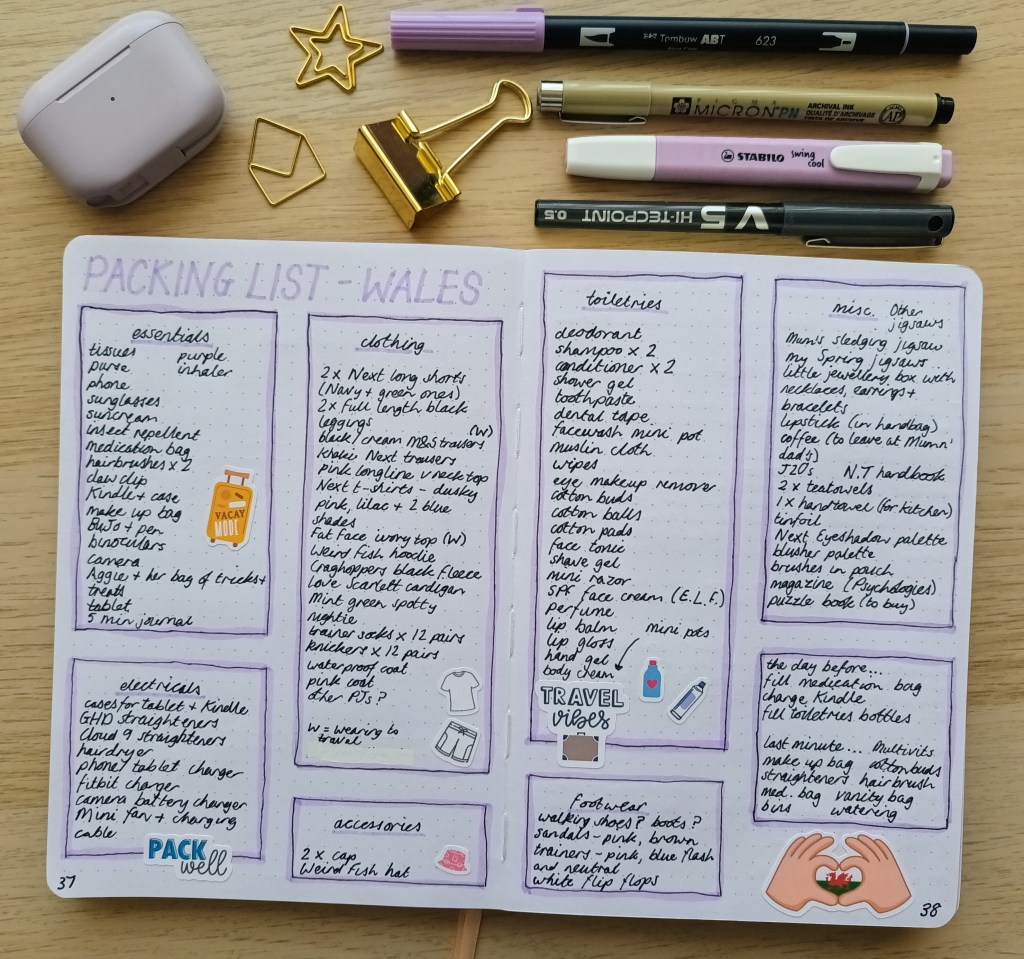
There are lots of packing lists examples available online and you can even purchase PDF versions, but personally, I prefer writing my own from scratch for each holiday. This means it’s completely personal to me and relevant to the particular destination, season and length of time I’m away for. I also take my list with me in my bullet journal when I go so that I can do a quick whizz through before we go home so I can check I’ve repacked everything. Below is my packing list for our holiday to Wales. It’s still a work in progress as we’re not heading off yet and I like to take my time with it.

Photo credit: Laura Jones for Keeping It Creative

Final words…

I hope you’ve found today’s blog post useful and can see how creating a packing list, for me, is an essential before travel task which is great for making me much more relaxed and better organised. Drawing up your own personalised list can lead to you feel less stressed and better prepared and I promise you will realise what a worthwhile activity it is. I’d love to know where you think would be the best place to write your list (analogue or digital?) and if you can see the benefits of keeping them in a safe place until your next holiday.

Thanks for reading!

P.S. Some of my readers have messaged me via email and have expressed an interest in dropping a comment or asking a question after reading a particular blog post. Unfortunately, this involves setting up a WordPress account but, luckily, it doesn’t take long and, once created, you can leave comments on any blog posts (from bloggers who use WordPress) which spark your interest. Also, you don’t need to be a blogger to set up account either. I hope this helps! I plan to paste this into each of my posts in future but have put it in post script so my regular readers and fellow bloggers can ignore!

Posted in bullet journal, Bullet journaling, creativity, planner girl, planner lifestyle, Planning and journaling, sticker making

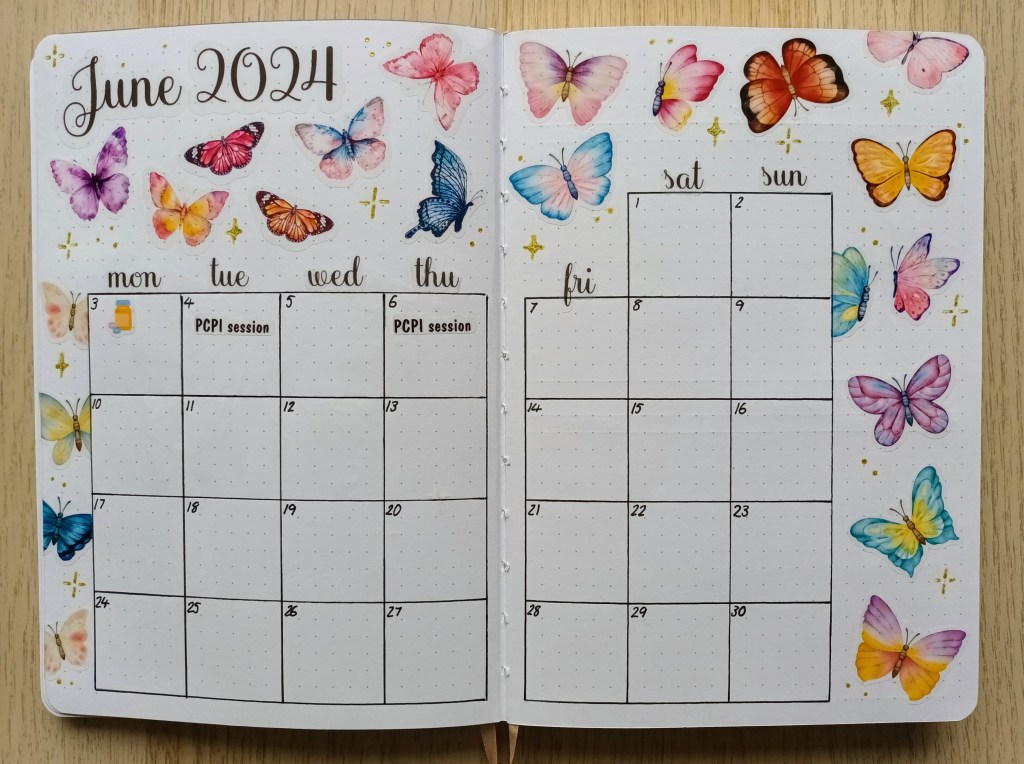
Setting up my Bullet Journal for June 2024: Butterflies theme

Last night, having completed all of my spreads for next month, I had a vague recollection that I’d done a butterfly theme in my bullet journal once before. I searched my blog (much quicker than flicking through all of my BuJos) and discovered that I had indeed, back in June 2021, chosen butterflies. However, the pages are quite different today, even though I have stuck with the same calendar layout as this size is perfect for my needs. Whereas last time, I painted and drew outlined butterflies, this time I’ve made use of my Cricut machine and my favourite coloured pencils. I love how my spreads have turned out and I really enjoyed making them.

The front cover

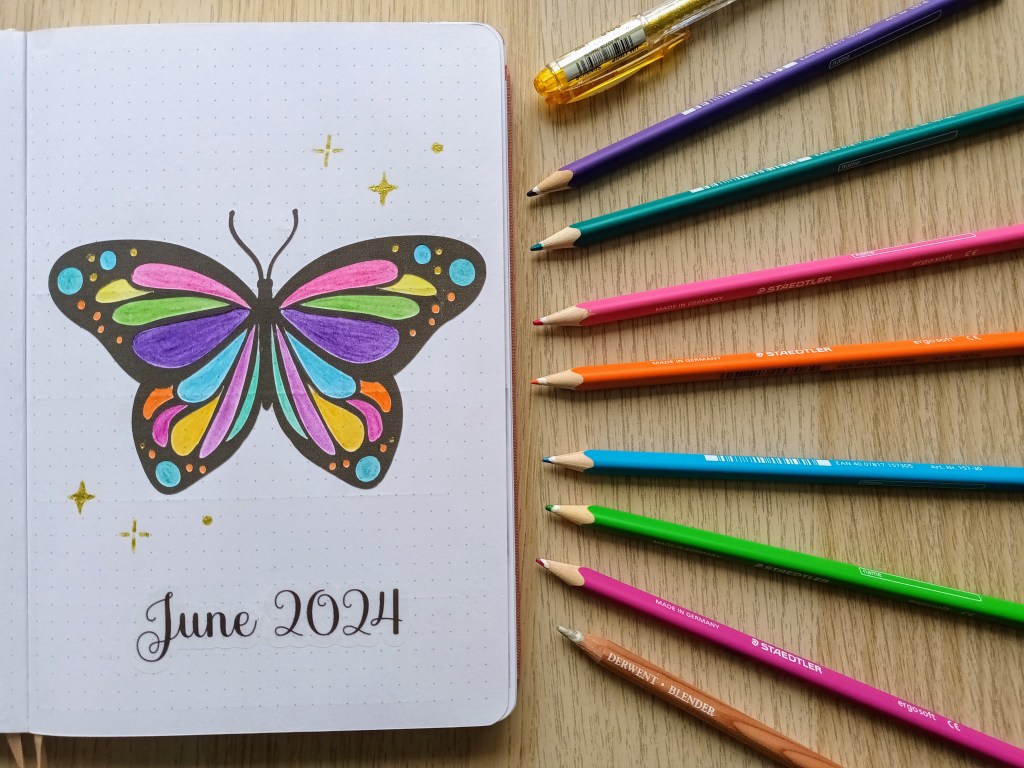
For the front cover, I wanted to create a perfectly symmetrical butterfly outlined in black and shaded in using bright colours. I debated using paint and folded paper like we used to do at school but then I had the idea of printing and cutting an image in Cricut Design Space using sticker paper and then colouring in the interior shapes with Staedtler Ergosoft pencils. I used the add bleed feature when printing so as to ensure the outline was precise and it turned out really well. The tricky bit was peeling the shape from the backing and sticking it down straight and without wrinkles.

To ensure smooth colouring, I blended using a Derwent blending pencil. I also had to be careful to get into the edges of the cut shapes so there was no white space left. After finishing the butterfly, I couldn’t resist adding some gold sparkles using one of my Uniball Signo pens.

Photo credit: Laura Jones for Keeping It Creative

Monthly calendar

My calendar uses a combination of Canva Pro and Cricut Design Space. These were printed and cut on transparent vinyl. I also used Design Space fonts to create the title for both the front cover and this spread and the days of the week headers. More sparkles were added using the gold gel pen.

Photo credit: Laura Jones for Keeping It Creative

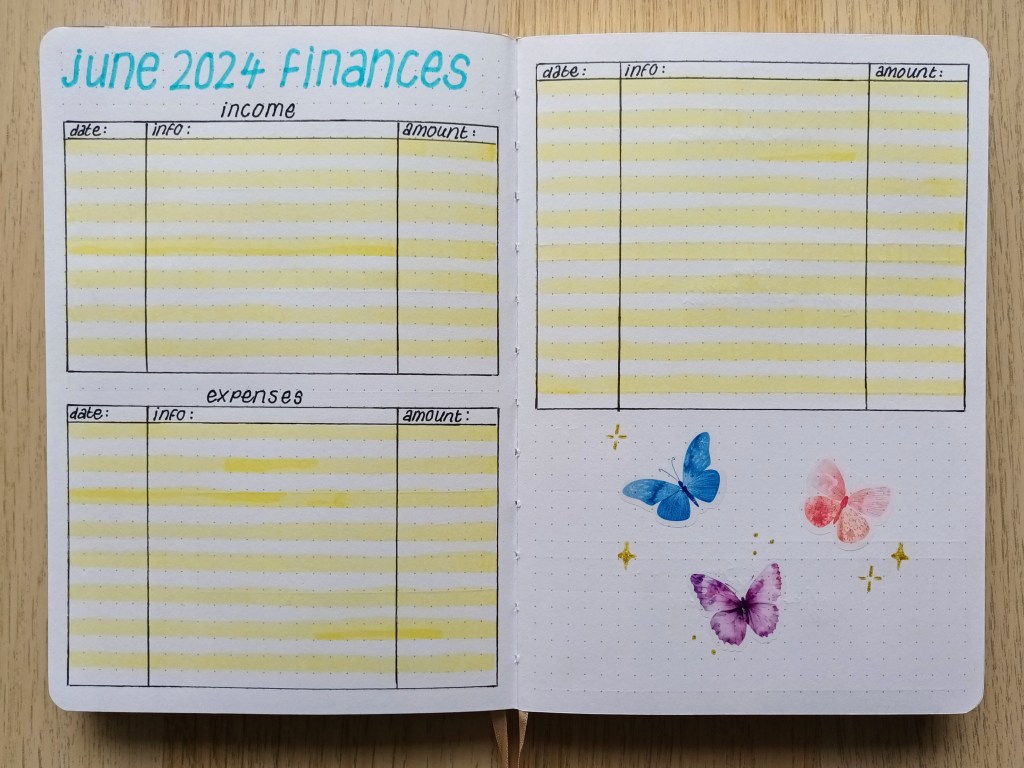
Finances record

Again, I used stickers and gold sparkles to decorate the bottom of my finances record so it’s in keeping with the rest of my pages.

Photo credit: Laura Jones for Keeping It Creative

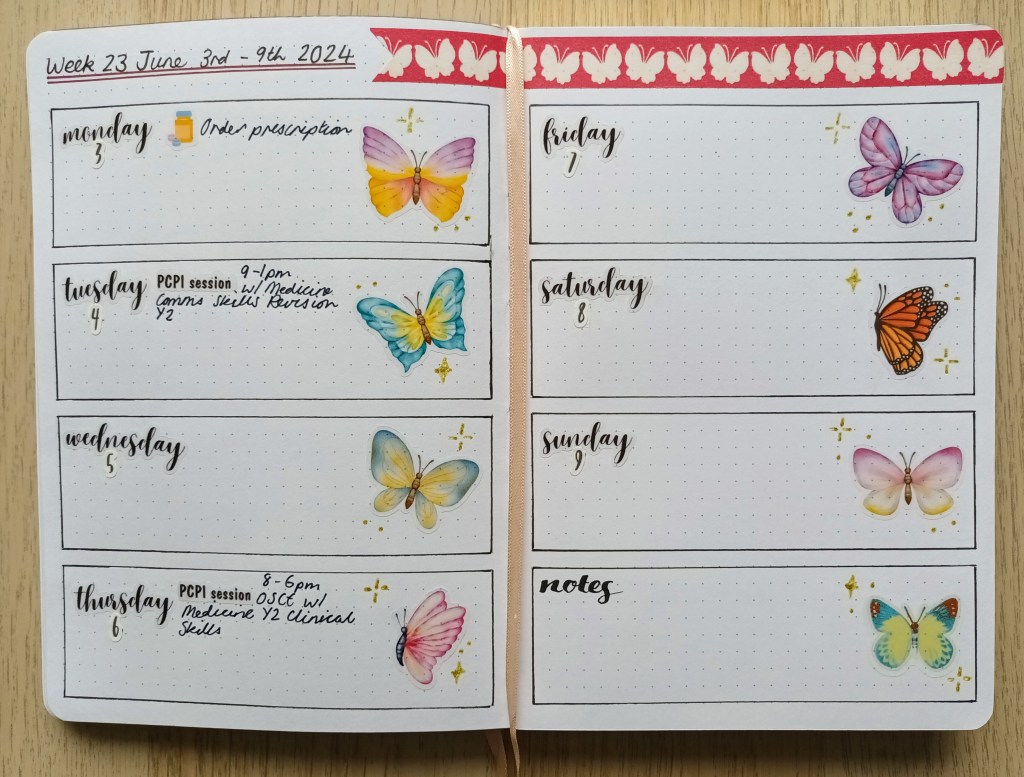
First weekly spread

I’ve been using this layout for a while now and it provides just enough space for events and a couple of day specific to-dos. This month, I’ve decided to use some days of the week stickers I’ve had for a while, plus some tiny number stickers. Unfortunately the digits don’t quite match the words because I couldn’t find the font that was used for the days which was a pre-produced file on Design Space. I found some butterfly washi in my stash which finishes the page nicely and was much quicker to add than creating a repeating pattern sticker like I did last month.

Photo credit: Laura Jones for Keeping It Creative

Final words…

Thank you for visiting my blog to look at my spreads for June. I enjoyed using stickers again to set up my pages and it made it slightly quicker to do than trying to draw and colour lots of symmetrical butterflies. It does take a while to find the images I want though and then I have to turn them into print and cut images, resize them and add offsets to each one. Also, there seems to be some issue with Design Space each time I use it but I guess that’s one of the joys of technology!

Wishing you a happy and healthy June and lets hope the weather starts to improve soon (especially as I want to wear my new pairs of shorts I’ve bought for our Wales holiday),

Posted in Bullet journaling, goal setting, life hacks, lifestyle, memory keeping, planner girl, planner lifestyle, Planning and journaling

Creating a bright and colourful Summer Bucket List spread in my Bullet Journal

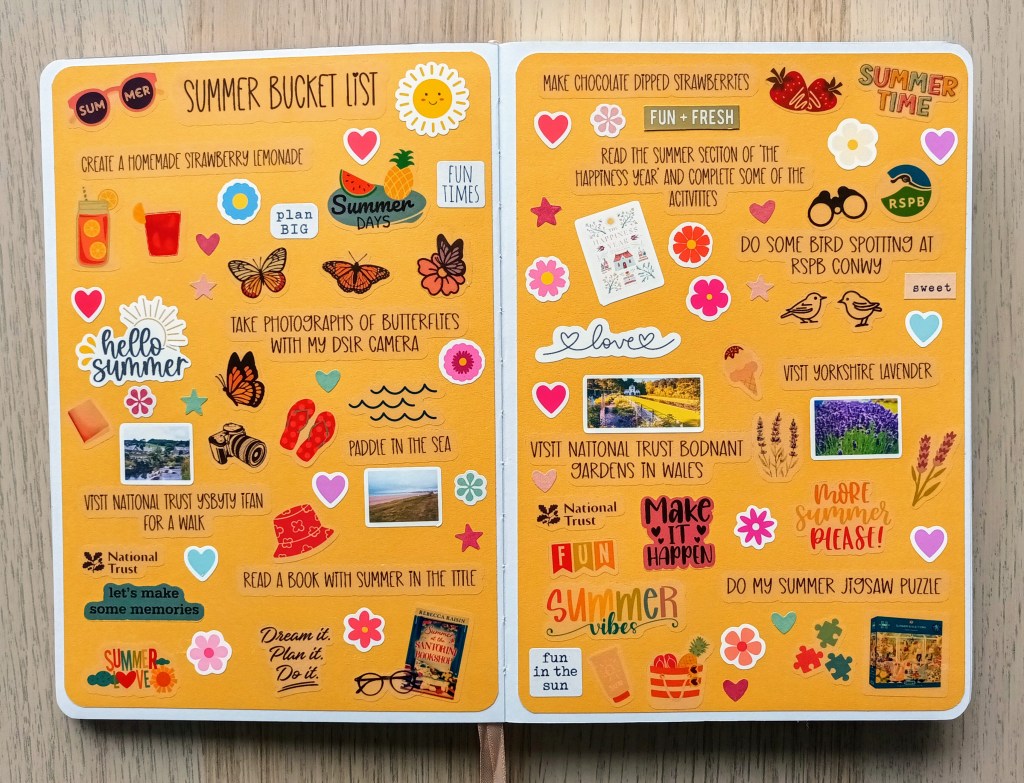
Last autumn, I set myself the challenge of creating a bucket list for each of the four seasons and making a Traveler’s Notebook journal for each in which to record all of my experiences across the year. This week, I finished setting up my final double page spread for the summer season in my Bullet Journal and I’m super pleased with how it turned out. The aim was to produce something inspirational using bright summer colours and images which embody the summer season. I enjoyed the process from start to finish and thought I’d share with you my finished product, explain a bit about how I went about setting it up and give a step by step guide to help you make your own.

Photo credit: Laura Jones for Keeping It Creative

Defining the season

The first step I took was decide on the dates for summer – I chose to base my seasons on the meteorological start and end which is June 1st to August 31st, but I could have opted for the astronomical period which cites the beginning as Thursday 20th of June to Sunday 22nd September. It’s obviously up to you which you go with and you probably already have your own idea when summer falls.

Brainstorming ideas

Initially I look at a range of bucket list ideas on Pinterest and noted down any which appealed. I also spent some time thinking about what summer means to me e.g. going to the beach and activities I enjoy doing such as birdwatching, photography, tasting summer fruits and going for walks in nature. As we’re off on holiday to Wales for a week next month, I then researched places to go and things to do in the local area which I could add to my list.

If you end up with a huge, long list of ideas, think about which activities most excite you, which fit in with your priorities for this year (e.g. relaxation, having fun, being adventurous, learning new things etc.) and which feel most realistic.

Setting some achievable goals

Whilst adding items to my list, I tried to make sure that there we’re some quick and easily achievable goals and some which will take more planning and organising. It’s also important to consider your budget, time constraints and any other commitments you have. It’s no good writing that you want to do a hot air balloon ride if you have no idea of the cost and haven’t researched locations from which these are available.

Creating a visual representation

For my bullet journal inspiration board, I selected some stickers from my stash and made some in Cricut Design Space. I even chose to add some real photographs of the places we would like to go, so I have an image of my local beach, and pictures I found online of Yorkshire Lavender and the two National Trust places we intend to visit during our holiday in Wales. I also found some tiny stickers to fill in the gaps between the bucket list items.

Of course, you don’t have to create a concrete visual representation for display. You might choose to simply close you eyes and picture yourself doing the activities and thinking about how they would make you feel or you might just write your list and put it somewhere you can regularly refer to.

Planning the details

For each activity, I’m now spending time fleshing out the details. So, for example, I’ve found what looks to be a simple and tasty recipe for strawberry lemonade and added it to Notion. I’ve written down the postcodes and travel times for the National Trust places and the RSPB reserve and have done some reading so I know what to expect when we go. I’ve also noted costs involved for different items and have purchased my summer novel on Kindle (for 99p!) and seasonal jigsaw puzzle already.

Final words…

I hope I’ve inspired you to make your own bucket list for summer 2024 full of exciting activities you’d like to try and maybe some old seasonal favourites. Creating a plan which is unique to you, is a great way to explore possibilities for the upcoming months so as to ensure you make the most of all of the free time you have available to you.

Wishing you a fun summer,

Posted in goal setting, life hacks, lifelong learning, personal growth, productivity, Setting goals and intentions

Monday Matters: 7 ways to be a lifelong learner (Part 2 of 2)

Today, I’m sharing the second and final part of my mini-series on lifelong learning. In Part 1, I considered the character traits of lifelong learners and discussed the benefits of being a lifelong learner. In Part 2, I’m going to be identifying different habits to adopt for continual learning and also sharing a range of ways to be a lifelong learner. I hope you find both of my posts useful and they help you think about the value of continued learning, your preferred learning styles, plus little tweaks you could make to your daily life and schedule so that learning is both a priority and a joy.

Photo credit: Laura Jones for Keeping It Creative

1. Consider your learning styles

We all have preferred methods of learning and, as adults we can develop our understanding of the different styles, decide which of them work best for us personally, and then use our knowledge to tailor our learning experiences appropriately. Here are some of the most common types of learner:

  • auditory – learns by listening e.g. through music, lectures, podcasts, and talks
  • visual – prefers to use visual aids such as pictures, photographs, videos, charts and diagrams, they may also draw their own illustrations to help them remember key information
  • kinesthetic – learns by doing and often described as ‘hands on’ learners, likes to use different senses to take in the information
  • reading / writing – learns through seeking out written information in books and magazine articles, prefers to write things down in words rather than using pictures or graphs, also likes to underline key points, colour code information or write notes in the margin when given a handout
  • logical / analytical – learns by processing data and solving problems, often looks for patterns to connect different aspects of the information in order to make sense of what is being presented
  • naturalistic – learns through investigating the natural environment, particularly enjoys outdoor and environmental learning opportunities. Enjoys carrying out field studies, watching wildlife documentaries, keeping nature journals with own sketches, photographs, observations etc. and finding out more about different environmental issues such as climate change
  • interpersonal – this type of learner functions best when they engage in group activities like quizzing one another, becoming involved in discussions or brainstorms and forming study groups
  • intrapersonal – this type of learner prefers a solitary learning style and finds self study particularly effective

You may find that from the list above, you prefer several of the different learning styles and this can help you to explore particular approaches to learning. However, it’s also important to recognise that some types of learning are more pertinent to particular topics of study or aspects of learning than others. For example, if you want to learn how to play a musical instrument, auditory, visual and kinesthetic (hands on) activities may be more helpful than reading or writing about the skills involved.

2. Identify your passions and interests

As an adult, you have lots of choice in terms of what you’d like to learn about and the skills you’d like to develop. You’re also free to explore and follow your passions and interests in any way you choose or even decide that you’re not as interested in something as you thought you were! Here’s some ideas for identifying specific passions and interests:

  • reflect on your past experiences and activities you’ve particularly enjoyed – does anything stand out in your memory that you’d like to become involved in or try again?
  • think about your particular set of skills and abilities – are there any particular ways in which you’d like to put them to good use?
  • consider your core values – this will help you establish what matters to you in life and then you can create learning experiences which reflect this. There are lots of resources online with lists of core personal values but you might find this article particularly helpful as it adds a little detail to each item on the list
  • consider favourite topics of conversation with friends and family members or what you like to teach others about
  • try out new things and discover what sparks your curiosity and interest
  • write a list of things you’d like to get better at e.g. cooking, gardening, playing guitar, drawing, singing, applying make up – give yourself plenty of time to see what comes up!

3. Read every single day

Developing a habit of reading each and every day is a great way of learning new things. To make it stick, try habit stacking by pairing it with an existing habit of yours. So, for example, part of my morning routine is breakfast, filling in my journal and reading a book or article of my choice for 5, 10 or 20 minutes depending on the time I have available. I also always read a novel on my Kindle each night as soon as I get into bed.

Any form of reading is an opportunity to learn, but varying your reading material is the best way to gain new knowledge and different perspectives. In a month, you might read several novels (choosing different genre such as crime thriller, romance, historical fiction and fantasy), a collection of love poetry, an article in a magazine which is full of self care ideas, a few blog posts on topics that interest you such as a particular creative pursuit or easy vegetables to grow in your garden, the definition of a previously unfamiliar word in a dictionary, a newspaper article about an environmental issue and a few chapters from a non-fiction book about creating a well-organised home.

4. Set realistic and meaningful goals

A great way of setting learning goals and pursuing them is to use the SMART framework. Taking time to identify the specifics and draw up small and achievable steps is crucial if you want to make meaningful progress and enjoy the outcomes of your learning.

5. Manage your time effectively

If you want to make learning a priority, you need to dedicate time to it on a regular basis and ensure it becomes a key part of your routine. Good time management is such an important skill to develop (and might be something you want to learn about first before pursuing your passions and interests). Key ways to manage your time well so you can create opportunities for learning include:

  • keeping yourself organised – make sure your calendar is up-to-date so you know your commitments and when you might be able to carve out some time for learning
  • maintain a tidy environment where everything has its place – so you don’t spend precious minutes or hours looking for things you need but can’t find
  • prioritising – making decisions about the best use of your time today, deciding what’s important for you in your life right now and making those things a priority (don’t forget to add time for breaks too)
  • scheduling – try ‘time blocking’ by first adding in regular tasks and activities such as eating meals, sleeping, going to work etc. and then fitting in other priorities around these
  • avoiding time and energy drainers such as scrolling social media, excessively checking your email, phone notifications (especially sounds and pop ups which draw your attention straight away), negativity whether that’s from people, watching the news or doomscrolling
  • set short term goals for learning that help you take steps towards your long term goals and regularly evaluate your progress to check you’re heading in the right direction

If you want to know more about making time for your current priorities and developing time management skills, I highly recommend ‘Make Time: How to focus on what matters every day’ by Jake Knapp and John Zeratsky.

6. Make use of free online resources

Follow a small number of podcasts, blogs and vlogs on a topic of your choice, hosted by people you find interesting to hear from and schedule some time each week to check in with them and explore new content or older uploads that you might have missed. Also look for online tutorials for beginners (there’s loads to choose from on YouTube or within blogs) or introductory courses so you can give things a go before committing to them financially. Alternatively, to develop your knowledge of a subject in general, you might like to join a group (for example on Facebook) where you can follow interesting topics of conversation, start a thread to discover different opinions or ask a question of someone with a higher level of expertise in the field.

7. Don’t forget to rest

Although making time for learning is important if you want to explore your passions and interests, equally valuable is taking regular breaks for rest and relaxation. This might mean meditating, listening to a favourite album or piece of music, spending time in nature or engaging in creative activities such as drawing, painting or papercrafting. Ensuring you get adequate, quality sleep is also essential for good cognition so be sure to make this a priority too.

Final words…

I hope today’s blog post has given you a few new ideas on how to be a lifelong learner. Ultimately, you are looking to cultivate a growth mind set where you are always looking for opportunities to learn, aren’t frightened to try new and challenging things, seek out new perspectives as a way to see the world in a different way, view mistakes, failures and setbacks as learning opportunities, find value in constructive criticism and believe that, with effort, you are more than capable of developing both your knowledge and abilities in order to reach your full potential.

I wish you well on your various learning journeys and remember every day is a new opportunity to be who you want to be,

Posted in art, bullet journal, Bullet journaling, creativity, Cricut, lifestyle, planner girl, planner lifestyle, Planning and journaling

Setting up my Bullet Journal for May 2024: Gardening quotes and flowers theme

This month, it’s time for me to start a new bullet journal and the one I’ve chosen is the Tsuki ‘suzume’ from Notebook Therapy. Suzume is Japanese for sparrow and, as a bird lover, this was the perfect choice for me. The notebook features gold embossing of a sparrow carrying a flower in its beak plus a crescent moon, shooting star and sparkles on the front of the gorgeous pink linen cover. There’s also small details such as the same flower to the spine, plus gold edges to the pages which are really special touches too.

For my theme this time, I’ve chosen a combination of gardening quotes and pretty flowers. I’ve mainly used stickers to decorate my pages but I did take the time to create a hand drawn and coloured in image for my front cover. Hopefully, this month the weather will be a little warmer (and drier) and there will be a few more opportunities to get outside to tend to our flower beds and pots and see our bright blooms appear. We’re also hoping to spend some time relaxing on our garden bench (including after dark looking for our hedgehog visitor) and I might even get to enjoy my morning coffee in the sunshine. Fingers crossed!

My lovely new notebook!

So, here are my pages for the month of May. I hope you enjoy looking at them and I would love to hear your thoughts or questions about any aspect of my set up in the comments below.

Front cover

I enjoyed using a combination of Tombow Dual Brush pens and Crayola Supertips to colour in my hand drawn design. I then added the spots to the watering can using a Sakura gelly roll pen to add more interest.

Photo credit: Laura Jones for Keeping It Creative

Month on two pages

The sticker decor for this page was all created using images from Cricut Design Space and turning them into print and cut images. I couldn’t resist adding a few sparkles using a Uniball Signo gold glitter pen.

Photo credit: Laura Jones for Keeping It Creative

Finances

My usual chart to record my incomings and outgoings.

Photo credit: Laura Jones for Keeping It Creative

Weekly plans

I’ve done the same set up for each of my weeklies and used flower decor throughout. This is for the first week which I’ve already started to fill in. I’ve been busy making tiny icon stickers to use to represent different activities and I’m continuing to add to my collection. This will make my planning process quicker and more visual.

Photo credit: Laura Jones for Keeping It Creative

Final words…

Thank you so much for taking the time to read my blog post and look at my bullet journal spreads today. I appreciate any form of support or encouragement towards my blog whether that’s reading my content, liking my posts, making comments or asking questions – especially as things seem to have gone a little quiet over the last few months (sob!).

Wishing you a joy filled May whatever your plans are for the month. I’m hoping to get the rest of my Spring bucket list ticked off as there are still quite a few items left including a waterfall walk and a bike ride!