Blog

Posted in bullet journal, gardening, Planning and journaling

Useful gardening spread ideas for your bullet journal

As I was setting up my bullet journal spreads for June 2020, I decided that I would really like to begin to record key information about our garden including new plants, veggies we’re growing this year, plants which are thriving and which are not and why, plus sketches of our front and back spaces. I debated creating a separate garden journal but in the end I decided just to dedicate some pages each month within my planner so that everything about my life and our home and garden is all in one place. Before deciding on some layouts for my gardening spreads, I trawled Instagram, Pinterest and various websites for ideas. I found some really great spreads and took inspiration from them to set up my own.

I decided that over the next couple of months, I would like to create the following:

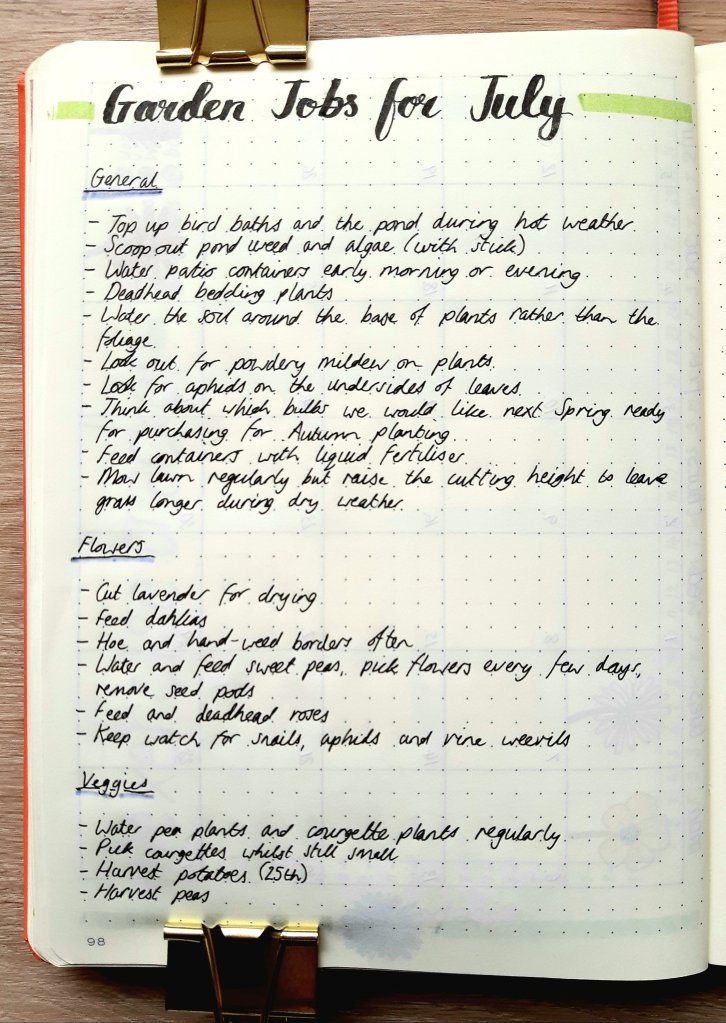
  • Jobs for each month – split into general tasks, flowering plant care, veggies and notes.
  • Information cards for new plants and our potted herbs
  • Photos of our actual plants in flower each month
  • Gardening quotes and motivationals
  • Wildlife spotted in the garden – with sketches
  • Plants to encourage wildlife
  • Birds in the garden – sketches and info
  • Aerial drawings of our different planting / garden areas

Garden tasks

There are lots of jobs for us to do in June but we’ve ticked off quite a few of them already. We certainly won’t be needing to water the garden or mow the lawn right now as it’s very wet out there because we’ve had rain showers for the last week or so. I intend to create one of these spreads each month using information collated from various websites.

I finished off the information cards for all of the plants that we’ve bought so far and also created some for our garden herbs. I’m hoping to get a few more different herbs soon so I’ve left some room for those on the spread too. The layout of these pages was inspired by the work of Emma at http://emusing-emma.blogspot.com who shared her houseplant information cards which she produced in her BuJo (direct link here). Make sure you check out her website if you love looking at ideas for your own bullet journal.

Information cards for different plants

I showed the beginnings of this type of spread in my June plans but I have since added some more drawings and information. I’ve also created some cards for the herbs we have in our containers. Again, my inspiration for these layouts was from Emma over at http://emusing-emma.blogspot.com/ The specific bullet journal spreads can be seen if you check out this link but I think all of her blog is well worth a look if you are like me and enjoy using a bullet journal and also love to get creative.

Garden related quotes and motivationals

I’ve recently written a blog post about the health benefits of gardening and the opportunity to practise mindfulness whilst you are spending time in your outdoor space. As part of the article, I included some quotes about gardening. I found some more quotes whilst I was perusing the internet so I decided to handwrite some of them in my BuJo. These were written with my lovely left handed Lamy fountain pen which flows beautifully!

Wildlife friendly planting

We’re really keen to encourage wildlife into our garden and already have a bird feeding station, two bird baths, a bug hotel which my husband made and a small pond. We also like to have lots of plants which attract bees and butterflies so I decided to create a spread of wildlife friendly shrubs and flowers. We have some of these already but I have red valerian on my wishlist for the front garden.

Bird’s Eye View’ of our garden areas

This is the first of my aerial view sketches of areas of our outside space. Just this one section took me a while to draw and add some colour and it’s not even to scale! I decided to use coloured pencils to shade around the outside of the shapes denoting our containers so that I could remember which of our pots we used for each of the plants. I’m going to aim to have all of my garden sections drawn out in my BuJo by the end of next month – let me know if you want to see the rest and I’ll do my best to take some decent photos when we have some brighter weather.

Wildlife spots

These pages are going to have little sketches of minibeasts which have been spotted in our garden and key information about them collected from a variety of sources. My spread is completely blank at the moment as I want to capture the bugs with my macro lens and at the moment, it’s too wet and drizzly to go out!

Birds in the garden

We get plenty of birds in our garden, particularly in the Springtime so I thought I’d create some pages in which to include sketches of our visitors and some information about them. I decided to do the actual drawings in my sketchbook and then transfer the pictures over to my bullet journal by scanning them on my scanner and then printing them off. This has lots of benefits – it means I can make several attempts at them if necessary, I can use decent quality drawing paper and I won’t end up getting pencil smudges in my BuJo. I’m yet to start my sketches yet but hope to be able to share some soon. As I’m typing a goldfinch has just landed on our sunflower seed feeder. It’s the first one I’ve actually seen visit our feeding station this year. We have two seed feeders containing niger seeds and a tiny seed mix specifically for finches and typically, it hasn’t gone for either of those – maybe collecting tiny seeds is too much effort in the pouring rain!

Do you keep a garden journal or do you just keep the little plant label information things from the pots like we’ve done previously? Have you got a dedicated notebook or do you prefer to produce spreads in your main planner? I would love to hear about the kinds of records you keep and if they’ve particularly helped you with your garden.

Happy gardening!

Posted in creativity, life hacks, lifestyle, Mindfulness, wellbeing

Monday matters: 7 mindful hobbies for stress reduction and relaxation

Hobbies are a great way to focus on the present, reduce stress and anxiety levels, leaving you feeling calm and relaxed and with a wonderful sense of achievement. What’s more, they’re an excellent form of mindfulness which is proven to benefit you in a number of ways both mentally and emotionally. Here’s some hobbies that I currently enjoy, have tried and loved in the past and one that I would love to try in the future.

Zentangles

I had a go at producing some Zentangles quite a few years ago when they were featured in a magazine (I think in Breathe). I found information from the article that I’d cut out in one of my journals a few days ago but I couldn’t actually find the patterns that I did. I do remember that I found them really relaxing to do and was pleased with the results so I decided to give them another go.

The Zentangle method was created in 2003 by an American couple called Maria Thomas and Rick Roberts. They describe it as an ‘easy-to-learn, relaxing, and fun way to create beautiful images by drawing structure patterns’ which they call tangles. The three and a half inch tangles are drawn on a small square of paper, and are made using a combination of dots, lines, simple curves and orbs. You have no idea what your finished piece will end up like as you focus on the process rather than worrying about the results. To find out more about the method and to see some beautiful examples visit the official website. For now, here’s some from a complete beginner (me!):

My first attempt at Zentangle in a long time. Photo credit: Laura Jones for Keeping it creative.

Birdwatching

I love birdwatching in my own garden, whilst out for nature walks and from various hides in local reserves and parks. It’s such a relaxing activity yet one which requires plenty of concentration and patience. Although our back garden is relatively small, we have a range of feeders in a little wildlife area and have recently purchased a new covered table which the birds are just starting to take to. We also have a small pond, several bird baths, plenty of shrubs, plus a fence covered in ivy which is full of spiders and their webs. Our space has recently become really popular with a range of small and larger birds and we even had a sparrow hawk visiting last month!

I bought a pair of binoculars last year so I could see birds up close when I visit the hides in nature reserves across the North East but you really don’t need to have any equipment to enjoy birding – just your eyes and your ears, making it a cheap as well as mindful hobby.

Photo credit: Laura Jones for Keeping it Creative

Journalling

Mindful journalling is all about the act of expressing your thoughts and feelings on paper and is a wonderful tool for reflecting, evaluating and processing all that is going on in your life. Done regularly, journalling has many benefits including stress reduction, improved mood, emotional regulation, more self confidence, better immunity, a sharper memory, increased productivity and the ability to empathize with others.

I’ve been journaling for a long time now and it has become a part of my daily routine and something I would really miss if I stopped doing it. I mainly tend to put pen to paper in the evening as I like to reflect on my day, record what I grateful for and write about what I’m looking forward to the next day or what I’m anxious about (click here to see my previous post which describes the ‘putting the day to rest’ technique in detail).

I do sometimes do some journalling in the morning as a way of starting my day on a positive and creative note and find the book ‘Five Minutes in the Morning – A Focus Journal’ provides some great prompts to help me decide what to write about. I managed to pick it up really cheaply in my local bookshop but it’s also available on Amazon as an ebook which you could use if you bought a special notebook to write in.

Photo credit: Laura Jones for Keeping it Creative

The journal is split into different sections, each with a particular focus and considers topics such as the power of writing, creating clarity, considering what’s important in your life, developing an attitude of abundance, solving problems and challenges, productivity and goal setting. It’s up to you how you use the book, you could either work through each prompt in order or you could just pick and page at random and see what you find.

Another book that I really love for prompt ideas is ‘Mindful Journaling’ by Tara Ward. The focus of this book is on exploring mindfulness in a variety of ways and then recording and evaluating your experiences of doing the different tasks. Recently, I completed an activity where you put something in front of you that you would like to eat and reflect on how the food stuff reached your bowl or plate and all of the processes involved in sourcing the ingredients and creating the product. I chose some Crunchy Nut Cornflakes and had so much to write about and it made me eat them much more mindfully afterwards too.

Photo credit: Laura Jones for Keeping it Creative

Sketching

I used to hate drawing as I thought I was no good at it but recently I’ve started to really enjoy developing my skills. My favourite things to draw are plants and other aspects of nature such as leaves, berries and fruit. I always really take my time and focus in on the outline shape of the objects and then add detail carefully. Apparently this style of drawing is known as a ‘Zen method’ which is all about observing and following the contours of the object with your eyes whilst letting your hands draw. You can find out more in renowned Dutch artist Frederick Franck’s book ‘Zen seeing, Zen drawing’ which I have neither seen or read but it sounds like it is focused on mindful drawing as a meditative technique for observing and discovering the world around you.

My first attempt at still life fruit sketching! Photo credit: Laura Jones for Keeping it Creative

Watercolour painting

As those of you who follow my blog will know, I got into watercolouring about 9 months ago and have enjoyed experimenting with different techniques including creating washes, wet on dry and wet on wet methods. Now I’ve learnt the basics, I’ve started to try out my skills on creating actual art pieces. This is my first try at wet on wet poppies and adding stems using wet on dry. In order to create my piece I spent some time looking at photographs of poppies and the work of other watercolour artists. I then really focused on the process of mixing colours, getting the right consistency of pigment to water and then allowing the colours to blend on the page. I wasn’t concerned about the finished look but I think it turned out well, for a beginner anyway!

Photo credit: Laura Jones for Keeping it Creative

Pottery

I’ve done two ceramics courses at a local wellbeing centre and found them to be amazingly beneficial. I met some wonderful, like-minded people who I got on really well with and involving myself in playing with the clay to explore different techniques and then designing and making my own pieces was so relaxing. The sessions were three hours long and in that time, I found that my mind was fully focused on the tasks at hand and the level of concentration required helped me to switch off from my anxious thoughts and feelings. Most weeks, we also got some of our freshly fired work back and it was so exciting to see our pieces at various stages of the making process and celebrate what we had achieved as we developed our skills.

Obviously, at the moment, there are no ceramics classes available which you can attend due to lockdown restrictions still being in place but it is certainly something I would recommend looking into in the future if you enjoy getting creative with your hands.

Flower arranging

This is a mindful activity that I would love to have a go at in the future as I imagine it’s really interesting to learn the various techniques involved and you can produce some stunning pieces to decorate your home and bring you joy. There are loads of free video tutorials and tips available online from florists and expert flower arrangers if you want to discover the basics or if you sign up to Skillshare you can do a full online course at home. I know my local college usually offer beginner’s floristry sessions but it may be a while before they are able to start them up again.

Photo credit: James Coleman, Unsplash

Do you do any of the activities I’ve listed already or do you have other favourites? Have you found you have more time to do hobbies because of the lockdown restrictions?

Posted in art, bullet journal, creativity, Planning and journaling

Setting up my bullet journal for June: Summer fruits theme

This month I’ve gone for a bright and colourful Summer fruits theme and have included my own little fruit watercolour paintings which I scanned in and worked on using Photoshop on my computer and then turned them in to little stickers. I’ve not totally got to grips with all of the different things you can do on this program but I followed a great little tutorial which I’ll share below.

For my front cover, I created five different fruits, namely papaya, orange, kiwi, cherries and pineapple. I started by sketching them with pencil and then when I was happy with how they looked, I went over the outline and some details using a 0.2 UniPin fineliner. I then mixed colours from my Daler Rowney travel set and used a tiny brush to paint them. Each one is less than 4cm so I really took my time to ensure accuracy and it was a great mindful watercolouring activity. After scanning the paintings, I edited the background to make it white and removed some minor blemishes. Check out this great tutorial on YouTube for how to do this.

For my month at a glance I used the same kind of layout as usual with 6×6 dot boxes and again made my own stickers from some fruity artwork. I successfully covered up part of the date using some paper washi style stickers as I accidently wrote the beginning of the year as 200 instead of 2020. I did the spread late in the evening and think I was overly tired and that’s when I tend to make lots of mistakes. I also messed up on the next page too with is why I have a red paper background to the words ‘exercise tracker’.

As you can see, there’s a distinct lack of things happening in June due to the continuation of lockdown restrictions! My husband and I have started to go out to places but we tend to go on a whim rather than pre-planning.

I’m continuing to monitor my workouts in June and have just made a few small modifications and changed the colour scheme to fit with the Summer fruits theme. I’ve decided to make the steps tracker larger and have changed the scale on the graph to make it easier to fill in.

Finally, this month I’ve decided to make a record of the plants we’ve bought at the garden centre this year and include key information from each of the labels that came in the pots. I’ve also added a small drawing and coloured it in for each entry so that I’m also practising my drawing skills. The art work isn’t perfect but I’m getting better the more I give sketching a go. The layout of the spread is inspired by Emma at emusing-emma.blogspot.com who did something similar for her houseplants a few years ago in her bullet journal.

That’s all my spreads for this month. I have more plants to add to my record but won’t get them drawn until later on. If you would like to see more of my plant information, let me know and I’ll add them on to my BuJo set up for July.

Take care and stay safe everyone,

Posted in lifestyle, mental health, Mindfulness, wellbeing, wellness

Monday Matters: Plantastic ways that gardening boosts your wellbeing

Over the period of lockdown, many of us have been finding ourselves with extra time to spend in our gardens and will have no doubt experienced the many benefits that gardening brings for our bodies and our minds. Today’s Monday Matters post is a collection of reasons why gardening and looking after plants is so good for your wellbeing. At the end of the article, I’ve also included a number of gardening related quotes from poets, famous gardeners, psychologists and other gardening fanatics that I’ve collected and would like to share with you.

Gardening is great exercise

Digging, planting, mowing the lawn, weeding, raking, deadheading and pruning all burn calories, increase flexibility and give your muscles a really good stretch. Some activities are obviously more labour intensive than others, but on average, an hour of gardening has been shown to burn up approximately 300 calories. And what’s more, this form of exercise not only helps your body and strengthens your heart, but also gives you an amazing space to sit it and enjoy the glorious sunny weather we’re currently having.

Mindfulness whilst gardening

Gardening is a great opportunity to practise mindfulness techniques which focus on being aware of the present moment and our current thoughts and feelings and the sensations which we are experiencing. When gardening mindfully, we appreciate the process and use our senses to explore, rather than thinking about the future and worrying about how we are going to get our space looking perfect or Instagram worthy. Before you even collect together your tools and start the jobs on your gardening to-do list, spend some time appreciating your outdoor space, maybe considering all that you have achieved so far or focusing on how grateful you are to have a garden. Use your senses to explore, taking in all of the sights, sounds, smells and sensations such as the bright and colourful flowers, the amazingly active insects as they dart from plant to plant, the different leaf shapes, textures and scents, the birds singing or the breeze gently blowing your hair.

When you do start on the hard work, continue to pause and use your senses to explore your bodily sensations and immediate environment such as the texture of the soil between your fingers, your muscles flexing as you move the mower back and forth on your lawn, the sun warming your skin, the water sprinkling the ground as you use your watering can, or the array of different plant shapes and petal colours in your borders.

Focusing on the present will help you to slow down and take a break from the fast pace of modern life. It will also enable you to forget about all of your various stresses and anxieties for a while as you really concentrate on what you are doing and how it is making you feel. In this way, gardening becomes a kind of meditation which is amazing for your mental wellbeing.

Gardening in the sunshine

It’s well known that to much sunshine can be harmful for your skin but as long as you apply an appropriate level of sun cream and seek shade during the middle of the day, the sunlight can have lots of mood lifting and health benefits. It is believed that exposure to the sun increases the release of seretonin in the brain which makes you feel happier, calmer and more focused. Vitamin D is also produced by your body naturally in response to sunlight and this has a number of benefits including regulating your wake and sleep cycle, improved immunity, stronger muscles, reduced inflammation, reduced risk of osteoperosis, reduced risk of some forms of cancer and reduced risk of type 2 diabeties.

Getting in touch with your creative side

Gardening is a great way to express yourself creatively. You get to decide on a design for your garden based on your budget and the space you have available to you including the kind of areas you wish to have such as somewhere to sit and relax or dine al fresco to fruit and vegetable patches or wildlife havens. When you’ve learnt about the type of soil you have, planting times and which areas of your garden get the sun and at what time, the fun of visiting garden centres to choose plants or packets of seeds to grow your own begins. You can select the colours you find appealing for flowering plants and spend time reading different labels to establish which plants are best suited to each garden condition. Even if you don’t have flower beds, you can choose from a huge array of pots and containers to put on your patio to create a container garden.

What if I don’t have a garden?

If you don’t have access to your own garden, don’t fear, you can still benefit from plants and nature in a number of ways. Most garden centres have now re-opened whilst keeping to social distancing rules and many supermarkets are stocking a range of houseplants making it really easy to bring beautiful greenery into your home environment.

Photo credit: Alena Ganzhela for Unsplash

Another way of brightening up your space is by treating yourself to a bouquet of fresh cut flowers of your favourite blooms. Again, these can easily be found in your local supermarket and a good quality bunch should be guaranteed to last for at least seven days.

Photo credit: Christie Kim for Unsplash

If you’re feeling creative, you could also make a pretty collage of plant images collected online. I did this last month to go with my succulents theme in my bullet journal. Basically, I went onto Unsplash and Pexel and searched for cacti and other succulents and then printed off some of my favourite images on photo paper. Then I stuck them into my journal and added some decor using my brush pens and some stickers. Just looking at the spreads brightens my mood.

One of the double page spreads I made last month

Finally, here’s those quotes I mentioned which I think are really motivational and thought provoking at the same time:

‘Gardening adds years to your life and life to your years.’ – Author unknown

‘A garden is a grand teacher. It teaches patience and careful watchfulness; it teaches industry and thrift; above all it teaches entire trust.’ – Gertrude Jekyll (British garden designer, writer and artist)

‘We might think we are nurturing out garden, but of course it’s our garden that is really nurturing us.’ Jenny Uglow (British biographer, historian, critic and publisher)

‘Gardening: It grounds us… gets us out of our busy heads and back into our bodies. Alone there on our knees, we can breathe. With our nurturing hands duly occupied, while gardening we allow ourselves the time & space to truly feel – peace, pride, satisfaction, joy.’ Cardthartic Birthday card (cardthartic.com)

‘The glory of gardening: hands in the dirt, head in the sun, heart with nature. To nurture a garden is to feed not just the body, but the soul.’ – Alfred Austin (English poet)

‘By becoming in tune with the seasons of growth and fall, preparation and harvest you make your mind and your body happier and healthier. By having a direct stake and involvement with the process of plants growing, of having your hands in the soil and tending it carefully and with love, your world and everyone else’s world too, becomes a better place.’ Monty Don (Gardeners World presenter and keen horticulturist)

‘Flowers are restful to look at. They have neither emotions nor conflicts.’ – Sigmund Freud (Austrian Psychologist)

‘Everything that slows us down and forces patience, everything that sets us back into the slow circles of nature is a help. Gardening is an instrument of grace.’ Mary Sarton (American poet)

I hope you’ve enjoyed reading about the many health benefits of gardening and my post has encouraged you to get outdoors and spend time in your own outside space or even visit one of your local parks to have a picnic and appreciate the floral displays and plants there. Let me know in the comments what your favourite aspects of gardening are and what you’ve been getting up to over the last few months.

Posted in art, creativity, watercolour painting

7 simple but effective watercolour techniques using the wet on wet method that you just have to try

A few weeks ago, I shared my experiences of using the wet on wet method for watercolour washes. Today, I’m going to show you the results of some really cool wet on wet techniques using a range of household items which you should already have readily available to you. Let the fun begin…

Applying cling film

This technique is so easy to do but creates some really amazing effects. Simply wet your paper with water and then apply either a single paint colour or blend several together. Next, apply your cling film over the top, allowing it to crinkle in various places. Place a weight over the film e.g. a heavy book and leave it to dry. Remove the cling film and admire the weird and wonderful results (left hand image).

You can also work a different way where you place the cling film flat onto your table, add some clean water and then apply pools of paint directly to the plastic wrap (you could try maybe two or three different colours. After doing this, place your watercolour paper directly on top of the cling film. Flip it over and then either leave the plastic wrinkled where it is or move it around slightly to disperse the colour. When you’re happy with your creation, carefully remove the cling film and leave your paper to dry (right hand image).

Salt

For this one, you need to search for some salt in your kitchen store cupboard or pantry – any kind will do but I used some coarse sea salt which we had in our mill. I attempting this technique quite a few times and I got different results, some more interesting and effect than others. Begin by wetting a small piece of paper with clean water. Now paint the area with one, two or three colours. Ensure that the area is damp and shiny but not too wet. Dry off any excess with small amounts of kitchen towel if you have any puddles. Add a small amount of salt either by pinching and sprinkling it or using a mill like I did. Let the paint dry and leave the salt to work its magic. Brush off the salt with your hand or use a small ruler to gentle scrape it away.

Applying rubbing alcohol

This was one of my favourite techniques. Rubbing alcohol AKA surgical spirit is usually part of our first aid kit (I use mine to clean my silver earrings too!). But did you know, you can use it to create some interesting effects on wet watercolour paint? Place a small amount of rubbing alcohol into a dish and put aside for later. Wet the area of your paper you want to work on and then add some paint. Now, dip your finger or a cotton bud (I used a cotton bud for the first example) into the surgical spirit. Tap your finger or the cotton bud onto the painted area. Repeat as many times as you like. You can also use cotton wool balls for larger blobs (as shown in the second piece).

Lifting paint with paper towel

This is also a good technique to use if you make a mistake in your work or you have excess pooled paint or water on you paper. Mask off the edges of your paper for a clean line around the edge. Wet the whole surface until it is shiny and then apply a wash of colour. Use a scrunched up piece of kitchen towel to blot away the colour. As you can see, I made little cloud shapes in my mid blue sky wash. Doesn’t it look great?

Feathering

You can feather the paint in a range of different ways. The first example (on the top and bottom paper) involves wetting a section of the paper and then applying a single stroke of slightly diluted paint in a downwards motion. This causes the colour to spread to create a feathery effect. For the second examples (number two and three on the top paper and in the middle of the second paper, I applied a strip of pinky red and then applied another colour in the same shape, touching the very right hand edge of the first colour. This causes the first colour to feather into the second and vice versa. The wetter and more diluted your paints the more it feathers. For the final example on the second piece of paper, I applied yellow paint and then rain a strip of pinky red down the centre.

I thought these techniques would be good for using to create variegated tree bark and petals. Do you agree?

Blooms and drop colour

Another really simple but effective technique is to drop colour onto a pre-wetted piece of paper. You can either apply lots of drops using a large brush to blend the colours or you can drop small blobs of paint and watch them bloom. Again, the wetter the paper and more diluted the colour, the more the paint will spread.

As you can see, I had a little bit of a problem with the paint leaking under the masking tape on the second one. I’m not sure if I applied too much water or if the cheap three rolls of tape for £1 didn’t help the situation!

Splattering

I covered this technique in my wet on dry post but as you can see, the splatters look different when applied to wet paper. On this example, below, the paper was wetter in the centre and so the splatters there spread further than those at the very edge of the area.

I hope you have enjoyed looking at my watercolour experiments. I had great fun exploring the different techniques and found it really calming and relaxing. If you’re looking for something creative to do during lockdown I would totally recommend giving it a go and I think it would be something great to do with kids too.