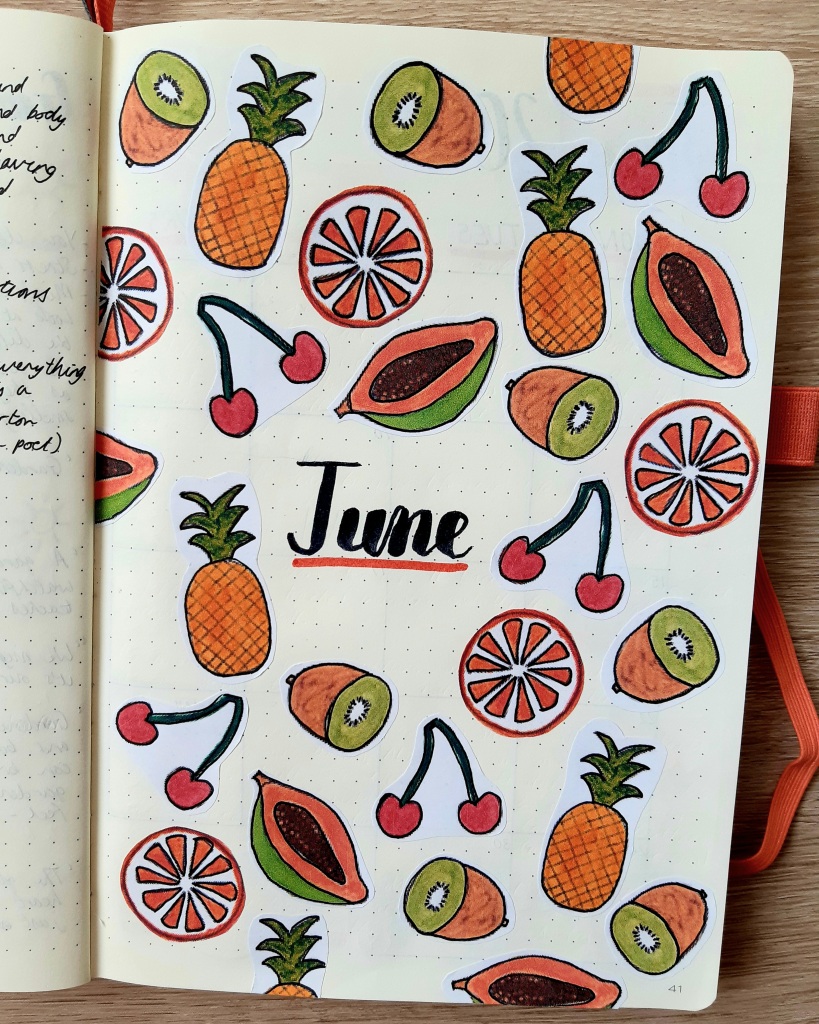
This month I’ve gone for a bright and colourful Summer fruits theme and have included my own little fruit watercolour paintings which I scanned in and worked on using Photoshop on my computer and then turned them in to little stickers. I’ve not totally got to grips with all of the different things you can do on this program but I followed a great little tutorial which I’ll share below.
For my front cover, I created five different fruits, namely papaya, orange, kiwi, cherries and pineapple. I started by sketching them with pencil and then when I was happy with how they looked, I went over the outline and some details using a 0.2 UniPin fineliner. I then mixed colours from my Daler Rowney travel set and used a tiny brush to paint them. Each one is less than 4cm so I really took my time to ensure accuracy and it was a great mindful watercolouring activity. After scanning the paintings, I edited the background to make it white and removed some minor blemishes. Check out this great tutorial on YouTube for how to do this.
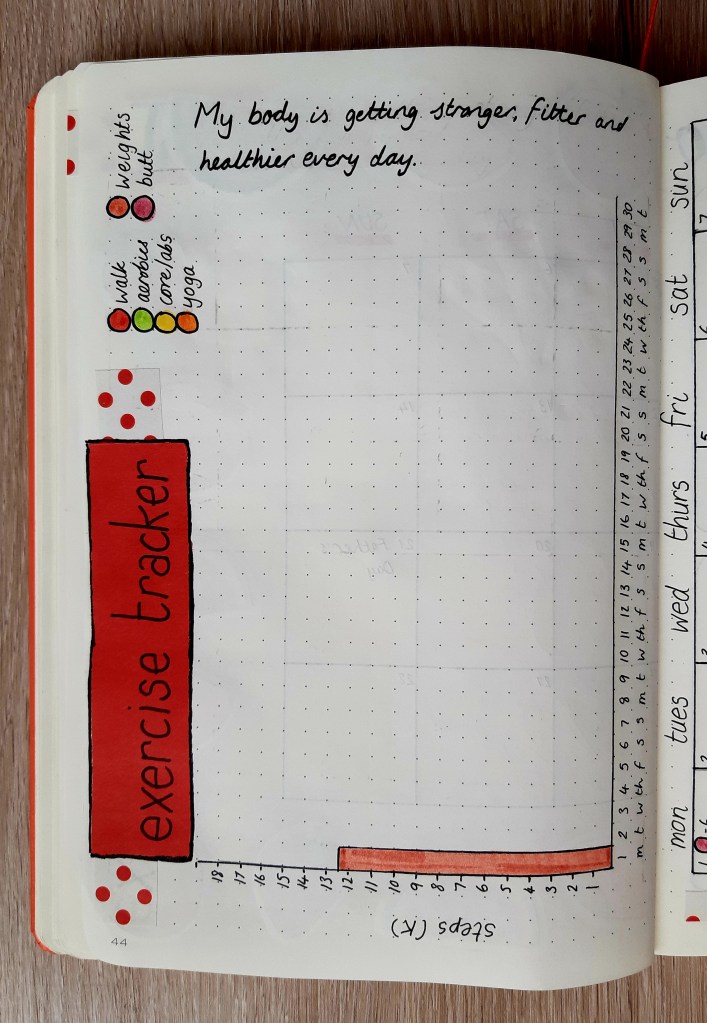
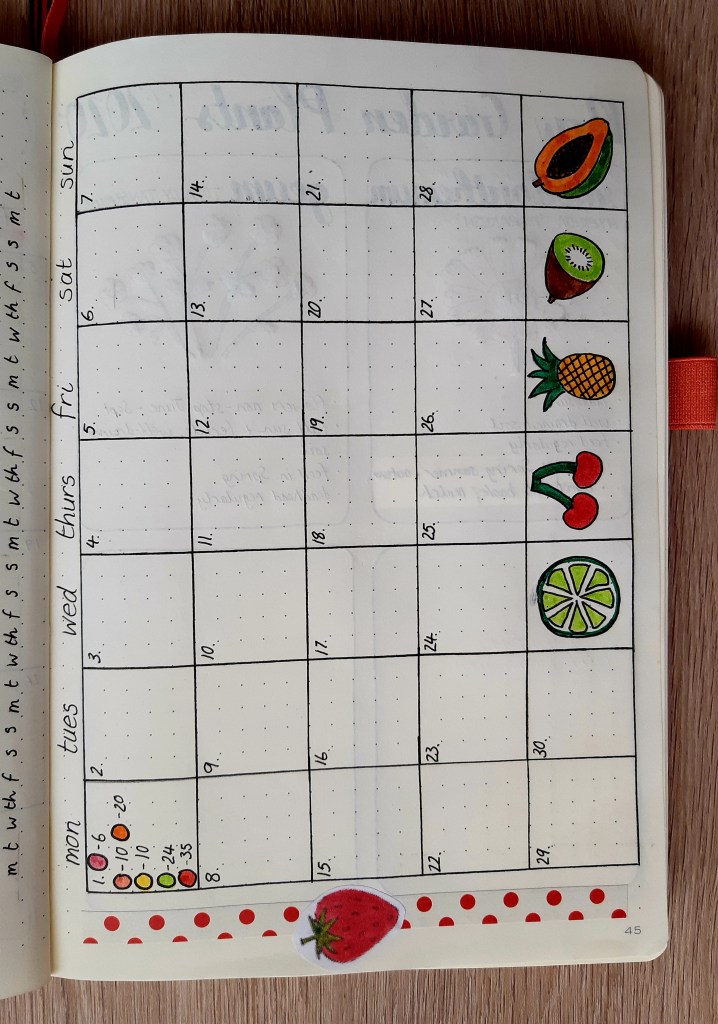
For my month at a glance I used the same kind of layout as usual with 6×6 dot boxes and again made my own stickers from some fruity artwork. I successfully covered up part of the date using some paper washi style stickers as I accidently wrote the beginning of the year as 200 instead of 2020. I did the spread late in the evening and think I was overly tired and that’s when I tend to make lots of mistakes. I also messed up on the next page too with is why I have a red paper background to the words ‘exercise tracker’.
As you can see, there’s a distinct lack of things happening in June due to the continuation of lockdown restrictions! My husband and I have started to go out to places but we tend to go on a whim rather than pre-planning.
I’m continuing to monitor my workouts in June and have just made a few small modifications and changed the colour scheme to fit with the Summer fruits theme. I’ve decided to make the steps tracker larger and have changed the scale on the graph to make it easier to fill in.
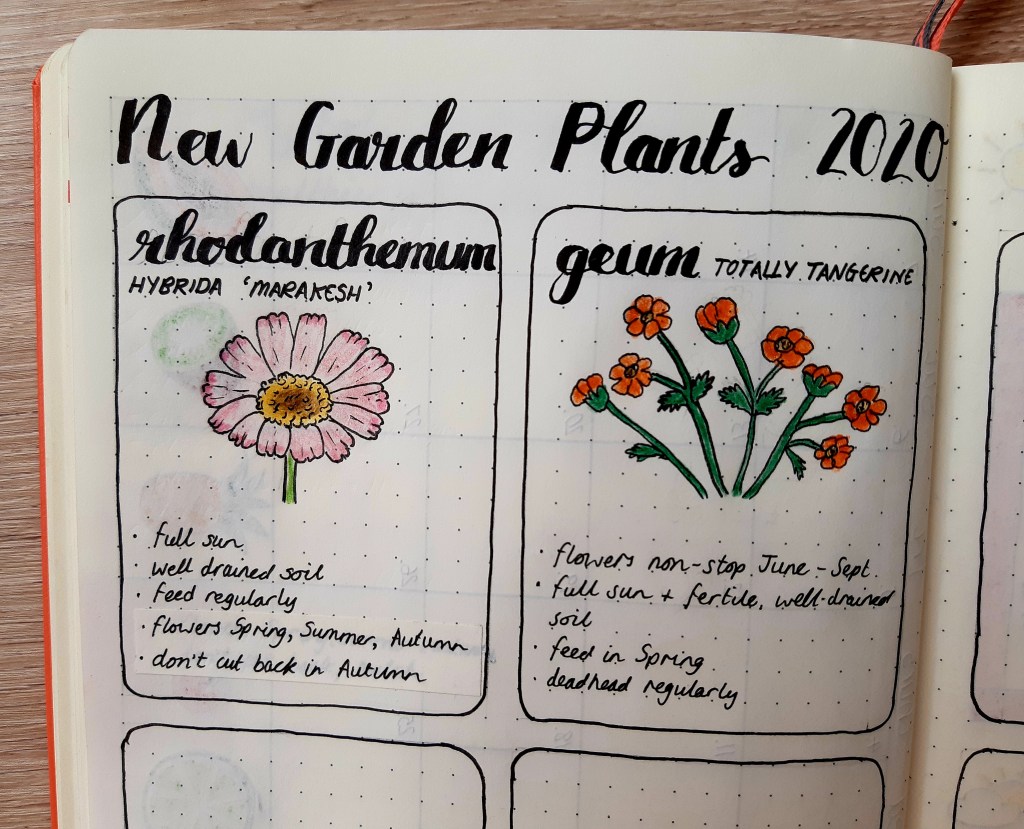
Finally, this month I’ve decided to make a record of the plants we’ve bought at the garden centre this year and include key information from each of the labels that came in the pots. I’ve also added a small drawing and coloured it in for each entry so that I’m also practising my drawing skills. The art work isn’t perfect but I’m getting better the more I give sketching a go. The layout of the spread is inspired by Emma at emusing-emma.blogspot.com who did something similar for her houseplants a few years ago in her bullet journal.
That’s all my spreads for this month. I have more plants to add to my record but won’t get them drawn until later on. If you would like to see more of my plant information, let me know and I’ll add them on to my BuJo set up for July.
Over the period of lockdown, many of us have been finding ourselves with extra time to spend in our gardens and will have no doubt experienced the many benefits that gardening brings for our bodies and our minds. Today’s Monday Matters post is a collection of reasons why gardening and looking after plants is so good for your wellbeing. At the end of the article, I’ve also included a number of gardening related quotes from poets, famous gardeners, psychologists and other gardening fanatics that I’ve collected and would like to share with you.
Gardening is great exercise
Digging, planting, mowing the lawn, weeding, raking, deadheading and pruning all burn calories, increase flexibility and give your muscles a really good stretch. Some activities are obviously more labour intensive than others, but on average, an hour of gardening has been shown to burn up approximately 300 calories. And what’s more, this form of exercise not only helps your body and strengthens your heart, but also gives you an amazing space to sit it and enjoy the glorious sunny weather we’re currently having.
Mindfulness whilst gardening
Gardening is a great opportunity to practise mindfulness techniques which focus on being aware of the present moment and our current thoughts and feelings and the sensations which we are experiencing. When gardening mindfully, we appreciate the process and use our senses to explore, rather than thinking about the future and worrying about how we are going to get our space looking perfect or Instagram worthy. Before you even collect together your tools and start the jobs on your gardening to-do list, spend some time appreciating your outdoor space, maybe considering all that you have achieved so far or focusing on how grateful you are to have a garden. Use your senses to explore, taking in all of the sights, sounds, smells and sensations such as the bright and colourful flowers, the amazingly active insects as they dart from plant to plant, the different leaf shapes, textures and scents, the birds singing or the breeze gently blowing your hair.
When you do start on the hard work, continue to pause and use your senses to explore your bodily sensations and immediate environment such as the texture of the soil between your fingers, your muscles flexing as you move the mower back and forth on your lawn, the sun warming your skin, the water sprinkling the ground as you use your watering can, or the array of different plant shapes and petal colours in your borders.
Focusing on the present will help you to slow down and take a break from the fast pace of modern life. It will also enable you to forget about all of your various stresses and anxieties for a while as you really concentrate on what you are doing and how it is making you feel. In this way, gardening becomes a kind of meditation which is amazing for your mental wellbeing.
Gardening in the sunshine
It’s well known that to much sunshine can be harmful for your skin but as long as you apply an appropriate level of sun cream and seek shade during the middle of the day, the sunlight can have lots of mood lifting and health benefits. It is believed that exposure to the sun increases the release of seretonin in the brain which makes you feel happier, calmer and more focused. Vitamin D is also produced by your body naturally in response to sunlight and this has a number of benefits including regulating your wake and sleep cycle, improved immunity, stronger muscles, reduced inflammation, reduced risk of osteoperosis, reduced risk of some forms of cancer and reduced risk of type 2 diabeties.
Getting in touch with your creative side
Gardening is a great way to express yourself creatively. You get to decide on a design for your garden based on your budget and the space you have available to you including the kind of areas you wish to have such as somewhere to sit and relax or dine al fresco to fruit and vegetable patches or wildlife havens. When you’ve learnt about the type of soil you have, planting times and which areas of your garden get the sun and at what time, the fun of visiting garden centres to choose plants or packets of seeds to grow your own begins. You can select the colours you find appealing for flowering plants and spend time reading different labels to establish which plants are best suited to each garden condition. Even if you don’t have flower beds, you can choose from a huge array of pots and containers to put on your patio to create a container garden.
What if I don’t have a garden?
If you don’t have access to your own garden, don’t fear, you can still benefit from plants and nature in a number of ways. Most garden centres have now re-opened whilst keeping to social distancing rules and many supermarkets are stocking a range of houseplants making it really easy to bring beautiful greenery into your home environment.
Photo credit: Alena Ganzhela for Unsplash
Another way of brightening up your space is by treating yourself to a bouquet of fresh cut flowers of your favourite blooms. Again, these can easily be found in your local supermarket and a good quality bunch should be guaranteed to last for at least seven days.
Photo credit: Christie Kim for Unsplash
If you’re feeling creative, you could also make a pretty collage of plant images collected online. I did this last month to go with my succulents theme in my bullet journal. Basically, I went onto Unsplash and Pexel and searched for cacti and other succulents and then printed off some of my favourite images on photo paper. Then I stuck them into my journal and added some decor using my brush pens and some stickers. Just looking at the spreads brightens my mood.
One of the double page spreads I made last month
Finally, here’s those quotes I mentioned which I think are really motivational and thought provoking at the same time:
‘Gardening adds years to your life and life to your years.’ – Author unknown
‘A garden is a grand teacher. It teaches patience and careful watchfulness; it teaches industry and thrift; above all it teaches entire trust.’ – Gertrude Jekyll (British garden designer, writer and artist)
‘We might think we are nurturing out garden, but of course it’s our garden that is really nurturing us.’ Jenny Uglow (British biographer, historian, critic and publisher)
‘Gardening: It grounds us… gets us out of our busy heads and back into our bodies. Alone there on our knees, we can breathe. With our nurturing hands duly occupied, while gardening we allow ourselves the time & space to truly feel – peace, pride, satisfaction, joy.’ Cardthartic Birthday card (cardthartic.com)
‘The glory of gardening: hands in the dirt, head in the sun, heart with nature. To nurture a garden is to feed not just the body, but the soul.’ – Alfred Austin (English poet)
‘By becoming in tune with the seasons of growth and fall, preparation and harvest you make your mind and your body happier and healthier. By having a direct stake and involvement with the process of plants growing, of having your hands in the soil and tending it carefully and with love, your world and everyone else’s world too, becomes a better place.’ Monty Don (Gardeners World presenter and keen horticulturist)
‘Flowers are restful to look at. They have neither emotions nor conflicts.’ – Sigmund Freud (Austrian Psychologist)
‘Everything that slows us down and forces patience, everything that sets us back into the slow circles of nature is a help. Gardening is an instrument of grace.’ Mary Sarton (American poet)
I hope you’ve enjoyed reading about the many health benefits of gardening and my post has encouraged you to get outdoors and spend time in your own outside space or even visit one of your local parks to have a picnic and appreciate the floral displays and plants there. Let me know in the comments what your favourite aspects of gardening are and what you’ve been getting up to over the last few months.
A few weeks ago, I shared my experiences of using the wet on wet method for watercolour washes. Today, I’m going to show you the results of some really cool wet on wet techniques using a range of household items which you should already have readily available to you. Let the fun begin…
Applying cling film
This technique is so easy to do but creates some really amazing effects. Simply wet your paper with water and then apply either a single paint colour or blend several together. Next, apply your cling film over the top, allowing it to crinkle in various places. Place a weight over the film e.g. a heavy book and leave it to dry. Remove the cling film and admire the weird and wonderful results (left hand image).
You can also work a different way where you place the cling film flat onto your table, add some clean water and then apply pools of paint directly to the plastic wrap (you could try maybe two or three different colours. After doing this, place your watercolour paper directly on top of the cling film. Flip it over and then either leave the plastic wrinkled where it is or move it around slightly to disperse the colour. When you’re happy with your creation, carefully remove the cling film and leave your paper to dry (right hand image).
Salt
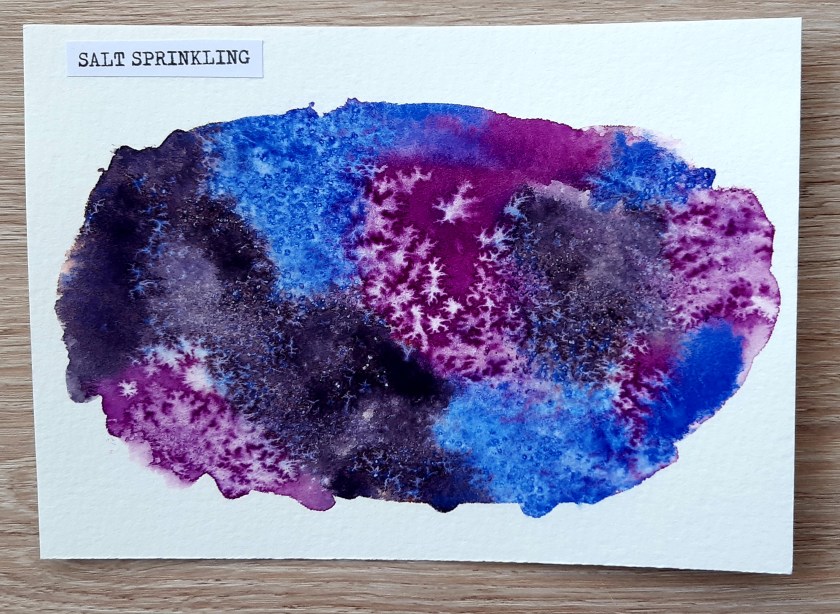
For this one, you need to search for some salt in your kitchen store cupboard or pantry – any kind will do but I used some coarse sea salt which we had in our mill. I attempting this technique quite a few times and I got different results, some more interesting and effect than others. Begin by wetting a small piece of paper with clean water. Now paint the area with one, two or three colours. Ensure that the area is damp and shiny but not too wet. Dry off any excess with small amounts of kitchen towel if you have any puddles. Add a small amount of salt either by pinching and sprinkling it or using a mill like I did. Let the paint dry and leave the salt to work its magic. Brush off the salt with your hand or use a small ruler to gentle scrape it away.
Applying rubbing alcohol
This was one of my favourite techniques. Rubbing alcohol AKA surgical spirit is usually part of our first aid kit (I use mine to clean my silver earrings too!). But did you know, you can use it to create some interesting effects on wet watercolour paint? Place a small amount of rubbing alcohol into a dish and put aside for later. Wet the area of your paper you want to work on and then add some paint. Now, dip your finger or a cotton bud (I used a cotton bud for the first example) into the surgical spirit. Tap your finger or the cotton bud onto the painted area. Repeat as many times as you like. You can also use cotton wool balls for larger blobs (as shown in the second piece).
Lifting paint with paper towel
This is also a good technique to use if you make a mistake in your work or you have excess pooled paint or water on you paper. Mask off the edges of your paper for a clean line around the edge. Wet the whole surface until it is shiny and then apply a wash of colour. Use a scrunched up piece of kitchen towel to blot away the colour. As you can see, I made little cloud shapes in my mid blue sky wash. Doesn’t it look great?
Feathering
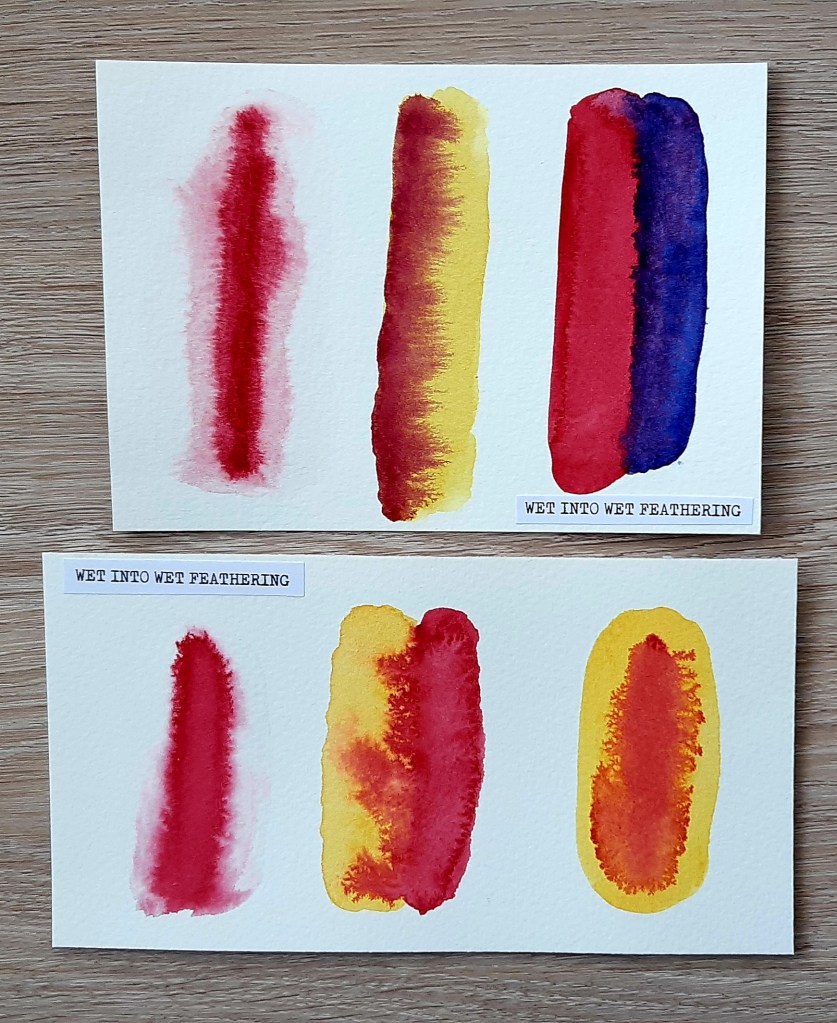
You can feather the paint in a range of different ways. The first example (on the top and bottom paper) involves wetting a section of the paper and then applying a single stroke of slightly diluted paint in a downwards motion. This causes the colour to spread to create a feathery effect. For the second examples (number two and three on the top paper and in the middle of the second paper, I applied a strip of pinky red and then applied another colour in the same shape, touching the very right hand edge of the first colour. This causes the first colour to feather into the second and vice versa. The wetter and more diluted your paints the more it feathers. For the final example on the second piece of paper, I applied yellow paint and then rain a strip of pinky red down the centre.
I thought these techniques would be good for using to create variegated tree bark and petals. Do you agree?
Blooms and drop colour
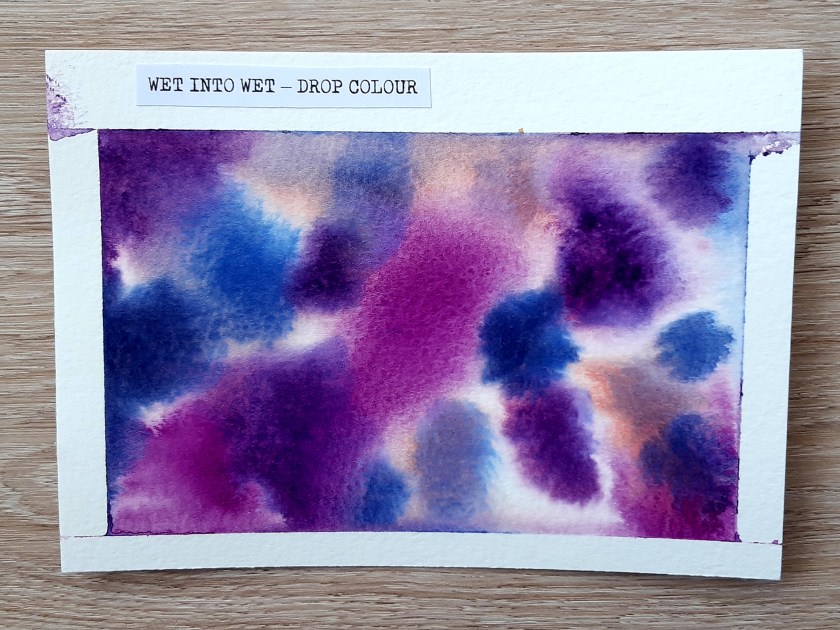
Another really simple but effective technique is to drop colour onto a pre-wetted piece of paper. You can either apply lots of drops using a large brush to blend the colours or you can drop small blobs of paint and watch them bloom. Again, the wetter the paper and more diluted the colour, the more the paint will spread.
As you can see, I had a little bit of a problem with the paint leaking under the masking tape on the second one. I’m not sure if I applied too much water or if the cheap three rolls of tape for £1 didn’t help the situation!
Splattering
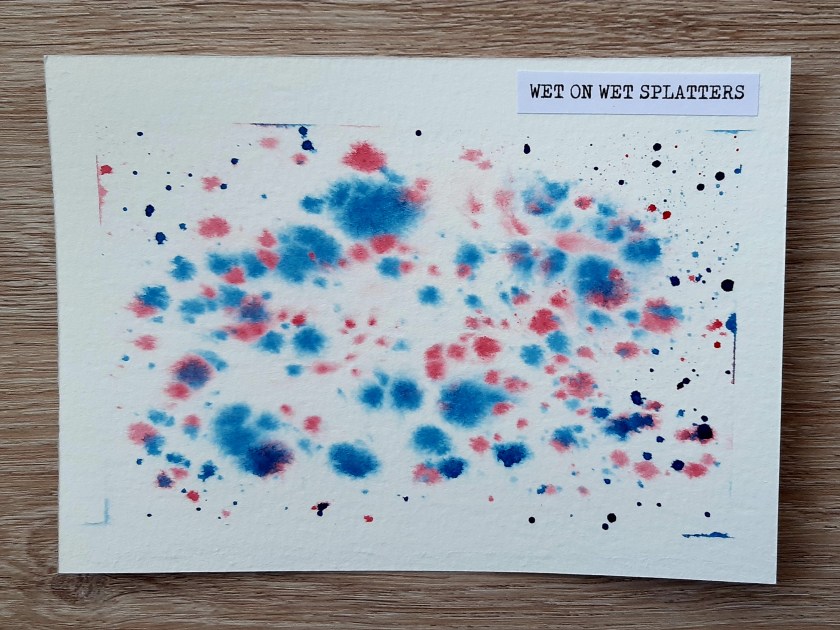
I covered this technique in my wet on dry post but as you can see, the splatters look different when applied to wet paper. On this example, below, the paper was wetter in the centre and so the splatters there spread further than those at the very edge of the area.
I hope you have enjoyed looking at my watercolour experiments. I had great fun exploring the different techniques and found it really calming and relaxing. If you’re looking for something creative to do during lockdown I would totally recommend giving it a go and I think it would be something great to do with kids too.
Those of you who regularly read my blog will know that my Monday Matters series is generally concerned with mental health and wellness. So, you might be thinking, how come this post has veered off that topic completely and is about weight loss, or more importantly lack of? Well, if you are trying to lose weight yourself through a combination of dietary changes and increasing your activity levels, you will know that when you step on the scales each week (or maybe even daily) to check your progress, it feels pretty rubbish if they read exactly the same as the previous time (or even worse, the number has crept up!). And the likelihood is, that this has a really negative affect on your mental health in terms of mood, confidence levels and motivation to keep going. So really, this post is totally on topic.
For the benefit of myself and any other readers who are working hard on their fitness and hoping to lose a few pounds on the way, here’s a collection of reasons why those scales might appear to be stuck and what you can do about it…
You’re not resting enough
I talked about the importance of rest days in my previous post here where I gave suggestions on how to create a workout for beginners but I didn’t know at the time that exercising too much could actually cause weight gain. Apparently, if you over exercise, your body can get stressed out and increase the production of cortisol (the stress hormone) which can contribute to you putting on weight. The solution for this one, is to make sure you incorporate rest days into your workout schedule where you don’t do any intense working out such as aerobic exercise or HIIT programmes (High Intensity Interval Training. Fitness experts recommend you train five days a week and have two rest days.
You’re not getting good quality sleep each night
Also related to rest is our sleep habits. If you’re not getting enough Zzzzzs then you’re not giving your body the chance to repair muscles and tissues. In fact, lack of sleep can also lower your metabolism which doesn’t help on the weight loss front either. Different people need different amounts of sleep to function well but you’ll know what feels right for you. I personally like to get between 7 and a half to 8 hours each night. If you’re struggling with getting good quality sleep, you can check out last Monday’s post in which I presented some ideas on how to get better kip.
Another issue with lack of sleep is that it can drastically affect your mood. If you’re sleep deprived, you can feel irritable, confused, depressed and lethargic the next day and this can reduce your general activity levels or make you reach for quick energy boost food and drinks which are often not healthy choices. As well as tracking your meals, you could also track your sleep and your mood to see how they affect each other and your food choices.
Your calorie intake is too high
According to dieticians, a woman needs to eat approximately 2000 calories to maintain her weight. For weight loss, you should be eating less than this each day. Obviously, this depends on age, weight and height as well as a range of other factors but the simple fact is that in order to drop some pounds, more calories need to be expended than are entering the body. I have a Fitbit which tells me how many calories I’ve burnt each day (usually around 2400 on an active day) but I really have no idea how many calories I have coming in because I don’t measure them. Some people swear by counting calories religiously but I think a better solution is to keep a food and drink diary so you can see exactly what you are consuming each day and how often you’re eating highly calorific items. This will help you examine your diet and can help you see if you’re making bad food choices or overeating.
Your calorie intake is too low
Conversely, it’s also possible to eat too little due to a highly restrictive diet and this causes you to go into starvation mode. The effective of this is that your body tries desperately to conserve energy which can prevent you from losing weight. A common symptom of starvation mode is that you feel extremely tired all the time which is certainly not good for your health. Again, I would recommend keeping a food diary so you can track how much fuel you are giving yourself each day. You should also check that you are getting a balanced diet and not avoiding any food groups. There’s lots of advice online about making sure you eat properly and as I’m no expert on the subject, I’ll just share this link from the NHS.
You’re eating and drinking ’empty’ calories
The source of the calories that you do take in is really important if you want to lose weight. If you are eating a drinking things that have little or no nutritional value then you may find that this is preventing weight loss or even causing you to gain. Food and drinks that contain a high level of solid fats or processed sugars are generally to blame. These are found in fast foods, pre-packaged desserts, fried foods, carbonated soft drinks, salted snacks, energy drinks and alcohol.
If you don’t want to deny yourself of these types of food and drinks altogether, you should at least make sure that they are the occasional treat and don’t feature too heavily in your diet. You should also try to balance them out with healthier choices and ensure you increase your activity levels accordingly. Keeping a food and drink diary can also help you to spot how often you are eating these types of items.
You’re focusing wholly on weight loss and ignoring other indicators of success
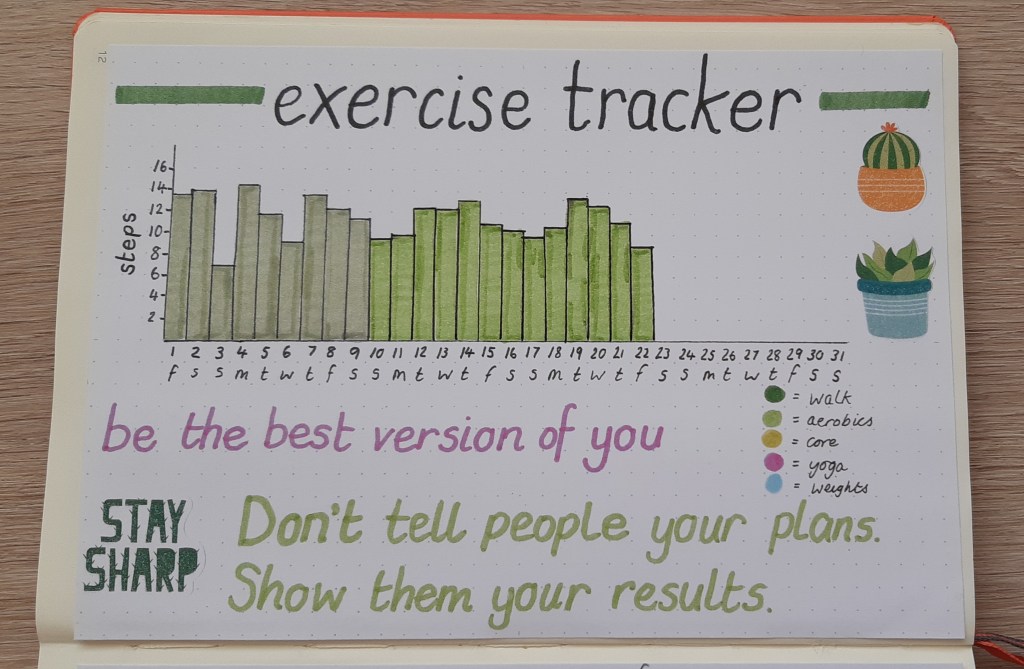
When you step on your bathroom scales you are simply learning how much you currently weigh. What you’re not finding out is how much of that weight is muscle, how much is fat, how much is water and how much is your bones and your bodily organs. So really, checking the scales is quite a limited way of discovering your progress and success levels. Therefore, if weighing yourself isn’t providing you with the motivation you need to stick with your current eating and exercise plan, you might be better off with a different approach. I’ve already shared my exercise tracker that I have as part of my bullet journal set up for May and I’ve really enjoyed filling it in and celebrating my achievements. Here’s the partially completely version (I moved BuJo part of the way through May so I photocopied them and stuck them in).
As well as monitoring your workouts, you could also find other ways to check in with yourself, for example, you could be more mindful of how your clothes feel and fit or you could do a pictorial record of what you look like each week in your exercise gear using your camera phone. You might also try setting yourself some performance related goals and congratulate yourself when you achieve them e.g. with a nice, bright workout top or some new leggings. My husband and I have both noticed positive changes with my body in terms of better posture from my yoga, toned muscles from my aerobics, weight training and targeted stretching and slimmer waistline and face.
If the scales are leaving you feeling discouraged, I also recommend writing some fitness related affirmations. They might not directly cause you to gain muscle and lose fat but they can be a great way to provide or increase motivation. Here’s some that I’ve recently added to my BuJo:
My overall health and mood are improving as a result of my increased exercise levels.
I enjoy working out and the energy it gives me.
My body is getting stronger, fitter and healthier every day.
I am proud of myself for exercising regularly.
You’re suffering from water retention
Water retention is when your body is failing to eliminate excess water. This can happen for a number of reasons and is particularly common in women at different times in their hormonal cycle (e.g. the week before your period). If you are being really careful about your diet and are exercising regularly but it’s having absolutely no effect, you may be carrying excess water weight. Physical signs of water retention include swelling e.g. of your ankles, breasts, fingers or stomach, puffy face, hips and abdomen and stiff joints.
Fluid retention can sometimes be caused by medication so if you think this might be the case, have a chat with your doctor about it. Other causes can be too much sitting about in one position so to combat this, try to get moving for a few minutes each hour (Fitbit watches are great for reminding you to move!).
You can also make dietary changes to reduce excess water, for example, increasing your intake of magnesium (found in whole grains and leafy green veg), vitamin B6 (found in bananas, potatoes and walnuts) and potassium (found in bananas, avocados and tomatoes).
You’re not staying hydrated
Talking of water, you need to make sure you’re getting plenty throughout the day so that you stay properly hydrated. Your body actually tends to store water when you’re dehydrated which can cause bloating and weight gain. You should try to drink at least two litres of water a day and more if you are doing intense exercise that causes you to sweat. You can also add hydrating foods to your diet – some of my favourites at this time of year include watermelon, strawberries, peaches and nectarines. Staying properly hydrated helps to flush out extra fluids and sodium from your body. It also helps you to avoid constipation which as well as being unpleasant can also cause extra pounds on the scales.
You’re eating mindlessly
Mindless eating is when you’re not giving your full attention to what you’re eating. This could be because you’re busy doing something at the same time e.g. watching a movie and snacking on crisps or chocolate or because you’ve let your attention wander to something else e.g. chores you need to do or what you want to do later in the day. Mindless eating can lead to overeating and the feeling of being ‘stuffed’ as you tend not to stop when you start to feel full.
The complete opposite of this is mindful eating which is where your attention is wholly focused on what you are consuming. If you are eating mindfully, your conscious of every bite or every sensation in your mouth until the point you swallow. This makes you eat more slowly as you savour each mouthful of your food. It also helps you to know when you are full and satisfied with what you’ve had which makes you more likely to stop before you become overly stuffed.
There are many ways that you can eat more mindfully. Always try to sit down for your meals, preferably at a table and away from any electronic devices. Spend some time appreciating what’s on your plate visually before you start to tuck in. Think about where different elements of your meal have come from and who has helped to make them available to you. Do you feel grateful for what you have to eat? When you start eating, go slow and take small bites, really savouring the taste and texture. Focus on enjoying each and every mouthful until you feel full.
Your medication is causing increased appetite
When I went through a bad spell with my mental health, I started to take two forms of anti-depressant medication alongside each other. One of these was Mirtazapine, and although my mood greatly improved, I found that I was constantly hungry even after eating a large meal, whereas before I had no appetite and lost weight. I’ve now stopped taking this particular drug as I watched my weight creeping up and didn’t want it to continue. When I talked to my doctor about it, he said that all antidepressants can cause these issues. According to my online research, when you start to feel better, things begin to become more pleasurable and this can include food. Now, I’m not going to stop taking my Citalopram and wouldn’t suggest you stop any medication which helps you but it is worth bearing in mind and monitoring your food intake closely.
A final recap
In summary, the key thing to focus on when trying to get fit and healthy is fat loss and developing a well defined and toned body. So, make sure you measure your progress in a range of different ways instead of just obsessing over your weight. Also try to ascertain if your calorie intake is less than your expenditure by doing some basic monitoring of your diet and finding out roughly how many calories you burn doing the different exercises in your weekly workouts.
Wishing you lots of success on your health and fitness journey, keep up the hard work!
The current pandemic has surrounded us with worry and uncertainty and many of us with mental health issues will be finding ourselves battling with increased anxiety and heightened stress levels. This, coupled with changes to our daily routines, can have a huge impact on our sleep such as struggling to fall asleep and waking in the night. This then impacts on us the next day as we feel lethargic, unhappy and irritable and sometimes barely able to function due to being so tired. Although I’ve had huge issues with insomnia in the past (and chronic restless leg syndrome), I’m actually sleeping really well right now due to a few different things that I’ve put in place. So, although I’m no sleep doctor or expert, I thought I would share my 5 best tips on how to get a good night’s sleep that have worked for me.
Journal writing as a way of putting the day to rest
This is a technique that I’ve been using off and on since I learnt about it in my CBT sessions. It’s particularly useful when you feel like your mind is overloaded and if anxious thoughts usually start for you as soon as you get into bed.
Choose a time when you feel it’s best for you to reflect on your day. This should be late enough that you have done any household chores and finished any sort of homework or studying but early enough that you can spend some time relaxing afterwards before heading up to bed.
Using a notebook or paper and pen rather than a laptop, begin by reflecting on your day and how you feel about how it went. Jot down a few of your thoughts, focusing on the main points, including what went well and what, if anything, is troubling you.
Photo credit: Laura Jones for Keeping it creative
Next, write a to do list of things that you maybe planned on doing but didn’t get done or tasks that you might like to complete tomorrow or later on in the week. Getting it down on paper will mean it’s there for you tomorrow if you need to revisit it.
Now think about tomorrow – what are you looking forward to and what may cause you anxiety. Write down your schedule for the next day (looking back and your list from the above task). Also, make a note of anything in your planner that you need to enquire about or check out.
Now put your journal or paper to one side and focus on doing relaxing and unwinding activities of your choosing for the rest of the evening e.g. reading for pleasure, a craft activity, some yoga or meditation.
If any worries pop into your head when you get into bed, remind yourself that you’ve already dealt with them or have scheduled a time to focus on them tomorrow.
Avoid any type of stimulant later in the evening
We all know that coffee and regular teas contain caffeine and that you are best off avoiding them in the hours before bed, but have you ever thought about other drinks and foods that have a stimulating effect? Any drinks that contain a high level of sugar, for example hot chocolate, fizzy soft drinks such as coca cola or lemonade, and (unfortunately) many of my favourite liquors such as Archer’s, Baileys, Kahlua and Amaretto, will increase your energy levels – and that’s the last thing you need if you want a good night’s sleep. Also, alcohol of any kind will make you feel drowsy straight after drinking (making you think it’s perfect for making you tired) but also often causes night time waking e.g. with an urge to visit the bathroom, and changes to your sleep pattern such as to vivid dreams as a result of abrupt transitions between sleep stages.
High sugar desserts such as cookies, cakes and ice cream should also be avoided if you are eating quite late – in fact, eating late in the evening should really be avoided as, if you do, your body will still be processing your food when you lie down in bed and this can cause indigestion, reflux and other digestion problems which are certainly not going to help your sleep situation.
Another stimulant which commonly affects people is the use of electronic devices last thing before bed. The bright blue light being emitted from tablets, televisions and mobile phones is known to stop the production of melatonin which is the hormone responsible for your circadian rhythm AKA your body’s internal clock. Some phones and tablets have an option to put on a blue light filter and you can even create a schedule so that it is turned on between set hours. I still try to avoid using devices for at least an hour before bed and instead do some relaxing activities such as meditation, reading a paperback or doing some restorative yoga.
Use of social media shortly before retiring for the evening can also be a source of heightened stress levels. I’m sure we’ve all read something online which has incensed us or wound us up and made it very difficult for us to relax as a result. I try to avoid going on platforms like Facebook and Twitter after a certain time for this very reason.
Create an evening relaxation routine
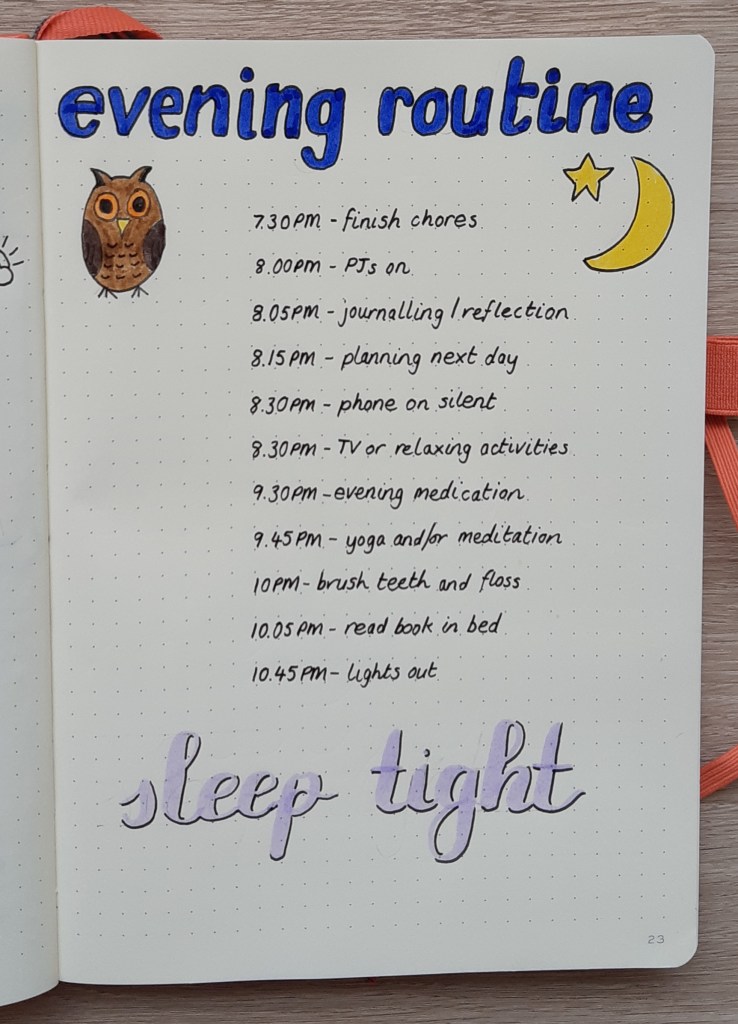
Last week, I made a spread in my bullet journal that detailed an evening routine of relaxation techniques that I feel will help promote a feeling of restfulness in preparation for going to bed. I started by thinking about what my evenings have looked like in the past which have lead to a terrible night’s sleep and jotted down my ideas e.g. eat late and drink wine or cider after 9pm, get into a debate on a social media platform e.g. Facebook or Twitter, or read something controversial online, tackle chores just before bed, work on projects late into the evening etc. Then I thought about the complete opposite of this e.g. eating at a reasonable time, limiting alcohol intake and not drinking after 8pm (2 hours before bedtime), finishing chores by 8.30pm, journaling and putting the day to rest, doing a gentle yoga routine, completing a breathing meditation, silencing my phone, doing meditative activities such as colouring on, cross stitching or a jigsaw puzzle etc.
Photo credit: Laura Jones for Keeping it creative
Obviously it takes weeks to establish a new routine but by writing it down, I think it reinforces your intention and makes you more likely to stick to it. You can also reflect on it as part of your evening journalling, for example, writing down that you woke up with a headache and detailing reasons why this might have happened, recording that you woke up feeling refreshed because you had a wonderful night’s sleep and why this might be the case.
Get some exercise but avoid anything aerobic for at least 2 hours before bed
I’ve found that I’m able to sleep so much better since developing a daily exercise routine. You don’t have to do something intense each day but a nice, brisk walk for around 30 minutes should help you feel less stressed and more relaxed by the time evening comes. Make sure, however, that you don’t do any exercises that get your heart rate up for a couple of hours before bed as this will leave you feeling energised and stimulated and actually delay your transition into sleep.
Get your bedroom environment just right
If there’s one piece of bedroom furniture worth investing some money on, it’s a decent mattress. We’ve tried various types over the years and at one point had a memory foam topped one but we found it made us too hot and this wasn’t conducive to sleep. We now have a ‘Posturepedic’ which provides amazing support, helps maintain good spinal alignment and is super comfortable. You should also think carefully about your pillows too as the kind you choose depends on your regular sleeping position i.e. if you are a back sleeper or side sleeper.
Another consideration is the temperature in your room. It’s suggested that the ideal is around 16-18 degrees Celsius (between 60 and 67 degrees farenheit) and that if your bedroom is too hot or too cold it may affect the drop in your body’s internal temperature and cause you to have disrupted sleep. During the warmer months, we get the sun coming in through the window on an afternoon so I often close the blinds and make sure the door is wide open to avoid it getting too hot in there. We also have different togs of duvet and a cotton sheet for different times of the year to ensure we’re cosy in the winter and not too hot in the summer.
Having your room nice and dark also helps you to sleep better and many people like to use blackout curtains or blinds for this reason. However, we prefer just to use dark and thick, well-lined curtains as we find that some natural light first thing (during the spring and summer months) helps you to wake up gradually – think about how difficult it is to drag yourself out of bed when it’s still pitch black in the winter months!
I hope this tips help you to get a restful night’s sleep. I know at the moment, with the lockdown restrictions, it might be hard to maintain a good bedtime routine but your body will thank you for it if you do.















 Keeping it creative