
Posted in Anxiety management, bullet journal, life hacks, lifestyle, mental health, planner lifestyle, wellbeing

Monday Matters: 5 reasons why you should make a packing list for your holiday (AKA vacation)

As my regular readers will know, my husband and I are off on a week’s holiday later in the month. Before we go on any trip, whether it’s a weekend away, a mid week trip or a longer holiday, without fail, I create a packing list in my bullet journal which includes absolutely everything that I plan to take no matter how obvious the items are – I’ll even list the contents of my handbag even though the stuff is already inside. Today, I’m going to share with you my three reasons for making the aforementioned list and why I believe is an essential part of holiday preparation.

It helps you avoid under or over-packing

Before starting my packing list, I spend time thinking carefully about the length of our holiday and how many days worth of clothing I will need. I’ll also think about whether I will need more than one outfit for any of the days or if it’s likely we will be going out for the day and then coming back in the evening and staying in. Finally, I’ll consider whether any items will be re-worn or if, for example, they might have become sweaty if it’s really hot weather. The same process will be applied to my underwear items so I know I have just the right amount of stuff. This helps me avoid over or under packing and usually means that I have the perfect amount of clothing. After careful consideration I will work on my clothing list, writing down exactly how many of items were I need multiples e.g. 15 pairs of socks, 5 bras etc.

It ensures you don’t forget any essentials

There are always a number of items which you absolutely must take on your holiday. For me, this is things like my medication, mobile phone, debit cards and cash, hairbrush and for somewhere hot, sunscreen, a cap and my sunglasses. These would go on my essentials list and are written down first when I create by bullet journal spread. Doing this ensures you don’t forget any essentials – or at least it does if you run through your list before you set off and tick off all of the items!

You can pack methodically in a (relatively) stress free way

In the past, I’ve found packing my bags for departure extremely stressful, even to the point of inducing tears. Creating a packing list makes things much easier and a hell of a lot calmer. By going down your list for each category, you can get each item folded (or rolled) and ready in a collection so all that remains is to decide where it will go in your suitcase or bag.

As part of my list, I also add a ‘last minute’ list which includes things which will be in use at home before travel e.g. my toothbrush, hairbrush and make up, and tasks which need completing before setting off e.g. emptying the kitchen bin, watering our pots in the front and back garden etc.

You can keep your lists to help you next time

As all of my packing lists are written in my bullet journals, I can flick back and find a similar holiday list to help me get started. So, for example, if we’re going down to visit my parents in the summer time, I can look back at last years list and re-write it with some tweaks such as adding new items of clothing, removing bits and pieces that I no longer own etc. This makes things super quick and easy and again contributes to packing being a less stressful event!

It stops you stressing over forgotten items

My husband always says to me in the car to the airport or on our way to our destination “have you remembered anything that you’ve forgotten yet?”. Invariably, my answer is no, unless I forgot to do my last minute check through like I did when we went to my mum and dad’s house last and I forgot my hairdryer as it was in use prior to setting off. In the past, for my husband, the answer was quite regularly “yes” when I replied “have you?” until he realised a list on his phone might be of great help!

As well as preventing you forgetting things (at least minimising the potential), it also means that you don’t have to then go searching for replacements at your destination. This is particularly helpful if you’re going somewhere remote with limited access to shops, if you prefer particular products (e.g. I only use vegan cosmetics and toiletries) or if you’re going abroad somewhere (especially if you don’t speak the language). It might not be the end of the world if you forget non-essential items but it often causes some form of inconvenience at least.

My packing list for this month’s holiday

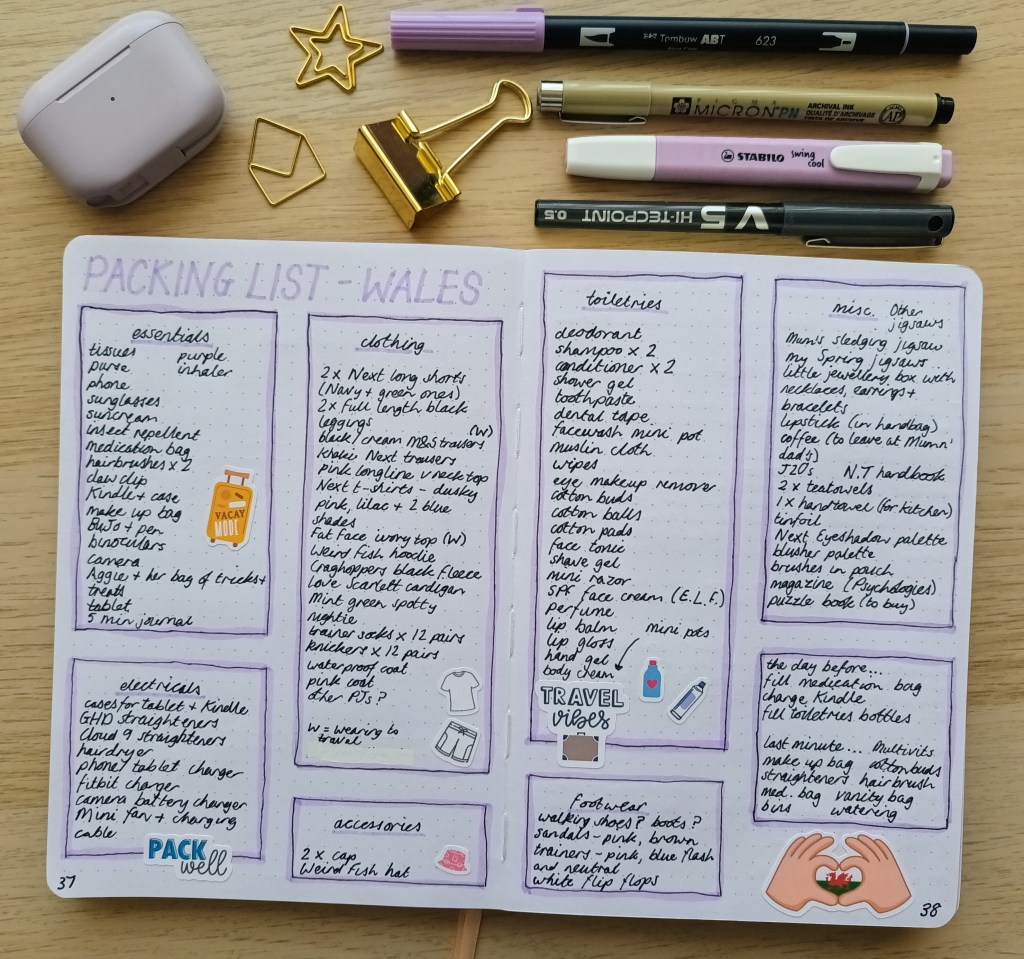
There are lots of packing lists examples available online and you can even purchase PDF versions, but personally, I prefer writing my own from scratch for each holiday. This means it’s completely personal to me and relevant to the particular destination, season and length of time I’m away for. I also take my list with me in my bullet journal when I go so that I can do a quick whizz through before we go home so I can check I’ve repacked everything. Below is my packing list for our holiday to Wales. It’s still a work in progress as we’re not heading off yet and I like to take my time with it.

Photo credit: Laura Jones for Keeping It Creative

Final words…

I hope you’ve found today’s blog post useful and can see how creating a packing list, for me, is an essential before travel task which is great for making me much more relaxed and better organised. Drawing up your own personalised list can lead to you feel less stressed and better prepared and I promise you will realise what a worthwhile activity it is. I’d love to know where you think would be the best place to write your list (analogue or digital?) and if you can see the benefits of keeping them in a safe place until your next holiday.

Thanks for reading!

P.S. Some of my readers have messaged me via email and have expressed an interest in dropping a comment or asking a question after reading a particular blog post. Unfortunately, this involves setting up a WordPress account but, luckily, it doesn’t take long and, once created, you can leave comments on any blog posts (from bloggers who use WordPress) which spark your interest. Also, you don’t need to be a blogger to set up account either. I hope this helps! I plan to paste this into each of my posts in future but have put it in post script so my regular readers and fellow bloggers can ignore!

Posted in lifestyle, mental health, Mindfulness, Planning and journaling, reflective journalling, wellbeing, wellness

Monday Matters: 4 Ways to Destress after a Busy Day

Photo from Unsplash

Most of us lead very busy lives and it can be incredibly difficult to switch off and relax in the evening in preparation for a good night’s sleep. Today, I’m sharing four excellent ways to wind down after a stressful or busy day. The following activities are great for your mental health and wellbeing and I’m going to be offering lots of different options to choose from depending on your preferences.

Do a journalling activity

After a busy or particularly stressful day, it can often be super difficult to calm our mind. Your head can be full of all kinds of clutter in the form of thoughts (both positive and negative), ideas or feelings. Maybe you’re busy analysing or deconstructing everything that has happened and going through things that were said. Perhaps you’re worrying about your mounting to do list and what didn’t get crossed off today because of x,y and z which took priority. Or, you might be looking towards tomorrow, thinking about the events in your diary or how you can be super productive and get more done whilst making it a calmer, less stress inducing day. If any of the above apply, you might be wondering if you will ever be able to switch off and sleep tonight. This is where getting your thoughts and feelings out of your head and onto paper can be super helpful. Just ten minutes of free flow or structured journal writing can make all the difference.

I learnt the following method for putting the day to rest when I was teaching, when every day was a busy day and I was really struggling to relax and sleep.

Putting the day to rest activity

  • Set aside 20 minutes in the early evening (I used to do this at 7.30pm)
  • Sit down somewhere quiet
  • Think about your day today and how it has gone, what you did and how you feel about it
  • Write it down in bullet points or free writing if you prefer
  • Write down anything you didn’t get done off your to-do list
  • Think about tomorrow – do you have any particular events coming up? what are looking forward to? are there any worries you have about what’s happening?
  • Write down a loose or structured plan for your day depending on your own needs (you can always modify this as you learn what works best for you.
  • When it comes to later evening and bedtime, if thoughts about today or tomorrow pop into your head, remind yourself that you’ve already evaluated your day and planned for tomorrow, so you don’t need to think about it any more.
  • If new thoughts come into your head at bedtime, jot them down on a piece of paper or on a notepad.

Other types of prompt based journalling might also work for you and there are some lovely ones on the market which can be used before bed. I’m a big fan of The Five Minute Journal but there are plenty of much cheaper options if this doesn’t fit with your budget. How much you want to write is up to you but it’s good to develop a consistent practice which becomes a positive habit to end your work time or day with.

Try a Mindful or Meditative Practice

Any type of activity that requires a high level of concentration and uses different senses is great for helping you to forget about the busyness of your day. Here’s some ideas for mindful and meditative activities which you might like to try:

  • Meditation – this can simply be sitting quietly and focusing on your breathing or using a guided practice. I recently found this account on YouTube that has some lovely ones with different foci that you mind find helpful. When choosing a guided session, it’s important to find someone who’s voice you find soothing and relaxing so you might like to try out a few to establish your preferences.
  • Crafting – there are so many different crafting options such as papercrafting, watercolour painting, knitting, sewing, crochet, model making and so on – why not give a few beginner projects a go to see which you prefer.
  • Some kind of puzzle e.g. a jigsaw, wordsearch, crossword etc. – great for keeping your mind active
  • Games – this could be something on your computer that you play by yourself such as Angry Birds, Candy Crush, Word Cookies or Patience, or one you play with others such as Boggle, Yahtzee, Gin Rummy, Scrabble or Jenga.
  • Enjoy a scented bubble bath and use your senses to fully appreciate the experience.
  • Cook a meal from scratch – measure out your ingredients with care, fully engaged with chopping / dicing / peeling etc, smell the different flavours as the dish cooks, taste the mixture to check the seasoning and so on. Mindfully enjoy the results at your dining table. Share your experience with others.
  • Watch something engaging on TV – comedy, drama, nature, historical interest or reality. Whatever you enjoy, give it your full attention and leave your phone or tablet in another room so you don’t get distracted. If you’re anything like me at this time of year, you’ll want to get your PJs on and snuggle under a warm blanket with your feet up for this one!

Read a book or magazine

Spending time reading a novel, information book, or favourite magazine is a great way to unwind and get yourself all relaxed and ready for bed. I love Psychologies magazine, as it’s full of positive ideas, and I can learn new ways of managing mental health and wellbeing at the same time.

Some people argue that you shouldn’t read in bed, but I find reading a few chapters of my Kindle novel (or for about 30 minutes) helps me to drift off really quickly. Try reading just before bed and reading in bed to see which works best for you.

Spend quality time with a loved one

Arranging an after work activity to do with a co-worker, friend, family member or partner can also help us destress. This could involve going out for an after-work drink, doing an evening class, watching a film at the cinema, seeing a comedy show or visiting a new or favourite restaurant. Alternatively, you might plan something fun to do together at home such as making popcorn to eat whilst watching a film, playing a board game or learning something new such as massage or reflexology.

Spending time with a pet is also great way to destress and calm the mind. This could include something you know they enjoy such as throwing a ball for your dog to catch at your local park (depending on the time of year), stroking your cat as they sit curled up on your knee, or watching your hamster as they zip around the house in their exercise ball.

Final words…

So there you have it, four ways to take yourself out of work/busy mode and into a relaxed state for the evening. I hope today’s post has given you food for thought and you’ll try one or two of the activities listed to see how they help. If you have any other preferences for your wind down routine, let me know in the comments.

Posted in compassion, creativity, depression management, lifestyle, meditation, mental health, self care

Monday Matters: Working towards a life full of calmness and positivity – simple ideas to try today

Today I’m sharing some easy self-help strategies to enable you to create a life which is both calmer and more positive. I hope you find the tips useful and they motivate you to make a change or two going forward.

Be kind to yourself

Showing self-compassion, practising self-care and giving yourself grace when you make mistakes or are struggling with the stresses of modern day living is an important and helpful first step to take in developing a more positive life. If a good friend of yours was finding things difficult right now, you would offer them support and encouragement, sympathy and well wishes, yet when we find ourselves in a similar situation do we behave in the same way? Here’s a few ways to be kind to ourselves (and they don’t need to be reserved for when we are down or struggling with our mental health either):

  1. Forgive yourself often – for making mistakes, not being perfect, not being super productive etc. Whatever you beat yourself up about, STOP!
  2. Keep yourself hydrated – this simple act of self-care is important and will help you feel your best throughout the day
  3. Listen to your body – if it needs rest, a day off, a holiday, a break from chores, a lie in etc. provide exactly that.
  4. Explore how you’re feeling mentally and why – try a spot of journalling or talk to a close friend, then, if need be, take appropriate steps to remedy the situation.
  5. Eat well – eating a balanced diet full of fresh produce, wholegrains and all of the vitamins and minerals you need is a great way to look after yourself. Yes, you shouldn’t deny yourself the occasional treat, but eating a predominately healthy diet will help you maintain good energy levels, restful sleep and better mood.
  6. Get some exercise – you don’t need to lift weights at the gym or pedal the exercise bike for hours each week, do something you enjoy whether it’s yoga, pilates, a walk in the countryside or playing outside with your dog. Exercise releases feel good hormones as well as keeping you in good shape.
  7. Celebrate your achievements – think about what you’ve achieved this week / month / year and give yourself a pat on the back. Even better, treat yourself to some kind of reward such as a bunch of flowers, a new notebook or something else that’s been on your wishlist for a while.

Be kind to others

Small acts of kindness towards others can have an enormous impact on both on the giver and receiver. Just something simple like holding a door open for someone who has their hands full or letting someone who is only buying one item go before you in the queue for groceries is enough for benefits such as brighter mood, lower stress levels, feelings of connection and belonging to the community and improved self-esteem and confidence.

Release your inner creativity

No matter how busy your day is, there’s always at the very least a small window of opportunity to get creative (try putting your phone in another room for half an hour!). Whether it’s doing some colouring in and choosing colours which complement each other, developing a poem about your experiences, doing some seasonal doodling in your bullet journal or creating a mood board for your living room, anything which uses your imagination or original ideas to make something is a boost to your creative side. And even if you don’t see yourself as the creative type, trying out different expressive activities will help you develop this part of yourself which I promise is lurking inside somewhere! Engaging in creative pursuits is wonderful for bring calmness and tranquility as well as a sense of achievement. It’s also a lovely way to practice self care.

Develop an attitude of gratitude

I write about gratitude in a lot of my wellbeing posts here on my blog but it is with good reason. Being grateful for what you have and celebrating ways in which you are very lucky has proven health benefits such as being better able to cope with adversity, enjoying improved sleep and immunity, building stronger relationships with others (particularly if you show gratitude for family and friends) and generally feeling much more positive and happy. Feeling gratitude and expressing your appreciation for things in your life is a very spiritual practice, creating a feeling of ease and contentment.

Be more mindful

Mindfulness is all about paying more attention to the present moment, focusing on your current thoughts and feelings and what is going on around you right now. Some examples of how this might manifest itself in your life include:

  • meditation and breathwork
  • paying full attention to the little things you do each day as part of your routines such as taking a shower, brushing your teeth, eating your breakfast, making your bed, brushing your hair or getting dressed. This will help you to change the focus from rumination about the past or worrying about the future
  • taking a walk in nature and becoming really conscious of your immediate surroundings – use your five senses to explore the environment
  • working on one thing at a time – avoid trying to multi-task (which is a complete myth anyway as you can read here)
  • eat mindfully – really pay attention to what you’re eating, how it tastes, how it feels in your mouth, how it is making you feel (this is also good for making sure your eat slowly and stop when you start to feel full and satisfied)
  • use the 5,4,3,2,1 grounding technique to bring you back to the present moment (this is particularly useful if you start to become anxious about something)
  • do some journalling – writing your thoughts, feelings and experiences in a journal is a great way to slow down and become aware of how things are for you right now
  • try movement meditation – most of us associate meditation with sitting or lying very still and focusing on the breathe. However, this is just one example of how to meditate. Check out this article for seven popular styles of movement which are meditative in their nature.

Start a slower and more relaxing morning routine

Your morning routine has the power to set you up for a calm, happy and productive day or leave you stressed out, tired and wanting to go back to bed. For a gentle start to your day, try the following tips:

  • prepare for your day the night before – check your planner to see what you have scheduled for tomorrow, write a list of intentions for the next day or choose your priorities from your to do list, choose your outfit and check to see if it needs ironing or unfolding to let the creases drop, if you are going out somewhere, pack your bag ready.
  • wake up early – plan to get up at a time which gives you the opportunity to get ready without rushing (this might involve going to bed earlier or other tweaks to your evening routine to encourage restful sleep)
  • open your curtains or blinds to let natural light in, or, during winter, use a sunrise simulation lamp to mimic the effects.
  • try journalling – this could be completing the morning entry of The Five Minute Journal like I do, doing morning pages or making note of a few things or people you are grateful for
  • avoid reaching for your phone – checking our phones as soon as we get up is an automatic reaction for most of us but it has been shown to have negative effects on the brain. Issues include heightened stress and anxiety levels, poor performance levels at work, lack of productivity as well as loss of our precious time. Instead, eat your breakfast mindfully and slowly, take yourself outside to get some morning light, do some gentle stretches or record your thoughts, feelings or daily gratitudes.
  • choose a slow living activity to put you in the right mindset – read a chapter from a motivational book, listen to a podcast, make a nutritious breakfast, savour your morning coffee (rather than downing it when it’s too hot or going cold), sit outside and watch the sunrise, close your eyes and focus on your breathing or flick through your favourite magazine. Make the most of rising early before you start to tackle your to do list or head off to work.

Final words…

I hope you’ve found the above tips useful and are motivated to try some of them. I know that making lifestyle changes can be quite difficult and require time and commitment. You might want to try to transform many aspects of your current life but doing too much at once will most definitely lead to overwhelm and the temptation to give up. I recommend choosing one thing to focus on and, where possible, enlist the help and support of your partner or a close member of the family or a good friend. I also encourage you to regularly evaluate and reflect on how things are going for you and consider if the small change you’ve made is having the desired effect. This will help you to refocus and serve as a good reminder of why you started.

Posted in lifestyle, mental health, self care, wellbeing

Monday Matters: 23 screen free ways to relax and recharge

This week, I’m sharing 23 ways to relax and recharge, which don’t involve scrolling on your phone, looking at things on your laptop, or staring at your TV screen. Why not make a list of your favourites in your bullet journal or notebook and choose one next time you need a break from modern day technology? (that’s every day for most of us!)

23 screen free activities to help you relax and recharge

  1. Try ‘Progressive muscle relaxation‘ This technique involves tensing and then relaxing your muscles one by one and is a great way to release tension. Check out this link for a straightforward explanation of how to do it.
  2. Curl up with a good book or magazine and a beverage of your choice Depending on the time of year and the weather, you might read outdoors in your garden or local park, in your favourite chair with an ice cold glass of water or under a blanket with a hot chocolate.
  3. Spend time in nature This is one of my favourite ways to relax at any time of year but the autumn months are particularly beautiful to be outdoors in a park, woodland or forest setting. Put your phone in your bag or coat pocket in case of emergencies and use your senses to explore your environment. As long as you’re suitably dressed for the weather, I can almost guarantee you’ll fall in love with the peace and quiet and feel restored afterwards.
  4. Connect with family or friends Choose to connect with people who make you feel good and whose company you enjoy. Activities could include meeting for coffee and cake, taking a walk in a scenic location, having lunch or an evening meal together in a restaurant or cafe or inviting people round for an informal dinner party (or takeaway if the thought of playing host for dinner fills you with dread!).
  5. Arrange a games evening Playing games can be great fun and are often so absorbing that you’ll completely forget about your to do lists and responsibilities for a while. My husband and I love Scrabble, Yahtzee, Rummikub and card games such as Gin rummy or Cribbage.
  6. Pamper yourself Depending on your preferences, this could involve a long soak in the bath, an invigorating shower and an all over body scrub, a face mask, a foot massage, manicure or pedicure or even a much needed lie in. See it as essential me time rather than self indulgence.
  7. Look through a photograph album My husband and I did this on our wedding anniversary last month and it brough back some really happy memories of our special day. It’s also nice to look at holiday photos through the years or albums showing your children growing up.
  8. Do some gardening Get some fresh air whilst giving your flower beds and pots some much needed attention. Even 20 minutes can make a real difference and leave you with an outdoor space to be proud of.
  9. Sharpen your mind with a puzzle Why not unwind with a word or number puzzle, a jigsaw or a brain teaser. I love wordsearches, Sudoku, 1000 piece jigsaw puzzles and letter arrangement games.
  10. Spend time with a pet Playing with or observing your furry four-legged friend is great for increasing your levels of seratonin and dopamine to calm and relax you. I love having snuggles with my hamster Millie, seeing her play in her digging tower or watching her collect treats which we hide around her cage.
  11. Make a foodie treat We often make dishes from scratch but these are generally main meals and often involve time and energy. Making something indulgent for dessert or as an afternoon snack with a cuppa is often easier and much quicker. One of my favourites is malteser tiffin and the hardest bit is leaving it in the fridge long enough to set properly!
  12. Enjoy a meal out with your partner, friends or family Letting someone else do the cooking for a change is a great way to rest and recharge. My husband and I love going for a vegetarian banquet at our favourite Asian fusion restaurant we try to make sure we focus on the food and the company by keeping our phones off the table.
  13. Make time for your hobbies Most of us have at least one hobby that we absolutely love but how regularly do you make time for yours? Doing something creative after a busy day is a wonderful way to unwind and leave you feeling relaxed and ready for bed.
  14. Focus on your breathing Have a look at this simple breathing technique (you don’t need to be feeling stressed to find it beneficial). When I first starting doing focused breathing and mini meditations, I found it really difficult to switch off, but now, after regular practise, it’s so much easier so don’t give up if your mind keeps bobbing about all over!
  15. Listen to music I love to just sit with my eyes closed and listen to my favourite classical pieces or songs. Immersing myself in the music or really tuning in to the lyrics allows my mind to switch off from everything else. The tunes don’t need to be relaxing or soothing ones – anything you enjoy will help you hold your focus.
  16. Do a meditative activity If you find sitting still to meditate difficult, doing a repetitive activity can help you reach a meditative state. Check out this post for 8 ideas to try.
  17. Journal your thoughts and feelings Journalling is a great way to clear your mind by putting things down on paper. You might want to write about how your day has gone, what you’re looking forward to in the future or how you feel you are progressing towards your current goals. If the thought of getting started seems a little taunting, journalling prompts are a great way to get ideas on what to write about.
  18. Switch to audio content Instead of scrolling through content on your phone, tablet or laptop and reading or watching videos, trying listening to audio content. This could be a podcast on a topic which interests you or an audiobook which you can listen to with your eyes closed.
  19. Do something fun which you used to enjoy as a child When I was young, phones and tablets didn’t exist and the only screen time I had each day was watching TV or playing games on our Commodore 64 (hand up if you remember this state of the art machine from the 80s!). Aside from these, we used to make our own entertainment, playing outdoor games, doing creative projects, building things out of Lego, making a den under the dining table or playing with toys such as skipping ropes, space hoppers, dolls and Transformers. Whatever you used to do as a kid, think about how adult you can do the same or similar and make some fun plans for the weekend. You might buy a stunt kite and take it to a local hill on a windy day or buy some bubble mix and have a competition to see how can make the best or biggest bubble.
  20. Sign up for an evening class A few years ago, I did a beginners photography course at my local college (which offered a qualification to go with it) and also a couple of ceramics classes where we made and glazed various clay creations. I thoroughly enjoyed all of these and it was great to meet and get to know like-minded individuals. The ceramics beginner and intermediate sessions were incredibly relaxing and it was so exciting seeing our items when they came out of the kiln. Wherever you live, there’s likely to be a range of creative classes in your local area and if not, you could get together with friends to try something new.
  21. Join a choir Group singing is a wonderful way to de-stress and feel part of the community. There will probably be a range of choirs and musical societies available to join depending on the type of music and songs you prefer. A small cost may be incurred but I know from my own experience it’s a small price to pay for something which is very therapeutic and creates a real high.
  22. Do something arty When we were young kids, most of us enjoyed art activities such as painting, drawing, making collages and constructing from junk materials. That’s because it was mainly about enjoying the creative process and experimenting with different techniques. As we get older, we tend to focus on the finished result and being happy with what we’ve made, rather than having fun as part of the process. So, get out your paints, markers, crayons, pencils and pens and simply explore and experiment.
  23. Be a tourist in your home town or city (or one nearby) You’ve probably already visited a few places and buildings in your local area but do you know their and how your town or city has developed over time? A quick check on Tripadvisor and I’ve discovered a number of ideas for places to go, activities to try and history to read up on where I live in Sunderland.

I hope you’ve found today’s blog post useful and it’s given you plenty of ideas for relaxing activities which offer much needed screen free time. I would love to know which one is your favourite and why. And if you don’t feel like you have a space in your day to fit in any of the above, is it because your diary is genuinely completely full or is it because mindlessly scrolling is taking over your life right now?

Posted in depression, mental health, productivity, Selling on Etsy, social media, wellbeing, wellness

Monday Matters: The Hidden Costs of Staying Informed: How the News Negatively Impacts Your Stress and Anxiety levels plus other aspects of your Mental and Physical Health

Last month, I met up with a few of my close friends for lunch and a good catch up. We had a lovely afternoon and there was so much to talk about. We reminisced about old times when we all worked together, talked about our recent holidays and plans for future breaks, shared what we’d been up to over the summer (and how fast the months were flying by) and commented on how children are so different from when we were young. As is often the case when the conversation is flowing, we spent some time chatting about current affairs local and national news. Sitting there listening and very occasionally contributing to the discussion, I realised that I knew much less about most of the topics than anyone else in our group. They seemed to know every detail about a particularly harrowing subject and had formed lots of opinions about all that they had read and heard. When I returned home, I mentioned this to my husband and considered why I was much less informed. I came to the conclusion that the main reason is that I firmly believe that over-consumption of news, particularly of the negative kind, seriously impacts my mental health and so I tend to avoid watching and reading too much. Today, I’d like to share what I have learnt from my online reading on this interesting and thought-provoking topic and present some strategies for avoiding ‘doomscrolling’ and managing your news consumption in general.

The concept of ‘doomscrolling’ and issues with easy access to news media

The term ‘doomscrolling’ came into regular use during the Coronavirus pandemic and is the act of spending an excessive amount of time reading and consuming large quantities of negative news online. This, coupled with 24 hour news channels on the TV, sensationalist headlines being so easily accessible and the negativity bias of media outlets can mean that the news is seriously harming your health and wellbeing. Some of the detrimental effects include:

  • increased anxiety levels
  • difficulty concentrating, completing tasks or relaxing
  • worsening symptoms of depression
  • elevated stress levels and trouble sleeping
  • obsessive worry and fear
  • gut and stomach problems
  • muscle tension and pain
  • poor productivity levels
  • feelings of helplessness or paranoia

So, why do people involve themselves in ‘doomscrolling’ and excessive negative news consumption?

According to my research there are several main reasons why people engage in this kind of behaviour:

  • having a natural negativity bias that makes them pay more attention to bad news than good news
  • wanting to feel in control and prepared for potential threats in a world that seems chaotic and uncertain
  • being addicted to the dopamine rush that comes from getting new information, even if it is negative
  • because they wrongly believe that they are keeping themselves safe by doing so

What strategies can I try to prevent ‘doomscrolling’ and over consumption of negative news media?

  • Limit your time Set a time limit for your news consumption and stick to it
  • Make use of mobile apps and your phone settings Use apps or tools that block or limit your access to social media or news sites
  • Look for the good news Seek out positive or uplifting stories that balance out the negative ones
  • Consider better alternatives Choose to engage in activities that make you happy, such as hobbies, exercise, meditation, or spending time with loved ones
  • Seek help or support Talk to a therapist or a trusted friend if you feel overwhelmed by the news or your emotions

Final words…

I hope you’ve found today’s post thought provoking and useful. Remember, staying informed is important in terms of feeling involved, knowledgeable and connected to others and is a valuable way to learn and grow. However, taking care of yourself is of equal importance so make sure you control your news consumption rather than letting it control you!

Wishing you good health and wellness,