Posted in lifestyle, Mindfulness, self care, wellbeing

Monday Matters: 15 Relaxing things to do this Summer

The summer is finally here bringing with it longer and warmer days, sunshine and gentle breezes. Today, I’m sharing fifteen relaxing activities for you to try over the next few months. Why not create a bucket list (maybe with little doodles for each item) in your notebook or planner as a visual reminder?

Enjoy a picnic in your local park

One of my favourite things to do in the summer is to fill our cool bag with lots of tasty lunch items to enjoy al fresco in a park or at a local picnic spot. Must haves for me are juicy strawberries and a nice cold bottle of fresh orange but you can tailor make a menu of your favourite cold foods.

Take a hike

There are so many different options for a long summer walk – ambling through shady woodland, following a riverside path, taking a coastal route, heading for the hills or following a trail at a nature reserve are just some ideas that come to mind. If it’s a hot one, pace yourself and take plenty of water to keep yourself hydrated. After I got bitten repeatedly whilst on holiday in Norfolk, I would also recommend a good application of insect repellant too! Often, there’s little or no phone signal out there so you get a tech break too.

Make lemonade

Nothing beats a refreshing lemonade on a hot summer’s day and it’s even better if it’s homemade. Check out this easy recipe to make your own from scratch and then enjoy as part of a picnic or in your back garden.

Watch the sunset

I’ve seen and photographed some spectacular sunsets over the years and each time it’s an amazingly calming and restful way to end my day either alone or with someone special. All you need is a view to the west, a good spot to sit or stand such as a park, a hill or somewhere else high up such as a rooftop bar, the beach or even a window in your house, and maybe a blanket if it’s become a little chilly outside.

Sit outside after dark and stargaze

This one takes a bit of planning as you need to choose a clear night but free apps like Nightshift tell you what the forecast is like and StarTracker or similar identifies the constellations you can see if you point your phone up to the night sky. It also helps if you choose a location which is high up or somewhere that gives you a wide view of the sky with limited light pollution. Hills and beaches are particularly suitable.

Go somewhere quiet and read a summer themed novel

Nothing beats sitting in the sunshine or under the shade of a tree in a quiet spot to read a lighthearted summer novel. Popular authors who have written some great seasonal fiction include Phillipa Ashley, Sue Morecroft, Veronica Henry, Emily Henry, Katie Fforde and Jo Thomas.

Enjoy an iced coffee (or other iced drink if you prefer)

There are so many summer drinks options available in our local cafes at the moment – frappuccinos, refreshers, iced teas and coffees and new bubble teas. My favourite is a Starbucks Iced Brown Sugar which is made with oat milk, espresso and brown sugar syrup. And it’s less calorific than the hot caramel macchiato I choose during the colder months. Whichever drink you go for, make sure you consume it mindfully and savour every sip.

Treat yourself to a delicious ice cream

There’s nothing better than ice cream on a hot summer’s day and nowadays there’s so many flavours and styles to choose from. And if you’re dairy free or vegan, there’s often plant based options including the new vegan raspberry swirl Magnum or a nice, refreshing and tangy sorbet. We like to take our foldable chairs in the boot of our car when we go out in the summer time so we can sit and enjoy our tasty treat in comfort and relax for a while in the sunshine afterwards..

Immerse yourself in nature

Spending time outdoors in nature can improve both your physical and mental health. Some of my favourite relaxing summer activities include visiting a botanical garden, wandering through a meadow spotting bees and butterflies, visiting wetland habitats with my binoculars to observe water birds and taking my DSLR camera to photograph flora and fauna.

Make fruit salad

A cocktail of fresh fruits is a great summer dessert and is super healthy too. Seasonal choices which work well include strawberries, mango, watermelon, raspberries, papaya, pineapple, melon, blueberries and cherries (don’t forget to remove the stones). Preparing the fruit salad yourself is a wonderfully calm and mindful activity and it means you can choose your absolute favourites to include. Popping the bowl in the fridge to chill for a while before eating makes it even more refreshing.

Try earthing

Earthing is the practise of being in direct contact with the earth’s surface. This could involve walking outside barefoot, sitting or lying on the grass, paddling in the sea or outdoor swimming. Research shows that this popular summer time activity has a whole host of benefits including releasing tension, improving sleep, boosting our immune system and generally leaving us feeling calm and relaxed.

Get active

There are so many fun ways to get active outdoors such as going for a bike ride, canoeing, sea swimming, beach volleyball, tennis, cricket, rounders or even enjoying a game of frisbee. Whatever sporting activity you choose, requires a great deal of concentration which can help to take your mind off the stresses of modern life. Just remember to dress appropriately and wear sunscreen.

Attend an outdoor event

Most towns and cities offer a range of outdoor events over the summer to suit different ages and tastes. Your local newspaper and council webpages should provide all of the information you need about what’s on. This year in Sunderland there are outdoor music concerts at our football stadium, a food and drink festival, plus a dance party in the city centre featuring local DJ sets and a range of other musical artists. There’s also a pride event which includes a parade and lots of other colourful and fun activities. Slightly further afield, there are a number of open air theatre events which include Jane Austen’s Emma, A Midsummer Night’s Dream and a family friendly adaptation of The Secret Garden. The National Trust Website is a good place to find our about a range of outdoor theatrical events.

Play a lawn game

There are so many fun outdoor games you can play either in your back garden, if you have one, or on the grass at your local park. There’s giant versions of popular indoor favourites such as garden dominoes, giant Jenga and lawn darts, plus other options you might have tried out as a kid like swingball, quoits, bean bag challenges and croquet. You could even have a get together with family or friends and hold a tournament!

Make a summer scrapbook or Traveller’s Notebook journal

Creating a scrapbook or Traveler’s Notebook journal is a wonderful way to document all of the fun things you did over the summer. Each time you do something on your bucket list, take a photo or two to capture it and make a note of how you felt and anything funny or particularly memorable that happened. It’s up to you whether you dedicate a few hours to working on your memory keeping each week or spend a whole day getting creative. You can also add other souvenirs such as tickets, postcards, packaging, maps or leaflets from places you went, pressed flowers, mini printed out book covers of novels you read etc.

Final words…

So there we have it, fifteen relaxing and enjoyable activities to try this summer. Let me know in the comments which ones appeal the most and if you have any further ideas, I would love to hear them.

Enjoy your summer of happy memory making,

Posted in lifestyle, memory keeping

Currently… life update June 2023

The Summer is here bringing sunshine and blue skies plus my three monthly life check in and a short update. I encourage all of my readers to give this a go, either as a blog post or handwritten in a journal. They’re great to look back on over the months and years to see how life changes.

Currently reading…

… 5 books at the same time! This is unusual for me as I usually read a fiction book on my Kindle in bed on a night and a non-fiction self development style book in the morning with my coffee but my Five Minute Journal weekly challenge last week was to revisit a previously loved book and I’ve been dipping in and out of two of Amy Tan and Abbey Sy books over the last couple of months. I’m enjoying all of my current reads:

  • The Midnight House by Amanda Geard
  • Walk: The Path to a More Mindful Life by Sholto Radford (re-read)
  • The Art of the Travel Journal by Abbey Sy
  • Twelve Moons: A Year Under a Shared Sky by Caro Giles (a beautifully poetic memoir)
  • Craft a Life You Love by Amy Tangerine

Currently creating…

… helpful BuJo spreads for our trip to Norfolk. So far, I have a map showing our route and estimated journey time (a screenshot from Google), information about our accommodation, a list of places to visit such as National Trust properties, wetland centres and the broads, plus veggie and vegan cafes and restaurants nearby. Next to create is my packing list which I hope to get done this afternoon.

Currently journalling…

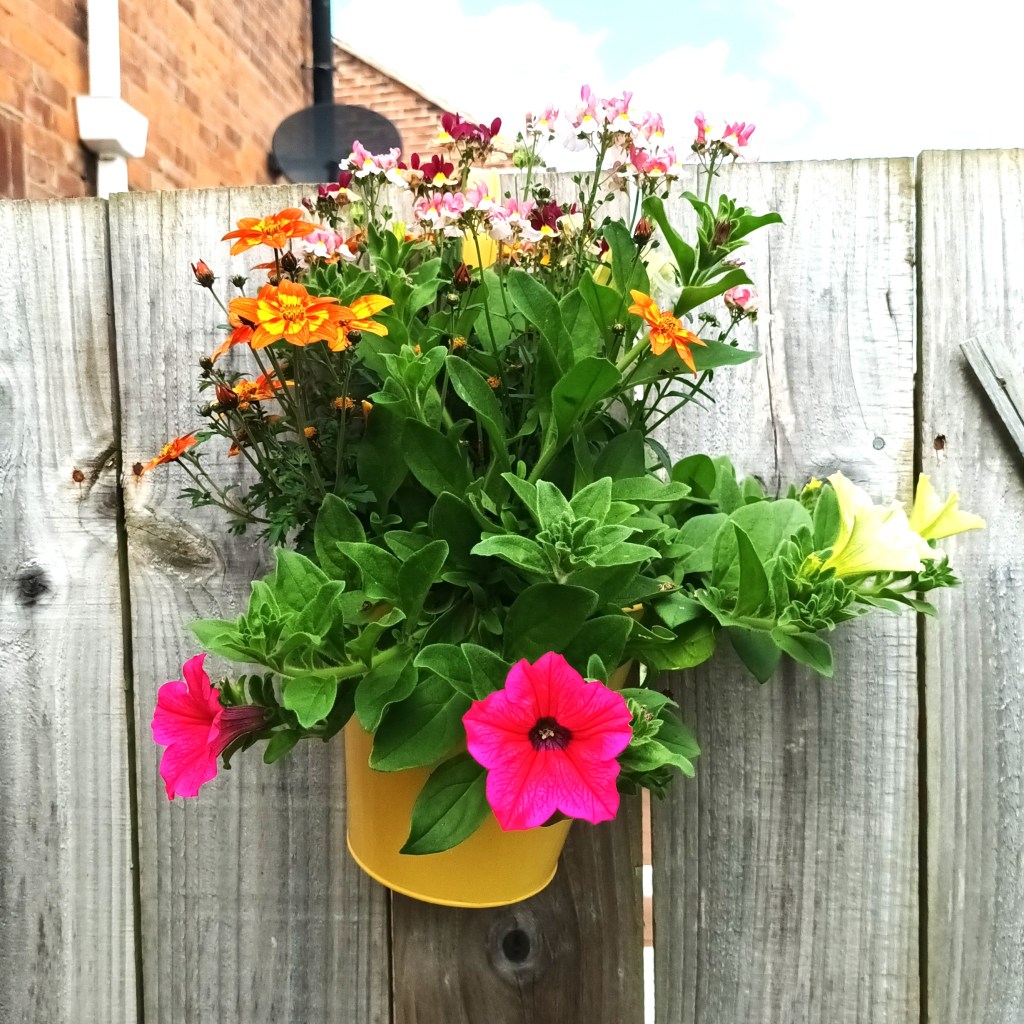
… in my handmade TN insert of a recent trip to Raby Castle for a walk around the grounds and deer park, photos of our new hanging basket and cute yellow hanging tin container, plus a bit about the sun and star necklace that I treated myself to with some of my wages from my uni work (I might have purchased it three weeks before I actually got paid!).

Currently enjoying…

… watching the wildlife in our back garden. Yesterday, there was a huge party of about 15 juvenile starlings on our lawn dipping their beaks in the grass searching for tasty morsels. Out new sunflower hearts seed feeder is very popular with the sparrows and the fat balls are a firm favourite with all of the birds. After dark, I love sitting on our bench, watching a pair of bats hoovering up months and occasionally I catch a glimpse of a visiting hedgehog crunching on his nightly saucer of biscuits. If the hog comes late, we can always check our wildlife cam footage the next day too.

Currently learning…

… more about gardening. So far, I’ve read up on plants for shady areas, how to deal with green and black fly without chemicals, how to grow my own rainbow chard and more about our recent plant purchases. There’s always lots more to learn and websites like the Gardeners’ World and RHS ones are full of helpful information. Also, my mum has been a keen gardener for many years now so has a wealth of experience to draw on to help us.

Currently eating…

… lots of salads and vegan poke bowls as it’s too warm to have the oven on. We had our first poke (pronounced poh-kay) bowl in Vienna and they’re amazing. Plus you can add a rainbow of veggies which makes them super healthy as well.

Currently drinking…

… Pimms and lemonade with fresh strawberries and pineapple mint from our garden. Well, when I say currently, I don’t mean I have a glass on the go right now at 2pm but later in the evening sat outside in the garden is perfect. I also love flavoured cider at this time of year and my favourites are Brother’s Toffee Apple and Strawberry & Lime from Aldi.

Final words…

That’s it for my life update. I hope you enjoyed reading what I’m currently up to. Let me know in the comments if you give this kind of journalling a go and where you choose to write your lists.

Posted in gardening, goal setting, journalling, lifestyle, Planning and journaling, productivity, reflective journalling, Setting goals and intentions

Monday Matters: 7 Reasons Why You Need to Keep a Garden Planner and Journal

Photo credit: Laura Jones for Keeping It Creative

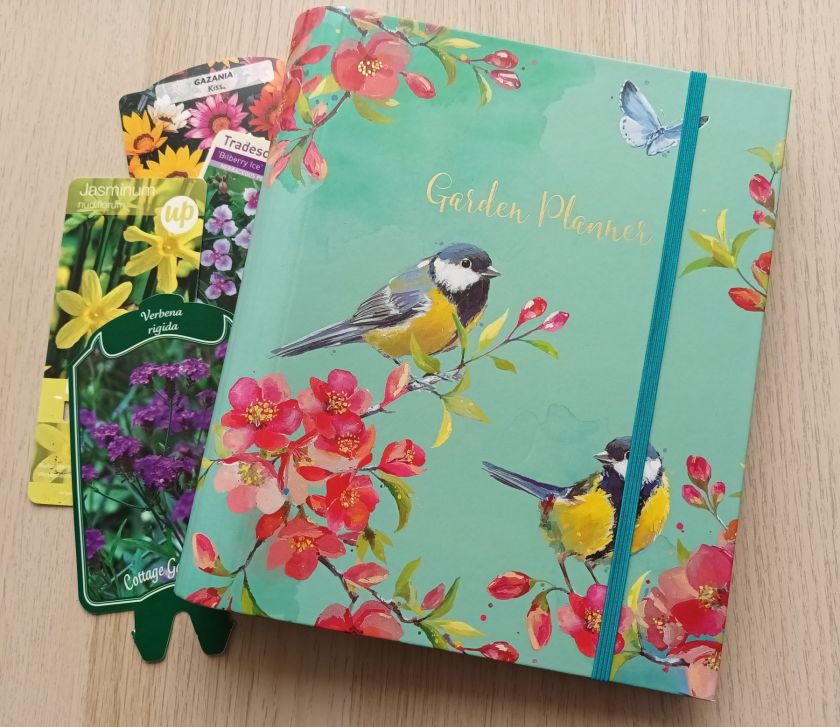
Over the years, I’ve kept various records of plants we’ve put in our garden, and I’ve saved all of the plastic information cards that come stuck in the pots when you buy them. I’ve also made notes in my bullet journal and even drawn plant ID cards for some of my favourite purchases. However, these resources are in an array of different folders and notebooks and often I can’t locate what I need when I want to check something. So, I decided I would like to keep a garden planner / journal and I found the perfect folder when I visited one of my local garden centres and asked my husband if he would like to buy it to give me for Christmas. Of course, any notebook or file would have done, but as someone who adores beautiful stationery, this one provides the motivation to use it regularly and has lots of different papers and pockets to put things in.

I’ve been using the folder since the very beginning of Spring 2023 and so far I’m finding it a really useful record keeping tool. I’m also hoping that by documenting everything garden related, it will help me to feel a real sense of achievement and begin to recognise that all of our efforts are paying off (even when I feel like it’s a constant battle to keep on top of the weeds or a few of our plants aren’t looking their best).

What is a garden planner and journal?

A garden planner and journal is a paper based or electronic place to store everything related to your outdoor spaces and even your houseplants if you so wish. As well as making you super organised it can provide, for example, a place to keep track of what you’ve planted and where, journal space to evaluate what has worked and what hasn’t, pages to record and plan seasonal tasks, list of to dos (AKA jobs for the weekend!), photo showing different parts of your garden over time so you can see and celebrate your achievements over the months and years. You can customise your records to suit your needs but you might include details of your soil in different parts of the garden, information about your various plants and notes on how well they have done depending on their location, ideas you have collected from magazine and online articles, issues you’ve had with some of your plants such as garden pests or poor growth, labelled sketches of flower beds or the garden as a whole, lists of your seed purchases and even a garden wishlist – the possibilities are endless.

Why should I keep a garden planner and journal?

In a nutshell, keeping a garden planner and journal, which you regularly write in, will make you a better and more efficient gardener and enable you to get so much pleasure from your space no matter whether it’s a few containers on your balcony, a tiny plot or a vast amount of land which keeps you constantly busy. Here are my top seven reasons why you should start a garden planner and journal today:

It helps you remember what’s where

Drawing a labelled sketch of the different parts of your garden such as flower beds, vegetable sections, corner plots, rockery etc helps you to remember exactly what you’ve got and where things are located. It can also provide information such as the particular colour or variety of plants.

I’ve also created a list of containers (size, colour and location helps here), what’s in each and when the plant grows and flower so that I know what’s going to pop up when and also, if it doesn’t come back, I can record and evaluate accordingly.

It’s a good idea to sketch your garden each season so you can see what’s in flower at particular times, which veggies are currently being grown and where your evergreen / deciduous shrubs and trees are. Then you can add in your annuals and assess whether there are any gaps which you want to fill.

You can create and maintain weekly and monthly plans

If you love your garden and want it to look good, you need to regularly dedicate time and energy to gardening. My planner contains weekly overviews for each season where you can record particular jobs that need doing each year and also ‘Jobs for the Weekend’ pages for running task lists. It’s really satisfying ticking them all off and it helps us to see what we still need to do and estimate how long each job will take. These task lists can then be revisited next year.

I like to go on reliable websites like Gardener’s World and RHS plus other UK based sites to look at what I should be doing each month and then handpick jobs specific to our garden. I also follow a few UK YouTube accounts for ideas too. You could even keep a list of useful websites in your journal somewhere too.

A place to log new additions to your garden spaces

All gardeners love going to local garden centres and nurseries to choose new perennials plus annual bedding plants for instant colour. You can record all of these in a list, stating where they were purchased and how much they cost, plus key information front the plant labels. getting new bits and pieces for their garden whether it’s a perennial plant, a new pot, a comfortable bench or chair and cushions, so And your new additions list doesn’t just have to be a space for greenery, you can also record new pieces of furniture such as a gorgeous new bench and bright cushions or a little potting bench, atmospheric solar powered or mains operated lights, new paths or replacement gravel, patio slabs, hanging baskets, rockeries, storage spaces such as a little shed or a box to put soft furnishings over winter, and wildlife friendly pieces such as a pond, bug hotel, hedgehog house or toad abode! Then, when you can’t recall how long you’ve had raised bed, you can check your records instead of trying to establish how long it’s lasted from memory.

A good chart to have in your planner is a record of seeds which you plan to set, when and where e.g. in trays indoors or directly into prepared veg beds or outdoor pots, how many to set (usually dependent on size and desired crop), date to set and germination times. You can also include a section for any notes, so, for example we find that our two courgette seeds for the two large plants we want don’t always germinate so we tend to put a couple in each plug or create more plugs.

You can find examples of seed charts on Pinterest for you to draw up (preferably on gridded paper), or, if you’re pushed for time, you can purchase printables on Etsy.

Helps you track progress over time

The other week I found some photographs of my husband sitting out in our back garden a couple of years after we’d moved into our house. I decided to print them out as there’s a huge difference between how the space looked then and what it looks like now less than 10 years later. The transformation is amazing and if we didn’t have a photographic record, I don’t think we would be able to fully appreciate all that we’ve achieved. You might not have photos from a decade ago (or maybe you do?) but why not start recording now and see how your space has changed in one, two or even ten years?

A useful spot to record successes, challenges + complete failures and reflect on why

We’ve been developing our garden for over ten years now and have had many successes but probably just as many failures. Some of the failures are permanently stuck in my memory, like the fact that every time we have tried to grow lupins, no matter where we got the plants from, the ended up covered in aphids which made my skin crawl! Likewise, some of our complete successes still take pride of place in our flowerbeds such as the beautiful, long lasting and colourful geums. However, there are many more triumphs and disappointments that I wish I’d written down and reflected on. Here’s a list of aspects of gardening which you might like to make a few notes on:

  • garden pests – what specific plants they’ve eaten, when they eat (daytime, night time, particular times of year, following particular weather etc), thoughts about why they eat e.g. slugs and snails love to munch on our dahlia so this year we’ve potted one up, covered the soil in grit and placed it in the front garden porch away from other plants and it’s doing much better
  • plant diseases and treatment e.g. our hollyhocks get rust every year so I inspect them early on and removed infected leaves quickly and dispose of them
  • plants which don’t like the conditions – too dry, too wet, hate clay soil, not enough sun/shade etc and whether they are to be moved or just dug up
  • weather related challenges (e.g. storms, continuous rain, dry spells etc.) and how specific plants coped
  • seed germination failures – dates planted and when replacements set or when new seeds purchased and set
  • weed related issues e.g. we have a huge problem with celandine and it’s a constant battle to get rid of them, I spend 10 minutes every day on their removal and I’m glad when they die back by mid May

I’m sure you probably have many more ideas but hopefully these are enough to get you started.

A place to dream, make wishlists, include inspirational images, identify your short and long term goals and make plans of action

If, like me, you have a beautifully, colourful and well maintained garden on your vision board for the future, it’s a good idea to have a section in your journal to include wishlists, inspiring photographs, goals and action steps and maybe even a written explanation of what you want your dream garden to look like and how you want to feel when in it. You can then check in regularly with this section of your journal and see how well you are progressing with your goals. You can also note down things from your wishlist to look for next time you go shopping to one of your local garden centres.

Final words…

As you start your record keeping, remember that your file doesn’t need to be perfect and will most certainly evolve over time. You might want to start by simply taking a few photos of how your space looks now and then making a few notes of some of the plants which are located in each section. Or, if you like drawing and creating diagrams, you might take some squared paper to draw different parts of your plot and label the names of plants currently growing there. I can also recommend colouring in the plants that are currently in flower so you can see the balance across your plot.

Then, on another occasion, you might make a basic to do list (try Googling garden jobs for June and your specific location) for the month and tick tasks off as you complete them. You could even add a few jobs that are already complete or underway to get some easy and satisfying ticks by the end of the week.

I hope you’ve found today’s post useful and it has inspired you to give this form of planning, record keeping and journalling a go. Let me know what you choose to do first and how you get on.

Posted in CBT, compassion, lifestyle, mental health, Setting goals and intentions, wellbeing, wellness

Monday Matters: Nine ways to make your day amazing

As I shared in a previous post, I’ve started using The Five Minute Journal morning and evening as a way to be more grateful, live with intention, remain positive and just generally have a good day, every day, no matter what. One of the prompts for early morning is to decide on three things that would make today great and list them. At first, when I started using the journal, the temptation was to just write my ‘must do’s’ from my ever lengthening to-do list as a way of being and feeling super productive. However, what I think is much more valuable (and a key idea with the book) is to think about ways in which you can upgrade your day by considering things such as be present (mindfulness), doing things that really matter to you (based on your core values + current goals and intentions) and finding time for or creating habits which give your body and mind what they really need to improve both your physical and mental health and therefore your general wellbeing. So, today, I’m going to share nine ways to improve your day by figuring out your current priorities, doing things that align with your core values, instilling positive habits, re-phrasing self talk and making meaningful progress towards your short term / medium term / life goals, desires and intentions.

Of course, I do realise that, every now and then, events happen in our day which contribute to uncomfortable emotions such as those associated with anger, fear, sadness and disgust and that sometimes, it becomes difficult to remain positive or optimistic. However, I hope that by sharing these suggestions, I will be helping you to learn simple ways to create high vibe states such as peace, joy, gratitude, enthusiasm, optimism, hope and happiness and recognise the effect that these can have on your day. As you create and maintain healthier habits, you should also notice that you spend less time dwelling on negative events and situations and more time celebrating the positives and recognising all that is good in your life.

Today, I’m sharing nine ways to improve your day-to-day but I’m sure, when you think about it, you’ll be able to come up with many more ideas for upgrading from an okay day, to one which leaves you feeling satisfied that you’re living your best life.

Be present

Being present is a state of mindfulness where we slow down and bring awareness to what is right in front of us and what is happening in the current moment. By focusing on the here and now, we’re not dwelling on the past (sometimes referred to as rumination) or worrying about the future. This can help us feel calmer and more relaxed. It can also have a positive impact on our relationships, make it easier for us to manage stress and relieve mental health symptoms such as anxiety and depression.

Bringing you attention to and staying in the current moment is a skill that everyone can develop but it does take a lot of practice and can, at times, be really difficult. However, it’s definitely worth persevering if you want to experience the above benefits. To get started, give this blog post a read.

Consider what really matters and take action

Have you ever sat down and seriously reflected on what really matters to you right now? If you haven’t, I can highly recommend taking some time to do this as it can provide a useful starting point to help you decide where to make changes in your life for the better. I find that the best way to do this is to look at a comprehensive list of personal, professional or core values and make a note of those which particularly resonate most with you. Then, when you’ve selected those which matter the most, you can either continue to make time for these things, think about new habits to work on instilling or work on better aligning your behaviour to fit with your current priorities. So, for example, you might decide that having fun with your partner is really important to you and something you want to make more time for in your relationship. Then, you might list fun activities you’ve enjoyed in the past e.g. going to a comedy show, playing mini golf, spending the day at the seaside paddling in the sea, building sandcastles and eating ice cream, and some you’d like to try in the future e.g. canoeing, a Segway tour, exploring the night sky at an observatory, taking a road trip to somewhere new or go camping.

Get your body moving.

I’m sure you already know the benefits of exercise for your mind and body but adding movement to your day doesn’t necessarily mean hitting the gym for an hour. Here’s some quick and easy ways to raise your pulse rate:

  • check out this webpage for some easy stretches you can do in the morning before you even leave your bed
  • put on your favourite upbeat track and dance around your bedroom / kitchen / living room
  • take a quick power walk around the block in your lunch break
  • find a 10 minute ‘no equipment’ exercise routine on YouTube to have a go at. Add those you enjoy to your favourites.
  • Do some gentle stretching exercises throughout your day to ease tension and improve your circulation, flexibility, blood flow and posture. Try focusing on areas of your body where you typically hold tension such as your neck, shoulders and upper back. The NHS website has plenty of ideas – try searching ‘NHS flexibility’.

Do a little cleaning, tidying or decluttering

Doing a little bit of cleaning, tidying or decluttering each day can provide a real mood boost and a sense of satisfaction when you admire what you’ve achieved. It doesn’t have to be a long or arduous task, but just taking five or ten minutes can make a difference. You might give your kitchen worktops a deep clean, choose just one drawer or shelf in your kitchen to re-organised or decide to check through your make up bag for products which are past their best or haven’t been used in a while. Over time, these short, focused ‘projects’ will help you to create and maintain a home that you’re super proud of and, if you want an easy way to measure your progress, I recommend taking a quick before and after snap on your phone so you can see what a difference you’ve made – you could even store the ‘after’ photos in a digital folder called ‘my lovely home’!

Practice gratitude

I’ve talked about the importance of being grateful for the things and people you have in your life in a number of previous blog post and the benefits of a daily gratitude practice are well documented. The morning part of The Five Minute Journal asks you to record three things that you are grateful for and, I’ve found that I know find it so easy to fill in. I also find myself expressing my gratitude in my thoughts throughout the day on a regular basis. So, for example today, I was a little annoyed that I had to get the washing off the line as it started raining as soon I’d finished hanging it out but I was glad I had to because it rained much heavier whilst I was at my Zumba class. I was also grateful that I’d made the decision to pop on my raincoat to wear to the gym as the rain became torrential before the end of my class.

If you want to start a gratitude practice but you’re not sure how, check out this blog post which gives my best tips as well as discussing the benefits of developing a consistent daily habit.

Learn something new

Making time in your routine to learn something new each day is not only a wonderful workout for your brain, it’s also an effective way of reducing stress and calming your body down. Acquiring new information on a topic of interest or developing your skills in a particular area promotes self- improvement and personal growth and can really boost your self esteem and confidence. What you set out to learn and how you do it is really up to you but it’s a good idea to spend some time quietly thinking about subjects of interest and jotting them down in a notebook e.g. money management, particular hobbies, creative writing and animal welfare, things you’d like to know more about e.g. eco friendly cleaning solutions, a particular country or place you’d love to visit, British history, and skills you’d like to work on e.g. cooking, drawing, leadership, time-management and so on. Once you’ve done this, you can then schedule time for learning and begin to collect a bank of useful resources e.g. books, online articles, videos, in person or online classes etc.

Replace ‘I have to…’ with ‘I get to…’ and consider other aspects of your self talk

On the subject of being grateful for what you have, another way you can work on altering your mindset in a positive way is to begin to notice when ‘I have to…’ pops into your head and change it to ‘I get to…’ So, rather than saying ‘I have to go to work’, you would rephrase it as ‘I get to go to work’ focusing on the fact that you have the opportunity rather than it being an obligation.

In a similar vein, statements such as ‘I need to…’, ‘I have to…’ or ‘I should…’ can create pressure and an expectation to perform, whereas better self talk could include ‘I would like to…’, ‘I might…’ or ‘it would be good if…’ e.g. rather than ‘I need to get that washing up done because it’s piling up’ you could say ‘It would be good if I did the washing up now so that the kitchen is clean and tidy for making dinner’. (Find out more by reading this blog post from a few years back.)

Find time for things you love

I believe that setting aside time to do something you love each day is super important if you want to feel a sense of satisfaction with your life. Again, writing down activities you enjoy or get value from and recording a short explanation of why can help. Here’s some examples from my personal list to give you some ideas:

  • bird watching
  • nature walks
  • reading health and wellbeing magazines
  • watching psychological thrillers on TV (or reading them on my Kindle)
  • playing card and board games
  • making sweet treats such as flapjack, cookies or cupcakes
  • doing 1000 piece jigsaws
  • playing Angry Birds 2, Candy Crush and Word Cookies on my tablet
  • hand lettering with my brush pens
  • painting my nails
  • using my watercolours

Avoid distractions and information overload

My final tip for making the most of your time and having a great day, is to minimise sources of distraction and develop ways to prevent information overload. I would say that the most common source of distraction and productivity killer comes from modern technology and presents itself in the form of notifications such as text messages, emails or social media happenings (such as tweets, status updates on Facebook, Instagram stories and photo shares, YouTube video postings and so on) and often a combination of all three. I don’t consider myself an expert on avoiding such distractions but this is what I’m trying at the moment:

  • two email addresses – one for work related emails for my Etsy shop, blog and university work with notifications for messages from actual people (rather than organisationd) going to my Fitbit watch during the day, the other for all other emails such as those from businesses with notifications turned off. If I’ve placed an online order and want to track progress, I just use the search facility to find the relevant information.
  • keep my phone in another room whilst I’m working (whether that’s on my shop, my blog, gardening, housework etc)
  • turning off social media notifications and then setting aside a small amount of time each day to ‘check in’
  • avoiding looking at my phone during my 5 minute Pomodoro Technique breaks

In terms of information overload, there are some useful tips contained in this blog post including how to consider the type of content you wish to engage depending on your current priorities.

Final words…

I’ve found The Five Minute Journal really useful in helping me to decide what my priorities are for that particular day and in thinking about what would turn my week days and weekend days from just okay or average to great or amazing. Whether you use this journal system or not, spending a few minutes each morning in mindful contemplation in relation to the above can make such a difference to your day.

I hope you have taken away something useful from your reading and I would love to hear any thoughts or additional ideas you may have in the comments.

Posted in art, bullet journal, Bullet journaling, lifestyle, Planning and journaling

Setting up my Bullet Journal for May 2023: Travel theme

This month, we’re finally going on our long awaited holiday to Vienna in Austria. It was originally planned for August 2020 but in March of that year, obviously COVID-19 hit and our flights were cancelled. My husband re-arranged for May 2021 but restrictions were still in place, so we made the decision to wait for another year. Everything is now booked (including an overnight stay in a hotel in Manchester as our flight is from there) and during the last month we have again started to think about what we’re going to take with us in the hold and in our hand luggage and what we want to see and do over the 5 days.

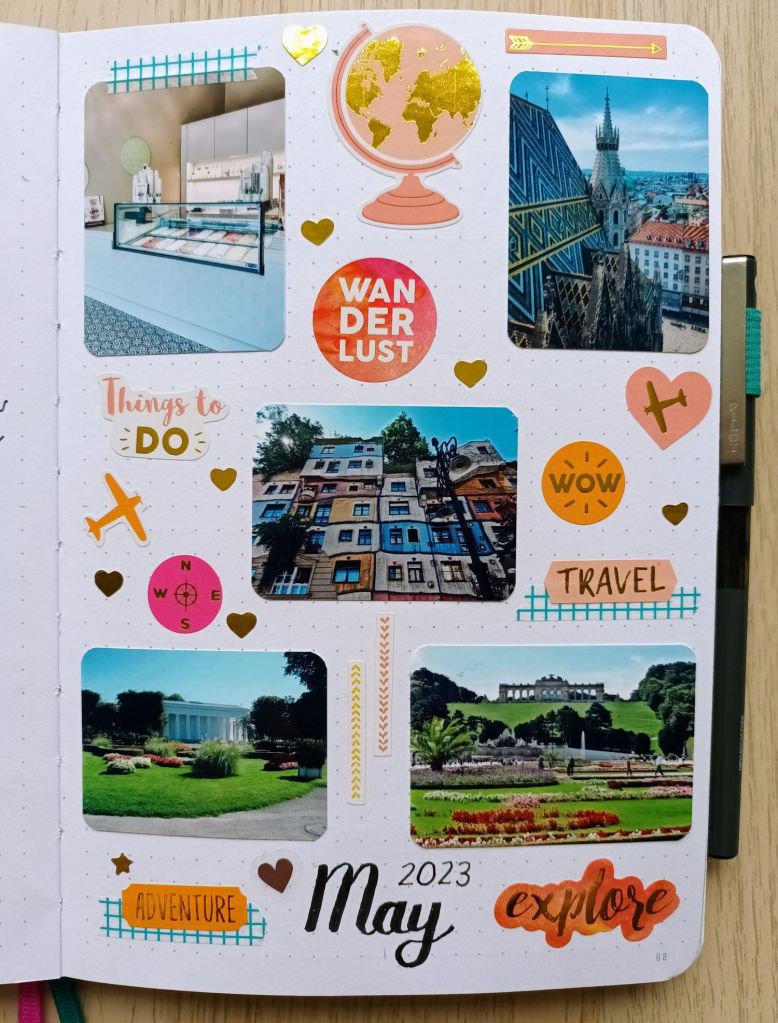
As we were making our plans, I decided it would be nice to create scrapbook style spreads with photographs of our hotel, plus must visit locations including parks, buildings and attractions. I’ve not finished all of my travel planning spreads yet but I’m making good progress and I’m happy with everything I’ve done so far.

My cover page

After printing mini photographs on my Canon Selphy printer, I chose 5 of them to include on the front cover. Whilst searching through my journalling supplies, I found a small travel themed sticker book with mini word and icon stickers plus some tiny hearts to fill in the spaces. I also treated myself to some new washi tapes from Stationery Pal and they arrived just in time for me to use one of them in my spreads.

Photo credit: Laura Jones for Keeping It Creative

Monthly calendar

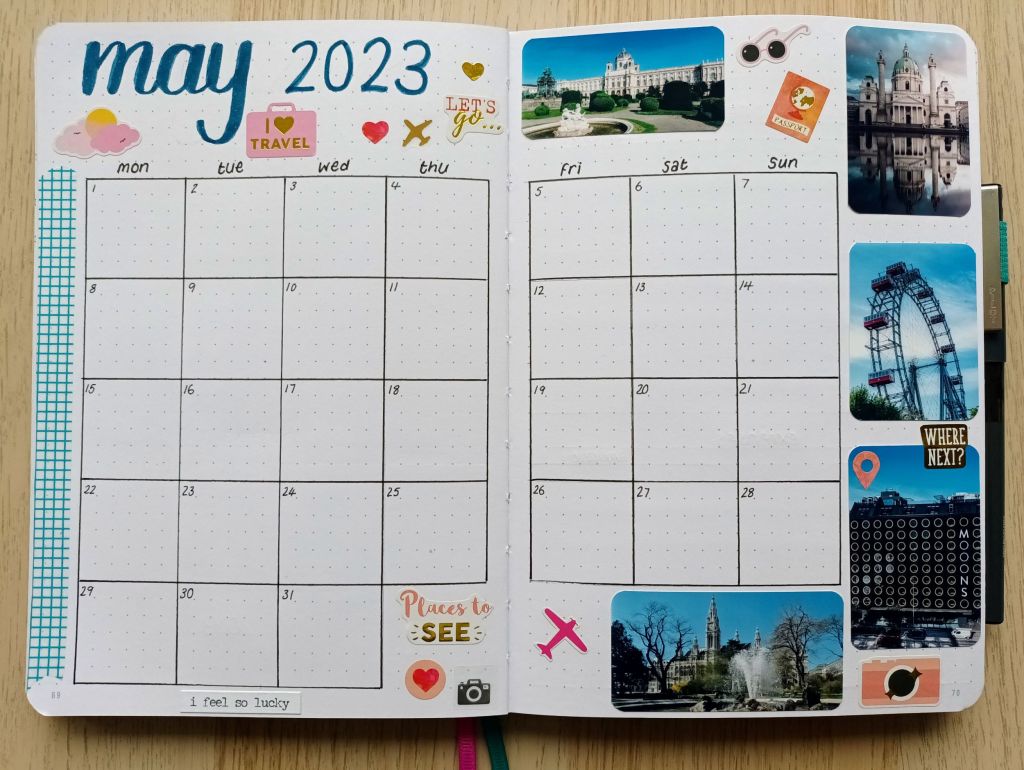
I’ve gone back to the slightly larger boxes for this month so I have plenty of room to record my university work, fitness classes and travel plans. Again, I’ve included mini photos of popular places in Vienna to visit and then filled in the spaces with more of the little stickers from by booklet. I didn’t really come up with a colour scheme but I wanted to go for different shades of blue to match with the bright blue skies in some of the photos.

Photo credit: Laura Jones for Keeping It Creative

May finances

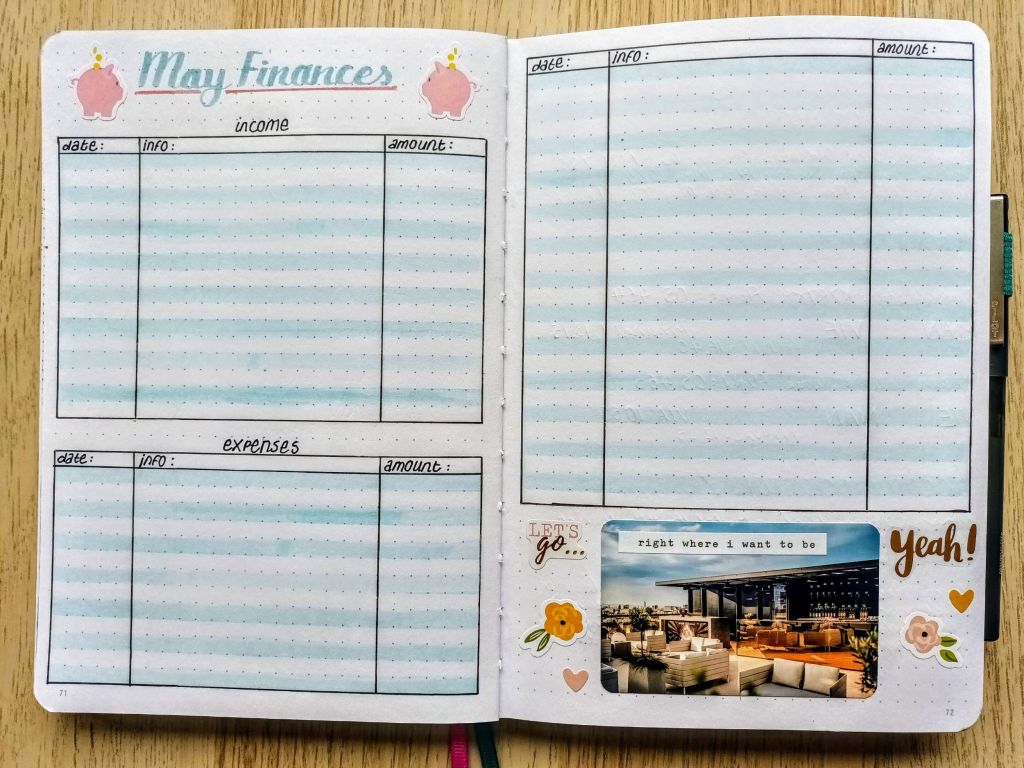
I’m sure we’ll be spending lots in May with all the bank holidays and our trip do I’ve made my expenses section a little bigger than last month. I decided to include a photograph of the amazing rooftop bar in our hotel as I reckon we’ll be spending time and money there relaxing with a cocktail or two!

Photo credit: Laura Jones for Keeping It Creative

Travel information spreads

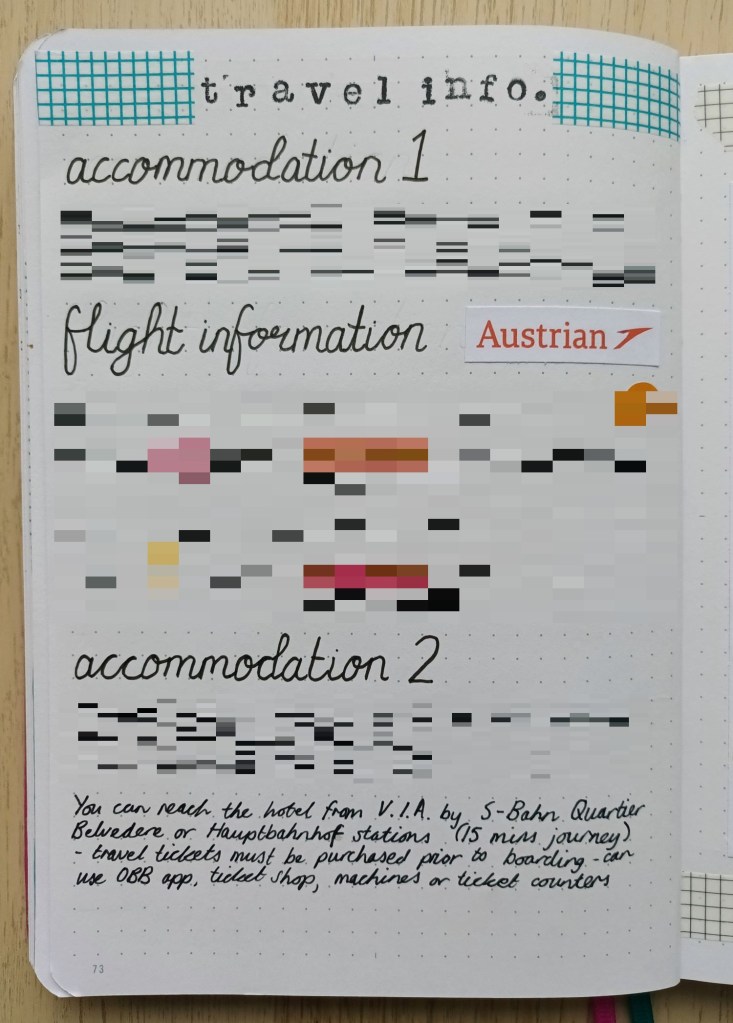
I want us to be super prepared for our trip as it helps to keep travel anxiety at bay. The booking information is all in various emails so I asked my husband to forward everything to me so I could add everything to my bullet journal. I understand why everything is done electronically now but I used to like paper copies so that I could stick things into my Traveller’s notebook as part of my scrapbooking.

So far, I’ve got our Manchester hotel booking information, the outbound and return flight details and our hotel booking information for Vienna. I’ve also written details of the train we can catch from airport and the stations we can alight at. I’ve pixelated the specifics for privacy reasons!

Photo credit: Laura Jones for Keeping It Creative

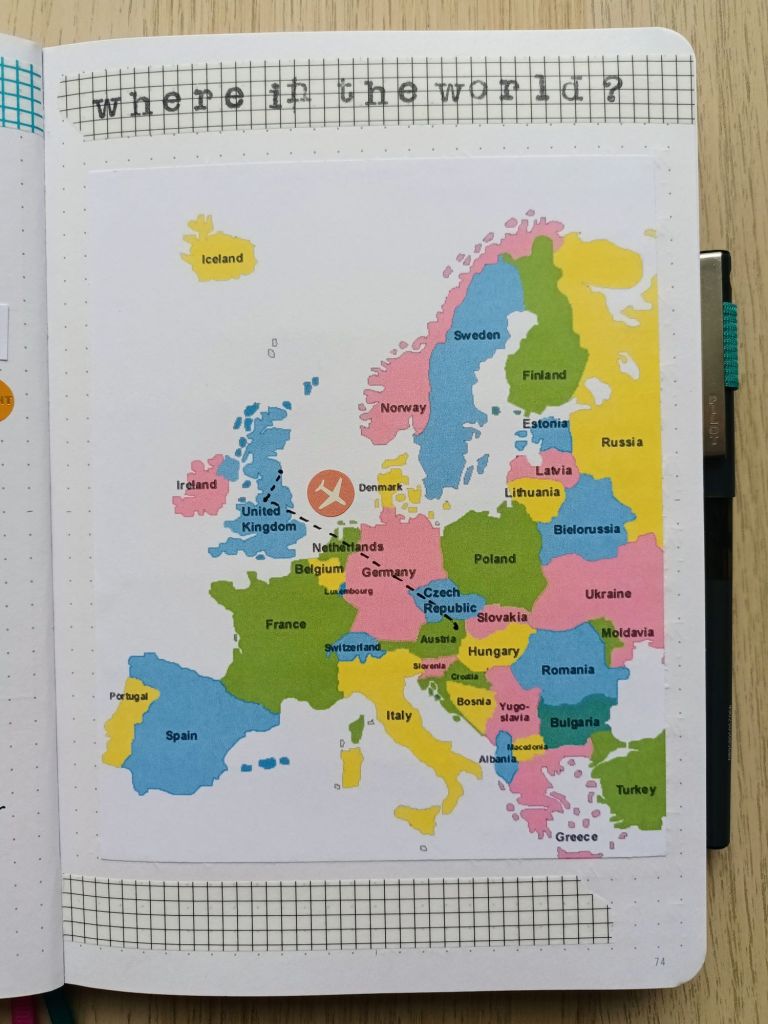
On the next page, I’ve included a map of Europe which shows Sunderland to Manchester (as the crow flies!) and the route from Manchester Airport to Vienna International Airport. It was also good to learn more about the countries which border Austria too. The ink I used for the stamping is Stazon which claims to allow you to use it on any surface so I tried it out on the top of one of my grid washis and it printed and dried really well.

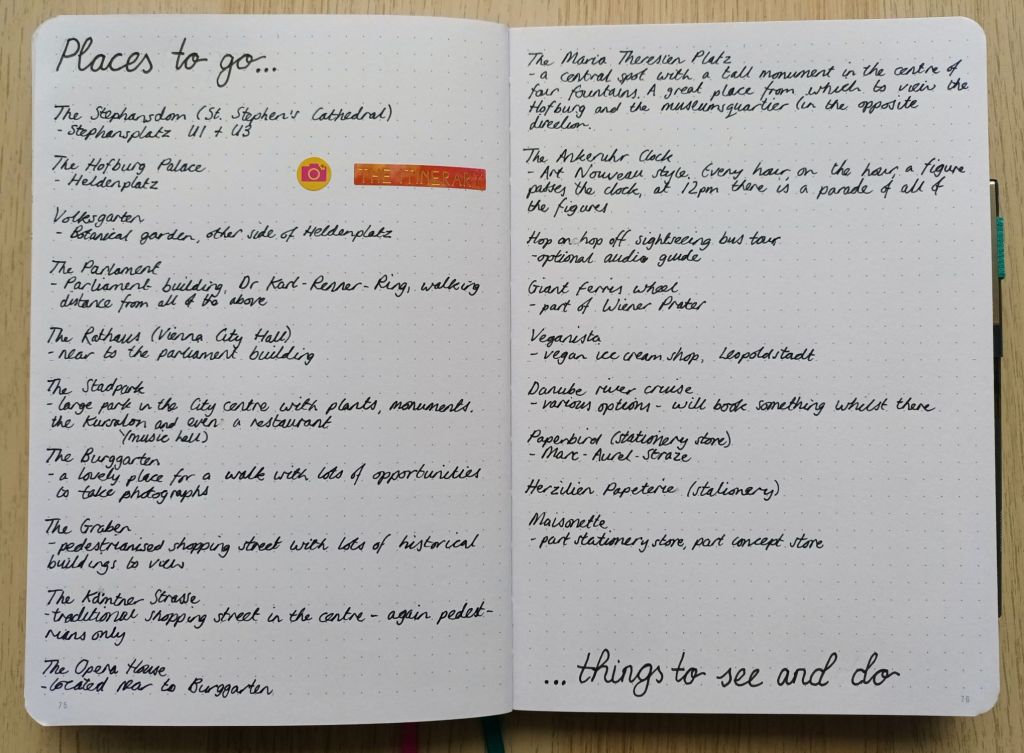
Over the page, I’ve listed the must see and must visit places on a double page spread. This has helped me to create an itinerary for the first full day we are there.

Photo credit: Laura Jones for Keeping It Creative

The next spread I have planned is a list of veggie / vegan cafes and restaurants which we might go to. I’ve tried looking at the menus for various places but most of them seem to be in German. I hope they have English menus as well as I can only speak / read about five words and none of them are food names.

My final travel spread will be my comprehensive packing list. I always do one of these no matter where we are headed and for how long as it ensures I remember everything and helps me to stay calm during the packing process. In the past, sorting everything out for a trip has made me really stressed out so I now do whatever I can to make the process easier and less fraught. Does anyone else find packing and organising for a holiday stressful?

Final words…

I hope you’ve enjoyed seeing my spreads for this month and that they’ve given you some ideas for travel planning and preparation. Obviously, for privacy reasons, I haven’t shown the exact dates for our trip or any specifics related to our journey or accommodation but I’m sure you get the idea and I may share my filled in pages on social media when we return.

Wishing you a wonderful May, whatever your plans are for the month,