I haven’t done one of these updates for a while (it was last March in fact!) so thought I might spend an hour or two composing one this afternoon. There have been quite a few changes since the last one so here goes:
Currently adjusting…
to a new mental health diagnosis. Yesterday, I had an appointment with the mental health team and psychiatrist to discuss issues that I had been having for an almost six month period. Basically, last year, I met with the team as I thought I had cyclothymic disorder which is a mild form of bipolar. However, it felt nothing like a mild illness, with me being very depressed since mid September 2021 and only getting better a few weeks ago. My appointment lasted two hours and it was really helpful as I had a long chat with a member of the team and then a video call with the psychiatrist who is working from home. I’ve now been diagnosed with Bipolar 2 and will be embarking on a completely new treatment plan which doesn’t involve anti-depressants – one of which I’ve been on for over 20 years! So now, I have a new condition to read up on and get my head around. Well, I say a new condition, but really I’ve had it for around 24 years and have only just been correctly diagnosed.
Currently buying…
nothing but the essentials. I have so many clothes, accessories and crafty bits and bobs that I really don’t need anything but food, drink and a few toiletries right now. In fact, I’m about to embark on a huge declutter of stuff as the wardrobe is fit to burst and my craft room has enough materials to last a lifetime and beyond.
Currently enjoying…
seeing glimpses of Spring. Things are starting to pop up in the garden, the birds are singing and the weather is starting to improve – today I went out without my coat on for the third time this year! Although I hate too much sunshine with having very fair skin, I love putting on my sunglasses and going out for relaxing walks or spending time in the garden. when the weather gets milder.
Currently learning…
all about productivity and organising stuff using a very popular method. Although I’ve not read the book, I’ve been able to use information from various infographics and YouTube videos to learn about the Getting Things Done Method by David Allen. I’m hoping to implement the main ideas shortly to help me get super organised and work efficiently throughout the week so I have the weekends totally free to spend time with my husband or on personal projects. If you want to learn the basics, I recommend you check out this YouTube channel as Emma provides a series of videos which talk you through GTD and shares real examples of how she follows the principles.
Currently making…
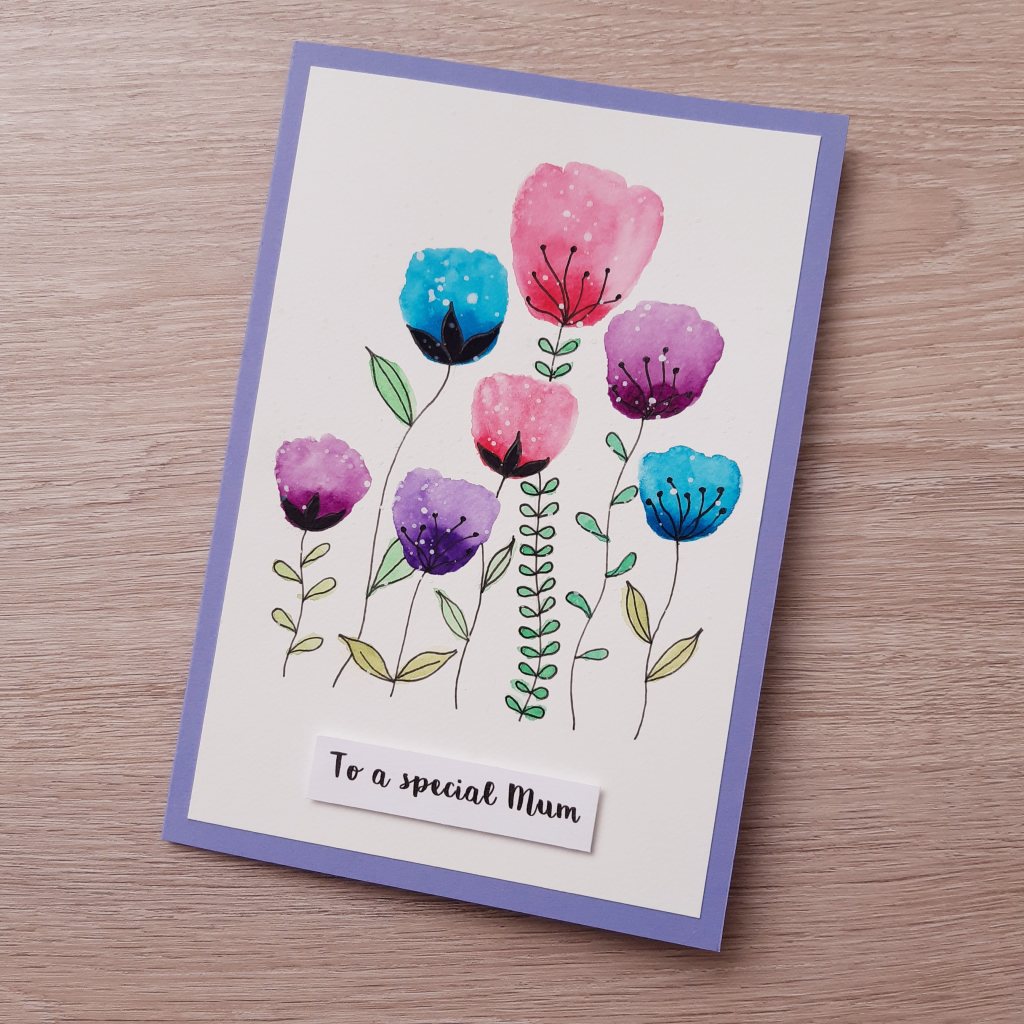
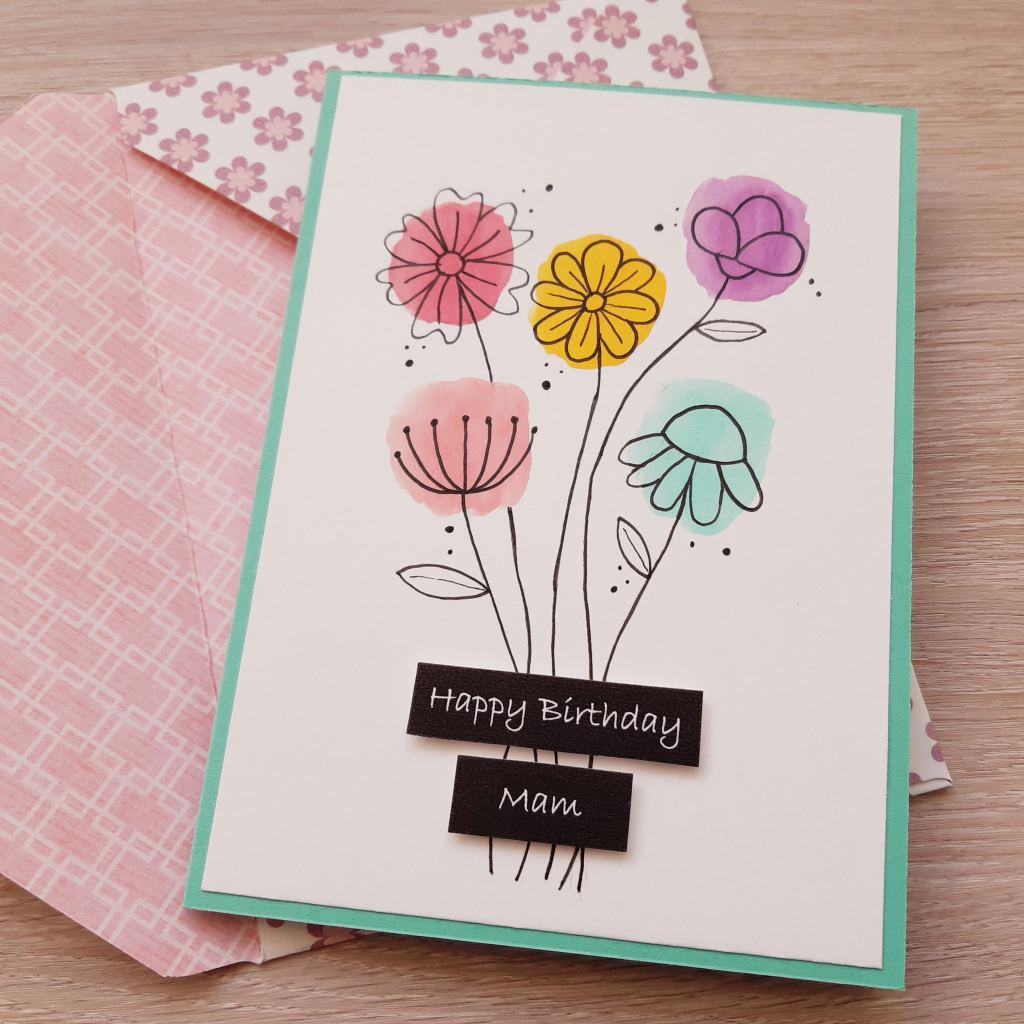
watercolour paintings to be used as designs for greetings cards. It all started when I couldn’t find a nice card for my dad for his birthday so I created a variegated watercolour wash using some of his favourite colours and then added some gold paint flecks to give it some sparkle. Then I started looking at tutorials on YouTube and Pinterest, had a go at some of them, and now I’m hooked on making my own unique cards. I even made my own envelopes using the We R Memory Keepers 1,2, 3 punch board!
Currently pinning…
a range of watercolour tutorials to give me ideas for cards and front cover designs for my monthly bullet journal set ups. I’m now using a Scribbles That Matter journal so the pages are nice and thick, although often I do the painting on hot pressed watercolour paper and then scan, print and stick it in. If you want to see some of my pins, you can check my Pinterest here.
So, that’s a mini update on me and my life currently. I hope you enjoyed reading about what I’m up to. I might do life updates more regularly in future, particularly if my new treatment plan for Bipolar 2 helps to keep me well. And if anyone reading has Bipolar disorder and writes about how it affects them in their blog, I would really love it if you dropped the link in the comments so I can check out your experiences and see if I can pick up any tips on managing the condition. Until next time, keep safe and well.
Back in October of last year, I found my mental health deteriorating, and, once again, started to have difficulties with anxiety and depression. I’m now (thankfully) feeling much better and my improved wellbeing has enabled me to start blogging again. Whilst I was struggling, the main focus of life was on doing any little thing I could either to distract myself from how I was feeling or to improve my mood. I found music was a huge help and so, for today’s Monday Matters post, I want to focus on the benefits of listening to music. The following are applicable whatever your musical preferences and can be utilised whether you are finding things difficult at the moment or feeling happy, content and positive, like I am currently. Let’s get started..
1. Elevates your mood
Whatever our taste in music, I expect we can all name at least one song which, when it starts to play, is able to shift our mood in a matter of seconds, making us want to turn the radio up, jump to our feet and start dancing around the room or burst into song. It may be the tempo, the lyrics or the sparking of a happy memory which uplifts us. Whichever of these it is that gets us going, scientific research proves that these tunes promote the release of a neurotransmitter known as dopamine into our bodies and it is this which is responsible for making us feel so good. If you do find yourself singing or dancing along to the music too, you will be doing yourself the extra favour of encouraging happy hormones known as endorphins to flood your body as well!
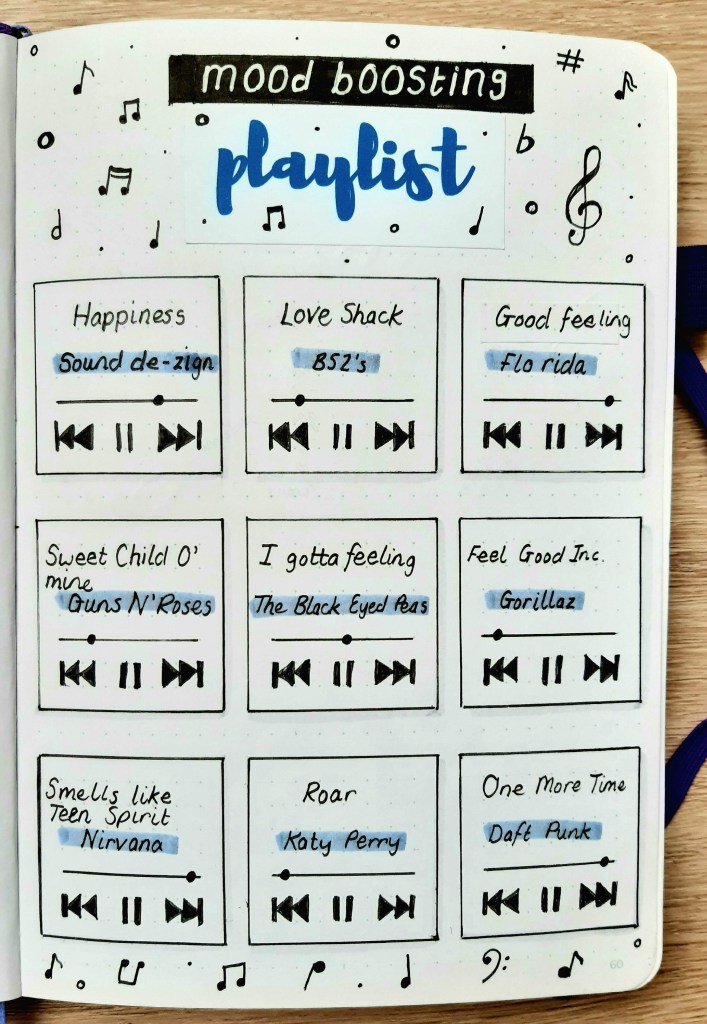
Making a playlist for times when you are feeling a little low or even depressed can be really useful. This can either be on your phone, your IPod or even in your bullet journal so you can seek out those songs on Spotify, YouTube or whatever is your music player of choice. Having them written down is particularly helpful for those times when you are struggling as, at that time, you may not be able to recall songs which are able to make you feel more upbeat.
The following page was inspired by one created by @sunshine_journal_ on Instagram.
A page from by current bullet journal. Photo credit: Laura Jones for Keeping It Creative
2. Improves your workout
According to my Fitbit app, which has just this second provided me with an activity tip (it must have somehow known I was writing this blog post):
‘Listening to music can help exercise feel easier, and even boost your speed. Songs with 120-140 beats per minute appear to have the biggest motivating effect’
Source: Fitbit app info.
Clicking through to the information, which was written back in 2017, I learnt that music can increase your speed, make you feel more powerful, make exercising feel easier (wahoo!), boost your mood and help to keep you motivated. When I was battling with my mental illness, I didn’t have the energy to do my Zumba workouts but I did make sure that I went for at least one long walk per day and my playlist helped to put at least a little bit of a spring in my step. Now I’m back to good health, the music is really motivating and some of the track make me want to break into a run (luckily I haven’t acted upon the urge as I don’t wear my sports bra whilst pounding the streets or the paths of my local park and don’t want to be off to the doctors with detached boob syndrome which I’m sure would be the resulting affliction lol!).
Here’s a list of some of my motivational music, many of which I copied into iTunes from some old CD singles which I believe I purchased whilst at uni many moons ago:
Choose Life – PF Project feat. Ewan McGregor
Forever – Dee Dee
Another Chance – Roger Sanchez
Alone – Lasgo
Beautiful – Matt Darey Feat. Marcella Woods
Treat Infamy – Rest Assured
The Night Train – Kadoc
The Silence – Mike Koglin
Kickstarts – Example
In For The Kill – La Roux
They’ve been put into a playlist on my old Apple iPod, aptly called ‘On The Go’ as I couldn’t work out how to give them my own title.
3. Boosts your concentration levels when working or studying
When I’m struggling with anxiety and depression, it becomes very difficult for me to concentrate on the simplest of tasks and even harder to be motivated to do things in the first place. Studies have shown that particular types of music can be really useful in encouraging productivity and creativity. Some tunes can also be quite therapeutic, reducing stress levels so that you are able to concentrate better. Personally, I prefer instrumental music as many lyrics can be more of a distraction than a help. Whilst conducting online research for today’s blog post, I discovered that the best types of musical accompaniment were suggested to be the following (one of them may surprise you like it did me!) :
classical music
ambient music
nature sounds
between 50 and 80 BPM (Beats per minute)
video game music!
You can find many different collections of classical music for work or study on YouTube but I like to create my own playlists as there’s nothing worse than a tune coming on that you simple don’t like. My absolute favourite has to be Fur Elise by Beethoven, but, my musical choices are often dependent on the type of task I’m working on.
Ambient music is a genre that is generally identifiable as being atmospheric and environmental in nature. According to online definitions, it is gentle and largely electronic with no persistent beat. One of my favourite pieces of ambient music is Porcelain by Moby and, although mostly tracks are instrumental, this one does have minimal lyrics. If your chosen music does have words, I think it is best to have the song on at a low volume so they don’t distract you.
I love listen to the sounds of nature in my local park or in the garden on a fine day. When you’re working or studying, apps such as ‘Calm’, ‘Sleep sounds’ or other relaxation and meditation focused packages, are great for providing nature sounds such as rain on leaves, Autumn woods, water flow, coral reef and wind in pines. I’m not sure how much of the Calm app is accessible for free ordinarily because I’m currently making use of an extended free trial but the sleep sounds app has lots free to use (my phone is Android but I expect there are iPhone Apps too).
According to my research, music at 50-80 BPM is good for stimulating the left side of the brain for information processing and problem solving. Again, collections of tracks can be found on YouTube but I would definitely recommend you create your own playlist of music you love. For sparking your creative juices, more upbeat, faster music is suggested (more BPM).
Who knew that music created to accompany video games could help boost your output? I certainly didn’t. The ones that I play tend to get on my nerves and I mute them but apparently they’re designed to enhance your gaming experience by stimulating your senses and blocking out other stimuli which may distract you. One game that both my husband and I always have the music on for though, is Angry Birds 2 but I’ve never thought of listening to it when working or studying – that is, until now (I may just have it playing in the background as I type away on this blog post!).
4. Calms the mind and relaxes the body
Some music can be really soothing when you are feeling overwhelmed, anxious or uptight. According to a number of studies, listening to calming tracks can help you relax by slowing your breathing and heart rate, lowering blood pressure and reducing levels of stress hormones such as cortisol and epinephrine (AKA adrenaline). Try searching for ‘peaceful music’, ‘soothing music’ or ‘music for relaxation’ on YouTube (I found some wonderful extended compositions by talented Norwegian musical artist Peder B. Helland whose videos also contain beautiful imagery), create your own playlist or check out some of the music on apps such as Calm.
5. Great for mindful listening
Music can be a great part of your daily mindfulness practice. Mindfully listening grounds us in the present moment and, by paying attention to what’s going on currently, you won’t be focusing on ruminating about the past or worrying about things in the future. Mindfulness is obviously a huge topic which I couldn’t possibly cover in this blog post but with regard to mindful listening to music, you can start with really paying attention to the piece, noticing its melody, rhythm, tone or lyrics and tuning in to how it makes you feel or what emotions it evokes. And of course, if your mind wanders off, as with all mindfulness practices, gently and kindly bring it back to the music without berating yourself for losing your attention or starting to think things such as ‘I can’t do this’ or ‘why do I have the concentration skills of a goldfish?’!
6. Combats isolation and feelings of loneliness
Many of us will be struggling with feelings of isolation and loneliness right now due to the effects of local lockdowns and social distancing as the result of Coronavirus. Studies have shown, however, that listening to music can combat these by triggering the release of a hormone called oxytocin which plays a key part in cultivating empathy, trust and compassion for others and creates a sense of belonging and connection.
7. Brings back happy memories
Sometimes, when you hear a song on the radio, it evokes happy memories and has the ability to transport you right back to the time when you first heard it or to a particular occasion (e.g. your wedding day, a night out with friends in your early 20s, or a family get together. Adding these to a playlist can evoke fond memories or help you recall and remember happier periods of your life when you’re feeling down. Research has shown that just replaying music helps us reconnect with the feelings we were experiencing at the time.
Talking of memory, there’s also scientific evidence that listening to music can help us retrieve memories and is also good at helping us to lay down new ones. For this reason, music can be wonderful resource for elderly relatives or those who have dementia.
8. Helps you to process difficult emotions and heal from heartache and grief
I’m sure most, if not all of us have experienced the heartache that goes with losing a loved one at some point in our lives. Although music doesn’t have the capacity to make the feelings of emotional anguish or grief go away, it can certainly help us process and make sense of things. Seeking out and listening to tracks where the lyrics seem to be describing our situation perfectly is something many of you will have found yourself doing automatically. In the past, following the breakdown of a romantic relationship, I would always find myself reaching for CDs of sad songs and having a good cry. I wasn’t sure that choosing such tunes was helpful, but according to my research, it definitely can be. In fact, listening to music which matches our mood (either in terms of tempo or lyrics), whether that be sadness, anger, excitement or joy, benefits us by activating our limbic system (the section of our brain which is directly related to emotional processing).
Final thoughts…
I hope you have found this music focused post helpful in some way and that is has encouraged you to think about using songs and instrumental pieces to benefit your mental health and wellness. Let me know in the comments if any of what I’ve said resonates with you.
This month, I decided to start a yoga journal to record my sessions and reflect on the progress I’m making and how it is helping to develop me mentally and physically. It’s something I’ve thought about doing for a while as I’ve been doing yoga almost every day for over a year now. Today, I’m sharing the benefits of the journal and what I include in mine. I’m also going to show my actual journal and some of the contents, as I’m really loving using it and thought you might like to see how much I write.
Why keep a yoga journal?
I’ve only been keeping my journal for a week but so far I’m finding it really helpful. Here’s some of the main benefits I’ve found so far:
it’s a wonderful creative outlet – I really enjoy writing and I love any opportunity to get my thoughts and feelings down on paper, if you feel the same, why not have a go!
it’s helping me become more in tune with my emotions by reflecting on how I feel before and after my practice – sometimes I discover I’m frustrated because I feel like I haven’t achieved enough in my day, but then after my session, my concerns have melted away
it’s great for accountability
I’m becoming more aware of my progress – it’s helped me realise that there are poses I can now do more easily than when I started a year ago were much more challenging
I’m connecting more deeply with my practice by reflecting on it regularly
What equipment do I need to get started?
All you’ll need is a notebook (or some space in your BuJo if you prefer to plan and journal all in one place), a nice pen (I’m using a Muji gel pen in 0.38 as I prefer a smaller nib) and some scheduled time in your day to get writing (for my post of creating and sticking to new habits click here). I’m also using some small sheets of sticker paper to put in images of poses I’ve been practising so I have a visual reminder of the correct form and any modifications or variations for less advanced students – this is completely optional though and just my preference.
My journal is quite small at 4 x 6 inches and the lined pages are relatively thin. I already had this notebook in my stash and, as it’s so pretty, I enjoy looking at the covers each day. The paper isn’t the best quality but it’s just fine for notemaking and adding images of asanas that are new to me or that I need to modify with various equipment. Also, I’m a fan of hoarding pretty little notebooks rather than actually using them so this was the perfect opportunity to use one of my supplies!
My cute notebook – a bargain from TKMaxx a couple of years back!
What should I include in my yoga journal?
Here’s my ideas of what to include if you fancy starting your own journal for your yoga. It might also spark prompts for other form of exercise or mindfulness practises that you engage in on a regular basis.
date and time
length of session
class / home practise?
video / book / ebook or just practising from memory of different asanas?
how did I feel before?
which asanas did I do?
what equipment did I use and how did it help me?
which of the asanas did I find difficult?
what do I want to work on next time?
how do I feel after?
I’ve added these suggestions to the front of my journal so I can turn to the page for ideas. I don’t necessarily answer all of the questions each time but it reminds me of things that I can include if I want to.
Here’s a few example pages from this week:
Prompts on back of front cover and first page. Photo credit: Laura Jones for Keeping It Creative
More journalling page examples. Photo credit: Laura Jones for Keeping It Creative
I hope you have enjoyed reading my ideas for creating a yoga journal and that my post has encouraged you to start your own to record your fitness journey. Let me know in the comments if you already track your progress in some way or if you are thinking about setting up your own yoga journal.
The end of September marks the beginning of the season of Autumn and is an ideal time to ramp up your self care regime. In today’s Monday Matters post, I’m going to share 8 ideas to get you started.
Get your home Autumn ready
As the weather turns chillier, it’s time to pack away your Summer clothes and accessories, give your wardrobe and drawers a good vacuum and then fill them with cosy jumpers, knitted cardigans, scarves, hats and gloves. I also like to adorn my sofa with a couple of soft blankets to make use of on chilly evenings.
Go on a nature walk
I love to go on long walks in the countryside all year around but being out in nature in the Autumn time is particularly special. It’s such a complete feast for the senses with all the changes that are taking place as I shared in this blog post last September.
I also like to take my DSLR camera with me so I can collect photographic examples of the season such as leaves changing colour, wild and wonderful fungi, fallen conkers, acorns and sycamore seeds, hedgerow fruits and super sweet wildlife such as squirrels and hedgehogs.
Make a deliciously warming soup
It’s now the perfect time to have a go at making your own delicious and nourishing soup. I like to make the most of seasonal vegetables and try out lots of different squashes. Each one has a slightly different taste so why not try a few and see which you like best?
Sort out your skincare routine
I find that my skin gets really dehydrated in Autumn and Winter due to a combination of having the central heating on and the drying effects of the cold and windy weather so developing a good skincare routine is vital. After my daily shower, I apply a generous amount of aqueous cream all over my body but particularly on my legs which tend to get very dry and cracked. I then use a rich vitamin E cream on my face which contains an SPF and gives my skin a lovely radiant glow. Throughout the day, I make sure I drink plenty of water, adding a sugar free Cherries and Berries squash to make it more flavoursome. Before going out for my daily walk, I apply Vaseline to my lips as a protective barrier against the elements. I use the same face wash all year round which is a mild, gentle and fragrance free one specially formulated for sensitive skin and I make sure I moisturise well after each use. I’m also debating adding a night cream to my routine this year too but I need to do a little more research on them first.
Try out an Autumn craft
Doing something creative can be a great mood booster and a chance to practise mindfulness. There are lots of ideas for Autumnal crafts for adults and kids on Pinterest but this Autumn leaf Mason Jar craft particularly caught my eye.
Snuggle up and read
Get your cosiest pyjamas on and your warmest socks. Make your favourite hot drink and then snuggle up on your sofa wrapped in a soft blanket to read a good book. Bliss!
Treat yourself to an Autumn scented candle
A cheap and easy way to create a cosy Autumnal atmosphere in your home is to treat yourself to one or two gorgeous scented candles. There are so many different fragrances to choose from and a quick Google search produce results such as pumpkin spice, warm apple and cinnamon, pecan pie, crisp campfire apples, vanilla pumpkin marshmallow, spiced orange and Autumn glow.
Make an Autumn bucket list in your bullet journal
A wonderful spread to make in your bullet journal and to ensure you get the most out of the season is an Autumn bucket list. Then you can add all of the above activities plus any of your own that you want to try. Search Fall or Autumn bucket list on Pinterest and select your favourites.
Photo credit: Laura Jones for Keeping It Creative
I hope today’s post has given you lots of ideas on how to look after yourself over Autumn. I would love to hear about your plans for the season so, if you get the chance, leave me a little comment below.
A few months ago, I wrote a blog post which explored different ways to practise self love and gave some ideas for bullet journal spreads you might like to try. Today’s writing is an extension of this them and focuses on self-compassion. I hope you find it both interesting and useful.
What is self-compassion?
Self-compassion is all about showing yourself warmth, love, kindness and understanding, especially during difficult times. It’s about accepting ourselves as we are, learning to be less self-critical and avoiding judgement. It’s about being mindful of our different emotional states and the situations we find ourselves, recognising that we all make mistakes, that no-one is perfect and that we all struggle at times so we’re not alone in our suffering.
Why should I practice self-compassion?
There has been a lot of recent research into the benefits of being self-compassionate and how it can work wonders on our wellbeing. Individuals who practise self-compassion have been shown to be much happier, more optimistic, grateful for what they have, and enjoy better relationships with their loved ones. They’ve also been shown to have lower stress levels as they avoid being judgemental towards themselves, others and situations, recognise and accept that we all find things hard at times and, through mindfulness, become more in tune with their thoughts and emotions. Self-compassionate people are also likely to have a higher level of resilience as they are easily able to bounce back from difficulties and can accept and learn from their mistakes.
Self-compassion is also a great antidote for perfectionist tendencies, which I, for one, have always struggled with, right from childhood and I’m sure many of my readers will have too.
How can I bring self-compassion to my life?
Today, I’m going to share with you some simple ways to bring self-compassion into your life so that you can start being easier on yourself and show yourself the love and kindness you would demonstrate to someone else you care about.
Notice and reframe your critical self-talk
I’ve spoken before about the negative ways in which we tend to talk to ourselves before in my blog post about self love. We can be so good at saying unkind and unhelpful things such as “I’m such an idiot”, “Other people are so much better than me”, “No-one likes me” and “I’m just no good at…” etc. And, as you can imagine, this critical inner voice can destroy our self confidence and lead to feelings of worthlessness and depression.
So how can we put the lid on this damaging talk? The very first step is to start noticing when you are being self-critical. Take the time to examine the situations in which you use negative self talk, the exact words you use and the tone of voice that you adopt. You could even try keeping a little notebook of examples to reflect on. Now consider how you could reframe things in a more positive way. Focus on being self-compassionate, non-judgemental, supportive and mindful of the situation. If you find this difficult, think about what a really compassionate friend would say to you. Changing how we talk to ourselves might be hard at first but it will get easier with time and practise so keep working on your skills and congratulate yourself on your efforts.
Write yourself a letter
This is a great exercise to do if you are going through a difficult time or are struggling to accept something which has caused you mental pain. Start your letter by outlining the situation that you find yourself in and how it has or is affecting you. Next, go on to identify your thoughts and feelings and what you were hoping for or needing to make things easier. Now offer a message of common humanity which will remind you that you are not alone and encourage you to feel connected to others e.g. ‘we all make mistakes’ or ‘everyone has times when they feel…’ etc. Finally, offer yourself some guidance and positive encouragement like you would to a friend who needs your support. Sign your letter with a loving message and add some stickers, washi tapes or little drawings of something nice if you would like to. When you have finished your letter, you can either read it out loud to yourself straight away or put it away somewhere special for when you need to show yourself some compassion.
Start a self-compassion journal
Keeping a journal is a great way to reflect on how you are feeling and what is happening for you right now. I like to spend about ten minutes each evening writing down my thoughts. What I chose to write about differs each day but might include:
what I have achieved today
what I learnt today
ways in which I am proud of myself
things I’m grateful for
anything I found challenging today and why
what I’m looking forward to tomorrow
anything I’m feeling apprehensive about
You can finish your writing by adding some kind, understanding and sympathetic words to yourself. For example, ‘most people would get annoyed in that situation and it’s okay that you lost your temper’ or ‘things were difficult today, but hopefully you’ll have a better day tomorrow’ etc.
Use affirmations
Another great way of showing yourself loving kindness it to write your own personal affirmations and practise saying them to yourself each day. I like to create a decorative spread of them in my bullet journal every few months – it is a great way of practising my brush lettering too. Here are some examples:
I am enough
I talk to myself with love and kindness
I’m proud of myself and my achievements
I accept my flaws because no one is perfect
I’m doing my best and that is enough
Engage in self-soothing activities
If you know you’ve had a difficult day, your week isn’t going quite as planned or you’re finding yourself in a negative mood, you can help to make yourself feel much better by engaging in some self soothing activities.
Here’s some examples of things I like to do:
take a walk in nature and use my senses to explore the immediate environment
get under the duvet and read a good book
do some drawing or colouring in
listen to a guided meditation
make a collage in my bullet journal of things I love
do some watercolour painting
mindfully eat a bar of my favourite chocolate
watch a funny film
paint my nails
If you would like to read more about using self soothing for emotional regulation, you can check out this blog post I wrote last year.
I hope today’s blog post has helped to develop your understanding of self-compassion and how important it is. Let me know which of the activities I suggested appeal to you the most and if you try some of them, be sure to share how you got on.








 Keeping it creative