Posted in Bullet journaling, goal setting, life hacks, lifestyle, Planning and journaling, Setting goals and intentions, wellbeing

Monday Matters: A guide to creating your own seasonal bucket list for Spring 2024

For Autumn 2023 and Winter 23/24, I have thoroughly enjoyed and benefitted from creating my own personalised bucket lists and adding my seasonal ideas to a two page spread in my bullet journal for inspiration and reference. For each of the seasons, I also handmade and stitched a pretty TN wide size notebook to go in my TN journal where I added photographs, text, a variety of stickers, ephemera and tip ins to record my achievements over the months. I’ve found the bucket lists a great way to plan in some interesting and exciting activities, set some goals and ensure my husband and I make the most of each season of the year. So, today, I’m sharing my bucket list for Spring 2024, in the hope that you will be inspired to create your own and live your life to the full.

What is a bucket list?

A bucket list is a number of items that a person would like to achieve, experience or bring into fruition over a given time frame. This could be over a lifetime, a year, or, as with mine, during a specific season. There are many benefits of creating and working towards things on your bucket list including:

  • Helping you to reflect on what is important to you as an individual and what you really want from life
  • Offers you a number of things to look forward to over the chosen time frame, increases your excitement levels
  • Providing you with a visual reminder and the focus and motivation you need to move towards your goals
  • Creating a sense of accomplishment
  • Pushes you out of your comfort zone which is really good for your personal growth

You can create one which is just for you, or you could make plans with your partner, a close friend or even sit down as a family to come up with some ideas together.

My Spring 2024 Bucket List

Here’s my bucket list for this season in my bullet journal. The words and images were all made into stickers using Cricut Design Space and I’m really pleased with how it turned out. I’ve included a little ceramic bunny I purchased, the wooden egg which I got in the Hobbycraft sale last year and the jigsaw I picked out which I can’t wait to get started with. I’m yet to make the handstitched notebook but I have lots of floral papers which will be suitable for the cover.
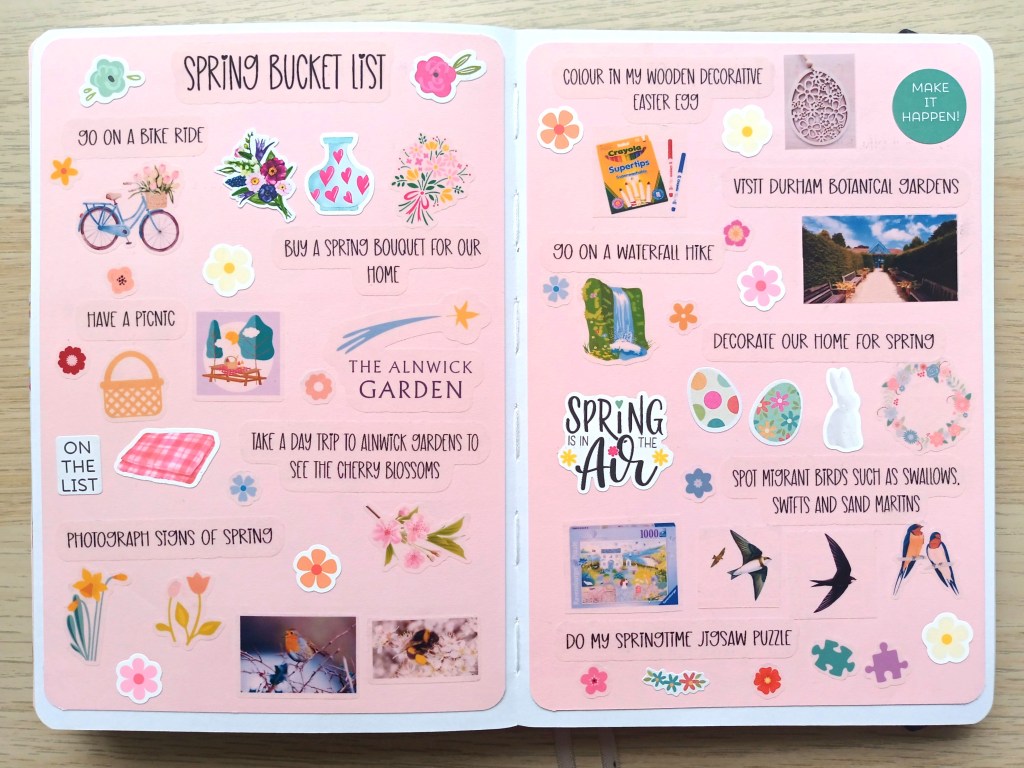
Photo credit: Laura Jones for Keeping It Creative

So, how do I get started with my Spring seasonal bucket list?

There’s plenty of seasonal bucket list inspiration online but I like to spend some time in quiet contemplation first. That way, what I add to my list is all about what I want rather than what others believe would make a good Springtime.

Consider your core values and what really matters – Spend some time thinking about what is most important to you in your life or what you wish to focus on more. You might want more fun and adventure, better balance between work, rest and play, opportunities to develop your creativity, new experiences or the chance to learn a new skill. You might want to experiment more in the kitchen, spend lots of time in nature or plan some different day trips to places in your local area. Living in alignment with your personal values is key to improved psychological wellbeing which includes your general happiness levels and outlook.

Think about the particular season you are making plans for – consider the weather associated with Springtime and any particular holidays or events which take place during the season. So, for example, in Spring, the temperature is starting to rise during the day but the evenings are still pretty cool. In Britain, the weather can be calm and dry, but, showers are also pretty common and it can often be a bit breezy. Buds and blossom begin to appear and early blooms such as snowdrops, crocuses, iris and daffodils begin to pop up in the flower beds. Spring is also the time for observing and listening to wildlife too. Bumblebees and butterflies start to make an appearance and hibernating animals such as bats and hedgehogs can be seen from dusk into the night. You might find frogspawn in ponds and watch tiny froglets appear in a matter of weeks. Birds are noisier and livelier as they pair off and start to nest and spring visitors such as swifts, swallows and house martins begin to arrive.

Mother’s Day and Easter both fall in the Springtime and there are, of course, a few Bank Holidays to look forward to. And if you want to find out about events specific to your town or city this website is a great source of information.

Write down every idea that comes to mind – Make a list of potential ideas, big and small, inexpensive and more costly, time consuming and quick. This could include a visit to Pinterest and other sites to look at bucket list ideas and inspirational images.

Refine your list – Having written a long list, it’s time to decide which items are the best fit for your values and priorities. Try to choose some activities which you enjoy each year and are somewhat traditional, but also make sure you include some which are completely new and will push you out of your comfort zone.

Choose a place to store your list – Having a finalised record of your bucket list is important if you want your aspirations to become a reality. Depending on your personal preferences, you might choose to put your list in your planner or journal or have a digital document in Notion of Microsoft Word. There’s even a website and online community dedicated to bucket lists! And, if you relish every opportunity to get creative, like I do, you can make a physical copy of your list with fancy lettering, motivational phrases, sketches, stickers and inspirational images. You might even find you’re excited to share it with your friends and family too.

Remember things can change – Your finished bucket list is a set of items that you hope to experience this Spring but, it’s not a list of commitments or things that you must do or achieve over the time period. You may find that priorities or circumstances change and that some of the items become less important or need to be put on hold for another year. You might also learn of some new opportunities as the season progresses which you want to add to your list or replace an item with.

Previous Bucket Lists

I think I’ve previously shared my Autumn and Winter bucket lists but thought readers might like to see them again for examples of the kinds of thing you could add and how you might decorate a spread in your notebook or bullet journal.

I achieved everything on my Autumn one but didn’t get to play in the snow over the Winter time as it was mostly wet and often quite mild. I still included all of the items in my Traveler’s Notebook journal. but I wrote a few lines about the weather and the impact it had on the season.
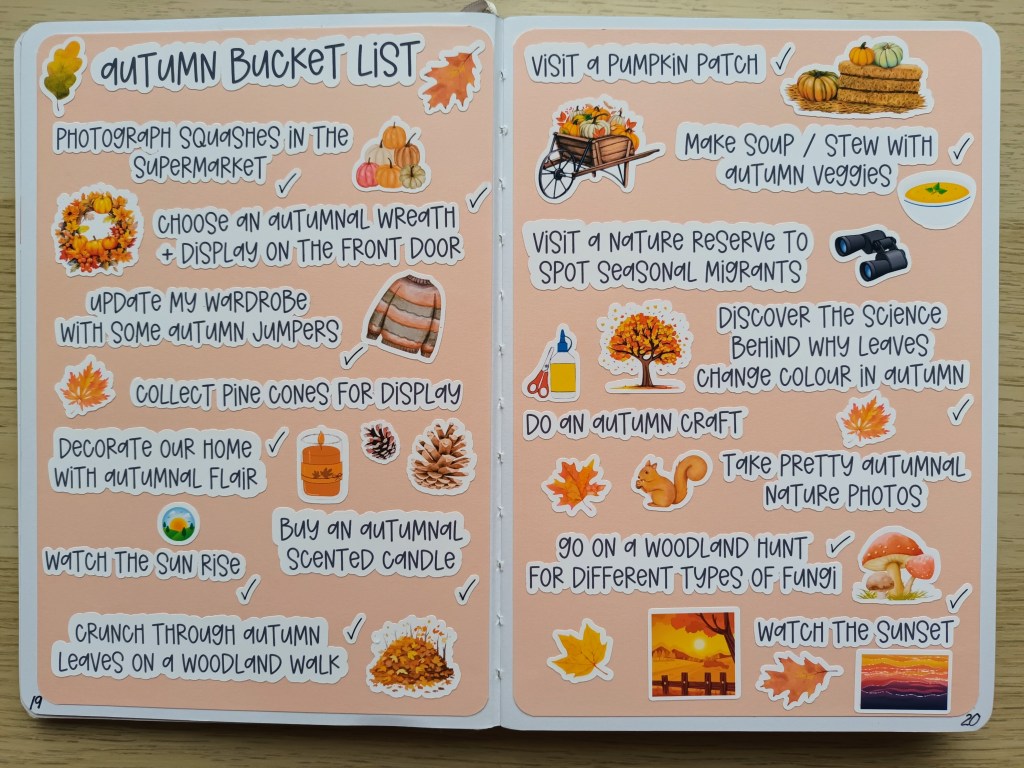
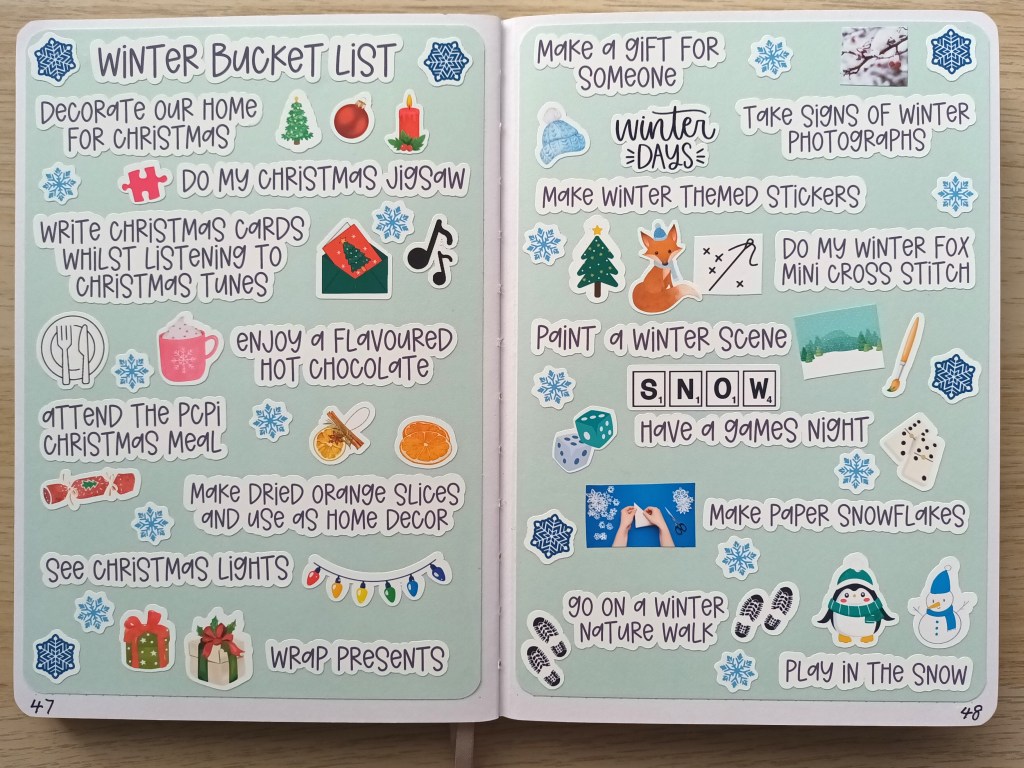
Photo credit: Laura Jones for Keeping It Creative

Final words…

Creating a bucket list for the season is a wonderful way to plan in some interesting, fun and different activities for the coming months. I also enjoyed making stickers to go with the items on my list but if you prefer, you could have a go at drawing and colouring in some little pictures instead.

Let me know a couple of items that you want to add to your list for Spring 2024. I’m looking forward to hearing your ideas and hope you thoroughly enjoy creating some new memories.

Posted in finances, goal setting, life hacks, money management

Monday Matters: Should you do a ‘No spend November’ challenge next month?

Last week, I was talking to my other half about what an expensive month October has been for me. Firstly, it’s my husband’s birthday on Halloween, and, although I haven’t bought him too many presents, I like to get him something that he really wants and at least a couple of surprises as well. Secondly, an incident occurred with my much loved and well used Kindle. In our house, we have quite a lot of plants and we have an issue with tiny, little compost flies, which, as their name suggests, tend to live in the soil of our plants but also like to venture out around our rooms, gravitating towards anything they like the look of. One landed on the screen of my Kindle when I was reading and I whacked it with my hand. Unfortunately, my wedding and engagement rings also hit the screen and fractured it in several places in the very centre, causing the backlight to shine through. So, because I read my kindle on a daily basis, I had to purchase a replacement straightaway and that was an unexpected expense (well, obviously I could have managed for the time being but I love reading so…). Finally, my craft room tends to get a little cold in the autumn and winter months so I have added to my collection of jumpers to keep me warm.

My husband suggested that I do a ‘no spend November’ and I thought, “Ooooh, that has a nice ring to it, surely he hasn’t just made that up?” and sure enough, I Googled it, and it is already an actual thing. I read up on the basic premise as obviously the month can’t be entirely expense free (I’m pretty sure HSBC won’t be impressed if we don’t bother paying our mortgage next month and it won’t be much fun if we let the cupboard go bare and have nothing to eat!) and so I thought I’d share what I learnt in case you want to know more or join me in the challenge.

Let’s get to it…

What is ‘No spend November’?

Basically, ‘No spend November’ is a way of saving money by only purchasing things that are absolutely necessary. The goal of the challenge is to save more, make better spending decisions and to live more simply throughout the month. It’s considered an ideal time to reign in your spending as you’ll avoid buying unnecessary ‘bargains’ during the Black Friday period and it will help you to save a little (or maybe even a lot) for the festive period.

You can plan for the challenge to last the whole month, or you can identify a shorter period of no spend time in November – say for a week or a fortnight. You could also choose certain days of the week as no spend days such as weekends or Fridays. If you found it fun or helpful, you could also repeat the challenge at another time, such as when trying to save up for a holiday or a special event.

Essentials to continue to spend money on

Obviously, no spend doesn’t literally mean no money coming out of your bank account, but it does mean keeping costs to just the absolute essentials. What you class as essential will be very personal to you and will differ for each individual doing the challenge. Here’s what you might include but might include:

  • rent or mortgage payments
  • utilities such as gas, electric, Internet
  • taxes e.g. council tax
  • groceries
  • childcare
  • insurance payments such as health, life, car etc
  • phone top ups or phone bill
  • fuel or other car expenses
  • memberships that are on direct debit
  • things that absolutely need to be fixed straight away such as a broken washing machine or things that fall in to complete disrepair and need replacing
  • newspapers and magazines (except free ones)

For me, my gym subscription is an essential as it is a key part of my routine and going to classes and talking to others is one of the ways I keep myself well mentally as well as physically.

Non-essentials you might choose NOT to spend money on

Again, this differs from person to person, but some examples include:

  • takeaways
  • coffee shop coffee
  • cake from a cafe
  • meals out
  • craft supplies
  • hobbies
  • branded toiletries and cosmetics
  • entertainment (try visiting free events or go for a walk in your local park)
  • branded groceries or premium selections at the supermarket
  • clothing
  • shoes
  • impulse purchases
  • seasonal decor items
  • lunch from a sandwich shop – make your own packed lunch!
  • books – borrow some from the library instead, read some already purchased novels on your Kindle or re-read favourites

Reasons why you might choose to do a ‘No Spend November’ challenge

  • you overspent last month and so want to have a light spend month
  • you really want to assess your finances and become more in control of your money
  • you want to save money ready for the festive period itself
  • you like to choose Christmas gifts during the month of December
  • you plan to class Christmas gifts for family and friends as part of your essential spending
  • you want to be more intentional with your spending
  • you would like to do more home cooking and having a takeaway free month will facilitate this
  • you want to cut down on luxury items such as expensive toiletries and make up items in favour of choosing simple products like supermarket and chemist own brand items
  • You are a creative crafts type and want to encourage yourself to complete projects you are already working on or use materials you already own such as stickers, papers, yarns, fabrics etc
  • You have a debt to pay off and having a no spend month seems like an ideal way to do it

Reasons why you might not want to do a ‘No Spend November’

  • You have plenty of money for essentials and luxuries so saving and cutting down on spending doesn’t really feel like a priority right now
  • You have a list of items you want to get in the Black Friday sales and you know you are capable of sticking to that list and not buying things on impulse
  • You’re already pretty pleased with the state of your finances and you rarely purchase luxury items anyway
  • You want to try the challenge but at a different time of year, for example January of next year
  • You don’t see the point of the challenge for you personally
  • You feel totally unprepared for such as challenge and know that you won’t keep up with it so why start!

A few tips for a successful ‘No Spend November’

  • Record your why – why have you decided to do the challenge? what do you hope to get out of doing it?
  • Make two lists – one of essentials that you will spend money on and the other non-essentials or luxury items which you agree not to buy
  • Let others know that you are doing the challenge – explain to your partner, tell the kids and explain why the challenge is important to you, tell your friends so they don’t wonder why you are saying no to big night’s out and coffee catch ups.
  • Make a meal plan each week and then create a shopping list based on it
  • Create a picnic of homemade and home-prepared items for your free days out e.g. cheese and tomato sandwiches, chopped vegetables such as carrot or cucumber sticks with hummus for dipping, crisps from a multipack or decanted from a large bag, homemade scones, cakes or a traybake
  • record your expenses and see how they compare to other months – write down how much you think you’ve saved
  • plan some fun nights and days in – maybe have a pamper day or a games night, suggest friends come around for tea / coffee and each bring a sweet treat
  • make a list of things you were tempted to buy during the month and journal about why
  • seek out alternatives to more expensive grocery items e.g. supermarket own brand, budget range items etc

Final words…

So, who’s going to join me for a ‘No Spend November’ and who’s horrified by the idea? If you would like to curb your spending, I would love to hear what category of non-essentials has the most negative impact on your finances and which items you will struggle not to spend on. Let me know in the comments. Mine has to be craft related items or coffees from cafes I think although I may prove myself wrong when I start doing the challenge. Also, I think I may have to identify Christmas presents for others as essential if I see something that is just perfect when I’m out and about!

Posted in life hacks, lifestyle, productivity, self care, Setting goals and intentions

Monday Matters: 7 benefits of a clutter free and well-organised home environment plus some tips for getting started with decluttering

Photo from a selection on Canva Pro

One of my current goals, which has been ongoing for quite a while now, is to declutter, tidy and organise my craft room / office, in a way which makes it a pleasant and distraction free environment and consequently a productive place to work and get creative. It’s an enormous job because a) I have soooo much stuff and b) it’s packed into what, in house buying terms, would be described as the box room / box bedroom. I did get started with the process, but then, I found other easier and more preferable projects and activities to do, and now, even the thought of ‘it’ is overwhelming and enough to put me off.

My knowledge and experience of tackling large projects tells me that taking it one tiny step at a time and making a list of tasks to work from (and tick off) would be helpful but I’m sure any of you who have ‘lots of stuff’ can relate and sympathise with me when I explain that pretty much anything and everything else is getting prioritised instead. To give myself the idiomatic ‘kick up the backside’, the idea of writing this blog post was born, to hopefully be a good reminder of the main benefits of a clutter-free and organised space even though I’m pretty sure you can guess a few of them. This might also help with the absorbing of information and fingers crossed with taking action. Clutter-free, super-organised readers can read and then polish their halos plus maybe leave a tip or two in the comments to help me and others. If today’s post has motivated you or helped you feel less alone in having a less than immaculate home environment I would love it if you dropped a comment below to generally make me and others feel better.

Without further ado, here are, what I consider to be the main benefits of a clutter free and well-organised space whether it’s your whole home, a room within your house or just a small area, such as your pantry or the junk drawer. I hope you find the following useful and that, fingers crossed, it gives you the incentive to take that first baby step and then keep going.

Reduced stress and anxiety

Being in an environment full of clutter causes sensory overload, heightened stress levels and feelings of shame and embarrassment (especially if you have visitors). The opposite is true of a clutter free and well-organised home. You’ll find yourself calmer, more relaxed and in control. You’ll likely feel a sense of pride when you look at your environment and what you’ve achieved and are able to maintain, and, you’ll also be much happier showing visitors in – even those who are unexpected! Plus you won’t be needing to apologise for the mess anymore or spend frantic hours trying to hide clutter in random, out of sight places.

Boosts productivity and creativity

A neat and tidy work environment means fewer distractions and plenty of space in which to work. This generally leads to better concentration levels, deeper focus and improved productivity. It also helps to free your mind of mental clutter and provides the space for innovative thoughts and letting your creative juices flow.

So much easier to find things

When you have fewer possessions and every item has a specific home, it makes it much easier to find something when you need it saving you a lot of time and energy. On the other hand, if you’re house is in disarray, it can become extremely frustrating and time consuming to locate the item you need. Often, when I’m struggling to find something, I get myself so worked up that I end up in tears. Aldo, searching places that the item might be reminds me of how much stuff I actually have (and creates feelings of guilt) and brings to mind how, in the past, I’ve bought things to try to make myself feel better when I’ve been depressed.

Rids your home of allergens

As someone who is asthmatic and has a dust allergy, this one is a huge plus for me. Keeping a tidy and uncluttered home makes it much quicker and easier to clean and remove dust, moulds and mildew. Plus, less stuff in general helps with airflow and ventilation. This is good news for anyone with respiratory conditions or other allergies which many people have.

Improved sleep

A neat, tidy and clutter free bedroom creates a sanctuary in which to seek comfort and relaxation ready for a restful night’s sleep. It also provides a peaceful and calming space in which to enjoy a slow start to your morning routine, rather than being immediately overwhelmed by stuff as soon as you open your eyes.

More time for hobbies and socialising with family and friends

A clutter-free and organised home environment is so much quicker and easier to clean and keep tidy. Less time on household chores leaves you with more time to engage in your favourite hobbies and more opportunites to socialise with family and friends. It also means that you can happily invite people round to enjoy your home with you.

Better relationships with those you share your home with

When researching today’s blog post, I came across a range of articles and studies which discussed how mess and clutter can affect relationships and even completely destroy them. This can be due to the clutterer struggling with psychological issues as a result of their stuff, leading to feelings such as stress, anxiety, overwhelm, shame, depression and low self worth. Or, the clutter can cause conflict between individuals living in the home creating feelings of anger, resentment and frustration as well as being a source of arguments and ill feeling.

On the other hand, a tidy and clutter free home environment creates a harmonious and happy house, where all occupants can relax and feel comfortable. A well-organised home also reflects personal qualities such as a sense of control, high self worth, confidence, purposefulness, self love, resourcefulness and resilience, which, together with teamwork and authentic conversation with regard to belongings can result in a much more amicable and loving relationship with your partner or housemates.

Tips for getting started with decluttering

  1. Make a commitment – before you start, you need to be prepared to put in the required time and energy for decluttering. Creating a clutter free and organised home doesn’t happen overnight, it takes a huge commitment which is why it’s good to consider the benefits discussed above. Tidying and decluttering needs to be a priority in your life and something you put your heart and soul into. The tip below should really help to get clear in your mind about what the benefits are for you personally.
  2. Think about and visualise your overall goal – imagine what your tidy home would look like and how it would feel to be there. Visualise yourself walking through your house when you’ve met your goal. Consider exactly how you would spend your time at home. Sketch or write about the improvements you’ve made and ask yourself why it feel the way it now does – a key to manifesting a clutter free and organised home is to imagine you already have exactly what you desire.
  3. Start small – set tiny goals such as tackling one box, one drawer, one shelf, a single pile of papers. Work on one room at a time and make a note of places to work on which will really make a difference – so for example your desk space in your office or craft room, the main counter in your kitchen or the coffee table in your living room.
  4. Allocate an amount of time to the job – you might decide you have 5 or 10 minutes, an hour or a whole afternoon (starting small is good if you’re feeling overwhelmed) . Set a timer and turn on do not disturb mode on your phone.
  5. Take before and after photographs – want a visual reminder of how much progress you’ve made? Take a quick snap on your phone of what the area looked like before and what it looks like at the end of your allocated amount of time. Repeat before and after each decluttering and tidying session.
  6. Get support from an expert Once you’ve got started with the process and have seen some of the impact you can have, you might want to get help from a professional declutterer or a celebrity who has created a home you admire. So, for example Marie Kondo has developed the Spark Joy method for tidying where you work on categories of items in your home in the order suggested, whilst Stacey Solomon has her TV series ‘Sort Your Life Out’ plus her ‘Tap to Tidy’ book full of advice and tips. You don’t need to actually invite Kondo or Stacey Solomon to your home – just make use of their skillset.
  7. Enlist help from family or others in your social circle – if you find decluttering overwhelming, you might want to enlist the help of a family member or friend, even if they’re just there to help you gather things together, make decisions about where to store things or to offer moral support. And if they can’t be there physically, use them as an accountability partner asking them to regularly check in to see how you’re getting on and what progress has been made.
  8. Donate, sell or recycle what you can. This will help you reduce waste (and feel good about your impact on the environment), make a little extra cash or help someone in need (just because it doesn’t spark joy for you, doesn’t mean it won’t for others).
  9. Find a specific home for each and every item – the key to keeping your home neat and tidy is to have a specific storage location for every single item. That way, you’ll know exactly where to put it when you’ve finished with it or where to display the object in your home. Try to keep most things out of sight in drawers, cupboards and boxes as this will make it easy to clean surfaces.
  10. Don’t strive for perfection As you embark on your decluttering journey, be kind to yourself and celebrate small achievements and elements of progress along the way, rather than expecting everything to be perfect before moving on to the next task. Decluttering is a process and can take a lot of time (often much longer than you think), so little and often is the way to go. Also, slightly lowering your expectations can help you to feel like you’re getting there.

I hope you’ve found today’s blog post useful and have picked up a few tips as you’ve read. I’m sure you can see how beneficial a clutter free and well-organised home is for your mental and physical health and how it can make for a happier living space overall.

Additionally, I’m thinking about doing another piece at some point in the future that focuses specifically on decluttering and organising craft supplies, as this, for me, is the area that needs most work. Let me know in the comments if you would find this helpful too.

Happy decluttering, tidying and organising,

Posted in goal setting, life hacks, productivity, self care, Setting goals and intentions

Embrace Your Journey: Living Your Best Life and Achieving Your Goals – Guest post by Linda Chase

Image: Pexels

Today, I’m sharing a second great blog post written by Linda Chase of Able Hire, this time discussing strategies to help you cultivate your best life and meet with success as you make your way towards your hopes and dreams for the future. I’m sure you’ll like the content as much as I did and will pick up some useful tips as you read. Enjoy!


As we navigate through life, we are constantly exploring ways to enhance our journey. The journey to live our best life and achieve our dreams is a continuous process that requires commitment, resilience, and a balanced approach. Here, Keeping it Creative presents eight key strategies you can incorporate right now to help you lead a fulfilled life and accomplish your aspirations.

Build your confidence through fashion

Confidence is a fundamental ingredient for success, and one way to boost it is through your personal style. Fashion can be an expression of your personality, serving as a confidence booster. Dressing in a way that makes you feel good about yourself can have a significant impact on your self-assuredness.

Cultivate resilience

Life is full of challenges, but the way we perceive and respond to these difficulties greatly impacts our growth. Embrace challenges as opportunities for learning and self-improvement. Develop coping strategies, like mindfulness or journaling, to overcome setbacks and bounce back stronger than before.

Embrace Self-Care

In our pursuit of goals, we often neglect our physical, emotional, and mental well-being. Make self-care a priority. Incorporate regular exercise into your schedule, practice mindfulness, and cultivate healthy eating habits. Pursue things that make you happy! If you love art, check out the fun options on Keeping it Creative. These small actions can significantly improve your overall well-being and productivity.

Foster Positive Energy

It’s important to surround yourself with positivity as much as possible wherever you are. If your family, roommates, or coworkers seem stuck in a negative mindset, take time to talk through what is going on and make it right. Then, you can cleanse the space with naturopathic cleaning remedies to reset the energy. You can even smudge with sage if you desire. It is hard to be at your best when you are surrounded by negativity, so take control of the energy around you!

Develop a Growth Mindset

A growth mindset – the belief that you can learn, improve, and evolve – is crucial for personal development. See failures not as dead-ends but as stepping stones towards success. In fact, anxiety and stress can be positive motivators to get out of our comfort zone and do something amazing! Regularly seek out opportunities for growth and learning, and embrace change as a necessary part of the journey.

Stay Curious

Curiosity acts as a catalyst for creativity and innovation, driving us towards our objectives. By committing to daily learning, be it through reading a new book, enrolling in an online course, or delving into a fresh hobby, we stimulate our minds. This practice of maintaining an active and engaged mind is a testament to the power of curiosity in fueling our personal and professional growth.

Network with Like-Minded Individuals

Surround yourself with people who share your values and aspirations. Build a network of supportive, motivating individuals who inspire you to keep moving forward. Exchanging ideas, collaborating on projects, and supporting each other’s journeys can significantly contribute to your overall success.

Keep a Clean Home

The condition of your living environment is a reflection of your mental well-being, and an organised, clean space can positively influence your mood, enhancing productivity and promoting tranquility. Concurrently, setting clear, manageable objectives offers essential direction and focus in your life’s journey. Regularly taking time to declutter and re-organise your physical space is as crucial as periodically reviewing and adjusting your goals for maintaining motivation. Both practices ensure you’re on the right path towards achieving a harmonious mental state and accomplishing your aspirations. Get the most out of your cleaning efforts by taking advantage of resources like Cleaner Digs.

Foster Meaningful Connections

Cherishing our connections with loved ones greatly enhances our overall happiness. It’s essential to prioritise time for gatherings, providing opportunities to fortify bonds and create lasting memories. Embrace technology with a free invitation maker, which simplifies the process of planning both impromptu and scheduled events. You can create invitations by modifying templates and adding your own text.

Search for Joy and Meaning

Living your best life and achieving your goals is a journey of resilience, self-care, growth, curiosity, and supportive networks. By incorporating these eight key strategies into your life, you’re setting yourself up for success. Remember, it’s not about the destination, but the journey, and every step you take towards betterment is a step closer to living your best life and achieving your dreams.


So there you have it, eight wonderful strategies for living your best life and embracing your journey towards your goals. I particularly enjoyed learning more about the effect your physical environment can have on your mental wellbeing. As some of my readers will know, I’m currently in the process of decluttering my craft room and my goal is to have a neat and well-organised space which is a joy to work and craft in. I’ve realised that I would benefit from re-prioritising this aspiration as Linda has reminded me that it’s key to boosting my mood, being more productive and feeling in control.

Both Linda and I would love to hear your thoughts on today’s guest post, especially which points resonated with you the most, so feel free to drop a comment below.

Posted in life hacks, productivity

Monday Matters: Nine super easy ways to improve your concentration and focus when working

Last week, I caught up with a lot of pages in my creative traveller’s notebook journal. I’d had photos and bits and pieces printed for a while and wanted to get them stuck in with typed and handwritten sections of memory keeping and decorative stickers. I’m impressed with how much I got done and for today’s Monday Matters, I’ve decided to share some simple ways in which I ensure I stay focused on the task in hand, concentrate well and improve my productivity levels. So, here’s some tips for better concentration which you can apply today:

Keep hydrated

Throughout the day, I make sure I always have a large bottle of water or squash on my desk to sip from. Keeping myself hydrated helps to prevent headaches, lethargy and decreased alertness – all of which can negatively affect mental performance and workflow. Having a large drink container means I only need to refill during longer breaks and I don’t get thirsty in the middle of tasks.

Eat a healthy diet

We all know that too many junk foods (those which lack nutrients, vitamins and minerals and are high in salt, sugar and fat), are bad for your general health but did you know that they can play havoc with your energy and concentration levels too?

According to my research, the best types of food for improved concentration are:

  • foods high in omega -3 (I’m trying to snack on chopped walnuts whilst working but I really don’t like them! haha)
  • foods high in antioxidants e.g. berries, tomatoes and vegetables such as broccoli, cauliflower and cabbage are particularly good and help improve brain function
  • foods which provide a dopamine boost such as bananas, avocado, spinach, tomatoes, nuts, seeds and chickpeas are great for increased motivation, better mood and improved attention levels
  • a moderate amount of caffeine, for example from green tea, a small amount of dark chocolate or one or two cups of coffee per day (maximum) can increase mental alertness
  • foods high in Vitamins B6 and B12 which improve cognitive function – I get my B6 and B12 from fortified oat and soya milk, wholegrain cereal, eggs, nuts and seeds but none vegetarian sources include lean meat and oily fish.
  • foods high in fibre such as veggies, fruits, whole grains, nuts, seeds and beans which all help to keep blood sugar levels stable preventing spikes and dips in energy

Get some exercise

Exercise is a great stress buster, mood improver and mindful activity, all of which can help with concentration. After a good workout (following the initial tiredness), our mind feels sharper and our cognition improves too. I do yoga, Pilates, Legs, Bums and Tums and Zumba each week but I also make sure I fit in a walk each day, preferably in nature as I find it really calming. I also take mini exercise breaks between working sessions which might involve dancing to a favourite upbeat tune, doing some basic stretches or completing a five minute low impact fat burning exercise such as high knees, modified jumping jacks and oblique crunches.

Work to improve your sleep

At the moment, I generally enjoy a really good night’s sleep and wake up feeling refreshed and ready to start my day. However, in the past, I’ve really struggled with insomnia and know the effect that tiredness can have on both the body and mind. Sorting your sleep out takes commitment but is vital if you want to stay alert and productive during the day. A good place to start is to ensure you find a restful and relaxing activity to do just before bed. However, if you’re really struggling with poor sleep this in depth post should help too.

Take regular breaks

I’ve shared before how I use The Pomodoro Technique to help me take regular breaks during my working day. Taking a short break enables you to rest and recharge ready to continue your task or start a new one. Just make sure that what you do during your break isn’t something just as taxing and mental exhausting as your work related task. Here’s a few ideas:

  • stretch your legs
  • grab a refreshing drink
  • re-fuel with a healthy snack
  • do a mini meditation
  • close your eyes and listen to a favourite piece of music (I prefer classical)
  • tend to your houseplants
  • declutter your workspace
  • read a few pages of a book or magazine
  • close your eyes and do some deep breathing
  • go outside and explore your environment using your senses
  • do some doodling
  • find a new recipe to try (extra points if it’s a healthy one!)

Identify your priorities for the day

Each evening, I like to sit down with my bullet journal and evaluate my day. I then take five minutes to decide what my priorities should be for tomorrow. This could be particular tasks such as shop orders or preparation for a session at the university, but equally, might be wellbeing activities such as enjoying a brisk walk after breakfast or spending some time tending to the garden to get me motivated to do some focused work.

Eliminate distractions

Modern life and technology provide constant sources of distraction which can seriously affect our concentration levels and work rate. However, most of these things are completely within our control and we can choose to do something about them. Here’s a few ideas to get you started:

  • turn off your email notifications
  • choose a time (after lunch) to check and deal with emails
  • put your phone in another room
  • leave your laptop turned off and adopt pen and paper methods for a while
  • create a work plan for the next day in the early evening
  • remember your priorities for the day – work on them first and exclusively at the beginning of your working day
  • adopt a social media ban habit between set hours of the day
  • tidy your desk up each evening and between task so you have a tidy environment to work in

Slow down

It might seem counter-intuitive, but slowing down can really help you focus better and get more done. My favourite way to do this is through my morning routine, where I get up early, have a leisurely and mindful breakfast whilst curled up on the settee and then fill in my Five Minute Journal. After that, I do some quiet reading, usually of some kind of self-help type of book but sometimes I choose a beautifully descriptive memoir that I’m currently reading called Twelve Moons. Other ways of intentionally slowing down include:

  • leaving gaps in your plan for the day to do something relaxing such as sitting out in the garden and feeling the sun or a gentle breeze on your face, working on a puzzle such as a wordsearch or jigsaw, or reading a magazine.
  • making time for a hobby or a special interest each day, for example, you might read, paint, draw or learn how to play a musical instrument
  • eating at the dining table and be really mindful of what your eating and how it smells and tastes (leave your phone in another room)
  • having ‘tech free’ time each day – no phone, laptop, tablet, TV or radio. Enjoy the break and use the time to think or journal about how things are going for you right now
  • practicing gratitude – this could be as part of your morning routine or something to do before bed

Remember multi-tasking is a myth

It’s a modern belief that being able to multi-task (doing two or more tasks at once) is a desirable quality that leads to better results through an increase in productivity. However, various studies by psychologists have found that our brains are not capable of working on multiple tasks at the same time and what we actually do is quickly switch our attention and focus from one task to another. The negative effects of this include higher stress levels, lack of focus, mental blocks which hamper progress, fatigue, poor problem solving skills and mistakes. The better option, is to select one task at a time, eliminate distractions and cultivate ‘deep work’ which science professor Cal Newport defines as peak concentration that lets you learn hard things and create quality work quickly.

Final words…

I hope you’ve found today’s tips useful and they’ve given you some ideas for simple changes you could make to your working day to aid your concentration and focus. Some of the points may resonate with you more than others and I would suggest you give one or two of these a try first. You should also know, that even though I have good awareness of strategies for aiding productivity, I do have days where I break my own rules and consequently get much less done. However, if I feel like I haven’t achieved a great deal, I will usually sit down in the evening to reflect on why and make plans to do better tomorrow. And, even more importantly, I’ll remember to be kind and self-compassionate by not berating myself for the lack of progress with my to-do list.

What’s your best strategy for improving your focus and concentration? How does it help? Let me know in the comments.