Today, I’m sharing a second great blog post written by Linda Chase of Able Hire, this time discussing strategies to help you cultivate your best life and meet with success as you make your way towards your hopes and dreams for the future. I’m sure you’ll like the content as much as I did and will pick up some useful tips as you read. Enjoy!
As we navigate through life, we are constantly exploring ways to enhance our journey. The journey to live our best life and achieve our dreams is a continuous process that requires commitment, resilience, and a balanced approach. Here, Keeping it Creative presents eight key strategies you can incorporate right now to help you lead a fulfilled life and accomplish your aspirations.
Build your confidence through fashion
Confidence is a fundamental ingredient for success, and one way to boost it is through your personal style. Fashion can be an expression of your personality, serving as a confidence booster. Dressing in a way that makes you feel good about yourself can have a significant impact on your self-assuredness.
Cultivate resilience
Life is full of challenges, but the way we perceive and respond to these difficulties greatly impacts our growth. Embrace challenges as opportunities for learning and self-improvement. Develop coping strategies, like mindfulness or journaling, to overcome setbacks and bounce back stronger than before.
Embrace Self-Care
In our pursuit of goals, we often neglect our physical, emotional, and mental well-being. Make self-care a priority. Incorporate regular exercise into your schedule, practice mindfulness, and cultivate healthy eating habits. Pursue things that make you happy! If you love art, check out the fun options on Keeping it Creative. These small actions can significantly improve your overall well-being and productivity.
Foster Positive Energy
It’s important to surround yourself with positivity as much as possible wherever you are. If your family, roommates, or coworkers seem stuck in a negative mindset, take time to talk through what is going on and make it right. Then, you can cleanse the space with naturopathic cleaning remedies to reset the energy. You can even smudge with sage if you desire. It is hard to be at your best when you are surrounded by negativity, so take control of the energy around you!
Develop a Growth Mindset
A growth mindset – the belief that you can learn, improve, and evolve – is crucial for personal development. See failures not as dead-ends but as stepping stones towards success. In fact, anxiety and stress can be positive motivators to get out of our comfort zone and do something amazing! Regularly seek out opportunities for growth and learning, and embrace change as a necessary part of the journey.
Stay Curious
Curiosity acts as a catalyst for creativity and innovation, driving us towards our objectives. By committing to daily learning, be it through reading a new book, enrolling in an online course, or delving into a fresh hobby, we stimulate our minds. This practice of maintaining an active and engaged mind is a testament to the power of curiosity in fueling our personal and professional growth.
Network with Like-Minded Individuals
Surround yourself with people who share your values and aspirations. Build a network of supportive, motivating individuals who inspire you to keep moving forward. Exchanging ideas, collaborating on projects, and supporting each other’s journeys can significantly contribute to your overall success.
Keep a Clean Home
The condition of your living environment is a reflection of your mental well-being, and an organised, clean space can positively influence your mood, enhancing productivity and promoting tranquility. Concurrently, setting clear, manageable objectives offers essential direction and focus in your life’s journey. Regularly taking time to declutter and re-organise your physical space is as crucial as periodically reviewing and adjusting your goals for maintaining motivation. Both practices ensure you’re on the right path towards achieving a harmonious mental state and accomplishing your aspirations. Get the most out of your cleaning efforts by taking advantage of resources like Cleaner Digs.
Foster Meaningful Connections
Cherishing our connections with loved ones greatly enhances our overall happiness. It’s essential to prioritise time for gatherings, providing opportunities to fortify bonds and create lasting memories. Embrace technology with a free invitation maker, which simplifies the process of planning both impromptu and scheduled events. You can create invitations by modifying templates and adding your own text.
Search for Joy and Meaning
Living your best life and achieving your goals is a journey of resilience, self-care, growth, curiosity, and supportive networks. By incorporating these eight key strategies into your life, you’re setting yourself up for success. Remember, it’s not about the destination, but the journey, and every step you take towards betterment is a step closer to living your best life and achieving your dreams.
So there you have it, eight wonderful strategies for living your best life and embracing your journey towards your goals. I particularly enjoyed learning more about the effect your physical environment can have on your mental wellbeing. As some of my readers will know, I’m currently in the process of decluttering my craft room and my goal is to have a neat and well-organised space which is a joy to work and craft in. I’ve realised that I would benefit from re-prioritising this aspiration as Linda has reminded me that it’s key to boosting my mood, being more productive and feeling in control.
Both Linda and I would love to hear your thoughts on today’s guest post, especially which points resonated with you the most, so feel free to drop a comment below.
Last week, I caught up with a lot of pages in my creative traveller’s notebook journal. I’d had photos and bits and pieces printed for a while and wanted to get them stuck in with typed and handwritten sections of memory keeping and decorative stickers. I’m impressed with how much I got done and for today’s Monday Matters, I’ve decided to share some simple ways in which I ensure I stay focused on the task in hand, concentrate well and improve my productivity levels. So, here’s some tips for better concentration which you can apply today:
Keep hydrated
Throughout the day, I make sure I always have a large bottle of water or squash on my desk to sip from. Keeping myself hydrated helps to prevent headaches, lethargy and decreased alertness – all of which can negatively affect mental performance and workflow. Having a large drink container means I only need to refill during longer breaks and I don’t get thirsty in the middle of tasks.
Eat a healthy diet
We all know that too many junk foods (those which lack nutrients, vitamins and minerals and are high in salt, sugar and fat), are bad for your general health but did you know that they can play havoc with your energy and concentration levels too?
According to my research, the best types of food for improved concentration are:
foods high in omega -3 (I’m trying to snack on chopped walnuts whilst working but I really don’t like them! haha)
foods high in antioxidants e.g. berries, tomatoes and vegetables such as broccoli, cauliflower and cabbage are particularly good and help improve brain function
foods which provide a dopamine boost such as bananas, avocado, spinach, tomatoes, nuts, seeds and chickpeas are great for increased motivation, better mood and improved attention levels
a moderate amount of caffeine, for example from green tea, a small amount of dark chocolate or one or two cups of coffee per day (maximum) can increase mental alertness
foods high in Vitamins B6 and B12 which improve cognitive function – I get my B6 and B12 from fortified oat and soya milk, wholegrain cereal, eggs, nuts and seeds but none vegetarian sources include lean meat and oily fish.
foods high in fibre such as veggies, fruits, whole grains, nuts, seeds and beans which all help to keep blood sugar levels stable preventing spikes and dips in energy
Get some exercise
Exercise is a great stress buster, mood improver and mindful activity, all of which can help with concentration. After a good workout (following the initial tiredness), our mind feels sharper and our cognition improves too. I do yoga, Pilates, Legs, Bums and Tums and Zumba each week but I also make sure I fit in a walk each day, preferably in nature as I find it really calming. I also take mini exercise breaks between working sessions which might involve dancing to a favourite upbeat tune, doing some basic stretches or completing a five minute low impact fat burning exercise such as high knees, modified jumping jacks and oblique crunches.
Work to improve your sleep
At the moment, I generally enjoy a really good night’s sleep and wake up feeling refreshed and ready to start my day. However, in the past, I’ve really struggled with insomnia and know the effect that tiredness can have on both the body and mind. Sorting your sleep out takes commitment but is vital if you want to stay alert and productive during the day. A good place to start is to ensure you find a restful and relaxing activity to do just before bed. However, if you’re really struggling with poor sleep this in depth post should help too.
Take regular breaks
I’ve shared before how I use The Pomodoro Technique to help me take regular breaks during my working day. Taking a short break enables you to rest and recharge ready to continue your task or start a new one. Just make sure that what you do during your break isn’t something just as taxing and mental exhausting as your work related task. Here’s a few ideas:
stretch your legs
grab a refreshing drink
re-fuel with a healthy snack
do a mini meditation
close your eyes and listen to a favourite piece of music (I prefer classical)
tend to your houseplants
declutter your workspace
read a few pages of a book or magazine
close your eyes and do some deep breathing
go outside and explore your environment using your senses
do some doodling
find a new recipe to try (extra points if it’s a healthy one!)
Identify your priorities for the day
Each evening, I like to sit down with my bullet journal and evaluate my day. I then take five minutes to decide what my priorities should be for tomorrow. This could be particular tasks such as shop orders or preparation for a session at the university, but equally, might be wellbeing activities such as enjoying a brisk walk after breakfast or spending some time tending to the garden to get me motivated to do some focused work.
Eliminate distractions
Modern life and technology provide constant sources of distraction which can seriously affect our concentration levels and work rate. However, most of these things are completely within our control and we can choose to do something about them. Here’s a few ideas to get you started:
turn off your email notifications
choose a time (after lunch) to check and deal with emails
put your phone in another room
leave your laptop turned off and adopt pen and paper methods for a while
create a work plan for the next day in the early evening
remember your priorities for the day – work on them first and exclusively at the beginning of your working day
adopt a social media ban habit between set hours of the day
tidy your desk up each evening and between task so you have a tidy environment to work in
Slow down
It might seem counter-intuitive, but slowing down can really help you focus better and get more done. My favourite way to do this is through my morning routine, where I get up early, have a leisurely and mindful breakfast whilst curled up on the settee and then fill in my Five Minute Journal. After that, I do some quiet reading, usually of some kind of self-help type of book but sometimes I choose a beautifully descriptive memoir that I’m currently reading called Twelve Moons. Other ways of intentionally slowing down include:
leaving gaps in your plan for the day to do something relaxing such as sitting out in the garden and feeling the sun or a gentle breeze on your face, working on a puzzle such as a wordsearch or jigsaw, or reading a magazine.
making time for a hobby or a special interest each day, for example, you might read, paint, draw or learn how to play a musical instrument
eating at the dining table and be really mindful of what your eating and how it smells and tastes (leave your phone in another room)
having ‘tech free’ time each day – no phone, laptop, tablet, TV or radio. Enjoy the break and use the time to think or journal about how things are going for you right now
practicing gratitude – this could be as part of your morning routine or something to do before bed
Remember multi-tasking is a myth
It’s a modern belief that being able to multi-task (doing two or more tasks at once) is a desirable quality that leads to better results through an increase in productivity. However, various studies by psychologists have found that our brains are not capable of working on multiple tasks at the same time and what we actually do is quickly switch our attention and focus from one task to another. The negative effects of this include higher stress levels, lack of focus, mental blocks which hamper progress, fatigue, poor problem solving skills and mistakes. The better option, is to select one task at a time, eliminate distractions and cultivate ‘deep work’ which science professor Cal Newport defines as peak concentration that lets you learn hard things and create quality work quickly.
Final words…
I hope you’ve found today’s tips useful and they’ve given you some ideas for simple changes you could make to your working day to aid your concentration and focus. Some of the points may resonate with you more than others and I would suggest you give one or two of these a try first. You should also know, that even though I have good awareness of strategies for aiding productivity, I do have days where I break my own rules and consequently get much less done. However, if I feel like I haven’t achieved a great deal, I will usually sit down in the evening to reflect on why and make plans to do better tomorrow. And, even more importantly, I’ll remember to be kind and self-compassionate by not berating myself for the lack of progress with my to-do list.
What’s your best strategy for improving your focus and concentration? How does it help? Let me know in the comments.
In our current society, information overload has become a real issue for many, if not all of us and one which can seriously impact our mental and physical health and general wellbeing. In today’s Monday Matters, I’m going to consider what is meant by the term, discuss ways in which an information-rich environment can affect us and present 5 ways you can make it easier to deal with.
Put simply, information overload is when we are faced with so much information (much of it irrelevant to us) that our brains become overstimulated and we find it impossible to fully process it all. If I were to make a list of all of the types of information we’re bombarded with every day for most of us it would include texts, emails, news articles, search engine results, news broadcasts, advertisements: online – via banners, pop ups, game and social media interruptions, on TV, radio and on billboards, notifications from social media, the stuff we read as we mindlessly scroll through the aforementioned social media, telephone calls, radio shows, TV programmes, blog articles, discussions in meetings, with customers, colleagues or other acquaintances – the list goes on and you’re probably exhausted after reading just this sentence. All of this can lead to feelings of overwhelm, stress, inadequacy, anxiety, confusion, exhaustion and a general lack of control. It can also result in physical health symptoms such as headaches, increased blood pressure, vision problems and insomnia. It can affect our work quality, decision making, memory, efficiency, self esteem, confidence and sleep.
With that list of unwanted side effects of information overload, it’s pretty vital that we find ways to cope with and control what we consume each day. Hopefully the following tips will help.
Make your morning routine tech free
When I say tech free, I don’t mean giving up on using your alarm clock to wake up, lights to see clearly, or your heating to keep yourself warm, but avoiding the use of communication devices such as your phone, tablet, laptop and TV can help make your morning routine both mindful and productive but also a relaxing and stress free one. On my best days, I will wake up using my new Sunrise alarm clock (so I don’t immediately have to pick up my phone) and fill in my 5 minute journal. I’ll then make myself a healthy breakfast of wholewheat cereal with soya milk, a piece of fruit, a glass of squash to take my morning medications and my first cup of coffee of the day. Whilst eating and drinking, I try to focus on being mindful, showing gratitude for what I’m consuming, thinking about the nutritional content and how this will fuel my body, and not allowing anything to distract me from the process. Next, whilst I’m finishing my coffee, I begin reading, highlighting and completing journalling tasks in my current non-fiction book. At the moment I’m reading Manifest by Roxie Nafousi and I have the hardback edition which feels good in my hands and makes it much easier to mark important points, annotate or complete tasks. My reading lasts for around 20 minutes and is another quiet, slow and relaxed element of my routine. Finally, I’ll get myself ready in the usual way by showering, brushing my teeth, washing my face and doing my skincare before starting on my tasks for the day.
As I said earlier, the above is followed on my best days when my morning routine is a mindful and relaxing start to my day. However, on some days (thankfully not very often since evaluating and making changes), I will pick up my phone, check notifications from in the night, view the content from these, look through my emails, go on YouTube to see if there’s any new videos from vloggers I subscribe to and then watch the content, check the news, pop on Facebook to wish friends or family members a happy birthday (and then start looking at my feed) before taking a second to breathe and think about all of the ideas, things on my to do list and random stuff which is filling my mind from all of the information I’ve already consumed before I’ve even finished my coffee (which I’ve probably barely even tasted!). So, which routine would you prefer to give you a good start to your day?
Of course, I’m not saying that my personal routine would suit everyone, and I’m conscious that some of you will have responsibilities towards others or an early work start, but I think we can all benefit from a calmer, more peaceful and mindful start to our day.
Think about the content you wish to engage with and why
There are certain types of information which we have little or no control over. For example you might tire of listening to your boss and other members of senior management talking about targets or sending you long-winded emails, your colleagues might frustrate you by regularly interrupting you from your flow of work to ask questions etc. but you can’t really tell them that you’re going to ignore them for a week and stop attending meetings because you’re trying to feel less overwhelmed by all of the information you consume (well you could but I’m pretty sure you would be waving bye bye to your job pretty soon). However, outside of work, we can generally make choices and set boundaries which help to limit our exposure to information. Here’s some ideas to think about:
Focus on your current interests Choose content from a reliable source which is relevant to your current interests. For example, you might read non-fiction texts and watch videos about watercolour painting because it’s something you enjoy doing in your free time and want to get better at. You might search for Pinterest content which shows Spring outfit and fashion ideas because you want some ideas on how to update your wardrobe. Or, you might search online for exercise ideas from qualified instructors which focus on building core strength because you’ve heard it will help to improve your posture and make you more toned.
Consider your goals Think about your current aspirations, desires and goals to help you decide what kind of information will benefit you in the long term. For example, if you want to work on creating a vegetable garden so you can enjoy your homegrown produce in your meals, you will probably want to read articles in magazines or online from from reputable sources such as Gardener’s World or RHS. You might also plan to watch YouTube videos for planting tips or buy a comprehensive guide to making the most of your plot. The key is to live in alignment with your current priorities whilst making choices which reflect you values and beliefs.
Ignore information and media content which doesn’t make you feel goodThink about the effect certain information has on your mood. For example, if reading and watching local or national news makes you feel sad, angry, frustrated or anxious, try to limit your exposure or try avoiding it for a while and see how you feel (if there’s anything major happening in the world or your local community, you’re certain to hear about it somewhere and then you can find out more if you need to). If looking at your friend’s social media feed makes you feel inadequate and as though your life is uninteresting and uneventful, try giving it a miss for a while. Similarly, if you follow content creators on YouTube who always appear to be super-organised, productive and well put together and it makes you feel like your life is an absolute mess or that you’re a domestic slattern, it might be time to unsubscribe.
Remember, social media is designed to be addictive The designers of social media platforms and the teams running them want you to spend hours scrolling and thrive on the fact that you keep coming back for more. That’s why it’s so hard to cut down or stop. In their book Make Time, Jake Knapp and John Zeratsky refer to these apps, and other sources of ever updating information, as infinity pools, which provide constant distraction from what we would actually like to focus our time on each day. If you struggle with productivity issues or decisions about what to prioritise in your life, their book is well worth a read. For now, try spending a little time reflecting on your current social media usage, asking yourself questions such as:
How do I feel after using (insert S.M. platform)? Why?
What times of day do I find myself using S.M.?
How much of my time per day / week is spent on S.M.? (Some mobile phones can track this for you and compare your usage over consecutive weeks)
What impact does my S.M. usage have on my mental health? Do I feel more connected with others who share my interests or inspired by the content I consume? Alternatively, does it leave me with feelings of isolation, inadequacy, dissatisfaction, loneliness (and anything else that makes you uncomfortable)?
Would I describe my social media habits as unhealthy? e.g. is it the first thing I think about when I wake up or do I scroll just before or in bed and end up not being able to sleep?
Make a plan to take control of the information you choose to consume before it takes control of you!
Turn off your notifications and alerts
One of the easiest and most effective ways to reduce the volume of information that comes your way is by turning off notifications and alerts from the various social media platforms and apps you use. Again, you should think about whether the notifications and alerts are a distraction or are useful for you. So, for example, I have a star gazing app and I quite like the messages I’m sent a few times a week which tell me about particular celestial bodies that can be viewed that night and opening the app shows us where to find them in the sky. I also get an alert which reminds me to fill in by Bipolar mood tracker each evening as it’s important for me to see what affect different events or activities have on my mood and wellbeing. Of my two email accounts, one is for professional and important stuff like work related opportunities, Etsy shop sales or messages from customers etc., whilst the other is for all the random marketing emails from various shops and companies which I don’t want to be notified of throughout the day. For online orders that I’ve placed, I’ve found there is the option on Yahoo Mail to received notifications of dispatch and delivery information. I’m not quite sure how it works but I presume it searches for key words within the emails.
The second thing you can do is go into your phone settings and set up a ‘do not disturb’ when you are busy (which you turn off at a time of your choosing) and a sleeping schedule which means that after a selected time in the evening and before a chosen time in the morning, your phone does not send notifications of any kind. You can alter this so that alarms can still go off if you need any reminders. For example, I have an alarm set to remind me to take my evening medications and another one to remind me to book my exercise class for the next week when it gets to 10.15pm (annoyingly, if I don’t book straightaway the class fills up with 1 minute of going live!).
Take a break (away from social media)
I’ve discussed before how I use the Pomodoro technique to be productive during the day but one of the most important aspects of the method is taking regular breaks. It’s tempting to check in with social media at these times but I make a point of doing something different so I’m not still looking at a screen and I don’t end up losing track of time. Some ideas for activities to do in your break include:
get outside or open a window and inhale some fresh air
do a mini meditation
listen to some music with your eyes closed or have a little boogie
make a hot or cold drink
enjoy a healthy snack
read a book or magazine
do some doodling / colouring in
do some stretches
declutter your workspace
Do a brain dump
If you feel like you’re drowning in thoughts, feelings, ideas and to-dos, it’s a good idea to get it all out on paper. This is the idea behind a ‘brain dump’, where you free write everything that is currently on your mind onto a blank sheet in a format of your choosing – in long hand, note form, spider diagram style etc. and it can be a powerful way to relieve stress. When you’ve finished, you can decide what to do with all the information – do you need to add something to your calendar or schedule in a time to explore further? might you need to add a few things to your to do list for the next week? would you benefit from talking to someone about how you’re feeling? maybe you need to seek out some positive news stories or make plans for a self care day or a weekend away?
Final words…
I hope you have found today’s tips helpful and feel inspired to try some of them as a way to improve your health and wellbeing. If you do give any of the suggestions a go, I would love to hear how you get on. I know that it can be tempting to consume as much information as you can through the fear of missing out (FOMO) but remember that a lot of what’s out there is neither useful, helpful, relevant or worthy of your time so try and adopt the joy of missing out (JOMO) approach instead!
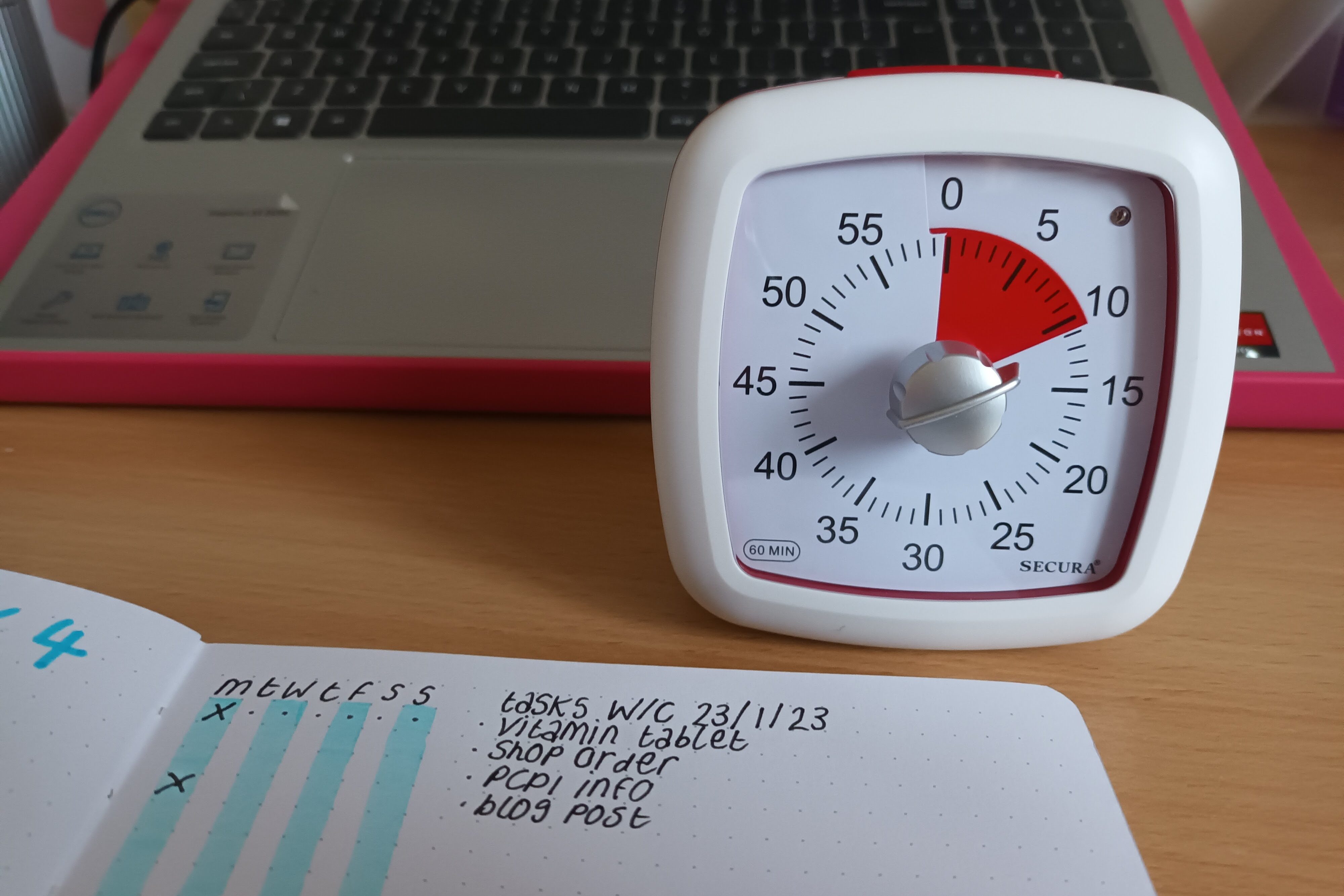
It’s been over two months now since I bought a countdown timer from Amazon to use for the Pomodoro Technique which aims to increase productivity. I already felt that I got plenty done each day but I loved the idea of breaking down work into intervals, having regular breaks and knowing how long I’d been hard at it for. I’ve been consistently using the time management method, apart from a week off for Christmas and I thought I’d share what it is and how I feel it’s helping me.
Those of you who have never heard of this technique may be wondering if it is named after a particular person, but you might be surprised to know that pomodoro is actually Italian for tomato. What does a tomato have to do with productivity? Read on and you’ll find out!
What is The Pomodoro Technique?
The Pomodoro Technique is a time management method which was developed by Italian Francesco Cirillo in the late 1980s. At this time, Cirillo was a university student and was struggling to stay focused on his studies. He challenged himself and posed the question ‘Can you stay focused for two minutes without distraction?’. To check if he could, he grabbed his countdown timer from the kitchen which was red and shaped like a pomodoro, or, in English, a tomato. He set the timer, and after two minutes of focused activity, the timer rang and he had achieved his mission. After this, he considered why the use of a timer had worked and he experimented with gradually upping the time and reducing it when it became too much. In the end, he decided that 25 minutes was perfect and that a short break (5 minutes) was required before continuing.
Cirillo carried on experimenting and came up with some basic principles. The timer was an important part but only one element of the method. He suggests the following:
Pick one task you want to work on.
Set your timer for 25 minutes and place it somewhere highly visible (so you can see how much time remains).
When the buzzer goes off, have a 5 minute break.
Repeat this with 3 more periods of 25 minutes and 5 minute breaks.
Mark each pomodoro with an X when you’ve completed it (this could be on a mini whiteboard, a post-it note or in your planner.
After 4 ‘pomodoros’ (work periods of 25 minutes and 5 minute breaks), take a longer break of 20-30 minutes.
Once your longer break is finished, go back to step 1.
But what if I have a really long project or lots of short tasks to do?
For complex projects, you should break things down into smaller actionable steps. This will help you avoid overwhelm and ensure you make good progress towards your end goal.
Any tasks which will take less than one pomodoro should be combined with other quick tasks. This might include a range of admin such as book a hairdressers appointment, reply to an email, making a shopping list for the supermarket and reviewing your bank statement.
If you finish your chosen task before the pomodoro timer rings, you should continue to use the rest of your time in a productive manner e.g. by going over what you’ve just learned, making a list of next steps, reading up on a related topic etc.
What should I do during my 5 minute breaks?
When the timer goes off, it’s sometimes tempting to continue working, especially if you’re in a flow state. However, taking breaks is really important if you want to stay productive. What you do during your short breaks is up to you but here are some suggestions that you might find helpful. For me, taking time away from screens such as my computer or my phone is super important and gives my eyes a good rest.
Do a short guided meditation
Get out in the garden and reap the benefits of fresh air
Do some stretches
Put on an upbeat track and dance about your kitchen / living room or anywhere with some space to move
Take a quick walk for a serotonin hit
Drink some water, squash or a flavoured tea
Sit in a comfy chair and read a good book
Do a mindful activity such as a spot of doodling, a word puzzle, jigsaw or some colouring in.
Listen to some music – trying closing your eyes so you really tune in.
Watch birds in your garden.
How is the Pomodoro Technique working for me so far?
So far, I’ve found the method to be incredibly effective. I bought my timer hoping that it might help in some small way but I didn’t realise how beneficial it would be as it’s such a simple idea. Here are some of the advantages I’ve experienced so far:
Makes it easy for me to get started. When you have a big project to do, it’s easy to get overwhelmed by its size and this can often lead to procrastination AKA putting things off. Contrary to popular belief, for most people, procrastinating is less about laziness and lack of self control, and more about fears of failure or feelings of self doubt. Knowing that I can do things in baby steps where I only have to do 25 minutes before being allowed a break is all the encouragement I need to get started.
Increasing my awareness of time. Using the timer makes you really aware of time going by and this encourages you to really focus in on your chosen tasks.
One thing at a time. The method encourages you to work on one specific task or a group of related tasks at one time and this helps to prevent the urge to multitask or context switching (where you jump from one task to another) which studies show is detrimental to productivity.
Great for avoiding distractions. In some ways, 25 minutes feels like plenty of time but if you don’t use it wisely, it can soon be gone. Because of this, I’ve taken steps to avoid anything which might interrupt my work flow. Depending on the type of work I’m doing, this might include putting my mobile phone in another room, adopting pen and paper methods for recording, switching off notifications and playing background music to block out other sounds.
Encourages me to plan my day. Before you start work, you’re encouraged to plan your tasks in advance. This helps you to decide what you want to get done, at what time and how long you think an activity is likely to take. At the end of your working day, you can evaluate your progress and consider if you overestimated or underestimated how much time tasks took. This can then inform your future planning.
Ensures I take regular breaks. Taking regular mental breaks from your work helps you to stay focused and remain efficient and productive during your 25 minute time blocks. If you’re working at a desk, it’s really beneficial to get up and move around as this improves your circulation and helps to combat fatigue.
Helps me maintain motivation. Seeing the time counting down on the timer in front of you is great for ensuring you work at a good pace. Also, after each session, I mark my progress in my bullet journal and this in itself makes me feel good and gives me the encouragement I need to keep going.
Encourages me to be self-evaluative. On days when I feel like I haven’t been super productive, despite using the Pomodoro Technique, I always question why. Common culprits include distractions from notifications or social media (especially if I’m researching something online), working in an untidy environment (meaning I can’t find things I needed) not taking my 5 minute break (or unconsciously extending them), deviating from my plan when I get back to work (because I found something else much more appealing, or when taking a break, engaging in something which didn’t allow me to relax and recharge (e.g. reading news articles online). When I’ve established what the issues are, I can develop strategies to combat them.
Final words…
I hope you have found today’s blog post useful, especially if you are looking for ways to beat procrastination, become more time savvy, and generally work more productively each day. If you want to know even more about the Pomodoro Technique you will find Francesco Cirillo’s book available in e-book format or paperback on Amazon. Also, feel free to ask any questions you may have in the comments and if you already use the Pomodoro Technique, let me know how it’s working out for you.
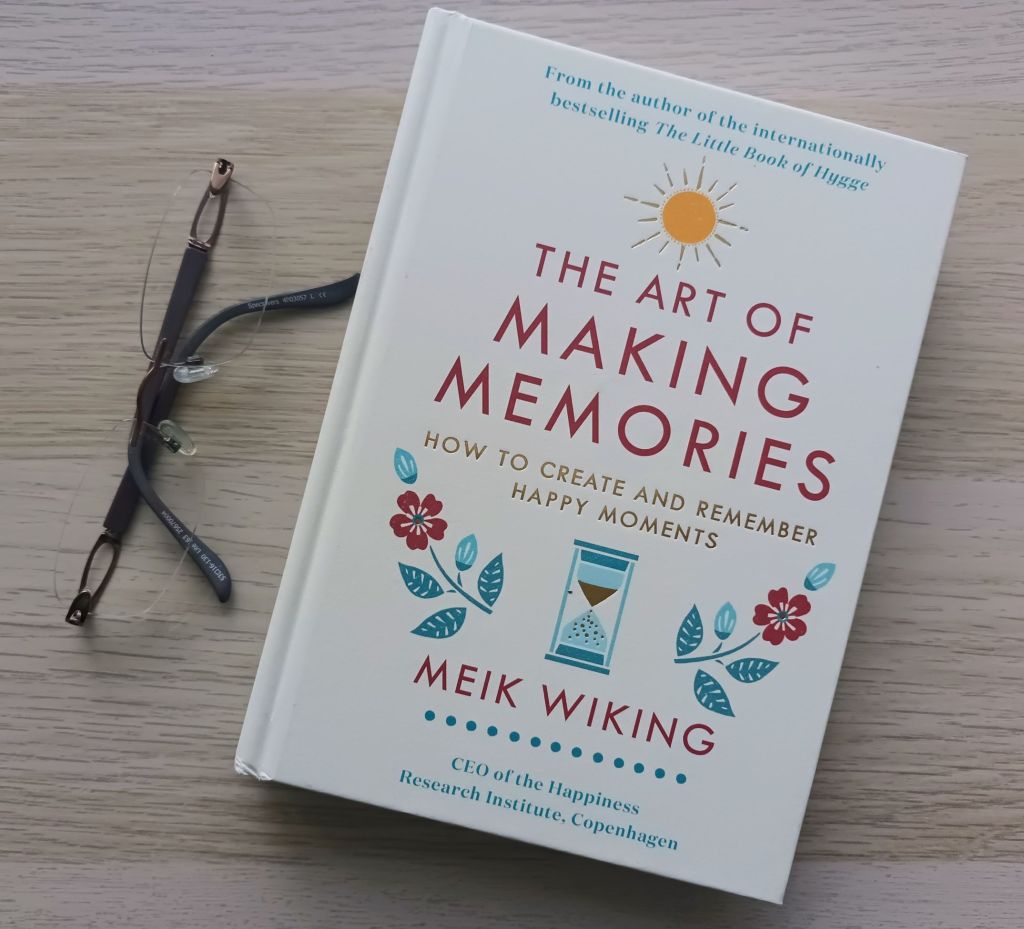
This month I finished reading The Art of Making Memories: How to create and remember happy moments by Meik Wiking. I actually started it last year, but I put it to one side and picked it up again around the middle of October. I’d forgotten many of the key points and ideas, so I re-started from the beginning and spent 20 minutes each morning, reading and highlighting. This has now become part of my early routine and takes place in a super comfortable chair by the window to give myself a good dose of natural light. And, as one of my current affirmations on my vision board is ‘I use self-development books to help me grow’, I’m working hard to apply my learning and decided it would be a good idea to share some of the ideas on here too. I’m also going to talk about some of my own suggestions for memory keeping such as journalling, photography, scrapbooking, memorabilia displays and memory boxes, plus a few more ideas I found online.
Why are memories important?
Rather than provide my own thoughts on the above question, I collected a few ideas from others to share:
Happy memories are essential to our mental health. They strengthen our identity, sense of purpose and relationships.
Rangan Chattergee
There are important moments that make up our life’s narrative. We remember the defining moments in our lives, the moments that made us who we are, the moments where we became who we hoped we could be.
Meik Wiking, The Art of Making Memories
I love those random memories that make me smile no matter what is going on in my life right now.
The moment may be temporary but the memory is forever.
Bud Meyer
‘Happy memories form the cornerstone of our identity, and can help with combating depression and loneliness,’ says Wiking. ‘They influence our happiness in the current moment, as well as providing a framework for our hopes and dreams about the future.’ Nostalgia makes us happy, increasing self-esteem and strengthening social connectedness, so the more vividly we remember the good times, the happier we are overall.
Meik Wiking
Memories are timeless treasures of the heart.
So how can we create a life full of happy memories to treasure?
Following extensive research conducted by the team at The Happiness Research Institute in Denmark, Meik came up eight keys ingredients for creating happy memories whether they’re of important events such as births and marriages, everyday events such as drinking good coffee and eating delicious cake in a cafe with a friend for the first time in ages, adventures such as moving to a new city, climbing a mountain or going abroad for the very first time or struggling to finish a big assignment but then being delighted with the feedback given by the course tutor. Here’s a brief explanation of each of these elements:
Unforgettable firsts
This is the idea that the very first time you experience something is likely to be remembered much better than subsequent very similar experiences. So, for example, you’re likely to remember your first time on an aeroplane, your very first pet, your first job, your first kiss etc. A great idea then, is to seek out new and novel experiences on a regular basis, the more extraordinary the better. You might like to schedule an evening in your diary or planner to find out what’s available to you and explore different options – you might organise a holiday, choose a new restaurant for a family meal (trying a new food or dish will make it even more memorable), sign up for an evening class (I recommend beginners ceramics) or plan to visit a museum is a nearby town or city.
Make it multisensory
In the classroom, during my years as a primary school teacher, one of the important ways of ensuring all children learnt well and enjoyed activities was to create multisensory experiences. These are the kinds of lessons which stay with them for years and they can still remember well after they’ve left school. This can be applied to memory making too. Don’t just experience things with your eyes, try to make sure you use all of your senses (not just sight) to take everything in. Consider if there are any particular aromas in the air, like the smell of freshly roasted coffee, the scent of cinnamon and winter spices in a pot pourri at Christmas time. Be still and listen for near and distant sounds (either pleasant or unpleasant) such as the drumming of a woodpecker in a faraway tree, the roar of the ocean or music drifting on the breeze. Take time to explore different textures such as soft knitted blankets as you get all cosy after a chilly winter walk, or smooth pebbles on the beach and you sit on the sand. Maybe as you relax and take everything in you become aware of a range of sensations, the chill of winter on your skin or the warmth of the Sun on your face in summer or the crunchy autumn leaves below your feet. Perhaps new or favourite tastes complete the scene -succulent strawberries, crunchy, salty popcorn, the sharp tang of the lemon slice in your chilled glass of Pimms and lemonade. And, as you attend to every detail of your experience, you’re engaging in one of the key aspects of mindfulness which is wonderful for your mental health too.
Pay full attention
It should come as no surprise that experiences are best remembered if you invest your complete attention on them. So, for example, if in the summer you went on a Sunday afternoon boat trip to see puffins, but you spend most of the time thinking about all of the work you have to do on Monday, you’re unlikely to remember key details like the warm sun as it sparkled on the water, the interesting facts the captain shared as you headed towards Coquet island, the joy of spying a line of cute seals bobbing in the water making sure that the boat didn’t get too close, the thousands of noisy puffins flying overhead and diving down into the water to catch sand eels, and the hundreds more birds basking in the warmth after a busy morning fishing. However, if you remain attentive during whole cruise, you’re likely to be able to recall all of the magical trip and how you felt for many years to come.
Keep it meaningful
Meaningful moments in your life are those which are of great significance or value to you, where positive emotions such as gratefulness, love, happiness, pride, warmth, peace and often, a sense of connection with loved ones is felt. These could be ‘big’ milestone moments such as finishing college or university, starting a new job, the day you got married, the birth of a child or buying your very first house. They could also be smaller events or happenings which are really important to you and your personal values, for example, for me as a wildlife and nature lover, sitting quietly with my husband in the hide at Kielder Forest, watching and listening to the woodland birds and then suddenly spotting a red squirrel taking a snack from a feeder is one of my favourite memories which I will cherish for a very long time. As well as making exciting plans to celebrate each of our birthdays and our wedding anniversary, my husband and I also make sure we schedule in plenty of other pleasurable activities and adventures for our weekends such as visits to nature reserves, riverside walks in different parts of the Northeast, trips to the theatre, lunches in various vegetarian cafes and overnight stays in quaint villages or vibrant cities.
The emotional highlighter pen
According to Meik, emotions act like a highlighter pen so experiences involving heightened emotions will stick fast in your memory. That’s why we never forget the exact details of times when we’ve felt really embarrassed (no matter how much we’d like to). ‘An emotional reaction will make experiences and moments more memorable, so the art of making memories means making the emotional highlighter pen work for you.’ This also works for exhilarating, joyful, scary, traumatic, sad and shocking events too. Next time you’re planning a holiday, try to add a few activities to the itinerary which are bound to be emotional highlights.
Peaks and struggles
Some of the milestones mentioned above such as completing your university degree, buying your first home or getting married are highly memorable events, but the struggles, stresses and hard work involved to get there is likely to be unforgettable too. There’s so much involved in planning your wedding day that working full time and having a long to do list of preparations months and weeks before can be so stressful and exhausting that when the day arrives it’s such a relief that it (mostly!) went to plan, and you can enjoy what should be one of the happiest occasions of your life.
Meik shares these happy memory tips:
save the best for last – e.g., if giving a few gifts to your partner for their birthday or Christmas, save the most precious / exciting one until the end, when creating a holiday itinerary, do something with the ‘wow’ factor on the last day etc.
make the journey part of the experience and try taking the long route – for example, go on a gentle and relaxing boat trip along the river to the other side of the city or hire a bike for the day to cycle around the various attractions, rather than jumping in a taxi.
plan something for your weekend that helps it to end on a high note
Share your memories as stories and regularly have ‘remember when…’ conversations
A memory model known as The Ebbinghaus Forgetting Curve shows that over time our retention of memories decline, unless we take action to keep them. Knowing about and understanding the forgetting curve can be important when we are trying to learn new skills or absorb vital information but how does it help us with remembering happy memories? Well, according to Meik, regularly sharing your happy moments with others as stories can help immensely. This could involve helping loved ones to hold on to past events by retelling anecdotes, having ‘remember when?’ conversations or even sharing funny or interesting experiences from your own childhood. Regularly reminiscing has also been shown to help combat memory loss as we get older too.
Outsourcing
The final ingredient for maintaining happy memories is to outsource them. In business, as some of you may know, this generally means asking a third party to take care of a particular job or task. In memory retention, however, we can outsource memories by taking photos, collecting mementoes, keeping a diary or journal or by sharing to social media, such as Instagram, Facebook or even a blogging platform.
Most of us take thousands of photos each year which are generally stored on our phones or online using ‘the cloud’. Flicking through these images can certainly spark memories but personally, I prefer to use a range of memory keeping strategies and I especially love creative journalling.
Memory keeping ideas
Monthly memory pages
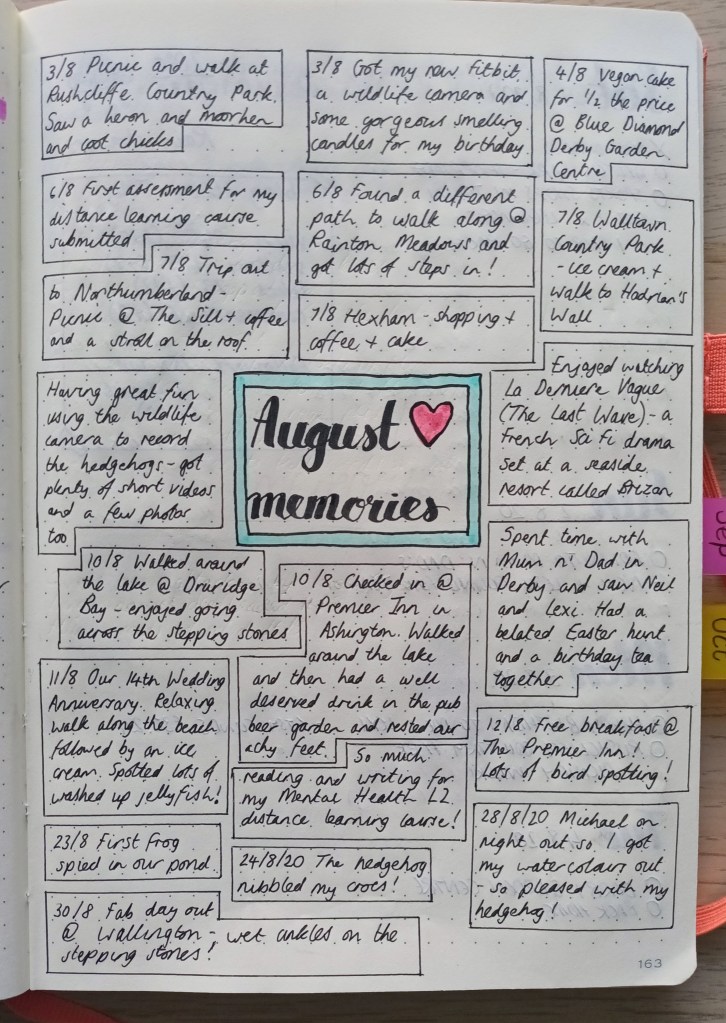
I’ve created a few of these in my bullet journal to help me to remember what happened during the month. I’ve tried to summarise each event in a few lines so I can fit plenty of memories in. Some of them are dated, whereas others are just something that occurred over time such as watching a particular TV series.
Mementoes
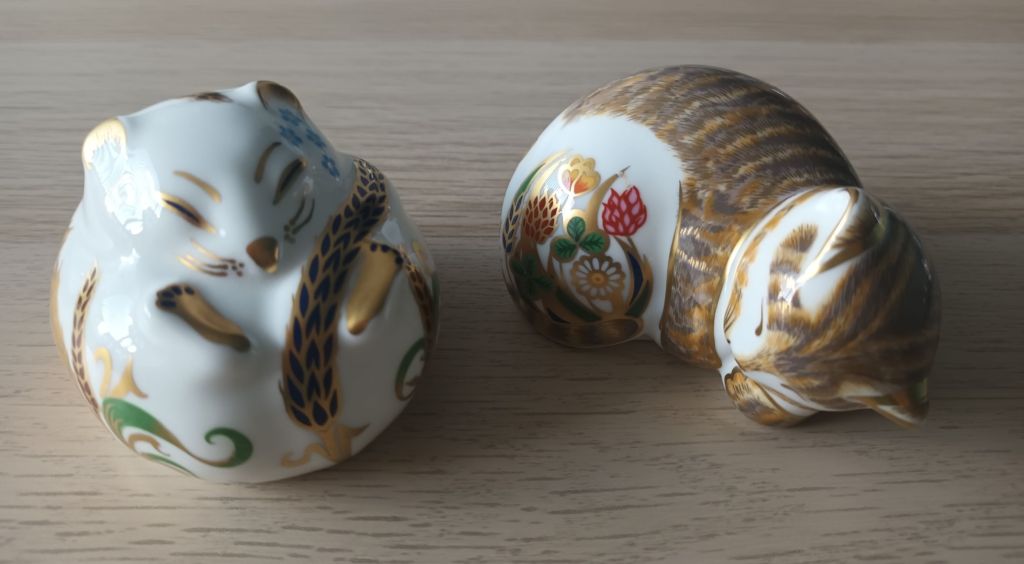
A memento can be defined as an object kept as a reminder of a person or past event. It can spark memories or feelings of happiness each time we see it. For example, when my nan passed away, my mum selected two ornaments from her Royal Crown Derby Cottage Garden Collection – a sleeping kitten and a cute little Dormouse, to give to me to keep. They remind me of my nan, her many ornaments which she had displayed around her home and my grandparents’ pet cat called Tibbles. Also, I like the animals which were chosen and the decor on each piece so they’re things that I’m happy to display in my own home.
Other mementoes you might consider include:
something from each of your holidays such as a fridge magnet
a photo in a frame of special occasions e.g., wedding days, child’s first day at school in uniform, the stunning view from a hill you walked up, the bespoke birthday cake that was made for someone’s 80th etc.
hand or footprint casts – you can even get one done of your pet’s paw!
your child’s first tooth
your child’s first artwork
a souvenir from some of your ‘firsts’ holidays e.g., a mini Eiffel Tower
newspaper clippings from something important to you that made the local news
Photographs
You’ve probably heard the adage ‘a picture is worth a thousand words’ which basically means that one single image can often convey multiple ideas, messages and meanings more effectively than a long verbal description can. Therefore, you could write pages and pages describing particular experiences in your life but sometimes, photographs can be enough to spark your memory. Similarly, if you selected a particular photograph from one of your albums (or located one on your phone) you could use it to tell someone else the story of that particular occasion or spend time recalling the event in detail with whoever you shared the moment with.
Set up a private social media account
Many of you will have an Instagram account which features carefully cropped photos with perfect lighting, filters, captions and emojis. This is the stuff you’re happy to share with people online for likes and comments. What Meik suggests is creating another account for everyday memories which might not be Instagram ready bits and pieces you want the whole world to see but are still part of your experience and would give you pleasure to look at.
Creative journalling
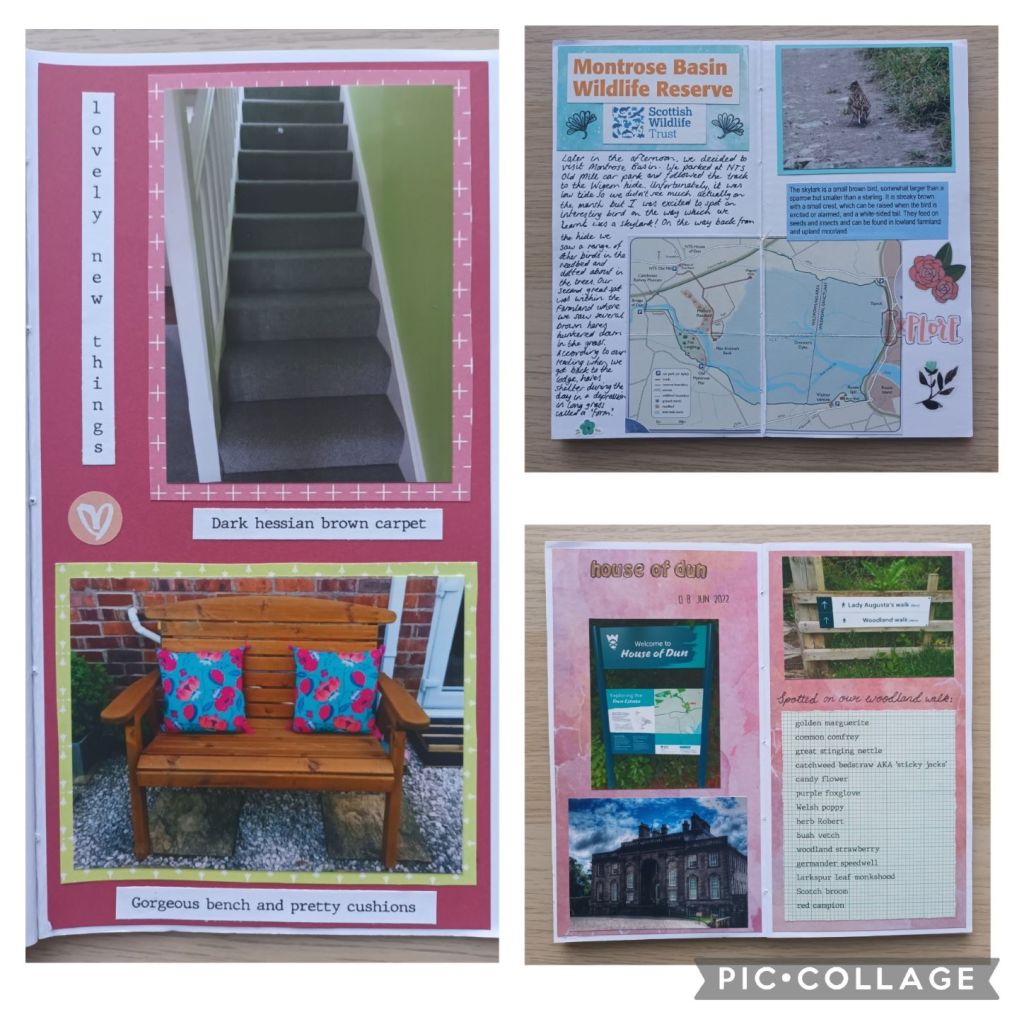
Personally, I like to combine lots of different memory keeping tools and techniques in my creative journals. I use a traveller’s notebook size and like to record days out, holidays, special events, clothing, accessory and home decor purchases, craft and art projects, wildlife sightings, new dishes, snacks and sweet treats tried, anything really, but especially new and novel experiences (as per Miek Wiking’s power of firsts). As well as including journaling and photographs in various sizes I also like to stick in related mementoes such as restaurant menus, tickets, receipts, packaging, lists of wildlife or nature spots – anything that adds to the memory.
December daily
December Daily is a project idea created by memory keeper, Ali Edwards and is a way of documenting the 25 days leading up to Christmas. A few years ago, I had a go at creating a Christmas journal using a range of papers I picked up from my local Lidl supermarket making my own traveler’s notebook size insert. I made a page or two for each day
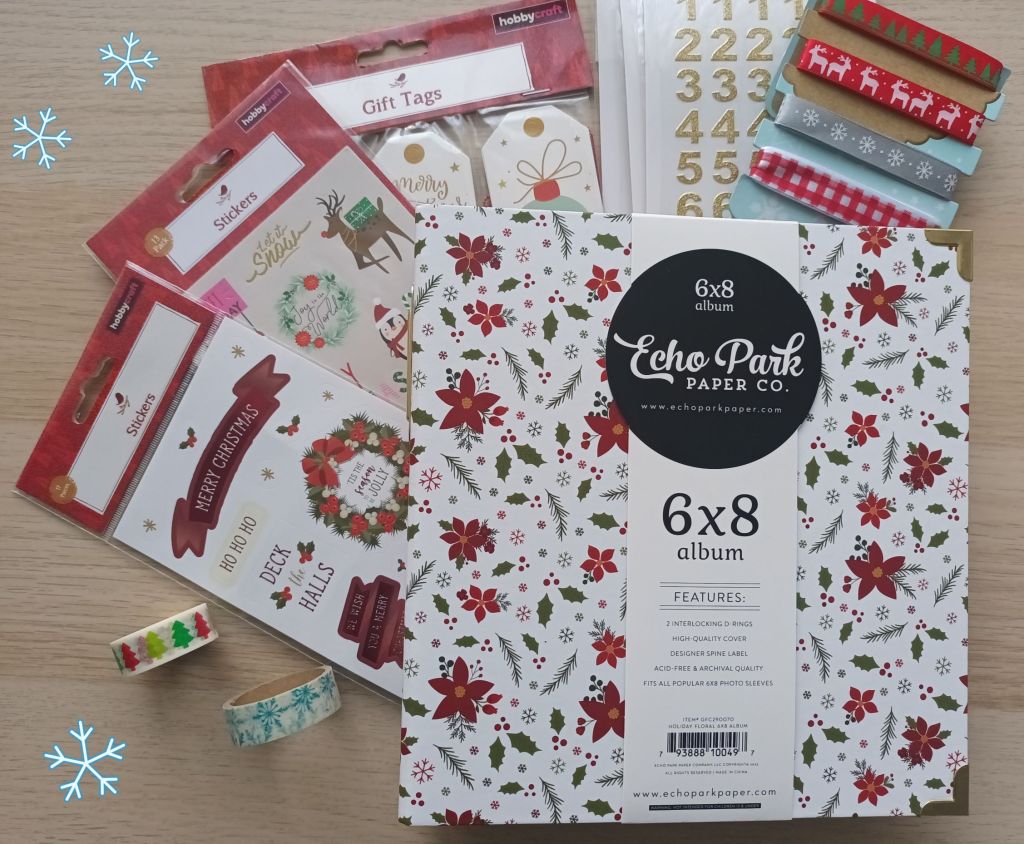
This year, I’ve bought a Chistmassy 8×8 album and a range of different pocket pages which can be filled with photos, bits of journalling and anything which will spark off festive memories. I’m busy building a collection of stickers and ephemera to use and am enjoying watching different approaches to the project on YouTube. I’ve also printed off lots of different prompts I found online to make sure I record lots of different aspects of the month of December and don’t run out of ideas.
Memory playlists
I’ve not tried this one myself, but it sounds like a really nice idea. In January, you start a new personal playlist e.g. ‘Tunes of 2022’, to which you add your current favourite songs throughout the year and tracks which evoke particular memories. When you listen to your playlists you are transported back in time, recalling memories based on music. Although I’ve not specifically done this, I know that when certain songs come on the radio I’m reminded of nights out at university, hitting the dancefloor, writing out or printing lyrics and learning every single word to sing along, wedding night songs including our first dance, favourite bands and artists we’ve been to see, trips to the theatre, movies we’ve enjoyed and many other fun times throughout the years. In fact, I read some information online this afternoon which suggested that playlists can be a particularly useful tool to create for elderly loved ones to help elicit memories of times gone by.
1 second everyday – video journalling
This is a video recording app (1SE for short) which enables users to create a video journal by recording meaningful one second movies for a myriad of everyday aspects of their lives. Each short video is stitched together sequentially to create a seamless record. So, for example, you might create a series of video during the month of November featuring a book cover of a novel you’re particularly enjoying, the crashing waves at the beach whilst on an Autumnal walk, your nails after applying a pretty nail polish, a finished craft project, coffee and cake at a new cafe you’ve tried, the smile of a friend during a good catch up, the rain lashing against your window that started just after you got home, a new recipe that you’re about to give a go and all of the ingredients lined up along the countertop etc.
Line a day journal
This can be a spread you do in your bullet journal each month which you fill in each day or you can purchase a special notebook that usually has space to record five years’ worth of memories. Whichever format you choose, it is meant to be something that you can quickly complete at the end of each day to summarise things such as events, experiences, things you are grateful for, purchases made, something nice someone said, something kind you did for a friend or a stranger etc.
Final words…
I hope you’ve found today’s post interesting and useful and that it’s prompted you to think about the different ways in which you can create wonderfully happy memories, keep and cherish them. Some people prefer to keep digital records whilst others, like myself, prefer to create tangible journals which can be flicked through and talked about with family members or friends. If you’re interested in finding out more about making and remembering memories, I definitely recommend you check out Meik Wiking’s book. He’s recently re-released it under another name ‘Happy Moments: How to Create Experiences You’ll Remember for a Lifetime’ but the content is the same. I like to buy this kind of book rather than purchasing the e-version as then I can more easily highlight parts I particularly want to remember and then flick through the pages whenever I wish to.
Do you enjoy creating journals or photo albums full of happy memories or do you find yourself flicking through digital albums on your phone and thinking about how you should really print a few of the photos off in case you have an issue with your cloud storage one day?