Posted in art, creativity, watercolour painting

Wet on Dry washes and 5 Super Fun Wet on Dry Techniques to get you started with the Basics of Watercolour Painting

A few weeks ago, I shared my vision board for the lockdown period in which I set some things to work on whilst we are social distancing and spending more time at home. One of these was to do more watercolour painting. A while back I started an online 7 day challenge but unfortunately, circumstances dictated that I didn’t get it finished. I got myself all stressed out about doing it and it basically became a chore when it was meant to be enjoyable (sometimes I get too serious!). This time around, I’ve done a lot more research (to develop my confidence), binge watched lots of YouTube videos and read lots of information on various websites (some were much better at explaining than others. I’ve also made notes on what I have learned. In this post, I want to share with you some wet on dry techniques that I tried out and really enjoyed. Hopefully it will encourage you to have a go yourself. I’ll be doing wet on wet techniques soon so look out for that popping up on my blog.

So what is Wet on Dry?

Also known as wet into dry, this technique involves using dry paper and applying wet paint to your page (which is demonstrated here). It also refers to adding wet paint to a dried area of paint already on the paper using layering (something I will explore at a later time). Wet on dry is regularly used by artists as it allows plenty of control over the paint. There are lots of wet on dry techniques and I loved experimenting on small pieces of watercolour paper. I actually split up a few large sheets into sections using masking tape and then left them to dry and used my paper trimmer to make little labelled cards showing the different examples.

Washes

The first technique I tried was washes. These basically involve adding paint to your paper in a smooth uniform way. There are three main types of wash – flat, graded and variegated. With a flat wash you apply the same colour and tone across the whole of the area you are working on. With a graded wash you graduate the colour from a light to dark tone or from dark to light. And in a variegated wash the colour and tone changes in various places of the work area.

With the flat wash, I wet my brush in clean water and then half loaded it with paint. Starting in the top left hand corner, I swept horizontally to the top right hand corner. I then repeated that action adding more paint for each stroke all of the way down the marked out piece of paper (I used masking tape to get neat edges). As you are working wet on dry, you need to work quickly to ensure that the paint in the wash area you are working on stays wet. You also need to slightly overlap your brush strokes so you are working into the bead of paint that forms at the base of each line. If you find when you get to the bottom that too much paint solution has formed at the end, you can mop it up with a paper towel dried clean brush to avoid streaking or a back wash being created which is where the solution bleeds back up the paper and creates an unwanted blooming effect.

For the graduated wash (also known as a graded wash), I started with a little water and lots of pigment. I then did one sweep horizontally like in the flat wash. For the second sweep I added a little more water. You then continue adding more water to lighten the colour until you have very little pigment on your brush by the bottom of the page to create a very gradual change in tone. As you can see with my example, you can sometimes see the brush strokes which I guess is one of the drawbacks of using a wet on dry technique.

You can also do a graduated wash in reverse from light to dark by adding more pigment to your paintbrush each time but I found this much more difficult and so have not included the results here! I’m sure some of you would be quite happy to see my failed attempts but I’m afraid I filed them in a special place under my desk 😀 ha ha!

I found the variegated wash the most difficult and again, had a fair few failed attempts. In the end, I found the best method was to start with one colour at the top of the page and graduate to the middle and then repeat the process in reverse with another colour from the bottom of the page. I then blend the colours whilst they were still wet in the middle. This may not suit everyone and I may find I develop my technique differently as I become more proficient with the medium. I would recommend experimenting and finding what works for you personally.

You can vary the density of the colour in the flat wash by using a lot of pigment and a little water for an opaque wash or a small amount of pigment and lots of water for a lighter translucent shade as shown in the second photograph. Whatever kind of wash you are doing, it’s a really good idea to use small pieces of cheaper watercolour paper to play around with different washes so you can develop your technique. As I said before, I found I needed quite a few goes at the variegated wash before I was happy with the results.

Since doing my washes, I’ve found a watercolour tips website which suggests that if you are left handed, like me, you might be better off working from right to left (as I sometimes wish I could do when writing!). I will be sure to try this next time as I think it might make things a little easier.

Dry brushing

As the name suggests, this technique involves using a dry brush and wet paint. However, it is a good idea to wet the brush and then dry it off on paper towel so it is a little bit damp before you start. I experimented with a flat brush working with the very edge and then the whole brush in a downward motion to create different effects. I then used a pointed round paint brush and kind of smooshed it onto the paper and then used a vertical wiping motion at the bottom of the paper. I think these techniques would be great for adding texture to clothing or buildings in a painting.

Splatters

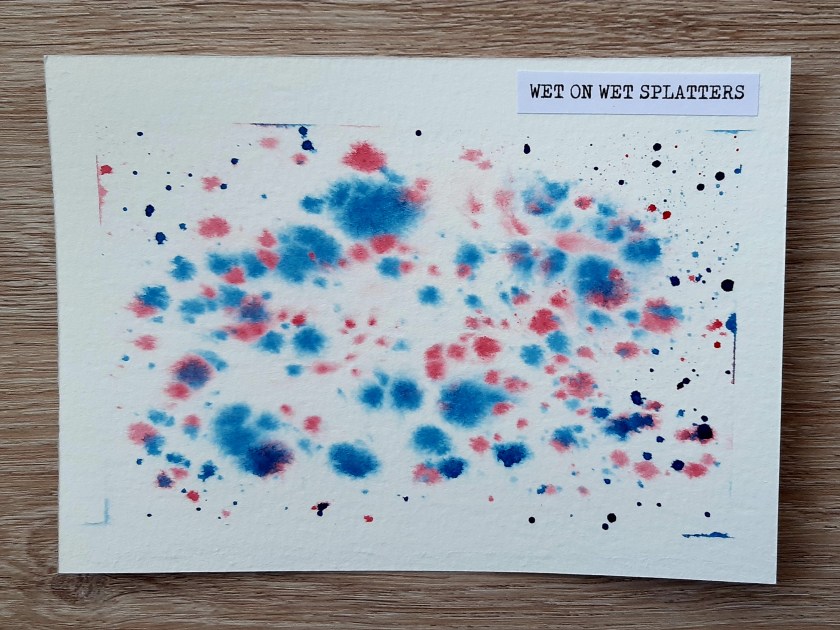
Next I had great fun trying different splattering techniques, The first method involved flicking the bristles gently with my finger. I used a flat brush for this and it produced a fine splattering which I could control pretty well. I’ve actually used this before in my Autumn tree painting which I shared as part of my bullet journal set up for October 2019. The second method involved tapping the handle of the brush. For this one, I used a round brush and had to load quite a lot of slightly watered down paint onto the full head. I tried tapping with my finger on the handle and then using another brush handle which I found was easier. Both got quite messy so I would recommend covering any areas of paper you don’t want to work on and using a plastic cover on your table!

Another way to create splatters is by blowing. This can be done using your mouth only or using a straw. With both methods, you need to apply a blob of paint to your page and then blow in the direction you want the colour to splatter. I found that I could get much more control when I used a straw and didn’t need anywhere near as much puff!

Pulling

This technique involves adding a fairly concentrated area of pigment to your page and then using a wet brush to pull the colour in different directions. I created kind of flower shapes by adding a blob of paint and then using a wet brush I lightly touched and pulled the colour outwards from this central point. In the second example I used a more controlled pulling method to create five petal star shaped flowers by placing blobs of paint to mark the very edges of the five petals and then pulling into the centre, again using a brush wetted in clean water. I much preferred creating the looser flowers and definitely need more practise with the detailed work. For the detailed pulling, I found it hard to create an image in my head of where I needed the five petal points to go.

Feathering

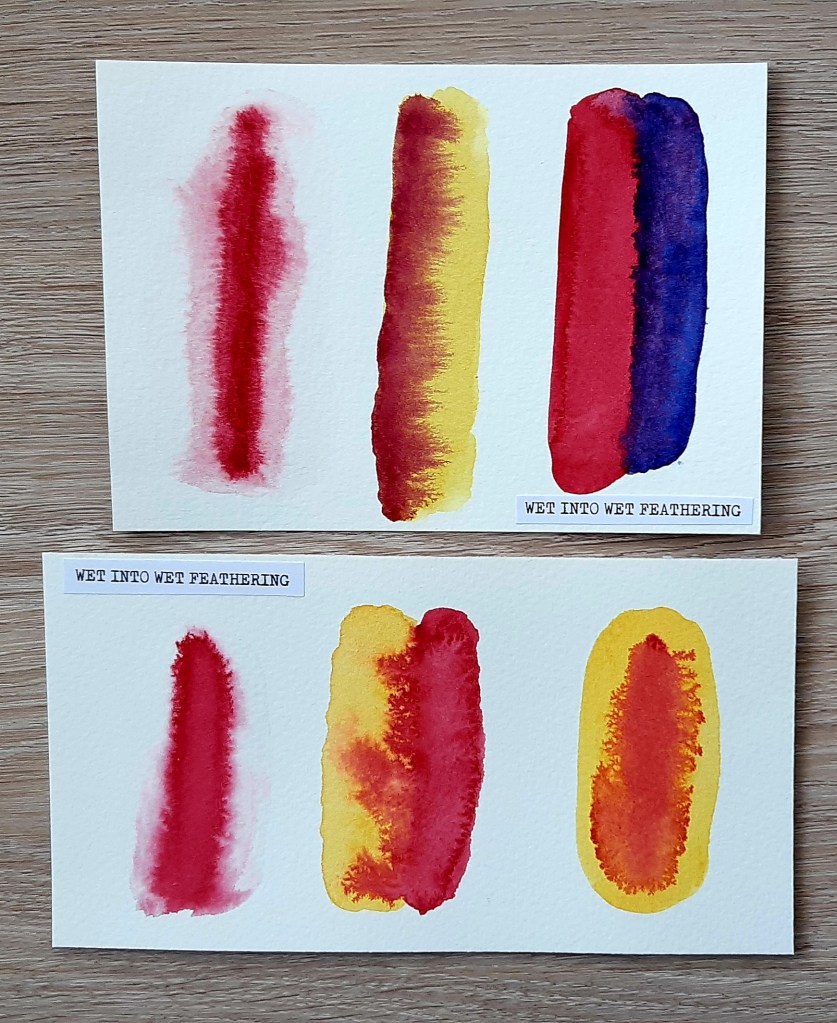
I really loved this technique which involved using dry paper but a kind of wet into wet technique to make the paint bloom. For the first one, I painted a line of highly pigmented paint vertically to my paper. Then I touched the paint gently with a wet brush on either side working downwards to create a feathery effect. For the second example, I repeated the process but this time using different colours of paint. It’s a really cool effect isn’t it!

Drips

This technique involves adding a splodge of paint at the top, lifting your paper at an angle and then dabbing into it with a water and paint solution to create a bead. Eventually the bead of paint will become so heavy that gravity will cause the paint to drip down. Depending on how much solution is added and how much the paper is lifted the drip may even run off the page. I used masking tape at the bottom so it created a straight edge but you could leave the paper un-masked and allow the paint to run as far as you want. I found a great little watercolour piece using the dripping technique here which I might try at some point soon.

That’s all the techniques I tried using wet on dry. If you want to find out more from real artists who have played with watercolour a lot more than me, here are some great websites and YouTube channels I came across whilst perusing the internet.

– Anthony shares tips and tricks here for complete beginners and has really good explanations and photos. He goes into depth about washes and how to improve your technique.

– Shelby goes over basic techniques and also provides lots of ideas for using watercolour paint in your bullet journal. Find her at https://littlecoffeefox.com/ I would love to do perfect my techniques and be ready to do some spreads in my BuJo but I’m certainly not at that stage yet!

– Hieu (AKA kelogsloops) who is an aspiring artist from Melbourne in Australia, provides funny but informative demos on this part of his YouTube channel He uses thicker paper than me but as I’m just a beginner, I figured cheaper stuff was good enough for now and better than nothing!

I hope you have enjoyed seeing my wet on dry watercolour work. I really encourage you to give them a go as you might find a new favourite and relaxing hobby during this lockdown period. I’ve got quite a collection of brushes and paints and a couple of blocks of relatively cheap watercolour paper now but you don’t need much equipment to get started. I began with a couple of brushes, a travel tin of Daler Rowney half pan paints and a gummed pad of coldpress watercolour paper.

Let me know if you fancy giving these techniques a go and which you think might be your favourites to play around with.

Happy watercolouring,

Posted in wellbeing, wellness

Monday Matters: Creating a W.R.A.P. Part 4

The cover I made for my file using MS Word

In this series, I’m breaking down the aspects involved in creating a Wellness Recovery Action Plan (W.R.A.P.) and sharing my experiences of the course I did at my local recovery college where I worked on my own individual plan. In Part 1, I talked about what a W.R.A.P. is and why they are helpful. I identified the main principles and introduced the idea of making a wellness toolbox to help you think about activities which you find help your mental health. In Part 2, the focus was on identifying what you are like when you are well and making a list of every day activities which you should do to keep yourself feeling well. For Part 3, we looked at the importance of recognising your triggers or stressors and creating a plan of methods for coping with these when they occur. We also considered our own personal warning signs that we are beginning to become unwell and I shared examples of my signs and actions for combatting these. Today, the focus is on signs of further decline when your coping methods and action plans are not helping you and simple steps you can take to remediate.

Sometimes, I find that even though I’m trying really hard to keep myself well, certain sets of circumstances or aspects of life cause my mental health to deteriorate. When I start to become depressed, it seems like nothing I can do will help and thoughts such as ‘I’m never going to get better’ kick in. Even though I’ve got through periods of depression and anxiety countless times before, I always panic that this is going to be the one time when I stay unwell indefinitely.

When I made my list of signs of decline, I was actually living that depressive and anxious side of my life so it was easy to write everything down but also quite upsetting. I also struggled to come up with coping methods and an action plan and this is where the support of the course facilitator at the college became so important. If you are struggling it’s really important to reach out for help. A family member, a close friend or a therapist can all help to provide objectivity and encouragement in finding a way forward.

Now I’m feeling stable, I have added to my list. In fact, I’ve turned it into two lists – one for times of depression and anxiety and the other for when I’m struggling with hypomania. Here are some examples that may help you get started with creating your own list or lists:

Depressive episodes

crying a lot

lack of motivation

avoid doing things

anxiety on waking

isolating myself

feeling hopeless

can’t see a way forward

rocking and pacing

fragile

lots of negative self talk

let things upset me that I wouldn’t ordinarily

feeling tired all of the time

sleeping in

very poor appetite – feeling sick

hopelessness

convinced I will never get better

Hypomania

erratic driving

spending money on unnecessary things

talking non-stop

not sleeping properly

taking on too much

jumping from one activity to another

thinking I’m superior / better than most

My coping methods / action plan

Go back to my wellness toolbox and choose self soothing and mindful activities

Do things ion my ‘Daily Maintenance’ list even though I don’t feel like doing them

Get some exercise – a gentle walk in nature

Do a meditative activity e.g. colouring in

Write a short action plan for each day

Try to celebrate small achievements

Write a done list of all of the things I have achieved each day e.g. had a shower, ate some lunch etc

I hope my posts are helping in terms of managing your mental health conditions and has shown how a Wellness Recovery Action plan can help with anxiety, depression and symptoms of bipolar illness. The fifth part will be about crisis planning which is particularly relevant for those of you who may struggle with manic episodes and severe periods of depression where someone else needs to take over your care. As my mood disorder is not as debilitating as this and I have learnt to manage hypomania and moderate depression, I did not fill in this part of the plan but I will still be sharing ideas for its completion.

Until next time,

Posted in lifestyle, lockdown

Managing life during lockdown: A guest post from a primary school teacher

Photo credit: Arnel Hasanovic on Unsplash

Today we hear from a lovely teacher friend of mine who has described the impact of lockdown on her personally. It has been really interesting for me to read, because, as you probably know if you follow my blog, I’m an ex primary school teacher myself. I hope you enjoy reading about her experiences of how day-to-day life has changed.

My name could be Louise, but it is not! I am a Y3 teacher at a school in a South coast resort.  Sounds idyllic?  Well, living near to the sea is wonderful, but for many of the children in my school, life is far from idyllic.  My heart was always to teach children for whom life was a struggle and that is certainly the case where I am.  Many people find it hard to believe that a town which has many extremely wealthy people and where many folk aspire to spend a long and happy retirement, should also have some of the most deprived, uncomfortable and antisocial wards of the UK. 

I have been a teacher for almost 20 years, coming into the profession after getting my own 3 sons and daughter through the pre-school years.   I have never aspired to senior leadership, but am currently leader of KS2 and maths in my school.

Weekday life – before and after lockdown

My usual school day starts at 6, but I often don’t leave for school till 7:40 when I leap on my trusty bike and cycle 6 miles across town.  I love that time because it is often the only time I have in a busy life to think! Once at school, I rush in, wash, change and switch the technology on.  By the time the children come in at 8:40, I am ready for them.  Mornings are maths and English, with a break in between.  English includes half an hour of reading and I, as maths lead, worry that there is an imbalance between the emphasis on English skills and the time given to maths.  My lunch time is generally spent marking at least the maths books, though I will have done some during the lesson, and preparing for the afternoon.  I rarely sit to eat in the staff room, but try to get in there to make a cup of tea, at least.  Two hours of topic lessons and spellings take us to clearing away and story time.  Having a younger class means the parents or carers often want to speak to me at the end of the school day, so it often takes time to get back to my room, where I then spend my time up till I am chucked out, making sure I am ready for the next day and that all marking etc is up to date.  In the evenings, I plan and prepare resources, except for Tuesdays when I have running club.  

Since lockdown, though, that has obviously changed.  Our school, like many, though not all, is still open to children of key workers and the vulnerable.  This latter category for us, is quite large, but not many have taken up the offer of coming in to school as yet.  However, as lockdown enters week 5, we have persuaded more to come into school.  This is a relief really, as there are some children about whom one worries when they are at home in a potentially volatile situation.  We have a rota of staff (teachers and TAs) who come in, usually for a couple of days at a time.  A member of SLT (Senior Learning Team) is on hand to deal with the overall admin of receiving and dismissing children, together with lunches and giving us all a break during the day when needed.  Our key worker children have parents who work in care homes or supermarkets, rather than hospitals.

Mornings now start with children washing hands, collecting their named trays and sitting in their assigned places.  At 9 we all do Joe Wicks PE – a chance for me to develop muscles I didn’t know I had, whilst the children (5 maximum in a room) claim it’s easy and bounce up and down, without putting much effort into their squats and lunges!  Over the Easter holidays, the days were filled with arts and craft activities, which I found hard as I have not got an artistic bone in my body.  In the afternoons we allowed the children time on ipads, playing games or doing some online learning set by their teachers.  Now it is term-time, the children all have work packs to get through in the mornings and something a little less onerous in the afternoon. The learning activities have all been set by their teacher and are mainly designed to prevent the pupils forgetting things rather than teaching them new concepts. We have had to use offline resources in the main as our children don’t have free access to laptops and computers.

On days when I am not in school, I have a long list of jobs to get through each week.  These involve setting the learning for the following week, giving feedback on the learning achieved so far.  That can be a nightmare as often parents will send a tiny photograph of the child’s book or sheet which cannot be read clearly enough to see if it is correct! Other tasks include writing reports and a lot of subject leader development jobs, including those I set myself!

The good thing about lockdown working is that I can choose the hours to suit myself.  So I am up later, I go for a run whilst it is daylight and can fit shopping, cleaning, washing  etc around my chosen work hours.  Although my children are all grown up, 2 of them still live at home with us, and our daughter was at home on holiday when we went into lockdown, so she is still with us.  It quickly became clear that shopping and cooking would work best if we all took the cooking in turns.  That has been great – trying the different foods my family make – although when shopping (my job) they do seem to provide me with a list of unusual ingredients to try and find! 

Weekends

Prior to lockdown, my big moan was that I had so little weekend time of my own.  Even with my careful planning and weeknight work, I would still have things to do for school.  That has been the biggest difference really in that I now have more of a difference between weekday and weekend life.  

Saturday morning was always an earlyish start to get to parkrun – our nearest is only a short walk away so no excuse really.  Early social distancing measures brought an end to parkrun and I am really looking forward to it starting up again, when life “gets back to normal”.  For now, my club has organised a challenge that is parkrun (5k related) and I am thrilled that on my 5k course, my daily exercise has paid off and I am now faster than I have ever been (by 1 second!).

The rest of Saturday would be a blur of housework, but I am now finding that is more often done during the week, freeing up time for me to spend on more relaxing pursuits, or gardening.  Sundays again would be more social with church at least once, or possibly a running race in the morning. 

With lockdown, church has continued, but online.  Skilled tech people are managing to record and meld together services including my husband and me leading some of the songs – all pre-recorded and then woven together.  I think technology has been a real boon in this period.  I love being able to talk to people on Zoom from our home, or participate in a virtual pub quiz etc.  Obviously, being with the people would be best, but when that cannot be done, this is a fantastic substitute.  

Sadly, my elderly parents have no internet, or TV, or computer, so their only way of reaching the outside world is through the telephone.  They are really struggling with the loss of independence and not being able to see people.  I find it so hard when I phone to hear my mum crying over the phone about the things that have gone wrong in the house, how she just wants to be able to buy her own food and so on.   And always at the back of my mind, is the dreaded thought that, at 88 and 90, they are extremely vulnerable should they pick up the dreaded infection.  They live 180 miles away, and never before has 180 miles felt so far.  

Overall, I think I prefer some aspects of life in lockdown because it gives me more time for the things that are important to me – family, faith and running.  However, I miss my wider family even though we didn’t get to see them that often, I think this experience has shown that they are important to me and I would like to be able to see them more.  I hope that when life opens up again, we will have a new normal that means work lives are adjusted so that there is a much better balance between having a life and working all life.

Thanks for reading!

A final word from me:

I’m so pleased that you took the time to share your experiences with us and give some insight into the life of a teacher before and after lockdown. It sounds like you are still extremely busy but I’m glad you have found some benefits to the situation. Thank you so much for your contribution and I hope you enjoyed getting down your thoughts in a slightly different way to what you are used to.

Posted in Planning and journaling, Setting goals and intentions, watercolour painting

Setting up my bullet journal for May: Succulents theme

Earlier this month, whilst picking up some watercolouring supplies from The Range, I found a Dovecraft sticker book full of cacti and other succulents plus little plant related phrases. I decided these would be perfect for decorating my May bullet journal quickly and easily.

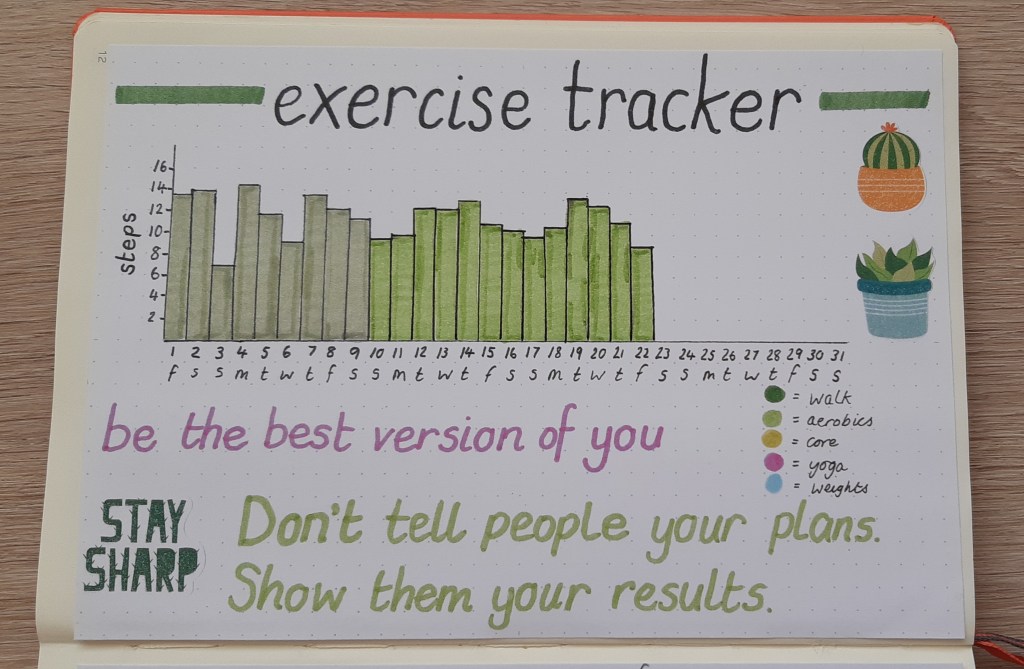
I’ve set up my spreads over the last few days and thought I’d share them with you. I’ve kept it quite minimal with a cover, monthly overview on two pages and a double page fitness tracker which is something I wish I’d started last month as I’ve been working out in different ways almost every day.

For the cover page, I decided to get out my watercolour paints and create my own image. I searched Google for step by step succulents and came across an amazingly simple tutorial from Dear Ann Art who can be found on Instagram @dearannart I also learned, after I’d followed the step-by-step that she has her own YouTube channel jam packed with tutorials and even her own book which I’m definitely adding to my wishlist.

This is a close up of my version of the cactus and I’m quite pleased with how it turned out.

After painting on cold press watercolour paper, I photocopied the image onto regular printer paper and added May in brush lettering. I then trimmed it down and placed it in my bullet journal using double sided tape.

For the calendar page, I stuck to my usual format and decorated with lots of the stickers. I think it looks really bright and cheerful.

On the exercise tracker, I intend to do a bar chart showing my daily steps count as recorded on my FitBit. I’ve been ensure I do at least a 30 minute walk each day and also get lots of steps on doing my aerobics routine.

On the calendar part of the tracker, I intend to record each time I do a yoga routine, my daily LISS (Low Intensity Steady State) walk and my aerobic workout. I’ve been following an old beginner’s routine from Instructor Live which I found for free on the NHS website.

I hope you’ve enjoyed looking at my spreads for this month. I haven’t included any weekly plans because I don’t actually make any in advance as I prefer to create daily plans which I sit down to make in the evening or first thing in the morning after breakfast.

Have you done your bullet Journal spreads for next month yet? Have you picked a theme? Let me know in the comments and include a link and I’ll go check it out.

Posted in mental health, wellbeing, wellness, yoga

Over 20 physical and psychological benefits of yoga that will help your body and your mind

As those of you who follow my blog will know, I started attending an Iyengar yoga for beginners class several months ago. After three sessions, the class was suspended due to Coronavirus and then shortly after that, the complete lockdown began. Keen to continue my practise, I’ve built up my collection of equipment and have found suitable classes on YouTube. I’m pleased to report that I’m doing at least 10 minutes of yoga every day and I’m reaping the physical and mental benefits already. So, in this post, I thought I’d share with you how yoga can transform your body and your mind. Please bear in mind that, although I have fully researched the article, most of what you read is my own limited experiences of practising and I am not an expert yogi!

Yoga is an ancient form of exercise that originated in India around 5,000 years ago. There are many different styles but all types focus on increasing strength and flexibility and breathe control in a way which boosts physical and mental wellbeing. The type of yoga that I practise is called Iyengar and this form places emphasis on detail, precision and alignment. When you begin, you are encouraged to use a variety of props such as bricks, blocks, blankets, a strap, a bolster and even a special yoga chair. This equipment is designed to assist you in your practice so you are able to form the asana (poses) correctly.

Although yoga is performed slowly and carefully, so won’t count as part of the recommended 150 minutes of moderate activity per week, it is an extremely good strengthening exercise with lots of benefits for your physical and mental health. This makes it an incredible worthwhile practice to adopt alongside more aerobic activities that get your heart rate up. It is also suitable for all ages and fitness levels. In fact, B.K.S. Iyengar who developed the Iyengar style, still practised for several hours per day when he was in his nineties, before his death at the grand old age of 95!

Physical Benefits of yoga

From the very first week that I went to my yoga class, I could feel my muscles getting a really good stretch in each pose. Now I’ve been practising for a few months, I’m beginning to develop increased flexibility throughout my body. I’m still using lots of equipment in my practice such as bricks, blocks, a strap and a bolster, but I’m able to push myself a little bit further each time as my muscles lengthen. Overall, my body feels a lot better and stronger already.

I’ve always suffered from back and neck pain since my teenage years and a physiotherapist that I went for a rotator cuff injury in my shoulder and sciatic pain identified bad posture as part of the problem. He suggested a variety of physio exercises but also said that in the long term working on my core strength by doing Pilates or yoga would really help. I’m now starting to find that I have much better posture and reduced pain in my body in general. I still suffer from neck and shoulder pain at times but I am hoping this will lessen with daily yoga practice.

A big part of yoga is a focus on the breath. When you bring attention to your breathing, you find that you take full and deep inhalations and exhalations and this can help to increase lung capacity and improve the function of your blood vessels which may lower blood pressure. As an asthma sufferer, I was pleased to learn that yoga can improve your breathing technique and develop your ability to control the depth of your breathing.

Although I’m having no trouble sleeping at the moment, I do tend to develop insomnia during times of high stress. I was pleased to read then, that yoga can promote better sleep and that people who practise some kind of meditation each day find they fall asleep quicker, stay asleep longer and have better quality sleep than those who don’t.

Many yoga poses, such as downward facing dog, have a weight bearing element to them and this has been shown to strengthen your bones and ward off osteoporosis. I find this particularly useful to know as weakening of the bones is very common as we get older, and it often effects women.

Photo credit: Form on Unsplash

Psychological benefits of yoga

Yoga not only transforms your body, it can also improve your mental health in so many ways too. Even after my very first class, I felt calm and relaxed and generally blissful. We did lots of strengthening and stretching poses and then for 10 minutes at the end of the session, the teacher put on some relaxing music and we did some restorative poses that were nice and easy to stay in whilst working on progressive muscle relaxation. The asana (postures) were so lovely that I didn’t want to move out of the final pose at the end!

When you are practising yoga, you are concentrating fully on each of the poses and the transition from one posture to another. You focus on your breath and the lengthening of various muscles, and this full awareness can be seen as a kind of movement based meditation and mindfulness practise. The benefits of meditation are backed by scientific study and include stress reduction and lower levels of anxiety, improved outlook on life and better self image.

As someone who suffers from repeated bouts of depression and anxiety, I was pleased to note that yoga is great for managing both conditions. People who consistently practise have been found to have increased serotonin levels (which contribute to wellbeing and happiness) and reduced cortisol levels (the body’s main stress hormone). In fact, during a telephone appointment with a mental health nurse last month, she suggested I give yoga a try as an adjunctive treatment – she was happy to hear that I’d already started to give it a go.

Yoga can also increase confidence levels and improve self esteem. It teaches us to slow down and pay attention to ourselves and the current moment. Doing this enables us to focus and find the mental clarity within us that we need to solve problems, make decisions and create improvements to our personal situations. This is in contrast to our modern society which encourages us to work harder and faster, buy more and consume more, compare ourselves to others and seek external validation for everything we do.

I hope today’s post has helped you develop a better understanding of yoga and the physical and mental benefits of the practice. Although there are no yoga classes in the UK and many other countries running currently due to the lockdown, I would recommend that you start to learn yoga by attending a class. This is so that the yogi (instructor) is available to correct your postures, give advice and supply extra equipment to help you if needed. When you have perfected particular asana, you can then start to practise them at home.

Let me know if you already regularly practise yoga and are thriving from the physical and mental benefits to your practise. If you haven’t given it a try before, I hope my post has given you the encouragement you need to give it a go.

Namaste,