Posted in compassion, meditation, Mindfulness, wellbeing, wellness

Monday Matters: 5 Easy ways to Practice Mindfulness every day

When practiced regularly, mindfulness can have a really positive impact on our mental health, reducing feelings of depression, anxiety and stress. In today’s post, I’m going to share five simple ways to incorporate mindful activities into your day so you can enjoy the many benefits mindfulness brings.

What exactly is mindfulness?

There are lots of explanations and definitions available online but I particularly like this one from the Oxford dictionary:

a mental state achieved by focusing one’s awareness on the present moment, while calmly acknowledging and accepting one’s feelings, thoughts, and bodily sensations, used as a therapeutic technique.

Oxford online dictionary

Basically, mindfulness is about paying attention to the here and now, showing curiosity about what’s going on in a non-judgmental way. That’s not to say that as soon as you start practicing the various techniques that your mind won’t wander, it will, and that’s completely okay. But as you get used to paying attention in a range of simple ways, you’ll likely find it becomes easier.

So here are five ideas for practicing mindfulness every day that anyone can try.

Choose an activity you do each day and really pay attention

A great way to get started with mindfulness is to choose one activity that you do every day and bring moment to moment awareness each time you do it. Examples of suitable activities could be: drinking your cup of coffee or tea first thing in the morning, brushing your teeth, taking a shower, washing your face, getting dressed, driving to work. Whichever activity you choose, focus on knowing what you’re doing as you’re actually doing it, and what you are thinking and feeling from moment to moment too. At first, you’ll likely find that your mind wanders quite frequently, but if it does, gently bring yourself back to the present moment. With time, you’ll find it gets easier to remain mindful.

Connect with each of your five senses

Using your senses – touch, taste, smell, sight and hearing is a great way to focus on what’s happening right now. You can either spend time exploring each one in turn or pick a particular sense to focus on in a given moment. So, for example, you might sit quietly at home curled up in your chair with a coffee, smelling the aroma, being warmed by the heat of the mug. You might then close your eyes and tune in to sounds within the room such as the clock ticking, and far away sounds such as a dog barking. As you open your eyes, you might change your focus to the colour of your drink or the patterns on your mug, before taking a sip and savouring the flavour. At another time during your day, you might focus in on just one of your senses. So, during your daily shower, you might choose to focus on smell, inhaling the scent of your shampoo, shower gel or soap and your conditioner and really appreciating each one. By doing this you will be immersed in your current experiences rather than dwelling on past events or getting stressed about all of the things you have to get done before bedtime.

The following mindful activity is also a good one to do when you’re feeling anxious to help distract from negative thoughts, judgements and physical sensations associated with a tense body.

  • Close your eyes or lower your head and soften your gaze. Take some slow and deep breaths in and out.
  • Open your eyes and take your focus outside of your body. Find the following:

5 things you can see.

4 things you can hear.

3 things you can touch.

2 things you can smell.

1 thing you can taste.

Focus on your breathing

Breathing is a key part of mindfulness practice as it’s something we do naturally out of necessity. There are many online exercises which focus on the breath such as alternate nostril breathing, square or box breathing and equal breathing where you focus on making the inhalation the same length as the exhalation, but the technique which I find easiest and most comforting is soothing rhythm breathing, which I was taught as part of my compassion group sessions a few years ago.

  • Sit comfortably in your chair with both feet on the ground and your hands resting in your lap.
  • Close your eyes or direct your gaze downwards – whichever feels most comfortable.
  • Gently bring your focus to your breathing feeling the ribcage expanding as the air coming in to your lungs and leaving your body as you exhale.
  • Try breathing a little faster or slower until you find a breathing pattern that feelings soothing and comforting.
  • Focus on the breath as it comes in and leaves your body. You might like to notice the sensation of cool air entering your nose and warm air leaving.
  • Turn your attention to your body. Sensing the weight of your body resting in the chair feeling relaxed and supported. Feel your feet touching the floor beneath you.
  • If your mind wanders, notice what has happened and gently bring the focus back to your breath. Even if your mind is bobbing about all over the place, just accept what is happening without judgement and come back to the breath.
  • As you bring the exercise to a close, gently wiggle your fingers and toes and bring the focus back to the room around you.

To ensure you commit to this short meditative practice each day, you might find it helpful to make an appointment with yourself in your bullet journal or diary e.g. 5 minutes after you’ve eaten your breakfast or as an end of the day thing to encourage restful sleep. Again, this breathing exercise is also helpful to calm yourself down in moments of anxiety.

Engage in mindful walking

Whatever the weather, cold, warm, rainy, bright sunshine, cloudy, try to find 10 or 15 minutes each day to go for a mindful walk outside. Take time to pay attention to the different aspects of your experience. Start by exploring how your body feels when you’re walking – your feet as they make each step, your legs as they move you forwards, your arms as the swing by your sides. Next, tune in to what’s going on around you using all of your senses – perhaps you can hear traffic in the distance or a bird singing, maybe you can see the sun shining through the trees, perhaps you can smell the damp earth. Be open to whatever you notice, wherever you are and whatever happens. Try to fully immerse yourself in the here and now. As you end your walk, bring your attention back to how you feel as a result of your practice.

If you want to read about mindful walking in more depth, I wrote a whole blog post on it last year which can be found here.

Be totally present during conversations

All too often during conversations, we’re either multi-tasking or our mind wanders so we’re not paying full attention. However, being fully present has so many benefits for the speaker and the listener. Not only will you both feel valued, you’ll have a better understanding of the other person’s needs and any information that you impart is likely to be comprehended more easily. You’ll also likely improve both your communication skills and your relationship with the other person whether you’re talking to a friend, colleague or family member.

If you want to be more mindful in conversations, the first step is to notice when your mind wanders and, without judgement (no berating yourself for being a terrible listener!), bring your attention back. Try to resist the temptation to make excuses for being distracted such as “I was bored by what they were saying”, “I’ve got so much to do I couldn’t wait for them to finish” or “they were just repeating themselves”. Just remember that mindfulness takes practice and you are just learning but it will get easier with time.

In today’s busy world, multitasking is very tempting and often encouraged, but studies have shown that humans aren’t really capable of focusing on more that one task at a time, and in actual fact, what happens is our brain constantly switches between the different demands on our attention. If you want to be full focused on a conversation, try to put distractions aside. Put your mobile phone away in your bag, close your emails, avoid looking at what others are up to or what’s happening elsewhere by facing and looking at the participants. Really listen with interest to what the other person or people are saying using gestures such as a nod of the head, a smile or an “I understand” as appropriate. Think about the words they are using, their tone of voice, body language and emotions to really comprehend what they’re saying. Let the other person finish before you contemplate what they have said and offer a response.

Being a mindful communicator takes practice and isn’t always easy, but it’s a great skill to have and can be really useful in social settings as well as work situations.

Final words…

Although in today’s post I’ve presented a number of simple ways in which you can start to be more mindful every day, mindfulness in itself is not always easy to master. It might be helpful to remember that it’s not all about being perfectly present at all times – it’s a way of slowing down and making a conscious decision to notice our thoughts, emotions and the world around us, intentionally accepting things as they are right now without judgement. Being mindful can help us to enjoy life, understand ourselves better and reduce stress. It’s something that everyone can try and, when practiced consistently, has been shown to have positive effects on our physical and mental health, happiness, work and relationships.

Feel free to let me know in the comments how you get on and if you have any questions, I’ll be more than happy to answer them if I can, or direct you to further resources which you may find useful.

Until next time,

Posted in art, Bullet journaling, compassion, mental health, Planning and journaling, watercolour painting, wellbeing

Monday Matters: Creating a ‘Words Of Encouragement’ spread to help you get through tough times

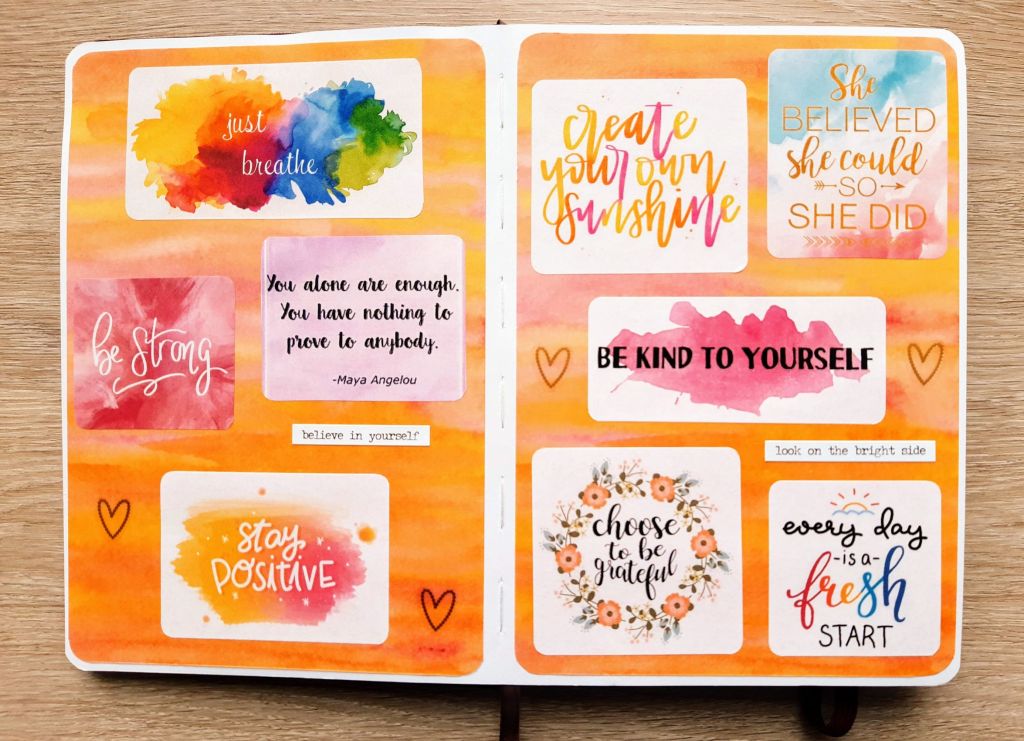
This month, I moved into a new bullet journal – a gorgeous handcrafted linen notebook from Notebook Therapy. The journal is completely blank so I set up the usual index, future log and grid spacing cheat sheet. Then I decided that I wanted to create a spread which was full of messages of support and encouragement to help me whilst I’m struggling with my mental health. The idea is that I read all of the positive content each morning a bit like you would a list of affirmations. It took me quite a while to make but I’m really pleased with how it turned out so I thought I’d share the results on here and talk a little about the process.

Creating the background

A watercolour wash

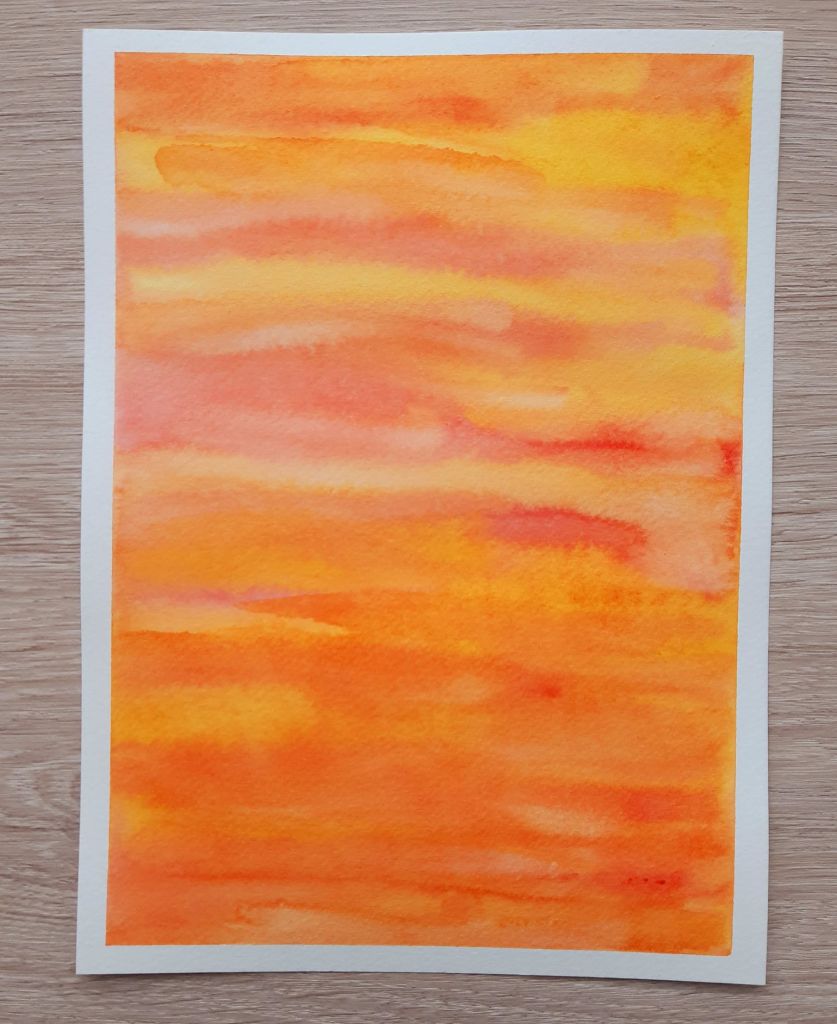
I wanted something bright and cheerful for the background so I decided to create a wet on wet variegated wash using just two of my Winsor & Newton Cotman watercolour tubes – cadmium red and gamboge yellow hue. I used an A5 piece of Aquafine smooth paper and taped the edges down so I got nice clean lines. After coating the paper with water, I swished the first colour back and forth from the top to the bottom, leaving gaps between the paint strokes. I then did the same with the second, filling in the gaps but also sweeping over the first colour slightly so that they nicely blended together. I was really pleased with the effect I achieved. When the paint was dry, I removed the tape and then scanned the piece in using my printer/scanner. I then printed it off twice, trimmed the papers so that they would fit perfectly in my bullet journal and stuck them in using double sided tape.

Finding the supportive messages

When I’d created my backgrounds and stuck them in, it was time to find some messages to stick on the pages. I spent a while thinking about what I’m struggling with at the moment and some words of positivity that I could focus on. So, for example, I’m being really hard on myself and self critical so I chose a ‘be kind to yourself’ message and a quote about being enough. Most of the images were found online by typing them into an image search (a lot of them are actually phone wallpapers cropped to size). I also got a few from a Tim Holtz Small Talk idea-ology sticker book but you could just as easily type onto plain paper and cut and stick them. I created a MS Publisher document to add the images to and cropped them and altered the size until they would all fit into the double page spread. I then printed them onto an A4 sticker sheet to make it easier to stick them in but you could easily use an A4 sheet of paper and cut them out using a paper trimmer.

What you choose to put in your spread or board would depend on the particular difficulties you’re facing. For example, you might need some confidence boosters, help with dealing with anxiety, messages to encourage you to manage your depression or some little reminders about positive body image and loving the skin you’re in. Here’s some ideas to get you started:

Confidence boosting – You’ve got this. You’re more powerful than you think. Inhale confidence. Exhale doubt. Believe in yourself. Self confidence is a super power. Once you start believing in yourself magic starts happening. I can and I will.

For dealing with anxiety – Everything is going to be alright. I can’t control everything and that’s okay. I am stronger than my struggles. Just breathe. My anxiety does not control me.

Managing depression – I am strong. I can get through this. Life is tough but so are you. Keep going. I’m enough. Stay positive. Choose to be grateful. Think positive and positive things will happen. Everything’s going to be okay.

Body positivity – Happy, beautiful and strong. Your body loves you. Love it back. My body. My goals. My happiness. Be kind to your body. All bodies are good bodies.

Final words

I made a spread in my bullet journal because it’s somewhere I look every day. However, if you’re not into bullet journaling, you could just as easily create a board out of a piece of coloured card to go up on your wall or some other place to look each morning. As an alternative to searching online, you might choose to use post it notes to write messages to yourself or cut small pieces of paper and use brightly coloured pens for your reminders. The most important thing is to make sure you look at what you’ve made frequently so you can try to take on board the supportive statements.

I hope you have found today’s post interesting and it’s inspired you to have a go at creating a similar ‘Words of encouragement’ spread. Let me know in the comments what you think you would benefit from telling yourself each day.

Posted in lifestyle, Planning and journaling, psychology, wellbeing

Monday Matters: 9 benefits of practising gratitude and how to get started today

Last year, I wrote a couple of blog posts about gratitude. One was about how I was practising gratitude despite the situation with COVID-19 and the local lockdowns that were being enforced, and the other presented a few ways in which you could start to practice being grateful. Today, I want to dive a little deeper into the core benefits of a daily gratitude practice and share ideas on ways you can get started with a view to make it part of your routine.

What is gratitude?

Gratitude is about being aware of and thankful for all of the positive things and situations in your life and their impact on you. It’s about regularly taking a moment to reflect on and appreciate what you have, even during particularly challenging times.

Finding gratitude is a skill that anyone can develop and there are so many benefits of a daily practice. Read on and you’ll see exactly why I’ve made it a habit and part of my nightly routine.

9 Benefits of practising gratitude

Makes us feel happier Gratitude encourages us to focus on the positives in our life, helping to reduce negative emotions such as anger, resentment and regret. It can also minimise feelings associated with depression such as sadness, worthlessness, self-hate and guilt.

Reduces stress High levels of stress can leave us feeling extremely tense, anxious, restless and overwhelmed. Luckily, cultivating feelings of gratitude is the perfect antidote. According to research, being more grateful lowers the stress hormone (cortisol) in our body, making us feel much calmer. It can also minimise negative self-talk which can help you to feel confident in dealing with everything life throws at you.

Improves our self-esteem One of the main things that ruins our self-esteem as adults is comparing ourselves with others in an unfavourable way. Instead of engaging in this destructive behaviour, try focusing on gratitude instead. Boost your self worth by thinking of all of your strengths and their impact on your day. Rather than feeling envious of or resentful towards others, try complementing them on their skills and be grateful for how they help you in your life.

Better sleep Finding time each evening to pause and reflect on what you’re grateful for helps you to end the day on a calm and more positive note. This can help you to wind down before bed and has been shown to improve sleep quality and quantity. If you’re really struggling with your sleep, I recommend doing some reflective journalling (see point number 1 of this post) before spending time filling in your gratitude log.

Improved physical health Those who practise gratitude have been shown to exercise more regularly and have medical check-ups more often. When we reflect on what we’re grateful for, we’re likely to show more appreciation towards good physical health and this can prompt us to take better care of ourselves.

Increases resilience We might have lots going on right now which is making life super tough for us, but practising gratitude can help us see the bigger picture, appreciating that we still have lots to be thankful for and assuring us that we have the ability to cope with what’s going on and get through it, coming out stronger on the other side.

Improves our romantic relationships Gratitude plays a key role in strengthening our loving relationships. By actively pay attention to the positive things that our partner does, we learn to appreciate them more, show our gratitude and give them thanks. Expressing your thankfulness is likely to motivate them to do more things to show they love and care about you. Also, when you feel gratitude towards your partner, the chance of you behaving in a positive, kind and caring way back is greatly increased.

Reduces materialism There’s strong evidence that being materialistic i.e. being overly concerned with material things rather than spiritual, intellectual and cultural values leaves a person feeling depressed and dissatisfied with life. Learning to be grateful for what you have reduces these feelings and increases happiness and life satisfaction.

Increases optimism Developing a daily gratitude practice can help you to become a more optimistic person by encouraging you to focus on what’s going right rather than dwelling on negative aspects of your life. If we perceive our current life to be good, we’ll start to believe that this will continue in the future.

My top tips for getting started

With this many benefits, you’ll probably want to get started straight away so here’s a mini guide to help you begin:

Keep it simple It’s best not to develop some elaborate routine that will become too onerous and make you feel like finding gratitude is a complete chore and one which you can’t keep up with. When I first started I made a simple ‘two line a day’ spread in my bullet journal and decided to come up with two or three things each day. This takes me less than 10 minutes each evening and things often pop into my head during the day which I want to add (a benefit of the practice being ingrained).

Choose your method of recording Think about what style of journal appeals to you most – would you prefer writing in your notebook or BuJo or are you happier writing notes on your phone using a dedicated app? I use my bullet journal but I have looked into a couple of apps for research, Gratitude App provides daily prompts and also challenges which run for between one and three weeks. Examples of prompts are ‘Why did you start gratitude journalling? Express gratitude to yourself for taking this step’ and ‘Express gratitude for the new beginnings life gives you’. This is good if you need a little help on the ideas front. The other app is Presently, which is a lot more simple and just gives you space to free write what you’re grateful for each day. Both apps offer alarm prompts as reminders to write.

Make it a habit I’ve written before about ways to cement habits but in brief, you need to start with a cue or trigger which reminds you to do your daily practice e.g. a time, such as 8pm (for which you can set an alarm) or before/after another habit such as when you’ve emptied the dishwasher, after dinner or before you settle down to watch TV. Then, you need to focus on the benefits you receive from the habit, so, for example, you might re-read this list, or, when you get established, you might reflect on how you feel as a result of practising e.g. calmer, happier or sleeping better.

Add a little variety Try to find different things to be grateful for each day and make sure you are really specific so you can see the impact of things in your life e.g. the sunshine because it dried my washing nicely, my ability to persevere with an arduous task until I got it finished, the reassuring words my friend said to give me the strength confidence to get through a difficult time etc.

Share your gratitude with your family and friends If I write about something my husband said or did which I’m grateful for, I tell him. This helps him to know that I don’t take him for granted and that I really do appreciate him. The same can be applied to other family members and friends.

Final words…

As you start to practise gratitude, remember it takes time and effort to make it a habit. Each evening, I like to read through all of the things I’ve listed so far that month as a positive reminder of all of the great things and experiences my life brings. And, I make sure that I express gratitude for the fact that I’ve kept going with my daily routine, even during tough times or when lack of motivation kicks in. Of course there have been a couple of days when I’ve been super busy and a change of routine has meant that my ‘two lines a day’ didn’t get filled in, but I’ve just accepted it and reflected on why it happened so that I can put in place strategies to ensure that not completing my gratitude practice doesn’t become a habit instead.

Posted in CBT, depression, lifestyle, mental health, Planning and journaling, psychology, wellbeing

Monday Matters: Negative self-talk – its impact on you and 3 ways to challenge and reframe it

For today’s Monday Matters post I want to discuss something which I’m currently really struggling with, and that is negative self-talk. I’ve been taught various strategies in different therapy sessions throughout the years but applying them when you’re really struggling is easier said than done. Also, during periods of better mood, the techniques tend to be forgotten about as the amount of negativity is much less. So, here’s some examples of different types of negative self talk, an outline of how it damages us mentally and three key ways to challenge and reframe it.

What is negative self talk?

Before you can begin to challenge your negative self-talk you need to know exactly what it is so you can label it as such as soon as it pops into your head or out of your mouth. Basically, we have lots of thoughts running through our minds all of the time such as ‘I wonder if there’s anything good on TV tonight?’, ‘I haven’t done any watercolouring this week, perhaps I’ll have a go at some tomorrow’ or ‘I feel a bit rough today so I’m going to take it easy’. These kinds of self-talk and reflection are perfectly normal and help you to make decisions and get on with things in your life. However, when the self-talk becomes harsh and self critical, such as ‘I can’t believe I did that, I’m such as idiot’, this is when it becomes a problem and can be really damaging in all kinds of ways.

The main forms of negative self-talk (AKA cognitive distortions)

The following are some of the main forms of negative self-talk. In psychology, they’re known as cognitive distortions because they’re inaccurate, exaggerated, irrational and negatively biased.

Overgeneralisation – this is where we draw conclusions about things in life or the future based on things that have happened (often once) in the past e.g. all men are liars, we’re bound to get stuck in traffic, bad things always happen to me, I’ll never be able to do that, I always fail.

Catastrophising – very closely related to the above, this is where we imagine and believe the worst will happen and completely blow things out of all proportion, for example, during a period of depression, saying that you will never get better and will spend the rest of your life miserable, or following the end of a romantic relationship, stating that you’re unlovable and will never find anyone else.

Mental filter – this is when we experience positive and negative things but only focus on the bad stuff and filter out anything good. So, for example you might have had a day out at the park, enjoyed a picnic in the sunshine, strolled around the lake, feed the ducks and swans and admired the cute, fluffy little cygnets before getting an ice cream from the café. But, on return home, you might say that you had an awful time because you were stupid enough to drip ice cream on your t-shirt and that you got burnt because you failed to re-apply your sunscreen.

Predicting the future (AKA fortune telling) -this is where we predict what is going to happen based on little or no evidence, for example, we might say things like: ‘I just know I’m not going to get the job’, ‘I’m not going to the party because I’ll have an awful time’.

Mind reading – here, you assume what others are thinking, often in a negative way. So, for example, you might decide that your friend hates your clothes because she didn’t say how nice your new dress looked, or you might conclude that your husband is sick of you because you keep getting upset all the time.

Black and white thinking – this one involves thinking in extremes rather than anything in-between or in a ‘shade of grey’. It commonly involves the use of the words ‘always’ or ‘never’. Some examples that I’ve said recently are: ‘I always mess things up’, ‘I’ll never get better’ and ‘I’m a complete mess’.

Labelling – these are things that you say about yourself either in your head or out loud which are wholly negative and unhelpful e.g. ‘I’m a fat pig’, ‘I’m useless’, ‘I’m such a failure’ etc.

Shoulds and muststhis involves putting undue pressure on yourself and creating unreasonable expectations which become impossible to keep. For example, you might say ‘I should be a better wife’, ‘I must tidy up all of this mess’, ‘I should exercise more’, I must make sure I’m on time for my appointment’. Using ‘I need to…’ isn’t particularly helpful either e.g. ‘I need to lose weight’, ‘I need to be a better mum’, I need to get that work done’. I’ve written an in depth blog post on this previously as it’s something we covered in my compassion group classes.

The consequences of a tendency towards negative self-talk

As well as causing high levels of stress for both the individual and their close family and friends, negative self-talk has a number of negative consequences including:

  • lack of self belief
  • poor levels of resilience
  • diminished ability to make positive changes in your life
  • reduced self-confidence
  • decreased motivation
  • feelings of worthlessness
  • feelings of hopelessness
  • likelihood of depression and anxiety being exacerbated

Personally, I find that negative self-talk goes hand-in-hand with depression and feelings of anxiety which only serves to make things worse.

3 ways to tackle your negative self-talk

In order to remedy our tendency to negative self-talk we need to recognise when we’re involved in it and actively challenge our words. Here are three ideas on how to do this:

Recognise it, write it down and challenge it

There are a number of psychological studies that have looked into developing awareness of self-talk and the key findings suggest that those individuals who wrote down their own personal examples in some form of log book showed greater insight into the specific content of their self-talk and the consequences of its used. They were also able to start challenging their initial thoughts in order to create more balanced conclusions.

Recognising and challenging your self-talk takes time and commitment but is really worthwhile doing. The following example is my own and I hope, by sharing it, you can see how the process works (you may need to click and enlarge it to see properly). When challenging the evidence, I find it helpful to think about what a good friend or my lovely husband might say in response to what I said.

Take it to court

This is a great technique, which I used in my chart above and feel is really helpful for cross examining your self talk. It commonly used in CBT (Cognitive Behavioural Therapy) and involves metaphorically take the thought or belief to court and place it in the dock. You then find evidence for and against the thought or belief, considering the factual evidence and not opinions. Working for the defence, you try to prove that the accused (your thought or belief) is truthful and correct by providing evidence that shows that your thought or belief is 100% totally true. You can see examples in column 4 of my chart. Then, working for the prosecution, you look for evidence that this thought or belief is not true 100% of the time. For this, you need to select good quality evidence that would hold up in court. Finally, the judge summarises all of the evidence and composes a final statement which is realistic, rational and balanced. This should then help you to see alternative ways of thinking and enable you to undermine your extreme and unhelpful though. You can find worksheets to go with this technique at Getselfhelp.co.uk.

Find more positive alternatives

When you catch yourself saying negative things, try to come up with more positive alternatives or different ways of looking at the situation. Again, think about what a good friend or your partner would say to counteract your thought or belief. Here are some examples which might help:

Negative self-talkPositive self-talk
I hate feeling like thisIt’s okay to feel like this, my feelings are valid
I’m never going to get betterThis is temporary and I have the ability to get through it. I’m taking things one step at a time.
I hate my bodyI’m grateful for everything my body can do, I’m healthy and strong and my body is beautiful.
My life is awfulThere are so many good things in my life right now.
I’m getting everything wrongEveryone make mistakes and we all have days that are better than others.
I need to do some exerciseI would like to do a little more exercise so I can feel more toned.
I can’t do itIt’s going to be hard work but I can do it
I’m so stupidI made a mistake, so what, everyone makes them!

Final thoughts

You might not need to complete these exercises all of the time but when you find yourself dealing with feelings associated with anger, depression or anxiety, try to make time to stop and become more aware of your thoughts. Then you can start to reflect on them, challenge your views and find alternative ways of looking at things. Hopefully, after developing the skills associated with thought investigation and thought challenging, you’ll find it easier to put the ideas into practice and conquer your negative self-talk and start being nicer towards yourself.

Thanks for reading and good luck!

Posted in Bullet journaling, lifestyle, Planning and journaling, self care

Monday Matters: 8 self care activities for Autumn

Photo credit: Piotr Laskawski for Unsplash

The end of September marks the beginning of the season of Autumn and is an ideal time to ramp up your self care regime. In today’s Monday Matters post, I’m going to share 8 ideas to get you started.

Get your home Autumn ready

As the weather turns chillier, it’s time to pack away your Summer clothes and accessories, give your wardrobe and drawers a good vacuum and then fill them with cosy jumpers, knitted cardigans, scarves, hats and gloves. I also like to adorn my sofa with a couple of soft blankets to make use of on chilly evenings.

Go on a nature walk

I love to go on long walks in the countryside all year around but being out in nature in the Autumn time is particularly special. It’s such a complete feast for the senses with all the changes that are taking place as I shared in this blog post last September.

I also like to take my DSLR camera with me so I can collect photographic examples of the season such as leaves changing colour, wild and wonderful fungi, fallen conkers, acorns and sycamore seeds, hedgerow fruits and super sweet wildlife such as squirrels and hedgehogs.

Make a deliciously warming soup

It’s now the perfect time to have a go at making your own delicious and nourishing soup. I like to make the most of seasonal vegetables and try out lots of different squashes. Each one has a slightly different taste so why not try a few and see which you like best?

Sort out your skincare routine

I find that my skin gets really dehydrated in Autumn and Winter due to a combination of having the central heating on and the drying effects of the cold and windy weather so developing a good skincare routine is vital. After my daily shower, I apply a generous amount of aqueous cream all over my body but particularly on my legs which tend to get very dry and cracked. I then use a rich vitamin E cream on my face which contains an SPF and gives my skin a lovely radiant glow. Throughout the day, I make sure I drink plenty of water, adding a sugar free Cherries and Berries squash to make it more flavoursome. Before going out for my daily walk, I apply Vaseline to my lips as a protective barrier against the elements. I use the same face wash all year round which is a mild, gentle and fragrance free one specially formulated for sensitive skin and I make sure I moisturise well after each use. I’m also debating adding a night cream to my routine this year too but I need to do a little more research on them first.

Try out an Autumn craft

Doing something creative can be a great mood booster and a chance to practise mindfulness. There are lots of ideas for Autumnal crafts for adults and kids on Pinterest but this Autumn leaf Mason Jar craft particularly caught my eye.

Snuggle up and read

Get your cosiest pyjamas on and your warmest socks. Make your favourite hot drink and then snuggle up on your sofa wrapped in a soft blanket to read a good book. Bliss!

Treat yourself to an Autumn scented candle

A cheap and easy way to create a cosy Autumnal atmosphere in your home is to treat yourself to one or two gorgeous scented candles. There are so many different fragrances to choose from and a quick Google search produce results such as pumpkin spice, warm apple and cinnamon, pecan pie, crisp campfire apples, vanilla pumpkin marshmallow, spiced orange and Autumn glow.

Make an Autumn bucket list in your bullet journal

A wonderful spread to make in your bullet journal and to ensure you get the most out of the season is an Autumn bucket list. Then you can add all of the above activities plus any of your own that you want to try. Search Fall or Autumn bucket list on Pinterest and select your favourites.

Photo credit: Laura Jones for Keeping It Creative

I hope today’s post has given you lots of ideas on how to look after yourself over Autumn. I would love to hear about your plans for the season so, if you get the chance, leave me a little comment below.