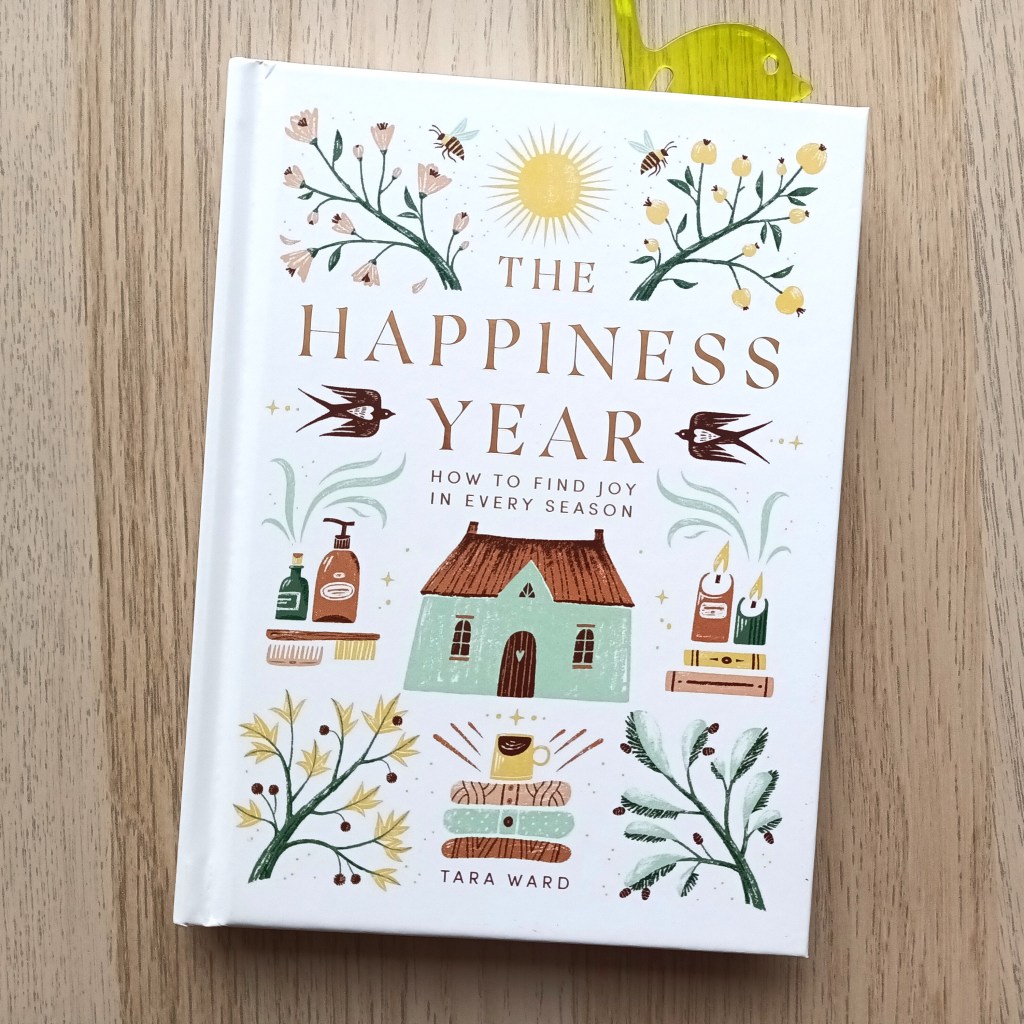
A few months ago, I was looking in the health and wellbeing section at Waterstones and came upon a beautifully illustrated book about finding joy throughout the year by trying out different seasonal activities. At the time, I didn’t purchase it, but I regretted my decision so I ordered it from an online retailer. When it arrived, I added it to the bookcase in my craft room as I was already in the process of reading about 8 different books which is a few too many even by my standards. I pulled it out a few days ago and there are some lovely activities inside in the section which I started with – Spring. I tried out the first exercise this morning and really enjoyed it so I thought I would give a short summary of the book and share that first prompt with you today.
The Happiness Year: How to Find Joy In Every Season by Tara Ward
In the introductory section of the book, Tara discusses the aims of The Happiness Year and also talks about the emotion of happiness and the four positive chemicals that are released into your body when you’re happy – dopamine, oxytocin, serotonin and endorphins (referred to as DOSE throughout the book). She then goes on to explain how to use and enjoy the book.
The remainder of the book is split into four sections – Spring, Summer, Autumn and Winter and there are a collection of exercises provided in each which you can pick and choose from. In combination, they promise to help you in an holistic way – physically, mentally, emotionally and spiritually. Personally, I think I will probably try out all of the different activities and see which I prefer and benefit from the most.
Included within the book, there are journalling and brainstorming activities, meditations, physical exercises, goal setting and planning tasks, plus many more to explore and enjoy. You are also invited to complete them in a way that feels comfortable for you, taking into account individual differences and preferences.
So far, I’ve only read the Spring chapter in depth but I’ve had a good flick through all of the book and I can already see there are many exercises that will appeal.
Exploring your thoughts, feelings and ideas about Spring
As I said earlier, I completed the first activity this morning and I enjoyed it so much that I felt compelled to share it with you. I think this exercise would work well for each of the four seasons, not just Spring. Here’s a step by step explanation of what to do:
Take an A4 piece of paper and place it in front of you
Write the word SPRING in large letters at the bottom of the page
Close your eyes and take three deep, comfortable breaths to focus you in the present moment
Open your eyes and look at the word
What comes to mind when you think of Spring?
Write down everything which comes up for you
When you’ve run out of ideas, close your eyes again, breathe deeply and continue thinking about the season
Note down any further ideas or images which come to mind
When you feel you’ve finished, look over your sheet
What jumps out at you the most? Circle any words or phrases which particularly resonate or feel important to you. Are then any surprises?
What is the overriding emotion when you look at your words? Write that emotion or emotions at the top of the page.
Look through the words and make a list of those which generate feelings of happiness.
I hope you found this a helpful exercise and it reminded you about all of the lovely things which happen in the Springtime. I’ve included my sheet below, how does it compare to yours?
Photo credit: Laura Jones for Keeping It Creative
Final words…
If you enjoy mindful activities such as journalling, setting intentions, exploring the world using your five senses, breathwork, meditation and appreciating the simple things in life, I would definitely recommend checking out The Happiness Year. The book will help you find ways to appreciate and make the most of all of the things that each season has to offer you. You’ll also find a range of self care activities to increase your happiness levels by releasing a good ‘DOSE’ of positive chemicals. Let me know if you try the exercise outlined above and how it made you feel.
Most of us lead very busy lives and it can be incredibly difficult to switch off and relax in the evening in preparation for a good night’s sleep. Today, I’m sharing four excellent ways to wind down after a stressful or busy day. The following activities are great for your mental health and wellbeing and I’m going to be offering lots of different options to choose from depending on your preferences.
Do a journalling activity
After a busy or particularly stressful day, it can often be super difficult to calm our mind. Your head can be full of all kinds of clutter in the form of thoughts (both positive and negative), ideas or feelings. Maybe you’re busy analysing or deconstructing everything that has happened and going through things that were said. Perhaps you’re worrying about your mounting to do list and what didn’t get crossed off today because of x,y and z which took priority. Or, you might be looking towards tomorrow, thinking about the events in your diary or how you can be super productive and get more done whilst making it a calmer, less stress inducing day. If any of the above apply, you might be wondering if you will ever be able to switch off and sleep tonight. This is where getting your thoughts and feelings out of your head and onto paper can be super helpful. Just ten minutes of free flow or structured journal writing can make all the difference.
I learnt the following method for putting the day to rest when I was teaching, when every day was a busy day and I was really struggling to relax and sleep.
Putting the day to rest activity
Set aside 20 minutes in the early evening (I used to do this at 7.30pm)
Sit down somewhere quiet
Think about your day today and how it has gone, what you did and how you feel about it
Write it down in bullet points or free writing if you prefer
Write down anything you didn’t get done off your to-do list
Think about tomorrow – do you have any particular events coming up? what are looking forward to? are there any worries you have about what’s happening?
Write down a loose or structured plan for your day depending on your own needs (you can always modify this as you learn what works best for you.
When it comes to later evening and bedtime, if thoughts about today or tomorrow pop into your head, remind yourself that you’ve already evaluated your day and planned for tomorrow, so you don’t need to think about it any more.
If new thoughts come into your head at bedtime, jot them down on a piece of paper or on a notepad.
Other types of prompt based journalling might also work for you and there are some lovely ones on the market which can be used before bed. I’m a big fan of The Five Minute Journal but there are plenty of much cheaper options if this doesn’t fit with your budget. How much you want to write is up to you but it’s good to develop a consistent practice which becomes a positive habit to end your work time or day with.
Try a Mindful or Meditative Practice
Any type of activity that requires a high level of concentration and uses different senses is great for helping you to forget about the busyness of your day. Here’s some ideas for mindful and meditative activities which you might like to try:
Meditation – this can simply be sitting quietly and focusing on your breathing or using a guided practice. I recently found this account on YouTube that has some lovely ones with different foci that you mind find helpful. When choosing a guided session, it’s important to find someone who’s voice you find soothing and relaxing so you might like to try out a few to establish your preferences.
Crafting – there are so many different crafting options such as papercrafting, watercolour painting, knitting, sewing, crochet, model making and so on – why not give a few beginner projects a go to see which you prefer.
Some kind of puzzle e.g. a jigsaw, wordsearch, crossword etc. – great for keeping your mind active
Games – this could be something on your computer that you play by yourself such as Angry Birds, Candy Crush, Word Cookies or Patience, or one you play with others such as Boggle, Yahtzee, Gin Rummy, Scrabble or Jenga.
Enjoy a scented bubble bath and use your senses to fully appreciate the experience.
Cook a meal from scratch – measure out your ingredients with care, fully engaged with chopping / dicing / peeling etc, smell the different flavours as the dish cooks, taste the mixture to check the seasoning and so on. Mindfully enjoy the results at your dining table. Share your experience with others.
Watch something engaging on TV – comedy, drama, nature, historical interest or reality. Whatever you enjoy, give it your full attention and leave your phone or tablet in another room so you don’t get distracted. If you’re anything like me at this time of year, you’ll want to get your PJs on and snuggle under a warm blanket with your feet up for this one!
Read a book or magazine
Spending time reading a novel, information book, or favourite magazine is a great way to unwind and get yourself all relaxed and ready for bed. I love Psychologies magazine, as it’s full of positive ideas, and I can learn new ways of managing mental health and wellbeing at the same time.
Some people argue that you shouldn’t read in bed, but I find reading a few chapters of my Kindle novel (or for about 30 minutes) helps me to drift off really quickly. Try reading just before bed and reading in bed to see which works best for you.
Spend quality time with a loved one
Arranging an after work activity to do with a co-worker, friend, family member or partner can also help us destress. This could involve going out for an after-work drink, doing an evening class, watching a film at the cinema, seeing a comedy show or visiting a new or favourite restaurant. Alternatively, you might plan something fun to do together at home such as making popcorn to eat whilst watching a film, playing a board game or learning something new such as massage or reflexology.
Spending time with a pet is also great way to destress and calm the mind. This could include something you know they enjoy such as throwing a ball for your dog to catch at your local park (depending on the time of year), stroking your cat as they sit curled up on your knee, or watching your hamster as they zip around the house in their exercise ball.
Final words…
So there you have it, four ways to take yourself out of work/busy mode and into a relaxed state for the evening. I hope today’s post has given you food for thought and you’ll try one or two of the activities listed to see how they help. If you have any other preferences for your wind down routine, let me know in the comments.
When I was teaching, I would regularly feel completely wiped out physically and mentally, and, for the first days of any holiday, whether it was half term, Easter, Christmas or the summer break, I would end up either ill or sleeping most of the time as my body and my mind couldn’t take any more.
The other week, I was listening to a group of pharmacy students at the University as they discussed their workloads and lifestyle choices because of how much they had to do. It reminded me of that feeling of never having enough time and the pressure and stress that came with it. So, today, I thought I’d talk about the signs which suggest you may be heading towards burnout (or are already there), and, perhaps more importantly, what you can do about it before you reach that stage.
What is burnout?
Burnout can be defined as a state of physical, mental and emotional exhaustion which can result from long-term or repeated bouts of stress. This could include, but is not limited to, working in a stressful or high pressured job, doing an intense amount of studying (e.g. for a degree course or post graduate qualification, or having a particularly demanding life circumstance such as being a single parent, caring for a loved one (such as a young person with special needs or an aging relative), having financial difficulties or worries related to job security, being involved in a house move, divorce or separation or trying to juggle too many responsibilities at once.
What are the main signs of burnout?
The signs of burnout differ depending on the individual but common signs to look out for include:
fatigue – constantly feeling tired, drained or exhausted
sleep issues e.g. insomnia, panicked night time waking, regularly getting less than 6 hours a night etc
frequent feelings of cynicism, anger, irritability and a pessimistic life outlook in general
poor immunity – resulting in regularly feeling under the weather or having frequent coughs, colds, sore throats etc
gastro-intestinal issues such as IBS, stomach upsets, sickness and diarrhea or unexplained abdominal pains
recurring headaches
poor concentration levels which may result in reduced efficacy or success at work, making careless mistakes, being easily distracted, struggling to maintain attention, trouble thinking clearly or making decisions, forgetfulness and poor working memory.
depressed mood which may cause tearfulness, sadness, feelings of emptiness, loss of interest or pleasure in things you once enjoyed, feeling worthless, suicidal ideation, a sense of isolation and inability to relate to others
feelings of anxiety such as restlessness, agitation, irritability, having a sense of dread or fearing the worst
How can I prevent burnout?
Educate yourselfLearn about your current stresses and your coping strategies using ‘the stress bucket model’ that I discovered on Mental Health UK. You can download your own to fill in here. Make a list of helpful activities (known as taps in the example) and plan to do some of them each day to help you destress and unwind.
Prioritise self care You might not be able to remove the sources of stress you are dealing with right now, but you can make sure that self care becomes a non-negotiable part of each day. Try writing two lists – everyday (basic) self care that keeps you functioning each day e.g. keeping yourself hydrated, eating regular and nutritious meals, getting some exercise and taking regular work breaks, and ‘me time’ self care activities you find calming or relaxing e.g. having a walk in nature, quiet reading, taking a bubble bath, having some time away from your phone and social media, listening to music with your eyes closed, doing a mini meditation etc.
Learn to say no If you feel like you’re taking on too much to cope with, could it be that you are agreeing to requests or feeling obligated to doing things that are further adding to your stress? Although easier said than done, learning to say no can really help you to prioritise what matters to you or what you consider is absolutely essential for your health and wellbeing.
Accept that perfection is unachievable Perfectionism and the impossibly high standards that go with this trait can become overwhelming and will almost certainly lead to burnout. To manage this, take time to think about your current situation realistically and try to think positively about how well you are doing under the circumstances. Mantras such as ‘I can only do my best’, ‘done is better than perfect’, ‘nobody is perfect’ and ‘I don’t have to do things perfectly’ can help if said regularly.
Show some self-compassion If a friend was having to juggle all the commitments and responsibilities you’re currently facing, what would you say to make them feel better? A helpful exercise I learned in one my compassion group sessions is to write a letter offering sympathy, advice and support and post it to yourself or read it regularly. It might feel a little strange writing at first but it can really help.
Take a break from your devices After a particular busy or stressful day, you might be inclined to sit (or lie) on the sofa and mindlessly scroll through your phone or tablet. This might seem like a good way to relax at the time, but studies show that being addicted to our digital devices has a seriously negative impact on our mental and physical health, not to mention our productivity levels. Rather than constantly reaching for your phone, why not try a screen free hobby, for example, doing a mindful craft such as painting, drawing, sewing or knitting, doing puzzles such as jigsaws, crosswords, wordsearches or Sudoku which stretch your brain and help you relax at the same time or losing yourself in a good book or your favourite magazine.
Get organised Use your planner or calendar to map out your day and manage your schedule. Being organised can help you feel more in control and can also be a useful tool for identifying and planning for your priorities.
Practise mindfulness and meditation Mindfulness is a technique that involves paying attention to the current moment with non-judgmental awareness of our thoughts and feelings. Click here to read about five simple ways of incorporating mindfulness into you daily routine. Meditation, which is a key aspect of mindfulness practice, has been shown to combat potential burnout by lowering stress and anxiety levels, helping us to build resilience and coping skills, improving self- awareness and self-esteem, cultivating positive thoughts and emotions and boosting our ability to focus and concentrate on tasks. For ideas on how to get started, you might like to read this blog post which has beginner friendly suggestions and tips.
Reach out to others Sometimes, when struggling to cope with everything life is throwing at us, we start to believe we’re the only one who’s finding things difficult. Our thoughts and feelings can then lead us to withdraw from loved ones or isolate ourselves from others. However, this is the time when seeking out your support network can be most useful. Positive social interaction such as meeting a friend for coffee, taking a full lunch break with work colleagues or fellow students, or doing something fun with family members can help in a range of different ways such as providing a listening ear, support, sympathy and useful advice, taking your mind off your sources of stress or giving you the chance to do something enjoyable or relaxing.
Take steps to manage your sleep routine High stress levels can have a profoundly negative effect on your sleep. It’s really important to take steps to develop a relaxing evening routine which sets you up for a good night’s sleep. This wonderful article discusses the relationship between sleep and burnout and includes lots of useful tips for your day, evening and bedtime routine.
Final words…
For many of us, avoiding burnout isn’t easy and there are commitments in our busy lives which we can’t avoid or say no to. However, actively taking steps to combat the daily stresses in our lives by using some or all of the coping strategies above can really help. I think filling in the stress bucket would be a good first step in boosting self- awareness prior to making small lifestyle changes with a view to preventing burnout and generally improving health and wellbeing in the future. Let me know in the comments if you try out some of the ideas above and you find them beneficial.
Today I’m sharing some easy self-help strategies to enable you to create a life which is both calmer and more positive. I hope you find the tips useful and they motivate you to make a change or two going forward.
Be kind to yourself
Showing self-compassion, practising self-care and giving yourself grace when you make mistakes or are struggling with the stresses of modern day living is an important and helpful first step to take in developing a more positive life. If a good friend of yours was finding things difficult right now, you would offer them support and encouragement, sympathy and well wishes, yet when we find ourselves in a similar situation do we behave in the same way? Here’s a few ways to be kind to ourselves (and they don’t need to be reserved for when we are down or struggling with our mental health either):
Forgive yourself often – for making mistakes, not being perfect, not being super productive etc. Whatever you beat yourself up about, STOP!
Keep yourself hydrated – this simple act of self-care is important and will help you feel your best throughout the day
Listen to your body – if it needs rest, a day off, a holiday, a break from chores, a lie in etc. provide exactly that.
Explore how you’re feeling mentally and why – try a spot of journalling or talk to a close friend, then, if need be, take appropriate steps to remedy the situation.
Eat well – eating a balanced diet full of fresh produce, wholegrains and all of the vitamins and minerals you need is a great way to look after yourself. Yes, you shouldn’t deny yourself the occasional treat, but eating a predominately healthy diet will help you maintain good energy levels, restful sleep and better mood.
Get some exercise – you don’t need to lift weights at the gym or pedal the exercise bike for hours each week, do something you enjoy whether it’s yoga, pilates, a walk in the countryside or playing outside with your dog. Exercise releases feel good hormones as well as keeping you in good shape.
Celebrate your achievements – think about what you’ve achieved this week / month / year and give yourself a pat on the back. Even better, treat yourself to some kind of reward such as a bunch of flowers, a new notebook or something else that’s been on your wishlist for a while.
Be kind to others
Small acts of kindness towards others can have an enormous impact on both on the giver and receiver. Just something simple like holding a door open for someone who has their hands full or letting someone who is only buying one item go before you in the queue for groceries is enough for benefits such as brighter mood, lower stress levels, feelings of connection and belonging to the community and improved self-esteem and confidence.
Release your inner creativity
No matter how busy your day is, there’s always at the very least a small window of opportunity to get creative (try putting your phone in another room for half an hour!). Whether it’s doing some colouring in and choosing colours which complement each other, developing a poem about your experiences, doing some seasonal doodling in your bullet journal or creating a mood board for your living room, anything which uses your imagination or original ideas to make something is a boost to your creative side. And even if you don’t see yourself as the creative type, trying out different expressive activities will help you develop this part of yourself which I promise is lurking inside somewhere! Engaging in creative pursuits is wonderful for bring calmness and tranquility as well as a sense of achievement. It’s also a lovely way to practice self care.
Develop an attitude of gratitude
I write about gratitude in a lot of my wellbeing posts here on my blog but it is with good reason. Being grateful for what you have and celebrating ways in which you are very lucky has proven health benefits such as being better able to cope with adversity, enjoying improved sleep and immunity, building stronger relationships with others (particularly if you show gratitude for family and friends) and generally feeling much more positive and happy. Feeling gratitude and expressing your appreciation for things in your life is a very spiritual practice, creating a feeling of ease and contentment.
Be more mindful
Mindfulness is all about paying more attention to the present moment, focusing on your current thoughts and feelings and what is going on around you right now. Some examples of how this might manifest itself in your life include:
meditation and breathwork
paying full attention to the little things you do each day as part of your routines such as taking a shower, brushing your teeth, eating your breakfast, making your bed, brushing your hair or getting dressed. This will help you to change the focus from rumination about the past or worrying about the future
taking a walk in nature and becoming really conscious of your immediate surroundings – use your five senses to explore the environment
working on one thing at a time – avoid trying to multi-task (which is a complete myth anyway as you can read here)
eat mindfully – really pay attention to what you’re eating, how it tastes, how it feels in your mouth, how it is making you feel (this is also good for making sure your eat slowly and stop when you start to feel full and satisfied)
use the 5,4,3,2,1 grounding technique to bring you back to the present moment (this is particularly useful if you start to become anxious about something)
do some journalling – writing your thoughts, feelings and experiences in a journal is a great way to slow down and become aware of how things are for you right now
try movement meditation – most of us associate meditation with sitting or lying very still and focusing on the breathe. However, this is just one example of how to meditate. Check out this article for seven popular styles of movement which are meditative in their nature.
Start a slower and more relaxing morning routine
Your morning routine has the power to set you up for a calm, happy and productive day or leave you stressed out, tired and wanting to go back to bed. For a gentle start to your day, try the following tips:
prepare for your day the night before – check your planner to see what you have scheduled for tomorrow, write a list of intentions for the next day or choose your priorities from your to do list, choose your outfit and check to see if it needs ironing or unfolding to let the creases drop, if you are going out somewhere, pack your bag ready.
wake up early – plan to get up at a time which gives you the opportunity to get ready without rushing (this might involve going to bed earlier or other tweaks to your evening routine to encourage restful sleep)
open your curtains or blinds to let natural light in, or, during winter, use a sunrise simulation lamp to mimic the effects.
try journalling – this could be completing the morning entry of The Five Minute Journal like I do, doing morning pages or making note of a few things or people you are grateful for
avoid reaching for your phone – checking our phones as soon as we get up is an automatic reaction for most of us but it has been shown to have negative effects on the brain. Issues include heightened stress and anxiety levels, poor performance levels at work, lack of productivity as well as loss of our precious time. Instead, eat your breakfast mindfully and slowly, take yourself outside to get some morning light, do some gentle stretches or record your thoughts, feelings or daily gratitudes.
choose a slow living activity to put you in the right mindset – read a chapter from a motivational book, listen to a podcast, make a nutritious breakfast, savour your morning coffee (rather than downing it when it’s too hot or going cold), sit outside and watch the sunrise, close your eyes and focus on your breathing or flick through your favourite magazine. Make the most of rising early before you start to tackle your to do list or head off to work.
Final words…
I hope you’ve found the above tips useful and are motivated to try some of them. I know that making lifestyle changes can be quite difficult and require time and commitment. You might want to try to transform many aspects of your current life but doing too much at once will most definitely lead to overwhelm and the temptation to give up. I recommend choosing one thing to focus on and, where possible, enlist the help and support of your partner or a close member of the family or a good friend. I also encourage you to regularly evaluate and reflect on how things are going for you and consider if the small change you’ve made is having the desired effect. This will help you to refocus and serve as a good reminder of why you started.
Last month, I met up with a few of my close friends for lunch and a good catch up. We had a lovely afternoon and there was so much to talk about. We reminisced about old times when we all worked together, talked about our recent holidays and plans for future breaks, shared what we’d been up to over the summer (and how fast the months were flying by) and commented on how children are so different from when we were young. As is often the case when the conversation is flowing, we spent some time chatting about current affairs local and national news. Sitting there listening and very occasionally contributing to the discussion, I realised that I knew much less about most of the topics than anyone else in our group. They seemed to know every detail about a particularly harrowing subject and had formed lots of opinions about all that they had read and heard. When I returned home, I mentioned this to my husband and considered why I was much less informed. I came to the conclusion that the main reason is that I firmly believe that over-consumption of news, particularly of the negative kind, seriously impacts my mental health and so I tend to avoid watching and reading too much. Today, I’d like to share what I have learnt from my online reading on this interesting and thought-provoking topic and present some strategies for avoiding ‘doomscrolling’ and managing your news consumption in general.
The concept of ‘doomscrolling’ and issues with easy access to news media
The term ‘doomscrolling’ came into regular use during the Coronavirus pandemic and is the act of spending an excessive amount of time reading and consuming large quantities of negative news online. This, coupled with 24 hour news channels on the TV, sensationalist headlines being so easily accessible and the negativity bias of media outlets can mean that the news is seriously harming your health and wellbeing. Some of the detrimental effects include:
increased anxiety levels
difficulty concentrating, completing tasks or relaxing
worsening symptoms of depression
elevated stress levels and trouble sleeping
obsessive worry and fear
gut and stomach problems
muscle tension and pain
poor productivity levels
feelings of helplessness or paranoia
So, why do people involve themselves in ‘doomscrolling’ and excessive negative news consumption?
According to my research there are several main reasons why people engage in this kind of behaviour:
having a natural negativity bias that makes them pay more attention to bad news than good news
wanting to feel in control and prepared for potential threats in a world that seems chaotic and uncertain
being addicted to the dopamine rush that comes from getting new information, even if it is negative
because they wrongly believe that they are keeping themselves safe by doing so
What strategies can I try to prevent ‘doomscrolling’ and over consumption of negative news media?
Limit your time Set a time limit for your news consumption and stick to it
Make use of mobile apps and your phone settings Use apps or tools that block or limit your access to social media or news sites
Look for the good news Seek out positive or uplifting stories that balance out the negative ones
Consider better alternatives Choose to engage in activities that make you happy, such as hobbies, exercise, meditation, or spending time with loved ones
Seek help or support Talk to a therapist or a trusted friend if you feel overwhelmed by the news or your emotions
Final words…
I hope you’ve found today’s post thought provoking and useful. Remember, staying informed is important in terms of feeling involved, knowledgeable and connected to others and is a valuable way to learn and grow. However, taking care of yourself is of equal importance so make sure you control your news consumption rather than letting it control you!








 Keeping it creative