For the last five months, I have been setting a number of monthly goals which I aim to have met by the end of the month. Today, I thought I’d share my process using my actual list for this month as an example. I also want to explain how I make sure that each of them are SMART, even if the original goal is rather loose and unspecific.
Before I share my goals for February, here’s a quick reminder of what the letters of the acronym SMART stand for.
S – Specific
M – Measurable
A – Achievable
R – Relevant
T – Time bound
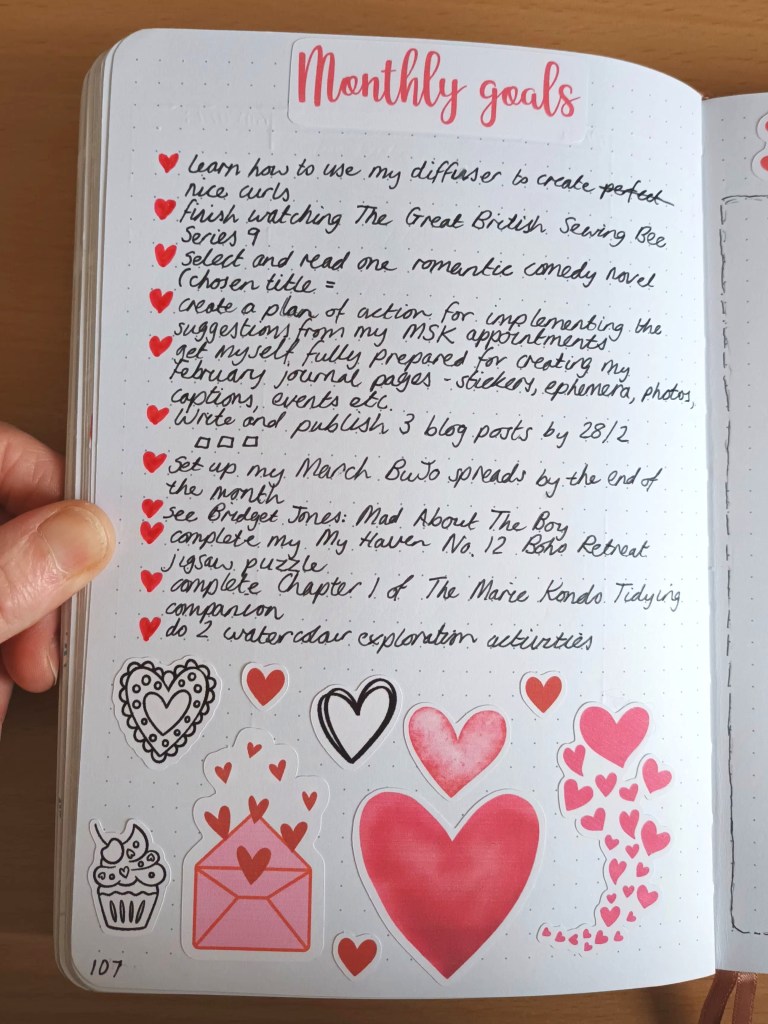
Now, obviously, all of my goals are time bound as I aim to have achieved them by the end of the month, but how do I make sure my goals meet the rest of the criteria? Well, here’s an image showing my simple goals laid out in my bullet journal and I’ll pick out two of them to consider in detail so you can see my thought process and actions I take to prepare.
My actual goals for February 2025
Image credit: Laura Jones for Keeping It Creative
Let’s take the first one:
Learn how to use my diffuser to create perfect nice curls.
I’ve made this goal specific by explaining exactly what I hope to achieve by learning to use my diffuser. I haven’t just said ‘learn how to use my diffuser attachment’, I’ve also stated what I want to use it for.
My goal can be measurable as I’m currently clueless on how to use the diffuser correctly, whereas when I’ve achieved my goal I should be able to use it to create nice looking curls. I’ll deem them to be nice enough if I would be happy to leave the house for the day with them looking like they do!
The goal is achievable as I have the resources required to work towards it, i.e. I own a diffuser attachment for my hairdryer and I can select video tutorials on YouTube to watch to learn the techniques involved. And, you’ll notice I’ve crossed out the word ‘perfect’ – this was intentional as I’m saying that the curls don’t need to look as perfect as they would when I step out of the hairdressers, but need to look nice enough to show them off with confidence.
The goal is a particularly relevant one for me as my hairdresser has been curling my hair with with a wand or straighteners and, although they look beautiful at first, I’m always frustrated with the way they drop out in less than an hour so, I’ve armed myself with curling gel which should help to hold the curl better. Also, I’ve always wanted to be able to create bouncy curls so this is a good objective.
Now, I know I said earlier that the goal is time bound, but, for me, saying I’m going to get all of the above goals ticked off by the end of February leaves too much opportunity for failure, so, I like to get super specific and dedicate a block of time to each project, activity or task involved in my monthly plan. For example, I might decide that on Wednesday 12th February in the morning, I’ll watch a couple of tutorials on YouTube that have been liked by lots of viewers (more likely to be good quality) and then have a go at curling my hair in the afternoon. I’ll also dedicate another 2 or 3 hours to perfecting my new skill until the curls look nice enough to go out with.
I also want to talk about the very last goal in my list:
‘Do two watercolour exploration exercises’.
I’ve picked this one to explain about, because I had something similar for one of my January goals, but I didn’t achieve it. In fact, I didn’t achieve a single part of it because I wrote ‘Do some watercolour exploration each week, using ideas from Painting Calm’ and, although I did a small amount of watercolouring just before the end of January, it wasn’t using ideas from my new book (which I have barely looked at yet) and it certainly didn’t happen every week!
To be completely honest, my goal was far too ambitious as it demanded a lot of time, something that I didn’t have enough of, especially with all of the other goals I’d set for that month. Therefore, it didn’t fit the achievable element of a SMART goal. So, this time, I’ve reduced what is expected of me, and I’m going to write into my monthly BuJo calendar, exactly when my watercolouring sessions will take place. I’ll also pre-pick the ‘watercolour explorations’ I’ll be doing so I can get prepared before I start. They can also be activities from my new book or ones I see in social media if I fancy trying them instead (they’re specific but not too ridged).
So, for my final goal (i.e. the one at the bottom of my list), although ‘Do 2 watercolour explorations’ might seem a bit vague, it can easily be developed as a SMART goal. It is specific as it states the kind of art I want to do and explains that they’re explorations so basically just me trying out a couple of techniques. It’s measurable as I’ll be able to see the evidence of two exploration style activities on watercolour paper or in a sketch book. It seems to be much more achievable – as long as I don’t get COVID again! It’s relevant, as exploring with watercolour is on my vision board for 2025 and it’s time bound as I plan to do both activities before the end of the month with my sessions identified on specific days (recorded in my BuJo) and time blocks drawn up on the actual day, based on how long I would like to spend doing them.
Final words…
I hope today’s post has been helpful for you and will assist you in turning your simple goals into SMART goals to increase your chance of achieving them. I see so many examples of incredibly unspecific goals when people share their monthly spreads and then, when they come to review their progress, they talk about how they only achieved a small number of them or, more often than not, had forgotten what they had said they wanted to do! As well as making your goals SMART, you should also remember to check back in with them on a regular basis. This way, you can pick out two or three for each week of the month and then outline your plans, first in your monthly set up, and then in your weekly.
I would wish you the best of luck with your goals, but really, what’s required is hard work and paying attention to what matters to you so I’ll just say I hope you’re ready for action and are focused on what you want! Go get em!
Today, I’m sharing the second and final part of my mini-series on lifelong learning. In Part 1, I considered the character traits of lifelong learners and discussed the benefits of being a lifelong learner. In Part 2, I’m going to be identifying different habits to adopt for continual learning and also sharing a range of ways to be a lifelong learner. I hope you find both of my posts useful and they help you think about the value of continued learning, your preferred learning styles, plus little tweaks you could make to your daily life and schedule so that learning is both a priority and a joy.
Photo credit: Laura Jones for Keeping It Creative
1. Consider your learning styles
We all have preferred methods of learning and, as adults we can develop our understanding of the different styles, decide which of them work best for us personally, and then use our knowledge to tailor our learning experiences appropriately. Here are some of the most common types of learner:
auditory – learns by listening e.g. through music, lectures, podcasts, and talks
visual – prefers to use visual aids such as pictures, photographs, videos, charts and diagrams, they may also draw their own illustrations to help them remember key information
kinesthetic – learns by doing and often described as ‘hands on’ learners, likes to use different senses to take in the information
reading / writing – learns through seeking out written information in books and magazine articles, prefers to write things down in words rather than using pictures or graphs, also likes to underline key points, colour code information or write notes in the margin when given a handout
logical / analytical – learns by processing data and solving problems, often looks for patterns to connect different aspects of the information in order to make sense of what is being presented
naturalistic – learns through investigating the natural environment, particularly enjoys outdoor and environmental learning opportunities. Enjoys carrying out field studies, watching wildlife documentaries, keeping nature journals with own sketches, photographs, observations etc. and finding out more about different environmental issues such as climate change
interpersonal – this type of learner functions best when they engage in group activities like quizzing one another, becoming involved in discussions or brainstorms and forming study groups
intrapersonal – this type of learner prefers a solitary learning style and finds self study particularly effective
You may find that from the list above, you prefer several of the different learning styles and this can help you to explore particular approaches to learning. However, it’s also important to recognise that some types of learning are more pertinent to particular topics of study or aspects of learning than others. For example, if you want to learn how to play a musical instrument, auditory, visual and kinesthetic (hands on) activities may be more helpful than reading or writing about the skills involved.
2. Identify your passions and interests
As an adult, you have lots of choice in terms of what you’d like to learn about and the skills you’d like to develop. You’re also free to explore and follow your passions and interests in any way you choose or even decide that you’re not as interested in something as you thought you were! Here’s some ideas for identifying specific passions and interests:
reflect on your past experiences and activities you’ve particularly enjoyed – does anything stand out in your memory that you’d like to become involved in or try again?
think about your particular set of skills and abilities – are there any particular ways in which you’d like to put them to good use?
consider your core values – this will help you establish what matters to you in life and then you can create learning experiences which reflect this. There are lots of resources online with lists of core personal values but you might find this article particularly helpful as it adds a little detail to each item on the list
consider favourite topics of conversation with friends and family members or what you like to teach others about
try out new things and discover what sparks your curiosity and interest
write a list of things you’d like to get better at e.g. cooking, gardening, playing guitar, drawing, singing, applying make up – give yourself plenty of time to see what comes up!
3. Read every single day
Developing a habit of reading each and every day is a great way of learning new things. To make it stick, try habit stacking by pairing it with an existing habit of yours. So, for example, part of my morning routine is breakfast, filling in my journal and reading a book or article of my choice for 5, 10 or 20 minutes depending on the time I have available. I also always read a novel on my Kindle each night as soon as I get into bed.
Any form of reading is an opportunity to learn, but varying your reading material is the best way to gain new knowledge and different perspectives. In a month, you might read several novels (choosing different genre such as crime thriller, romance, historical fiction and fantasy), a collection of love poetry, an article in a magazine which is full of self care ideas, a few blog posts on topics that interest you such as a particular creative pursuit or easy vegetables to grow in your garden, the definition of a previously unfamiliar word in a dictionary, a newspaper article about an environmental issue and a few chapters from a non-fiction book about creating a well-organised home.
4. Set realistic and meaningful goals
A great way of setting learning goals and pursuing them is to use the SMART framework. Taking time to identify the specifics and draw up small and achievable steps is crucial if you want to make meaningful progress and enjoy the outcomes of your learning.
5. Manage your time effectively
If you want to make learning a priority, you need to dedicate time to it on a regular basis and ensure it becomes a key part of your routine. Good time management is such an important skill to develop (and might be something you want to learn about first before pursuing your passions and interests). Key ways to manage your time well so you can create opportunities for learning include:
keeping yourself organised – make sure your calendar is up-to-date so you know your commitments and when you might be able to carve out some time for learning
maintain a tidy environment where everything has its place – so you don’t spend precious minutes or hours looking for things you need but can’t find
prioritising – making decisions about the best use of your time today, deciding what’s important for you in your life right now and making those things a priority (don’t forget to add time for breaks too)
scheduling – try ‘time blocking’ by first adding in regular tasks and activities such as eating meals, sleeping, going to work etc. and then fitting in other priorities around these
avoiding time and energy drainers such as scrolling social media, excessively checking your email, phone notifications (especially sounds and pop ups which draw your attention straight away), negativity whether that’s from people, watching the news or doomscrolling
set short term goals for learning that help you take steps towards your long term goals and regularly evaluate your progress to check you’re heading in the right direction
If you want to know more about making time for your current priorities and developing time management skills, I highly recommend ‘Make Time: How to focus on what matters every day’ by Jake Knapp and John Zeratsky.
6. Make use of free online resources
Follow a small number of podcasts, blogs and vlogs on a topic of your choice, hosted by people you find interesting to hear from and schedule some time each week to check in with them and explore new content or older uploads that you might have missed. Also look for online tutorials for beginners (there’s loads to choose from on YouTube or within blogs) or introductory courses so you can give things a go before committing to them financially. Alternatively, to develop your knowledge of a subject in general, you might like to join a group (for example on Facebook) where you can follow interesting topics of conversation, start a thread to discover different opinions or ask a question of someone with a higher level of expertise in the field.
7. Don’t forget to rest
Although making time for learning is important if you want to explore your passions and interests, equally valuable is taking regular breaks for rest and relaxation. This might mean meditating, listening to a favourite album or piece of music, spending time in nature or engaging in creative activities such as drawing, painting or papercrafting. Ensuring you get adequate, quality sleep is also essential for good cognition so be sure to make this a priority too.
Final words…
I hope today’s blog post has given you a few new ideas on how to be a lifelong learner. Ultimately, you are looking to cultivate a growth mind set where you are always looking for opportunities to learn, aren’t frightened to try new and challenging things, seek out new perspectives as a way to see the world in a different way, view mistakes, failures and setbacks as learning opportunities, find value in constructive criticism and believe that, with effort, you are more than capable of developing both your knowledge and abilities in order to reach your full potential.
I wish you well on your various learning journeys and remember every day is a new opportunity to be who you want to be,
Many of us, as part of our new year’s resolutions each year, set goals to get fit. We start off with good intentions, joining the gym or attending exercise classes but oftentimes, our motivation isn’t maintained and by February, our workouts have dwindled and other priorities have come to the fore. As someone who has been a member of a local gym for over a year and a half, with a routine that includes at least seven workouts per week, I thought I’d share a small number of tips to help you get started with your fitness journey and maintain the motivation to keep going. So, let’s get started…
Set clear goals
Some people set the vague goal ‘get fit’ without considering what that statement means to them, how they’re going to do it and why. A much better approach is to use the S.M.A.R.T. goals system. I wrote a really comprehensive blog post on this quite a while ago which includes some useful questions to consider to get you thinking about why the goal is important, what your life will look like when you reach your goal and how you will go about working towards it. I also provide an example, which, whilst not fitness related, should help you with goal setting and goal getting.
Using your bullet journal or a dedicated notebook for the particular goal or goal getting in general can provide a useful record of your intentions, how far you’ve come so far or a space to record your experiences, successes and difficulties along the way. It can also help with accountability.
Creating a vision board which focuses on your fitness goals and includes motivational images and positive phrases or quotes can also help towards manifesting the fitness lifestyle you desire. This can be created digitally and used as your screensaver on your computer or can be paper-based and maybe created using images and words cut out of health, fitness and wellbeing magazines.
Consider any clothing and equipment required
If you’re serious about increasing your fitness levels, purchasing some dedicated workout gear and some basic equipment can really help in terms of motivation. I got a number of outfits for my gym sessions and my weekend walks and I spent quite a while choosing items in my favourite colours which fit beautifully and make me feel confident and well supported. This included sports bras for my aerobic sessions, moisture wicking tops which don’t expose my skin during downward facing dog and leggings which are fitted but not too tight as to feel uncomfortable or roll down during my exercise routines. I also got several pairs of hiking shoes for winter walks and lots of layers for warmth whilst out in the countryside. I didn’t get everything straightaway but have built up my collection based on my changing needs as I try and love different forms of exercise.
As I practise Iyengar yoga, I’ve invested in a mat, blocks, bricks and a belt for my practice. I also use some of this equipment in my Pilates and legs, bums and tums classes too so figured it was a good investment. Although the gym provides bits and pieces for the sessions, I find having my own things beneficial and it also means, if I miss a class, I can find a workout on YouTube to do some exercise at home.
Create an active lifestyle
If getting fit and staying fit are important to you, you’ll need to create an active lifestyle where exercise becomes a key part of your daily routine and something which you enjoy and thrive on. Yes, there will be days when you don’t feel like it and have to push yourself to get your exercise gear on and do a session, or times when you recognise the need to have a rest if you feel under the weather or think you might have over-exerted yourself, but on the whole, you’ll feel motivated and ready to go. A huge part of this involves choosing forms of exercise that you love and make you feel good. For example, when I started exercising, I would go to the gym at least 3 times a week to work on the cardio machines and the resistance training machines. My routine gave me a good full body workout, but I much preferred the social element of going to classes, getting chatting to various others who enjoyed exercise and fitness and developing friendships over the weeks. I now go to at least one class everyday and use the gym occasionally. I still do activities which work my whole body and I have maintained my motivation for different forms of exercise over several years now.
Sometimes, on busy days, when I’m working at the university or I have other plans, I have to cancel one or more of my classes. However, I will always make time to fit in exercise, even if it’s just 20 minutes of stretching at home or a face paced walk in nature or around the block.
Having a back-up plan for when you haven’t got time to do an hour long class or your usual hour and a half in the gym can really help and writing it down in the aforementioned notebook or journal can keep you consistent. This could include having a bank of videos saved on YouTube that you dip into or a selection of infographics showing stretch routines on Pinterest. You might also schedule in an early morning walk as part of your routine for that day or plan a long hike for the weekend when you don’t have so many other commitments.
Cultivate a positive mindset
A positive mindset can help you celebrate your progress and achievements, assess and overcome any setbacks and maintain motivation. Rather than focusing on what you didn’t achieve in a given week, celebrate the workouts you did do and how you felt afterwards. Look for signs of improved strength, flexibility and stamina and write down these wins in your notebook or journal. Draw up a list of rewards such as new fitness gear, a fun activity that you haven’t done for ages or have been meaning to try e.g. canoeing, surfing, bowling, kite flying, frisbee etc. or a pretty decorative item for your home.
“Studies have shown that if you have a ‘growth mindset’ – the belief that your abilities and skills can be improved – then you will have more effective workouts.
Put simply – it’s positive thinking. Believe you can, and you will.” (Why your mindset matters article on Metro.co.uk.)
Final words…
I hope you’ve found today’s blog post beneficial and it has given you some beginner friendly ideas for starting out on your fitness journey and keeping up the good work. When you begin, you might like to try out lots of different exercise options and then modify your routine based on your preferences. I’ve found I love dance based aerobic classes like zumba and clubbercise, but also enjoy more mindful practices like yoga and Pilates too. In the future, I would like to include more targeted upper body exercises to increase my strength in this area, but for now, I’m happy with the way things are progressing in terms of my general fitness and core strength.
Let me know in the comments if you plan on working on fitness and exercise related goals for 2024 and what you’ve taken away from today’s article to help you on your journey. Alongside your plans, you might like to consider dietary tweaks too in a way which compliments your fitness lifestyle and ensures better physical and mental health overall, for now and in the future.
Today, I’m sharing a second great blog post written by Linda Chase of Able Hire, this time discussing strategies to help you cultivate your best life and meet with success as you make your way towards your hopes and dreams for the future. I’m sure you’ll like the content as much as I did and will pick up some useful tips as you read. Enjoy!
As we navigate through life, we are constantly exploring ways to enhance our journey. The journey to live our best life and achieve our dreams is a continuous process that requires commitment, resilience, and a balanced approach. Here, Keeping it Creative presents eight key strategies you can incorporate right now to help you lead a fulfilled life and accomplish your aspirations.
Build your confidence through fashion
Confidence is a fundamental ingredient for success, and one way to boost it is through your personal style. Fashion can be an expression of your personality, serving as a confidence booster. Dressing in a way that makes you feel good about yourself can have a significant impact on your self-assuredness.
Cultivate resilience
Life is full of challenges, but the way we perceive and respond to these difficulties greatly impacts our growth. Embrace challenges as opportunities for learning and self-improvement. Develop coping strategies, like mindfulness or journaling, to overcome setbacks and bounce back stronger than before.
Embrace Self-Care
In our pursuit of goals, we often neglect our physical, emotional, and mental well-being. Make self-care a priority. Incorporate regular exercise into your schedule, practice mindfulness, and cultivate healthy eating habits. Pursue things that make you happy! If you love art, check out the fun options on Keeping it Creative. These small actions can significantly improve your overall well-being and productivity.
Foster Positive Energy
It’s important to surround yourself with positivity as much as possible wherever you are. If your family, roommates, or coworkers seem stuck in a negative mindset, take time to talk through what is going on and make it right. Then, you can cleanse the space with naturopathic cleaning remedies to reset the energy. You can even smudge with sage if you desire. It is hard to be at your best when you are surrounded by negativity, so take control of the energy around you!
Develop a Growth Mindset
A growth mindset – the belief that you can learn, improve, and evolve – is crucial for personal development. See failures not as dead-ends but as stepping stones towards success. In fact, anxiety and stress can be positive motivators to get out of our comfort zone and do something amazing! Regularly seek out opportunities for growth and learning, and embrace change as a necessary part of the journey.
Stay Curious
Curiosity acts as a catalyst for creativity and innovation, driving us towards our objectives. By committing to daily learning, be it through reading a new book, enrolling in an online course, or delving into a fresh hobby, we stimulate our minds. This practice of maintaining an active and engaged mind is a testament to the power of curiosity in fueling our personal and professional growth.
Network with Like-Minded Individuals
Surround yourself with people who share your values and aspirations. Build a network of supportive, motivating individuals who inspire you to keep moving forward. Exchanging ideas, collaborating on projects, and supporting each other’s journeys can significantly contribute to your overall success.
Keep a Clean Home
The condition of your living environment is a reflection of your mental well-being, and an organised, clean space can positively influence your mood, enhancing productivity and promoting tranquility. Concurrently, setting clear, manageable objectives offers essential direction and focus in your life’s journey. Regularly taking time to declutter and re-organise your physical space is as crucial as periodically reviewing and adjusting your goals for maintaining motivation. Both practices ensure you’re on the right path towards achieving a harmonious mental state and accomplishing your aspirations. Get the most out of your cleaning efforts by taking advantage of resources like Cleaner Digs.
Foster Meaningful Connections
Cherishing our connections with loved ones greatly enhances our overall happiness. It’s essential to prioritise time for gatherings, providing opportunities to fortify bonds and create lasting memories. Embrace technology with a free invitation maker, which simplifies the process of planning both impromptu and scheduled events. You can create invitations by modifying templates and adding your own text.
Search for Joy and Meaning
Living your best life and achieving your goals is a journey of resilience, self-care, growth, curiosity, and supportive networks. By incorporating these eight key strategies into your life, you’re setting yourself up for success. Remember, it’s not about the destination, but the journey, and every step you take towards betterment is a step closer to living your best life and achieving your dreams.
So there you have it, eight wonderful strategies for living your best life and embracing your journey towards your goals. I particularly enjoyed learning more about the effect your physical environment can have on your mental wellbeing. As some of my readers will know, I’m currently in the process of decluttering my craft room and my goal is to have a neat and well-organised space which is a joy to work and craft in. I’ve realised that I would benefit from re-prioritising this aspiration as Linda has reminded me that it’s key to boosting my mood, being more productive and feeling in control.
Both Linda and I would love to hear your thoughts on today’s guest post, especially which points resonated with you the most, so feel free to drop a comment below.
Over the last few months, I’ve read a couple of books on the topic of manifestation – ‘Make It Happen – Manifest the life of your dreams’ by Jordanna Levin and ‘Manifest – 7 Steps to Living your Best Life by Roxie Nafousi. I found both of them really interesting and learnt a lot about the theories behind manifestation and things to work on to maximise your chances of creating the life of your dreams or your best life as mentioned in the titles. Today, I hope to provide a summary of the concept and my key take aways from both books so you can use the ideas to work on your goals for 2023.
Both authors talk about the success they’ve had with manifesting everything they’ve wanted in their lives so far and the steps they’ve taken to get there. They also discuss some of the struggles they’ve had in the past and how they’ve overcome them through the power of manifestation and making changes to their thoughts, feelings and attitude.
What is meant my manifestation?
There are various dictionary definitions available online, but, in short, to manifest is to make something happen. In today’s post though, I want to explore the idea that I believe was first discussed in detail by television writer, producer and author Rhonda Byrne in her documentary film and related book The Secret back in 2006 where she explained that ‘Manifesting is about breathing life into your goals through action, emotions and belief’.
Levin adds to this in her book by introducing her ‘Manifestation Equation’ which is states that:
and is based on four laws – The Law Of Attraction, The Law Of Vibration, The Law Of Action and The Law of Rhythm.
Whilst Nafousi, in her first of two books on the subject, describes manifesting as ‘a meeting of science and wisdom’ and ‘a philosophy to live by and a self-development practice to help you live your best life’.
Finding clarity
The first step of manifesting is to get clear on what you want you want from your life. As Nafousi states ‘…you can’t get to where you want to go if you don’t know where it is you are headed’. A helpful practice for this is to create a vision board filled with your intentions. This can be done digitally on your computer, or physically as a display, and commonly includes inspiring pictures and/or words representing your dreams and aspirations. If you prefer written methods, you might like to write a list in a special manifestation journal and expand on your intentions for each. Another option to try, is following a guided visualisation meditation specifically for manifestation, where you consider what you ideal life would look like and even more importantly, what it would feel like if you already had what you desire. There’s a range available online, some for a small cost and others free. You might also want to think about the kind of person you want to be or take time to explore your core values. Jordanna has two free PDF resources for this which include a comprehensive list of core values and a long list of personality traits. I found both to be extremely useful. Finally, using a Wheel of Life to explore where you are right now and where you wish to be in the future can also help you make plans and set intentions or goals.
Whatever methods you use to set your intentions, it’s recommended that you work on a small number – a maximum of five at a time can help to keep them powerful. Also, the advice is to write them in positive language, keep them short and to the point and use present tense e.g. I am well-organised and productive, I have a happy and healthy relationship with my partner, I feel full of vitality etc.
Take action
As well as thinking about and visualising what you want in your life, you should also be prepared to take action in order to make progress towards those things. As Levin says when describing the Law Of Action – ‘you must do the things and perform the actions necessary to achieve what you are setting out to do’. You play a vital role towards creating your future so you must work to make it happen! So, for example if you want to be happy and fulfilled at work, you might start by considering you current job situation and how you feel about it. You could then take some time to journal about what aspects you enjoy and which leave you feeling dissatisfied. Having considered this, it might lead to you identify potential changes you could make or help you to realise that it is time to move on and try somewhere else or a different role. You would then have to think about and perform the necessary actions to move things on.
Raise your vibration
The scientific principle known as the Law of vibration states that everything in the universe (objects, thoughts, emotions etc.) has energy and a vibrational frequency ( from high to low). With regard to manifesting, according to this law, we need to vibrate at a similar frequency to the things we are trying to attract and the best way to do this is to work on raising our vibe. High vibration emotions include unconditional love, joy, peace, gratitude, hope and optimism, whilst particularly low vibration emotions include jealousy, anger, fear and despair. But how can we work on raising our vibration so we resonate more of these positive emotions? Here’s some of what I learnt from my reading:
Let go of fear and doubt
One of a number of ways of working on raising our vibe is to let go of fear and doubt. If you believe that you are not worthy of what you want or that you are not capable of taking action and making changes then you are unlikely to manifest those things. On the other hand, if you have faith in your abilities and are optimistic about the future, you are ready to receive everything you desire because you believe you are worthy of it. This happens because our subconscious has the power to drive us towards our dreams but also has the power to hold us back.
Our fears and doubts show up in a number of different guises including worries and insecurities, limiting beliefs, feelings of unworthiness and a lack of trust in the universe to provide for us. These can not only sabotage our chances of manifesting, they can also stop us from being aspirational with our dreams and wishes too.
Of course, ridding ourselves of fears and doubts is not something that can be done overnight, especially as many of us have been accumulating them over many years. It takes constant work and commitment (what some practitioners call deep work). Self development is achieved over time and with perseverance. It might also involve working with a therapist, life coach or mentor. who can guide you on the way and teach you new techniques for managing your thoughts and emotions and working on limiting beliefs. The main ways forward include:
exploring your thoughts and considering more realistic or alternative ways of looking at things (focusing on positive and empowering choices)
being careful about our choice of language e.g. replacing if with when, talking about what we want rather than what we don’t want, choosing positive words such as I can…, I will… etc rather than negative statements such as I can’t…, It’s too hard etc.
using positive mantras to repeat e.g. Life supports me in every possible way. I am thankful for the endless opportunities that come my way. Today I am the best version of myself. I’ll achieve everything I set out to do.
practice visualisation – imagine what it would look like and what it would feel like if you were living a life in alignment with what you desire. This can be done as a meditation or if you prefer creative writing, you could journal what your day would be like if you were living your best life.
cultivate self love and compassion – be kind to yourself and value your wellbeing. Celebrate achievements but also be patient and forgive yourself when needed. Believe in yourself and your ability to have success. Treat yourself as you would a good friend, offering support and encouragement.
Live in alignment
Another part of taking action is to align your behaviour with what you wish to manifest. It’s no good creating your vision on a board or just sitting there thinking about what you want for your like, you need to be proactive in your journey. As you work on banishing your fears and doubts, you will start to develop confidence in your abilities and this is when you can really push yourself and step out of your comfort zone. |Nafousi has this to say:
‘To manifest change, we must first create change. We must do something different, we must challenge our fears and doubts, we must act as our future self would act and we must show the universe how ready and willing we are to step into our power.’
A good way to do this is to behave the way your future self would. So, for example, if you want to be a tidy and well-organised person, you need to act like one. This could include regularly decluttering, making sure you have a place for everything and putting things away in that place when you’ve finished using them, creating a schedule for your day or writing to do lists to make sure you maximise your time, having a good sleep routine so you wake up feeling refreshed and ready to have a productive day, making tidying a priority and a habit which you see as important and of value. It could also include spending time researching and implementing habits of tidy and well-organised people and maybe asking for help and advice from friends who always have a neat and tidy home.
If you’re not sure what steps to take or changes you might need to make, Jordanna Levin’s book has chapters on different aspects of life which are full of ideas and exercises to try.
Develop an attitude of gratitude
Whilst you strive to manifest your intentions, it’s also important to be grateful for what you already have. As I’ve shared in several previous blog posts, gratitude is all about being thankful and showing appreciation for all of the things we have. Nafousi splits gratitude into three categories which I found particularly helpful – gratitude for the self, your life and the world. So, you can appreciate things about yourself such as your health, your ability to listen to others and your crafting skills. You can be thankful for what you have in your life such as a supportive partner, a beautiful home and a job you love. And, finally, you can feel grateful universal things such as good weather, connection with others and the wonder of nature.
Gratitude is a high-vibe emotion which is wonderful for your physical and mental health, your relationships, self esteem and sleep. Being grateful for things as they are now shows the world that when you do manifest something you what you want for yourself and your life, you will be super appreciative of it.
Gratitude journalling is something I do every day as part of my Five Minute Journal practice and it something that I feel really helps to develop those high vibe emotions we want to increase. I identify three things each morning to write about and then reflect on the highlights of my day (and what made these things possible) and what I’ve learnt in the evening. It doesn’t take long and it has the potential to make a huge difference to your life.
Use sources of envy to inspire you
When I was young, there seemed to be limited sources of envy. You might feel jealous of a school friend who got 10 out of 10 in her spelling test or your best mate who had pretty much every toy in the Argos catalogue / went on super expensive holidays / had a bedroom the size of the ground floor of your house or a garden full of expensive play equipment. Nowadays though, you can go on social media and be envious of the perfect lives of not only your friends, work colleagues and acquaintances, but also people you’ve never met who have the perfect Instagram feed / the energy to get up at 5 am and be super productive until 8pm / the healthiest body with flawless skin / the tidiest and most well-organised home with all the latest gadgets bought with their huge and effortless income – you get the idea. As Nafousi says in her first book ‘Social Media is a playground for comparison and a fertile land for envy to grow in’. She offers a few tips on how to manage things. One suggestion is to become more mindful of the content you engage with so that you choose only to read / explore content which you relate to, makes you feel good or inspires you in some way. You should also continue to work on removing your fears and doubts which are holding you back, some of which may present as envy and jealousy. Another potentially powerful idea is to recognise thoughts and feelings associated with low vibe emotions such as these and turn them into inspiration. So, rather than believing that they have things that you can’t have (scarcity mindset), you have the opportunity to reframe and choose to believe that you could have the same for yourself if you work hard (an attitude of abundance).
Trust that the universe has got your back
As part of your manifesting journey, you will meet challenges, difficulties and obstacles along the way. You have several choices when these tests turn up: 1) you could admit defeat, become impatient and decide you’re never going to get to where you want to be, believe you’ve failed, believe that other people have all the luck and let envy creep in basically, letting fear and doubt rule, or, 2) you could use these situations and obstacles in a more positive way to build your inner strength, resilience, courage and self belief to keep going and trust in the manifesting process. You might need to take action by do a bit of problem solving, trying different approaches, working things out by journalling how you feel, or using positive affirmations to remind yourself that you can and you will, but ultimately, if you have faith in yourself and the universe to provide for you then you can absolutely get there.
Final words…
Today’s blog post contains just a small part of what I’ve learnt about manifesting. If you want to find out more, then I particularly recommend Manifest: 7 Steps to Living Your Best Life by Roxie Nafousi as a succinct introduction and her more recent book Manifest: Dive Deeper to further your knowledge. Jordanna Levin’s book Make It Happen: Manifest the life of your dreams provides a much more indepth look into manifestation and also has lots of exercises to try. It also focuses on different aspects of life which you may want to work on as part of your manifesting journey.
I hope you have found the topic matter of manifestation interesting and something which is worth exploring further. As always, I would love to hear your thoughts or related comments.






 Keeping it creative