Posted in art, Bullet journaling, coloured pencil, creativity, goal setting, intentional living, lifestyle, line drawing, planner girl, planner lifestyle, Planning and journaling, productivity, Setting goals and intentions, Uncategorized

Setting up my Bullet Journal for July 2025: Summer flowers theme

Happy July everyone! This month, I’ve opted for a floral theme for my bullet journal, taking inspiration from nature, particularly wildflowers and those found in our garden. I initially found some simple flower bouquet stickers in my collection and planned to have a go at recreating them but, I decided that doing some drawing for my front cover was going to take enough time so I used the stickers themselves in my following pages. I know I said when I moved into this notebook that I was going to try to avoid too many stickers in my BuJo but the vinyl is very thin so I relented!

The front cover

For the cover page, I sketched out a number of flowers and leaves focusing on different shapes and sizes of bloom as well as different colours for both the flowers and the foliage. I took some inspiration from my own garden as we currently have some lovely bright orange poppies next to our pond, lavender in one of our pots and some pink flowers with white tips in our hanging basket.

After sketching, I used a size 0.2 Pigma Micron to outline before using coloured pencils and a blending pencil to add some nice, bright colours. I kept the stems black so the focus was on the blooms themselves.
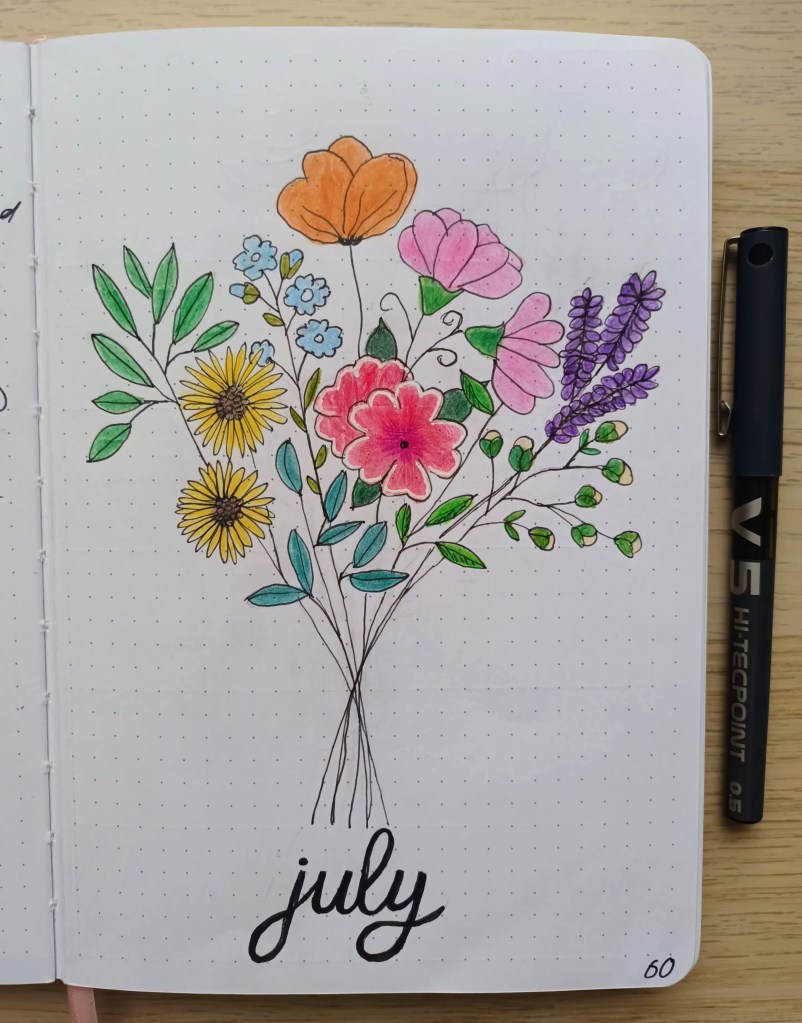
Photo credit: Laura Jones for Keeping It Creative

The monthly calendar

This is my usual calendar layout with stickers added as decor. I wanted to do something in the white spaces between and decided to add a few loose petals. I opted to do the title in a different font from my usual choices and I selected a nice bright purple which I felt complemented the flowers.

Photo credit: Laura Jones for Keeping It Creative

July finances

I like to choose quite a pale colour for the lines in my finances log and I picked out this minty green to go with the mid pink colour of the title. I also used one of my stickers leftover from the calendar and added a few petals to look like they’d fallen from the bouquet.
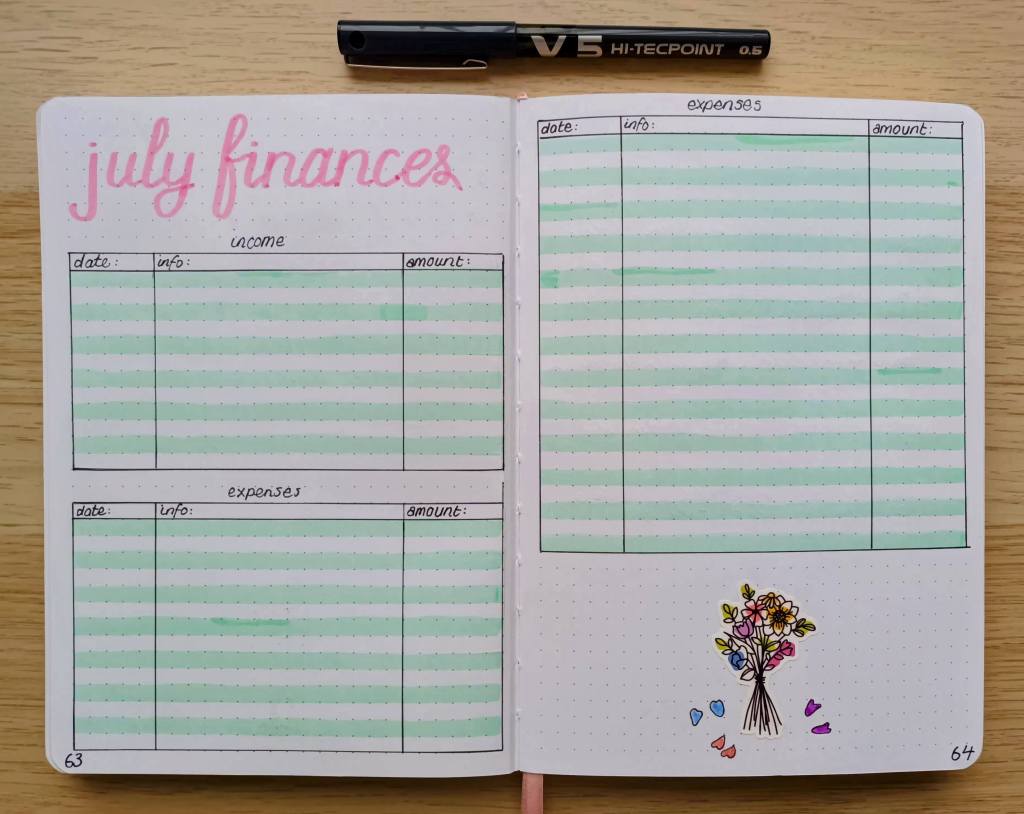
Photo credit: Laura Jones for Keeping It Creative

Monthly goals

A goals page has become a regular feature in my monthly bullet journal pages. I look at my vision board for the year and also my bucket list to help me choose a small number of goals to work towards. When I first started adding goals, I would come up with around eight in total, but I soon discovered that this was too much and for the last few months, I chosen five which I feel is a lot more attainable, even if I’m busy with work and fitness classes.
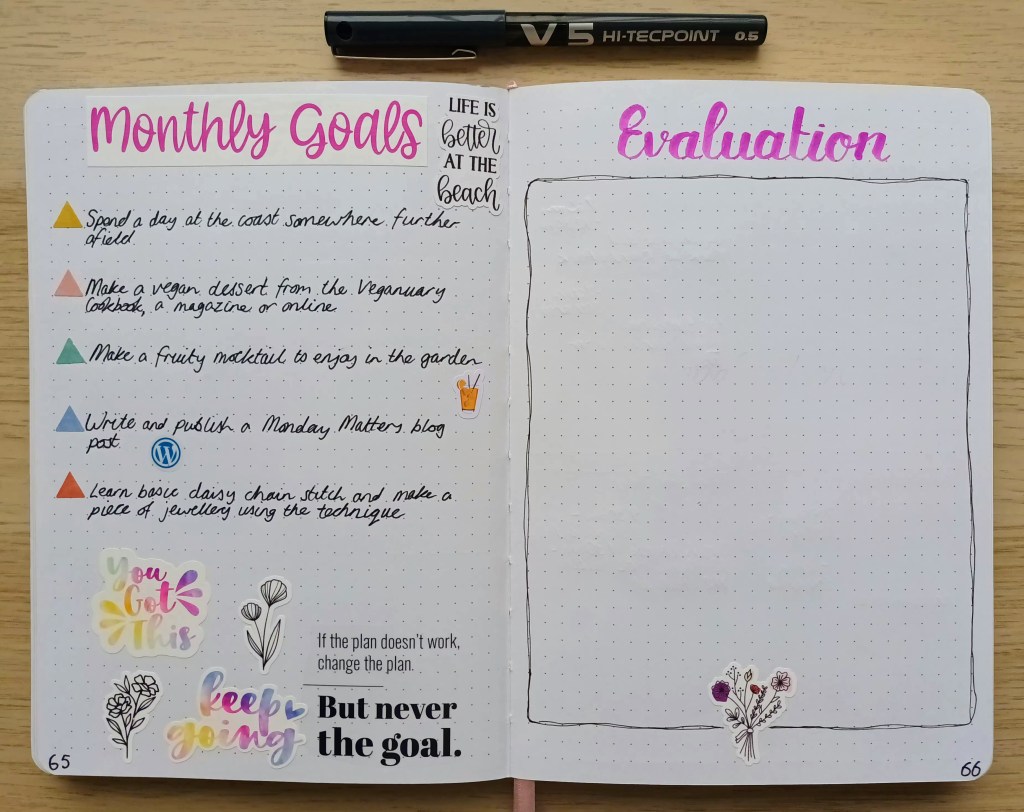
Photo credit: Laura Jones for Keeping It Creative

I’ve actually created some more little stickers to add to my goals pages but unfortunately Cricut Design Space is currently down for maintenance and I wanted to get today’s post up at soon as I possibly can so I’ll have to print and cut them later and add them tomorrow.

Weekly spread

This has become my favourite layout for weekly spreads as it allows plenty of room for events and to dos. Sometimes, I’ll add decor at the bottom of the boxes and sometimes it’ll just be a long list of things I want to get done that day so I’ll skip the decor. Often, I’ll add more information or to do lists to the boxes as the days go by. Also, on a weekend, we might make last minute plans so I’ll write in what we got up to in retrospect. This helps me remember any days out so I can include photographs and text to my highlights journal when the month is over.
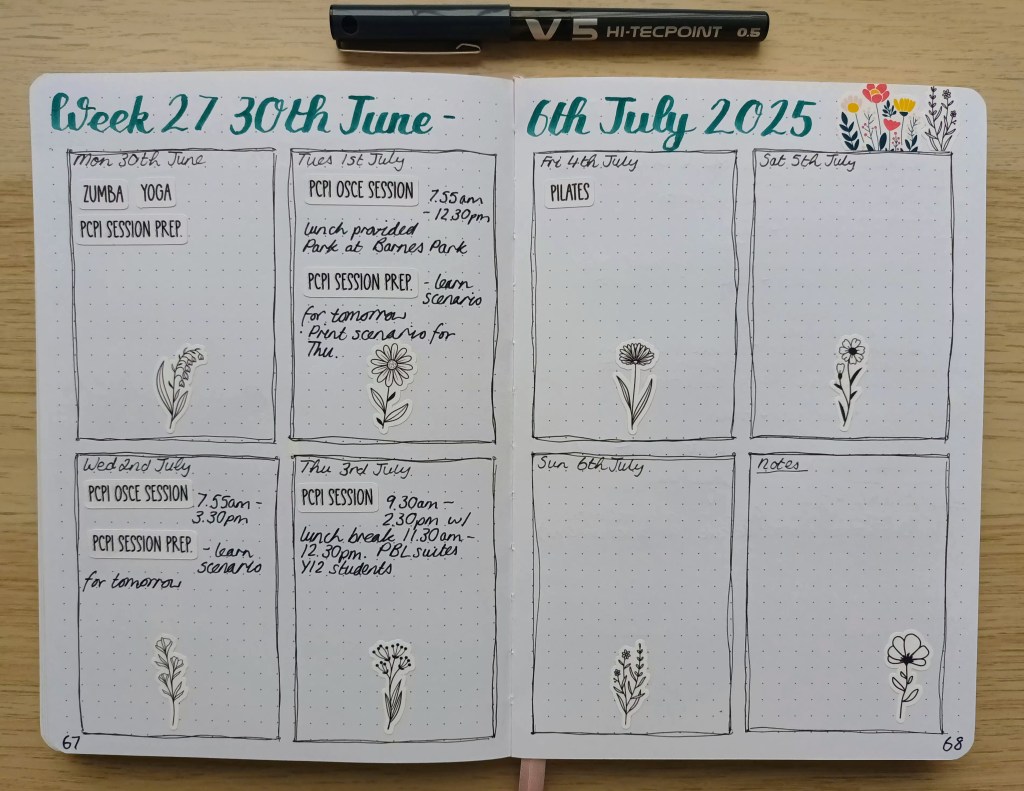
Photo credit: Laura Jones for Keeping It Creative

Final words…

Thank you for taking the time to visit my blog to look at my bullet journal set up for July. I’m super excited to use my pages this month as I love how bright and colourful they are. As well as drawing flowers, I’ve also treated myself to a flower press and I’ve been busy pressing blooms from our garden. I’ve had mixed success with it so far, with some of the flowers falling apart when I’ve removed them from the greaseproof paper, but I’ve also had some which look fantastic. I’m hoping to get my watercolours out to have a go at painting the results but this was one of my goals for June and, so far, I haven’t dedicated any time to it. I have my second lot of flowers pressing and they’ll be ready by mid month so hopefully, I’ll give it a go at some point in July or, if not, August.

Wishing you a relaxing month where you find time to do some of the things you enjoy too.

Posted in Anxiety management, Bipolar disorder, compassion, depression management, grief, life hacks, mental health, productivity, Uncategorized, wellbeing

Monday Matters: How writing a ‘done list’ can improve your wellbeing during periods of physical and/or mental illness

Welcome to my first blog post of 2025. Happy New Year to you all, and a special hello to my new followers! I hope you had a wonderful Christmas and are excited for what this year will bring.

My husband and I both enjoyed the festive period, which this year (make that last year!) was a double celebration as my brother and his partner got married a few days after Santa had been. The wedding was a joyous occasion and a great a chance to chat with family I hadn’t seen in a while too.

Whilst on the way back home, and with my husband doing the driving, I made the most of being in the passenger seat by reflecting on 2024 and thinking about what I would like to achieve in 2025. I also started to mentally compose a to-do list full of chores and more pleasurable activities to make the most of the remaining three days of the holiday. Little did I know that something would scupper my plans…

Bloody COVID-19 strikes again!

By the time we got back, we both had a bit of a sore throat, which I assumed was just a bit of dehydration from the long car journey. By New Year’s Eve, we felt absolutely dreadful, and so my husband did a test (just in case), and I’m sure you can all guess how that turned out! Needless to say, we’ve barely had the energy for basic self care, nevermind any chores, fun activities or creative pursuits.

We did, however, manage to  psych ourselves up enough to take a quick shower each day, despite how exhausted we were and, despite the fact that the powerful water raining down and massaging in my shampoo and conditioner brought actual pain to my scalp! – random covid symptom or what?????? And I’m so glad we did because this idea for a blog post was born – in fact, some of my best content and general epiphanies come to me whilst showering (anyone else??). 

Basically, I was busy thinking about how annoying it was that I was too exhausted to do anything and that being ill was a giant waste of time, and then I recalled that during my worst bipolar depressions, I still achieved a few things each day and tried my best to be kind to myself and celebrate small wins. To help me do this, I created something that I call a ‘done list’ and, although my illness was physical rather than mental on this occasion, I realised the same technique could be used to make myself feel better.

As everyone goes through ups and downs in life, I thought I’d share how my done list works. You might not need to apply the technique now, but it’s a lovely, self compassionate activity which you can store in your physical or metaphorical toolbox to use when needed such as when you’re sick or struggling with low mood. It can also be used when you’re not feeling under the weather, as a celebration of how productive you’ve been in general or as you work towards your goals for the week / month / year and so on.

In fact, as I sat on the sofa (on day 3 of COVID-19), soothing my throat with a warm drink, I actually started mentally creating one to help my husband and I feel a sense of achievement because I realised we actually did something that day despite feeling like crap.

So what’s a done list?

A done list, as the name suggests, is basically a list of things you’ve achieved that hour / day / week / fortnight / month / different time frame of your choosing, which can be tailored to how you’re feeling – both physically and mentally. So, for example, your list could look something like this:

Today’s done list

  • got out of bed (before 10am too!)
  • got dressed
  • brushed my teeth and washed my face
  • planned 3 things to do
  • made and ate a sandwich (even though I didn’t feel hungry)
  • worked on my jigsaw
  • watched TV for 1 hour (and managed to follow the storyline of the drama)

Or, if you’re not feeling too bad (in a bit more pain than usual, or a little tired maybe and not 100%), could include more taxing items such as those found in the list below:

Things I’ve done this week

  • washed the car
  • tidied my craft room
  • decluttered 20 items from craft room!
  • made 3 meals from scratch
  • 5 gentle workouts (2 x 20 mins yoga and 3 x 30 mins Pilates)
  • created a journalling page using my crafting stash

As you can see from the above, you can include super-minute achievements (or what would considered to be when well) or more ambitious ‘done’ items at other times. These ‘done’ tasks make a good record of how you’ve spent your time and can help you realise that, yes, you might be on top form, but you did make some progress or make a dent in your mental to do list (or physical one if you wrote a list when feeling productive and then things changed e.g. illness, upsetting life event, overwhelm etc).

If you’re still at work, but it’s been a struggle not to phone in sick, you could even include things that you achieved as part of your job, like biting your tongue at a comment made by a colleague or being assertive and saying no to your boss or team leader!

What are the main benefits of creating a ‘done list’?

These are the main benefits I’ve found of creating a done list, but you may be able to come up with more:

  • a visual reminder of what you’ve achieved in the chosen timeframe – the smaller the items are, the longer your list can be!
  • boosts your motivation to do more things (be careful not to do too much though as the last thing you want to do is make yourself feel worse)
  • acknowledges your small wins during difficult times

Final words…

I apologise if this is not new content and I’ve already written about a ‘done list’ before – I did trail through my posts in a bid to find out, and couldn’t pinpoint anything but I still have ‘COVID brain’. Hopefully I’ve shared something helpful which has given you a new string to your ‘wellbeing bow’, particularly if you have recurrent issues with your physical or mental health like I do. Doing a ‘done list’ can also be a great record of what you’ve achieved over a period of time, so can be a really useful tool for measuring productivity too. However you use it, I’m pretty sure it’ll make you feel a little more upbeat about things and your lists may even bring a smile to your face at a later date if you keep them in your planner and happen to flip back!

Thank you for reading and I wish you and your loved ones a happy and healthy 2025,

Posted in exercise, fitness, lifestyle, Uncategorized, wellbeing, wellness

Monday Matters: Wheel Of Wellness – Physical – Part 1: Exercise

For the physical element of The Wheel Of Wellness, I’ve decided to split the topic into three separate posts as there’s lots I want to cover. Today’s Monday Matters is all about movement and exercise, how it affects your mental health and easy ways in which you can incorporate physical activity into your life.

Most of us are aware of at least some of the benefits of regular exercise for the body and its physical functioning but did you know that getting moving can have a dramatic impact on your mental health too?

What are the main benefits of physical activity on your mental wellbeing?

  • better self esteem – feeling good about yourself as your fitness levels improve and you meet your goals
  • reduces risk of depression or symptoms of the illness
  • enables you to connect with others – can help you meet new people and develop new friendships through doing team activities or seeing others engaged in the same activity such as going to the gym, walking in nature etc
  • happier moods – releases feel good hormones helping you to feel better in yourself and combatting lethargy by increasing energy levels
  • improved sleep – increased physical activity will make you feel tired by the end of the day and can get you ready for a restful night’s sleep
  • helps you manage stress, anxiety and intrusive thoughts – a positive coping strategy which gives your brain something else to focus on

How much physical activity should I be doing?

This depends very much on your life circumstances and your current level of fitness. You should think about what feels realistic to you right now and this might change quite dramatically if you are managing a mood disorder such as depression or bipolar disorder.

The NHS has lots of advice on how much activity is recommended each week for different groups of people and also provides information about the different forms of exercise which are helpful for maintaining good physical health. Again, the guidelines provide something to work to when you are feeling physically and mentally fit and you should always consult your doctor for tailor made advice if you have any form of injury or limiting health condition.

What type of exercise should I choose?

The best advice I can offer here is to choose activities that you think you will enjoy and give them a go. If you choose exercises which make you feel uncomfortable or you have to force yourself to do, you’re unlikely to stick with them. So, for example, if the thought of working out at your local gym fills you with dread then setting up a membership probably isn’t a good idea. However, if you choose an activity which is fun and enjoyable, you’re more likely to engage in it regularly and make it part of your routine. You’re also much more likely to experience the aforementioned benefits to your mental health.

There are lots of different things you can try – some you might know straight away are not a good fit for you whereas with others you might need to give them a go in order to make your mind up. Highly aerobic exercises might be less suitable if you’re just starting out or have reduced mobility and you and your GP are best placed to decide what you can currently manage and what you might be able to aim towards in the future.

Being more active at home

If you have a really busy schedule, doing a short home based workout might be an easy and convenient way of fitting in some exercise. Some of the benefits of working out or being more active at home include:

  • Saves time – no travelling required and no waiting for machines or equipment (as often happens at my gym when it’s busy!)
  • Privacy – if you think you would feel self-conscious working out in public, exercising at home with the blinds shut or curtains drawn can be much more comfortable
  • Work out any time – you can decide when you want to exercise so working out at home is super convenient – you might prefer first thing before you start work or half an hour prior to cooking your dinner.
  • Flexibility – when you go to a gym class, the pressure is on to keep up with others or to push yourself to work harder. Also, there are individuals who have been doing the class for months, and some who are having a go for the first time so the instructor is trying to cater for the needs of everyone. At home, you set the pace and if you feel like a particular exercise is too difficult or needs modification then you can skip bits or find out how you can simplify things.
  • Low cost – no gym fees or expensive equipment needed. You can workout on your living room carpet or on a cheap mat. If you want to use weights, a couple of small water bottles or cans of beans are ideal when you first start out

Ideas for home workouts

  • Set an alarm to remind you to move each hour (or set up your fitness watch to vibrate). Spend 10 minutes doing exercises which are good for your current fitness levels e.g. jumping jacks, burpees, bicycle crunches, high knees etc.
  • Dancing – Put on some music with a fast beat and dance around your kitchen / living room / bedroom etc.
  • Chair based exercises – if you have mobility problems or a physical health condition which makes it difficult to be out of a chair, there are exercise routines you can try whilst sitting down. Check out this page on the NHS website or look for chair based workouts on YouTube.
  • Find some free beginners YouTube videos which have exercise regimes on – try looking for cardio workouts, yoga, balance training, Pilates, legs, bums and tums, core based etc.
  • Play an active computer game e.g. Zumba fitness, Wii Sports etc
  • Housework – doing household chores is a great way to get moving. Dusting, vacuuming, cleaning the windows, mopping floors or washing and polishing your car can all increase your pulse rate and burn calories. Also, you can make the activities as gentle or strenuous as you like and you can make each task as short or as long as you want.
  • Gardening – Gardening is a great physical activity and is wonderful for your emotional wellbeing too. Again, you could engage in more strenuous activities such as digging, hoeing, mowing the lawn and pruning. Or more gentle activities such as pulling up a few small weeds or setting a few seeds in some pots.

A few tips for getting active at home

  • do a mini risk assessment in the room you intend to use for working out – is there enough room to exercise safely? do you have a ceiling pendant light which might get in your way if you stretch your arms up? might you need to move some furniture or move your mat so you’re not in danger of hitting things? is anyone likely to enter the room and knock into you or open the door onto you? etc
  • put on your workout gear like you would if you were going to a gym – this could be shorts and a t-shirt and might include a sports bra
  • try to do different types of workout e.g. cardio, strength, stretching, core etc so you’re targeting all parts of your body each week.
  • schedule ‘active time’ in your weekly plan like you would if you were going to the gym – let others know of your intentions so they can cheer you on / ask you how things went / be out of your way at your chosen time etc.
  • try setting some SMART goals to work towards
  • remember, it’s okay to skip a workout session if you’re really busy or something unexpected comes up but try not to make a habit of it or you won’t feel all of those wonderful benefits I mentioned earlier!

Out and about activities

There are lots of activities which you can do out and about and some gyms have instructor led and virtual classes to try too. Here’s some ideas:

  • Nature walk – this could be in your local park, through woodland, on the beach, around a lakeside path, next to the river etc. You could also look online for nearby nature reserves to visit either with friends, family or alone for some quiet time.
  • Walking or running – this could be to a friend’s house, to work, to the local shops or even around the block. All you need is a comfortable pair or shoes or trainers and you’re good to go. If you want your walk or run to be a sociable activity you could join a group in your local community (try searching online for walking or running groups) or arrange to meet a friend in the park or somewhere convenient for you both.
  • Dance classes – there are lots of different types of dance which you could try – some are more active / fast paced than others. Suggestions include Zumba (high intensity), salsa, ballroom, clubbercise or line dancing.
  • Sports and games with family or friends – these can be indoor or outdoor and include ball games such as tennis, football, rounders and netball, informal games such as frisbee, throw and catch and tag and supervised or instructor led watersports such as canoeing or surfing.
  • Cycling – this could be a family bike ride or as a way of making a journey e.g. to the shops, visiting friends or family or to work. You can start off with a really short distance and then increase the length and opportunities for uphill climbs as your fitness levels improve.
  • Gym classes – some gyms have fitness classes which you can try too. These can be instructor led or virtual (on a screen). Examples include yoga, kettlebells, Pilates, spinning, zumba, body pump, circuits, step and forever fit aimed at the over 50s.
  • Swimming – swimming can be a great workout for the whole body. It gets the heart rate up but takes most of the impact stress off your joints. If you’re a beginner, it’s best to do your swimming in a heated pool with lifeguards at hand to keep you safe.
  • Outdoor gyms – lots of parks have these now and the equipment is totally free to use. Your local council / local area website should tell you where these are located so you can give them a go.
  • Mindful exercise – yoga, pilates and tai chi are great for combining moving the body with mindfulness. I also like do some mindful movement when I’m on the reclining bike at the gym – I close my eyes and think about the effects it’s having on my body (I wouldn’t recommend doing this on other pieces of equipment like the treadmill though!!!)
  • The gym – many people are put off from joining the gym as they think it will be full of muscly men and women who are obsessed with their appearance. From my experience, yes there are some people of the aforementioned type, but there are also many other individuals too who are there for a common reason such as toning, increasing their fitness levels or trying to be more active. In my gym there are people of all shapes and sizes and all ages. The ones I attend are owned by the local council and are managed by Everyone Active and I think these gyms are the best for inclusivity. Most of them will offer a free trial too so you can see if it is something you enjoy before paying for a membership.

What if I’m feeling unwell or physical activity doesn’t work for me?

There may be times when physical activity is super helpful and you can really feel the benefits. However, there may also be other times when exercise just isn’t working for you. Maybe you’re struggling with high levels of anxiety or are having difficulties with depression and you don’t have the motivation to stay active. Or, you’re feeling frustrated because everyone is trying to tell you the benefits of getting some exercise and even though they mean well, it’s actually causing you to feel guilty or to beat yourself up for not adding some physical activity to your day.

For some people, exercise can make their mental health worse, triggering anxiety or further contributing to their mental health problem(s). For example, someone I spoke with in the Bipolar forum group that I’m a member of said that her Community Mental Health Nurse completed an exercise referral for her and at first was enjoying being more active, but then she became obsessed with going and her support worker began to see signs of overtraining and a fixation on getting fit. This was causing rapid weight loss and together, they decided that the current exercise programme was having a negative effect and should be stopped or at least greatly modified. If you or your family feel that your chosen physical activities are having a negative impact, you many need to discuss any concerns with a health professional such as a mental health nurse, support worker, doctor or therapist.

Whatever it is that’s currently stopping you from being active, it’s important not to be too hard on yourself. You might just need to focus on other self care activities for a while such as relaxing in the bath, spending time in nature or curling up with a good book. When you’re feeling a little better or have got yourself on top of things, you can gradually build physical activity into your routine again. This might mean re-evaluating your exercise plans and making a few changes or trying a different type of activity.

Final words…

Although an increase in physical activity can have lots of benefits for our health, it’s important to start slowly. Doing too much too quickly is likely to make you feel overly tired or burnt out and this can mean you’re unable to keep up with the expectations you’ve placed on yourself. This can result in unhelpful or negative feelings, put you off somewhat or cause you to quit altogether.

Try to plan a realistic and achievable routine which fits with you and your lifestyle. Building up your physical activity and the intensity a little each week can make a real difference. Also, remember that rest days are important too as they give your body time to recover.

And another thing… it’s okay to slow down or take a break if your energy levels aren’t as good as they usually are or if you’re having a tough time mentally or emotionally. You can resume your routine when you start to feel better, remembering to build up again slowly if you’ve not exercised for quite a while.

I hope you’ve found today’s blog post really helpful and it’s encouraged you to think about how increasing your physical activity may help you personally. Let me know what your favourite ways to exercise are or if there’s something you’ve always wanted to try and might give a go. It could even be an activity you used to have fun doing as a kid and secretly would love to have a go at again. For example I used to love trampolining sessions at the beach when on holiday with my family. I also used to enjoy badminton in the back garden with my dad but haven’t played for over 20 years!

Posted in Uncategorized

Monday Matters: Introducing the Wheel Of Wellness

A few weeks ago, I started a new course at my local recovery college. It’s something I’ve been wanting to learn about for a while now but I was waiting for the face-to-face courses to start again. Anyway, it’s all about exploring and assessing 8 different key areas of your life to make sure equal time and attention is given to each to try to achieve balance. This week, I thought I’d share some information about the concept of The Wheel Of Wellness and introduce the 8 aspects of life which we’ll be looking at in depth at our weekly sessions. If you are familiar with The Level 10 Life by Hal Elrod you will notice similarities, but this model is more related to mental wellbeing than achieving your best life. I hope you enjoy reading my series of Monday posts and my articles prompt you to reflect on your current lifestyle in relation to the dimensions of the wheel.

The Wheel Of Wellness model

There are lots of pictorial images of the Wheel Of Wellness online, some with more spokes than others, but the one I’ve chosen matches the life categories that I’m covering in my college course. As it’s a recovery college that I’m attending, the sessions focus on how each aspect relates to individuals who live with mental health difficulties such as anxiety, depression and bipolar disorder. However, I think the wheel is useful to anyone who has an interest in improving or maintaining their own wellbeing (which in my opinion should be everyone!).

The following example illustrates a wellness model with eight dimensions, namely emotional, physical, financial, intellectual, occupational, environmental, social and spiritual. All of the dimensions are interconnected and equally important for a well-rounded and balanced lifestyle and working on maintaining good mental health.

Over the coming weeks, I’ll be taking each aspect in turn and considering ways in which they impact on life and also how your mental health can have an effect on that particular dimension. I also suggest some ideas for making improvements in that particular area of the wheel. For now, here’s a brief explanation of each which includes things we discussed in our introductory session and my own ideas which I would like to raise:

Emotional

How effectively you cope with life and its many challenges. Awareness and management of your different feelings. Self esteem, self confidence, compassion and resilience. How mindfulness can help. Creating positive and satisfying relationships with others. How your emotions affect your mood and mindset and strategies for managing this.

Physical

Diet, exercise and sleep and their effect on your wellbeing. The impact life stresses and a busy lifestyle can have on these. How physical and mental health can affect all 3. Ways in which you can care for your body and signs which suggest you might be neglecting to look after yourself well.

Financial

Living within your means and managing your money effectively. How mental health can affect money decisions. How financial difficulties can impact on your wellbeing. Making responsible choices to ensure a good financial future.

Intellectual

Work and leisure activities that stimulate your mind. Keeping your brain active to avoid memory loss. Staying curious and cultivating your desire to learn new things throughout your life. Problem solving. Listening to the ideas of others and showing respect for their opinions. Finding ways to expand your knowledge and skills. Recognising your creative abilities and finding time to explore them. Keeping up to date with social and political issues.

Occupational

Finding work that satisfies you and enriches your life. Seeking a career that is interesting, enjoyable and meaningful. Engaging in activity that contributes to society in some way. Other work related activities such as volunteering for a worthwhile cause or doing things for the good of the community.

Environmental

Ways in which we can look after and care for our immediate environment and our planet e.g. reducing and reusing, recycling, upcycling, assessing our carbon footprint and conserving electricity. Being aware of the spaces we spend our time in and thinking about positive changes we can make to our environment. Keeping your home clean and organised. Decluttering.

Social

The positive and negative impact of social media. Connections between you are your family, friends, colleagues, acquaintances and anyone else in your life. Effective communication, feeling like you can be yourself with others, maintaining and developing relationships. Ways in which you can find out what’s on in your local community and how to get involved in projects in your locality.

Spiritual

Living a life which reflects your core beliefs and values. Ways to boost your spiritual wellbeing through gratitude, meditation, developing a mindfulness practice, self awareness and reflection, setting meaningful and fulfilling goals. Understanding your purpose in life. Consideration of your ethical or religious beliefs. Establishing peace and harmony in our lives.

Final words…

Now that I’ve shared the eight dimensions of the wheel of wellness you might like to consider which areas which you feel you do really well in and which do you think you could give greater attention to. I know for myself intellectual wellness is a big priority in my life as I have always been keen to learn new things and will often find ways to improve my knowledge of different subjects through reading and talking to others. I also like to explore my creativity and will always find time to engage in creative pursuits such as papercrafting, journalling, painting, drawing, handlettering, photography and jewellery making to name just a few! Physical wellness has also become very important to me at the moment and as well as finding different ways to be active including going to the gym and joining fitness classes, I’m also evaluating my diet and working on making healthier choices and trying out lots of nutritious recipes. The main areas I’d like to work on next are occupational wellness and socialization and I’m looking forward to deep diving into these as part of my college sessions.

It would be great if you could give this post a like if you are interested in learning more about the eight dimensions of wellness and I would also love to hear about areas in which you feel you thrive, as well as aspects of your life you’d like to work on in the future.