Posted in CBT, depression, lifestyle, mental health, Planning and journaling, psychology, wellbeing

Monday Matters: Negative self-talk – its impact on you and 3 ways to challenge and reframe it

For today’s Monday Matters post I want to discuss something which I’m currently really struggling with, and that is negative self-talk. I’ve been taught various strategies in different therapy sessions throughout the years but applying them when you’re really struggling is easier said than done. Also, during periods of better mood, the techniques tend to be forgotten about as the amount of negativity is much less. So, here’s some examples of different types of negative self talk, an outline of how it damages us mentally and three key ways to challenge and reframe it.

What is negative self talk?

Before you can begin to challenge your negative self-talk you need to know exactly what it is so you can label it as such as soon as it pops into your head or out of your mouth. Basically, we have lots of thoughts running through our minds all of the time such as ‘I wonder if there’s anything good on TV tonight?’, ‘I haven’t done any watercolouring this week, perhaps I’ll have a go at some tomorrow’ or ‘I feel a bit rough today so I’m going to take it easy’. These kinds of self-talk and reflection are perfectly normal and help you to make decisions and get on with things in your life. However, when the self-talk becomes harsh and self critical, such as ‘I can’t believe I did that, I’m such as idiot’, this is when it becomes a problem and can be really damaging in all kinds of ways.

The main forms of negative self-talk (AKA cognitive distortions)

The following are some of the main forms of negative self-talk. In psychology, they’re known as cognitive distortions because they’re inaccurate, exaggerated, irrational and negatively biased.

Overgeneralisation – this is where we draw conclusions about things in life or the future based on things that have happened (often once) in the past e.g. all men are liars, we’re bound to get stuck in traffic, bad things always happen to me, I’ll never be able to do that, I always fail.

Catastrophising – very closely related to the above, this is where we imagine and believe the worst will happen and completely blow things out of all proportion, for example, during a period of depression, saying that you will never get better and will spend the rest of your life miserable, or following the end of a romantic relationship, stating that you’re unlovable and will never find anyone else.

Mental filter – this is when we experience positive and negative things but only focus on the bad stuff and filter out anything good. So, for example you might have had a day out at the park, enjoyed a picnic in the sunshine, strolled around the lake, feed the ducks and swans and admired the cute, fluffy little cygnets before getting an ice cream from the café. But, on return home, you might say that you had an awful time because you were stupid enough to drip ice cream on your t-shirt and that you got burnt because you failed to re-apply your sunscreen.

Predicting the future (AKA fortune telling) -this is where we predict what is going to happen based on little or no evidence, for example, we might say things like: ‘I just know I’m not going to get the job’, ‘I’m not going to the party because I’ll have an awful time’.

Mind reading – here, you assume what others are thinking, often in a negative way. So, for example, you might decide that your friend hates your clothes because she didn’t say how nice your new dress looked, or you might conclude that your husband is sick of you because you keep getting upset all the time.

Black and white thinking – this one involves thinking in extremes rather than anything in-between or in a ‘shade of grey’. It commonly involves the use of the words ‘always’ or ‘never’. Some examples that I’ve said recently are: ‘I always mess things up’, ‘I’ll never get better’ and ‘I’m a complete mess’.

Labelling – these are things that you say about yourself either in your head or out loud which are wholly negative and unhelpful e.g. ‘I’m a fat pig’, ‘I’m useless’, ‘I’m such a failure’ etc.

Shoulds and muststhis involves putting undue pressure on yourself and creating unreasonable expectations which become impossible to keep. For example, you might say ‘I should be a better wife’, ‘I must tidy up all of this mess’, ‘I should exercise more’, I must make sure I’m on time for my appointment’. Using ‘I need to…’ isn’t particularly helpful either e.g. ‘I need to lose weight’, ‘I need to be a better mum’, I need to get that work done’. I’ve written an in depth blog post on this previously as it’s something we covered in my compassion group classes.

The consequences of a tendency towards negative self-talk

As well as causing high levels of stress for both the individual and their close family and friends, negative self-talk has a number of negative consequences including:

  • lack of self belief
  • poor levels of resilience
  • diminished ability to make positive changes in your life
  • reduced self-confidence
  • decreased motivation
  • feelings of worthlessness
  • feelings of hopelessness
  • likelihood of depression and anxiety being exacerbated

Personally, I find that negative self-talk goes hand-in-hand with depression and feelings of anxiety which only serves to make things worse.

3 ways to tackle your negative self-talk

In order to remedy our tendency to negative self-talk we need to recognise when we’re involved in it and actively challenge our words. Here are three ideas on how to do this:

Recognise it, write it down and challenge it

There are a number of psychological studies that have looked into developing awareness of self-talk and the key findings suggest that those individuals who wrote down their own personal examples in some form of log book showed greater insight into the specific content of their self-talk and the consequences of its used. They were also able to start challenging their initial thoughts in order to create more balanced conclusions.

Recognising and challenging your self-talk takes time and commitment but is really worthwhile doing. The following example is my own and I hope, by sharing it, you can see how the process works (you may need to click and enlarge it to see properly). When challenging the evidence, I find it helpful to think about what a good friend or my lovely husband might say in response to what I said.

Take it to court

This is a great technique, which I used in my chart above and feel is really helpful for cross examining your self talk. It commonly used in CBT (Cognitive Behavioural Therapy) and involves metaphorically take the thought or belief to court and place it in the dock. You then find evidence for and against the thought or belief, considering the factual evidence and not opinions. Working for the defence, you try to prove that the accused (your thought or belief) is truthful and correct by providing evidence that shows that your thought or belief is 100% totally true. You can see examples in column 4 of my chart. Then, working for the prosecution, you look for evidence that this thought or belief is not true 100% of the time. For this, you need to select good quality evidence that would hold up in court. Finally, the judge summarises all of the evidence and composes a final statement which is realistic, rational and balanced. This should then help you to see alternative ways of thinking and enable you to undermine your extreme and unhelpful though. You can find worksheets to go with this technique at Getselfhelp.co.uk.

Find more positive alternatives

When you catch yourself saying negative things, try to come up with more positive alternatives or different ways of looking at the situation. Again, think about what a good friend or your partner would say to counteract your thought or belief. Here are some examples which might help:

Negative self-talkPositive self-talk
I hate feeling like thisIt’s okay to feel like this, my feelings are valid
I’m never going to get betterThis is temporary and I have the ability to get through it. I’m taking things one step at a time.
I hate my bodyI’m grateful for everything my body can do, I’m healthy and strong and my body is beautiful.
My life is awfulThere are so many good things in my life right now.
I’m getting everything wrongEveryone make mistakes and we all have days that are better than others.
I need to do some exerciseI would like to do a little more exercise so I can feel more toned.
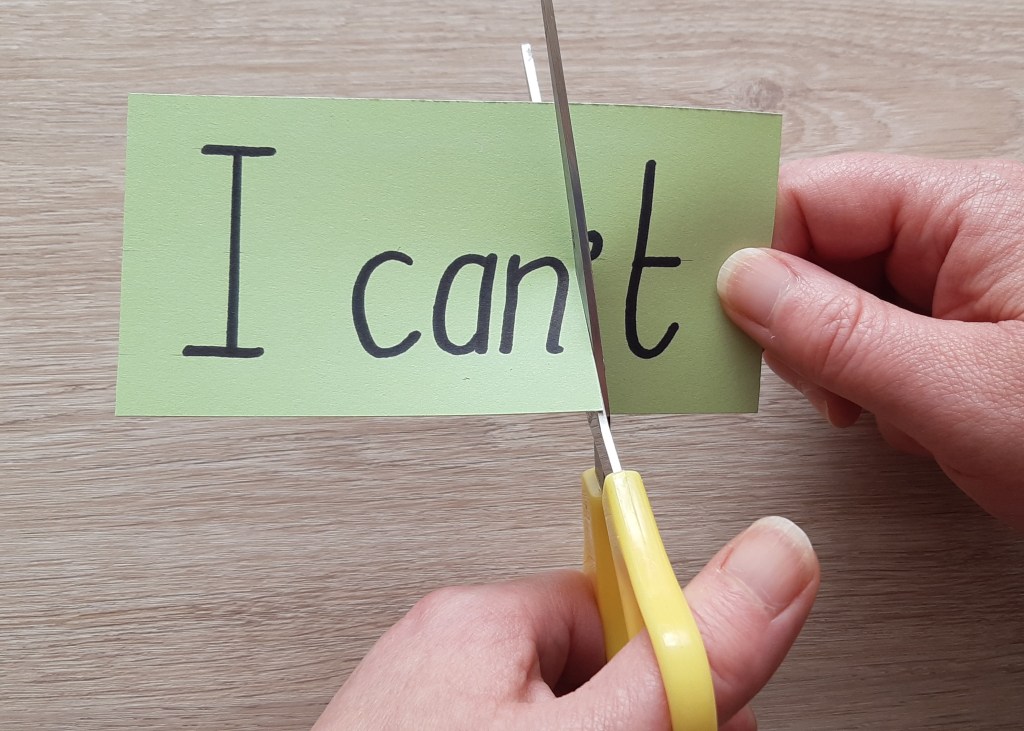
I can’t do itIt’s going to be hard work but I can do it
I’m so stupidI made a mistake, so what, everyone makes them!

Final thoughts

You might not need to complete these exercises all of the time but when you find yourself dealing with feelings associated with anger, depression or anxiety, try to make time to stop and become more aware of your thoughts. Then you can start to reflect on them, challenge your views and find alternative ways of looking at things. Hopefully, after developing the skills associated with thought investigation and thought challenging, you’ll find it easier to put the ideas into practice and conquer your negative self-talk and start being nicer towards yourself.

Thanks for reading and good luck!

Posted in Bipolar disorder, Bullet journaling, CBT, depression management, mental health, Planning and journaling, wellbeing

Monday Matters: Useful ways to track your mood

At the end of April, as part of my post on self-awareness and self-acceptance, I mentioned the usefulness of mood trackers as a way of learning more about how your mood changes and about different things which impact your mood. Although there are hundreds of examples of bullet journal spreads featuring decorative, pretty and colourful trackers (just type #moodtracker into Instagram or search Pinterest), I find that many are a little basic and are more about aesthetics than being an effective learning tool which helps you manage your mood. So, today, I’m going to explore why mood tracking is helpful and discuss some more useful ways of tracking your mood which go beyond colouring in shapes to show if you’re happy, sad or neutral.

Why track your mood?

You might simply track your mood to see if you spent more time feeling happy than sad during any given month but there are so many more benefits to be had such as:

  • It can help you to better understand your triggers and their impact – as well as genetic and physical factors affecting your mood, social and environmental factors play a big part too. By learning about your triggers, you can take steps to minimise the effect and work on developing healthy coping mechanisms.
  • Enables you to identify patterns – after you’ve tracked your mood for a while, you can start to look for patterns, so for example, you might notice that you always feel particularly stressed or down on a Monday after a weekly meeting at work, or anxious in the build up to going supermarket shopping on a Tuesday, or you might notice that a period of depression always kicks in at the end of Autumn and lifts when the weather starts to become brighter in the Springtime.
  • Helps you to develop strategies for managing your moods – when you’ve established patterns, you can then work on developing strategies to combat the effects of various triggers, such as working on positive self talk, doing relaxing breathing meditations, scheduling in something fun on a Monday evening, connecting with nature or getting a little Winter sunshine.
  • Helps you to track your progress – once you’ve put the various strategies in place, long term mood tracking can help you to see if what you’ve put in place actually works. And if you know specific things are really useful, you can do more of them!
  • Can help you to get an accurate diagnosis or appropriate self help strategies – you can take the information you’ve collected when you see a mental health practitioner such as a community psychiatric nurse (CPN) or your psychiatrist and then can use this to help you get an accurate diagnosis or to to make suggestions on how to manage your symptoms more effectively.

In fact, mood tracking is a key element of CBT (Cognitive Behaviour Therapy) and related exercises are often given as homework due to the fact that they can really help you manage your mental health much more effectively.

Issues I’ve had with keeping a basic one page per month mood tracker in my bullet journal

One of the first issues I had with a basic mood tracker was that my mood changed so much throughout the day that I wanted to record it all and ended up splitting the shape or section for that day into about 4 different colours e.g. I was tired first thing, then I was annoyed about something someone had said, then a little later in the day, I received some great feedback and I was happy, then by the end of a busy day I was either exhausted or extremely stressed at the amount of work I had to do the next day. A more useful idea is to record each time your mood or emotional state changes and what has made it change (i.e. the trigger or circumstances). Then you can come up with some strategies to combat the moods which are causing difficulties e.g. developing relaxation techniques, reframing particular thoughts and feelings, talking about things that are causing you to feel stressed etc.

Also, I think that a lot of mood trackers become restrictive when they only have a set number of moods such as happy, sad, neutral, tired and stressed. What if you feel embarrassed and it had a huge impact on your mood? What if something someone said has made you feel completely inadequate and this leads to feelings of self doubt and lots of negative self talk? There are so many different moods and I think it’s important to recognise them all. I downloaded and laminated a mood wheel a while back now and have found it really useful to find the words to pinpoint exactly how I feel. There’s lots of these available online and this one is available here.

A wheel showing every mood and feeling you could possibly think of!

Finally, recording your mood is more useful if you also take the time to journal about what caused the mood / emotion and the impact it had in terms of thoughts and subsequent behaviour. Then, you can come up with ways of going forward.

My idea for a more useful mood chart for your bullet journal

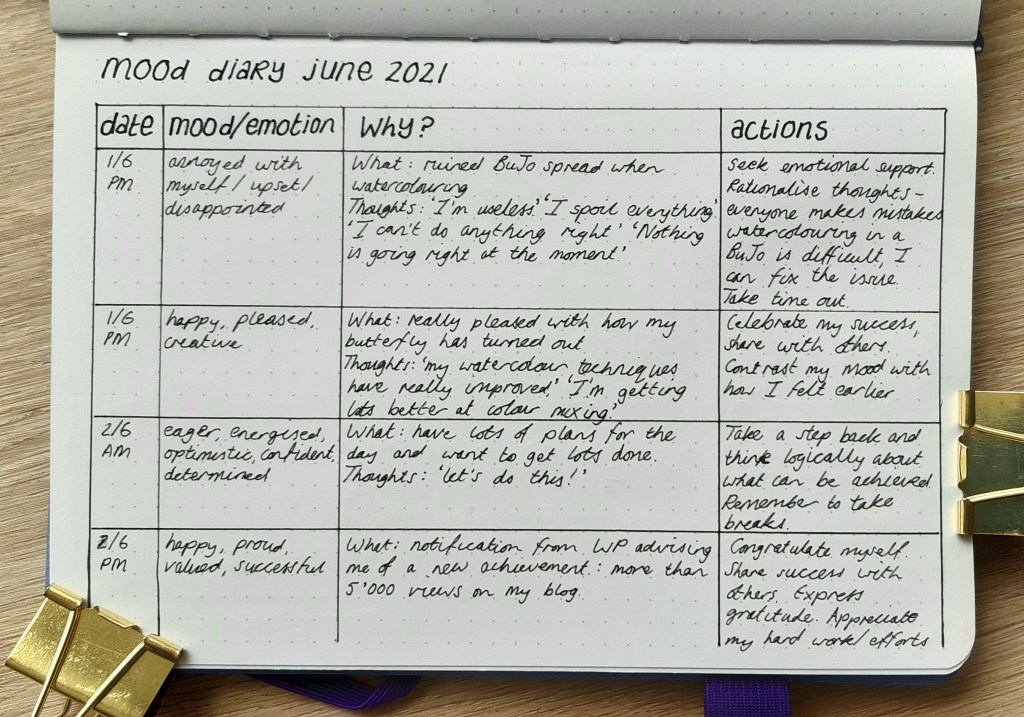
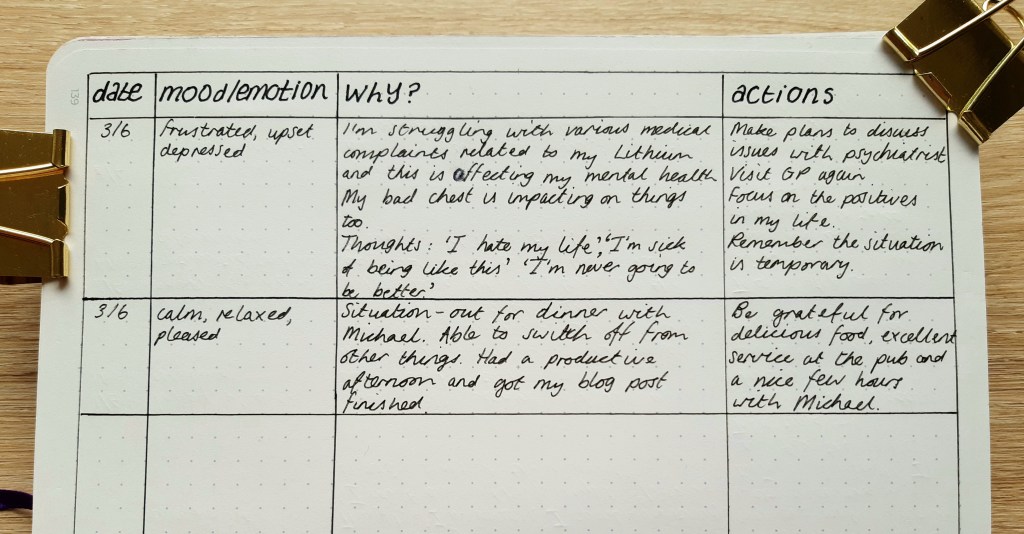
It took me a while to come up with a set up which isn’t too onerous but is helpful in identifying moods and emotions and can also be used to record action techniques such as those I learnt in CBT, Compassion and Mindfulness sessions to manage the moods. The main focus, I guess, is on negative moods but it’s also important to recognise positive moods so that you can try to find ways to inject more positivity whilst making sure that you don’t get too high if you are inclined toward mania or hypomania.

Obviously, this is an idea that I think will probably work for me so bear in mind that it might not suit you, but I hope that it might give you an idea for a layout which you can modify to fit your own needs. You might also think that the chart is time consuming, and yes, it does take time, but, if it helps you deal with your moods effectively, I think it’s well worth doing.

The date and mood/emotion columns are pretty self explanatory and I’m using the above wheel to help me best describe how I feel. The ‘why’ column can be used to identify the circumstances which caused the mood such as lack of sleep, a particular situation that you faced, a comment made by someone or an event which has occurred or may be about to happen. You might also like to record your related thoughts as these can really impact on things too. The final column ‘actions’ could be used to identify ways of improving your mood or providing a remedy to high levels of stress or excitement. Some ideas include:

  • work on reframing the thought that made you feel bad in some way
  • take it to court to consider the evidence for your thoughts / beliefs – this is a great CBT technique and you can find related PDFs here.
  • plan in some relaxing activities to combat stress / help you relax
  • talk to someone about what has happened with a view to getting an alternative point of view
  • go for a walk in nature
  • find something else to focus on if you’re finding yourself ruminating

A useful way to track bipolar moods

For bipolar disorder symptoms, the free charts from Bipolar UK are great for tracking changing moods so you can recognise signs that you are slipping into a depressed mood or becoming hypomanic or manic. My personal preference would be more room to make notes about triggers, so I would use the first sheet as to record my mood and then create a weekly page for information about events, triggers, wellbeing activities or interactions with others.

Using an app on your phone

If you’re not a fan of pen and paper methods, you could always track your moods on your phone. I’ve found several options and some are more in depth than others. These are all available for both iOS and Android but there are some I’ve read about that are just available for iOS). As with all apps, if you want access to all of the features, you’ll need to pay a subscription for Premium access, but there are some which offer simple ways of recording basic information and tracking things over time.

Daylio This one is particularly popular and, due to it having lots of clickable icons, you can quickly record how you feel, state what your sleep has been like and mark off what you’ve been up to during the day (e.g. hobbies, health related, kindness and compassion related and chores). There’s also the option to add some notes to sum up your mood and your day. I found the mood labels annoying at first as the really happy face one said ‘rad’ but after some exploring, I discovered you could change them to something you would actually say, I chose ‘joyful’. After consistently entering your data over a period of time, you can create graphs to see how your mood has changed over the weeks and you can also see how doing different activities impacts on how you feel. Also, to help you get into the routine of filling in your data, you can set a reminder for a particular time, for example, I tried 8pm so I could reflect each evening.

Bearable This one has loads of bits and pieces that you can record alongside your mood. You can add if you had a headache and if you had an mental health symptoms such as stress, anxiety and depression. You can also identify factors which may have impacted on your day such as how busy you’ve been, if you’ve been to work and how much screen time you had. You can say where you’ve been, how much physical activity you’ve engaged in and if you’ve been socialising and what your sleep has been like. Again you can set reminders and edit what you want to track.

emoods Another app which looks like it might be really helpful for individuals with Bipolar disorder is emoods. Each daily log has a space to record how much sleep you got (in increments of 0.5 hours) and your mood, focusing on the four areas of depressed mood, elevated mood, irritability and anxiety, rating them from none, mild, moderate to severe. Over time, the data you enter can then be made into various graphs so you can see if there are any patterns. You can also record if you had any symptoms of psychosis, if you attended some form of talk therapy and your medications (type and dose). Finally, there’s a box to type in anything else which is relevant and may have had an impact on your mood.

Tracking your moods on your phone has several benefits – you can have lots of data in digital format and it doesn’t take up lots of space like a paper version would and you can get graphs of your data which would be difficult and time consuming to create in your notebook. Personally I found both records to be useful but I much prefer working in my bullet journal.

Making it a habit

If you’re going to go to the effort of making a decision to track your moods and learn from it, you also need to make filling in the diary or using an app. a habit and part of your daily routine. If you use a paper based method, you might choose set times during the day to sit down and do some journaling. It’s helpful if you reflect on things pretty much straightaway so you can complete some action steps but it might not be feasible to make notes there and then so you need to find what works for you. My previous blog post on habit creation might help you with making sure you stick to filling in your chart but a simple way of reminding yourself is to set an alarm on your phone or a reminder with a notification tone in your calendar.

As I said earlier, the apps which I tried include the option of notifications to remind you to fill in your information at various points in the day which can be really helpful as long as you choose useful times for the messages to pop up.

Final words…

I hope you have found today’s post useful and it’s given you the key points about why it’s helpful to track your moods and some ideas for how to go about it. If you are really struggling with your moods, however, I would recommend you consider trying CBT as a trained therapist can help you to you look at your emotions and also teach you key techniques for dealing with unhelpful and negative thoughts.

Posted in Blogging, bullet journal, Bullet journaling, Planning and journaling, watercolour painting

Setting up my Bullet Journal for June: Butterflies theme

June is here and the weather is finally starting to warm up and give us blue skies and sunshine. As our gardens start to fill with flowers, we get more and more bees and butterflies visiting and the latter is the focus of my bullet journal this month. Again, I wanted to get my watercolour paints out, this time for a single focal image. I hope you like the results and that they inspire you to give a butterfly theme a go some time. The pages took me quite a while to produce, hence me being a little behind schedule sharing them but better late than never eh?!!

Front cover

One of my favourite butterflies is the peacock butterfly with its bright colours and its spectacular eye spots. I found a photograph online and printed it for reference and also did a black and white copy which I traced so as to get the butterfly looking symmetrical (yes, I cheated but I wanted the focus to be on the watercolour, not drawing!). I spent a while creating the perfect bluey colour and I’m definitely getting much better at colour mixing. The other colours were relatively easy to get right but the painting took a long while as I used tiny brushes for the details. I also used a Pigma Micron to do the stripy detailing along the top and a white gel pen for the spots. I was pleased with the results and the use of pale yellow paper at the top and bottom of the page has nicely hidden a problem I had with water dripping on the page which caused some of the Tombow ink from the calendar page to seep through (I may have cried a little when I messed up though!).

Watercolour peacock butterfly
Photo credit: Laura Jones for Keeping It Creative

Calendar page

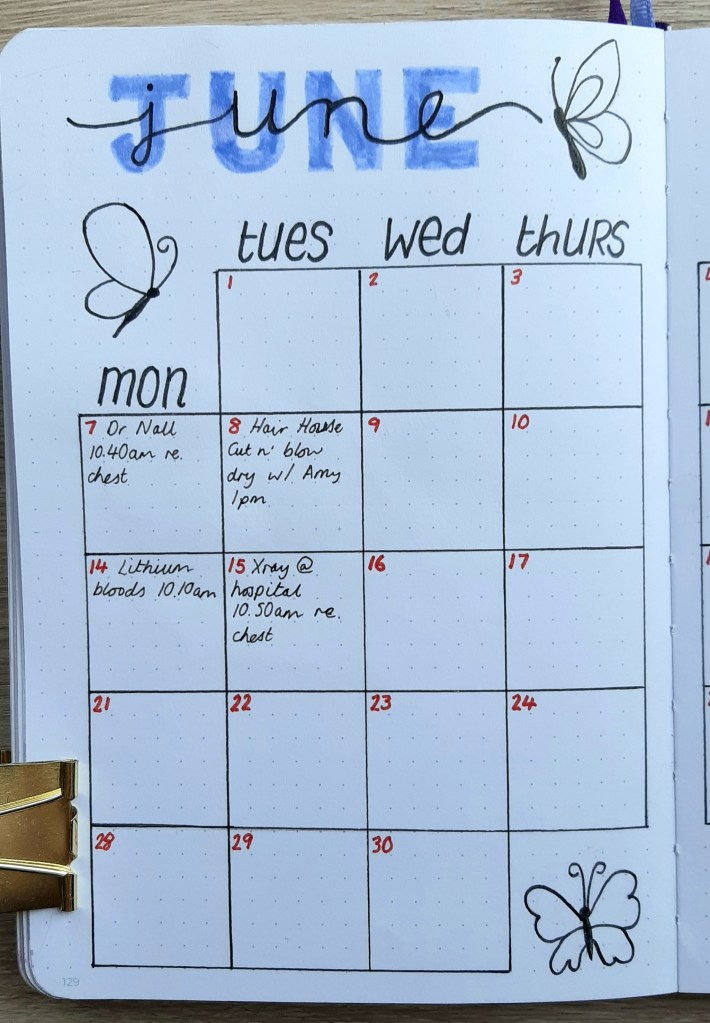
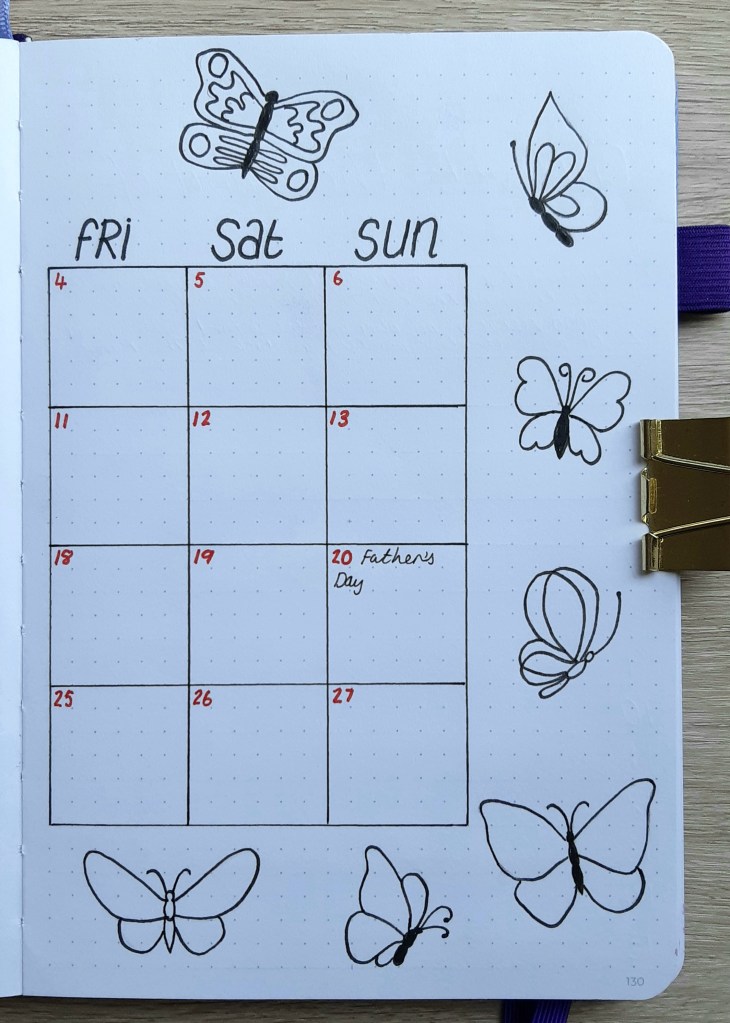
After spending a full afternoon on my front cover, I decided to keep the decoration on the calendar page quite simple. The line drawn butterflies were lightly sketched first to get the wing shapes and symmetry looking okay and then I inked them with a 0.3 Pigma Micron. I was surprised by how long it took me to draw them but then. drawing isn’t a strength of mine.

Photo credit: Laura Jones for Keeping It Creative

Gratitude pages

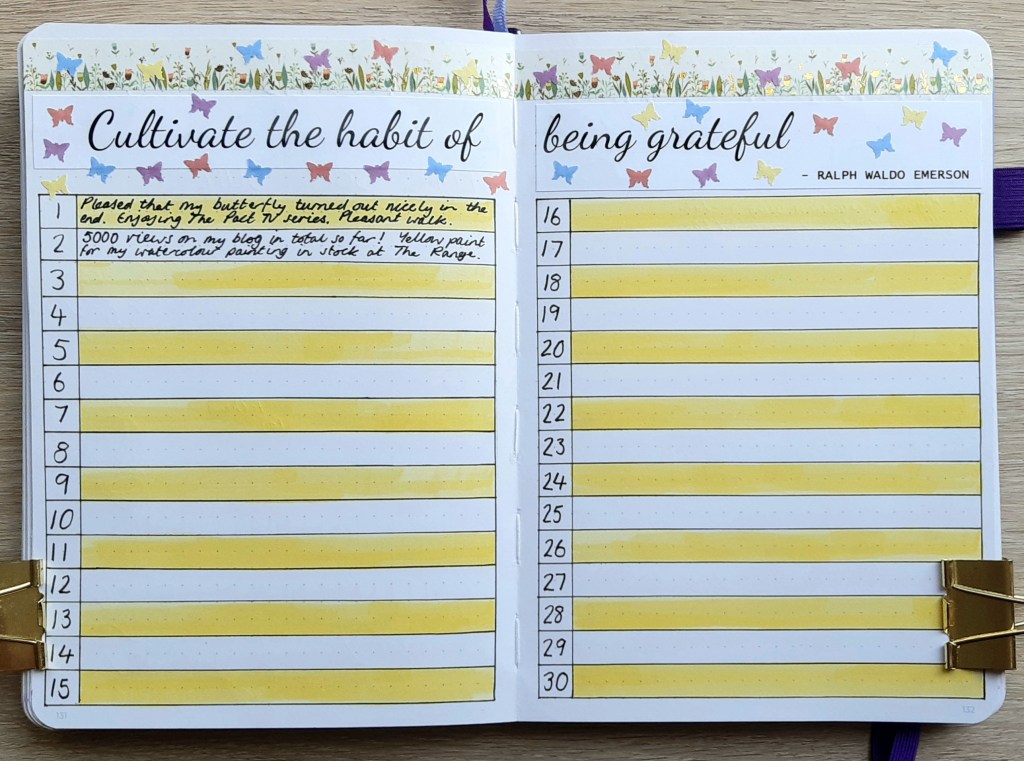
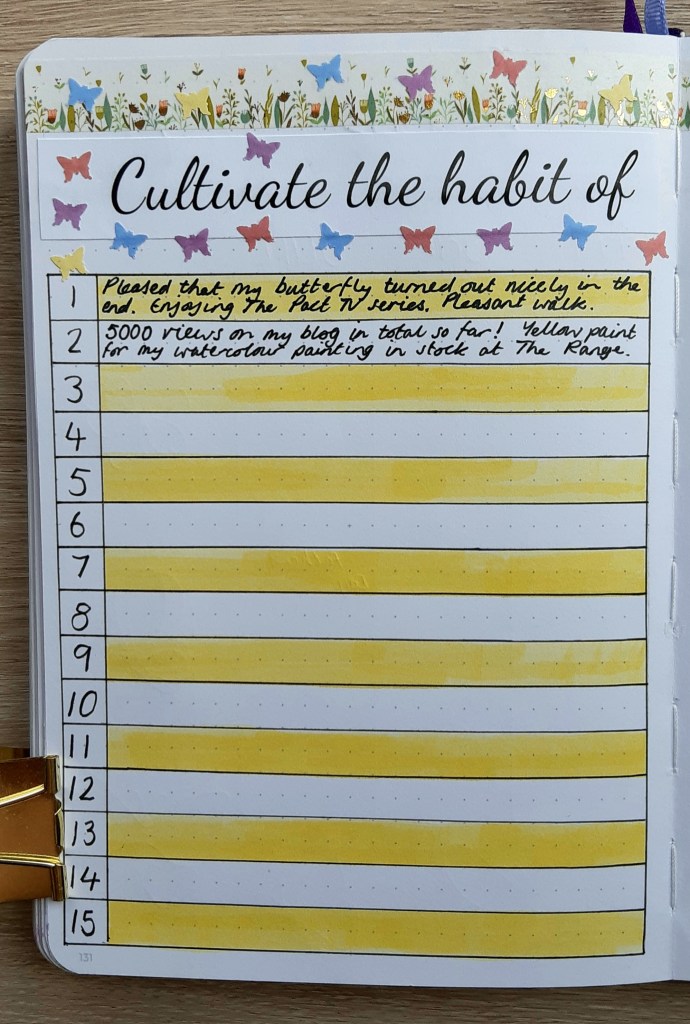
If you are a regular reader of my blog, you’ll know that I’ve been doing these gratitude pages for a while now. At the moment, I’m struggling with negativity due to various medical complaints impacting on my mental health and this means that finding things to be grateful for becomes a little more difficult but all the more useful. Sitting down and coming up with two or three things each night, reminds me that there are some good things to be thankful for. I’ve filled in the first two days to give you an idea of the kinds of things I write.

The meadow washi tape with gold accents is a nice addition to the page and I also added lots of tiny punched paper butterflies around the title section. I used a multipurpose glue and a little pin head to apply it to the reverse – time consuming again but they look cute I think.

Photo Credit: Laura Jones for Keeping It Creative
Photo credit: Laura Jones for Keeping It Creative

Yoga Session Tracker

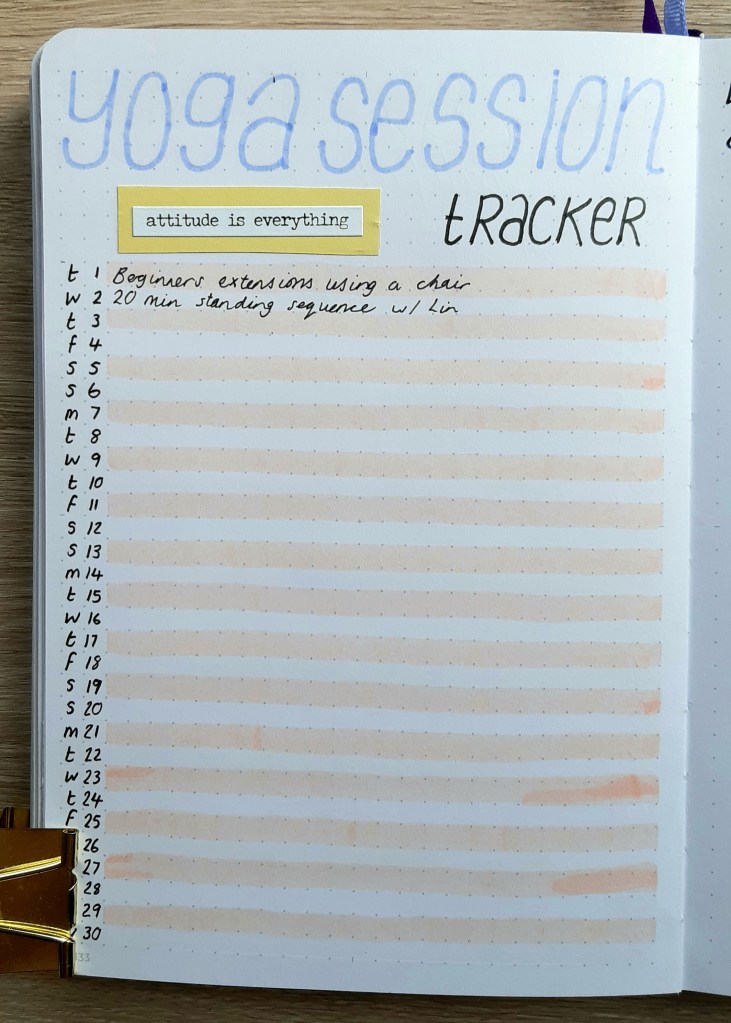
Another spread I’ve been doing for a while to record my daily yoga practice. I write down which YouTube yoga routine I’ve done so I can make sure I’m targeting different parts of the body and ensure that I’m not repeating sequences too often. I was keeping a yoga journal too but I seem to have got out of the habit of writing in there at the moment so this will do for now.

Photo credit: Laura Jones for Keeping It Creative

I hope you’ve enjoyed seeing my spreads for this month. I’m also planning on setting up a mood diary but I will hopefully be sharing this in my next Monday Matters post on the 7th. I’m now going to spend half an hour checking out everyone else’s spreads for this month as I love looking at a variety of themes and layout styles – I may have to set a timer though as it’s easy to lose hours on blog posts, Instagram, Pinterest and YouTube as I’m sure you’ll all be well aware!

Just one more thing before I go…

I just want to share this little graphic which popped onto my phone screen yesterday. Thank you so much to all of you who take the time to read my blog – I appreciate every single view, like and comment.

Posted in Bullet journaling, lifestyle, mental health, Planning and journaling, wellbeing

Monday Matters: Journalling for Wellbeing

Photo credit: Laura Jones for Keeping it Creative

If you have been following my blog for a while now, you will have seen from some of my previous posts that I’ve been a fan of journalling for a while now and really enjoy using both my bullet journal (BuJo) for planning and recording and my Traveler’s notebook journals for creative memory keeping. In today’s Monday Matters, I’m going to give a brief introduction to journalling, describe some of the ways it can support your mental health and wellbeing and provide you with some different types of journalling that you might want to try.

What is a journal?

A journal is a safe and private space for you to record your thoughts, feelings and reflections on life. It’s a place where you can write daily or just occasionally, when you feel the urge. You can produce a few short lines or a couple of pages depending on the type of journaling you want to do and what you’d like to get from it. There are no rules to follow and so it is a great way of letting your guard down and expressing yourself in any way you choose. Many people decide to share their journal with others – as you can see on Instagram or Pinterest, but this is completely optional and something you should only do if you feel comfortable or if you find it beneficial in some way.

There are many different kinds of journal that you may want to keep and you can either choose to have several on the go at once or keep it simple with one space to write something each day. There are also lots of dedicated books and booklets available for purchase if you want one with a structured framework in which to write but I personally prefer to create my own using a blank notebook. Here’s a list of some of the most commonly kept journals:

  • dream journal – a space to write down what you dream about and then think about what each specific one might mean
  • travel journal – a book in which to write about all of the places you’ve been, adventures you’ve had, people you’ve met on your travels, places you want to go in the future etc.
  • specific timeframe journal e.g. a record of a holiday, baby’s first year, wedding planning etc
  • reading journal – a record of the books read, your rating and your thoughts on them
  • garden / nature journal – details about your garden e.g. new plants, plans and layouts, nature spots etc
  • gratitude journal – a place to record one or two lines about things you are grateful for or a list of things you are thankful for each day
  • progress journal – a place to document your achievements in a particular area of your life e.g. yoga practice, work you’ve done towards your goals etc.
  • project journal – if you are working on a particular project, you might record how you are getting on e.g. photos of a house renovation or photos and words relating to decluttering a particular area of your home
  • creative journal – a scrapbook / junk journal style where you stick in tickets, receipts, leaflets etc and record your life experiences, adding decorative papers, stickers, stamped images etc
  • personal development – a record of how you have grown as a person, for example, a Level 10 life assessment followed by ways in which you have made progress in the different areas in order to work towards a better life

If you keep a bullet journal, you may even decide to create dedicated pages within your monthly spreads. For example, I draw up a 2 lines a day gratitude journal each month which comes after my cover page and monthly calendar.

What are the benefits of keeping a journal for good mental health and wellbeing?

Regular journalling can greatly improve your quality of life and various studies have proven it to be wonderful for your wellbeing due to the positive impacts it has on your physical and mental health. Some of the main benefits include:

Reduction of anxiety, stress and depression Journalling helps in a number of ways. The physical process of writing can be good for calming your mind and soothing your emotions as it is a meditative kind of activity. Writing can also boost your mood and put you in a more positive mindset – gratitude journalling is particularly great for this as it focuses your attention on appreciating the small things in your life that make things better. Getting all of your thoughts and feelings on paper can also help you rationalise and process all of the things that are going on for you at the moment. As you write, you may think of alternative ways of looking at things or find some solutions to your problems. You can even write a love letter to yourself where you identify difficulties that you are currently facing and offer kindness and compassion to yourself.

Improved self awareness Journalling can really help you get to know yourself better. Learning what makes you tick has been shown to help you deal with life’s ups and downs and can make you more much more resilient in the face of difficulties. It can also enable you to spot patterns and recognise any traps you may fall into on a regular basis.

Better cognition Regularly writing in a journal has been shown to boost our cognition. Cognitive skills include attention, memory, organising information, learning and solving problems. Also, if you engage in a reflective style of journalling which helps you process negative emotions and thoughts, you are creating room in your mind to explore your creativity and engage in more positive activities.

Reach your full potential Many people like to keep a journal to establish, track and achieve their short and long term goals and writing things down can be a great way of checking in with yourself to see how you are progressing.

Nightly journaling can provide an opportunity to reflect on how you feel your day has gone, any issues you had and how you dealt with them (whether in a good way or less than helpful way!), what you are looking forward to tomorrow and anything which is worrying you. This can help you make progress in both your personal and professional life and also encourages you to celebrate your achievements no matter how small.

Improved physical health Studies have found that regular journalling can decrease symptoms of long term health conditions such as asthma and arthritis. They also shown that it can boost your immune system, helping to reduce your chance of catching common illnesses such as a cold, and making your body better able to fight off any infections.

Are there any negative aspects to journalling?

For me, there’s just one and this is related to my perfectionist tendencies. Sometimes, I become overly concerned with aspects of writing such as cohesion, penmanship (handwriting, spacing etc), readability etc, which kind of detracts from the thoughts and emotions that I’m trying to get down on paper. Although I’m getting better at embracing the imperfections, this is still very much a work in progress. One way you can combat this is by writing down everything that’s in your head and enjoying the therapeutic effects, then destroying your pages by shredding them or hiding your writing by covering it with papers, thick layers of paint, pretty images etc,

Things to remember when you start journalling – some tips for beginners

No matter what kind of journal or journals you choose to keep, remember that it should be all about improving the quality of your life whether that’s making you more organised, relieving stress, having a creative outlet, recognising your achievements or any other of the wonderful benefits that come with a regular journalling practice. As a beginner, try to think about what you want to get out of keeping a journal. Do you want it to be all about reflection? Do you want it to be a record of your experiences and how you felt about them? Or do you want to focus on being more grateful and appreciative of the things you have in your life? Find your purpose and once you are clear on this, think about how you might present things.

There are many styles of journalling and there are no right and wrong answers. Some people write to just get everything out of their head in order to create some space – a popular method to create ‘morning pages‘ where you do some free writing first thing in the morning and fill a couple of pages without thinking about spelling, punctuation and grammar. However, this in not for everyone and not something I’ve tried. So one of the questions you might ask yourself is, do I want something that I can look back on for years to come or do I just want to focus on actually getting all of my thoughts and feelings out with no regard to what my pages look like as I’m not going to be looking at them again?

Also, when you first start, you might want to experiment in order to find your own journalling style or styles. In doing this, it may be tempting to spend hours perusing the internet looking at the work of others for inspiration and ideas. However, this can cause overwhelm and hightened stress levels before you even get going. Comparing yourself to other journallers can leave you feeling inadequate which is certainly not going to lead to good mental health and wellness! Also, you may be ‘wowed’ by everything you see online and end up buying every supply available – washi tapes, stamps and inks, watercolours, gouache, brush pens, gel pens stickers etc, when really, it’s probably better to start simple and choose a few basic supplies that suit your style e.g. a nice pen and some tape to stick in a few photos and maybe a couple of embellishments until you find what you like.

Of course, if your passion is the act of writing, you might just want to fill your pages with words and add only basic decoration in the form of a border or a cute sticker. Other journallers might prefer to create arty pages, adding decorative elements such as photos, sketches, watercolour, stickers, stamped images and so on, plus a few lines of text. Again, there’s no right or wrong answers – just do what you feel comfortable with.

Final words…

I hope you have enjoyed reading today’s post and it has whetted your appetite for a little journalling. Maybe you’re completely new to the idea or you’ve tried journalling in the past and would like to give it another go. Remember, start small and above all have fun with it as this is more likely to make it a habit you want to keep. You certainly won’t reap the wellbeing benefits if you do it only once or a couple of times, but if you journal as part of your daily or weekly routine, I’m sure you will soon see the benefits and want to continue. If you want to learn more about instilling new habits like journalling check out this post. Let me know in the comments if you are already a regular journaller and what impact it’s had on your life.

Posted in art, bullet journal, Bullet journaling, Planning and journaling, watercolour painting

Setting up my Bullet Journal for April: April showers theme

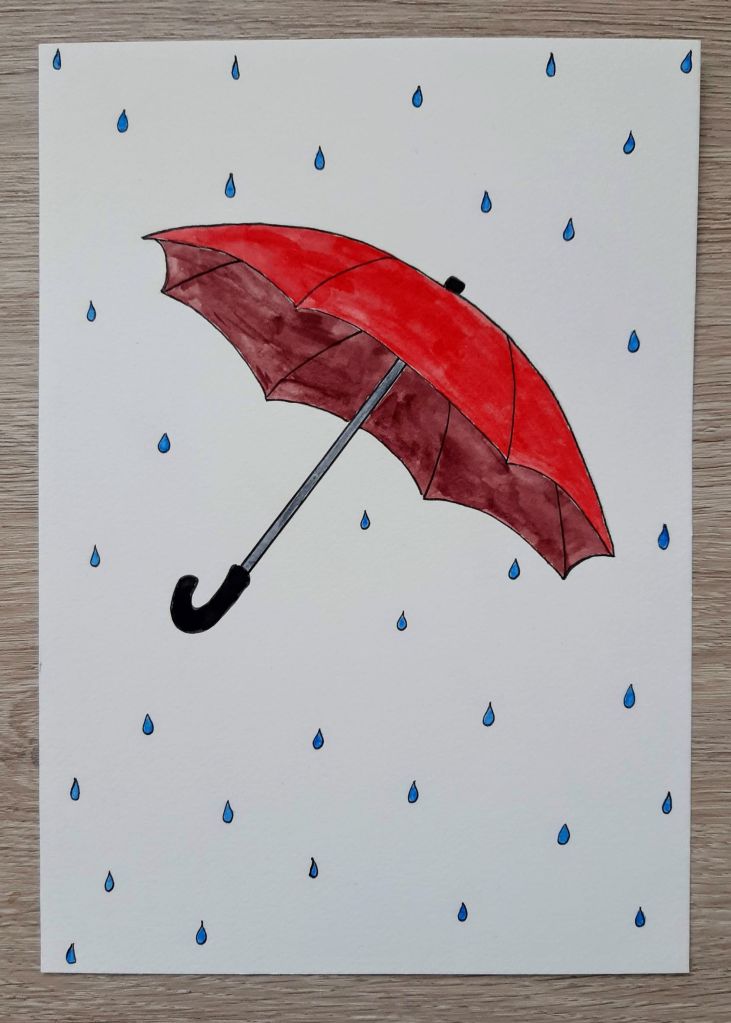
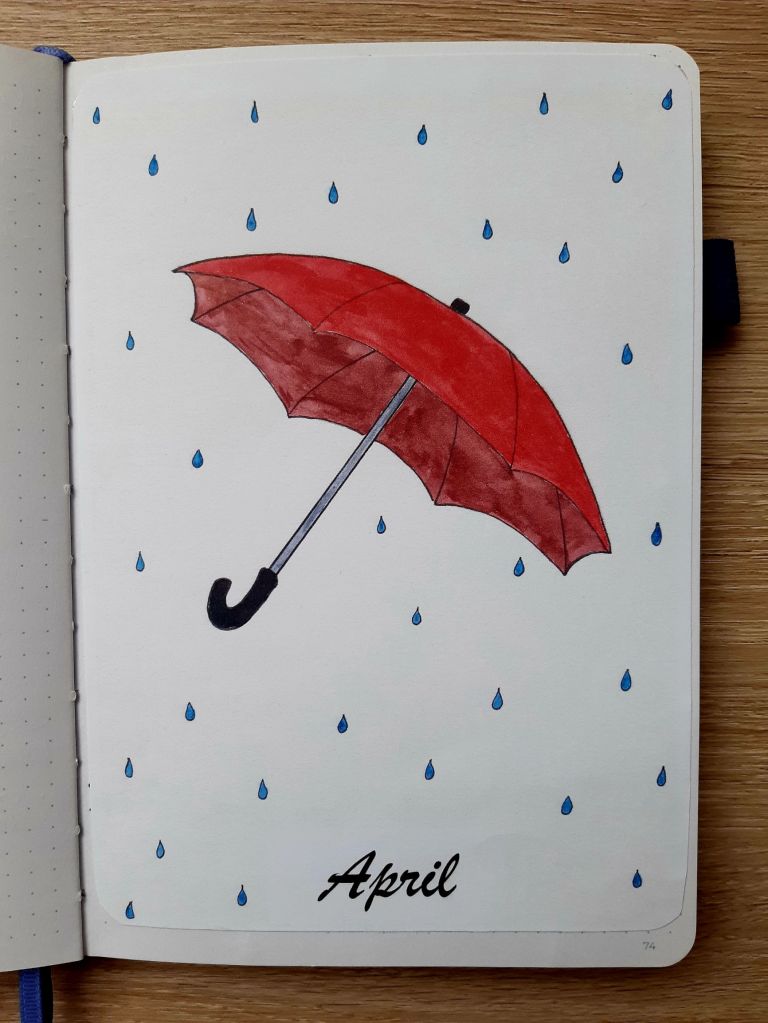
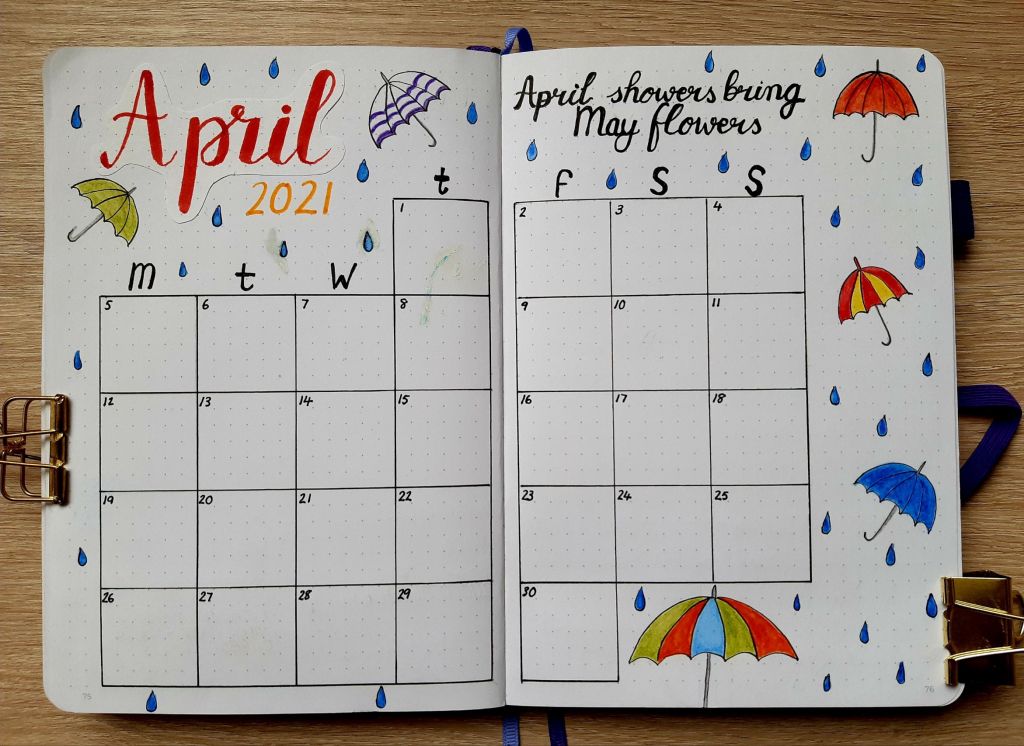
Hi everyone, hope you are all well and enjoying the warmer weather. This month, I’ve gone for an April showers theme featuring umbrellas and raindrops. Again, I had fun practising my drawing skills for the brollies and I also decided to get out my watercolours for the cover page using my Winsor & Newton Cotman paints for the large umbrella and my watercolour pencils for the tiny raindrops. I hope you enjoy looking at my spreads.

Cover page

For my cover page, I kept it simple with a single umbrella which I sketched in pencil onto hot pressed (smooth) watercolour paper and then inked using a Pigma micron pen in 02. I then wet some Cadmium Red deep straight out of the tube and used it for the top of the umbrella, applying the paint with a size 6 brush. After that had dried, I added a tiny amount of black to the mixture to create a darker contrasting hue for the underneath of the umbrella. By letting the first colour dry thoroughly, I avoided any colour bleeds when applying the darker colour. After leaving the umbrella to dry overnight to avoid any smudging, I drew the raindrops with the Pigma pen and then coloured them in with a dark blue watercolour pencil before using a small damp paintbrush (in size 0) to activate the paint. I was really careful not to lean on any of the wet paint as I didn’t want any issues like those I had with the calendar page as you will see next! The image was then scanned into my computer, pasted into a MS Publisher document and the month added.

Monthly calendar

For my calendar, I wrote April on dot grid paper and then cut it out to stick in as the header. The calendar is my usual six dots x six dots grid drawn with a 0.3 Pigma pen. The umbrellas are hand-drawn and coloured in with my watercolour pencils and then wetted to activate the paint. The raindrops were also done in the same way. As you can see, there are a few smudges, one from some Tombow ink and the other from accidentally dripping water on a couple of the raindrops. I’ve tried to cover them over with my white gel pen but I’m still not happy with it!

Photo credit: Laura Jones for Keeping It Creative

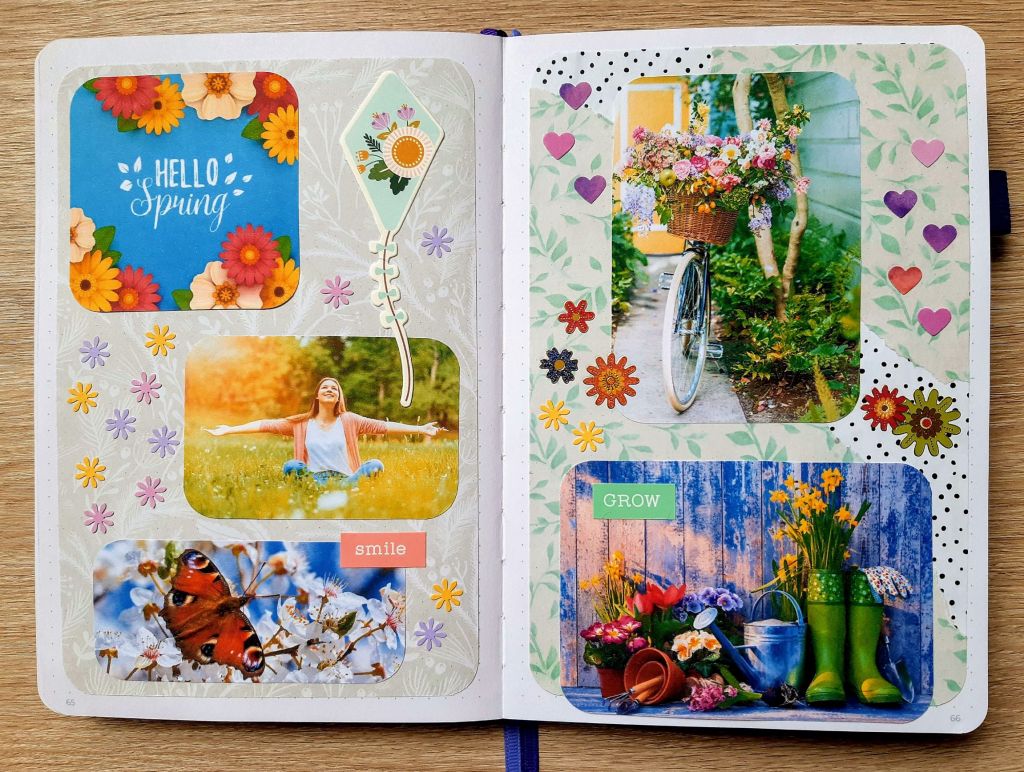
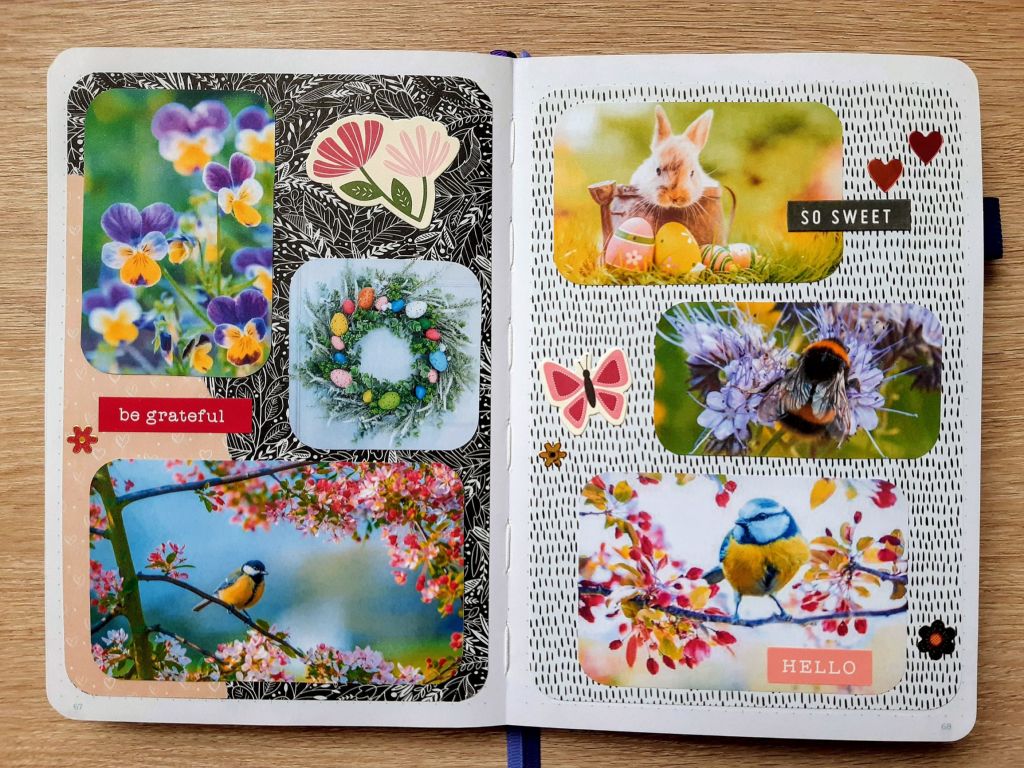
Another two double page Spring collage!

I enjoyed creating the other collages so much that I decided to do another one. Again, the photos are from Google Images. The paper backgrounds are from a paper pack I got from The Range and the hearts and flowers are cut with mini punches from Hobbycraft. Some stickers and ephemera completed the spreads nicely! The pages are such a joy to look at and I’m so pleased with how they turned out.

Photo credit: Laura Jones for Keeping It Creative

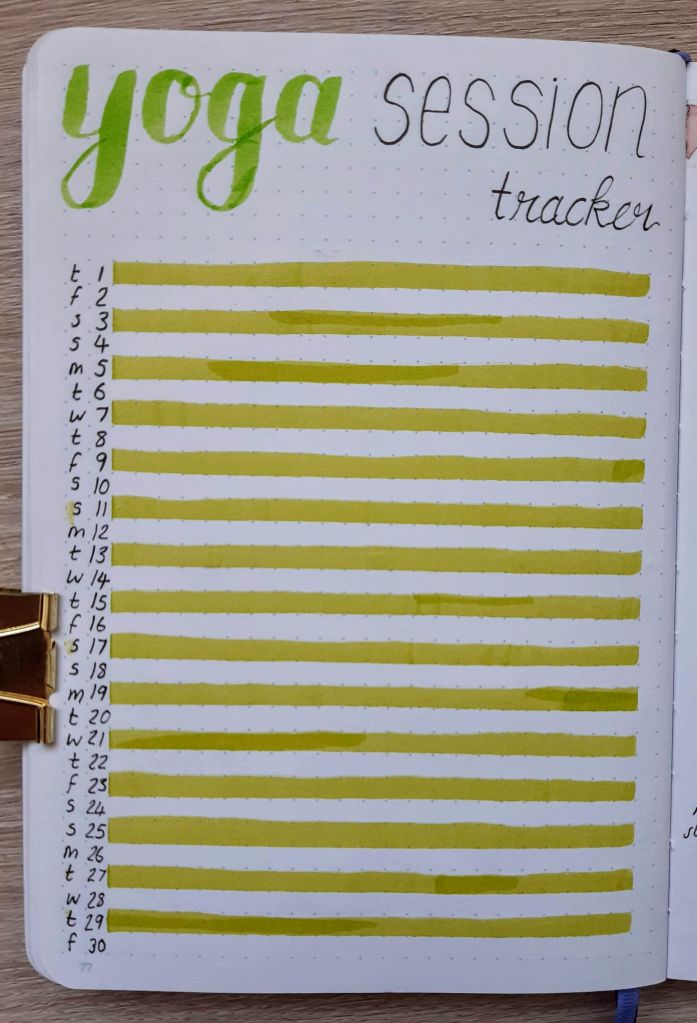
Yoga session tracker

This is where I record the session I followed on YouTube or the e-book sequence I followed. I also write in my yoga journal but I find writing in here gives me an at a glance record so I can be sure to have focused on stretching different parts of my body throughout the month. Again, I got smudges of Tombow elsewhere – the joys of being a leftie!

Photo credit: Laura Jones for Keeping It Creative

TBR and reading information spread

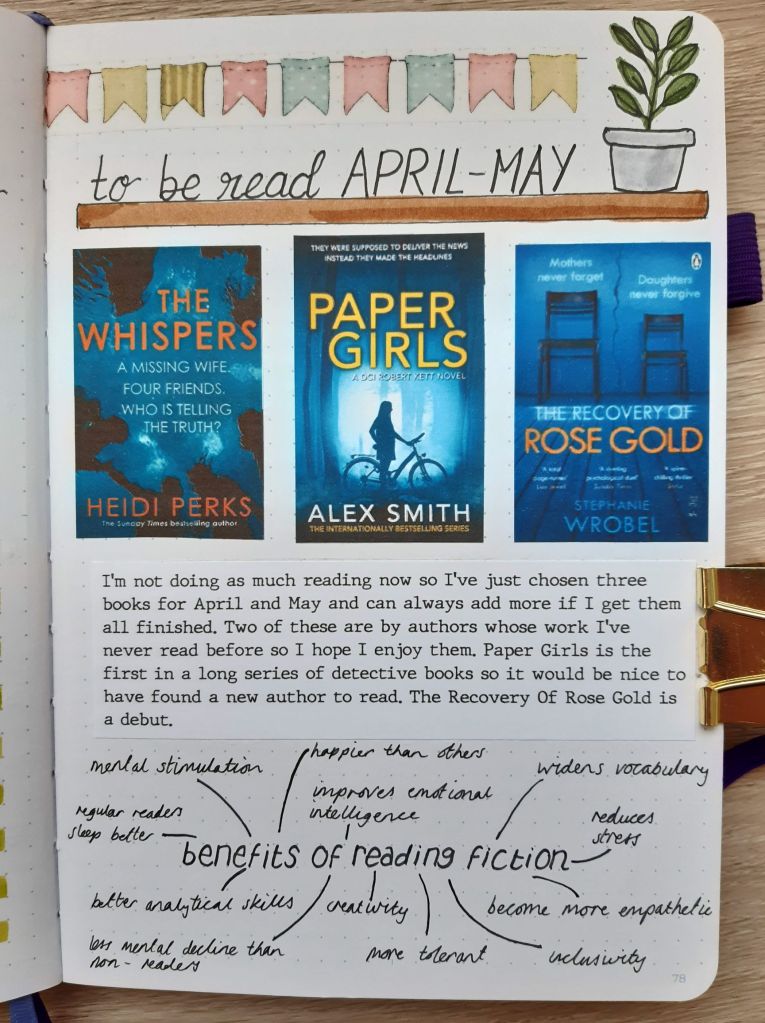
Again, I wanted to do a spread which shows the books I plan to read over the next couple of months. I also have an extra novel that I’m not going to get around to by the end of March too but I’d already done the spread so I shall read it in a few months time.

The benefits of reading fiction spider diagram was useful for reminding me about the benefits of reading for pleasure and also gave me the idea of writing this blog post. I’ve also done a bit of journalling about my reading and the books on my virtual TBR pile. I think it’s nice to include colour versions of the covers in my BuJo because, as I think I’ve said before, you don’t get to see them on the Paperwhite version of Kindle.

Photo credit: Laura Jones for Keeping It Creative

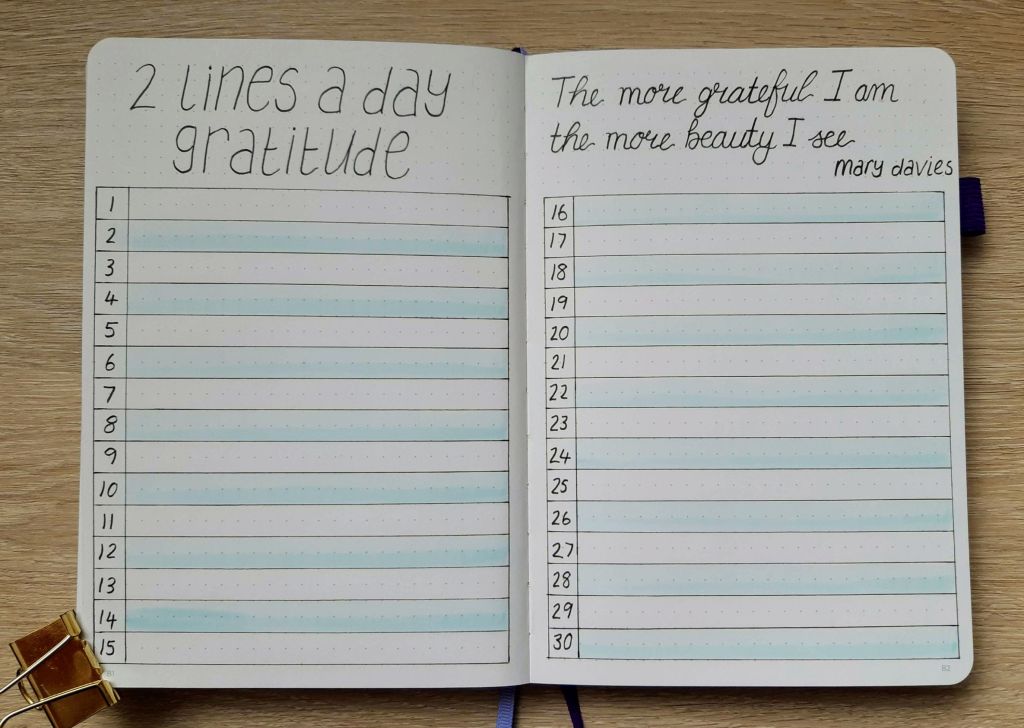
2 lines a day gratitude

A simple spread where I record at least three things a day for which I am grateful. I did this last month too and really enjoyed filling it in each evening.

That’s most of my spreads that I thought you might like to see this month. I have really got into using my bullet journal again now that my mental health has improved. I would love to know what theme you have chosen and, as usual, if you’ve shared your spreads on your blog, don’t forget to include a link so that other readers can have a nosey as well as me!

Happy bullet journalling!