Posted in compassion, lifestyle, manifestation, Setting goals and intentions

Monday Matters: An introduction to Manifesting Your Goals and Aspirations

Over the last few months, I’ve read a couple of books on the topic of manifestation – ‘Make It Happen – Manifest the life of your dreams’ by Jordanna Levin and ‘Manifest – 7 Steps to Living your Best Life by Roxie Nafousi. I found both of them really interesting and learnt a lot about the theories behind manifestation and things to work on to maximise your chances of creating the life of your dreams or your best life as mentioned in the titles. Today, I hope to provide a summary of the concept and my key take aways from both books so you can use the ideas to work on your goals for 2023.

Both authors talk about the success they’ve had with manifesting everything they’ve wanted in their lives so far and the steps they’ve taken to get there. They also discuss some of the struggles they’ve had in the past and how they’ve overcome them through the power of manifestation and making changes to their thoughts, feelings and attitude.

What is meant my manifestation?

There are various dictionary definitions available online, but, in short, to manifest is to make something happen. In today’s post though, I want to explore the idea that I believe was first discussed in detail by television writer, producer and author Rhonda Byrne in her documentary film and related book The Secret back in 2006 where she explained that ‘Manifesting is about breathing life into your goals through action, emotions and belief’.

Levin adds to this in her book by introducing her ‘Manifestation Equation’ which is states that:

Thoughts + Feelings + Actions + Faith = Successful Manifestation

and is based on four laws – The Law Of Attraction, The Law Of Vibration, The Law Of Action and The Law of Rhythm.

Whilst Nafousi, in her first of two books on the subject, describes manifesting as ‘a meeting of science and wisdom’ and ‘a philosophy to live by and a self-development practice to help you live your best life’.

Finding clarity

The first step of manifesting is to get clear on what you want you want from your life. As Nafousi states ‘…you can’t get to where you want to go if you don’t know where it is you are headed’. A helpful practice for this is to create a vision board filled with your intentions. This can be done digitally on your computer, or physically as a display, and commonly includes inspiring pictures and/or words representing your dreams and aspirations. If you prefer written methods, you might like to write a list in a special manifestation journal and expand on your intentions for each. Another option to try, is following a guided visualisation meditation specifically for manifestation, where you consider what you ideal life would look like and even more importantly, what it would feel like if you already had what you desire. There’s a range available online, some for a small cost and others free. You might also want to think about the kind of person you want to be or take time to explore your core values. Jordanna has two free PDF resources for this which include a comprehensive list of core values and a long list of personality traits. I found both to be extremely useful. Finally, using a Wheel of Life to explore where you are right now and where you wish to be in the future can also help you make plans and set intentions or goals.

Whatever methods you use to set your intentions, it’s recommended that you work on a small number – a maximum of five at a time can help to keep them powerful. Also, the advice is to write them in positive language, keep them short and to the point and use present tense e.g. I am well-organised and productive, I have a happy and healthy relationship with my partner, I feel full of vitality etc.

Take action

As well as thinking about and visualising what you want in your life, you should also be prepared to take action in order to make progress towards those things. As Levin says when describing the Law Of Action – ‘you must do the things and perform the actions necessary to achieve what you are setting out to do’. You play a vital role towards creating your future so you must work to make it happen! So, for example if you want to be happy and fulfilled at work, you might start by considering you current job situation and how you feel about it. You could then take some time to journal about what aspects you enjoy and which leave you feeling dissatisfied. Having considered this, it might lead to you identify potential changes you could make or help you to realise that it is time to move on and try somewhere else or a different role. You would then have to think about and perform the necessary actions to move things on.

Raise your vibration

The scientific principle known as the Law of vibration states that everything in the universe (objects, thoughts, emotions etc.) has energy and a vibrational frequency ( from high to low). With regard to manifesting, according to this law, we need to vibrate at a similar frequency to the things we are trying to attract and the best way to do this is to work on raising our vibe. High vibration emotions include unconditional love, joy, peace, gratitude, hope and optimism, whilst particularly low vibration emotions include jealousy, anger, fear and despair. But how can we work on raising our vibration so we resonate more of these positive emotions? Here’s some of what I learnt from my reading:

Let go of fear and doubt

One of a number of ways of working on raising our vibe is to let go of fear and doubt. If you believe that you are not worthy of what you want or that you are not capable of taking action and making changes then you are unlikely to manifest those things. On the other hand, if you have faith in your abilities and are optimistic about the future, you are ready to receive everything you desire because you believe you are worthy of it. This happens because our subconscious has the power to drive us towards our dreams but also has the power to hold us back.

Our fears and doubts show up in a number of different guises including worries and insecurities, limiting beliefs, feelings of unworthiness and a lack of trust in the universe to provide for us. These can not only sabotage our chances of manifesting, they can also stop us from being aspirational with our dreams and wishes too.

Of course, ridding ourselves of fears and doubts is not something that can be done overnight, especially as many of us have been accumulating them over many years. It takes constant work and commitment (what some practitioners call deep work). Self development is achieved over time and with perseverance. It might also involve working with a therapist, life coach or mentor. who can guide you on the way and teach you new techniques for managing your thoughts and emotions and working on limiting beliefs. The main ways forward include:

  • exploring your thoughts and considering more realistic or alternative ways of looking at things (focusing on positive and empowering choices)
  • being careful about our choice of language e.g. replacing if with when, talking about what we want rather than what we don’t want, choosing positive words such as I can…, I will… etc rather than negative statements such as I can’t…, It’s too hard etc.
  • using positive mantras to repeat e.g. Life supports me in every possible way. I am thankful for the endless opportunities that come my way. Today I am the best version of myself. I’ll achieve everything I set out to do.
  • practice visualisation – imagine what it would look like and what it would feel like if you were living a life in alignment with what you desire. This can be done as a meditation or if you prefer creative writing, you could journal what your day would be like if you were living your best life.
  • cultivate self love and compassion – be kind to yourself and value your wellbeing. Celebrate achievements but also be patient and forgive yourself when needed. Believe in yourself and your ability to have success. Treat yourself as you would a good friend, offering support and encouragement.

Live in alignment

Another part of taking action is to align your behaviour with what you wish to manifest. It’s no good creating your vision on a board or just sitting there thinking about what you want for your like, you need to be proactive in your journey. As you work on banishing your fears and doubts, you will start to develop confidence in your abilities and this is when you can really push yourself and step out of your comfort zone. |Nafousi has this to say:

‘To manifest change, we must first create change. We must do something different, we must challenge our fears and doubts, we must act as our future self would act and we must show the universe how ready and willing we are to step into our power.’

A good way to do this is to behave the way your future self would. So, for example, if you want to be a tidy and well-organised person, you need to act like one. This could include regularly decluttering, making sure you have a place for everything and putting things away in that place when you’ve finished using them, creating a schedule for your day or writing to do lists to make sure you maximise your time, having a good sleep routine so you wake up feeling refreshed and ready to have a productive day, making tidying a priority and a habit which you see as important and of value. It could also include spending time researching and implementing habits of tidy and well-organised people and maybe asking for help and advice from friends who always have a neat and tidy home.

If you’re not sure what steps to take or changes you might need to make, Jordanna Levin’s book has chapters on different aspects of life which are full of ideas and exercises to try.

Develop an attitude of gratitude

Whilst you strive to manifest your intentions, it’s also important to be grateful for what you already have. As I’ve shared in several previous blog posts, gratitude is all about being thankful and showing appreciation for all of the things we have. Nafousi splits gratitude into three categories which I found particularly helpful – gratitude for the self, your life and the world. So, you can appreciate things about yourself such as your health, your ability to listen to others and your crafting skills. You can be thankful for what you have in your life such as a supportive partner, a beautiful home and a job you love. And, finally, you can feel grateful universal things such as good weather, connection with others and the wonder of nature.

Gratitude is a high-vibe emotion which is wonderful for your physical and mental health, your relationships, self esteem and sleep. Being grateful for things as they are now shows the world that when you do manifest something you what you want for yourself and your life, you will be super appreciative of it.

Gratitude journalling is something I do every day as part of my Five Minute Journal practice and it something that I feel really helps to develop those high vibe emotions we want to increase. I identify three things each morning to write about and then reflect on the highlights of my day (and what made these things possible) and what I’ve learnt in the evening. It doesn’t take long and it has the potential to make a huge difference to your life.

Use sources of envy to inspire you

When I was young, there seemed to be limited sources of envy. You might feel jealous of a school friend who got 10 out of 10 in her spelling test or your best mate who had pretty much every toy in the Argos catalogue / went on super expensive holidays / had a bedroom the size of the ground floor of your house or a garden full of expensive play equipment. Nowadays though, you can go on social media and be envious of the perfect lives of not only your friends, work colleagues and acquaintances, but also people you’ve never met who have the perfect Instagram feed / the energy to get up at 5 am and be super productive until 8pm / the healthiest body with flawless skin / the tidiest and most well-organised home with all the latest gadgets bought with their huge and effortless income – you get the idea. As Nafousi says in her first book ‘Social Media is a playground for comparison and a fertile land for envy to grow in’. She offers a few tips on how to manage things. One suggestion is to become more mindful of the content you engage with so that you choose only to read / explore content which you relate to, makes you feel good or inspires you in some way. You should also continue to work on removing your fears and doubts which are holding you back, some of which may present as envy and jealousy. Another potentially powerful idea is to recognise thoughts and feelings associated with low vibe emotions such as these and turn them into inspiration. So, rather than believing that they have things that you can’t have (scarcity mindset), you have the opportunity to reframe and choose to believe that you could have the same for yourself if you work hard (an attitude of abundance).

Trust that the universe has got your back

As part of your manifesting journey, you will meet challenges, difficulties and obstacles along the way. You have several choices when these tests turn up: 1) you could admit defeat, become impatient and decide you’re never going to get to where you want to be, believe you’ve failed, believe that other people have all the luck and let envy creep in basically, letting fear and doubt rule, or, 2) you could use these situations and obstacles in a more positive way to build your inner strength, resilience, courage and self belief to keep going and trust in the manifesting process. You might need to take action by do a bit of problem solving, trying different approaches, working things out by journalling how you feel, or using positive affirmations to remind yourself that you can and you will, but ultimately, if you have faith in yourself and the universe to provide for you then you can absolutely get there.

Final words…

Today’s blog post contains just a small part of what I’ve learnt about manifesting. If you want to find out more, then I particularly recommend Manifest: 7 Steps to Living Your Best Life by Roxie Nafousi as a succinct introduction and her more recent book Manifest: Dive Deeper to further your knowledge. Jordanna Levin’s book Make It Happen: Manifest the life of your dreams provides a much more indepth look into manifestation and also has lots of exercises to try. It also focuses on different aspects of life which you may want to work on as part of your manifesting journey.

I hope you have found the topic matter of manifestation interesting and something which is worth exploring further. As always, I would love to hear your thoughts or related comments.

Posted in compassion, lifestyle, meditation, mental health, Mindfulness, self care, wellbeing, wellness

Monday Matters: Wheel Of Wellness – Spiritual

This week, in my series on The Wheel Of Wellness, I’ll be looking at the Spiritual segment. This section, which is the last to be covered, is all about finding life’s meaning and purpose whilst developing understanding of your personal values, beliefs and morals and using these to guide your actions and inform your way of living. Spiritual wellness does not necessarily involve being a deeply religious person or believing in the supernatural, rather, it is related to the human spirit or soul, as opposed to material or physical things.

A focus on spirituality involves learning to be more self-aware and recognising our existence in time and space. It’s also about becoming more familiar with our personal beliefs and values and how they affect the way we live and what we see as our purpose in life.

We all have a spirit within us which is constantly guiding us, looking after us and showing us the way to go. When we start to tune in to and listen to our inner voice, we’re using our spirit, and this is what can help us to lead a life in keeping with our wants, desires and passions. Connecting with our spiritual side can also help us to feel happier and healthier which I’m sure is something we all want.

Ways in which you can connect to your spiritual self

There are a number of ways in which you can really tune in to your spirit and think about what you really want for yourself and your life.

Quieten the mind – meditation is a great practice to develop but other mindful practices include writing in a daily journal, doing relaxing breathing exercises, taking a walk in nature, doing a meditative activity such as drawing, painting or colouring in, stretching exercises such as yoga, Pilates or mindful movements and praying.

Practise gratitude – identify a number of positives in your life each day, expressing and reflecting on them

Take a Mindful approach – focusing your awareness on the present moment, whilst calmly acknowledging and accepting your thoughts, feelings and bodily sensations is at the core of mindfulness as is a great way of becoming more in tune with your spiritual side.

Consider your personal values – values identify what is important to you in your life and how you wish to interact with the world. When your actions align with your core values you will immediately start to feel more content, fulfilled and satisfied. To help you do this, I’ve created a Pinterest board full of links to core values lists and related activities – try scanning the pages to see what resonates with you. You’ll see so many different ideas and the ones which you choose to add to your personal list will influence your decisions and life choices in many ways including:

  • your job or career path
  • your hobbies and pastimes
  • where you live
  • how you manage your money
  • your friendships, romantic partners and relationships
  • where you shop
  • compromises we are willing to make
  • how we parent our children
  • the ways in which we treat ourselves (both good and bad)

Whilst I was researching this blog post, I came across lots of worksheets, workbooks and exercises to try which focused on your values. One of these invited you to split your values into ‘Valuing myself’, ‘Valuing my relationships’ and ‘Valuing my work’. I had a quick go at this below but added ‘my life’ to the first category:

Valuing myself and my life

compassion, creativity, enthusiasm, open-mindedness, acceptance (self and others), creativity, happiness, health (emotional, physical and mental), learning, intelligence resilience, fun, wellbeing, respect for animals

Valuing my relationships

loyalty, thoughtfulness, love, playfulness, understanding, usefulness and humour

Valuing my work

contribution, commitment, professionalism, achievement, work/life balance

Spend time reflecting on your beliefs – these may have a religious focus or might be related to your core values. Examples of non-religious beliefs could be:

  • family comes first
  • we must take care of our planet
  • honesty is the best policy
  • everything happens for a reason
  • work/life balance is a priority
  • I should always try my best
  • community service is a central part of life
  • the different phases of the moon have particular influences on my life
  • breaking a mirror gives you seven years bad luck

Think about your dreams – not the ones you had in bed over the past few weeks, but your deepest desires and wishes. As part of this, you could do some journalling or have a go at creating a vision board. Afterwards, you might spend time reflecting on small but positive life changes that you could make right now to help you work towards these dreams.

Final thoughts…

Cultivating spirituality has many benefits for your physical and mental health and wellbeing. Getting to know your true self can help you begin to live in alignment with your core values and beliefs which is fundamental for a long and happy life. Psychologically, spiritual practices can develop your understanding of your inner self, leading to a greater sense of purpose. They can help you to think positively and clearly, lower your risk of stress, anxiety and depression and generally give you a better outlook on life. Physically, being more connected to your spiritual side can improve your immune system, help you to fight off illnesses, lower your blood pressure and reduce your risk of heart disease and stroke. It can also help you to make better choices in terms of diet and find other ways of looking after your body and your mind, for example by exercising regularly and finding time to relax. The peace and calmness we invite into our lives can also help us to get a restful night’s sleep.

I hope you have found today’s post useful and have enjoyed learning about The Wheel Of Wellness over the last few months. I would love to hear about your hopes, dreams and ambitions for the future and the ways in which you think you can bring these into fruition. In keeping with having an open mind, I’m currently learning about the magic of using the phases of the moon as a tool to develop self-awareness, self-care, nourishment and empowerment to live with purpose and to manifest my deepest wants and desires for life. You’ll see in my next blog post, in which I share my October bullet journal spreads, that this has inspired my theme for next month and provided me with lots of ideas.

Posted in compassion, meditation, Mindfulness, wellbeing, wellness

Monday Matters: 5 Easy ways to Practice Mindfulness every day

When practiced regularly, mindfulness can have a really positive impact on our mental health, reducing feelings of depression, anxiety and stress. In today’s post, I’m going to share five simple ways to incorporate mindful activities into your day so you can enjoy the many benefits mindfulness brings.

What exactly is mindfulness?

There are lots of explanations and definitions available online but I particularly like this one from the Oxford dictionary:

a mental state achieved by focusing one’s awareness on the present moment, while calmly acknowledging and accepting one’s feelings, thoughts, and bodily sensations, used as a therapeutic technique.

Oxford online dictionary

Basically, mindfulness is about paying attention to the here and now, showing curiosity about what’s going on in a non-judgmental way. That’s not to say that as soon as you start practicing the various techniques that your mind won’t wander, it will, and that’s completely okay. But as you get used to paying attention in a range of simple ways, you’ll likely find it becomes easier.

So here are five ideas for practicing mindfulness every day that anyone can try.

Choose an activity you do each day and really pay attention

A great way to get started with mindfulness is to choose one activity that you do every day and bring moment to moment awareness each time you do it. Examples of suitable activities could be: drinking your cup of coffee or tea first thing in the morning, brushing your teeth, taking a shower, washing your face, getting dressed, driving to work. Whichever activity you choose, focus on knowing what you’re doing as you’re actually doing it, and what you are thinking and feeling from moment to moment too. At first, you’ll likely find that your mind wanders quite frequently, but if it does, gently bring yourself back to the present moment. With time, you’ll find it gets easier to remain mindful.

Connect with each of your five senses

Using your senses – touch, taste, smell, sight and hearing is a great way to focus on what’s happening right now. You can either spend time exploring each one in turn or pick a particular sense to focus on in a given moment. So, for example, you might sit quietly at home curled up in your chair with a coffee, smelling the aroma, being warmed by the heat of the mug. You might then close your eyes and tune in to sounds within the room such as the clock ticking, and far away sounds such as a dog barking. As you open your eyes, you might change your focus to the colour of your drink or the patterns on your mug, before taking a sip and savouring the flavour. At another time during your day, you might focus in on just one of your senses. So, during your daily shower, you might choose to focus on smell, inhaling the scent of your shampoo, shower gel or soap and your conditioner and really appreciating each one. By doing this you will be immersed in your current experiences rather than dwelling on past events or getting stressed about all of the things you have to get done before bedtime.

The following mindful activity is also a good one to do when you’re feeling anxious to help distract from negative thoughts, judgements and physical sensations associated with a tense body.

  • Close your eyes or lower your head and soften your gaze. Take some slow and deep breaths in and out.
  • Open your eyes and take your focus outside of your body. Find the following:

5 things you can see.

4 things you can hear.

3 things you can touch.

2 things you can smell.

1 thing you can taste.

Focus on your breathing

Breathing is a key part of mindfulness practice as it’s something we do naturally out of necessity. There are many online exercises which focus on the breath such as alternate nostril breathing, square or box breathing and equal breathing where you focus on making the inhalation the same length as the exhalation, but the technique which I find easiest and most comforting is soothing rhythm breathing, which I was taught as part of my compassion group sessions a few years ago.

  • Sit comfortably in your chair with both feet on the ground and your hands resting in your lap.
  • Close your eyes or direct your gaze downwards – whichever feels most comfortable.
  • Gently bring your focus to your breathing feeling the ribcage expanding as the air coming in to your lungs and leaving your body as you exhale.
  • Try breathing a little faster or slower until you find a breathing pattern that feelings soothing and comforting.
  • Focus on the breath as it comes in and leaves your body. You might like to notice the sensation of cool air entering your nose and warm air leaving.
  • Turn your attention to your body. Sensing the weight of your body resting in the chair feeling relaxed and supported. Feel your feet touching the floor beneath you.
  • If your mind wanders, notice what has happened and gently bring the focus back to your breath. Even if your mind is bobbing about all over the place, just accept what is happening without judgement and come back to the breath.
  • As you bring the exercise to a close, gently wiggle your fingers and toes and bring the focus back to the room around you.

To ensure you commit to this short meditative practice each day, you might find it helpful to make an appointment with yourself in your bullet journal or diary e.g. 5 minutes after you’ve eaten your breakfast or as an end of the day thing to encourage restful sleep. Again, this breathing exercise is also helpful to calm yourself down in moments of anxiety.

Engage in mindful walking

Whatever the weather, cold, warm, rainy, bright sunshine, cloudy, try to find 10 or 15 minutes each day to go for a mindful walk outside. Take time to pay attention to the different aspects of your experience. Start by exploring how your body feels when you’re walking – your feet as they make each step, your legs as they move you forwards, your arms as the swing by your sides. Next, tune in to what’s going on around you using all of your senses – perhaps you can hear traffic in the distance or a bird singing, maybe you can see the sun shining through the trees, perhaps you can smell the damp earth. Be open to whatever you notice, wherever you are and whatever happens. Try to fully immerse yourself in the here and now. As you end your walk, bring your attention back to how you feel as a result of your practice.

If you want to read about mindful walking in more depth, I wrote a whole blog post on it last year which can be found here.

Be totally present during conversations

All too often during conversations, we’re either multi-tasking or our mind wanders so we’re not paying full attention. However, being fully present has so many benefits for the speaker and the listener. Not only will you both feel valued, you’ll have a better understanding of the other person’s needs and any information that you impart is likely to be comprehended more easily. You’ll also likely improve both your communication skills and your relationship with the other person whether you’re talking to a friend, colleague or family member.

If you want to be more mindful in conversations, the first step is to notice when your mind wanders and, without judgement (no berating yourself for being a terrible listener!), bring your attention back. Try to resist the temptation to make excuses for being distracted such as “I was bored by what they were saying”, “I’ve got so much to do I couldn’t wait for them to finish” or “they were just repeating themselves”. Just remember that mindfulness takes practice and you are just learning but it will get easier with time.

In today’s busy world, multitasking is very tempting and often encouraged, but studies have shown that humans aren’t really capable of focusing on more that one task at a time, and in actual fact, what happens is our brain constantly switches between the different demands on our attention. If you want to be full focused on a conversation, try to put distractions aside. Put your mobile phone away in your bag, close your emails, avoid looking at what others are up to or what’s happening elsewhere by facing and looking at the participants. Really listen with interest to what the other person or people are saying using gestures such as a nod of the head, a smile or an “I understand” as appropriate. Think about the words they are using, their tone of voice, body language and emotions to really comprehend what they’re saying. Let the other person finish before you contemplate what they have said and offer a response.

Being a mindful communicator takes practice and isn’t always easy, but it’s a great skill to have and can be really useful in social settings as well as work situations.

Final words…

Although in today’s post I’ve presented a number of simple ways in which you can start to be more mindful every day, mindfulness in itself is not always easy to master. It might be helpful to remember that it’s not all about being perfectly present at all times – it’s a way of slowing down and making a conscious decision to notice our thoughts, emotions and the world around us, intentionally accepting things as they are right now without judgement. Being mindful can help us to enjoy life, understand ourselves better and reduce stress. It’s something that everyone can try and, when practiced consistently, has been shown to have positive effects on our physical and mental health, happiness, work and relationships.

Feel free to let me know in the comments how you get on and if you have any questions, I’ll be more than happy to answer them if I can, or direct you to further resources which you may find useful.

Until next time,

Posted in compassion, depression management, lifestyle, mental health, self care, wellbeing

Monday Matters: 7 ways to be kind to yourself when you’re struggling

In today’s Monday Matters post, I’m going to be talking about something which I believe many of us struggle with and that is self-kindness. At school, we’re taught to be kind, respectful, patient, forgiving and gentle with others but do we apply this same compassionate attitude to ourselves? I know I certainly don’t, and I also notice that I’m particularly harsh and critical when I’m struggling. So, here are some ways in which being kind to ourselves can help our mental health and 7 ways you can show yourself some kindness right now.

Benefits of self-kindness which are particularly relevant during periods of difficulty

  • better self-esteem
  • increased resilience
  • less self-criticism
  • increased self-acceptance
  • helps us cope better with stress
  • improved self-confidence
  • decreases anxiety and depression
  • helps us feel more optimistic

7 ways you can be kinder to yourself

Practise self-compassion

During times of difficulty, many of us tend to be really unkind to ourselves. We place unrealistic expectations upon ourselves, say engage in negative self talk, criticise ourselves when things don’t go right, place blame unfairly, find fault in what we do and fail to celebrate our achievements. Sounds pretty harsh right? And it makes us feel ten times worse than we already do. Instead, what we would really benefit from is practising self-compassion, where we offer ourselves warmth, gentleness, understanding, acceptance and empathy. A good way to do this is to imagine what you would say to a friend who was going through a period of difficulty and was dealing with the same issues that you are. Then apply that compassion to yourself. You can even take this a step further and write yourself a compassionate letter where you offer support and encouraging words and then read it back. You can find out more about the therapeutic benefits of writing here.

Focus on the good

When we’re struggling, we tend to get into a negative frame of mind. Try to break this by thinking about your positives. Here are some ideas for you to try:

Congratulate yourself on your achievements no matter how small – maybe you got dressed and went out for a walk, maybe you completed something from your to-do list or maybe you dealt with a difficult situation assertively. Just getting out of bed can be a huge achievement if you’re struggling with depression.

Use positive self-talk – I’ve written before about the impact that negative self talk can have on us and how we can reframe it. As part of being encouraging and supportive towards yourself, you can counteract negative thoughts with positive affirmations. Some examples are: I am kind to myself during difficult times, I am doing the best I can, I can get through this, I have the ability to cope, I am brave and strong.

Make an all about you list – things you’re good at, your best qualities, a ‘done list’ of all of the things you’ve achieved today/this week. Try writing a different list each day to really improve your relationship with yourself.

Nourish your body and your brain

When you’re struggling, it can be really tempting to reach for high calorie snacks full of sugar or fat and eat processed foods for your meals. The reason we crave these items is because they temporarily increase our mood boosting endorphins leaving us feeling happy, blissful, calm or soothed or provide you with a chemical sugar high. Unfortunately, these feelings don’t last and can lead to overeating and poor diet overall. And of course, an unhealthy diet can create all sorts of problems including reduced energy levels, weight gain, obesity, depression, weakened immune system and vitamin and mineral deficiencies. Be kind to yourself by focusing on eating a balanced diet which includes a variety of fresh fruit and vegetables.

Something that I find really helpful is to plan my meals in advance. This means that I’m more likely to eat healthily but also that I can ensure I’m eating a balance of different foods and a range of fruit and vegetables. And don’t forget, you are allowed a treat every now and again but it’s best if you really take your time eating it so you can savour the flavour and really appreciate it (search ‘mindful eating’ online for more info).

Get moving

When life is hard you might feel tired and lacking in energy and this might mean that even the though of exercise too much. But, something gentle, like a walk in your local park, ten minutes of basic stretching exercises or a short yoga session could make you feel so much better. Exercise releases feel good endorphins which help to boost your mood and if you engage in a mindful activity you will also be focusing on the present moment and forgetting about other concerns in your life which can lead to feelings of calm and relaxation.

Do something that brings you joy

Try to make it a habit to do something you love each day. Try to carve out at least half an hour for your own enjoyment. Here’s some ideas:

  • Hobbies – sewing, watercolour painting, papercrafting, drawing, playing a musical instrument, baking.
  • Outdoors – time in the garden, nature walk, sculpture trail, sit in the sunshine.
  • Retail therapy – a new houseplant, a scented candle, a pretty scarf, some sweets you haven’t had since childhood, some stationery.
  • Brain stimulation – crossword, word search, sudoku, jigsaw puzzle, board game.
  • Movement – yoga, stroll along the beach, mindful walking, dancing to some upbeat music, ten pin bowling, try out a team sport.
  • Socialise – coffee with a friend, take a class e.g. flower arranging, phone a relative.

If you’re struggling with depression right now, you might be thinking that nothing brings you joy at the moment so there’s little point in doing anything. However, research has found that if you do some of the things that you normally enjoy, you will still reap the benefits of the activity so try scheduling something in and then congratulate yourself for finding the motivation to do it.

Add some soothing activities to your day

When you’re struggling with your mental health or life is extremely busy and stressful, it’s a really good idea to plan something soothing to help yourself feel calm and relaxed. The activity you choose is very much a personal preference but you could try one or more or the following:

  • a hot bath with scented bath oil or a bath bomb
  • a foot massage with refreshing peppermint oil
  • read a book, under a blanket with optional hot chocolate
  • light a scented candle and watch the flame flicker
  • buy some flowers and spend time arranging them in a vase
  • cuddle something – a pet or a soft toy
  • watercolour painting or colouring in

Make good sleep a priority

A good night’s sleep benefits us in so many ways including better mood, more energy, improved cognition and stronger relationships with others. However, when we’re struggling, we’re likely to find that the quantity or quality of our sleep is affected so it’s important to take steps to fix it. This can include doing relaxing activities before bed (and avoiding known stimulants), spending time journalling about your day so you can process what’s happened and prepare yourself for tomorrow, and making sure your bedroom environment is just right. If sleep is an issue for you right now you might want to check out this blog post. Or, for really in depth look at sleep issues, the NHS has a long self help guide which can be accessed here.

Final words…

I hope that today’s blog post has been useful in providing you with some ideas about how you can be kinder to yourself. However, if the thought of doing all of these things seems a little overwhelming, trying choosing one suggestion which you think might make you feel a little better and start from there. Remember tiny steps can lead to a big impact.

Posted in art, Bullet journaling, compassion, mental health, Planning and journaling, watercolour painting, wellbeing

Monday Matters: Creating a ‘Words Of Encouragement’ spread to help you get through tough times

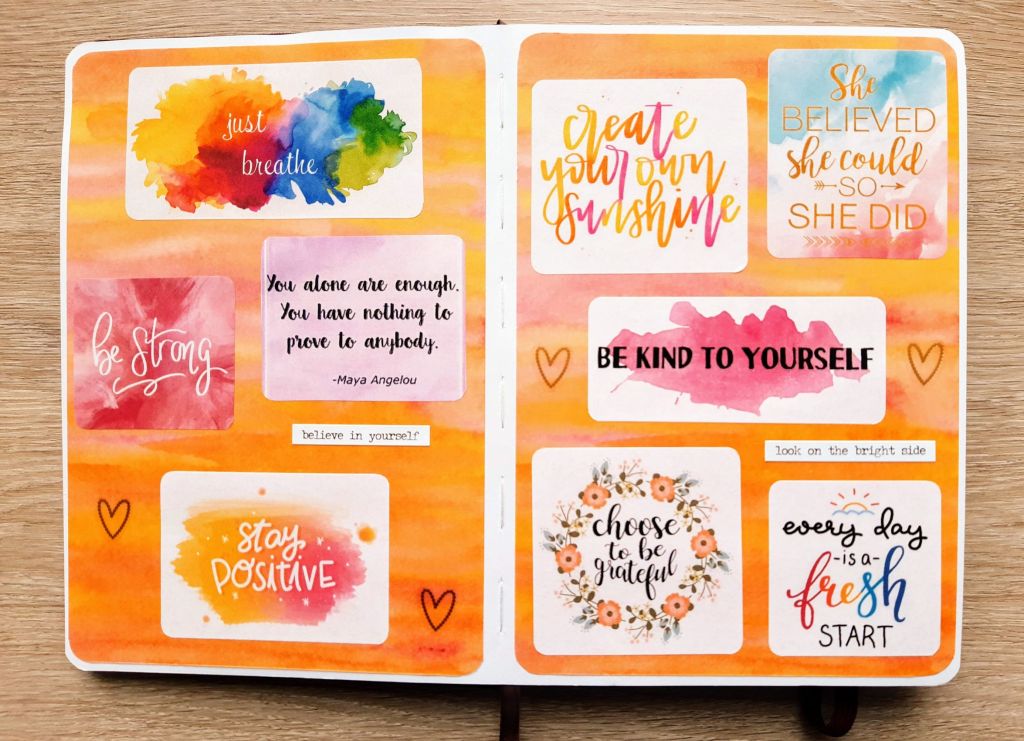
This month, I moved into a new bullet journal – a gorgeous handcrafted linen notebook from Notebook Therapy. The journal is completely blank so I set up the usual index, future log and grid spacing cheat sheet. Then I decided that I wanted to create a spread which was full of messages of support and encouragement to help me whilst I’m struggling with my mental health. The idea is that I read all of the positive content each morning a bit like you would a list of affirmations. It took me quite a while to make but I’m really pleased with how it turned out so I thought I’d share the results on here and talk a little about the process.

Creating the background

A watercolour wash

I wanted something bright and cheerful for the background so I decided to create a wet on wet variegated wash using just two of my Winsor & Newton Cotman watercolour tubes – cadmium red and gamboge yellow hue. I used an A5 piece of Aquafine smooth paper and taped the edges down so I got nice clean lines. After coating the paper with water, I swished the first colour back and forth from the top to the bottom, leaving gaps between the paint strokes. I then did the same with the second, filling in the gaps but also sweeping over the first colour slightly so that they nicely blended together. I was really pleased with the effect I achieved. When the paint was dry, I removed the tape and then scanned the piece in using my printer/scanner. I then printed it off twice, trimmed the papers so that they would fit perfectly in my bullet journal and stuck them in using double sided tape.

Finding the supportive messages

When I’d created my backgrounds and stuck them in, it was time to find some messages to stick on the pages. I spent a while thinking about what I’m struggling with at the moment and some words of positivity that I could focus on. So, for example, I’m being really hard on myself and self critical so I chose a ‘be kind to yourself’ message and a quote about being enough. Most of the images were found online by typing them into an image search (a lot of them are actually phone wallpapers cropped to size). I also got a few from a Tim Holtz Small Talk idea-ology sticker book but you could just as easily type onto plain paper and cut and stick them. I created a MS Publisher document to add the images to and cropped them and altered the size until they would all fit into the double page spread. I then printed them onto an A4 sticker sheet to make it easier to stick them in but you could easily use an A4 sheet of paper and cut them out using a paper trimmer.

What you choose to put in your spread or board would depend on the particular difficulties you’re facing. For example, you might need some confidence boosters, help with dealing with anxiety, messages to encourage you to manage your depression or some little reminders about positive body image and loving the skin you’re in. Here’s some ideas to get you started:

Confidence boosting – You’ve got this. You’re more powerful than you think. Inhale confidence. Exhale doubt. Believe in yourself. Self confidence is a super power. Once you start believing in yourself magic starts happening. I can and I will.

For dealing with anxiety – Everything is going to be alright. I can’t control everything and that’s okay. I am stronger than my struggles. Just breathe. My anxiety does not control me.

Managing depression – I am strong. I can get through this. Life is tough but so are you. Keep going. I’m enough. Stay positive. Choose to be grateful. Think positive and positive things will happen. Everything’s going to be okay.

Body positivity – Happy, beautiful and strong. Your body loves you. Love it back. My body. My goals. My happiness. Be kind to your body. All bodies are good bodies.

Final words

I made a spread in my bullet journal because it’s somewhere I look every day. However, if you’re not into bullet journaling, you could just as easily create a board out of a piece of coloured card to go up on your wall or some other place to look each morning. As an alternative to searching online, you might choose to use post it notes to write messages to yourself or cut small pieces of paper and use brightly coloured pens for your reminders. The most important thing is to make sure you look at what you’ve made frequently so you can try to take on board the supportive statements.

I hope you have found today’s post interesting and it’s inspired you to have a go at creating a similar ‘Words of encouragement’ spread. Let me know in the comments what you think you would benefit from telling yourself each day.