Earlier this month, I ordered a beautiful Notebook Therapy journal that has black linen covers and a falling star pattern to the front. Unfortunately, despite ordering over two weeks before February, it is yet to be dispatched. A few days ago, my husband suggested I should order a BuJo from the UK as I have just a few pages left in my current one. I did lots of research, and in the end, I went back to a brand which I have previously used, namely Scribbles That Matter. Since my last experience of using a STM journal, they’ve made some changes to their dot gridded notebooks so I thought I’d share the one I chose and discuss some improvements that have been made.
My new notebook in ‘Pink’ colourway with teal as a contrast
Ordering, delivery and packaging
I checked out both the STM website and the stock which they hold on Amazon, both offered free delivery but I decided that Amazon might dispatch slightly quicker, so I ordered from there. My notebook arrived within a few days and, due to minimal packaging, it fit through the letterbox (which was great as it arrived when we were both out).
As before, there were several choices of faux leather cover (AKA vegan leather), the iconic which has an embossed design and the plain pro version. Since I last ordered, they’ve also added other options such as a vintage version which it looked like they were selling off.
Over the years when I purchased STM notebooks, they seemed to often be changing the GSM (thickness and weight) of the paper to try to suit different customers needs. Now, I’m pleased to say, they offer 120gsm if you prefer thinner paper, and 160gsm if, like me, you like thicker paper with no bleed through and the ability to lightly use watercolours.
Various sizes of notebook are also offered including A5, B5, A6 and B6 but I have only ever order the A5 size. I’m pretty sure the quality would be the same but I noticed that the A6 and B6 are only available in the lower (and therefore thinner) GSM paper. The company also offer a large array of colours so there’s plenty of choice. However, I’ve come to like the little subtle motifs on the front of the Notebook Therapy branded journals so I shall miss that.
When I ordered a few years ago, STM were packaging their notebooks in ridged plastic and I believe a thin shrink wrap as well. Now, I’m pleased to say they come in a cardboard sleeve which I presume could be recycled. This is obviously much better for the environment.
The cover
I’ve always gone for the plain cover of the pro version of the notebook so I can only comment of the features of this one but I noticed that the only slight change is that it now says STM. at the bottom of the spine, whereas before it said SCRIBBLES THAT MATTER in the centre. This makes the branding much more discreet. The quality of the faux leather is still, in my opinion, great and, although it will probably get a few marks on it with use, this does not detract from the product. It’s also easy to wipe off any smudgy marks with soapy water.
The notebook stays closed with a vertical elastic band and there is a handy pen loop to the right hand side. A 0.4mm nib fineliner is included in the pen loop but I haven’t tested the quality of it yet. This size nib is new to me as I currently use 0.2, 0.3 and occasionally 0.5 Pigma Microns.
Interior design features
The notebook still has two ribbon bookmarks in colours which match the cover and elastic closure and as I’ve never had any of them become detached, they must be pretty secure (unlike my Notebook Therapy ones which have both come out this time!). There is again an expandable pocket to the reverse which I like to put stickers and receipts in, plus a sheet cut from the back so I can cut bits to cover larger mistakes.
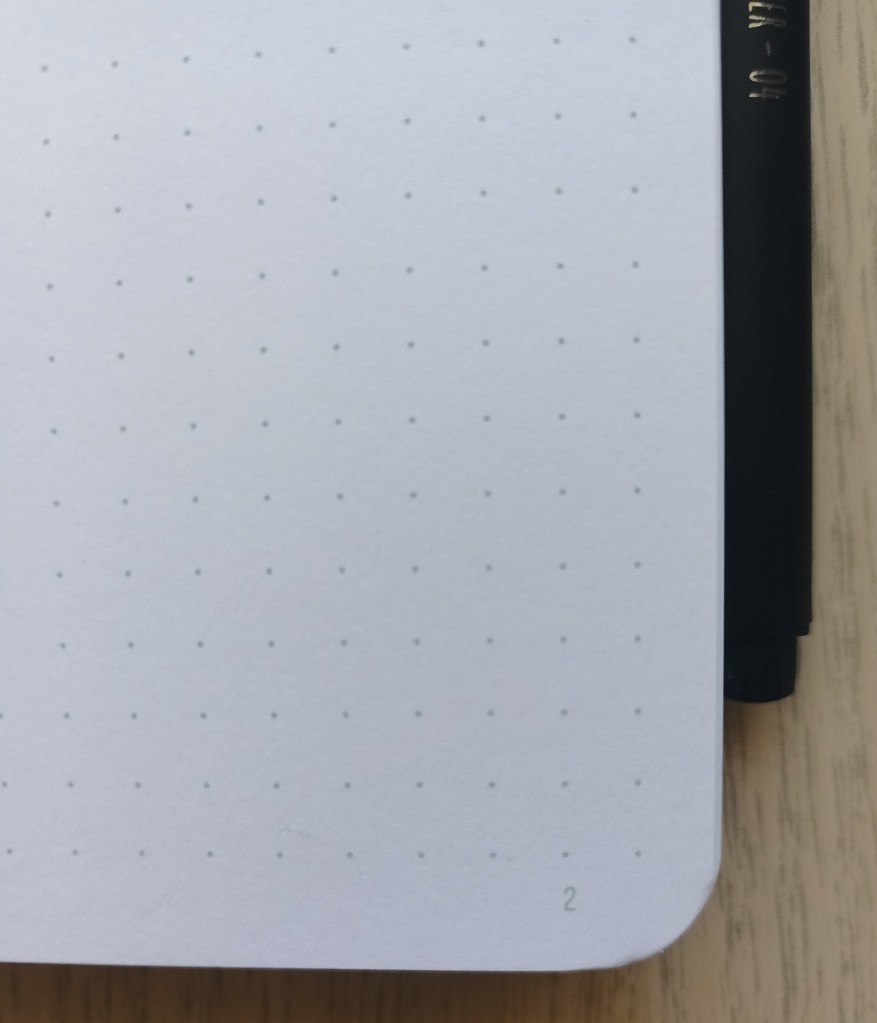
The page numbers are still small and subtle and I like the fact that the pages are numbered as this is not a feature of the NT journals. The dots go right up to the left and right of the page and are a subtle grey. There’s a slightly larger blank space at the top of the page and larger again at the bottom so the page number isn’t in the dot grid space.
5mm dot spacing with subtle page numbering
The paper is white in colour which I prefer to some other brands which have cream or off white pages. This is obviously just my personal preference but it is worth noting. STM say that there should be no ghosting or bleed through on the thicker GSM paper which suits my needs, but again you may prefer a thinner, lighter journal with thinner paper if neither of these issues bother you.
On the inside of the front cover, there’s a pre-printed bullet code page which is useful if you’re new to bullet journalling and need a hand reference. Or, if you want to change up your system. I’ve been using the same ones for years so I will probably cover it over with a motivational quote or something. Next is the name plate page with just has three relatively short lines on which you could write your full name and the date you started your notebook. There’s then a double page which is blank except for a footnote explaining the notebook style and size – A5 dotted and the paper thickness – 160 GSM. There are then 4 indexing grid pages with a blank space for you to write your own title. At the end of the book, there are two pen test pages, although one leaf is much thicker than the other so it’s not really a fair test to explore ghosting and bleed through. Personally, I would prefer the journal to be without these printed pages but they’re ideal for those who are new to bullet journal planning.
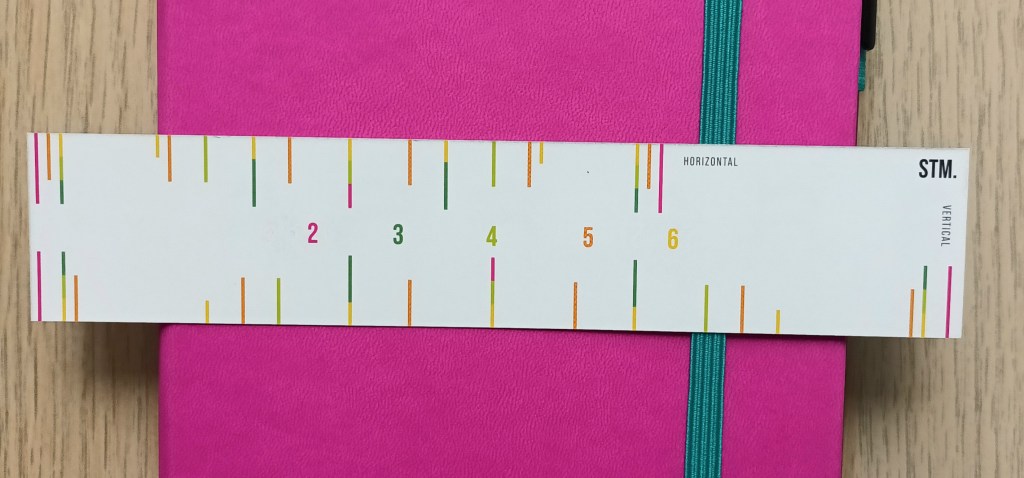
Inside the notebook is a little grid spacing ruler which is new. You can use it horizontally or vertically and it splits the page into 2, 3, 4, 5 and 6 using colour coded divisions. This will probably prove to be a useful addition which just fits in the back pocket.
Handy grid spacing ruler
Final words…
Overall, I’m really pleased with my new journal but I am disappointed that I had to source another notebook as I was looking forward to receiving my Notebook Therapy one. I have emailed them to enquire about what is taking so long but I received a standard reply advising that it may take up to three days for them to get back to me with a personal response. If you’re new to bullet journalling and looking for a quality, mid-price notebook which is made in the UK, then I totally recommend Scribbles That Matters. Any issues I had or questions have been responded to straightaway and I know they have a 100% satisfaction guarantee so that they continue to have very happy customers.
If you have any further questions about the A5 Pro Version journal, feel free to drop them in the comments and I will try my best to answer them.
It’s been over two months now since I bought a countdown timer from Amazon to use for the Pomodoro Technique which aims to increase productivity. I already felt that I got plenty done each day but I loved the idea of breaking down work into intervals, having regular breaks and knowing how long I’d been hard at it for. I’ve been consistently using the time management method, apart from a week off for Christmas and I thought I’d share what it is and how I feel it’s helping me.
Those of you who have never heard of this technique may be wondering if it is named after a particular person, but you might be surprised to know that pomodoro is actually Italian for tomato. What does a tomato have to do with productivity? Read on and you’ll find out!
What is The Pomodoro Technique?
The Pomodoro Technique is a time management method which was developed by Italian Francesco Cirillo in the late 1980s. At this time, Cirillo was a university student and was struggling to stay focused on his studies. He challenged himself and posed the question ‘Can you stay focused for two minutes without distraction?’. To check if he could, he grabbed his countdown timer from the kitchen which was red and shaped like a pomodoro, or, in English, a tomato. He set the timer, and after two minutes of focused activity, the timer rang and he had achieved his mission. After this, he considered why the use of a timer had worked and he experimented with gradually upping the time and reducing it when it became too much. In the end, he decided that 25 minutes was perfect and that a short break (5 minutes) was required before continuing.
Cirillo carried on experimenting and came up with some basic principles. The timer was an important part but only one element of the method. He suggests the following:
Pick one task you want to work on.
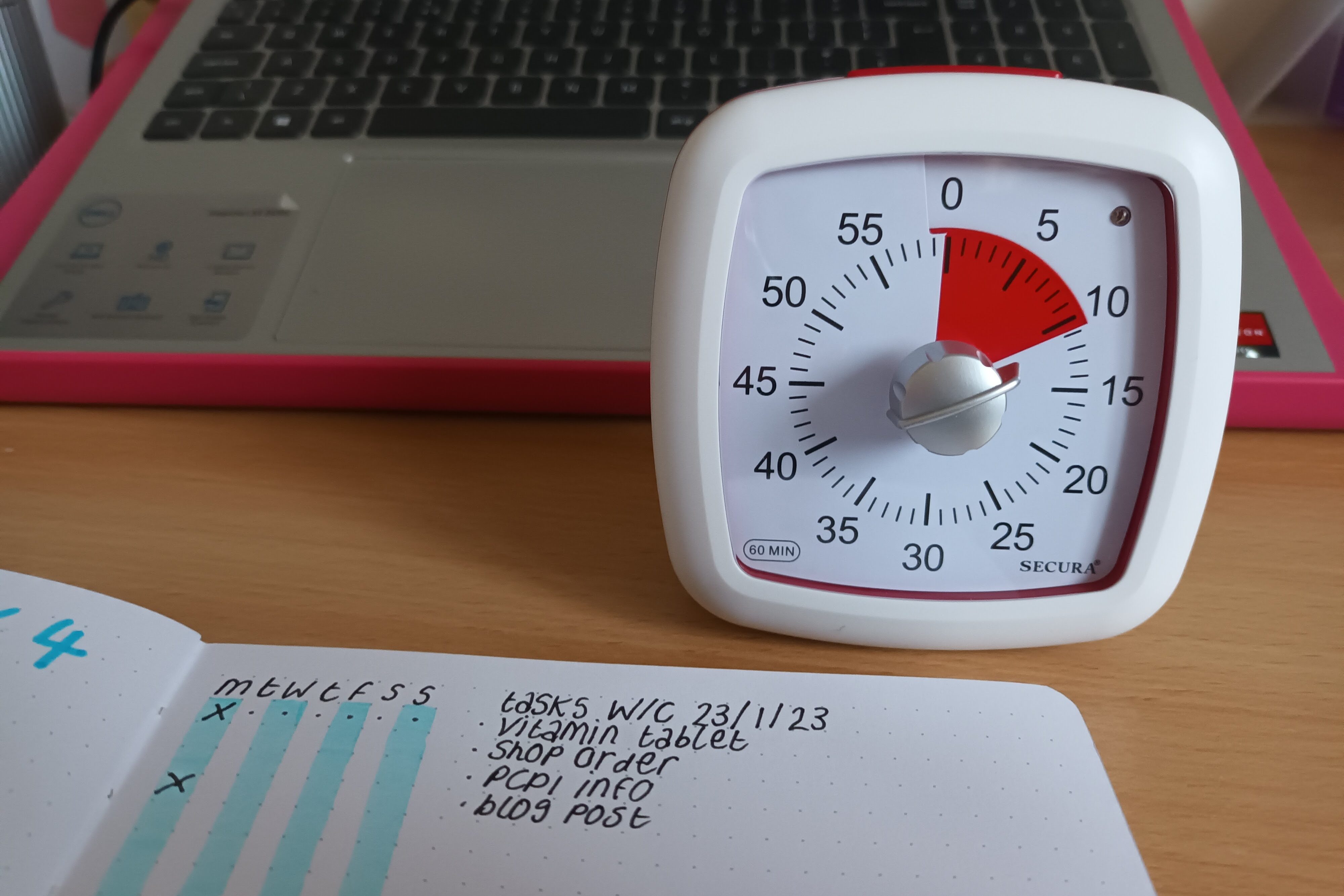
Set your timer for 25 minutes and place it somewhere highly visible (so you can see how much time remains).
When the buzzer goes off, have a 5 minute break.
Repeat this with 3 more periods of 25 minutes and 5 minute breaks.
Mark each pomodoro with an X when you’ve completed it (this could be on a mini whiteboard, a post-it note or in your planner.
After 4 ‘pomodoros’ (work periods of 25 minutes and 5 minute breaks), take a longer break of 20-30 minutes.
Once your longer break is finished, go back to step 1.
But what if I have a really long project or lots of short tasks to do?
For complex projects, you should break things down into smaller actionable steps. This will help you avoid overwhelm and ensure you make good progress towards your end goal.
Any tasks which will take less than one pomodoro should be combined with other quick tasks. This might include a range of admin such as book a hairdressers appointment, reply to an email, making a shopping list for the supermarket and reviewing your bank statement.
If you finish your chosen task before the pomodoro timer rings, you should continue to use the rest of your time in a productive manner e.g. by going over what you’ve just learned, making a list of next steps, reading up on a related topic etc.
What should I do during my 5 minute breaks?
When the timer goes off, it’s sometimes tempting to continue working, especially if you’re in a flow state. However, taking breaks is really important if you want to stay productive. What you do during your short breaks is up to you but here are some suggestions that you might find helpful. For me, taking time away from screens such as my computer or my phone is super important and gives my eyes a good rest.
Do a short guided meditation
Get out in the garden and reap the benefits of fresh air
Do some stretches
Put on an upbeat track and dance about your kitchen / living room or anywhere with some space to move
Take a quick walk for a serotonin hit
Drink some water, squash or a flavoured tea
Sit in a comfy chair and read a good book
Do a mindful activity such as a spot of doodling, a word puzzle, jigsaw or some colouring in.
Listen to some music – trying closing your eyes so you really tune in.
Watch birds in your garden.
How is the Pomodoro Technique working for me so far?
So far, I’ve found the method to be incredibly effective. I bought my timer hoping that it might help in some small way but I didn’t realise how beneficial it would be as it’s such a simple idea. Here are some of the advantages I’ve experienced so far:
Makes it easy for me to get started. When you have a big project to do, it’s easy to get overwhelmed by its size and this can often lead to procrastination AKA putting things off. Contrary to popular belief, for most people, procrastinating is less about laziness and lack of self control, and more about fears of failure or feelings of self doubt. Knowing that I can do things in baby steps where I only have to do 25 minutes before being allowed a break is all the encouragement I need to get started.
Increasing my awareness of time. Using the timer makes you really aware of time going by and this encourages you to really focus in on your chosen tasks.
One thing at a time. The method encourages you to work on one specific task or a group of related tasks at one time and this helps to prevent the urge to multitask or context switching (where you jump from one task to another) which studies show is detrimental to productivity.
Great for avoiding distractions. In some ways, 25 minutes feels like plenty of time but if you don’t use it wisely, it can soon be gone. Because of this, I’ve taken steps to avoid anything which might interrupt my work flow. Depending on the type of work I’m doing, this might include putting my mobile phone in another room, adopting pen and paper methods for recording, switching off notifications and playing background music to block out other sounds.
Encourages me to plan my day. Before you start work, you’re encouraged to plan your tasks in advance. This helps you to decide what you want to get done, at what time and how long you think an activity is likely to take. At the end of your working day, you can evaluate your progress and consider if you overestimated or underestimated how much time tasks took. This can then inform your future planning.
Ensures I take regular breaks. Taking regular mental breaks from your work helps you to stay focused and remain efficient and productive during your 25 minute time blocks. If you’re working at a desk, it’s really beneficial to get up and move around as this improves your circulation and helps to combat fatigue.
Helps me maintain motivation. Seeing the time counting down on the timer in front of you is great for ensuring you work at a good pace. Also, after each session, I mark my progress in my bullet journal and this in itself makes me feel good and gives me the encouragement I need to keep going.
Encourages me to be self-evaluative. On days when I feel like I haven’t been super productive, despite using the Pomodoro Technique, I always question why. Common culprits include distractions from notifications or social media (especially if I’m researching something online), working in an untidy environment (meaning I can’t find things I needed) not taking my 5 minute break (or unconsciously extending them), deviating from my plan when I get back to work (because I found something else much more appealing, or when taking a break, engaging in something which didn’t allow me to relax and recharge (e.g. reading news articles online). When I’ve established what the issues are, I can develop strategies to combat them.
Final words…
I hope you have found today’s blog post useful, especially if you are looking for ways to beat procrastination, become more time savvy, and generally work more productively each day. If you want to know even more about the Pomodoro Technique you will find Francesco Cirillo’s book available in e-book format or paperback on Amazon. Also, feel free to ask any questions you may have in the comments and if you already use the Pomodoro Technique, let me know how it’s working out for you.
A few days ago, I watched a YouTube video from content creator and maker Emma at Plan Inspire Create. It was all about selecting a word of the year, thinking about different meanings for the word and setting some intentions for the year based on the term. As I was watching, I was aware that we are almost half way through January, which might seem a little bit late for such an activity but, then I thought about the fact that there are still eleven and a half months remaining, so plenty of time to set intentions and live by the selected word. Today I’m going to share tips for choosing your word and ways in which you can set aims with regard to different aspects of your life. I’ll share my word of the year and the bullet journal spreads where I explore the term in depth.
Choosing your word
Personally, my ideal word, ‘create’ popped into my head straight away and I was brimming with ideas to bring into fruition. However, if you’re in need of some inspiration, you may want to look at lists and select words which seem appealing. A good way of doing this is to pop on Pinterest and search ‘Word of the Year’. It’s important not to rush the process as there are likely to be a number of words which resonate and feel like they might be the one. When I need help deciding, I create a list of words which have potential and then take time to consider each one before making my choice.
After choosing my word, I used letter stamps and one of my new embossing powders (which I got from my lovely friend Bev) to create shiny letters which I then cut out individually. I also used smaller letter stamps to create a ‘Word of the year’ title. These are going to be used in a dedicated bullet journal spread where I explore what the word means and my intentions for living by it. This will create a record which I can refer back to regularly. I’ve already shared my vision board for the first quarter of the year and this shows some of the ways I’m focusing on being creative too.
Look how many times I used my chosen word in the above paragraphs and you’ll see why I selected it!
Considering different meanings of your word
Emma recommended a website called WordHippo which has a ‘thesaurus and word tools for your creative needs’. I found it really useful for considering different meanings for my word and synonyms too. I copied down the particularly relevant definitions/contexts and also made a note of similar words to use in my BuJo spreads. I was amazed by how much information I took from the site.
Create
To bring into existence
To design with a new shape or form
To be creative or imaginative
To start or establish
To cause or bring about through action
To take the first step into something
I created a list of synonyms and used Word It Out to make a word cloud:
I love creating word clouds and I like to print them and stick them in my bullet journal.
Setting some intentions relating to your chosen word
To help you set intentions you can refer to the segments of The Wheel Of Life or The Wheel Of Wellness as your categories or create your own based on the areas of your life that you feel need most work. I decided to combine ideas from both wheels and create a few of my own titles. The following should help you with setting up yours based on your chosen word. You might also find information from WordHippo useful too.
Health and fitness
Continue to eat a balanced diet, keep up with getting plenty of active minutes each day and maintain a good sleep routine so that I have plenty of energy for creative persuits.
Practice self care to maintain good mental health e.g. engage in mindful activities and find ways to relax each evening and on weekends.
Financial
Set aside some money each month for creative projects.
Try to use the craft materials I already have rather than buying new things.
Continue to make myself available for PCPI work so I have income to use for creative resources.
Family and friends
Meet regularly with Bev so we can share the results of our creative endeavours, celebrate our achievements, offer praise, encouragement and ideas.
Contribution / giving
Post regularly on my blog sharing motivational and inspirational content related to my bullet journal, living your best life and being productive
Continue to consider how I’m making a difference to the students I work with – find ways to record experiences in my journal
Physical environment
Make tidying and organising my craft room a priority so I know where materials and tools are and have room to work on creative activities.
Use my garden journal to identify tasks for the different months, record new plants and include photos to document changes over time.
Social connection
Create opportunities to connect with others through shared passions e.g. animal welfare, nature, crafting, blogging, fitness, bullet journalling
Be open to all types of PCPI work and consider how my roles are helping others in their chosen profession
Passion
Continue to choose a highlight for my day so that I have dedicated time each week to focus on journalling, blogging and particular creative projects I’m currently working on.
Make time to regularly think about my progress towards goals and how I am living my life in a way that reflects my word of the year and my personal values.
Emotional
Create balance between the different aspects of my life and regularly check in with how I’m feeling.
Remember that my energy levels are lower at certain times of year and ensure that I don’t take on too much to retain emotional wellness.
Assess how I’m coping with changes and any challenges.
Marriage
Find opportunities for new experiences with my husband. Harness the power of firsts to create happy memories together.
Find a different vegetarian/vegan recipe each week and enjoy the experience of creating dishes together in the kitchen.
Final words…
I hope that today’s blog post has been helpful and encouraged you to take steps to create a life you love. If you prefer to work with images more than words, you could even create a vision board of pictures which represent how you would like to instill your word of the year. Let me know in the comments if you’ve chosen a word for 2023 and what it is.
I’ve created quite a few vision boards over the last few years and some of them have worked better than others. Often, I find I have manifested some of the things I’ve visualised for myself, whilst other dreams have been forgotten or have not totally come into fruition. Before I create a new board in my bullet journal, I always reflect on the previous one, thinking about which of my desires and goals have been met, which I’ve made progress towards and which either didn’t come true or are no longer in line with what I want for my life. Today, I thought I’d share some of my best tips for creating a vision board and ways in which you can use yours as an effective tool for manifestation.
What is a vision board?
In brief, a vision board is a visual representation of goals you want to work towards to create your ideal life. This can include inspiring images, text which states what you desire for yourself and also messages to yourself such as affirmations and motivational phrases and words. Vision boards can be created in a range of different formats and some of these are discussed a little later.
What do we mean by manifestation?
Put simply, manifestation is the act of materialising or bringing into fruition you deepest wishes, desires and dreams, so they become your true reality. So, for example, you might wish to be a more organised person and this could be shown in your home and work systems, the way you manage your time, the plans you put in place, your goals and priorities, your decision making skills, your self awareness and ability to evaluate your situation etc. There are a number of ways of manifesting the above and creating a vision board can be a really geat tool if you use it properly and effectively.
Where to begin
Before you even start creating your vision board, you need to get clear on what you want to prioritise for yourself right now and in the future. A good way to do this is to schedule some time to quietly think about and evaluate your current life with a view to considering plans to work towards a few goals and small changes that will help you on your way towards your dream life. The following journalling prompts and questions which I’ve collected from a range of sources and created myself will encourage this. You don’t need to answer them all, but they should help you orientate your thinking and ease you into contemplation, evaluation and reflection mode. I recommended writing down some or all of your responses (preferably on paper rather than using a tech device) as part of the process because this enables you to slow down and carefully consider things.
What did I do last year that made me happy? Why did these things make me feel this way?
In which ways was I successful in 2022? Which goals did I meet? How did I effectively deal with problems which came my way?
What was my greatest accomplishment of the year? How has thinking about this helped with my self worth and feelings of purposefulness?
What challenges did I face last year? What did I learn as a result?
What kind of self care activities did I regularly engage in? (if any) Which of these would I like to continue with or do more of? Which new self care activities might I like to try in 2023?
What did I spend too much time and energy on in 2022? As a result, what would I like to do differently in 2023? How might I go about this? Do I need to learn something new or create some sort of plan of action?
What is a new skill I learnt last year? Which skill / skills would I like to learn or develop in 2023?
Name 5 of your core values e.g. positivity, helping others, social connection, looking after the environment, growth, adventure etc. Am I living in alignment with these? What changes would I like to make in relation to my values and beliefs?
Do I feel in control of my life right now or do I feel like others are controlling it for me? Are there any changes I wish to make as a result of my answer?
When do I feel most fulfilled? Why?
What do I want to leave behind in 2022? This could be anything – an attitude, a toxic relationship, poor self image, negative thinking, lack of self compassion, saying ‘yes’ when you really want to say no, being overworked and underpaid etc
What do I want to take forward into 2023? (What do I want to continue doing? How do I want to continue being? Which goals do I want to continue to work towards? etc)
What new practices / attitudes / ways of being / skills etc do I want for myself for 2023? How might I implement these? (e.g. do some self development reading, work with a therapist, change up my routines, attend a class or do some distance learning, place more emphasis / importance on something etc)
What limiting beliefs am I holding on to? Why? How can I work on changing my beliefs about myself / others / the world? (This might be something that you need help and support with, in which case, seeking out therapist or life coach can be really helpful)
What does success look and feel like to you? Why?
If you change one thing about your working life to make it better, what would it be? What impact do you feel this would have?
How do you respond to criticism? Do you feel this is helpful / unhelpful or could be improved in some way?
What qualities do you admire in other people?
Is there a skill you have always wanted to master? What could you do to make a start with this?
What bad habits would you like to break?
What new habits would you most like to instill?
What would you like to be doing in 5 years time? Why?
Who could support you in working towards the different goals you are considering?
Another activity which you might like to try is filling in a ‘wheel of life’ or ‘life balance wheel’ to assess how balanced the different aspects of your life are. There are lots of resources online for this, including blanks which you can print off. Commonly used categories are:
Career / business
Health/fitness
Spirituality
Fun & recreation
Finances
Giving / contribution
Personal growth and development
Significant other / marriage / romance
Physical environment (home/office)
Family & friends
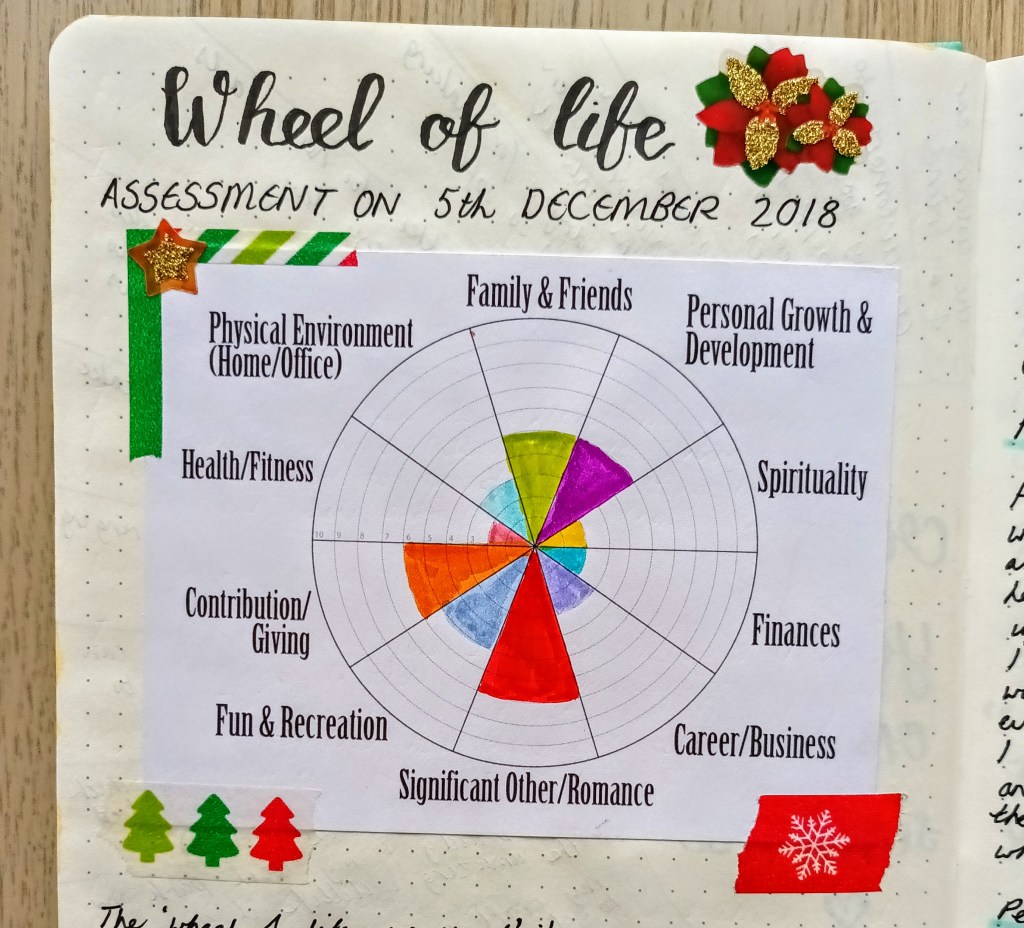
The category names can be tweaked to make them personal to you, so, for example, I would have marriage as a category, would choose business rather than career and have physical environment labelled with home / workspace. The idea is that you evaluate the aspects and give yourself a score out of 10 for each. This is mine from 2018 and it’s amazing to see how things have changed for me since then.
My wheel from the end of 2018 which I found in an old Bullet Journal
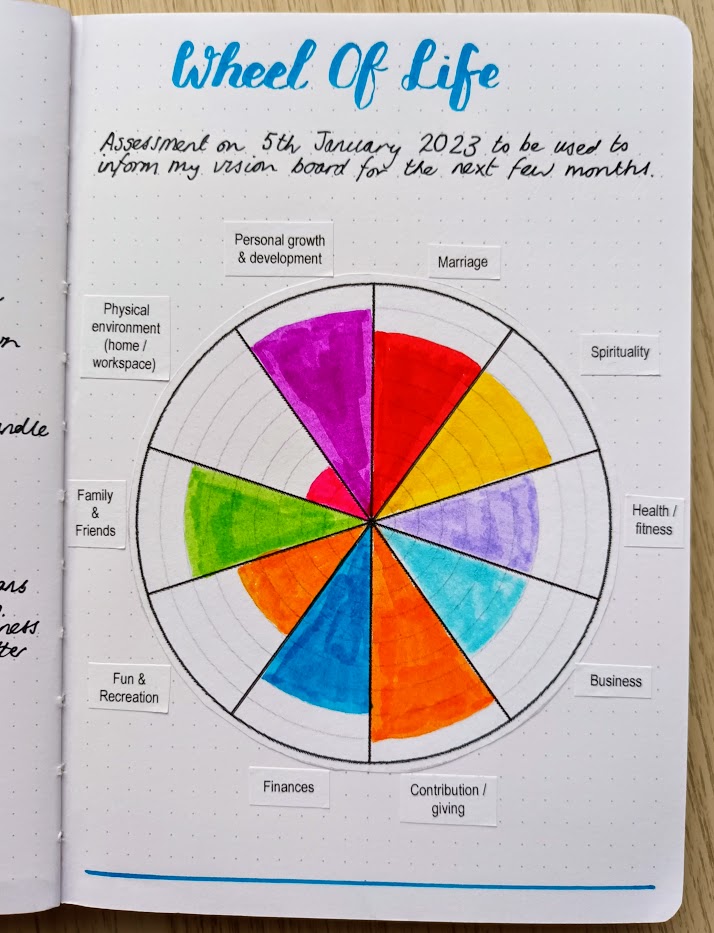
My new Wheel of Life!
When you’ve finished your wheel of life, you should see some categories that might benefit from a little bit (or a lot!) of work in order to level them up. For example, in mine, upgrading of the physical environment part of my life is my priority and I’m going to start with the part of my home that I spend most time in.
Personally, I prefer to work on tweaking things for the better rather than having grand ideas which are miles away from my current life. So, for example, if one of my current desires for myself was to have a healthy body and mind, I would think about things I could put in place to work towards this with small and achievable being the key words such as exercising for 30 minutes each day, making sure I eat at least 5 fruit and vegetables, having a balanced plate for my meals and doing at least half an hour of mindful activity each afternoon or evening or scheduling in other regular self care activities. This makes more sense than choosing what for me would be unreasonable goals such as losing loads of weight (unmeasurable), being a size 8 (not going to happen anywhere in the near future if ever,), eating a diet with no foodie treats (unmanageable) and spending two hours in the gym every day of the week (too high expectations).
One little word
Another idea you could try is to use a word to orientate you for the year / month / quarter. This was a tradition coined by Ali Edwards and is described on her website as ‘a word to focus on, to live with, to investigate, to write about, to craft with, and to reflect upon as I go about my daily life’. There are literally hundreds of words you could choose and if you want some inspiration, you’re welcome to check out my Pinterest board.
Vision board format
There are lots of different ways of making a vision board and some may be more appealing to you than others, so start asking yourself a few questions about what would work best for you and would be highly visible each day. Ideas include:
A vision board Pinterest board on your computer
A large A3 / A2 wall display which can easily be seen in a room of your choice
A collection of pictures and words added to a blank page in Canva and then used as your desktop on your personal/work laptop
Pictures and words surrounding the mirror where you do your hair/make up each day
An A4 sheet stuck onto your fridge with a magnet
A double page spread in your notebook or bullet journal
Whatever style you choose, it definitely needs to be one that you’re going to look at on a daily basis. It’s no good creating a vision board in a beautiful notebook and then placing it on a shelf to collect dust – that’s not going to help you manifest anything!
Collect your words and pictures
When you’ve become clear about what you want for yourself right now and have decided on an appropriate format, you can start to collect images and words which reflect this. There are a few different ways you can do this – you could get together some wellbeing related magazines, flick through them and cut out words and images which resonate or you could use Google or Pinterest and search for words and images related to your core values and ways of living you want to move towards. So, for example, if you want to increase the time you spend outdoors in nature, you might search for ‘woodland’, ‘outdoors’, ‘countryside’ or ‘walks in nature’ and then collect images that are the most visually appealing to you. I find it’s best to choose one image and a few words to represent each of your visions. You could even add an affirmation for each such as ‘I am a tidy and well-organised person’, I always take time to look after myself’, ‘I can do anything I put my mind to’, I dream. I believe, I receive. Personally, I like to type out words and phrases on my laptop, but an alternative method is to use letters and phrases from magazines in a kind of ransom note style!
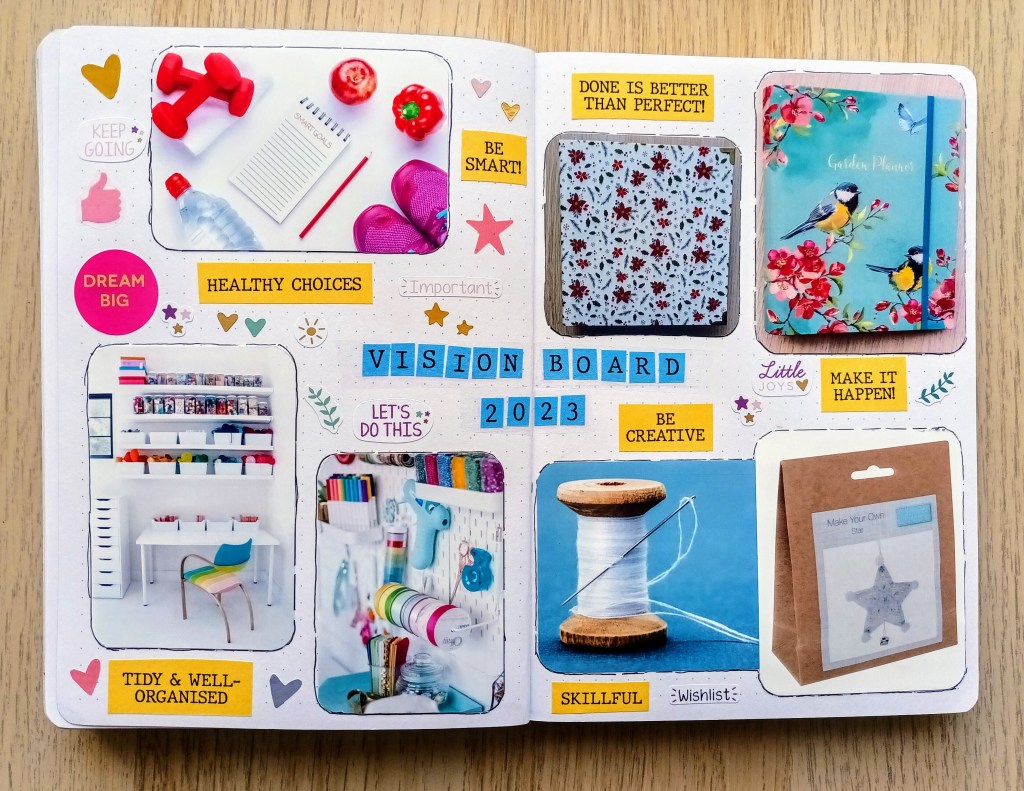
Whilst collecting your words and pictures, try to avoid picking too many things to work on as this is the fastest route to overwhelm and lack of clarity. For my last vision board, I chose just five things to work on and a few mindsets which will help me progress. I selected two motivational images for ‘tidy and organised’ as this is my number one priority and what I want to spend the most time on. As you can see from my vision board at the start of today’s post, I print my photos on glossy photo paper (using my Canon Selphy) and try to choose images which really pop and little bits of décor here and there to try to make my board attractive to look at. If you love the way your vision board turned out, you’re much more likely to want to look at it every day and it’s more likely to inspire you to take action to reach your goals.
A few hints and tips to ensure your vision board works
For a vision board to be classed as working, it needs to be helping to motivated you to work towards your goals and to provide inspiration to keep you heading in the right direction. As I said earlier, I’ve had mixed success with mine through the years and have definitely learnt what helps and what hinders me in making progress. Here’s some tips and tricks which will hopefully help you manifest effectively:
Focus on one thing at a time. Take a look at your vision board and decide which item you are most drawn to right now. This could be something you feel would be easy to implement as a great way to get you started or it could be something which you believe would have most impact. For example, if I had a tidy and well organised craft room, it would certainly make it easier to do my current creative craft project and find and make a start on one of my sewing kits. You can still do things which contribute towards achieving your other goals but try to make one element your priority for the next few weeks or month.
Devote time (at least 5 minutes every day) to look at and think about your vision board. You could also try closing your eyes to visualise what you want for yourself and how you would feel / act / think if a particular vision became your reality. Research shows that visualisation is a powerful tool for manifestation.
Ensure that any goals you set as a result of your vision for the next month / quarter / year are SMART. Make them:
Specific
Measurable
Achievable
Realistic
Timely
Use the acronym to help you flesh out each of your goals and identify some steps to success. This might take a while – another reason why it’s best to work on one aspect of your vision board at a time.
To help you to instill new habits and or break old ones, try reading up on habit formation. I’m currently reading James Clear’s Atomic Habits and making notes on what I’ve learnt but there are plenty of online resources available too.
Schedule in time to reflect on what’s working, what’s not and your progress each week. If things aren’t working, consider why not and then think of new things you could try. How could you increase your progress? Might you need to create smaller steps and celebrate the tiny achievements to spur you on? Will scheduling in blocks of time each day to work towards your current focus help?
Try creating a ‘highlight‘ each day which will lead you towards your goal. This is a method discussed in the book Make Time by Jake Knapp & John Zeratsky and involves choosing a single activity to prioritise and protect in your daily calendar. When you are engaging in activity for your daily highlight, try to rid your space of distractions so you can really focus on the task at hand.
Don’t be afraid to make updates as you go. You can add things, remove things, tweak things or even start again from scratch if necessary. It’s your vision board and if you decide that one of your images just isn’t inspiring you or that a motivational quote someone shared on Instagram is perfect for your needs – make the necessary changes and hopefully reap the rewards!
When motivation does dwindle, go back and look at your journalling that you did at the beginning of the progress and re-read the answers you wrote to particularly pertinent questions. This should provide you with your ‘reasons why’ and help you to get back on track.
Final words…
I hope that today’s blog post has encouraged you to have a go at creating a vision board for yourself which will help you work towards your goals and desires and ultimately work on designing a life which matches your core values and helps you manifest the aspirations you have for yourself. Wishing you lots of success with meeting your goals for 2023.
Happy New Year to all of my readers! Wishing you a fantastic 2023. I’m a bit late sharing my bullet journal pages this time as I only just got them finished. I’ve done a snowflakes theme before, but last time, I did a monochrome version with just my Pigma micron pens. I ordered some new brush and fine nib pens to arrive just after Christmas and there are lots of lovely blues in the set of 24, so I thought I’d try out the fine tips on my January spreads. I hope you like them and as always, if you’ve shared your pages for this month, feel free to link them in the comments.
Cover page
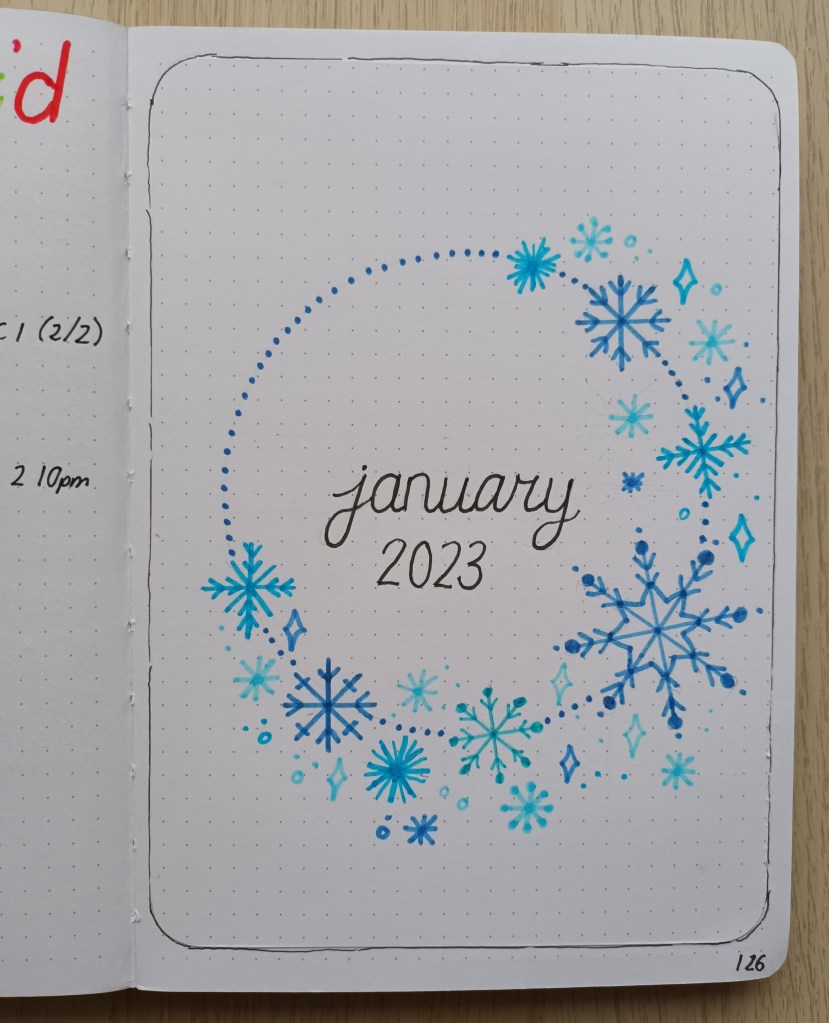
This month’s cover page is heavily influenced by a design from @createmore.se on Instagram. I’ve changed it up slightly by adding sparkles, dots and small circles but the composition is mainly the same. I used my circle drawing tool and, as I messed up the lettering in my notebook, I cut a page from the back using my X-Acto knife, trimmed it down, created the wreath and then stuck it in after I’d finished. I decided to do a rough freehand border around it to make it stand out. My new pens are from the Ohuhu brand and I ordered the mid tone range which has some lovely pastel colours.
Photo credit: Laura Jones for Keeping It Creative
Monthly Calendar
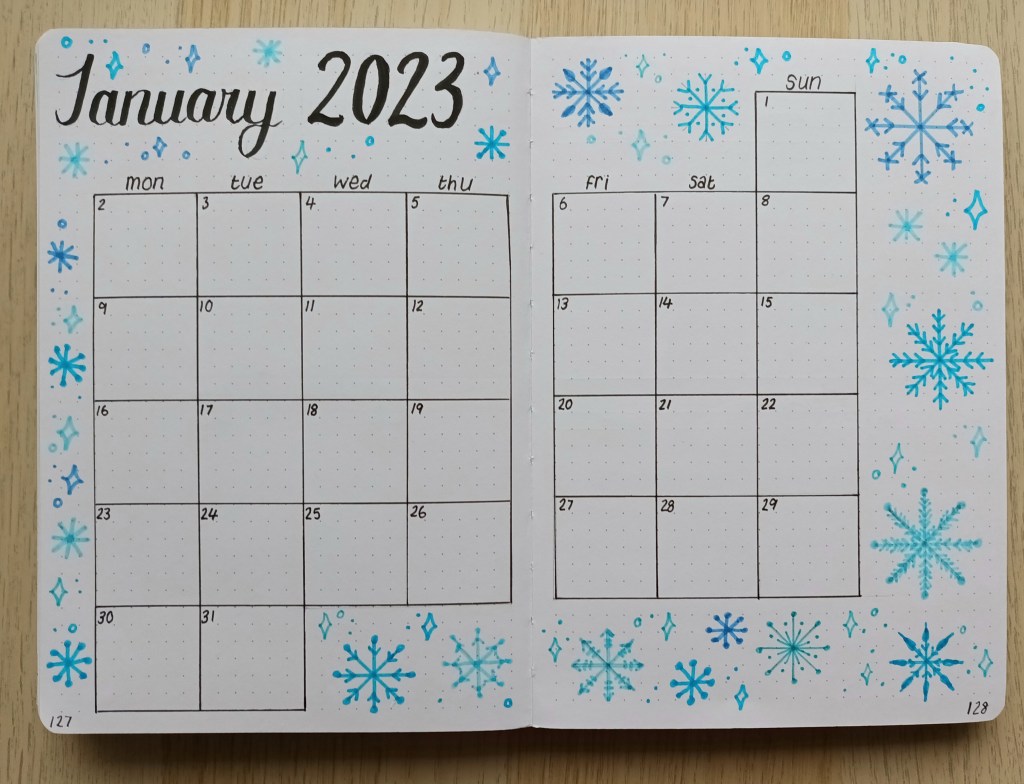
I’m really pleased with how this one turned out. It’s my usual grid layout with different snowflake designs filling the space. It took me a while but it was a nice bit of mindful drawing in the evening of the first of January,
Photo credit: Laura Jones for Keeping It Creative
Finances
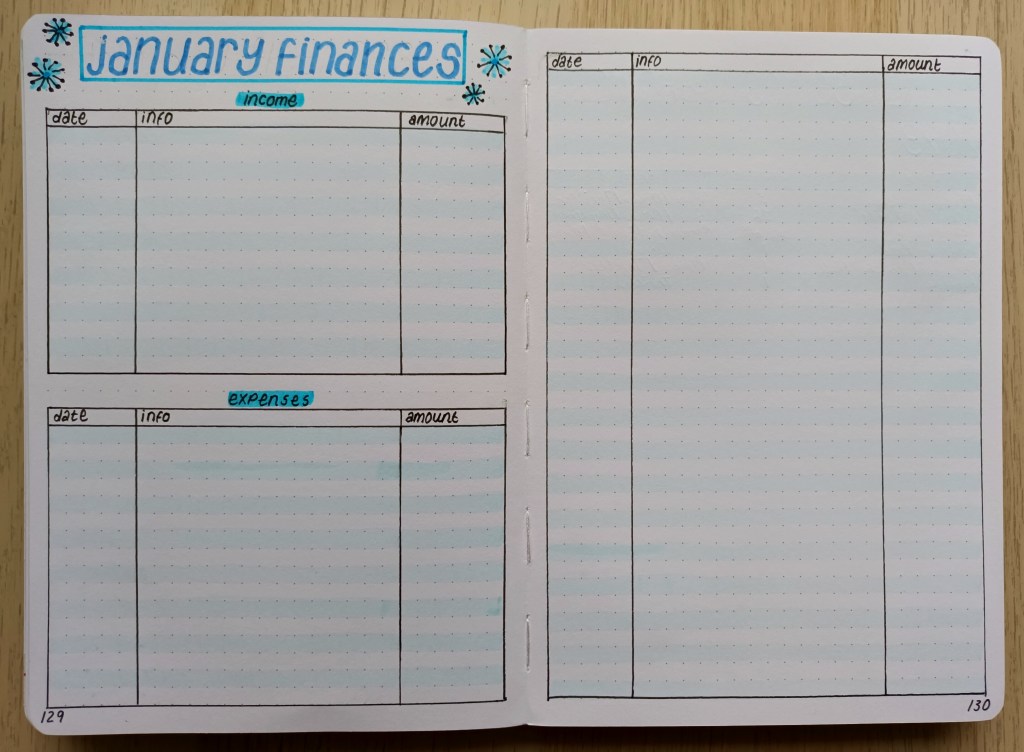
Again, this spread is self explanatory. By the end of last month, my expenses table was completely full – in fact I ran out of space! Hopefully, this month will be a lot lighter on the spending front!
Photo credit: Laura Jones for Keeping It Creative
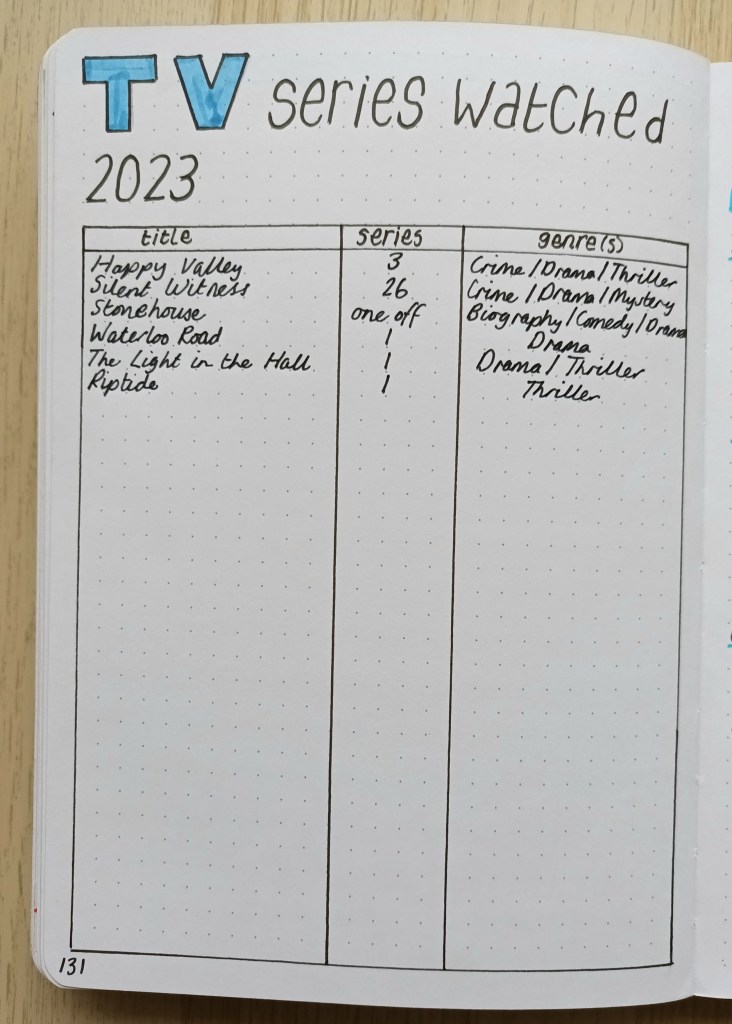
TV series watched
I don’t do one of these each month but my last one ran up until the end of December so I’ve just set up a new one. I like to record all of the different series we watch and the particular genres we enjoy. It’s nice to see all of the things we’ve watched and is a good reminder of what we’ve seen.
Photo credit: Laura Jones for Keeping It Creative
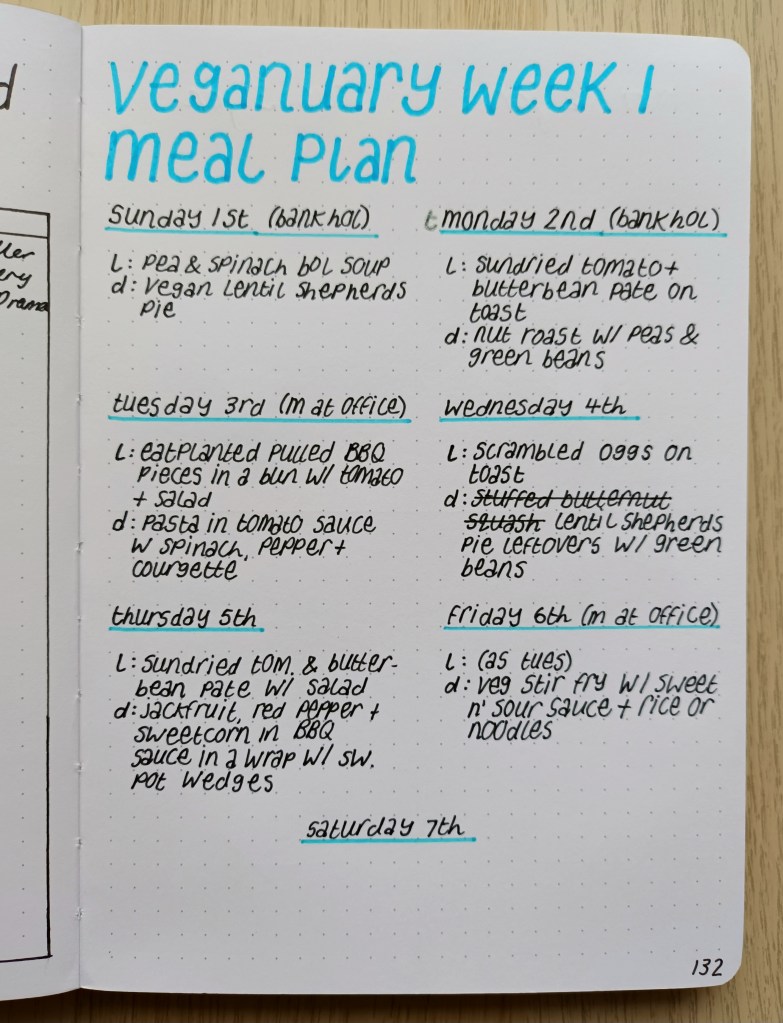
Veganuary Week 1 Meal Planning
My husband and I are doing Veganuary again this year which means we’re eating vegan for the whole of January. It gets easier every year but we still need to do a meal plan each week so that we know what we’re having for lunch and dinner each day. I also find the meal planning pages from previous years really useful. Obviously, this page could be useful whatever your diet but we don’t tend to spend long thinking of meal ideas the rest of the year.
Photo credit: Laura Jones for Keeping It Creative
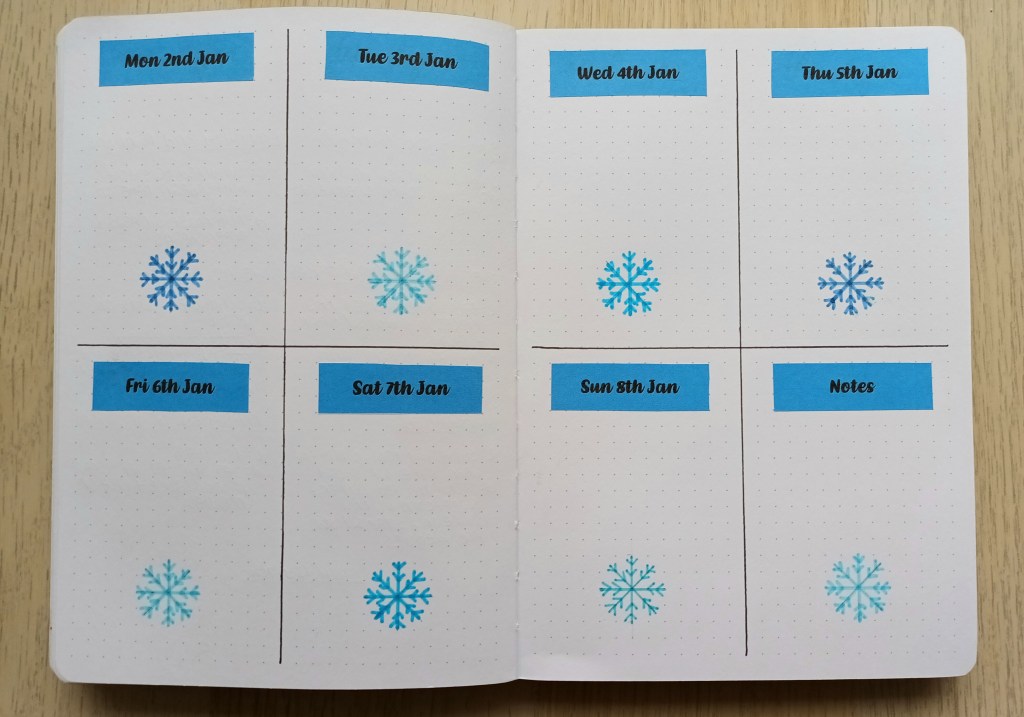
Weekly Plan
This is my first weekly of the month. I used the same snowflake design for each day because coming up with different designs is what took a lot of time for the cover and calendar. I messed up on the spacing for this spread so the bottom columns are one dot space shorter than the ones at the top but it doesn’t bother me too much as I tend to write less at the weekends anyway.
Photo credit: Laura Jones for Keeping It Creative
Final words…
That’s all of the spreads I’ve drawn up so far. I have my running task list to set up this morning which will go on the page after my weekly plan and I will of course be doing more meal planning spreads and weekly plans over the weeks. I hope you’ve enjoyed looking at my spreads for this month. We have no snow here at the moment but it is certainly cold enough to get some white stuff soon.





 Keeping it creative