Last weekend my husband and I went to our local Wetland Centre for the afternoon. We enjoyed a picnic in the sunshine, lots of bird spotting and a good, long walk. I also took my DSLR camera and got some nice shots of more common species and non-native varieties of bird, plus a few of the cute little family of Asian short-clawed otters . Although there were quite a few groups of visitors due to it being the weekend, the reserve includes 103 acres of open spaces and wetlands so we were able to find peace and quiet to enjoy our surroundings and explore. We had an amazing time and left the place feeling super calm and relaxed.
This week is World Wellbeing Week and it serves as a reminder of the importance of taking time to look after our physical and mental health. Connecting with the natural world, especially in spaces where there is water, is a key way of doing this, and although you may not have a Wetland Centre on your doorstep, we’re all able find ways to appreciate the outdoors.
A quick reminder of the key benefits of getting out in nature
Walking is a great form of exercise and reduces risk of obesity
Better energy levels
The chance to disconnect and slow down
Improved creativity due to lower stress and anxiety levels
Better air quality – less pollution
Reduces anxiety
A calm space where there are less triggers which may cause low mood or upset
Lowers blood pressure and makes us less tense
If the Sun is out, we can soak up vitamin D which is important for our general health
Lowers depression – boosts serotonin levels and promotes feeling of wellbeing
Increases our ability to heal
Helps with cognitive functioning – memory, processing, recall etc.
Being outside is great fun!
Photos
As I said, I took lots of photos with my DSLR camera on our way around the extensive grounds, Some turned out better than others, especially as a few of the birds observed from the hides were quite far away. I also tried to take some shots of the meadows but unfortunately it was a little too breezy. I’ve since printed a collection of them ready to do some journalling of our day but I thought I’d share a few of my favourites on here. I’ll let the images speak for themselves but will pop the species names underneath as a caption.
black swanFemale Chiloe widgeonRed breasted gooseWhite-headed duckWhite-faced whistling ducksPuna teal duckMallard duckling – nothing different but super cute!AvocetsNot a great photo but sweet little oystercatcher chick with mummy and daddy!A little glimpse of the Asian short-clawed otter family
Final words
I hope my post has been a good reminder of the benefits of time spent in nature and that it’s prompted you to explore places and spaces that are available in your local area. You can either choose to mindfully soak up the atmosphere or create a photographic account of your time, or, as I did, combine the two. Let me know what your favourite nature space is where you live and what you particularly love about it.
For today’s Monday Matters post I want to discuss something which I’m currently really struggling with, and that is negative self-talk. I’ve been taught various strategies in different therapy sessions throughout the years but applying them when you’re really struggling is easier said than done. Also, during periods of better mood, the techniques tend to be forgotten about as the amount of negativity is much less. So, here’s some examples of different types of negative self talk, an outline of how it damages us mentally and three key ways to challenge and reframe it.
What is negative self talk?
Before you can begin to challenge your negative self-talk you need to know exactly what it is so you can label it as such as soon as it pops into your head or out of your mouth. Basically, we have lots of thoughts running through our minds all of the time such as ‘I wonder if there’s anything good on TV tonight?’, ‘I haven’t done any watercolouring this week, perhaps I’ll have a go at some tomorrow’ or ‘I feel a bit rough today so I’m going to take it easy’. These kinds of self-talk and reflection are perfectly normal and help you to make decisions and get on with things in your life. However, when the self-talk becomes harsh and self critical, such as ‘I can’t believe I did that, I’m such as idiot’, this is when it becomes a problem and can be really damaging in all kinds of ways.
The main forms of negative self-talk (AKA cognitive distortions)
The following are some of the main forms of negative self-talk. In psychology, they’re known as cognitive distortions because they’re inaccurate, exaggerated, irrational and negatively biased.
Overgeneralisation – this is where we draw conclusions about things in life or the future based on things that have happened (often once) in the past e.g. all men are liars, we’re bound to get stuck in traffic, bad things always happen to me, I’ll never be able to do that, I always fail.
Catastrophising – very closely related to the above, this is where we imagine and believe the worst will happen and completely blow things out of all proportion, for example, during a period of depression, saying that you will never get better and will spend the rest of your life miserable, or following the end of a romantic relationship, stating that you’re unlovable and will never find anyone else.
Mental filter – this is when we experience positive and negative things but only focus on the bad stuff and filter out anything good. So, for example you might have had a day out at the park, enjoyed a picnic in the sunshine, strolled around the lake, feed the ducks and swans and admired the cute, fluffy little cygnets before getting an ice cream from the café. But, on return home, you might say that you had an awful time because you were stupid enough to drip ice cream on your t-shirt and that you got burnt because you failed to re-apply your sunscreen.
Predicting the future (AKA fortune telling) -this is where we predict what is going to happen based on little or no evidence, for example, we might say things like: ‘I just know I’m not going to get the job’, ‘I’m not going to the party because I’ll have an awful time’.
Mind reading – here, you assume what others are thinking, often in a negative way. So, for example, you might decide that your friend hates your clothes because she didn’t say how nice your new dress looked, or you might conclude that your husband is sick of you because you keep getting upset all the time.
Black and white thinking – this one involves thinking in extremes rather than anything in-between or in a ‘shade of grey’. It commonly involves the use of the words ‘always’ or ‘never’. Some examples that I’ve said recently are: ‘I always mess things up’, ‘I’ll never get better’ and ‘I’m a complete mess’.
Labelling – these are things that you say about yourself either in your head or out loud which are wholly negative and unhelpful e.g. ‘I’m a fat pig’, ‘I’m useless’, ‘I’m such a failure’ etc.
Shoulds and musts – this involves putting undue pressure on yourself and creating unreasonable expectations which become impossible to keep. For example, you might say ‘I should be a better wife’, ‘I must tidy up all of this mess’, ‘I should exercise more’, I must make sure I’m on time for my appointment’. Using ‘I need to…’ isn’t particularly helpful either e.g. ‘I need to lose weight’, ‘I need to be a better mum’, I need to get that work done’. I’ve written an in depth blog post on this previously as it’s something we covered in my compassion group classes.
The consequences of a tendency towards negative self-talk
As well as causing high levels of stress for both the individual and their close family and friends, negative self-talk has a number of negative consequences including:
lack of self belief
poor levels of resilience
diminished ability to make positive changes in your life
reduced self-confidence
decreased motivation
feelings of worthlessness
feelings of hopelessness
likelihood of depression and anxiety being exacerbated
Personally, I find that negative self-talk goes hand-in-hand with depression and feelings of anxiety which only serves to make things worse.
3 ways to tackle your negative self-talk
In order to remedy our tendency to negative self-talk we need to recognise when we’re involved in it and actively challenge our words. Here are three ideas on how to do this:
Recognise it, write it down and challenge it
There are a number of psychological studies that have looked into developing awareness of self-talk and the key findings suggest that those individuals who wrote down their own personal examples in some form of log book showed greater insight into the specific content of their self-talk and the consequences of its used. They were also able to start challenging their initial thoughts in order to create more balanced conclusions.
Recognising and challenging your self-talk takes time and commitment but is really worthwhile doing. The following example is my own and I hope, by sharing it, you can see how the process works (you may need to click and enlarge it to see properly). When challenging the evidence, I find it helpful to think about what a good friend or my lovely husband might say in response to what I said.
Take it to court
This is a great technique, which I used in my chart above and feel is really helpful for cross examining your self talk. It commonly used in CBT (Cognitive Behavioural Therapy) and involves metaphorically take the thought or belief to court and place it in the dock. You then find evidence for and against the thought or belief, considering the factual evidence and not opinions. Working for the defence, you try to prove that the accused (your thought or belief) is truthful and correct by providing evidence that shows that your thought or belief is 100% totally true. You can see examples in column 4 of my chart. Then, working for the prosecution, you look for evidence that this thought or belief is not true 100% of the time. For this, you need to select good quality evidence that would hold up in court. Finally, the judge summarises all of the evidence and composes a final statement which is realistic, rational and balanced. This should then help you to see alternative ways of thinking and enable you to undermine your extreme and unhelpful though. You can find worksheets to go with this technique at Getselfhelp.co.uk.
Find more positive alternatives
When you catch yourself saying negative things, try to come up with more positive alternatives or different ways of looking at the situation. Again, think about what a good friend or your partner would say to counteract your thought or belief. Here are some examples which might help:
Negative self-talk
Positive self-talk
I hate feeling like this
It’s okay to feel like this, my feelings are valid
I’m never going to get better
This is temporary and I have the ability to get through it. I’m taking things one step at a time.
I hate my body
I’m grateful for everything my body can do, I’m healthy and strong and my body is beautiful.
My life is awful
There are so many good things in my life right now.
I’m getting everything wrong
Everyone make mistakes and we all have days that are better than others.
I need to do some exercise
I would like to do a little more exercise so I can feel more toned.
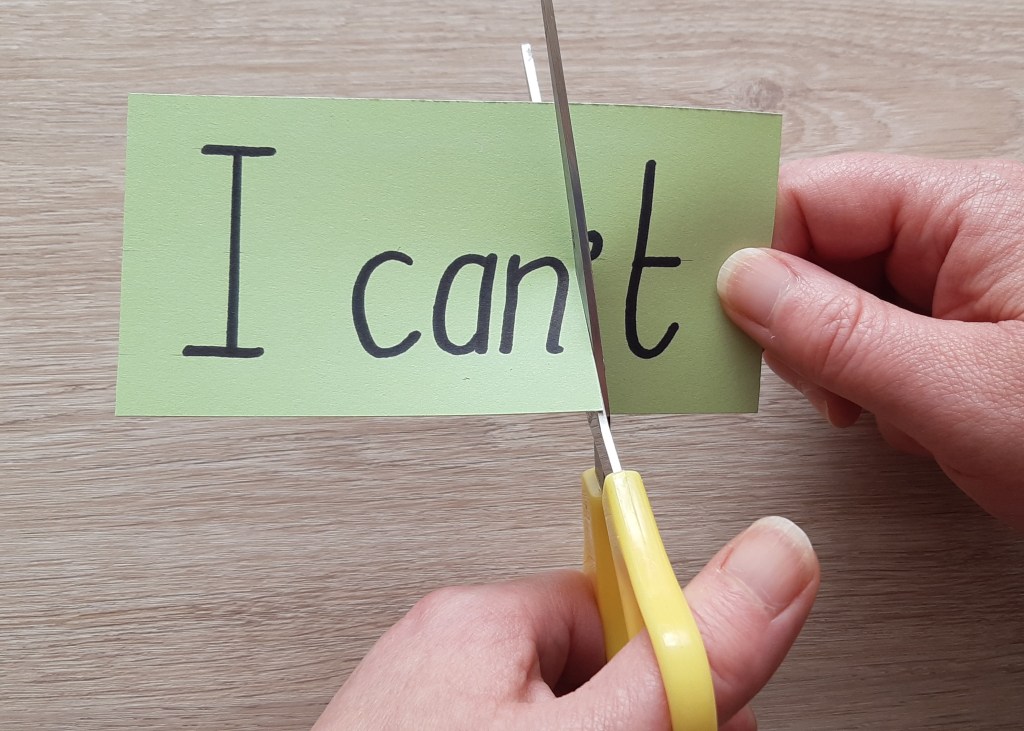
I can’t do it
It’s going to be hard work but I can do it
I’m so stupid
I made a mistake, so what, everyone makes them!
Final thoughts
You might not need to complete these exercises all of the time but when you find yourself dealing with feelings associated with anger, depression or anxiety, try to make time to stop and become more aware of your thoughts. Then you can start to reflect on them, challenge your views and find alternative ways of looking at things. Hopefully, after developing the skills associated with thought investigation and thought challenging, you’ll find it easier to put the ideas into practice and conquer your negative self-talk and start being nicer towards yourself.
At the end of April, as part of my post on self-awareness and self-acceptance, I mentioned the usefulness of mood trackers as a way of learning more about how your mood changes and about different things which impact your mood. Although there are hundreds of examples of bullet journal spreads featuring decorative, pretty and colourful trackers (just type #moodtracker into Instagram or search Pinterest), I find that many are a little basic and are more about aesthetics than being an effective learning tool which helps you manage your mood. So, today, I’m going to explore why mood tracking is helpful and discuss some more useful ways of tracking your mood which go beyond colouring in shapes to show if you’re happy, sad or neutral.
Why track your mood?
You might simply track your mood to see if you spent more time feeling happy than sad during any given month but there are so many more benefits to be had such as:
It can help you to better understand your triggers and their impact – as well as genetic and physical factors affecting your mood, social and environmental factors play a big part too. By learning about your triggers, you can take steps to minimise the effect and work on developing healthy coping mechanisms.
Enables you to identify patterns – after you’ve tracked your mood for a while, you can start to look for patterns, so for example, you might notice that you always feel particularly stressed or down on a Monday after a weekly meeting at work, or anxious in the build up to going supermarket shopping on a Tuesday, or you might notice that a period of depression always kicks in at the end of Autumn and lifts when the weather starts to become brighter in the Springtime.
Helps you to develop strategies for managing your moods – when you’ve established patterns, you can then work on developing strategies to combat the effects of various triggers, such as working on positive self talk, doing relaxing breathing meditations, scheduling in something fun on a Monday evening, connecting with nature or getting a little Winter sunshine.
Helps you to track your progress – once you’ve put the various strategies in place, long term mood tracking can help you to see if what you’ve put in place actually works. And if you know specific things are really useful, you can do more of them!
Can help you to get an accurate diagnosis or appropriate self help strategies – you can take the information you’ve collected when you see a mental health practitioner such as a community psychiatric nurse (CPN) or your psychiatrist and then can use this to help you get an accurate diagnosis or to to make suggestions on how to manage your symptoms more effectively.
In fact, mood tracking is a key element of CBT (Cognitive Behaviour Therapy) and related exercises are often given as homework due to the fact that they can really help you manage your mental health much more effectively.
Issues I’ve had with keeping a basic one page per month mood tracker in my bullet journal
One of the first issues I had with a basic mood tracker was that my mood changed so much throughout the day that I wanted to record it all and ended up splitting the shape or section for that day into about 4 different colours e.g. I was tired first thing, then I was annoyed about something someone had said, then a little later in the day, I received some great feedback and I was happy, then by the end of a busy day I was either exhausted or extremely stressed at the amount of work I had to do the next day. A more useful idea is to record each time your mood or emotional state changes and what has made it change (i.e. the trigger or circumstances). Then you can come up with some strategies to combat the moods which are causing difficulties e.g. developing relaxation techniques, reframing particular thoughts and feelings, talking about things that are causing you to feel stressed etc.
Also, I think that a lot of mood trackers become restrictive when they only have a set number of moods such as happy, sad, neutral, tired and stressed. What if you feel embarrassed and it had a huge impact on your mood? What if something someone said has made you feel completely inadequate and this leads to feelings of self doubt and lots of negative self talk? There are so many different moods and I think it’s important to recognise them all. I downloaded and laminated a mood wheel a while back now and have found it really useful to find the words to pinpoint exactly how I feel. There’s lots of these available online and this one is available here.
A wheel showing every mood and feeling you could possibly think of!
Finally, recording your mood is more useful if you also take the time to journal about what caused the mood / emotion and the impact it had in terms of thoughts and subsequent behaviour. Then, you can come up with ways of going forward.
My idea for a more useful mood chart for your bullet journal
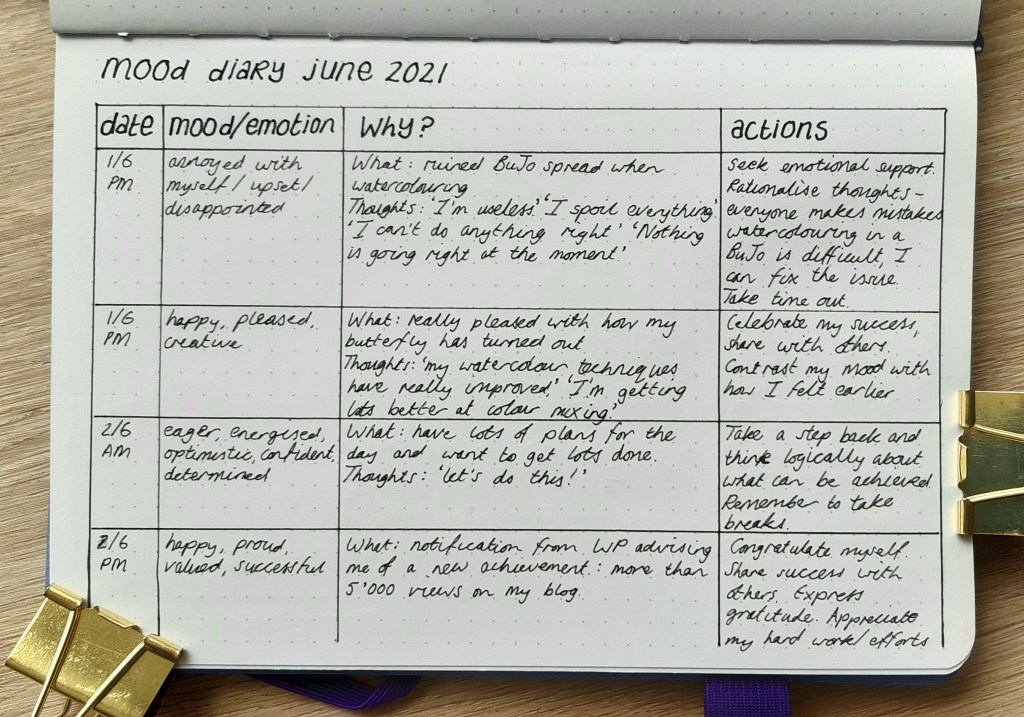
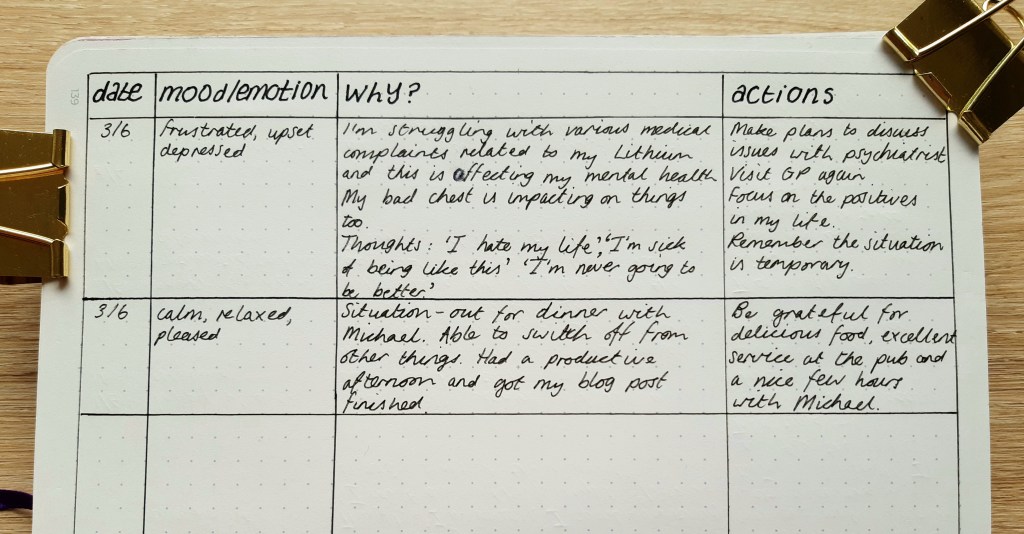
It took me a while to come up with a set up which isn’t too onerous but is helpful in identifying moods and emotions and can also be used to record action techniques such as those I learnt in CBT, Compassion and Mindfulness sessions to manage the moods. The main focus, I guess, is on negative moods but it’s also important to recognise positive moods so that you can try to find ways to inject more positivity whilst making sure that you don’t get too high if you are inclined toward mania or hypomania.
Obviously, this is an idea that I think will probably work for me so bear in mind that it might not suit you, but I hope that it might give you an idea for a layout which you can modify to fit your own needs. You might also think that the chart is time consuming, and yes, it does take time, but, if it helps you deal with your moods effectively, I think it’s well worth doing.
The date and mood/emotion columns are pretty self explanatory and I’m using the above wheel to help me best describe how I feel. The ‘why’ column can be used to identify the circumstances which caused the mood such as lack of sleep, a particular situation that you faced, a comment made by someone or an event which has occurred or may be about to happen. You might also like to record your related thoughts as these can really impact on things too. The final column ‘actions’ could be used to identify ways of improving your mood or providing a remedy to high levels of stress or excitement. Some ideas include:
work on reframing the thought that made you feel bad in some way
take it to court to consider the evidence for your thoughts / beliefs – this is a great CBT technique and you can find related PDFs here.
plan in some relaxing activities to combat stress / help you relax
talk to someone about what has happened with a view to getting an alternative point of view
go for a walk in nature
find something else to focus on if you’re finding yourself ruminating
A useful way to track bipolar moods
For bipolar disorder symptoms, the free charts from Bipolar UK are great for tracking changing moods so you can recognise signs that you are slipping into a depressed mood or becoming hypomanic or manic. My personal preference would be more room to make notes about triggers, so I would use the first sheet as to record my mood and then create a weekly page for information about events, triggers, wellbeing activities or interactions with others.
Using an app on your phone
If you’re not a fan of pen and paper methods, you could always track your moods on your phone. I’ve found several options and some are more in depth than others. These are all available for both iOS and Android but there are some I’ve read about that are just available for iOS). As with all apps, if you want access to all of the features, you’ll need to pay a subscription for Premium access, but there are some which offer simple ways of recording basic information and tracking things over time.
Daylio This one is particularly popular and, due to it having lots of clickable icons, you can quickly record how you feel, state what your sleep has been like and mark off what you’ve been up to during the day (e.g. hobbies, health related, kindness and compassion related and chores). There’s also the option to add some notes to sum up your mood and your day. I found the mood labels annoying at first as the really happy face one said ‘rad’ but after some exploring, I discovered you could change them to something you would actually say, I chose ‘joyful’. After consistently entering your data over a period of time, you can create graphs to see how your mood has changed over the weeks and you can also see how doing different activities impacts on how you feel. Also, to help you get into the routine of filling in your data, you can set a reminder for a particular time, for example, I tried 8pm so I could reflect each evening.
Bearable This one has loads of bits and pieces that you can record alongside your mood. You can add if you had a headache and if you had an mental health symptoms such as stress, anxiety and depression. You can also identify factors which may have impacted on your day such as how busy you’ve been, if you’ve been to work and how much screen time you had. You can say where you’ve been, how much physical activity you’ve engaged in and if you’ve been socialising and what your sleep has been like. Again you can set reminders and edit what you want to track.
emoods Another app which looks like it might be really helpful for individuals with Bipolar disorder is emoods. Each daily log has a space to record how much sleep you got (in increments of 0.5 hours) and your mood, focusing on the four areas of depressed mood, elevated mood, irritability and anxiety, rating them from none, mild, moderate to severe. Over time, the data you enter can then be made into various graphs so you can see if there are any patterns. You can also record if you had any symptoms of psychosis, if you attended some form of talk therapy and your medications (type and dose). Finally, there’s a box to type in anything else which is relevant and may have had an impact on your mood.
Tracking your moods on your phone has several benefits – you can have lots of data in digital format and it doesn’t take up lots of space like a paper version would and you can get graphs of your data which would be difficult and time consuming to create in your notebook. Personally I found both records to be useful but I much prefer working in my bullet journal.
Making it a habit
If you’re going to go to the effort of making a decision to track your moods and learn from it, you also need to make filling in the diary or using an app. a habit and part of your daily routine. If you use a paper based method, you might choose set times during the day to sit down and do some journaling. It’s helpful if you reflect on things pretty much straightaway so you can complete some action steps but it might not be feasible to make notes there and then so you need to find what works for you. My previous blog post on habit creation might help you with making sure you stick to filling in your chart but a simple way of reminding yourself is to set an alarm on your phone or a reminder with a notification tone in your calendar.
As I said earlier, the apps which I tried include the option of notifications to remind you to fill in your information at various points in the day which can be really helpful as long as you choose useful times for the messages to pop up.
Final words…
I hope you have found today’s post useful and it’s given you the key points about why it’s helpful to track your moods and some ideas for how to go about it. If you are really struggling with your moods, however, I would recommend you consider trying CBT as a trained therapist can help you to you look at your emotions and also teach you key techniques for dealing with unhelpful and negative thoughts.
I’m really lucky to have a very supportive husband who does everything he can to help when I’m struggling with my mental health. He seems to know exactly what to do and what to say and, although he will admit that life is hard for him too when I’m going through a period of difficulty (albeit only saying this when I’m feeling well again) he works tirelessly to look after me and make things easier, whilst at the same time, maintaining a busy full time job. With this is mind and knowing that most of us will have a partner, friend, family member or colleague who has mental health issues at some point, here are 7 ways that you can offer much needed support.
Ask ‘How are you? Twice.
Most of us will be able to sense if someone we know is having difficulties. They may seem a little quiet, look washed out or just not quite their usual self. The ‘Ask twice’ campaign recognises that most of us, when asked ‘How are you?’ tend to offer up the standard response of ‘I’m fine’ or ‘I’m okay’, even when we’re really not. Asking a second time can make all the difference as it can let the person know that you’re really interested in their welfare. It’s up to them whether or not they choose to open up to you, but at least you’ve let them know that you are there if they need you.
Make time to listen
Before you make the effort to ask someone if they’re really okay, it’s a good idea to think carefully about when is a good time for a mental health and wellbeing conversation. If they do choose to open up, it’s important that you both have a lengthy window for a chat and an appropriate space to too. Picking a quiet place with no distractions shows that you are seriously interested in what they have to say and also helps the person know that they won’t be overheard by others.
Remember, some people may never have spoken about their mental health before so might be worried about opening up and sharing how they feel. Others, like me, may have shared their thoughts and feelings with a variety of people including therapists and doctors. They may also have already received a diagnosis from a health professional. In this case, they may just need a listening ear, some reassurance or even a hug (according to my reading, a cautious cuddle is possible from 17th May when this post goes live!). In making a judgement about what the individual needs good listening skills are essential. Some basics include:
be patient and listen really carefully – lots of eye contact, supportive gestures such as a nod or supportive words such as ‘take your time’.
avoid second guessing – try not to jump in too quickly or make assumptions about what the person is saying
offer phrases which validate what the person is saying e.g. ‘that must be really hard’ rather than offering advice or solutions – don’t try to fix them!
avoid phrases which dismiss the person’s feelings or suggest that they can easily change how they feel e.g. don’t say things like ‘you’ll be fine’, ‘I know how you feel’, ‘everyone feels this way’, ‘it could be worse’ or ‘cheer up’.
use open ended questions e.g. ‘is there something I can do to help?’ ‘are there any signs I can look out for which might tell me you’re struggling?’
paraphrase – repeat back what they’ve said in similar words so you can check you understand fully
offer them reassurance – remind them that they have the strength to get through this, they have a support network to help them and that thing are going to be okay.
Read up on the person’s particular health condition
Everyone’s experience of mental health difficulties are different but there are some common symptoms to look out for and read up on. There’s lots of information available online and good places to start include the NHS Website and Mind. For specific conditions, you can also check out dedicated websites such as Anxiety UK, Bipolar UK, PTSD UK and ADHD UK. You might want to find out for yourself or you might want to share these resources with the individual so they can learn more about their diagnosis or discover self help strategies. There are also online communities which enable both of you to ‘meet’ others to share experiences, stories and tips for managing particular conditions.
Offer practical help
With some mental health conditions, day-to-day living becomes really difficult. Offering support such as getting shopping, making a nutritious meal, giving them a lift to a medical appointment or doing a household chore for them can be a big help. Other support you could offer includes working with them to make a list of things to share with the doctor (or questions to ask), reading literature about mental health conditions either in booklets or online and helping them to make notes, developing a bank of self help strategies to try.
Regularly check in with them
After the initial chat with the person, make sure it doesn’t end there. Someone who is depressed, anxious or struggling in some other way is very likely to withdraw from social contact with friends and family, but this kind of isolation can make things worse. Checking in with them regularly and occasionally suggesting short, one-to-one get togethers such as a quick coffee or a brief walk around a local park reminds them that you care and are still thinking about them. They might turn down the face-to-face contact if they’re feeling really bad but at least they will know that you’re there.
Even if you don’t see the person regularly, you can still show them you’re thinking about them by sending regular texts asking them how they’re doing or inviting them for coffee, a walk in the park or something similar. You might only get a few lines back or sometimes no reply at all but remember that your words are being read and are helpful.
Support them in getting further help
Depending on where the person is in their mental health journey, this might be offering to go with them when they visit their GP, looking into different treatment options or going online to find out more about a particular condition and self help strategies which are recommended. You could even offer to do something together which might help, such as going for regular walks in the sunshine, attending yoga classes or going to a support group.
Don’t forget to look after yourself too
Listening to and supporting someone who has a mental health difficulty can be challenging and at times very draining. You may find yourself getting upset or struggle to cope with seeing someone you love having such a tough time. If you live with the person, you might also be taking on the majority of or all household activities and chores such as cooking, cleaning, tidying and child care. In order to look after someone else as much as you can, it’s really important to find some time to take care of yourself both physically and emotionally. If you are adopting the role of caregiver when the person is unwell, you’re likely to need to have regular breaks where you spend some time alone or with others. And remember to set some boundaries between yourself and the person you’re looking after so that as well as having some space, they’re reminded that you have personal needs and limits too.
Final words
I really hope you’ve found today’s post useful. Figures suggest that about 1 in 4 people experience mental health problems every year and the lockdown restrictions which have been in place during 2020 and 2021 have made things particularly difficult for a lot of us. Therefore, it’s likely that at least one of your immediate family, close friends or colleagues may be finding things hard right now and could benefit from your help and support.
Currently we have lots of trays of seedlings all over the windowsills in our house as we get our baby plants ready for life outside when the weather warms up (hopefully some time this month!). To make way for them, we’ve had to reposition some of our many houseplants so our space is looking a little bit cluttered right now! I’m sure it won’t be long until the little plant plugs are transferred into our garden beds and the indoor plants can have pride of place again. In today’s Monday Matters I’m going to be sharing some of the joys of keeping houseplants, including 7 ways they’re beneficial for our physical and mental health. I’m also going to give my suggestions for some easy care varieties that take minimal time and effort and still look good.
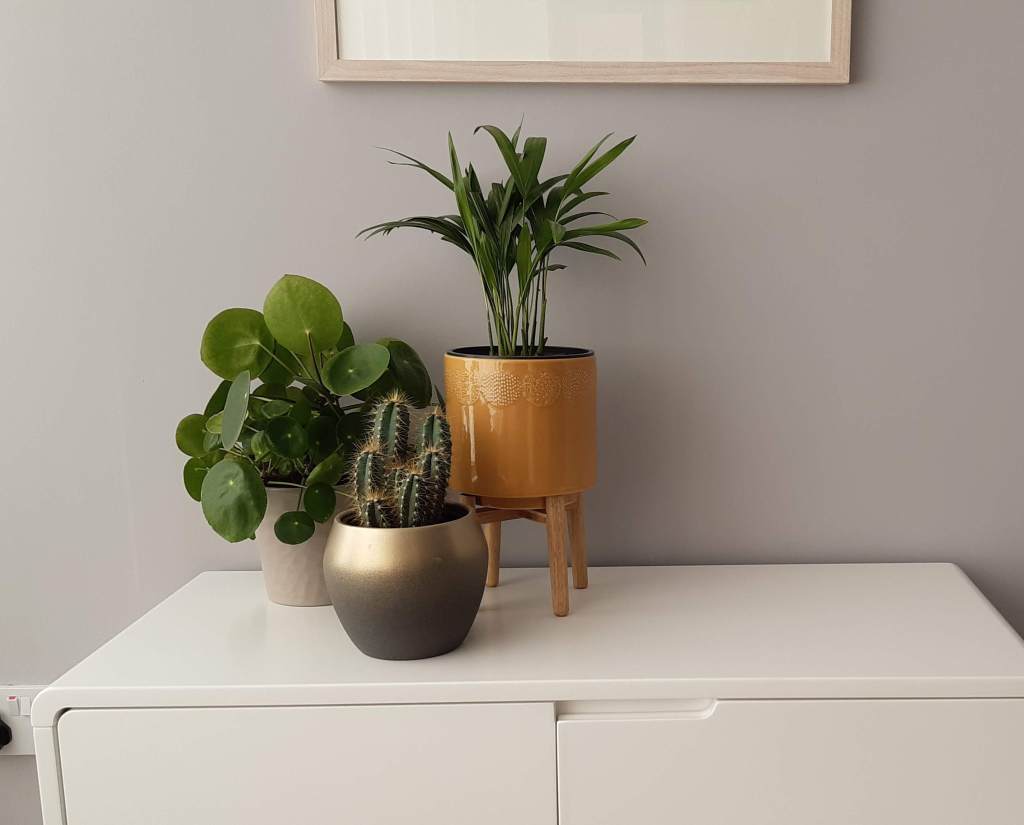
Photo credit: Laura Jones for Keeping It Creative
We have a range of different houseplants which we’ve accumulated over several years. A few of them have been grown from cuttings (such as our Christmas cactus which bizarrely decided to flower at Easter this time) but most have been bought quite cheaply from local garden centres. You can see a small selection of them above which I’ve grouped together just for the photograph! We love our plants because they look good, but recently I’ve learnt more about the excellent health benefits that come with them which I want to talk about today:
improve your mood
There’s a reason why people take flowers and plants to hospitals when they visit – they’re great for cheering us up. Whether it’s beautiful scented flowers or interesting and colourful leaves, plants are lovely to look at and can radiate a feeling of positive energy and make us feel much happier. They’ve also been shown to reduce negative thoughts and emotions such as sadness, anger, fear and stress. In addition, all houseplants require some basic maintenance and this can create a feeling of being needed which is particularly useful during periods of low mood associated with some mental health conditions.
boost your productivity levels
Various studies have found that working in a space containing greenery is great for productivity. Having a few potted plants on your desk improves cognition (AKA mental processing) and also makes you able to concentrate for longer periods of time. This is good news for office workers and students who want to increase their performance and get more done, more quickly.
reduce fatigue
Fatigue is a serious issue for many of us resulting in feelings of tiredness and exhaustion, irritability, poor motivation and concentration, lack of appetite and weakened immune system. Whilst plants can’t completely cure modern day fatigue, they can certainly help to improve some situations and causes. At work, they can create a more calming and informal environment, offering reminders of the joys of nature. At home, they can create a relaxing atmosphere where you feel more content. Plants may also help to relieve symptoms such as headache and aching joints.
Having a plant filled home has even been shown to help alleviate symptoms of seasonal affective disorder (AKA Winter depression), one of which is chronic fatigue. Although one of the main treatments for SAD is to try to get as much natural light as possible, studies have also found that exposure to plenty of greenery through indoor gardening can improve our mood and as the plants are often near to or in the window, the individual can benefit from light exposure as they tend to each of their pots.
lower stress and anxiety levels
Looking after houseplants can be a great mindful activity where the focus is shifted to the here and now, helping you to forget about all (or most) of the everyday stresses and strains of modern life. Starting from reading up about the plant and then potting the specimen in a cute new pot before finding the perfect location for it. Then you have maintenance tasks such as regularly checking the soil to see how moist it is, looking carefully at the plant to find out if it’s completely happy where it is, or is showing signs of underwatering or lack of exposure to light etc. Removing any dead leaves or flowers or checking a book or online article to find out more about the plant if it appears to be struggling.
One study conducted in Japan has even found that just gazing at a plant for a short amount of time can significantly reduce anxiety levels. I think to get the most out of your observation though, it’s important to really look and appreciate it as a living thing. So, for example, you could pay attention to the leaf shape and structure, the colour of the stem and the leaves, the shape and height of the plant, how it smells and how it feels – glossy, bumpy, spiky etc.
better air quality
A recent NASA study discovered that houseplants can help clean the air we breathe by reducing toxins. Apparently there are lots of pollutants in our home that you probably didn’t even know about. Sources include cooking, cleaning products, poor ventilation, some building materials, home furnishings, heating systems and damp. The air purification ability of the plants depends which varieties you choose, how big they are, how big the room is and how many you have but about 5 decent sized plants in a medium sized room should make a difference.
A word of warning though: Never rely completely on plants to clean your air. Simple solutions such as using chemical free cleaning products, removing mould, opening windows, choosing low odour paints and finishes etc. should be first on your list.
help to make rooms more comfortable
Plants can completely change the environment in a room, making it a more pleasant place to be. As well as the aesthetic benefits, plants can help to raise the humidity level as part of their respiration process and photosynthesis. A room which is more humid can help relieve dry skin conditions such as eczema and lessen symptoms of colds and asthma. Large houseplants can be useful for absorbing sound in a noisy environment so are ideal for rooms with hard floors. They can also provide a screen from unattractive aspects of a home such as plug points and trailing wires or help to give a pleasant dappled shade if placed beside a bright and sunny window.
therapeutic effects
The benefits of getting close to nature are widely studied, with research showing that spending time in a green space can have a huge positive impact on wellbeing. Going outdoors is beneficial but you can also enjoy nature from inside your home if the weather is preventing you from wanting to step foot outside or if anxiety or depression are making things extremely difficult for you. Having some potted plants is a great way of getting started and they can be enough to provide you with a routine of having something to give care and attention to, without being too onerous and overwhelming whilst you are struggling with your mental health.
Having an array of houseplants has also been shown to help combat feelings of loneliness and isolation. This is believed to be due to the mindful activities of watering and nurturing which make us feel needed and evoke a sense of purpose within ourselves and a feeling of joy from believing that we are making a difference to the world.
A recent study in the USA, conducted during the COVID-19 pandemic, found an increase in individuals taking up keeping plants as a hobby, with a large percentage of them reporting that they felt that the pastime improved their mental health. Many of those who shared their positive experiences reported that they hoped to continue enjoying the benefits of plant-keeping after the pandemic is over too.
And one more thing…
Aside from these great health and wellbeing benefits, houseplants look fantastic too, providing cheap and cheerful décor for your home. The different shades and textures of greenery itself offers great appeal and if you choose a range of striking pots and containers these can also add extra visual interest. We particularly love our recently acquired areca palm and the cute pot and stand. The extra height means that we can have the plant on the floor in the corner of our living room. When it gets bigger, the foliage will also hide the plug points and the cables along the skirting board too!
Easy care plants for beginners and busy people
There are so many different plants to choose from that it can feel overwhelming when you go to the garden centre. For beginners, I recommend starting with plants which can withstand sporadic watering, can tolerate a range of different positions in the home, and only need feeding every now and then. Here’s my favourite minimal care house plants:
spider plant (Latin name: Chlorophytum Comosum) – easy to look after and as it matures it creates trails of little baby plants that look amazing. Plus, it is really good at cleaning the air by reducing toxins which are emitted from everyday items in the home.
mother in law’s tongue (AKA snake plant or Latin name: Sanseviera) – if you think you might forget to regularly water your plant, this one is for you! This is probably the toughest houseplant I know. We have three now as we divided our original one down as it got a little big for the pot. A great one for the bedroom too as it releases oxygen into the air during the night.
rubber plants (Ficus Elastica) – create visual interest with the big, leathery, glossy, oval leaves. Also high on the list of plants which eliminate toxins from the air (according to NASA).
areca palm (Dypsis Lutescens) – a popular household plant which is good for releasing moisture into the air – a bonus for anyone who suffers from dry skin in the winter time
cacti – a huge variety of types available so choose one that you like the look of – some even have little flowers but these only grow in ideal conditions and if regularly fed). You can get some in miniscule pots and others in bigger containers – you can even get some that come with the decorative ceramic pot already installed, meaning that you don’t even need to think about getting a tray or container that’s the right size.
Chinese money plant (Latin name: Pilea peperomioides). Mine is pictured above and although I haven’t made my millions from having it, it has attractive circular shaped leaves and an interesting dark brown trunk like stem.
Aspidistra – also known as the cast iron plant due to it being almost impossible to kill! This has upright, lance like leaves which are quite a dark shade of green. Apparently, the plants were extremely popular in the Victorian times as they could be placed in relatively murky hallways and still survive!
Whichever plant of plants you choose, it’s good to experiment and if you fail on your first attempt and find your prized plant looking a little worse for wear, see if you can revive it and if not, learn from the experience and have another go.
Final words…
I hope you have enjoyed reading about the benefits of keeping houseplants and it has prompted you to consider getting your own plant baby to look after. If you have your own beloved plant or are on the hunt for one, let me know in the comments. Also, if you have a garden, like we do, you might want to check out this post which is all about the wellbeing benefits of gardening.

















 Keeping it creative