This month, I’ve again taken inspiration from our garden. A few weeks ago, I decided that I wanted to add more colour out the front of the house, so we went to the garden centre to look for a set of six bedding plants that should come back year after year. I opted for primroses (AKA primula) as there was already one out there which pops up each spring and was obviously set before we moved in over a decade ago. After the flowers had settled in – they went a bit floppy when we first installed them – I took some macro photos to use as inspiration for my spreads. It’s taken me ages to sketch out, draw and colour in all of the images but it was such a lovely, mindful activity that I found it really therapeutic. As I write this, it’s the 2nd May and I still haven’t finished all of the decor but I have drawn up my calendar, finances, goals and first weekly so I can actually fill in events and tasks. I hope you like my finished pages and they inspire you to give florals a go to practise your drawing, colouring or maybe painting skills.
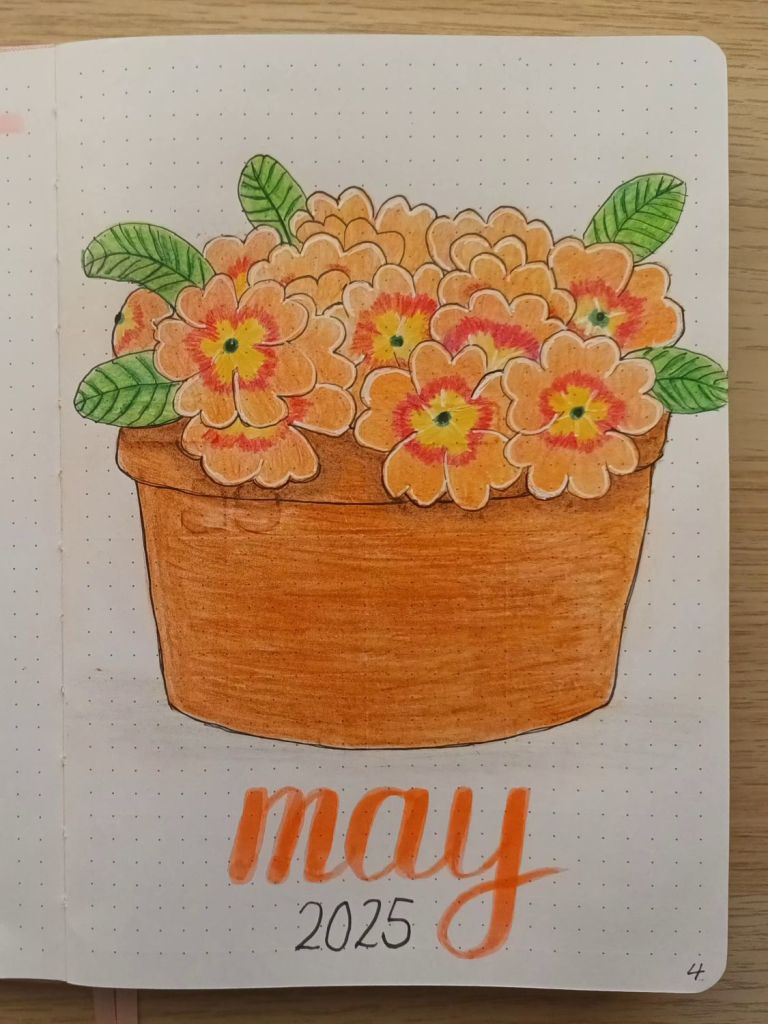
Front cover
The calendar was the last page I finished and took me a long while to complete. I used a photograph of a plant pot of primroses for reference which I found on Google. I used mainly my Staedtler Ergosoft coloured pencils and blended a few shades together to get a nice peachy colour. I also used my blending pencil to mix up the colours and to create a smooth appearance. I also used my Sakura Gelly Roll pen in a size 10 to draw lines inside of the Pigma Micron as the actual primroses had a very thin white trim.
Photo credit: Laura Jones for Keeping It Creative
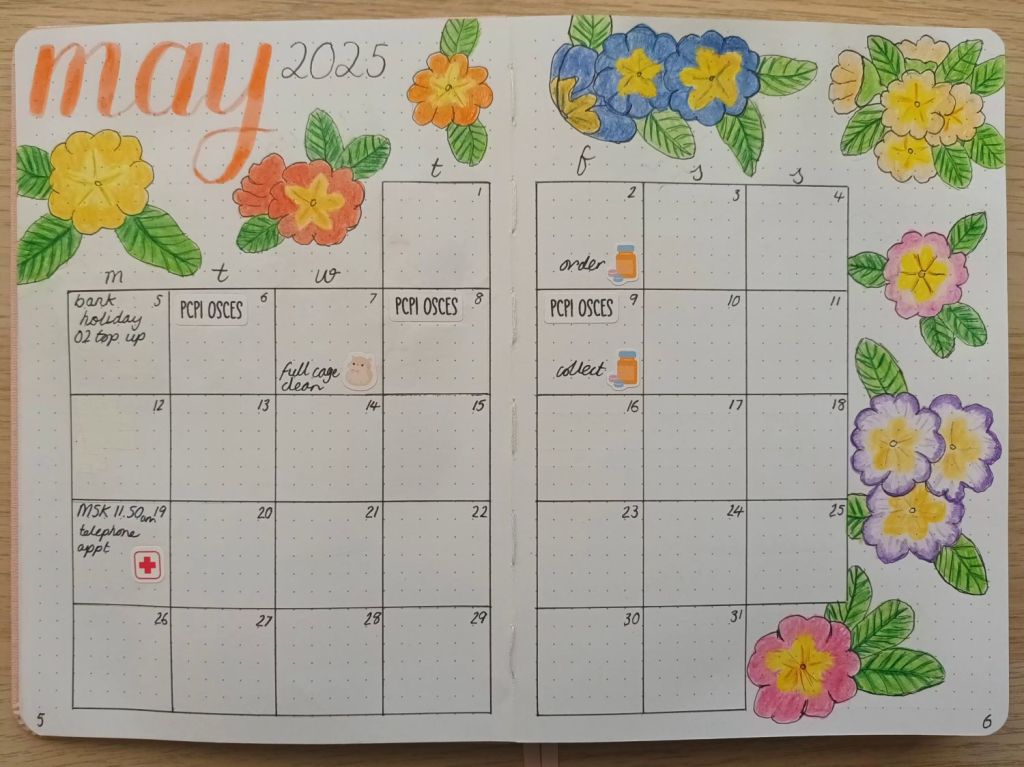
Monthly calendar
I added the decor to my calendar second, after I did the image for my finances record, and, as it had taken me such as long time to finish that one, I opted for a more sketchy appearance to the primroses you see here. I held my fineliner really lightly and tried to create a slightly wobbly appearance so the plants looked more natural. I’m really happy with how they turned out and the colours look so cheerful. I made good use of lots of my coloured pencils and also used my blending pencil to blend out any harsh lines.
Photo credit: Laura Jones for Keeping It Creative
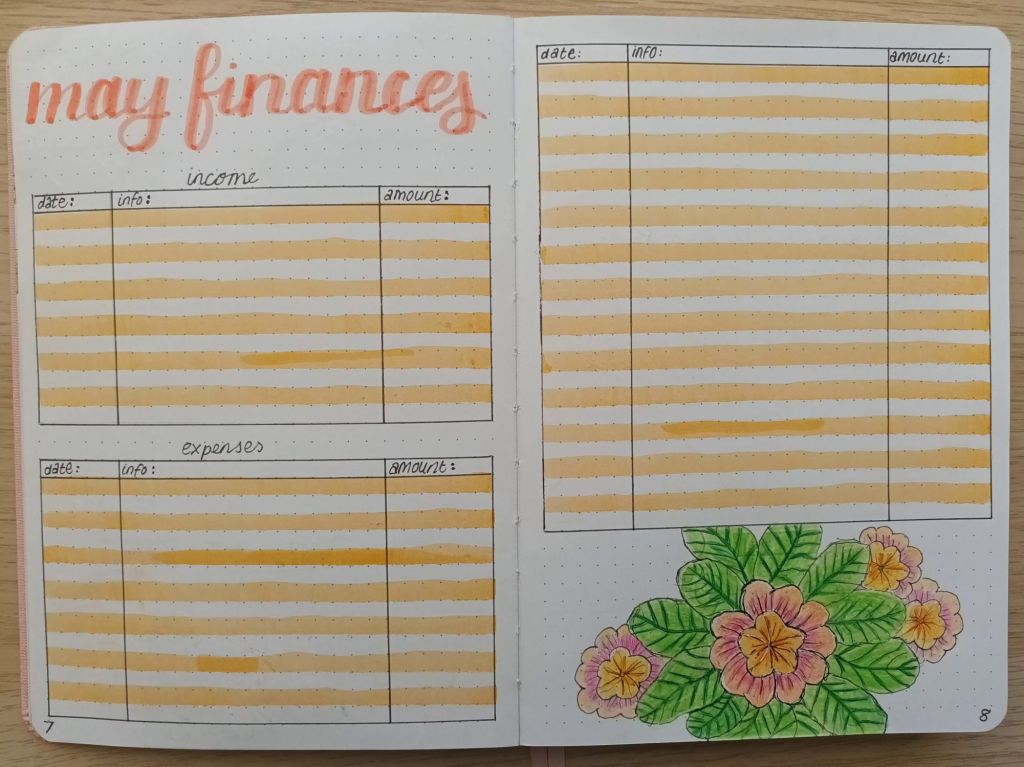
Finances record
As well as the pack of six small primrose plants, we also purchased a much larger one for our back garden. The flowers are a lovely, pale pink but I didn’t have a coloured pencil which matched so I’ve gone for more of a peachy colour. I initially did just the flower in the centre but decided there were too many leaves and not enough floral bits so I added the other two and made them a little more washed out so the central one stood out.
Photo credit: Laura Jones for Keeping It Creative
Monthly goals
Last month I (yet again), picked far too many goals to be in with any chance of achieving them all. So, for May, I’ve really, really restricted myself and opted for just 5 (go me!). And, I’ve already achieved one of them as I made bread for the very first time yesterday!
Rather than adding some more primrose illustrations, I opted to add some stickers to make the set up much quicker. Some, I’ve made myself and others are from my ever increasing stash (you can never have too many stickers – right?). However, I have just started a new BuJo this month and a not to do goal of mine is to add plenty of my own illustrations straight into my notebook rather than overloading with stickers and making my journal super bulky (my orange one would barely close by the time I finished it!).
Photo credit: Laura Jones for Keeping It Creative
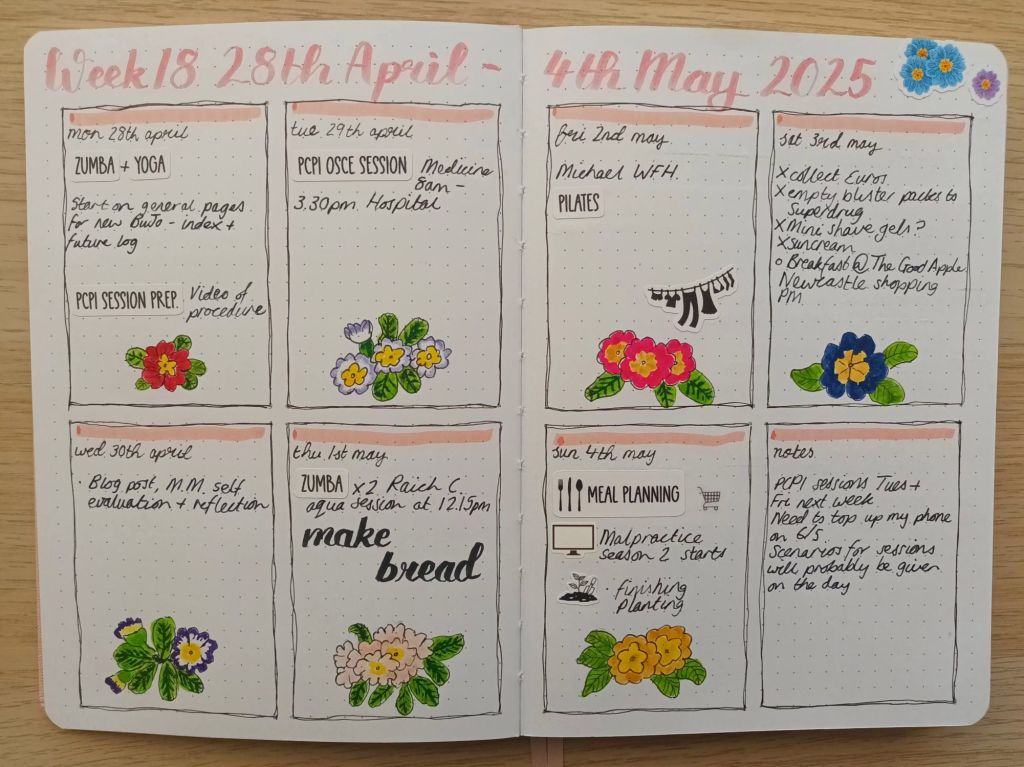
Weekly plan
I’ve been using this same style layout for quite a few weeks now and it really works for me. It gives me enough room to write events and add a few to dos underneath each day. I can then add a small illustration at the bottom if I want to, or use the full space for recording. This week, I’ve done some small primrose illustrations but I may not do any next week as I have lots of sessions at the university so I’ll be super busy.
Photo credit: Laura Jones for Keeping It Creative
Final words…
Thank you for taking the time to visit my blog today. I hope you like my finished spreads. I think they look really colourful and provide a great reminder of our new plants and all of the other bright colours of primrose which you can get. The flowers seem to be thriving at the moment but as we haven’t had any rain for weeks, they require daily watering as the soil is getting so dry. I’m hoping they’re going to stay looking good for a least another month and continue to make me smile each time I get in and out of my car!
As those of you who follow my blog will know, I started attending an Iyengar yoga for beginners class several months ago. After three sessions, the class was suspended due to Coronavirus and then shortly after that, the complete lockdown began. Keen to continue my practise, I’ve built up my collection of equipment and have found suitable classes on YouTube. I’m pleased to report that I’m doing at least 10 minutes of yoga every day and I’m reaping the physical and mental benefits already. So, in this post, I thought I’d share with you how yoga can transform your body and your mind. Please bear in mind that, although I have fully researched the article, most of what you read is my own limited experiences of practising and I am not an expert yogi!
Yoga is an ancient form of exercise that originated in India around 5,000 years ago. There are many different styles but all types focus on increasing strength and flexibility and breathe control in a way which boosts physical and mental wellbeing. The type of yoga that I practise is called Iyengar and this form places emphasis on detail, precision and alignment. When you begin, you are encouraged to use a variety of props such as bricks, blocks, blankets, a strap, a bolster and even a special yoga chair. This equipment is designed to assist you in your practice so you are able to form the asana (poses) correctly.
Although yoga is performed slowly and carefully, so won’t count as part of the recommended 150 minutes of moderate activity per week, it is an extremely good strengthening exercise with lots of benefits for your physical and mental health. This makes it an incredible worthwhile practice to adopt alongside more aerobic activities that get your heart rate up. It is also suitable for all ages and fitness levels. In fact, B.K.S. Iyengar who developed the Iyengar style, still practised for several hours per day when he was in his nineties, before his death at the grand old age of 95!
Physical Benefits of yoga
From the very first week that I went to my yoga class, I could feel my muscles getting a really good stretch in each pose. Now I’ve been practising for a few months, I’m beginning to develop increased flexibility throughout my body. I’m still using lots of equipment in my practice such as bricks, blocks, a strap and a bolster, but I’m able to push myself a little bit further each time as my muscles lengthen. Overall, my body feels a lot better and stronger already.
I’ve always suffered from back and neck pain since my teenage years and a physiotherapist that I went for a rotator cuff injury in my shoulder and sciatic pain identified bad posture as part of the problem. He suggested a variety of physio exercises but also said that in the long term working on my core strength by doing Pilates or yoga would really help. I’m now starting to find that I have much better posture and reduced pain in my body in general. I still suffer from neck and shoulder pain at times but I am hoping this will lessen with daily yoga practice.
A big part of yoga is a focus on the breath. When you bring attention to your breathing, you find that you take full and deep inhalations and exhalations and this can help to increase lung capacity and improve the function of your blood vessels which may lower blood pressure. As an asthma sufferer, I was pleased to learn that yoga can improve your breathing technique and develop your ability to control the depth of your breathing.
Although I’m having no trouble sleeping at the moment, I do tend to develop insomnia during times of high stress. I was pleased to read then, that yoga can promote better sleep and that people who practise some kind of meditation each day find they fall asleep quicker, stay asleep longer and have better quality sleep than those who don’t.
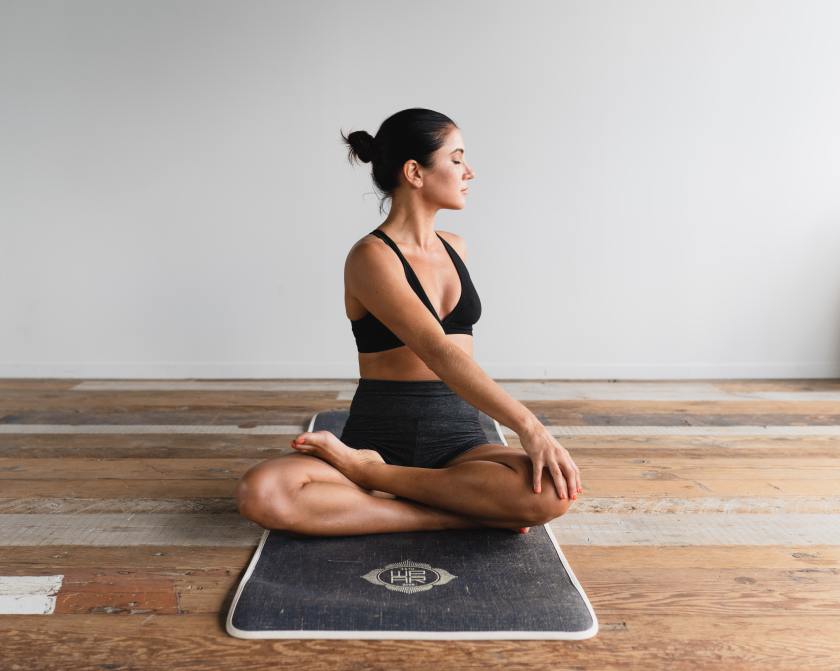
Many yoga poses, such as downward facing dog, have a weight bearing element to them and this has been shown to strengthen your bones and ward off osteoporosis. I find this particularly useful to know as weakening of the bones is very common as we get older, and it often effects women.
Photo credit: Form on Unsplash
Psychological benefits of yoga
Yoga not only transforms your body, it can also improve your mental health in so many ways too. Even after my very first class, I felt calm and relaxed and generally blissful. We did lots of strengthening and stretching poses and then for 10 minutes at the end of the session, the teacher put on some relaxing music and we did some restorative poses that were nice and easy to stay in whilst working on progressive muscle relaxation. The asana (postures) were so lovely that I didn’t want to move out of the final pose at the end!
When you are practising yoga, you are concentrating fully on each of the poses and the transition from one posture to another. You focus on your breath and the lengthening of various muscles, and this full awareness can be seen as a kind of movement based meditation and mindfulness practise. The benefits of meditation are backed by scientific study and include stress reduction and lower levels of anxiety, improved outlook on life and better self image.
As someone who suffers from repeated bouts of depression and anxiety, I was pleased to note that yoga is great for managing both conditions. People who consistently practise have been found to have increased serotonin levels (which contribute to wellbeing and happiness) and reduced cortisol levels (the body’s main stress hormone). In fact, during a telephone appointment with a mental health nurse last month, she suggested I give yoga a try as an adjunctive treatment – she was happy to hear that I’d already started to give it a go.
Yoga can also increase confidence levels and improve self esteem. It teaches us to slow down and pay attention to ourselves and the current moment. Doing this enables us to focus and find the mental clarity within us that we need to solve problems, make decisions and create improvements to our personal situations. This is in contrast to our modern society which encourages us to work harder and faster, buy more and consume more, compare ourselves to others and seek external validation for everything we do.
I hope today’s post has helped you develop a better understanding of yoga and the physical and mental benefits of the practice. Although there are no yoga classes in the UK and many other countries running currently due to the lockdown, I would recommend that you start to learn yoga by attending a class. This is so that the yogi (instructor) is available to correct your postures, give advice and supply extra equipment to help you if needed. When you have perfected particular asana, you can then start to practise them at home.
Let me know if you already regularly practise yoga and are thriving from the physical and mental benefits to your practise. If you haven’t given it a try before, I hope my post has given you the encouragement you need to give it a go.
Today’s Monday Matters post is all about engaging in mindful and meditative activities to achieve a relaxed state of mind and body. It aims to show you the benefits of being in the present moment whilst exploring ways of meditating that are more than just sitting still and focusing on the breath.
We’ve all heard of mindfulness and are probably aware of some of its benefits but if you were asked to explain what it actually means, you might struggle, so here’s a simple definition I found online:
a mental state achieved by focusing one’s awareness on the present moment, while calmly acknowledging and accepting one’s feelings, thoughts, and bodily sensations, used as a therapeutic technique.
Oxford dictionaries
In other words, it’s about consciously being aware of all that is going on for you mentally, physically and emotional at this present moment.
Similarly, meditation is a practice where we use a technique such as mindfulness or focusing the mind on an object, thought or activity to train attention and awareness in order to achieve mental clarity and an emotionally calm and stable state.
Both mindfulness and meditation require regular practise and you may have tried techniques before, found them difficult and decided it’s just not for you or too much like hard work. Some argue that they simply do not have time, but it’s my belief that busy individuals are those who would benefit most from the calm state which mindful and meditative activities bring.
When you say the word meditation to most people, it conjures up an image of sitting cross legged on the floor, with eyes closed, trying to empty the mind of all thought and action, possibly whilst repeating ‘ommm’. However, although this is one interpretation of meditating, it’s not the only way to be in a meditative state. Below are eight ideas for mindful activity based meditation that anyone can try.
Colouring in
Colouring an image using coloured pencils, crayons, pastels or paints combines the benefits of meditation and art therapy to create a soothing and mindful activity. As well as stimulating the part of your brain responsible for creativity and logic, the concentration required helps to clear your mind in a way that has been shown to decrease your stress levels and lower your blood pressure.
Photo credit: cropped from an image by Crawford Jolly, Unsplash
Reading
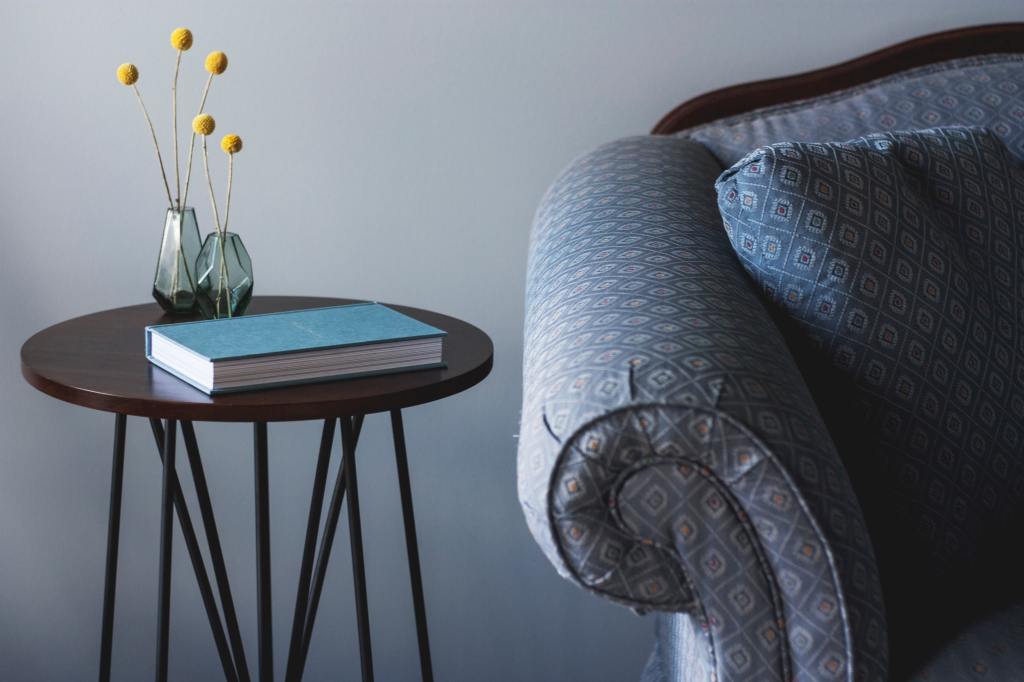
When I’m feeling particularly anxious or stressed due to lots going on in my life, I find reading to be a great way to focus the mind away from sources of worry. I love to curl up on the sofa or relax on my bed and change the focus away from what’s going on in my world.
Photo credit: Lenin Estrada, Unsplash
Walking
I’ve mentioned before that I’m a big fan of walking in nature as a way to unwind and destress. A short walking meditation can be done anywhere, even in your own back garden or yard. The trick is to focus your mind on your body such as your posture before you begin, the placement of your feet as they touch the ground or surface you are walking on and the change in your balance as you move and really feel the connection. Begin by paying complete attention to each and every step you make noticing any physical changes in your body on the inside and, when you begin to feel a sense of calmness and relation, begin to turn your attention to your environment, noticing, for example, the temperature of the air on your skin or any sounds and sights which present themselves. In mindful, meditative walking, you’re have no place to get to so, your attention is purely on the sensations in your body and awareness of the environment around you. You accept the way things are without judgement or interpretation.
If you do find your mind wandering (maybe you begin to ruminate on something that has already happened this week or you find yourself starting to make plans for later in your day), then you can gently and kindly bring the focus back to the here and now and resume focusing on your breath and sensations experienced by your senses.
Photo credit: Dmitry Schemelev
Quiet Observation
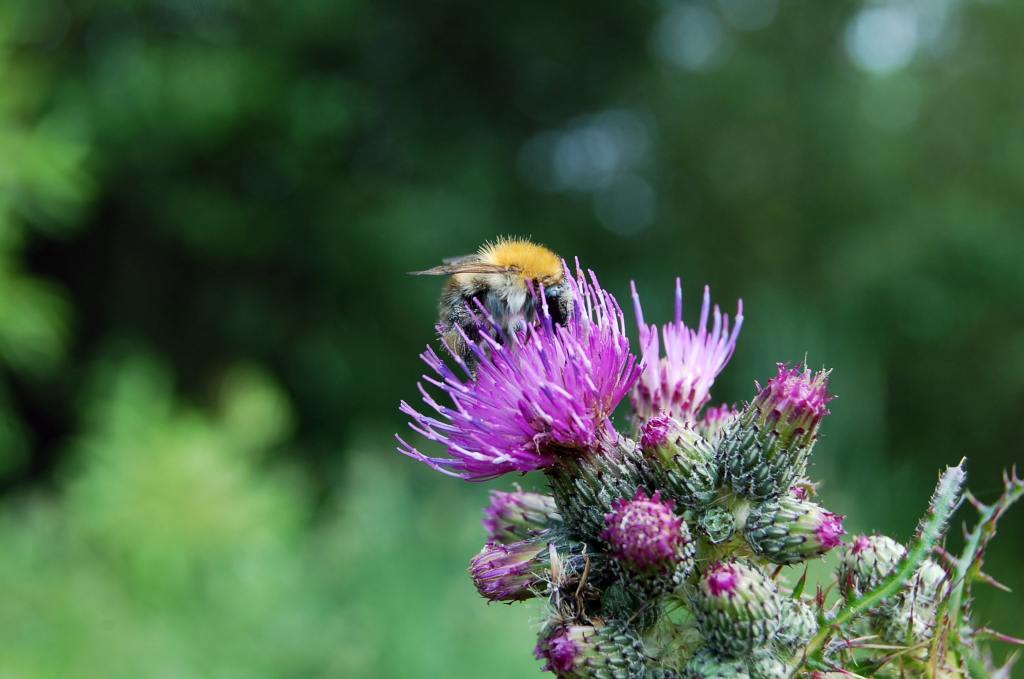
This is one that can be done by looking out of your window at home or whilst wandering the garden. It requires you to choose a natural object from within your immediate environment, and focus all of your attention on it. So, for example, if you are looking out of the window you might watch a tree blowing in the breeze or the clouds in the sky. While outside, you might find a particularly interesting flower growing on a garden plant or you might see an insect hard at work. Spend a few minutes simply noticing your chosen object and focusing on every visual aspect of it, almost as though you are seeing it for the very first time. This quiet contemplation should create a sense of peacefulness and calm. Whilst you explore and allow yourself to be consumed by the presence of your focal piece of nature, you are connecting with its energies and its purpose within the world.
Photo credit: Marieke Tacken, Unsplash
Repetitive craft
Doing crafts such as knitting, crochet, cross stitch and other hobbies involving repetitive action can be great for helping you get into a meditative state. You can focus completely on the small movements you are making and bring your attention to the texture of your yarn, or fabric in your hands as you quietly observe your piece taking shape. You may find your breathing has slowed down without you even noticing as you concentrate on the task in hand.
Photo credit: Les Triconautes, Unsplash
Housework
In a previous blog post, I talked about using mindfulness techniques when you are ironing. The same can be applied to any type of housework that involves repetitive action. Moving the duster back and forth over surfaces or the mop over your kitchen floor can bring about a meditative state which can be calming and relaxing. Pay attention to all of the different sensations, using your five senses to focus in on all of the different elements of your task e.g. feel the cleaning cloth in your hand, think about the energy in your hand as you move over the surface, notice how the scent of the project you are using hits your nostrils, admire how shiny your furniture looks, etc. You might even find you’re enjoying the activity and it spurs you to do more!
Photo credit: Dan Gold, Unsplash
Gardening
The benefits of gardening on your mental health and wellbeing are often discussed by one of my favourite gardeners, Monty Don on Gardeners’ World. As well as feeling a great sense of achievement when you see how beautiful your environment looks, you can also use mindfulness techniques to truly benefit from the processes involved in making your garden look that way.
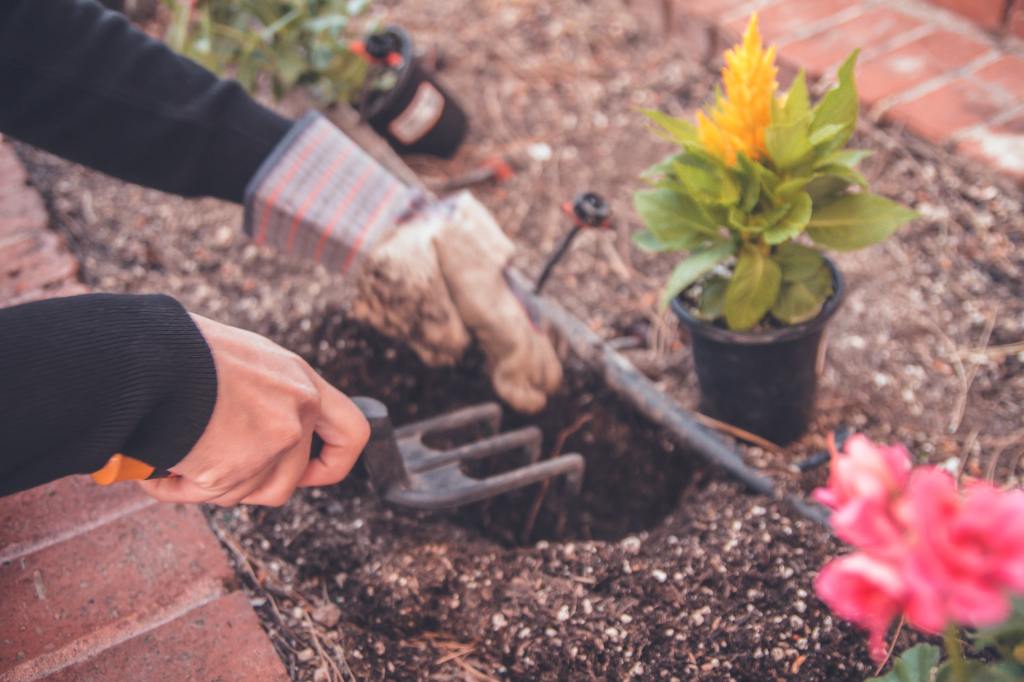
Before tending to your garden, spend some minutes really appreciating the natural space you find yourself in. Be grateful for what you have and if you’ve already made improvements, think about all you have achieved so far. Then, take your mind off any worries you have by using your senses as you work on planting, weeding, digging or whatever your chosen activity is. For example, if planting, spend time carefully choosing an appropriate location, evaluating where will work best. Then, pay attention to the physical effects on your body as you prepare the ground – is the soil compacted or is it easy to get your fork in? If using your hands, really think about how the earth feels. If there are any insects in the location, you might spend time observing as they go about their work. When adding your plant to the prepared space, really look at it as though examining it for the first time. Look at the colour and shape of the leaves then feel their texture. Explore if there is a scent to the plant itself or any flowers that are present. When you water it in, listen the sound of the water as it is sprinkled over the space. Finally, stand back and admire your hard work and evaluate its effect on your garden as a whole.
Photo credit: NeONBRAND, Unsplash
Yoga
As I’ve explained in a previous post, I have recently taken up an Iyengar yoga. The class takes place in the Arts and Wellbeing location where I previously did my ceramics sessions and I’m thoroughly enjoying it. This particular style of yoga involves the use of equipment such as foam bricks and pads and a fabric strap to allow you to comfortably get into the poses and stay in them whilst allowing your body to lengthen. There are many elements of the practise which I find meditative, and of course, a great deal of concentration is required to ensure you are performing the actions correctly and are stretching and lifting in all of the right places. Having aligned your body, you then focus on your breath which automatically seems to be calm and steady. The session even finishes with a relaxation pose and some soothing music which feels absolutely blissful.
At the moment, due to the lockdown with COVID-19, I am practising daily at home using YouTube videos, which, although not quite the same as a class where the teacher will provide extra equipment or correct your poses, is still enabling me to get into a relaxed state and enjoy the benefits. I do, however, look forward to resuming my class in the near future when it is safe to do so.
Photo credit: Dane Wetton, Unsplash
I hope you find these ideas useful and that my post will prompt you to try at least one of these mindful and meditative activities. It might be tempting to say that you are too busy to practise meditation, but if you become more mindful, and therefore present in the moment, as you go about your usual tasks each day, you will find that you really can reach a state of calm and become more relaxed.











 Keeping it creative