Posted in Bipolar disorder, creativity, depression management, lifestyle, mental health, Mindfulness, wellbeing, wellness

Monday Matters: Wheel Of Wellness – Intellectual

In today’s Monday Matters I’ll be considering the intellectual element of the Wheel Of Wellness. This segment is all about keeping your brain active, exploring creativity and finding different ways to expand your knowledge and skills in various areas. It also includes finding ways to challenge yourself and ensuring you do activities which stimulate each area of the brain e.g. speaking and listening, problem solving, fine motor tasks and using and developing your skills of observation etc.

What do we mean by intellectual?

Sometimes when we use the term intellectual, we’re referring to individuals who come across as ‘brainy’, clever or highly educated as demonstrated by their thought processes, reflections, use of vocabulary, problem solving and factual knowledge etc. However, the term can also refer to ways in which you can stimulate your mind.

Today’s blog post is not about trying to develop a superior intellect or the knowledge of a Mastermind contestant, but more about keeping the different areas of your brain active and becoming a lifelong learner. Good mental fitness is very beneficial for your general health and wellbeing, and, as you get older, it can help to prevent signs of dementia or, at the very least, slow down cognitive decline.

Great ways to keep your brain active and expand your mind

Puzzles The term puzzle might make you think of a box of pieces that you join together to make a picture but a jigsaw is just one type of puzzle. In fact, the term is used to defined any activity that requires mental effort and has a definite ending. This can include paper puzzles such as crosswords, wordsearches, spot the difference and sudoku, board games such as Cluedo and Scrabble, guessing games such as I spy and charades and online games such as Candy Crush, Word Cookies and my favourite Angry Birds 2! Puzzling takes lots of concentration and mental effort which is great for improving both your physical and mental health. Here’s 5 benefits for you:

  • improves your problem solving skills which can then be applied at home or work
  • a wonderful stress reliever
  • reduces your risk of mental diseases such as Alzheimer’s
  • slows mental aging
  • a good form of entertainment and can be great fun!

If you are currently struggling with anxiety or depression, puzzles are a great way to distract yourself from negative thoughts, rumination and general worry about your problems. During my last period of depression, I used to dedicate a lot of time to doing jigsaws, wordsearches, arrow words and online games as it provided respite from thoughts that I wasn’t going to get better and feelings of hopelessness and helplessness.

Learn to play a musical instrument There are so many benefits of learning to play a musical instrument that I could write a full blog post on it. According to my research, playing music uses both sides of the brain so you’re giving it a really good workout. Attentiveness, fine motor movements, memory and creativity are all required and as you get better at playing, you’ll become more confident, not just with regard to your instrument of choice, but also in general too. Setting and working towards goals and celebrating your achievements is bound to make you more positive and after a while, you will probably want to share you learning with others and impress them with your new skills – presenting a great opportunity to socialise with friends, family and even work colleagues.

In this month’s Happiful magazine, I also read that new research has found that learning a musical instrument (in the study they looked at the impact of piano practice) can protect against dementia in those over 60 as it strengthens white matter in the brain.

Read plenty of books, magazines and newspaper articles Being a regular reader is great exercise for the brain and both fiction and non-fiction have many benefits.

Fiction books can help improve your memory, vocabulary, empathy and emotional intelligence, analytical skills and tolerance of others. They can also be a huge source of pleasure and relaxation, alleviating stress and helping us to get a good night’s sleep.

Reading non-fiction books and articles (including blog posts) is a great way to improve your knowledge on a variety of topics which interest you. Whether you want to find out more about gardening, read about an interesting bird you spotted on a woodland walk, improve your understanding of a historical event or explore self help strategies for good mental health there are books and articles on every subject imaginable. And, if you join your local library, you can have access to a range of learning materials for free.

Many people also like to read a daily or weekly newspaper to keep themselves informed. Both the paper and online versions provide a source of global, national and local news, weather updates, the latest health and wellbeing advice, technological advances, entertainment and sports. You can even personalise the homepage on your computer so that news articles on particular topics appear first.

Learn a new skill Learning a new skill is a great way to fire up your brain. There are endless opportunities available for free online or you could try taking a class at your local college or doing a distance learning course. Here’s some examples which you might like to try:

  • flower arranging
  • photography
  • a foreign language
  • drawing
  • ceramics
  • watercolour painting
  • basic car repairs
  • Tai Chi
  • embroidery
  • good sleep hygiene
  • knitting
  • basic first aid
  • mindfulness
  • cooking on a budget
  • swimming
  • yoga
  • aromatherapy
  • Microsoft Office for beginners

As part of our course homework for last week, we were asked to have a go at learning something new. I chose something which I’ve been meaning to give a go for a long time which is developing the skills involved in creating wavy hair using a curling wand (which I purchased nearly a year ago and have barely tried out). My hairdresser showed me some of the basic techniques but it’s not so easy when you’re trying to do it on your own hair as you can’t see the back and you need to swap hands for each side meaning that for half of the styling process, you’re using your non-dominant hand for the wrapping. I found a few super helpful YouTube videos which used the same or a similar wand and have watched them a few times to get some tips. For next week’s session, I’m going to go to college with wavy hair to show off my new skill!

Try new things Trying something new is a great way to grow as a person. You might go to a restaurant you’ve never visited before, find a new recipe to have a go at, take a different fitness class, put on a different radio station, try listening to a different genre of music or go on a day trip to a place which a friend has recommended to you. You never know, you might discover a new favourite or create an amazing memory.

I took the opportunity to try out a new kind of exercise whilst I had access to all of the fitness classes for free. I’ve now discovered that I really enjoy doing pilates and although it’s a relatively gentle form of exercise, it’s great for toning your core muscles.

Ask questions This is something my husband and I do regularly as part of our thirst for new knowledge and greater understanding. For example, there are some swifts that come back every year and nest in one of the roofs we can see from our back bedroom. They’re fascinating birds and, being nature lovers, we always want to find out more about them. Some of the questions we’ve searched on Google this year include: When do swifts arrive in the UK? How many eggs do swifts have in a clutch? What do swift eggs look like? Do swifts pair for life?

You can also learn a lot from asking questions of friends, family, work colleagues and various acquaintances. You might want to get a different opinion or perspective or you might want to find out about something they seem to be somewhat of an expert in or at least know more about than you.

Try out a new hobby New hobbies are great for enhancing your skill set. Also, they present new challenges which can be wonderful for boosting your confidence and self esteem. Here’s a few hobbies that might appeal:

  • birdwatching
  • geocaching
  • upcycling
  • origami
  • gardening
  • calligraphy
  • scrapbooking
  • martial arts
  • astronomy
  • archery
  • camping

Keep a ‘things I want to learn’ list in your bullet journal or notebook Every time you think of something you’d like to know more about, write it down so you don’t forget. It might not be top of your to do list right now, but making a note can be a good reference for the future. When you’re ready, you can then pick something out to focus on and set some learning goals.

Watch documentaries If you’re a visual or auditory learner, documentaries are a great source of education. You can find out about anything you’re interested in, including wildlife, nature, different cultures, living with particular health conditions, environmental issues, technology, crime, history, arts and media, science, religion and current affairs. In the UK, Panorama and Dispatches are popular documentary programmes which tackle the latest issues, whilst Horizon focuses on a variety of subjects related to science and philosophy. I also find anything that Sir David Attenborough narrates to be both fascinating to listen to and incredibly informative.

Get creative Every one of us has the potential to be creative as long as regularly find the time to develop our skills. You might think that creativity is all about making a piece of art work or writing a story or poem, but you can be creative in many different ways. Here’s some examples:

  • developing a new storage system for all of your cleaning supplies and tools at home
  • finding an alternative solution to a problem at work
  • create a capsule wardrobe for your holiday abroad
  • choose a colour scheme for your living room and have fun choosing complementary soft furnishings
  • learn how to make bread dough and then have fun turning pieces into different animals
  • try styling your hair in a different way
  • create a costume for a fancy dress party
  • take a landscape photo and then recreate the scene as a watercolour painting
  • choose a new theme for your bullet journal spreads and have a go at designing different pages for the month

Final words…

Although as adults there are things that we feel we must learn to get by in life and to progress in our jobs or career, we should also make time to learn about things that particularly interest us. I love trying out different art techniques and a few years ago (before COVID struck), I joined a beginner’s ceramics course. I had so much fun and met some lovely people there and, even though we were given specific assignments, e.g. to make a pinch pot, our creations were all completely different and unique to us. Quite a few of us signed up for the intermediate class too to develop our skills further and try out different techniques. It was so exciting to see our finished projects when they’d been glazed and fired and we all felt a huge sense of achievement by the end of the course.

I would be really interested to know if you consider yourself a lifelong learner and, if you do, what you’d like to find out about next, which kind of hobby appeals the most, or which skills you particularly want to develop in the future.

Posted in lifestyle, social media, wellbeing, wellness

Monday Matters: Wheel Of Wellness – Social

In today’s Monday Matters I’ll be considering the social dimension of the Wheel Of Wellness, focusing specifically on the advantages and disadvantages of social media for individuals and using a variety of media to find out what’s on in your local community with a view to improving and extending your social connections.

What do we mean by the term ‘social media’?

Social media is a range of websites and applications (apps) that enable users to create and share content (information, ideas and interests) or to participate in social networking via digital channels. Examples include Pinterest, Facebook, YouTube, TikTok, Blogs, TripAdvisor, LinkedIn, Twitter and Instagram. Social media is used by millions of people and it has brought with it a lot of positives. However, it also has its negative side for individuals and society as a whole.

What are the main advantages of social media?

Connectivity The main advantage of social media has to be the way it connects people. Individuals from anywhere can connect with anyone regardless of their location or time zone. It enables us to easily keep in touch with friends, family, work colleagues, other students during our education and people who share our interests.

Education As well as providing opportunities for students and teachers to learn online, anyone can use social media to learn from experts and professionals. For example, I learnt brush lettering techniques for free using YouTube tutorials. I even found videos that looked at difficulties facing left handed letters and it was so nice to see lefties with beautiful handlettering. You can enhance your knowledge of absolutely anything and develop a range of skills in any field. Regardless of where you live and your educational background and level you can educate yourself, often completely for free.

Help, advice and support At one time, help used to be available from a small number of individuals such as relatives, neighbours, friends and colleagues or through reading books or magazines. Now, you can quickly share your issues in online communities and get so much help and advice you might feel overwhelmed and wonder which is most valuable! If you’re after money advice, you can join the Money Saving Expert forum, if you want local advice, you can join NextDoor and consult with your local community, if you need help with something related to your hobbies, there are countless groups on Facebook which you can sign up for.

Information and updates Another main advantage of social media is that it easily enables you to keep up-to-date with what is happening around the world. Rather than reading printed literature such as newspapers which tend to place a biased slant on things, you can seek information from more reputable sources such as the BBC or compare different articles on the same subject from multiple sources.

Awareness Social media is very good at increasing awareness of new and innovative ideas and products that can enhance the way we live and work. It also plays a huge role in helping people to be more aware of current affairs.

Builds communities There are a huge range of online communities and new ones are being started all of the time. On Instagram, you can follow hashtags which suit your interests and interact with others who share your passions. For example, I follow #hamstersofinstagram and #hamster and also post pictures of my pet for others to see. I also follow bullet journal related hashtags so I can inspiration for my own BuJo. Doing this means I can easily interact with other hamster lovers and people who love bullet journaling. On Facebook, I’m a member of various planner communities and groups who enjoy playing the game Angry Birds 2. One of my favourite groups is UKPA which has over 3.8K members. Not only do we discuss planning and share our planner spreads, but we also create lots of off topic threads related to everything and anything such as housework, friendships, productivity and lifestyle. This creates a feeling of ‘oneness’, bringing together people from different places, religions and backgrounds.

Sharing with others

Although some people seem to be in the habit of oversharing on social media, places like Facebook, Twitter, YouTube and Instagram are great platforms for sharing your creativity. This might be in the form of songs, photography, poems, art work or crafts such as knitting and sewing. If others like your recordings or items, they might express an interest in buying them which could even lead to a small business venture!

What are the main disadvantages of social media?

Time wasting It is very easy to spend far too much time mindlessly scrolling through feeds on apps such as Facebook, Instagram and Twitter, watching countless funny videos on YouTube or popping online to quickly check something only to find you’ve forgotten what you were supposed to be doing and have been distracted / pulled in by the wealth of other information which pops up on the screen of your phone, tablet or computer. Before you know it, several hours have passed by and you’ve not done any of the household / personal tasks you had on your to do list for today (seriously bad news for your productivity) or spoken to anyone you know IRL (in real life), including the people you live with, or spent any quality time interacting with your pets.

Addiction Social media can be extremely addictive, sometimes to the point where it has a seriously detrimental effect on your work and personal life and your relationships with others (see above). A recent study carried out just last year, found links between FOMO (fear of missing out) and excessive use of social media. This could either mean that FOMO causes individuals to keep checking social media, or what they see on social media makes them feel as though they are missing out and exacerbates the FOMO which in turn increases feelings associated with anxiety, depression and neuroses. These emotional effects can then have negative effects on physical health too.

Cyberbullying According to information online, cyberbullying is becoming a a big issue for children and adolescents. When I was a young girl, bullying (defined as repetitious unwanted and aggressive behaviour towards an individual) generally took place during the school day. Now, with the advent of social media it can happen 24 hours a day, 7 days a week – in other words relentlessly leaving the target with no respite. This information which I found on the Unicef website was incredibly informative on the subject and is well worth reading and talking about if you have your own children or spend time with young relatives. Of course, cyberbullying can also affect adults too and UK based Cybersmile Foundation has lots of useful help and advice available on their website.

Health issues Excessive use of social media can have a negative impact on both physical and mental health. Keeping yourself active is one of the keys to good health but constant use of social media promotes laziness and can lead to issues such as lethargy, weight gain, sleeplessness and a general inertia. Overuse of social media can also exacerbate mental health conditions. For example, seeing photos of friends having fun, being all smiley and making the most of life can sometimes cause feelings associated with inadequacy, unhappiness, dissatisfaction, loneliness, anxiety and depression.

Hacking Hacking is the process of gaining unauthorised access to data in a system or computer. This can be for a number of reasons including for financial gain, identity theft or to steal information or data. Hacking is one of the most dangerous aspects of social media usage so it’s really important to keep your information safe. See this Wikihow for simple ways to do this.

How can I make sure my experience of social media is a positive one?

I’ve written a blog post about this before so I’ll link it here rather than covering old ground. In terms of keeping safe, a few suggestions are:

  • Use strong passwords and make each one different (I write them down in a little book which only me and my husband know about)
  • Be careful about what you share. Don’t reveal personal information such as your home address, phone number or financial details
  • Familiarise yourself with the privacy policies on different social media sites. Customise your settings to control who sees what
  • Install anti-virus software
  • Delete, unfollow, unsubscribe to anything which makes you feel bad
  • Try to remember that if something seems to good to be true, it probably is!

Finding out what’s on in your local community

Although it’s nice to belong to a variety of online communities related to your hobbies and interests, its also important to have face to face interactions with others. A good way you can do this is by getting involved in things that are taking place in your local area. Events could take place in community centres, local areas, churches, leisure centres, country parks, theatres, historical buildings and if you live by the coast, your local beaches. There’s a range of ways to find out what’s happening:

  • Websites – for example, there’s a site for my local area called ‘See it Do it Sunderland’ but I’m pretty sure there will be something online for your locality too.
  • Facebook – If you type in where you live plus the word ‘events’ lots of local information should hopefully pop up
  • Nextdoor – joining this online community app enables you to interact with your neighbours, find out about community events, ask questions about your local area and get recommendations for various tradesmen
  • Leaflets and magazines – you might get a leaflet pushed through your letter box or receive a local magazine. There might also been an online magazine for your area – mine is called sunderlandmagazine.com
  • Word of mouth – work colleagues, friends, family members etc might be able to recommend something. I learnt about events from the course leader and participants at my Recovery College course.
  • Newspapers – the paper version or online edition can be a good source of information, although you obviously have to pay for this if you want regular access

Final words…

I hope you’ve enjoyed reading today’s Monday Matters post and it’s made you think about your use of social media and whether it mainly benefits you or affects you in a negative way. Maybe there are some positive changes you think you’d like to make but never seem to get around to – could you perhaps work on creating a new habit for yourself? Might you be spending too much time interacting with others online instead of making real life connections and involving yourself in social interactions with friends and family or people in your local community? Only you know what’s best for you but I know that I’m really enjoying and benefiting from the social side of going to fitness classes at my local gym group where I’ve got chatting to a number of different people with a range of life experiences.

Next week, I’ll be focusing on the intellectual segment of The wheel of wellness.

Posted in goal setting, Health and Nutrition, lifestyle, Planning and journaling, self care, wellbeing, wellness

Monday Matters: 5 main barriers to eating healthily and ideas to overcome them

As regular readers of my blog will know, I’m currently signed up to a weight management programme, where, for 12 weeks, I have free access to my local wellness centre including the gym and fitness classes and also receive tips on developing a more healthy lifestyle through exercise and diet. I was already quite active and have now upped my exercise levels significantly so that I’m burning more calories due to more steps and more active minutes each day. I’ve made some changes to what I eat but I need to continue to work on this so I thought that for today’s Monday Matters, I’d consider the barriers to eating healthily and ways in which they can be overcome.

Information overload

There’s so much information online, in magazines and in books about diets and ways to lose weight that it can seem really overwhelming and leave you feeling like you don’t know what to do for the best. There are a great number of ‘fad diets’ which promise super quick results in terms of weight loss with little scientific evidence to back up their claims. They’re also often very restrictive encouraging you to only eat at certain times or to dramatically cut down or cut out certain foods. Then there are adverts for diet pills and meal replacement drinks which make all sorts of claims about awesome results and feature images of slim, smiley, glowing women to go with the emotive and persuasive language used in the words.

Realistically, your goal should not be to lose weight at a rate of knots, but instead, should be about making gradual changes to your diet to make it balanced and more healthy. Here’s some ideas to help you:

  • Ignore ‘fad’ diets and read reliable information from reputable sources such as the government or the NHS (in the UK).
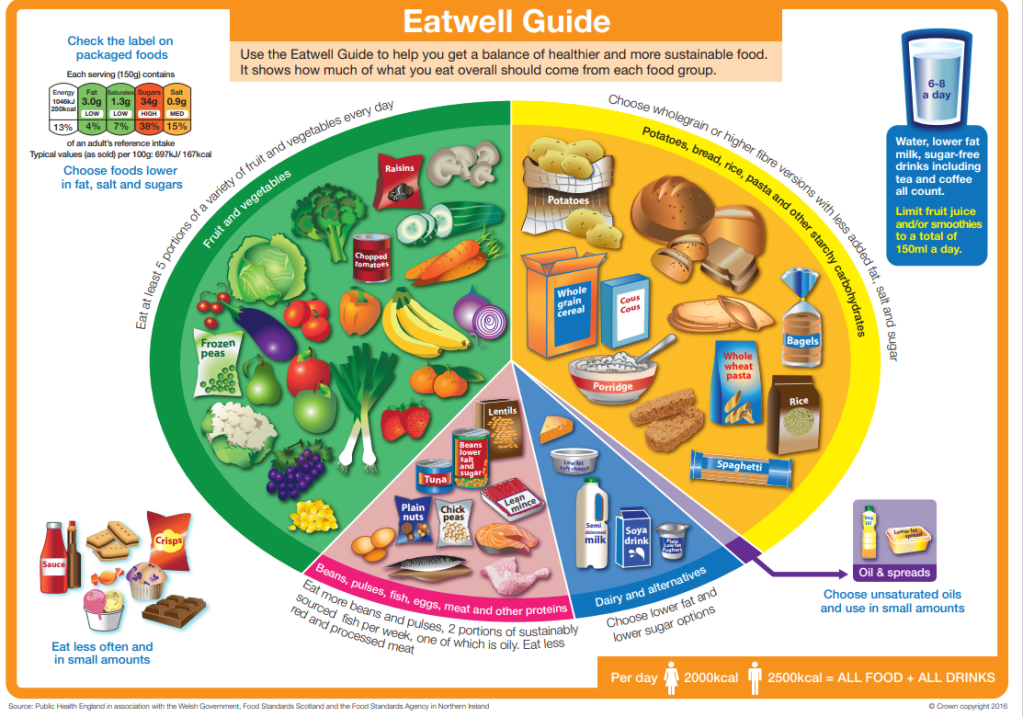
  • Check out a healthy eating plate like the one below to establish how much of each food group to should be eating.
  • Avoid listening to dietary advice from friends or family members, unless they’re a registered dietician or expert nutritionalist!
  • Remember that even diets which sound healthy, like vegetarian or vegan can still be highly calorific if certain choices are made e.g. eating lots of cheese and butter or consuming too much soya milk and other dairy alternatives.

There’s a wealth of accurate and reliable information provided by the (UK) government which includes a PDF version of the above and a comprehensive guide to eating well. Click here to go there now.

Lack of time

It takes time to develop a healthy lifestyle, including eating better and ensuring you have a balanced diet. Many people lead very busy lives and if improving your health isn’t currently one of your top priorities, you may feel that you haven’t got the time or energy to devote to making dietary changes.

The first thing I would suggest doing is spending about half an hour considering the different areas of your life and assessing which you’d like to focus on more. I use Hal Elrod’s Level 10 life sections to rate the different aspects of my life. The following aspects are given a score out of 10 (with 10 being near perfect and 1 being an area which requires lots of work):

  • Family and Friends
  • Personal growth and development
  • Spirituality
  • Finances
  • Career/business
  • Significant other/romance
  • Fun and recreation
  • Contribution/giving
  • Health/fitness
  • Physical environment (home/office)

If you figure you could make improvements in the area ‘health/fitness’ then it’s a good idea to identify some small changes you could make to your life to enable you to work on some related goals e.g. preparing a healthy packed lunch to take to work each day, cooking from scratch more often so you can enjoy the benefits of home cooked meals or creating a meal plan so that you can work on having a balanced diet with healthier snacks.

When most people say ‘I haven’t got time’, what they actually mean is that they don’t want to dedicate time to a particular venture, that they are actively making a choice to do something else or that the particular thing that they ‘haven’t got time for’ isn’t important enough to them or high enough up their agenda.

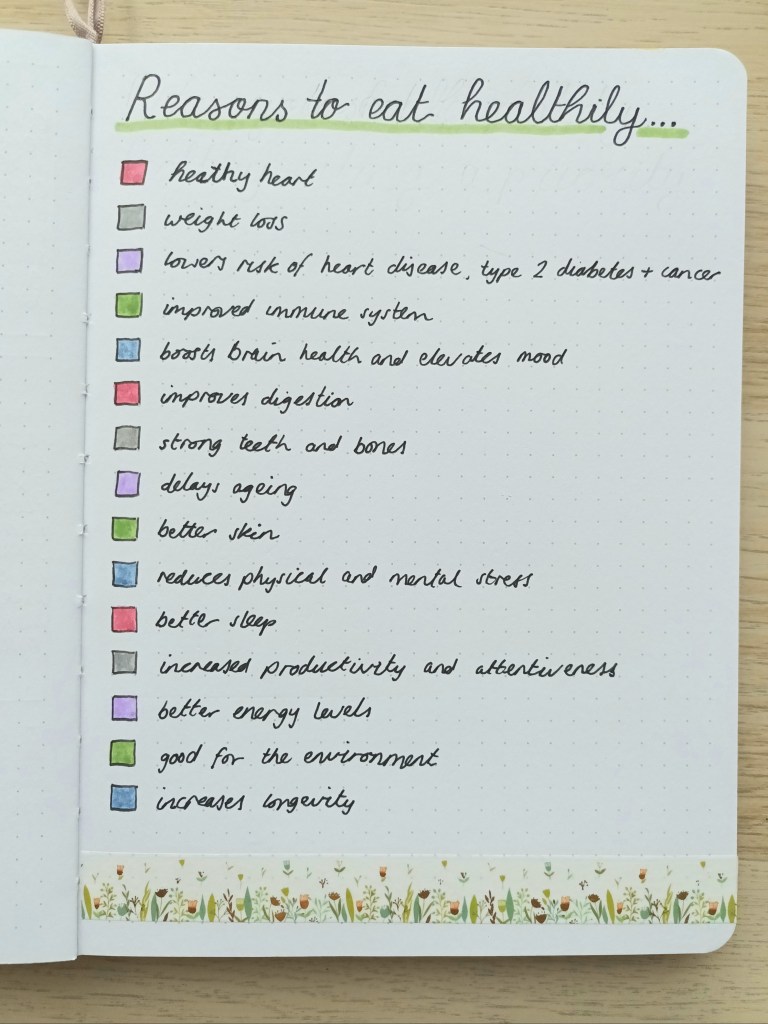
If you want to eat healthily but need help with motivating yourself to start changing your eating habits, you might want to do a little research on the benefits of a healthy diet and record your findings. I created a spread in my Bullet Journal as a great reminder of why healthy eating should be a priority.

A motivational page from my current bullet journal

A few time saving tips:

  • make twice the amount when cooking a favourite dish and save the rest to enjoy quick and easy leftovers later in the week
  • buy canned pulses so you don’t have to remember to soak them
  • have some pre-cooked packets of couscous, rice and grains to accompany your dishes
  • if you can afford it, buy pre-prepared veggies when you’re super busy
  • do a quick weekly meal plan over coffee on a Sunday morning and then make a list of groceries for the supermarket shop
  • have some frozen veggies in your freezer e.g. petit pois, spinach, green beans, mixed pre-chopped veg etc
  • batch cook and freeze soups and stews

Lack of confidence with cooking

Pre-prepared dishes or ‘ready meals’ as they are known, make it easy to enjoy a main meal but often these items are highly calorific and contain lots of sugar and salt. They’re also usually seriously lacking in vegetables which, as shown on the food plate above, should, along with fruit, make up a large portion of your daily food.

Home cooked meals might require a little more effort, but, you can find a range of simple, healthy recipes online or in cook books and if you specifically look for those which contain minimal or basic ingredients or label themselves as ‘one pot’ or ‘quick and easy’ then there’s no excuse to give it a go. You could also treat yourself to a few new tools and gadgets such as a set of cooks knives for speedy dicing of veggies, a food processor for chopping, mixing, grating and shredding, a blender for soups and smoothies or even a slow cooker for setting the dinner off at a simmer whilst you’re busy working so it’s ready to eat when you return home or get back to your kitchen.

My husband and I have found that each time we make a tasty and healthy dish we appreciate our efforts and the positive feelings it evokes prompt us to try more new recipes and boosts our confidence in the kitchen. We’re now more willing to try new ingredients and will give anything a go.

Feeling deprived

When you start working towards leading a more healthy lifestyle, you might give up some of the foods you like such as chocolate, crisps, salad dressings, sauces, ice cream and Friday night takeaways. Doing this may make you feel like you are being deprived of all of your favourites and can lead to lack of motivation to continue. Eating healthily doesn’t mean you have to stop eating everything you love. You just need to moderate the amount of sugary, fatty and highly calorific foods you have so that you eat then in small amounts and less often.

A popular way of achieving a healthy diet without feeling deprived is to apply the 80/20 mindset. This means that 80% of the time, you eat ‘clean’, choosing foods that are natural, whole and unprocessed e.g. fruit and vegetables, wholegrains such as wholemeal bread, brown rice, quinoa and wholemeal pasta, nuts and seeds, no-calorie beverages such as water, unsweetened tea. For the other 20% of the time, you can enjoy less-nutritious foods and treats. For example, on one day during the week, you might have an ice cream on a particularly hot afternoon or cake and coffee for a friend’s birthday etc. If you have several snacks a day over the period of a week, 11 or 12 of them would be healthy choices such as fruit, unflavoured nuts or low fat cheese on a wholewheat cracker, and 2 or 3 times you could enjoy a favourite treat such as a cookie or a small amount of chocolate.

Difficulty changing unhealthy or unhelpful eating habits and beliefs

Changing your eating habits to make them more healthy can be incredibly difficult, especially when many of them were established a long time ago, sometimes as far back as childhood. Some examples of unhelpful habits include:

  • eating whilst watching tv / YouTube videos etc (eating whilst performing other tasks)
  • piling your plate high with food at the buffet table (eyes bigger than your belly anyone?) because it all looks good / is free etc
  • eating a dessert even if you’re already full
  • emotional eating e.g. when bored, agitated, angry, stressed, upset etc. as a form of comfort
  • making your portion size the same as your partner who may have a much higher recommended daily calorie intake
  • believing that you have to eat everything on your plate, otherwise it’s wasteful
  • eating late at night, especially snacking just before bed
  • giving in to sugar cravings
  • believing you are hungry when really you’re actually thirsty
  • skipping breakfast
  • eating far too quickly

Even if you’ve had the same eating habits for years, it is possible to make improvements. I would suggest that the first step is to take time for some reflection. Consider what you good habits are e.g. always ensuring you get your 5 a day and your not so wonderful habits e.g. having a highly calorific dessert each evening after your main meal. If you’re not exactly sure what your habits are, try keeping a food diary, recording everything you eat and drink throughout one week. Also, think about what triggers your unhealthy eating such as a stressful day, a mid-afternoon energy slump etc.

Following your reflection and analysis, give yourself a congratulatory pat on the back for your healthy habits and then choose one of your bad habits to replace. So, for example, you might choose to focus on ‘eating too quickly’ and work on a plan to replace this with eating slowly and mindfully. Just as a bad habit does not evolve overnight, new and improved habits take time to develop too. But if you work on cementing one healthy habit at a time and continually reflect on how things are going, you can get there as long as a) you’re patient with yourself and take it one day at a time and b) you remember that there may be slip ups along the way and this does not mean that you’ve failed and should give up.

Tackling negative core beliefs about food and eating e.g. once I start eating, I can’t stop, I need to eat to make myself feel better, food is just fuel etc. can be extremely difficult. In this case, it is usually best to seek the help and advice of a trained professional such a dietician or a CBT therapist. These can be accessed via your GP.

Final words…

I hope you have enjoyed reading today’s blog post and it has helped to explain some of the main barriers to eating healthily. If you are planning on making changes to your diet, it’s best to make small changes rather than doing anything drastic. It might also be a good idea to do a little journalling and reflection on the process, for example, recording any improvements you notice such as clearer skin, better sleep and feeling more attentive when working etc. You could also reward your progress by giving yourself little treats (non-foodie ones preferably!) such as a bath bomb, a gorgeously scented hand cream, new stationery or a potted plant for your room.

Posted in Bipolar disorder, depression, depression management, lifestyle, mental health, Planning and journaling, wellbeing, wellness

Monday Matters: A mini guide to using Behavioural Activation as a treatment for depression

In last week’s blog post, I mentioned that my support worker and I have been using a technique called Behavioural Activation (B.A.) as a practical treatment for my depression and anxiety. Today, I thought I’d share an introduction to how B.A. works, ways in which it can help ease depression and anxiety and some tips on how to get the most out of using the method.

What is Behavioural Activation?

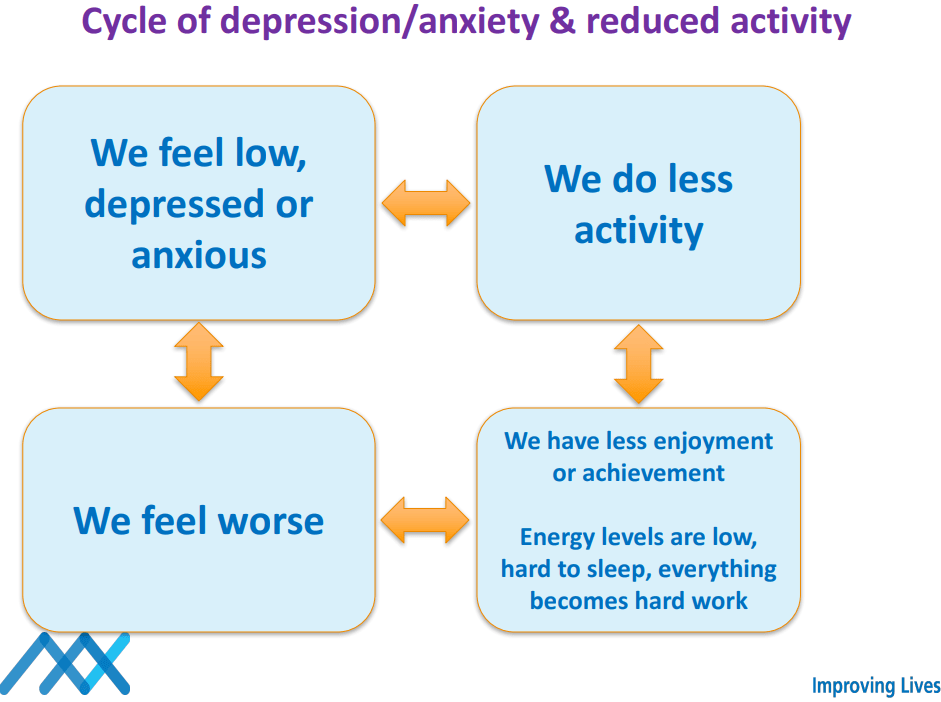
Behavioural Activation is an effective and pro-active treatment for depression which can be used in addition to medication and CBT techniques. Research shows that when individuals are struggling with depression their activity levels reduce, leading to less enjoyment and achievement and feelings of lethargy and poor motivation so that even small tasks and activities become hard work. This then becomes a vicious cycle of inactivity – depression and anxiety – inactivity and so on leading to us feeling worse.

Source: NHS Greater Manchester Mental Health

Additionally, a person may engage in unhelpful behaviours such as turning to drugs or alcohol, staying in bed late into the day, withdrawing from social situations or sitting ruminating about things.

Behavioural Activation (B.A.) aims to break the above cycle by increasing pleasurable and positive activity each week with a view to improving mood and decreasing feelings of anxiety, including any negative thoughts you might be having such as “I’m a useless wife/husband/partner”, “I can’t do this anymore”, “I’m never going to get better” etc.

Although Behavioural Activation is a relatively simple idea and can be used as a self- help strategy, I think it is best done with a therapist or support worker so that they can guide you through the process and provide encouragement along the way. They can also look at the particular difficulties you’re having and help you to put things in place to make positive steps towards tackling them.

Establishing a baseline – the first step of Behavioural Activation

Once you understand the principles behind B.A. therapy the first step in the process is to monitor your current activities throughout the week and how they affect your mood. This can either be done using an activity monitoring sheet, examples of which can be found online, or by simply making a list of what you do each hour of the day and scoring your mood out of 10 each time, 0 representing feeling very depressed and 10 representing feeling really good. This should help you to clearly see the relationship between your activity levels and your mood. You could also try listing which of your activities made you feel good and which made you feel bad, for example going for a walk in the park made me feel good, sitting and worrying that I’ll never get better made me feel bad.

Using a ‘Weekly Schedule’ sheet to make plans – the next step in the process

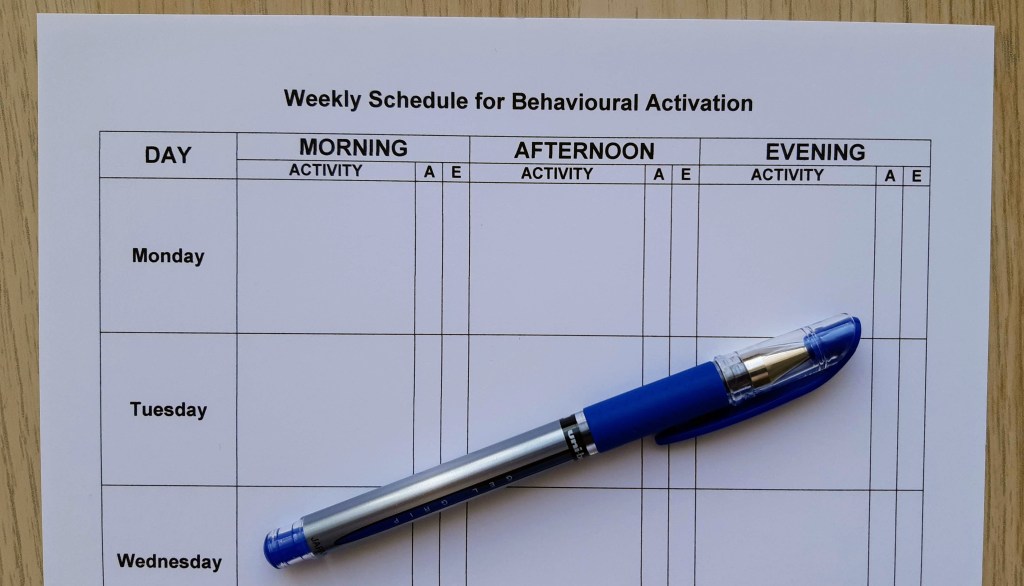
Once you’ve established what you are currently doing, it’s time to make some small improvements. Each week, you work on creating a schedule which should include routine plans such as having breakfast, going food shopping, pleasurable activities such as playing cards, watching TV, doing something creative etc and necessary things that need doing e.g. paying your car tax.

You should also try to include activities which you already do that make you feel better such as getting dressed, brushing your hair, going for a daily walk etc. So, for example, even though I didn’t feel like doing my yoga each day, I did it anyway as it helps to calm me and I feel good after doing it.

My modified B.A. weekly schedule sheet created in MS Word

What you write in the boxes depends on your current difficulties. For example, if you are struggling to get out of bed you might write in the first box ‘Up by 9.00am’, ‘Have breakfast’ and ‘Get ready’ (dressed, teeth brushed and face washed). If you’re currently not doing any household chores, you might add laundry related activities to your list. This can be broken down into small steps e.g. ‘Load the washing machine’, ‘hang out clothes’ and ‘Bring in washing’.

You should also try to think of activities which are important to you, for example spending time in nature, being creative, quality time with family or friends, eating a balanced diet etc. These are related to your core values and you might want to talk to a support worker or therapist to establish what you want from life so you can set some goals for the future. Although your depression is likely to lead you to believe that things will never get better and you will never again feel a sense of pleasure or achievement, try to think of your situation as temporary and know that things will improve in time (I know this is much easier said than done though).

Using your weekly schedule to good effect

Your weekly schedule is your plan for the week and is a guide for what you hope to achieve. It should be referred to throughout the day and will help you see what you have planned. It’s also a place to record your achievement and enjoyment levels (out of 10) so you can evaluate the effect B.A. is having on your mood. You might also like to spend time each evening reflecting on your day – you could even do a little journalling too. If you find your enthusiasm waning at any time, remind yourself why you’re using Behavioural Activation and think about the positives so far.

Tips on using Behavioural Activation to treat depression

Start small When I first started planning out my week according to the principles of B.A., I would identify one activity for in the morning, one for in the afternoon and another for in the evening. This would mainly include relatively simple and mindful activities which helped to distract my anxious and negative thoughts and improve my mood a little. So, for example, in the first week I would have breakfast, get dressed and straighten my hair in the morning, go for a walk in the park in the afternoon and then play cards, do some of my jigsaw or watch TV in the evening. By week 5, I was doing several activities in the morning, afternoon and evening and setting more difficult goals for myself. However, we always made sure I had some time for pleasurable and relaxing activities each week such as reading my book in bed two mornings a week (after having a good breakfast and brushing my teeth and washing my face).

Break down activities into steps When you’re feeling depressed, it’s common to lack the motivation to do even basic things. For this reason, it’s helpful to break down activities into small steps which feel more achievable. So, for example, ages ago I bought a cheap set of gouache paints and really wanted to have a go at using them. Rather than creating a full page art piece, I set myself the simpler task of painting some stems and leaves. For the first step, I experimented with creating different shades of green by mixing varying amounts of blue and yellow. Then I introduced small amounts of other colours of paint to explore what happened. I also added white to some of the mixture to make lighter shades. After that, I tried painting samples onto a small strip of watercolour paper to see if I had the consistency of the paint correct as I knew that gouache is quite a bit thicker than watercolour which I’ve used many times before. This was all I did on the first day. I returned to my paint samples a few days later and decided to have a go at some stems and leaves. I spent time looking online at different stem and leaf shape and patterns and then had a go at creating them using a small selection of brushes. By breaking down my art project, I avoided feeling overwhelmed. I also did the same for housework tasks e.g. rather than cleaning the whole kitchen, I started by just cleaning and polishing the sink area.

Routine, Pleasurable and Necessary Try to create a balance of activities on your plan so that you engage in a range of pleasurable and achievement related activities each week. So, for example, you might do some watercolouring on Monday morning because you know that you have enjoyed painting in the past. This would be a pleasurable activity (even if you believe that you won’t enjoy doing it). On Tuesday morning, you might put one load of washing in the machine and then hang it out in the sunshine when it’s finished. This would be a routine task (something that needs doing regularly) and is likely give you a sense of achievement. On Wednesday afternoon, you might plan to get a few necessary tasks out of the way such as renewing your car insurance, replacing a lightbulb or replying to an email or text message from someone.

Evaluate how your week has gone During my weekly support sessions, Nichola would ask me how my week had been and part of this involved talking through how I’d got on with my B.A. plans. This gave me the chance to share my achievements but was also an opportunity to identify any problems I’d had, if I’d found solutions myself or if I needed help to find a way forward. For example, one week, I’d got really upset because my dressing table in the bedroom was thick with dust and I felt ashamed at how bad it was. I only cleaned this one piece of furniture instead of the whole of our bedroom as I became really overwhelmed. We discussed that sometimes a task may need modifying or simplifying to make it easier and that I may need to try to be kinder to myself / show more self compassion etc.

Reward yourself regularly As well as going easy on yourself, it’s also a good idea to spend time recognising your achievements and reward yourself for progress made. As well as doing this with Nichola once a week, my husband talks with me about how my day had been and what I’ve achieved. Also, every Friday afternoon, we go to my favourite café for a coffee and cake as a well deserved treat. This has become a part of our weekly routine which will have carried on even though I’m now feeling much better and it’s not so hard to get things done.

Enlist the support of others If you find it difficult to motivate yourself to do the activities on your weekly schedule, it can be helpful to ask others for support. This could be a family member or friend who regularly checks in with you to see how you’re getting on and provides gentle encouragement. They might also help you with a particular task e.g. preparing a meal, filling in a form or tidying a space in your home.

Final words…

Although Behavioural Activation on its own isn’t a cure for depression, it can be a really useful coping mechanism and a helpful treatment for lifting your mood. Hopefully, in time, you will find that you start to enjoy some of the activities on your plan or feel a sense of achievement when you’ve completed tasks that you’ve probably been avoiding. As you continue to schedule in activities and complete them successfully, you’ll likely be motivated to do more. Remember, though, that there may be days along the way where you don’t feel so good and some of your tasks might not get done. This is okay and perfectly normal – just go easy on yourself and celebrate what you did achieve. Even a small number of activities done each day can have a big impact on your mood.

If you have any questions about Behavioural Activation, feel free to drop them in the comments and hopefully I’ll be able to answer them or direct you to an online resource which might help. Also, if you would like a copy of my Weekly Schedule, I would be more than happy to share it – just get in touch using the email address in the ‘Contact me’ section of my blog.

Posted in compassion, meditation, Mindfulness, wellbeing, wellness

Monday Matters: 5 Easy ways to Practice Mindfulness every day

When practiced regularly, mindfulness can have a really positive impact on our mental health, reducing feelings of depression, anxiety and stress. In today’s post, I’m going to share five simple ways to incorporate mindful activities into your day so you can enjoy the many benefits mindfulness brings.

What exactly is mindfulness?

There are lots of explanations and definitions available online but I particularly like this one from the Oxford dictionary:

a mental state achieved by focusing one’s awareness on the present moment, while calmly acknowledging and accepting one’s feelings, thoughts, and bodily sensations, used as a therapeutic technique.

Oxford online dictionary

Basically, mindfulness is about paying attention to the here and now, showing curiosity about what’s going on in a non-judgmental way. That’s not to say that as soon as you start practicing the various techniques that your mind won’t wander, it will, and that’s completely okay. But as you get used to paying attention in a range of simple ways, you’ll likely find it becomes easier.

So here are five ideas for practicing mindfulness every day that anyone can try.

Choose an activity you do each day and really pay attention

A great way to get started with mindfulness is to choose one activity that you do every day and bring moment to moment awareness each time you do it. Examples of suitable activities could be: drinking your cup of coffee or tea first thing in the morning, brushing your teeth, taking a shower, washing your face, getting dressed, driving to work. Whichever activity you choose, focus on knowing what you’re doing as you’re actually doing it, and what you are thinking and feeling from moment to moment too. At first, you’ll likely find that your mind wanders quite frequently, but if it does, gently bring yourself back to the present moment. With time, you’ll find it gets easier to remain mindful.

Connect with each of your five senses

Using your senses – touch, taste, smell, sight and hearing is a great way to focus on what’s happening right now. You can either spend time exploring each one in turn or pick a particular sense to focus on in a given moment. So, for example, you might sit quietly at home curled up in your chair with a coffee, smelling the aroma, being warmed by the heat of the mug. You might then close your eyes and tune in to sounds within the room such as the clock ticking, and far away sounds such as a dog barking. As you open your eyes, you might change your focus to the colour of your drink or the patterns on your mug, before taking a sip and savouring the flavour. At another time during your day, you might focus in on just one of your senses. So, during your daily shower, you might choose to focus on smell, inhaling the scent of your shampoo, shower gel or soap and your conditioner and really appreciating each one. By doing this you will be immersed in your current experiences rather than dwelling on past events or getting stressed about all of the things you have to get done before bedtime.

The following mindful activity is also a good one to do when you’re feeling anxious to help distract from negative thoughts, judgements and physical sensations associated with a tense body.

  • Close your eyes or lower your head and soften your gaze. Take some slow and deep breaths in and out.
  • Open your eyes and take your focus outside of your body. Find the following:

5 things you can see.

4 things you can hear.

3 things you can touch.

2 things you can smell.

1 thing you can taste.

Focus on your breathing

Breathing is a key part of mindfulness practice as it’s something we do naturally out of necessity. There are many online exercises which focus on the breath such as alternate nostril breathing, square or box breathing and equal breathing where you focus on making the inhalation the same length as the exhalation, but the technique which I find easiest and most comforting is soothing rhythm breathing, which I was taught as part of my compassion group sessions a few years ago.

  • Sit comfortably in your chair with both feet on the ground and your hands resting in your lap.
  • Close your eyes or direct your gaze downwards – whichever feels most comfortable.
  • Gently bring your focus to your breathing feeling the ribcage expanding as the air coming in to your lungs and leaving your body as you exhale.
  • Try breathing a little faster or slower until you find a breathing pattern that feelings soothing and comforting.
  • Focus on the breath as it comes in and leaves your body. You might like to notice the sensation of cool air entering your nose and warm air leaving.
  • Turn your attention to your body. Sensing the weight of your body resting in the chair feeling relaxed and supported. Feel your feet touching the floor beneath you.
  • If your mind wanders, notice what has happened and gently bring the focus back to your breath. Even if your mind is bobbing about all over the place, just accept what is happening without judgement and come back to the breath.
  • As you bring the exercise to a close, gently wiggle your fingers and toes and bring the focus back to the room around you.

To ensure you commit to this short meditative practice each day, you might find it helpful to make an appointment with yourself in your bullet journal or diary e.g. 5 minutes after you’ve eaten your breakfast or as an end of the day thing to encourage restful sleep. Again, this breathing exercise is also helpful to calm yourself down in moments of anxiety.

Engage in mindful walking

Whatever the weather, cold, warm, rainy, bright sunshine, cloudy, try to find 10 or 15 minutes each day to go for a mindful walk outside. Take time to pay attention to the different aspects of your experience. Start by exploring how your body feels when you’re walking – your feet as they make each step, your legs as they move you forwards, your arms as the swing by your sides. Next, tune in to what’s going on around you using all of your senses – perhaps you can hear traffic in the distance or a bird singing, maybe you can see the sun shining through the trees, perhaps you can smell the damp earth. Be open to whatever you notice, wherever you are and whatever happens. Try to fully immerse yourself in the here and now. As you end your walk, bring your attention back to how you feel as a result of your practice.

If you want to read about mindful walking in more depth, I wrote a whole blog post on it last year which can be found here.

Be totally present during conversations

All too often during conversations, we’re either multi-tasking or our mind wanders so we’re not paying full attention. However, being fully present has so many benefits for the speaker and the listener. Not only will you both feel valued, you’ll have a better understanding of the other person’s needs and any information that you impart is likely to be comprehended more easily. You’ll also likely improve both your communication skills and your relationship with the other person whether you’re talking to a friend, colleague or family member.

If you want to be more mindful in conversations, the first step is to notice when your mind wanders and, without judgement (no berating yourself for being a terrible listener!), bring your attention back. Try to resist the temptation to make excuses for being distracted such as “I was bored by what they were saying”, “I’ve got so much to do I couldn’t wait for them to finish” or “they were just repeating themselves”. Just remember that mindfulness takes practice and you are just learning but it will get easier with time.

In today’s busy world, multitasking is very tempting and often encouraged, but studies have shown that humans aren’t really capable of focusing on more that one task at a time, and in actual fact, what happens is our brain constantly switches between the different demands on our attention. If you want to be full focused on a conversation, try to put distractions aside. Put your mobile phone away in your bag, close your emails, avoid looking at what others are up to or what’s happening elsewhere by facing and looking at the participants. Really listen with interest to what the other person or people are saying using gestures such as a nod of the head, a smile or an “I understand” as appropriate. Think about the words they are using, their tone of voice, body language and emotions to really comprehend what they’re saying. Let the other person finish before you contemplate what they have said and offer a response.

Being a mindful communicator takes practice and isn’t always easy, but it’s a great skill to have and can be really useful in social settings as well as work situations.

Final words…

Although in today’s post I’ve presented a number of simple ways in which you can start to be more mindful every day, mindfulness in itself is not always easy to master. It might be helpful to remember that it’s not all about being perfectly present at all times – it’s a way of slowing down and making a conscious decision to notice our thoughts, emotions and the world around us, intentionally accepting things as they are right now without judgement. Being mindful can help us to enjoy life, understand ourselves better and reduce stress. It’s something that everyone can try and, when practiced consistently, has been shown to have positive effects on our physical and mental health, happiness, work and relationships.

Feel free to let me know in the comments how you get on and if you have any questions, I’ll be more than happy to answer them if I can, or direct you to further resources which you may find useful.

Until next time,