Posted in lifestyle, Planning and journaling, productivity, Setting goals and intentions

Monday Matters: What is the ‘WOOP technique’ and how can it help you achieve your dreams?

This week, I wanted to write a post about goal setting and fulfilling your dreams. I talked last week about the power of positive affirmations in developing confidence in your ability, but is telling yourself you are something such as successful, confident or happy enough to achieve in a particular aspect of your life? Whilst perusing the Internet for inspiration for my chosen focus, I came across something I’d never heard of before called WOOP. I’m willing to bet that a lot of my readers might not have heard of it either, so today’s Monday Matters is going to be an introduction to the principles behind this fascinating and scientifically researched idea, which to me, makes a lot of sense and might need more consideration.

What is WOOP?

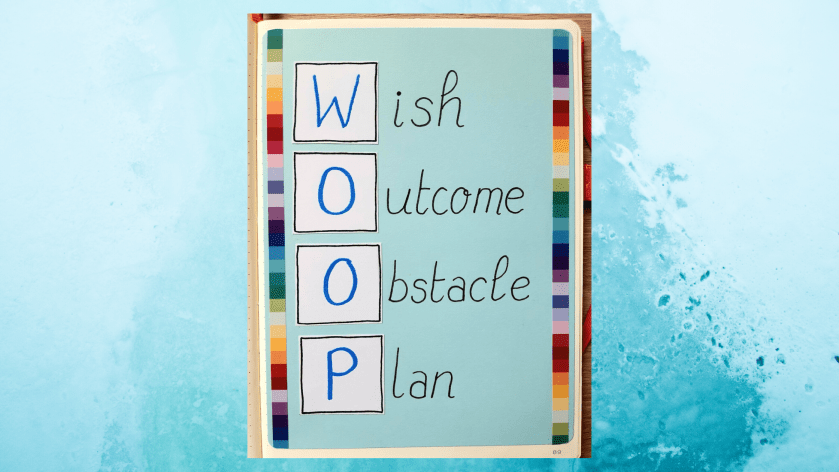
WOOP, which stands for Wish, Outline, Obstacle, Plan, is a scientifically based principle developed by German academic and psychologist Gabriele Oettingen. Her research has focused on ‘how people think about the future and how this impacts cognition, emotion and behaviour’ (Wikipedia). Gabriele has found that if we just dream or fantasise about something we want, our brains tend to think we have already attained what we desire and this can make us relax and prevent us from actually achieving our goals. She talks about two processes that we need to go through for the WOOP strategy to take effect, namely mental contrasting and implementation intentions (MCII for short). Basically, this means focusing on the contrast between the positive aspects of your desired goal and the barriers (negative aspects / obstacle / internal struggle) of you actually achieving your goal or wish. So, the WOO bit is the contrast as you imagine / visualise how wonderful it would be to fulfil your wish and then conversely, look at what might stop you. Thinking about both of these helps to motivate your self conscious to do something about the issue you face. The P part is the implementation intentions as you are coming up with a plan of actions and thoughts to work against your obstacle.

Gabriele and her team have spent 20 years fully researching and investigating goal achievement and the effects of mental contrasting and implementation intentions with studies including participants of different ages and backgrounds. The results of their work, has lead them to create WOOP as a framework for implementing change. The process has been found to be affective at helping people improve their social behaviour, health and academic performance. Examples of these scientific studies can be found online if you want to find out more.

Creating a WOOP

Wish Gabriele says that it is vitally important to give yourself some mental space in which to think about and imagine what you wish for yourself right now. You should dedicate some calm and uninterrupted time where you can specifically focus on your immediate wish for this present moment. Clearing your mind of everything else is essential so that you can dedicate your attention to working on your WOOP.

You may find that many wishes come into your mind, but you need to select the one that is most important to you and is challenging but do-able at the same time. Wishes can be about anything you want, your relationships, your job, your education, your health and fitness, whatever is important to you right now.

When you’ve decided on your wish, you should try to come up with 3 to 6 words to summarise it. I found this part really difficult as I’m very good at saying in 50 words what could be shrunken down to 5 but it’s important to be concise so you should really take your time to think.

Outcome When you have outlined your wish, you need to imagine what it would feel like if it came true (you might like to close your eyes for this bit so you can create an image of your life). Think about what the very best outcome would be and describe it in a small number of words (approximately 3 or 4 is a good number).

Obstacle Next, you need to think really carefully about what holds you back from achieving that wish. In other words, what is the main obstacle? For this, you should focus on an inner obstacle, i.e. something in you that is preventing you from realising your wish. You might find here, that you start to think of external obstacles such as other people or situations which you find yourself in but it’s important that you try to concentrate on yourself as it is much easier to create changes within yourself. Again, you could close your eyes and allow yourself to come up with a vivid image.

Plan When you’ve identified your main obstacle, you need to come up with a plan to overcome it. Again, you should try to summarise thoughts or actions in 3 to 6 words. Keep these in mind, whilst you create an If… then plan. Take your obstacle words and put them after the If. Then, place the thought or action after the ‘then…’. You can then recite your If… then plan a few times.

An example

Here’s an example from my own life. I’m now pretty good at doing yoga every day but there are always occasions when I don’t feel like doing it or think of other things I would prefer to do.

  • Goal: Yoga for 20 minutes every day
  • W: daily yoga practise for 20 minutes
  • O: Strength. Good posture. Mindfulness.
  • O: Don’t feel like it. Don’t bother.
  • P: If I don’t feel like it… then I’ll put my workout gear on, get out my mat and then remind myself of the many mental and physical benefits of practising.

Some other WOOP ideas

  • In bed by 10pm every night.
  • Be more productive.
  • Get a new job.
  • Find my soulmate.
  • Stop eating unhealthy snacks.
  • Read a self help book.
  • Meditate for 10 minutes each morning.
  • Finish a project before the weekend.

You might find the process a little tricky at first, but once you’re proficient in WOOP, you can apply it to so many situations – daily tasks, habits you want to instil, projects you want to complete or whatever you want really! Also, you will likely get much better at summarising and getting to the crux of the matter in terms of your inner obstacle which will help you develop solutions more quickly.

The WOOP app

When I visited the website for WOOP, I discovered that there’s a free APP available, so I thought I would download it and see how it works. As well as giving an introduction to WOOP, it also guides you though the process of creating WOOPs for professional, health and interpersonal wishes.
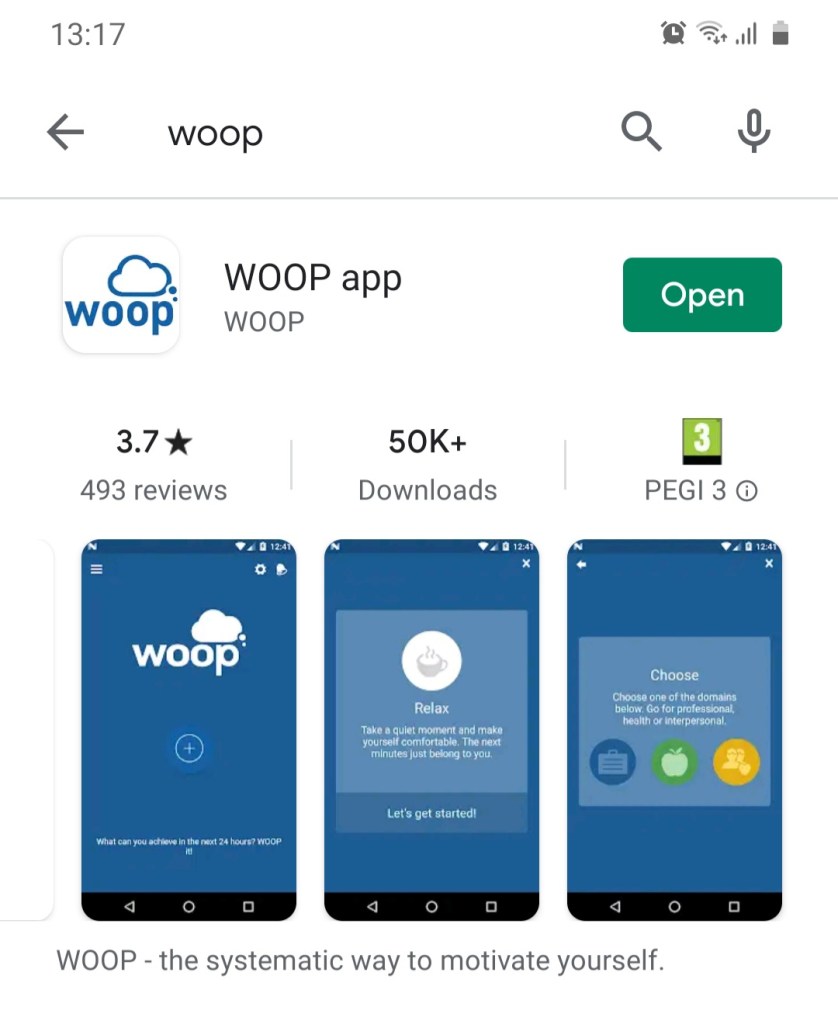
The app guides you through each WOOP by giving you a number of prompts. You can choose a timeframe from 24 hours or 1 month or you can select not to have a time frame. The app gives you limited characters in which to compose your wish, outcome, obstacle so as to encourage you to keep it brief but I can imagine it’s quite frustrating if you feel like you can’t condense it down that much. It also asks you to take your time with thinking about each step of WOOP and if you click through the steps too quickly, it will warn you that you are going too fast! If you like having things noted down on your phone, then I think you would benefit from using the app, but personally, I prefer to write things in my BuJo and have a notes page to refer to, to help me create my WOOPs.

That’s all for my introduction to using the WOOP technique for setting goals and creating a plan to achieve them. If you want to learn more about WOOP and watch a great video introduction, visit woopmylife.org Here you can also find the link for the mobile app and a free printable to help guide you through the process.

Posted in bullet journal, gardening, Planning and journaling

Useful gardening spread ideas for your bullet journal

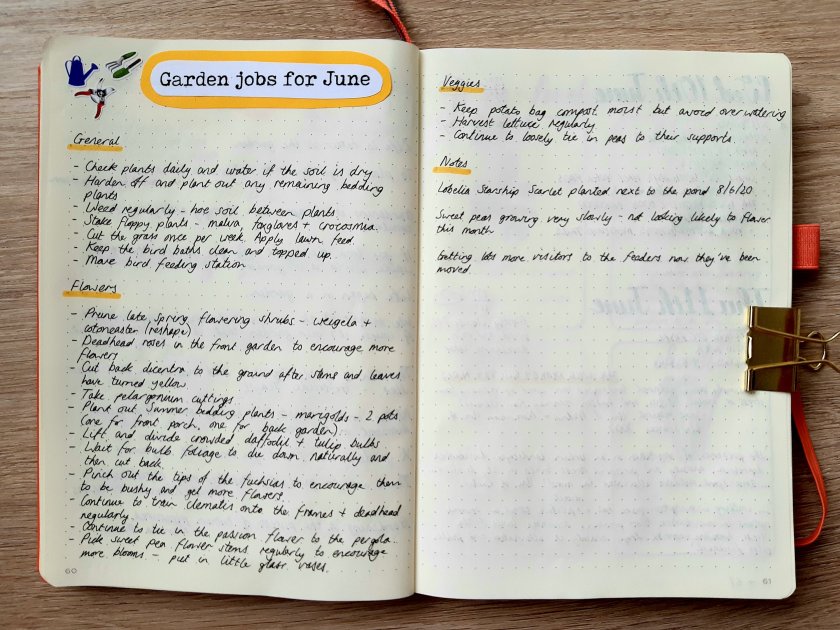
As I was setting up my bullet journal spreads for June 2020, I decided that I would really like to begin to record key information about our garden including new plants, veggies we’re growing this year, plants which are thriving and which are not and why, plus sketches of our front and back spaces. I debated creating a separate garden journal but in the end I decided just to dedicate some pages each month within my planner so that everything about my life and our home and garden is all in one place. Before deciding on some layouts for my gardening spreads, I trawled Instagram, Pinterest and various websites for ideas. I found some really great spreads and took inspiration from them to set up my own.

I decided that over the next couple of months, I would like to create the following:

  • Jobs for each month – split into general tasks, flowering plant care, veggies and notes.
  • Information cards for new plants and our potted herbs
  • Photos of our actual plants in flower each month
  • Gardening quotes and motivationals
  • Wildlife spotted in the garden – with sketches
  • Plants to encourage wildlife
  • Birds in the garden – sketches and info
  • Aerial drawings of our different planting / garden areas

Garden tasks

There are lots of jobs for us to do in June but we’ve ticked off quite a few of them already. We certainly won’t be needing to water the garden or mow the lawn right now as it’s very wet out there because we’ve had rain showers for the last week or so. I intend to create one of these spreads each month using information collated from various websites.

I finished off the information cards for all of the plants that we’ve bought so far and also created some for our garden herbs. I’m hoping to get a few more different herbs soon so I’ve left some room for those on the spread too. The layout of these pages was inspired by the work of Emma at http://emusing-emma.blogspot.com who shared her houseplant information cards which she produced in her BuJo (direct link here). Make sure you check out her website if you love looking at ideas for your own bullet journal.

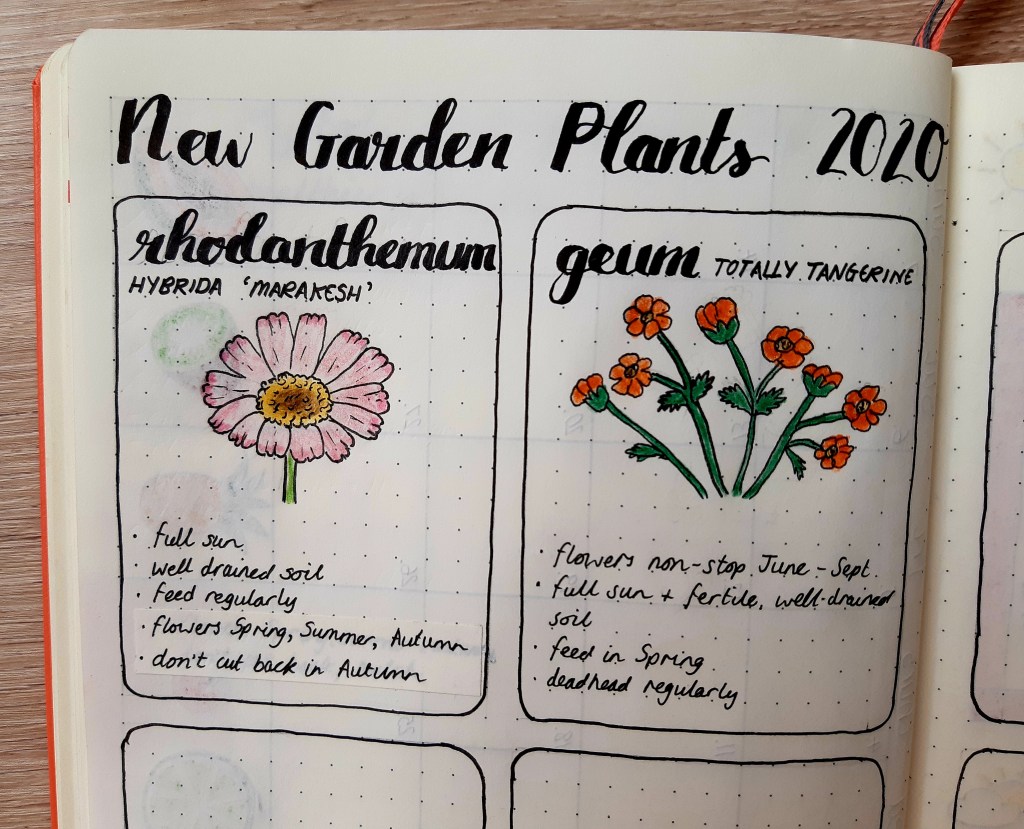
Information cards for different plants

I showed the beginnings of this type of spread in my June plans but I have since added some more drawings and information. I’ve also created some cards for the herbs we have in our containers. Again, my inspiration for these layouts was from Emma over at http://emusing-emma.blogspot.com/ The specific bullet journal spreads can be seen if you check out this link but I think all of her blog is well worth a look if you are like me and enjoy using a bullet journal and also love to get creative.

Garden related quotes and motivationals

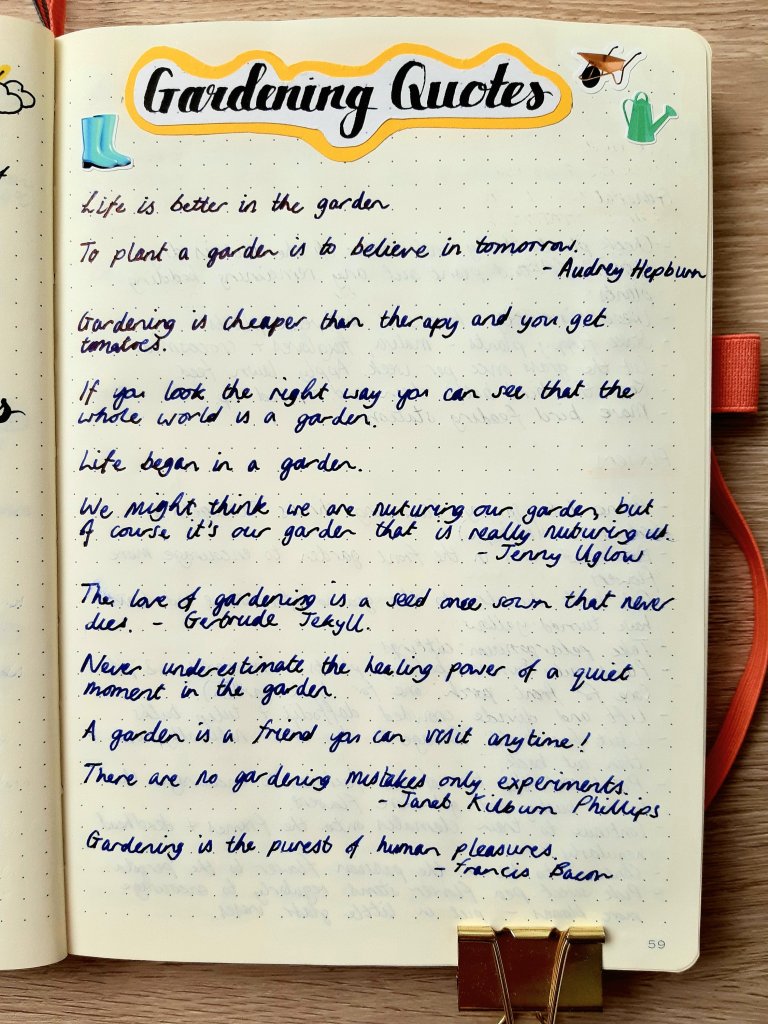
I’ve recently written a blog post about the health benefits of gardening and the opportunity to practise mindfulness whilst you are spending time in your outdoor space. As part of the article, I included some quotes about gardening. I found some more quotes whilst I was perusing the internet so I decided to handwrite some of them in my BuJo. These were written with my lovely left handed Lamy fountain pen which flows beautifully!

Wildlife friendly planting

We’re really keen to encourage wildlife into our garden and already have a bird feeding station, two bird baths, a bug hotel which my husband made and a small pond. We also like to have lots of plants which attract bees and butterflies so I decided to create a spread of wildlife friendly shrubs and flowers. We have some of these already but I have red valerian on my wishlist for the front garden.

‘Bird’s Eye View’ of our garden areas

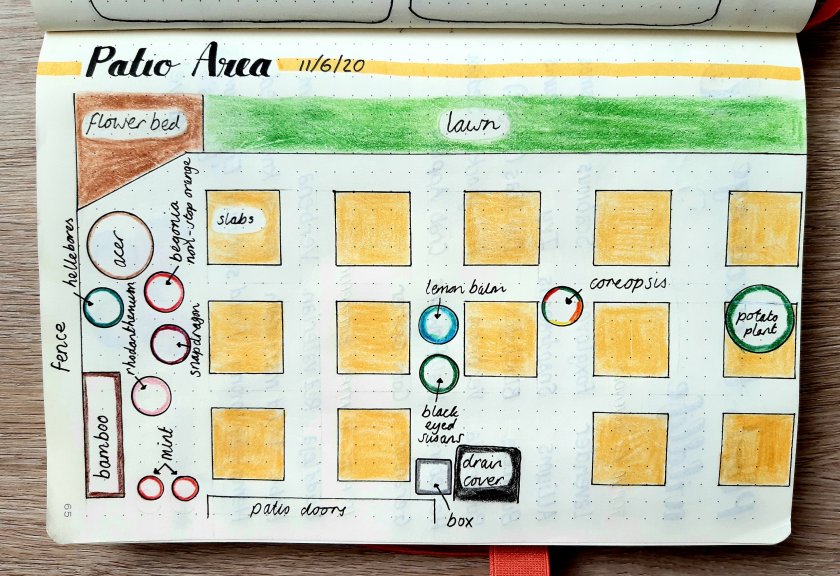
This is the first of my aerial view sketches of areas of our outside space. Just this one section took me a while to draw and add some colour and it’s not even to scale! I decided to use coloured pencils to shade around the outside of the shapes denoting our containers so that I could remember which of our pots we used for each of the plants. I’m going to aim to have all of my garden sections drawn out in my BuJo by the end of next month – let me know if you want to see the rest and I’ll do my best to take some decent photos when we have some brighter weather.

Wildlife spots

These pages are going to have little sketches of minibeasts which have been spotted in our garden and key information about them collected from a variety of sources. My spread is completely blank at the moment as I want to capture the bugs with my macro lens and at the moment, it’s too wet and drizzly to go out!

Birds in the garden

We get plenty of birds in our garden, particularly in the Springtime so I thought I’d create some pages in which to include sketches of our visitors and some information about them. I decided to do the actual drawings in my sketchbook and then transfer the pictures over to my bullet journal by scanning them on my scanner and then printing them off. This has lots of benefits – it means I can make several attempts at them if necessary, I can use decent quality drawing paper and I won’t end up getting pencil smudges in my BuJo. I’m yet to start my sketches yet but hope to be able to share some soon. As I’m typing a goldfinch has just landed on our sunflower seed feeder. It’s the first one I’ve actually seen visit our feeding station this year. We have two seed feeders containing niger seeds and a tiny seed mix specifically for finches and typically, it hasn’t gone for either of those – maybe collecting tiny seeds is too much effort in the pouring rain!

Do you keep a garden journal or do you just keep the little plant label information things from the pots like we’ve done previously? Have you got a dedicated notebook or do you prefer to produce spreads in your main planner? I would love to hear about the kinds of records you keep and if they’ve particularly helped you with your garden.

Happy gardening!

Posted in art, bullet journal, creativity, Planning and journaling

Setting up my bullet journal for June: Summer fruits theme

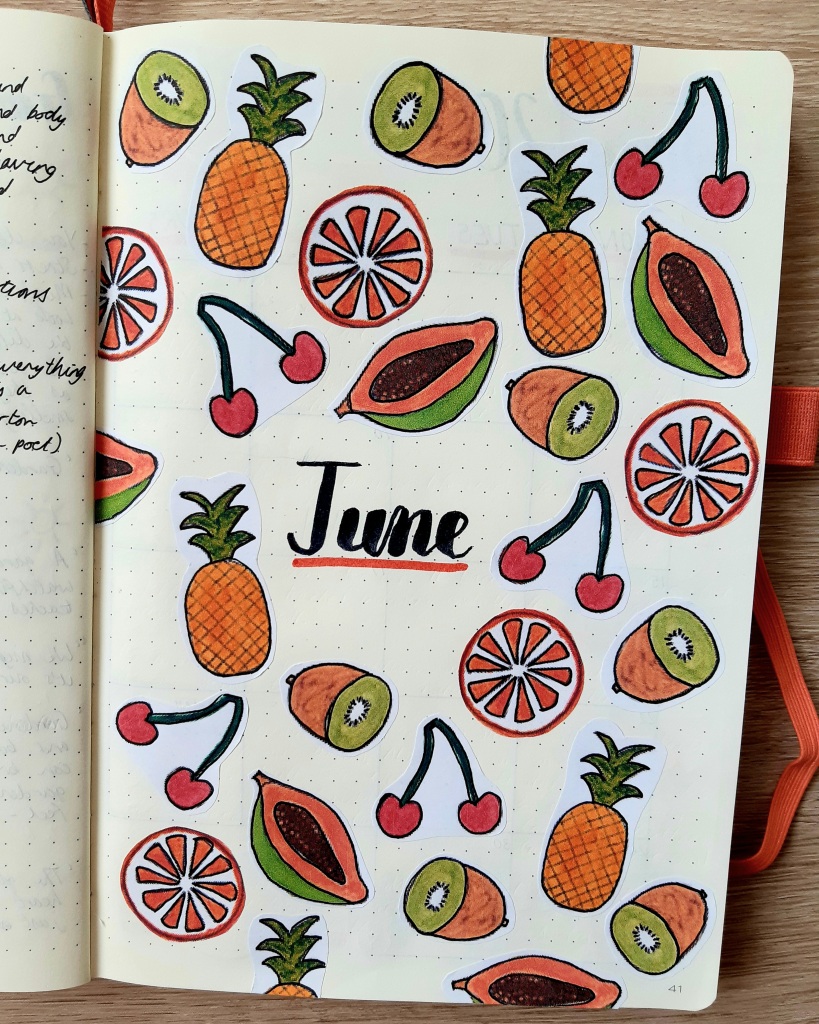
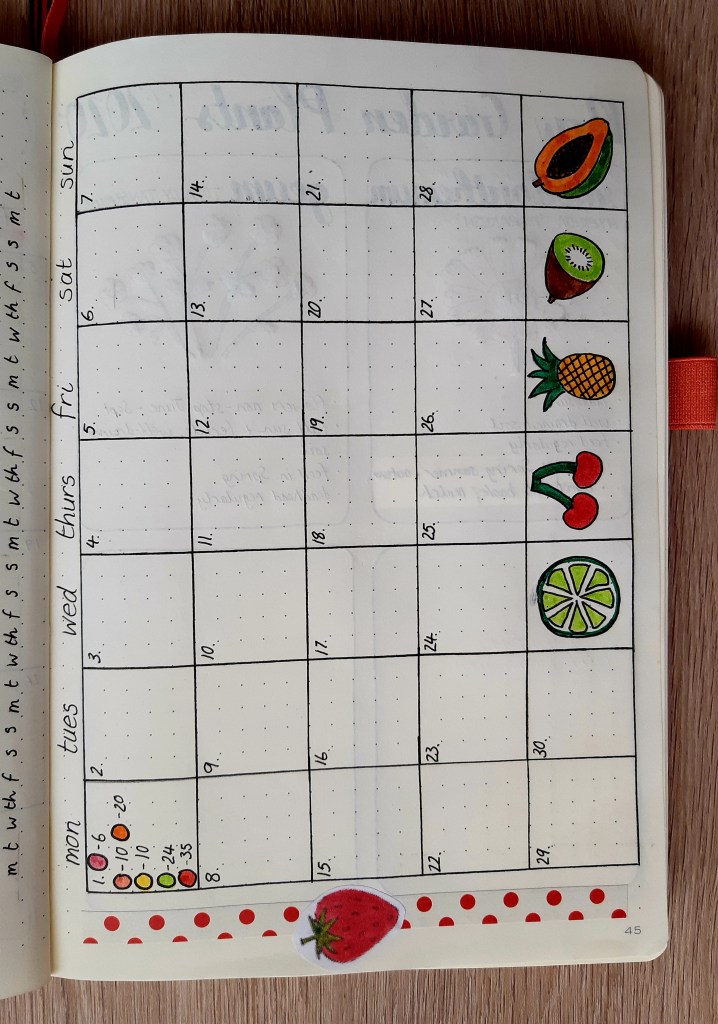
This month I’ve gone for a bright and colourful Summer fruits theme and have included my own little fruit watercolour paintings which I scanned in and worked on using Photoshop on my computer and then turned them in to little stickers. I’ve not totally got to grips with all of the different things you can do on this program but I followed a great little tutorial which I’ll share below.

For my front cover, I created five different fruits, namely papaya, orange, kiwi, cherries and pineapple. I started by sketching them with pencil and then when I was happy with how they looked, I went over the outline and some details using a 0.2 UniPin fineliner. I then mixed colours from my Daler Rowney travel set and used a tiny brush to paint them. Each one is less than 4cm so I really took my time to ensure accuracy and it was a great mindful watercolouring activity. After scanning the paintings, I edited the background to make it white and removed some minor blemishes. Check out this great tutorial on YouTube for how to do this.

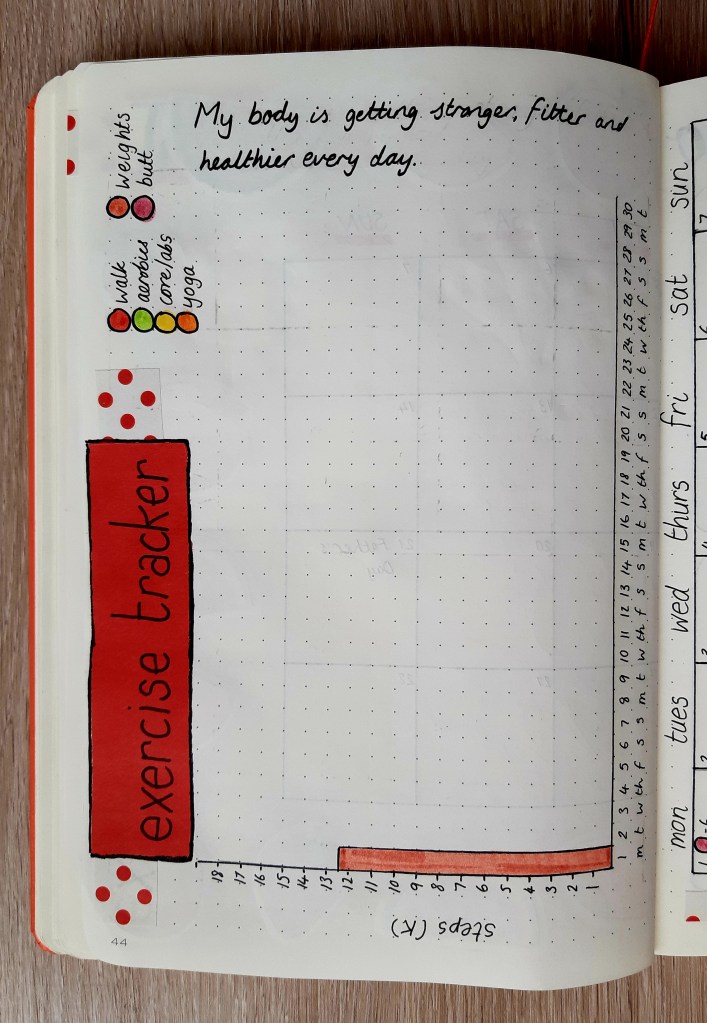
For my month at a glance I used the same kind of layout as usual with 6×6 dot boxes and again made my own stickers from some fruity artwork. I successfully covered up part of the date using some paper washi style stickers as I accidently wrote the beginning of the year as 200 instead of 2020. I did the spread late in the evening and think I was overly tired and that’s when I tend to make lots of mistakes. I also messed up on the next page too with is why I have a red paper background to the words ‘exercise tracker’.

As you can see, there’s a distinct lack of things happening in June due to the continuation of lockdown restrictions! My husband and I have started to go out to places but we tend to go on a whim rather than pre-planning.

I’m continuing to monitor my workouts in June and have just made a few small modifications and changed the colour scheme to fit with the Summer fruits theme. I’ve decided to make the steps tracker larger and have changed the scale on the graph to make it easier to fill in.

Finally, this month I’ve decided to make a record of the plants we’ve bought at the garden centre this year and include key information from each of the labels that came in the pots. I’ve also added a small drawing and coloured it in for each entry so that I’m also practising my drawing skills. The art work isn’t perfect but I’m getting better the more I give sketching a go. The layout of the spread is inspired by Emma at emusing-emma.blogspot.com who did something similar for her houseplants a few years ago in her bullet journal.

That’s all my spreads for this month. I have more plants to add to my record but won’t get them drawn until later on. If you would like to see more of my plant information, let me know and I’ll add them on to my BuJo set up for July.

Take care and stay safe everyone,

Posted in life hacks, lifestyle, Planning and journaling, wellbeing

Monday Matters: 5 ways to get better sleep tonight

Photo credit: Andrea Piacquadio on Pexels

The current pandemic has surrounded us with worry and uncertainty and many of us with mental health issues will be finding ourselves battling with increased anxiety and heightened stress levels. This, coupled with changes to our daily routines, can have a huge impact on our sleep such as struggling to fall asleep and waking in the night. This then impacts on us the next day as we feel lethargic, unhappy and irritable and sometimes barely able to function due to being so tired. Although I’ve had huge issues with insomnia in the past (and chronic restless leg syndrome), I’m actually sleeping really well right now due to a few different things that I’ve put in place. So, although I’m no sleep doctor or expert, I thought I would share my 5 best tips on how to get a good night’s sleep that have worked for me.

Journal writing as a way of putting the day to rest

This is a technique that I’ve been using off and on since I learnt about it in my CBT sessions. It’s particularly useful when you feel like your mind is overloaded and if anxious thoughts usually start for you as soon as you get into bed.

Choose a time when you feel it’s best for you to reflect on your day. This should be late enough that you have done any household chores and finished any sort of homework or studying but early enough that you can spend some time relaxing afterwards before heading up to bed.

Using a notebook or paper and pen rather than a laptop, begin by reflecting on your day and how you feel about how it went. Jot down a few of your thoughts, focusing on the main points, including what went well and what, if anything, is troubling you.

Photo credit: Laura Jones for Keeping it creative

Next, write a to do list of things that you maybe planned on doing but didn’t get done or tasks that you might like to complete tomorrow or later on in the week. Getting it down on paper will mean it’s there for you tomorrow if you need to revisit it.

Now think about tomorrow – what are you looking forward to and what may cause you anxiety. Write down your schedule for the next day (looking back and your list from the above task). Also, make a note of anything in your planner that you need to enquire about or check out.

Now put your journal or paper to one side and focus on doing relaxing and unwinding activities of your choosing for the rest of the evening e.g. reading for pleasure, a craft activity, some yoga or meditation.

If any worries pop into your head when you get into bed, remind yourself that you’ve already dealt with them or have scheduled a time to focus on them tomorrow.

Avoid any type of stimulant later in the evening

We all know that coffee and regular teas contain caffeine and that you are best off avoiding them in the hours before bed, but have you ever thought about other drinks and foods that have a stimulating effect? Any drinks that contain a high level of sugar, for example hot chocolate, fizzy soft drinks such as coca cola or lemonade, and (unfortunately) many of my favourite liquors such as Archer’s, Baileys, Kahlua and Amaretto, will increase your energy levels – and that’s the last thing you need if you want a good night’s sleep. Also, alcohol of any kind will make you feel drowsy straight after drinking (making you think it’s perfect for making you tired) but also often causes night time waking e.g. with an urge to visit the bathroom, and changes to your sleep pattern such as to vivid dreams as a result of abrupt transitions between sleep stages.

High sugar desserts such as cookies, cakes and ice cream should also be avoided if you are eating quite late – in fact, eating late in the evening should really be avoided as, if you do, your body will still be processing your food when you lie down in bed and this can cause indigestion, reflux and other digestion problems which are certainly not going to help your sleep situation.

Another stimulant which commonly affects people is the use of electronic devices last thing before bed. The bright blue light being emitted from tablets, televisions and mobile phones is known to stop the production of melatonin which is the hormone responsible for your circadian rhythm AKA your body’s internal clock. Some phones and tablets have an option to put on a blue light filter and you can even create a schedule so that it is turned on between set hours. I still try to avoid using devices for at least an hour before bed and instead do some relaxing activities such as meditation, reading a paperback or doing some restorative yoga.

Use of social media shortly before retiring for the evening can also be a source of heightened stress levels. I’m sure we’ve all read something online which has incensed us or wound us up and made it very difficult for us to relax as a result. I try to avoid going on platforms like Facebook and Twitter after a certain time for this very reason.

Create an evening relaxation routine

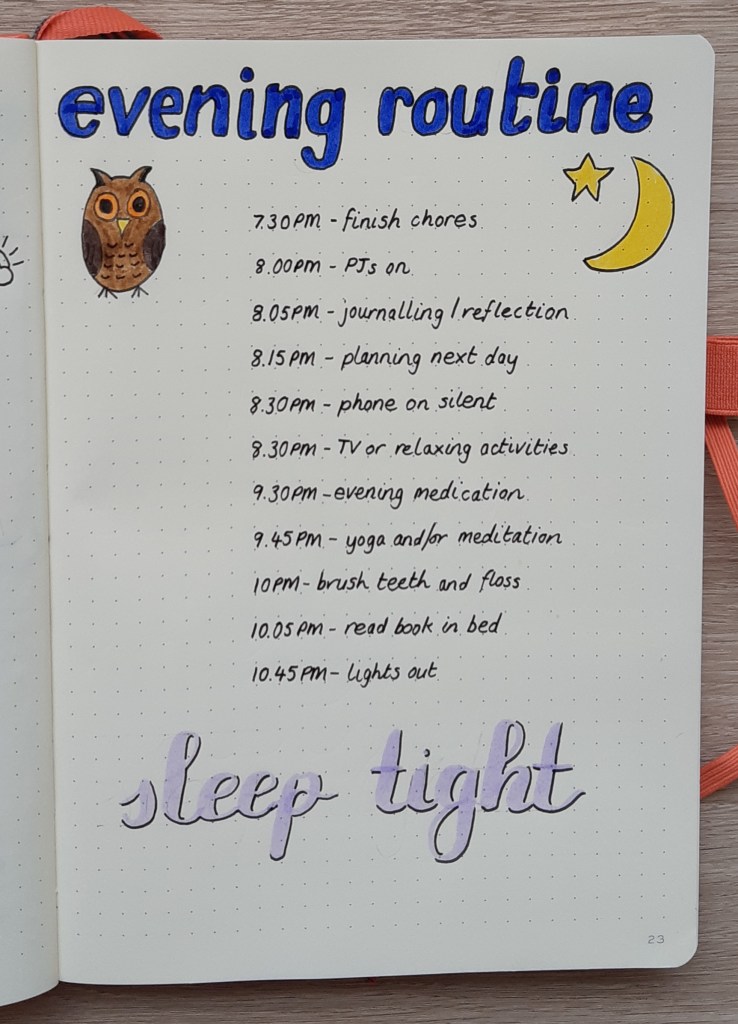
Last week, I made a spread in my bullet journal that detailed an evening routine of relaxation techniques that I feel will help promote a feeling of restfulness in preparation for going to bed. I started by thinking about what my evenings have looked like in the past which have lead to a terrible night’s sleep and jotted down my ideas e.g. eat late and drink wine or cider after 9pm, get into a debate on a social media platform e.g. Facebook or Twitter, or read something controversial online, tackle chores just before bed, work on projects late into the evening etc. Then I thought about the complete opposite of this e.g. eating at a reasonable time, limiting alcohol intake and not drinking after 8pm (2 hours before bedtime), finishing chores by 8.30pm, journaling and putting the day to rest, doing a gentle yoga routine, completing a breathing meditation, silencing my phone, doing meditative activities such as colouring on, cross stitching or a jigsaw puzzle etc.

Photo credit: Laura Jones for Keeping it creative

Obviously it takes weeks to establish a new routine but by writing it down, I think it reinforces your intention and makes you more likely to stick to it. You can also reflect on it as part of your evening journalling, for example, writing down that you woke up with a headache and detailing reasons why this might have happened, recording that you woke up feeling refreshed because you had a wonderful night’s sleep and why this might be the case.

Get some exercise but avoid anything aerobic for at least 2 hours before bed

I’ve found that I’m able to sleep so much better since developing a daily exercise routine. You don’t have to do something intense each day but a nice, brisk walk for around 30 minutes should help you feel less stressed and more relaxed by the time evening comes. Make sure, however, that you don’t do any exercises that get your heart rate up for a couple of hours before bed as this will leave you feeling energised and stimulated and actually delay your transition into sleep.

Get your bedroom environment just right

If there’s one piece of bedroom furniture worth investing some money on, it’s a decent mattress. We’ve tried various types over the years and at one point had a memory foam topped one but we found it made us too hot and this wasn’t conducive to sleep. We now have a ‘Posturepedic’ which provides amazing support, helps maintain good spinal alignment and is super comfortable. You should also think carefully about your pillows too as the kind you choose depends on your regular sleeping position i.e. if you are a back sleeper or side sleeper.

Another consideration is the temperature in your room. It’s suggested that the ideal is around 16-18 degrees Celsius (between 60 and 67 degrees farenheit) and that if your bedroom is too hot or too cold it may affect the drop in your body’s internal temperature and cause you to have disrupted sleep. During the warmer months, we get the sun coming in through the window on an afternoon so I often close the blinds and make sure the door is wide open to avoid it getting too hot in there. We also have different togs of duvet and a cotton sheet for different times of the year to ensure we’re cosy in the winter and not too hot in the summer.

Having your room nice and dark also helps you to sleep better and many people like to use blackout curtains or blinds for this reason. However, we prefer just to use dark and thick, well-lined curtains as we find that some natural light first thing (during the spring and summer months) helps you to wake up gradually – think about how difficult it is to drag yourself out of bed when it’s still pitch black in the winter months!

I hope this tips help you to get a restful night’s sleep. I know at the moment, with the lockdown restrictions, it might be hard to maintain a good bedtime routine but your body will thank you for it if you do.

Sweet dreams,

Posted in compassion, mental health, Planning and journaling, wellbeing, wellness

Monday Matters: Creating a WRAP Part 5 (final in the series)

Over the course of April, I’ve produced a series of posts about the process involved in creating a Wellness Recovery Action Plan. Today is the final installment in which I look at Crisis Planning. As I stated in my last Monday Matters post, I did not complete this section of the booklet myself as my illness has never reached crisis point but I intend to go over what this part of the plan would look like and suggest some ideas of what you might include.

What constitutes crisis?

Although there is no set definition for a crisis, it can be described loosely as being a state of emergency that poses an immediate threat to your physical or emotional wellbeing. Therefore, in spite of your best planning and actions to keep yourself well, you find yourself in a situation where others need to take over your care.

Crisis planning

This part of the W.R.A.P. has 9 sections and I will go over in in turn. Although the whole plan is very personal to the individual, I can offer suggestions on the kind of information you might record in each list.

Part 1: What I am like when I’m well

This can literally be copied from the second page of your plan and is simply placed in this part of the document for ease of access.

Part 2: Symptoms

This is a list of signs that tell others that they need to take over your care. Some examples include violent out of control behaviour, psychosis (loss of touch with reality), paranoia, abusive behaviour towards self or others, inability to perform basic tasks such as bathing, brushing teeth etc, showing signs of planning own suicide (Mind website information on this can be found here).

Part 3: Supporters

This is a list of people you want to care for you if the symptoms you listed in Part 2 occur. Include family members and health care professionals but make sure you seek their permission to me added to your list so that have advance warning in case something happens in the future. You can also include a list of people you do not want included in your supporters list too.

Part 4: Medication

In this section, you can write which medications are okay to be given and which are not. So, for example, you might have reacted in a bad way to a particular antipsychotic in the past and be worried that it might make you worse if administered again.

Part 5: Community Plan

In this section, you can list your preferences for your care so you can feel you have some say in what happens when you are unwell. So, for example, you might prefer to have the Crisis team visit you at home and come up with a plan for you in consultation with your partner or you might feel that you are best off being hospitalised.

Part 6: Treatment Facilities

Here, you would list where you would prefer to be treated or hospitalised if that becomes necessary. You can also add facilities that you would rather avoid if possible and why.

Part 7: Treatments

In this part, you can include treatments and therapies which you feel would be most beneficial and those which you wish to avoid and why. You may have tried alternative therapies that have worked in the past and wish them to be administered again.

Part 8: Help from others

Here, you can write down what you want from your supporters which will help make you feel most comfortable. Obviously, this list is very personal but might include the kind of things you would like people to say to you for encouragement or avoid saying as you know they will not help.

Part 9: When my supporters no longer need to use this plan

In this section, write a list of indicators that your supporters no longer need to take over your care. What are the signs that show you are once again in control of your life? This might include features of wellness that you display which show you are well on the path to recovery.

Looking forward

Remember that if you do reach crisis point, despite putting all of the elements of a W.R.A.P. in place, this is not the end of the world and it certainly does not mean that you won’t recover. After you have taken the time to get yourself feeling better and stronger, you might like to revisit your plan with one of your supporters and discuss any improvements you might be able to make to your plan and the action which goes with it. Maybe, on reflection, you didn’t do enough to keep yourself calm and relaxed in daily life and could benefit from putting more self soothing activities into place. Or perhaps a loved one recognised signs of deterioration but you chose to ignore it or go into a state of denial. Whatever happens, you can learn from the experience and try to make plans for the future.

And that, as they say in the filming industry, is a WRAP. I hope you have found my series helpful and can see the benefits of producing this kind of document to help with issues relating to mental health. If you would like support to write your WRAP, I suggest looking into if there is a Recovery College in your local area or if you are able to work with a mental health professional as part of therapy sessions to make one.

Wishing you a wonderful week,