
Posted in Bullet journaling, life hacks, lifestyle, Mindfulness, productivity

Monday Matters: 8 wonderful benefits of listening to music

Photo credit: Lee Campbell for Unsplash

Back in October of last year, I found my mental health deteriorating, and, once again, started to have difficulties with anxiety and depression. I’m now (thankfully) feeling much better and my improved wellbeing has enabled me to start blogging again. Whilst I was struggling, the main focus of life was on doing any little thing I could either to distract myself from how I was feeling or to improve my mood. I found music was a huge help and so, for today’s Monday Matters post, I want to focus on the benefits of listening to music. The following are applicable whatever your musical preferences and can be utilised whether you are finding things difficult at the moment or feeling happy, content and positive, like I am currently. Let’s get started..

1. Elevates your mood

Whatever our taste in music, I expect we can all name at least one song which, when it starts to play, is able to shift our mood in a matter of seconds, making us want to turn the radio up, jump to our feet and start dancing around the room or burst into song. It may be the tempo, the lyrics or the sparking of a happy memory which uplifts us. Whichever of these it is that gets us going, scientific research proves that these tunes promote the release of a neurotransmitter known as dopamine into our bodies and it is this which is responsible for making us feel so good. If you do find yourself singing or dancing along to the music too, you will be doing yourself the extra favour of encouraging happy hormones known as endorphins to flood your body as well!

Making a playlist for times when you are feeling a little low or even depressed can be really useful. This can either be on your phone, your IPod or even in your bullet journal so you can seek out those songs on Spotify, YouTube or whatever is your music player of choice. Having them written down is particularly helpful for those times when you are struggling as, at that time, you may not be able to recall songs which are able to make you feel more upbeat.

The following page was inspired by one created by @sunshine_journal_ on Instagram.
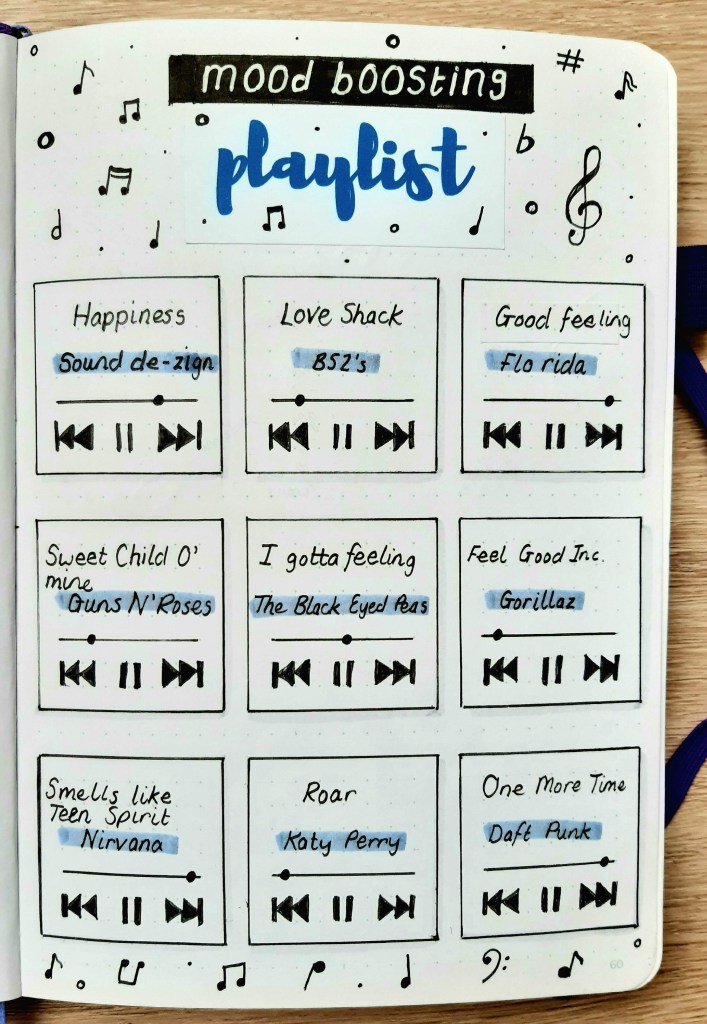
A page from by current bullet journal. Photo credit: Laura Jones for Keeping It Creative

2. Improves your workout

According to my Fitbit app, which has just this second provided me with an activity tip (it must have somehow known I was writing this blog post):

‘Listening to music can help exercise feel easier, and even boost your speed. Songs with 120-140 beats per minute appear to have the biggest motivating effect’

Source: Fitbit app info.

Clicking through to the information, which was written back in 2017, I learnt that music can increase your speed, make you feel more powerful, make exercising feel easier (wahoo!), boost your mood and help to keep you motivated. When I was battling with my mental illness, I didn’t have the energy to do my Zumba workouts but I did make sure that I went for at least one long walk per day and my playlist helped to put at least a little bit of a spring in my step. Now I’m back to good health, the music is really motivating and some of the track make me want to break into a run (luckily I haven’t acted upon the urge as I don’t wear my sports bra whilst pounding the streets or the paths of my local park and don’t want to be off to the doctors with detached boob syndrome which I’m sure would be the resulting affliction lol!).

Here’s a list of some of my motivational music, many of which I copied into iTunes from some old CD singles which I believe I purchased whilst at uni many moons ago:

  • Choose Life – PF Project feat. Ewan McGregor
  • Forever – Dee Dee
  • Another Chance – Roger Sanchez
  • Alone – Lasgo
  • Beautiful – Matt Darey Feat. Marcella Woods
  • Treat Infamy – Rest Assured
  • The Night Train – Kadoc
  • The Silence – Mike Koglin
  • Kickstarts – Example
  • In For The Kill – La Roux

They’ve been put into a playlist on my old Apple iPod, aptly called ‘On The Go’ as I couldn’t work out how to give them my own title.

3. Boosts your concentration levels when working or studying

When I’m struggling with anxiety and depression, it becomes very difficult for me to concentrate on the simplest of tasks and even harder to be motivated to do things in the first place. Studies have shown that particular types of music can be really useful in encouraging productivity and creativity. Some tunes can also be quite therapeutic, reducing stress levels so that you are able to concentrate better. Personally, I prefer instrumental music as many lyrics can be more of a distraction than a help. Whilst conducting online research for today’s blog post, I discovered that the best types of musical accompaniment were suggested to be the following (one of them may surprise you like it did me!) :

  • classical music
  • ambient music
  • nature sounds
  • between 50 and 80 BPM (Beats per minute)
  • video game music!

You can find many different collections of classical music for work or study on YouTube but I like to create my own playlists as there’s nothing worse than a tune coming on that you simple don’t like. My absolute favourite has to be Fur Elise by Beethoven, but, my musical choices are often dependent on the type of task I’m working on.

Ambient music is a genre that is generally identifiable as being atmospheric and environmental in nature. According to online definitions, it is gentle and largely electronic with no persistent beat. One of my favourite pieces of ambient music is Porcelain by Moby and, although mostly tracks are instrumental, this one does have minimal lyrics. If your chosen music does have words, I think it is best to have the song on at a low volume so they don’t distract you.

I love listen to the sounds of nature in my local park or in the garden on a fine day. When you’re working or studying, apps such as ‘Calm’, ‘Sleep sounds’ or other relaxation and meditation focused packages, are great for providing nature sounds such as rain on leaves, Autumn woods, water flow, coral reef and wind in pines. I’m not sure how much of the Calm app is accessible for free ordinarily because I’m currently making use of an extended free trial but the sleep sounds app has lots free to use (my phone is Android but I expect there are iPhone Apps too).

According to my research, music at 50-80 BPM is good for stimulating the left side of the brain for information processing and problem solving. Again, collections of tracks can be found on YouTube but I would definitely recommend you create your own playlist of music you love. For sparking your creative juices, more upbeat, faster music is suggested (more BPM).

Who knew that music created to accompany video games could help boost your output? I certainly didn’t. The ones that I play tend to get on my nerves and I mute them but apparently they’re designed to enhance your gaming experience by stimulating your senses and blocking out other stimuli which may distract you. One game that both my husband and I always have the music on for though, is Angry Birds 2 but I’ve never thought of listening to it when working or studying – that is, until now (I may just have it playing in the background as I type away on this blog post!).

4. Calms the mind and relaxes the body

Some music can be really soothing when you are feeling overwhelmed, anxious or uptight. According to a number of studies, listening to calming tracks can help you relax by slowing your breathing and heart rate, lowering blood pressure and reducing levels of stress hormones such as cortisol and epinephrine (AKA adrenaline). Try searching for ‘peaceful music’, ‘soothing music’ or ‘music for relaxation’ on YouTube (I found some wonderful extended compositions by talented Norwegian musical artist Peder B. Helland whose videos also contain beautiful imagery), create your own playlist or check out some of the music on apps such as Calm.

5. Great for mindful listening

Music can be a great part of your daily mindfulness practice. Mindfully listening grounds us in the present moment and, by paying attention to what’s going on currently, you won’t be focusing on ruminating about the past or worrying about things in the future. Mindfulness is obviously a huge topic which I couldn’t possibly cover in this blog post but with regard to mindful listening to music, you can start with really paying attention to the piece, noticing its melody, rhythm, tone or lyrics and tuning in to how it makes you feel or what emotions it evokes. And of course, if your mind wanders off, as with all mindfulness practices, gently and kindly bring it back to the music without berating yourself for losing your attention or starting to think things such as ‘I can’t do this’ or ‘why do I have the concentration skills of a goldfish?’!

6. Combats isolation and feelings of loneliness

Many of us will be struggling with feelings of isolation and loneliness right now due to the effects of local lockdowns and social distancing as the result of Coronavirus. Studies have shown, however, that listening to music can combat these by triggering the release of a hormone called oxytocin which plays a key part in cultivating empathy, trust and compassion for others and creates a sense of belonging and connection.

7. Brings back happy memories

Sometimes, when you hear a song on the radio, it evokes happy memories and has the ability to transport you right back to the time when you first heard it or to a particular occasion (e.g. your wedding day, a night out with friends in your early 20s, or a family get together. Adding these to a playlist can evoke fond memories or help you recall and remember happier periods of your life when you’re feeling down. Research has shown that just replaying music helps us reconnect with the feelings we were experiencing at the time.

Talking of memory, there’s also scientific evidence that listening to music can help us retrieve memories and is also good at helping us to lay down new ones. For this reason, music can be wonderful resource for elderly relatives or those who have dementia.

8. Helps you to process difficult emotions and heal from heartache and grief

I’m sure most, if not all of us have experienced the heartache that goes with losing a loved one at some point in our lives. Although music doesn’t have the capacity to make the feelings of emotional anguish or grief go away, it can certainly help us process and make sense of things. Seeking out and listening to tracks where the lyrics seem to be describing our situation perfectly is something many of you will have found yourself doing automatically. In the past, following the breakdown of a romantic relationship, I would always find myself reaching for CDs of sad songs and having a good cry. I wasn’t sure that choosing such tunes was helpful, but according to my research, it definitely can be. In fact, listening to music which matches our mood (either in terms of tempo or lyrics), whether that be sadness, anger, excitement or joy, benefits us by activating our limbic system (the section of our brain which is directly related to emotional processing).

Final thoughts…

I hope you have found this music focused post helpful in some way and that is has encouraged you to think about using songs and instrumental pieces to benefit your mental health and wellness. Let me know in the comments if any of what I’ve said resonates with you.

Happy listening!

Posted in CBT, compassion, lifestyle, mental health, Mindfulness

Monday Matters: The beginner’s guide to self-compassion

Photo credit: kaboompics.com for Unsplash

A few months ago, I wrote a blog post which explored different ways to practise self love and gave some ideas for bullet journal spreads you might like to try. Today’s writing is an extension of this them and focuses on self-compassion. I hope you find it both interesting and useful.

What is self-compassion?

Self-compassion is all about showing yourself warmth, love, kindness and understanding, especially during difficult times. It’s about accepting ourselves as we are, learning to be less self-critical and avoiding judgement. It’s about being mindful of our different emotional states and the situations we find ourselves, recognising that we all make mistakes, that no-one is perfect and that we all struggle at times so we’re not alone in our suffering.

Why should I practice self-compassion?

There has been a lot of recent research into the benefits of being self-compassionate and how it can work wonders on our wellbeing. Individuals who practise self-compassion have been shown to be much happier, more optimistic, grateful for what they have, and enjoy better relationships with their loved ones. They’ve also been shown to have lower stress levels as they avoid being judgemental towards themselves, others and situations, recognise and accept that we all find things hard at times and, through mindfulness, become more in tune with their thoughts and emotions. Self-compassionate people are also likely to have a higher level of resilience as they are easily able to bounce back from difficulties and can accept and learn from their mistakes.

Self-compassion is also a great antidote for perfectionist tendencies, which I, for one, have always struggled with, right from childhood and I’m sure many of my readers will have too.

How can I bring self-compassion to my life?

Today, I’m going to share with you some simple ways to bring self-compassion into your life so that you can start being easier on yourself and show yourself the love and kindness you would demonstrate to someone else you care about.

Notice and reframe your critical self-talk

I’ve spoken before about the negative ways in which we tend to talk to ourselves before in my blog post about self love. We can be so good at saying unkind and unhelpful things such as “I’m such an idiot”, “Other people are so much better than me”, “No-one likes me” and “I’m just no good at…” etc. And, as you can imagine, this critical inner voice can destroy our self confidence and lead to feelings of worthlessness and depression.

So how can we put the lid on this damaging talk? The very first step is to start noticing when you are being self-critical. Take the time to examine the situations in which you use negative self talk, the exact words you use and the tone of voice that you adopt. You could even try keeping a little notebook of examples to reflect on. Now consider how you could reframe things in a more positive way. Focus on being self-compassionate, non-judgemental, supportive and mindful of the situation. If you find this difficult, think about what a really compassionate friend would say to you. Changing how we talk to ourselves might be hard at first but it will get easier with time and practise so keep working on your skills and congratulate yourself on your efforts.

Write yourself a letter

This is a great exercise to do if you are going through a difficult time or are struggling to accept something which has caused you mental pain. Start your letter by outlining the situation that you find yourself in and how it has or is affecting you. Next, go on to identify your thoughts and feelings and what you were hoping for or needing to make things easier. Now offer a message of common humanity which will remind you that you are not alone and encourage you to feel connected to others e.g. ‘we all make mistakes’ or ‘everyone has times when they feel…’ etc. Finally, offer yourself some guidance and positive encouragement like you would to a friend who needs your support. Sign your letter with a loving message and add some stickers, washi tapes or little drawings of something nice if you would like to. When you have finished your letter, you can either read it out loud to yourself straight away or put it away somewhere special for when you need to show yourself some compassion.

Start a self-compassion journal

Keeping a journal is a great way to reflect on how you are feeling and what is happening for you right now. I like to spend about ten minutes each evening writing down my thoughts. What I chose to write about differs each day but might include:

  • what I have achieved today
  • what I learnt today
  • ways in which I am proud of myself
  • things I’m grateful for
  • anything I found challenging today and why
  • what I’m looking forward to tomorrow
  • anything I’m feeling apprehensive about

You can finish your writing by adding some kind, understanding and sympathetic words to yourself. For example, ‘most people would get annoyed in that situation and it’s okay that you lost your temper’ or ‘things were difficult today, but hopefully you’ll have a better day tomorrow’ etc.

Use affirmations

Another great way of showing yourself loving kindness it to write your own personal affirmations and practise saying them to yourself each day. I like to create a decorative spread of them in my bullet journal every few months – it is a great way of practising my brush lettering too. Here are some examples:

  • I am enough
  • I talk to myself with love and kindness
  • I’m proud of myself and my achievements
  • I accept my flaws because no one is perfect
  • I’m doing my best and that is enough

Engage in self-soothing activities

If you know you’ve had a difficult day, your week isn’t going quite as planned or you’re finding yourself in a negative mood, you can help to make yourself feel much better by engaging in some self soothing activities.

Here’s some examples of things I like to do:

  • take a walk in nature and use my senses to explore the immediate environment
  • get under the duvet and read a good book
  • do some drawing or colouring in
  • listen to a guided meditation
  • make a collage in my bullet journal of things I love
  • do some watercolour painting
  • mindfully eat a bar of my favourite chocolate
  • watch a funny film
  • paint my nails

If you would like to read more about using self soothing for emotional regulation, you can check out this blog post I wrote last year.

I hope today’s blog post has helped to develop your understanding of self-compassion and how important it is. Let me know which of the activities I suggested appeal to you the most and if you try some of them, be sure to share how you got on.

Posted in lifestyle, Mindfulness

Monday Matters: How to be a Great Listener

Photo credit: Wynand van Poortvliet for Unsplash

A few weeks ago, I met one of my friends for coffee and cake and then we had a stroll along the beach. It was a really windy day and I found it difficult to hear my friend talking because the huge gusts were blowing her voice away. We were also pretty distracted by plumes of sand which were in danger of going in our eyes. I had to make sure I was listening super carefully and paying close attention as she was talking about a rather delicate family situation that she had been dealing with and wanted to offload. It got me thinking about listening skills and how we teach children to be good listeners by facing the speaker, sitting still, not interrupting and being attentive. But it’s not just kids who need to work on their listening skills, some adults would benefit from a few pointers too. Today’s Monday Matters post is all about being a really effective listener something that I hope most, if not all of us, aspire to be, especially as it is often named as one of the most important qualities we look for in a friend or partner.

If you’ve ever sat in a café talking to a friend and have watched them check their phone repeatedly, start to gaze out of the window or pay more attention to the seemingly far more interesting conversation going on at the table to the left, you will know how frustrating or upsetting it is when you feel like you are not being listened to. Especially if you’ve sat nodding along and offering emotional support for the last ten minutes and now it’s your turn to share. Maybe you’ve read the above and are now thinking about a time when you’ve been the poor listener and have done some or all of the things listed above. Or, perhaps you can recall a time when you offered advice or an alternative point of view when, thinking back, really the speaker was simply needed to vent. Developing good listening skills isn’t easy and requires lots of practise but here are some ideas to help you:

Limit distractions

If you are face-to-face with the person, try to find a quiet space away from visual distractions. Put your phone away, or turn it on to silent so that you’re not tempted to look at it or respond to messages. Maintain eye contact for the majority of the time so that you’re not seeing the myriad of other things going on in the immediate environment which might otherwise attract your attention.

If you’re at home and on the phone, turn music or the TV off and make others aware that you are busy and not to be disturbed. If you have children, try to make sure they’re fully occupied with something and teach them about when it is vital that they do interrupt you (if they’ve had an accident and need your urgent assistance or the house is on fire) and when they should wait patiently until you’ve finished your call. A gentle reminder prior to picking up the phone is a good idea and be sure to praise your child for managing to entertain themselves or resist temptation to interrupt and explain why it was so helpful.

If you are at work and are in the middle of something, politely ask the person to wait until you are done or stop what you are doing and give them your full attention. This lets them know that you are interested in and value what they say.

Figure out their why and their what

Whilst you are listening, think about why they are talking to you and what the message is. Are they looking for a solution or some advice? Might they just be wanting to air their thoughts and feelings? Is the purpose just to let off steam or vent? Don’t offer a solution or your opinion unless you are asked.

If you are unsure what the person is getting at, then be sure to ask for clarification or pose questions which help you develop your understanding. For example, you might start with ‘So, what you’re saying is…’, ‘Can I just check…’ ‘Did you mean…’ etc.

Use non-verbal cues to help you

Look out for non-verbal cues which give you ideas about how the person is feeling and what they might be thinking. Check out their body language, facial expression and gestures. Are they smiling and relaxed or do they look tense and uptight? Think about how you can non-verbally show how attentive you are too. A smile, a nod, a look of concern – whatever feels appropriate based on what is being said (a good reason why it’s important to figure out the person’s why and what).

Reflect back on what you hear

Part of your job as an active listener is to make sure you fully grasp what the speaker is saying. A good way to do this is by paraphrasing what has been said. This is where you restate the information that has been presented to you but in different words, basically reflecting back a summary of the same content e.g. “In other words…”, “I gather that…” etc. In combination with this, you can also check that you understand the feelings and emotions involved, for example, “It sounds like you’re feeling pretty angry about…” or ‘”So, you were frustrated when…” This lets the speaker know that you understand the main messages in what they are saying and also shows that you are empathetic towards them.

Allow for silences

Silence can feel unnerving and the temptation is to quickly fill any gaps between talking. But the person may just be pausing to reflect on what they’ve said or thinking about how they can add to what they are saying so try not to interrupt. If they have finished, a moment’s silence allows you to consider what has been said and compose any questions you may have in a way that indicates how closely you were paying attention and that you are interested in what they are sharing with you.

Follow up on the conversation afterwards

There’s no better way to show how well you were listening and how much you care than bringing up the topic of conversation again at a later date. How you initiate thinks obviously depends on what was said but you might enquire if there are any updates, if they are feeling any better, how an event went or how a situation ended up resolving itself. The person will generally be touched that you remembered and made the effort to follow up on things.

Final thoughts

I hope my ideas have given you food for thought and that you might use one or two of my suggestions to help you become a better listener. We all have room for improvement and I include myself in this. No one can claim to be the perfect listener but we all have a desire to be heard so I think it’s really important to take the time to evaluate our skills and try to make some small changes. Let me know what you consider to be your strengths and weaknesses in terms of listening or, if you would prefer, use the comments space as your chance to air what you find particularly annoying when you’re the one doing the talking. Maybe your little rant will strike a cord with another reader and give them something to think about!

Posted in lifestyle, meditation, Mindfulness, Planning and journaling, wellbeing

Monday Matters: 5 easy ways to focus on being grateful

Photo credit: Gabrielle Henderson for Unsplash

Research shows that practising gratitude is great for your mental and physical health. Being thankful helps you be more optimistic, accepting and happy. It can even reduce some of the physical symptoms of illness and reduce our stress levels. In today’s Monday Matters post I’m going to share some easy ways in which you can incorporate a daily focus on being grateful for what you have.

What is gratitude?

Gratitude is all about being aware of the good things you have in your life and taking the time to express your appreciation for them. It’s about finding the positives and developing a glass half full attitude. It’s choosing to focus on abundance and how much you have to be grateful for, rather than a feeling of lack or complaint. It’s also about acknowledging the role others play in helping us and being thankful for everything they do.

Gratitude helps us to see what is there instead of what isn’t

Make gratitude meditation part of your daily practise

There are lots of short guided meditations available on YouTube or apps like Calm and Headspace which are really helpful if you are just getting started with meditation – just look for those which focus specifically on gratitude. These are great for developing a relaxed state by focusing on your breathing before inviting you to consider what you are grateful for.

If you are more experienced with meditation, you might create a script that you can follow (this could be written in your bullet journal or typed out and placed next to your bed as a visual reminder). For example:

  • Get yourself into a comfortable position where you are relaxed but purposeful
  • Sit nice and tall like a mountain but keep your shoulders relaxed
  • Close your eyes and breathe
  • Take a moment to focus on your breathing
  • Now change the focus to your body and think about what you have to be grateful for
  • Widen the lens and bring to mind some of the things that you have which make your life easier or bring you great joy
  • Now focus on the people in your life and what they offer you. Silently thank them and feel the love spread through your body.
  • Think for a moment about how all of this gratitude makes you feel. Enjoy the sensations it creates in your body.
  • Finish your practise with some slow and steady breaths before making small movements and when you are ready, open your eyes.

It’s up to you when you want to practise but I find it nice to do first thing in the morning as it sets an intention of being grateful for the rest of the day.

Use affirmations

Writing some personalised gratitude affirmations that you repeat each day is another great way of focusing on all of the positive in your life. These can be quite general and things which we often take for granted e.g. I’m grateful for the clean air I have to breathe. I’m grateful that I have a cosy place to call home. I’m grateful for clean running water to drink and bathe in. I’m grateful for all of the delicious food in my fridge. I’m grateful for all of the opportunities that the modern world presents me with. This would make a lovely spread in your bullet journal and you could change your list each season. In the Summer you can add things like ‘I am grateful for sunny days’, ‘I am grateful for cold drinks when I’m feeling hot’ etc. In Winter time, ‘I’m grateful for my cosy pyjamas to keep me warm’, I’m grateful that we have central heating in our house’ etc.

Start a gratitude jar

I haven’t tried this one myself but the idea really appeals. You can choose any jar and you could even decorate it to show its purpose. It should be placed in a prominent place somewhere in your house (this might be a communal area if you want others to contribute to it as well) with paper and pens beside it. Each day (or most days), try to find something you are grateful for, write it on a slip of paper and place it inside. On days when you need a little pick me up, take some of the notes out and read them to remind yourself of what you have. You could also set a date in your diary or bullet journal to empty the jar out to see all of the loveliness inside.

Create a gratitude spread in your bullet journal

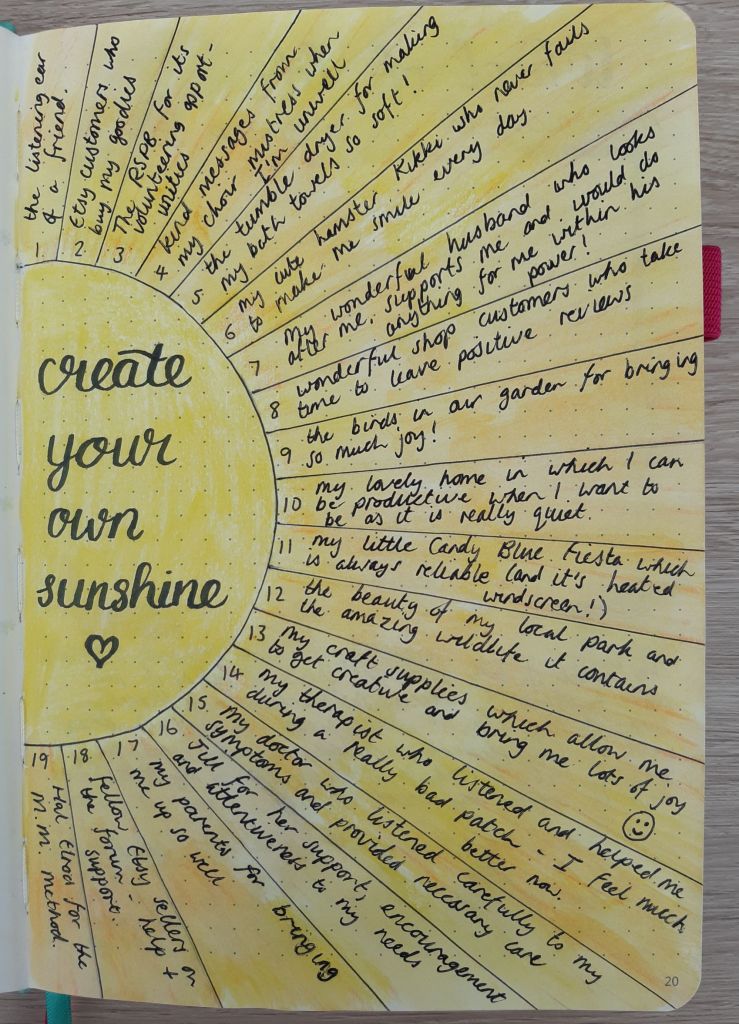
A few years ago, I created this wonderful sunshine gratitude spread and added to it during the weeks of December. I found it in one of my old bullet journals and have really enjoyed sitting and reading each of the things I had brought to mind. Many of them still stand today. I recall drawing the semi-circle by hand and adding the rays with a ruler to create the 19 sections. The centre of the sun is shading with coloured pencil and for the rest I used watercolour pencils as I didn’t have my paint sets then. There are so many different things you could focus on such as everyday things like your morning cup of coffee or your car to take you to different places. You can also think about people in your life who help you, for example your doctor who listens carefully and offers you appropriate treatment or your friend who provides a listening ear. You can even consider your own qualities and how they help you in your day-to-day life e.g. lots of patience with your children or your ability to be assertive when speaking to your boss at work.

Use gratitude prompts to evaluate your week

At the end of a busy week, it’s lovely to sit down and do some quiet reflection on all that you have to be grateful for. You can find a huge array of gratitude prompts on Pinterest -I’ve collected lots on this board so feel free to follow it if you need some ideas. You can either use them for journaling or to just focus your mind and thoughts. Here’s a few to get you started:

  • What challenge have you overcome and what helped you to face or overcome it?
  • What has been your favourite meal or snack over the course of the week?
  • Who have you felt inspired by?
  • What or who made you smile?
  • Think of a gadget in your home that has helped make something quicker or easier this week.
  • What is your main highlight?

You can also focus on your past experiences too:

  • Name a trip out that you’ve thoroughly enjoyed this year.
  • Think about one of your best memories from childhood.
  • Reminisce about one of your favourite holidays (vacations).
  • Recall something that you have made that you were really pleased with.
  • Think about something you have achieved in your life and consider your personal attributes which made you successful.
  • Recall one of the best gifts you have ever received and think about why.

That’s all of my tips for today. I hope you’ve enjoyed reading them and that they are helpful in instilling gratitude in your life. Remember that even if you are having a tough time right now, there’s always something to be grateful for. You might have to dig deep to bring something to mind, but, by taking the time to reflect, you will be able to pick out some positives and this will help to improve your mood.

Posted in lifestyle, meditation, Mindfulness, wellbeing, wellness

Monday Matters: 10 practical tips for starting an effective daily meditation practice

This month, I decided to implement a daily meditation routine and have spent some time researching how to get the most out my mindful minutes and encourage consistency. Today’s Monday Matters post shares some tips on creating an effective daily practise and how the different types of meditation can have a positive impact on your life.

Photo credit: Ben White for Unsplash

Why meditate?

Research has shown that there are a huge number of benefits of regular meditation for mind and body. Some of the main positives are:

  • Improves your self esteem and confidence and increases your levels of optimism
  • Helps you sleep better
  • Can make you more productive
  • Improves your brain function
  • Helps you appreciate your life more
  • Increases your attention span
  • Provides a sense of calm, peace and balance
  • Reduces pain and improves the immune system
  • Makes you feel more energetic, creative and spontaneous
  • Helps to control your thoughts
  • Decreases depression and anxiety
  • Reduces cravings such as for junk food, alcohol and cigarettes
  • Lowers blood pressure
  • Increases compassion towards yourself and others

but there are many more and once you start to fit meditation in your life, you will soon reap the rewards.

How can I fit meditation into my busy life?

When I attended a mindfulness class through wellbeing services a few years back, everyone talked about how wonderfully calm and relaxed they felt after each meditation. Yet, when asked if they’d used the CD full of mindful practises at home over the rest of the week, most of the participants said that they didn’t have time! However, with the benefits listed above, surely taking ten minutes each day to meditate is worth fitting in to your schedule? I bet if I’d asked the attendees if they’d had time to mindlessly scroll through social media for half hour they would offer a different response. Hopefully the following tips will help to commit more easily.

10 tips for starting a daily meditation practice

  1. Start small Like with any new habit, it’s best to start small and create a mini goal to work towards such as to meditate for a few minutes each day. There are plenty of 5 minute meditations on YouTube to choose from and a variety of different apps which offer free trials.
  2. Make it a routine There are some things you do automatically every day without thinking e.g. brushing your teeth, taking your mediation, applying your make up etc. These tasks have become a routine and you can easily add meditation to this list too. I recommend choosing a set time and sticking to it. I like to do mine first thing in the morning before I start work and then I can be sure it doesn’t get bumped off my to-do list. You could choose last thing before bed if you want to get all relaxed ready for sleep. Find out more about the science and practice of creating habits here.
  3. Choose a comfortable place Where you meditate is up to you but try to pick a place where you will not be distracted and feel at ease (not too relaxed that you begin to feel sleepy though!). You can sit in a comfortable chair, curled up on your sofa, on a cushion cross-legged on the floor or even lie on your bed. You can also use props such as a cushion, bolster or blanket to help you get nice and snug.
  4. Try out different meditations to help you with different aspects of your life There are so many kinds of meditations available – breathing, gratitude, compassion, confidence, focus etc. Think about what you’d most like to instil in your life right now and work from there.
  5. Use guided meditations at first When I first tried meditation a fair few years ago, I used to think it was all about just sitting their cross legged and completely emptying your mind. I used to get really frustrated and eventually decided it was impossible and wasn’t for me. Now I use the audio tracks from the class I attended as well as the Calm app and short guided sessions on FitBit premium. I have a free trial for both apps and I particularly love using my FitBit app as it logs all of my sessions for me so I can check my progress and how consistent I’m being.
  6. Journal about your experiences Take time to reflect on your practice, what went well, what you struggled with, how you felt during and after, if you came up with excuses to miss your session and why this might have happened etc. If you felt really relaxed, it helped you have a more productive day or you enjoyed a wonderful night’s sleep, celebrate your achievements and use them to motivate you to continue. If you found it really difficult to switch off and ended up feeling really frustrated, think about what you could do differently next time or accept that it is all part of the learning process and it will become easier with time. Or, if you forgot to do your daily meditation this time, how could you make sure you stick with it? Could you set an alarm or get a reminder from the app you are trying out? Might you attach the practise to another of your daily routines e.g. do your session straight after your morning cup of coffee?
  7. Remember repetitive activities can be meditative too If you find you’re struggling with just sitting and meditating, remember meditation is all about attention and awareness and you might find that doing a mindful activity such as colouring in is much easier for you. I wrote a post full of ideas earlier this year which you can find here. Movement meditations are also an option such as tai chi, yoga or mindful walking.
  8. Be kind to yourself Remember to treat yourself with compassion as you develop your practice. Accept that it might not be easy at first and that your mind will keep wandering. Know that it’s okay to find it difficult and you’re not doing it wrong (try not to judge yourself). Just bring your mind gently and kindly back to your breathe and start again.
  9. Apply your mindful practice to other activities Meditation is all about focus and so is a kind of mindfulness that can be applied throughout your day. For example, when you shower, really concentrate on what you’re doing and how it feels, use your senses to immerse your thoughts in your experience – inhale the scent of your shower gel, observe the water running down your tiles or the screen, listen to the sounds the water makes as it hits the bath or the shower tray. You can even get into a meditative state as you do your daily chores as I explained in this blog post.
  10. Use a habit tracker (but keep it simple) If you’re a bullet keen bullet journalist like me, you probably know all about habit trackers and have seen many examples on Instagram and Pinterest. Habit trackers are great for monitoring your progress and consistency and keeping you motivated. However, if you add too many habits, the filling in process can become an onerous task and you are likely to get sick of colouring in boxes, adding dots, ticks or crosses. I recommend tracking a very small number of habits and only choosing one or two new ones to focus on and selecting other things that you want to become more consistent with.

So that’s it, lots of reasons to add meditation to your daily routine and my top 10 practical tips for beginners that will hopefully help you develop a successful meditation habit that you can stick with. Let me know in the comments if starting a daily practice is something you’re interested in and today’s blog post has either given you the motivation to get started. If it has, I hope you are soon on your way to enjoying the benefits for body and mind.

Until next time,