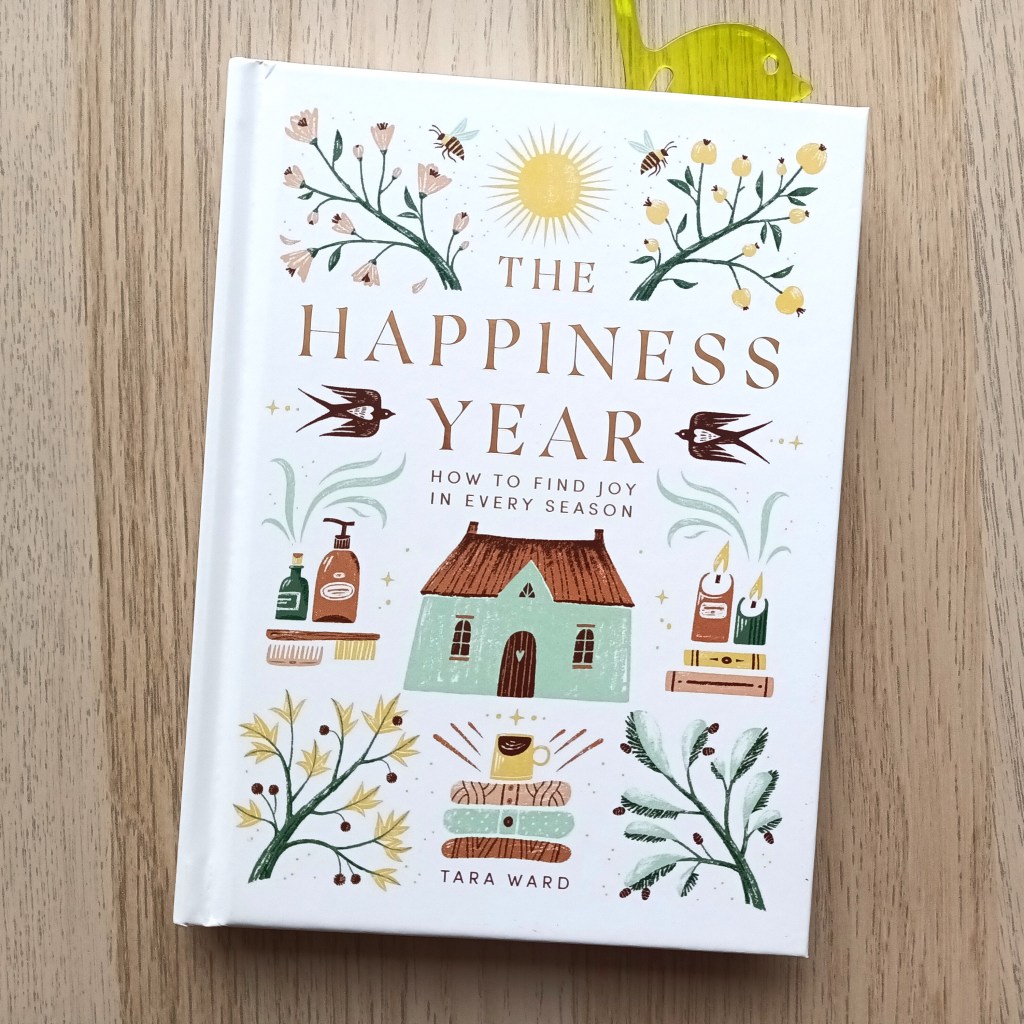
A few months ago, I was looking in the health and wellbeing section at Waterstones and came upon a beautifully illustrated book about finding joy throughout the year by trying out different seasonal activities. At the time, I didn’t purchase it, but I regretted my decision so I ordered it from an online retailer. When it arrived, I added it to the bookcase in my craft room as I was already in the process of reading about 8 different books which is a few too many even by my standards. I pulled it out a few days ago and there are some lovely activities inside in the section which I started with – Spring. I tried out the first exercise this morning and really enjoyed it so I thought I would give a short summary of the book and share that first prompt with you today.
The Happiness Year: How to Find Joy In Every Season by Tara Ward
In the introductory section of the book, Tara discusses the aims of The Happiness Year and also talks about the emotion of happiness and the four positive chemicals that are released into your body when you’re happy – dopamine, oxytocin, serotonin and endorphins (referred to as DOSE throughout the book). She then goes on to explain how to use and enjoy the book.
The remainder of the book is split into four sections – Spring, Summer, Autumn and Winter and there are a collection of exercises provided in each which you can pick and choose from. In combination, they promise to help you in an holistic way – physically, mentally, emotionally and spiritually. Personally, I think I will probably try out all of the different activities and see which I prefer and benefit from the most.
Included within the book, there are journalling and brainstorming activities, meditations, physical exercises, goal setting and planning tasks, plus many more to explore and enjoy. You are also invited to complete them in a way that feels comfortable for you, taking into account individual differences and preferences.
So far, I’ve only read the Spring chapter in depth but I’ve had a good flick through all of the book and I can already see there are many exercises that will appeal.
Exploring your thoughts, feelings and ideas about Spring
As I said earlier, I completed the first activity this morning and I enjoyed it so much that I felt compelled to share it with you. I think this exercise would work well for each of the four seasons, not just Spring. Here’s a step by step explanation of what to do:
Take an A4 piece of paper and place it in front of you
Write the word SPRING in large letters at the bottom of the page
Close your eyes and take three deep, comfortable breaths to focus you in the present moment
Open your eyes and look at the word
What comes to mind when you think of Spring?
Write down everything which comes up for you
When you’ve run out of ideas, close your eyes again, breathe deeply and continue thinking about the season
Note down any further ideas or images which come to mind
When you feel you’ve finished, look over your sheet
What jumps out at you the most? Circle any words or phrases which particularly resonate or feel important to you. Are then any surprises?
What is the overriding emotion when you look at your words? Write that emotion or emotions at the top of the page.
Look through the words and make a list of those which generate feelings of happiness.
I hope you found this a helpful exercise and it reminded you about all of the lovely things which happen in the Springtime. I’ve included my sheet below, how does it compare to yours?
Photo credit: Laura Jones for Keeping It Creative
Final words…
If you enjoy mindful activities such as journalling, setting intentions, exploring the world using your five senses, breathwork, meditation and appreciating the simple things in life, I would definitely recommend checking out The Happiness Year. The book will help you find ways to appreciate and make the most of all of the things that each season has to offer you. You’ll also find a range of self care activities to increase your happiness levels by releasing a good ‘DOSE’ of positive chemicals. Let me know if you try the exercise outlined above and how it made you feel.
Today I’m sharing some easy self-help strategies to enable you to create a life which is both calmer and more positive. I hope you find the tips useful and they motivate you to make a change or two going forward.
Be kind to yourself
Showing self-compassion, practising self-care and giving yourself grace when you make mistakes or are struggling with the stresses of modern day living is an important and helpful first step to take in developing a more positive life. If a good friend of yours was finding things difficult right now, you would offer them support and encouragement, sympathy and well wishes, yet when we find ourselves in a similar situation do we behave in the same way? Here’s a few ways to be kind to ourselves (and they don’t need to be reserved for when we are down or struggling with our mental health either):
Forgive yourself often – for making mistakes, not being perfect, not being super productive etc. Whatever you beat yourself up about, STOP!
Keep yourself hydrated – this simple act of self-care is important and will help you feel your best throughout the day
Listen to your body – if it needs rest, a day off, a holiday, a break from chores, a lie in etc. provide exactly that.
Explore how you’re feeling mentally and why – try a spot of journalling or talk to a close friend, then, if need be, take appropriate steps to remedy the situation.
Eat well – eating a balanced diet full of fresh produce, wholegrains and all of the vitamins and minerals you need is a great way to look after yourself. Yes, you shouldn’t deny yourself the occasional treat, but eating a predominately healthy diet will help you maintain good energy levels, restful sleep and better mood.
Get some exercise – you don’t need to lift weights at the gym or pedal the exercise bike for hours each week, do something you enjoy whether it’s yoga, pilates, a walk in the countryside or playing outside with your dog. Exercise releases feel good hormones as well as keeping you in good shape.
Celebrate your achievements – think about what you’ve achieved this week / month / year and give yourself a pat on the back. Even better, treat yourself to some kind of reward such as a bunch of flowers, a new notebook or something else that’s been on your wishlist for a while.
Be kind to others
Small acts of kindness towards others can have an enormous impact on both on the giver and receiver. Just something simple like holding a door open for someone who has their hands full or letting someone who is only buying one item go before you in the queue for groceries is enough for benefits such as brighter mood, lower stress levels, feelings of connection and belonging to the community and improved self-esteem and confidence.
Release your inner creativity
No matter how busy your day is, there’s always at the very least a small window of opportunity to get creative (try putting your phone in another room for half an hour!). Whether it’s doing some colouring in and choosing colours which complement each other, developing a poem about your experiences, doing some seasonal doodling in your bullet journal or creating a mood board for your living room, anything which uses your imagination or original ideas to make something is a boost to your creative side. And even if you don’t see yourself as the creative type, trying out different expressive activities will help you develop this part of yourself which I promise is lurking inside somewhere! Engaging in creative pursuits is wonderful for bring calmness and tranquility as well as a sense of achievement. It’s also a lovely way to practice self care.
Develop an attitude of gratitude
I write about gratitude in a lot of my wellbeing posts here on my blog but it is with good reason. Being grateful for what you have and celebrating ways in which you are very lucky has proven health benefits such as being better able to cope with adversity, enjoying improved sleep and immunity, building stronger relationships with others (particularly if you show gratitude for family and friends) and generally feeling much more positive and happy. Feeling gratitude and expressing your appreciation for things in your life is a very spiritual practice, creating a feeling of ease and contentment.
Be more mindful
Mindfulness is all about paying more attention to the present moment, focusing on your current thoughts and feelings and what is going on around you right now. Some examples of how this might manifest itself in your life include:
meditation and breathwork
paying full attention to the little things you do each day as part of your routines such as taking a shower, brushing your teeth, eating your breakfast, making your bed, brushing your hair or getting dressed. This will help you to change the focus from rumination about the past or worrying about the future
taking a walk in nature and becoming really conscious of your immediate surroundings – use your five senses to explore the environment
working on one thing at a time – avoid trying to multi-task (which is a complete myth anyway as you can read here)
eat mindfully – really pay attention to what you’re eating, how it tastes, how it feels in your mouth, how it is making you feel (this is also good for making sure your eat slowly and stop when you start to feel full and satisfied)
use the 5,4,3,2,1 grounding technique to bring you back to the present moment (this is particularly useful if you start to become anxious about something)
do some journalling – writing your thoughts, feelings and experiences in a journal is a great way to slow down and become aware of how things are for you right now
try movement meditation – most of us associate meditation with sitting or lying very still and focusing on the breathe. However, this is just one example of how to meditate. Check out this article for seven popular styles of movement which are meditative in their nature.
Start a slower and more relaxing morning routine
Your morning routine has the power to set you up for a calm, happy and productive day or leave you stressed out, tired and wanting to go back to bed. For a gentle start to your day, try the following tips:
prepare for your day the night before – check your planner to see what you have scheduled for tomorrow, write a list of intentions for the next day or choose your priorities from your to do list, choose your outfit and check to see if it needs ironing or unfolding to let the creases drop, if you are going out somewhere, pack your bag ready.
wake up early – plan to get up at a time which gives you the opportunity to get ready without rushing (this might involve going to bed earlier or other tweaks to your evening routine to encourage restful sleep)
open your curtains or blinds to let natural light in, or, during winter, use a sunrise simulation lamp to mimic the effects.
try journalling – this could be completing the morning entry of The Five Minute Journal like I do, doing morning pages or making note of a few things or people you are grateful for
avoid reaching for your phone – checking our phones as soon as we get up is an automatic reaction for most of us but it has been shown to have negative effects on the brain. Issues include heightened stress and anxiety levels, poor performance levels at work, lack of productivity as well as loss of our precious time. Instead, eat your breakfast mindfully and slowly, take yourself outside to get some morning light, do some gentle stretches or record your thoughts, feelings or daily gratitudes.
choose a slow living activity to put you in the right mindset – read a chapter from a motivational book, listen to a podcast, make a nutritious breakfast, savour your morning coffee (rather than downing it when it’s too hot or going cold), sit outside and watch the sunrise, close your eyes and focus on your breathing or flick through your favourite magazine. Make the most of rising early before you start to tackle your to do list or head off to work.
Final words…
I hope you’ve found the above tips useful and are motivated to try some of them. I know that making lifestyle changes can be quite difficult and require time and commitment. You might want to try to transform many aspects of your current life but doing too much at once will most definitely lead to overwhelm and the temptation to give up. I recommend choosing one thing to focus on and, where possible, enlist the help and support of your partner or a close member of the family or a good friend. I also encourage you to regularly evaluate and reflect on how things are going for you and consider if the small change you’ve made is having the desired effect. This will help you to refocus and serve as a good reminder of why you started.
This week, in my series on The Wheel Of Wellness, I’ll be looking at the Spiritual segment. This section, which is the last to be covered, is all about finding life’s meaning and purpose whilst developing understanding of your personal values, beliefs and morals and using these to guide your actions and inform your way of living. Spiritual wellness does not necessarily involve being a deeply religious person or believing in the supernatural, rather, it is related to the human spirit or soul, as opposed to material or physical things.
A focus on spirituality involves learning to be more self-aware and recognising our existence in time and space. It’s also about becoming more familiar with our personal beliefs and values and how they affect the way we live and what we see as our purpose in life.
We all have a spirit within us which is constantly guiding us, looking after us and showing us the way to go. When we start to tune in to and listen to our inner voice, we’re using our spirit, and this is what can help us to lead a life in keeping with our wants, desires and passions. Connecting with our spiritual side can also help us to feel happier and healthier which I’m sure is something we all want.
Ways in which you can connect to your spiritual self
There are a number of ways in which you can really tune in to your spirit and think about what you really want for yourself and your life.
Quieten the mind – meditation is a great practice to develop but other mindful practices include writing in a daily journal, doing relaxing breathing exercises, taking a walk in nature, doing a meditative activity such as drawing, painting or colouring in, stretching exercises such as yoga, Pilates or mindful movements and praying.
Practise gratitude – identify a number of positives in your life each day, expressing and reflecting on them
Take a Mindful approach – focusing your awareness on the present moment, whilst calmly acknowledging and accepting your thoughts, feelings and bodily sensations is at the core of mindfulness as is a great way of becoming more in tune with your spiritual side.
Consider your personal values – values identify what is important to you in your life and how you wish to interact with the world. When your actions align with your core values you will immediately start to feel more content, fulfilled and satisfied. To help you do this, I’ve created a Pinterest board full of links to core values lists and related activities – try scanning the pages to see what resonates with you. You’ll see so many different ideas and the ones which you choose to add to your personal list will influence your decisions and life choices in many ways including:
your job or career path
your hobbies and pastimes
where you live
how you manage your money
your friendships, romantic partners and relationships
where you shop
compromises we are willing to make
how we parent our children
the ways in which we treat ourselves (both good and bad)
Whilst I was researching this blog post, I came across lots of worksheets, workbooks and exercises to try which focused on your values. One of these invited you to split your values into ‘Valuing myself’, ‘Valuing my relationships’ and ‘Valuing my work’. I had a quick go at this below but added ‘my life’ to the first category:
Valuing myself and my life
compassion, creativity, enthusiasm, open-mindedness, acceptance (self and others), creativity, happiness, health (emotional, physical and mental), learning, intelligence resilience, fun, wellbeing, respect for animals
Valuing my relationships
loyalty, thoughtfulness, love, playfulness, understanding, usefulness and humour
Spend time reflecting on your beliefs – these may have a religious focus or might be related to your core values. Examples of non-religious beliefs could be:
family comes first
we must take care of our planet
honesty is the best policy
everything happens for a reason
work/life balance is a priority
I should always try my best
community service is a central part of life
the different phases of the moon have particular influences on my life
breaking a mirror gives you seven years bad luck
Think about your dreams – not the ones you had in bed over the past few weeks, but your deepest desires and wishes. As part of this, you could do some journalling or have a go at creating a vision board. Afterwards, you might spend time reflecting on small but positive life changes that you could make right now to help you work towards these dreams.
Final thoughts…
Cultivating spirituality has many benefits for your physical and mental health and wellbeing. Getting to know your true self can help you begin to live in alignment with your core values and beliefs which is fundamental for a long and happy life. Psychologically, spiritual practices can develop your understanding of your inner self, leading to a greater sense of purpose. They can help you to think positively and clearly, lower your risk of stress, anxiety and depression and generally give you a better outlook on life. Physically, being more connected to your spiritual side can improve your immune system, help you to fight off illnesses, lower your blood pressure and reduce your risk of heart disease and stroke. It can also help you to make better choices in terms of diet and find other ways of looking after your body and your mind, for example by exercising regularly and finding time to relax. The peace and calmness we invite into our lives can also help us to get a restful night’s sleep.
I hope you have found today’s post useful and have enjoyed learning about The Wheel Of Wellness over the last few months. I would love to hear about your hopes, dreams and ambitions for the future and the ways in which you think you can bring these into fruition. In keeping with having an open mind, I’m currently learning about the magic of using the phases of the moon as a tool to develop self-awareness, self-care, nourishment and empowerment to live with purpose and to manifest my deepest wants and desires for life. You’ll see in my next blog post, in which I share my October bullet journal spreads, that this has inspired my theme for next month and provided me with lots of ideas.
For the second part of the Physical element of The Wheel Of Wellness I will today be looking at the importance of quality sleep to maintain good physical and mental health. I’ve previously published a couple of blog posts on the topic of sleep namely 5 ways to get better sleep tonight and 5 things to do in the evening to ensure a restful night’s sleep and a productive next day which you may like to have a read of as well. Many people have issues with their sleep for one reason or another and if you’re one of them, you might want to prioritise this area of the wellness wheel and spend some time learning about the effect that sleep (or lack of) affects your body and your life and pick up some tips on how to manage this aspect of your physical health.
Why is sleep so important?
Sleep has a huge impact on our health and wellbeing throughout our lives. Anyone who has ever had difficulty sleeping will know that the quality and quantity of our slumber dramatically affects our mind, body, general quality of life and our safety. While you are sleeping, your body is actively working and preparing you for the next day.
The following is a list of the basic functions of sleep which illustrate the importance of a good night’s kip:
physical restoration
mood regulation
cleaning the brain of toxins
information processing and memorization (committing things to memory for later recall, the storing of visual, auditory or tactical information)
strengthening the immune system
In children and teens, sleep also supports growth and development.
In addition, further benefits of quality sleep include:
better heart health
stress reduction
generally makes you feel more alert throughout the day
can help you lose weight (you’re less likely to crave high sugar or junk foods)
reduced risk of anxiety and depression
improved appearance – healthy, glowing skin (versus dark circles under eyes, dehydrated complexion, breakouts and redness from lack of sleep, plus comments from friends and family along the lines of “you look like ****)
better concentration (hopefully leading to improved productivity)
better decision making
stronger immune system (so less likely to get ill / feel run down etc)
boosted creativity (better ideas and use of imagination)
reduced risk of high blood pressure, coronary heart disease, stroke and obesity
better emotional regulation (meaning amongst other things that you’re more likely to get along with others and less likely to become overwhelmed by your feelings)
Sleep and wakefulness is controlled by two biological processes: Sleep Homeostasis, commonly known as ‘sleep pressure’ and The Circadian rhythm, otherwise known as ‘the body clock’.
What is sleep pressure?
Sleep pressure is basically, the brain’s desire and need for sleep. The more time you’ve been awake for, the greater the sleep pressure. When you wake up in the morning, you should have very little need for sleep (if you’ve had a good night) so sleep pressure is very low. As we get on with our day, the sleep pressure begins to grow so that by evening time sleep pressure is much higher, making us feel sleeping and in need of our beds! By morning, following a good night’s sleep, our sleep pressure will have reset and be back to little or no desire for further sleep.
In order to make sure that we have the right amount of sleep pressure present by bed time, we should really make sure that we get up and go to bed at the same time each day. However, I know that a lot of people will have a lie in on a weekend, which tends to make it difficult to switch off and sleep on a Sunday night (especially if Sunday night dread is at play). Taking naps should also be avoided as this can reduce sleep pressure too. If you absolutely must have a nap, tried to take it before 3pm and make sure it lasts for less than one hour.
What is meant by the term Circadian rhythm AKA our ‘body clock’?
Like all living things, humans have a circadian rhythm which is the brain’s way of aligning the body with the environment. Our sleep/wake cycle follows this 24 hour rhythm. During the day, exposure to light helps us to feel alert, awake and active. As night/darkness falls our internal body clock starts to produce melatonin, a hormone which promotes sleep.
You can help promote a healthy circadian rhythm by seeking natural light (sunshine) during the day, getting some daily exercise, avoiding caffeinated drinks after mid-day, limiting light before bed and having a set bed time / wake up routine which prepares the body for sleep at night and encourages wakefulness first thing in the morning. I’ll discuss some of these in more detail later.
Creating the right bedroom environment
It’s really important to create a comfortable and relaxing environment in your bedroom to help you fall asleep quickly and easily. We invested in a ‘posturepedic’ mattress which is pocket sprung with a latex top. We’ve had it for years and it’s still completely supportive and so comfortable. Every time we go on holiday, we always look forward to being back in our own bed! The best sheets and pillowcases we’ve found for softness and durability are bamboo ones. An added bonus for us is that they’re breathable and hypoallergenic too.
Your bedroom should also be nice and dark as the absence of light sends a signal to your body that it’s time to get some rest. A nice thick pair of curtains or light blocking blinds are essential for this (we have blinds and lined curtains which allow just enough morning light to help us wake up). Some people also like to wear a sleep mask to block out light and these are also good for shift workers who are in bed during the day.
Other essentials for a calm and relaxing space include as little clutter as possible and a quiet environment to minimise distractions. Just the right room temperature – not too hot and not too cold is also helpful for inducing sleep (experts recommend around 18.3 degrees Celsius / 65 degrees Fahrenheit is ideal). Some people also swear by lavender as a soothing and sedating scent but I find it sets my allergies off which is certainly not sleep inducing!
Sleep experts also suggest that your bedroom should be strictly for two purposes only – sleeping and sexual activity. This means it should not be used for:
eating, drinking or smoking
dealing with bills, reading letters or any form of paperwork
using technology or looking at screens e.g. TV, mobile phone, laptop, tablet etc.
I also like to read fiction books on my Kindle Paperwhite in bed but I do find that as long as the screen is pretty dim, I become really sleepy after a couple of chapters. If you feel that reading certain books stimulate your brain too much, bedtime reading may be best avoided.
Diet and sleep
Most people know that caffeine isn’t good for sleep due to the stimulants it contains so if you have trouble sleeping, it’s best not to drink coffee or other caffeinated drinks such as cola, sports and energy drinks for at least 4 hours before bed. Having a large meal before bed is also likely to keep you awake as your body will still be digesting the food. Also, you may find yourself suffering from indigestion or acid reflux if you eat or drink too late. If you do find yourself craving a late evening snack a small amount of nuts, a banana or a small bowl of oatmeal with berries should be safe to eat.
Alcohol is well known to cause a slowing of brain activity and make you feel relaxed and sleepy but beware that the consumption of alcoholic beverages, especially in excess has been shown to cause poor quality sleep and shorter duration so you may find yourself waking up repeatedly in the night or not feeling very refreshed in the morning. Night-time drinking may also result in acid reflux too!
A good daily routine to help you sleep
Throughout the day, it’s important to get as much natural light as you can. This could include working next to a window, taking regular outdoor breaks during the day e.g. sitting in the garden with your morning cuppa and having an al fresco lunch. Obviously this is more difficult during the Winter months but even short walks outside, maybe with a nice, hot drink can make all the difference.
Exercise (or being active) including aerobic workouts, resistance training and yoga during the day can also help with sleep. Just make sure you don’t do anything which elevates your pulse rate for at least 3 hours before bed.
In the evening time, it’s a good idea to do relaxing activities which can calm the body and the mind. This could include listening to some soothing music, reading a book, doing some meditation, writing in your journal to help put the day to rest (see my 5 ways to get better sleep tonight for an explanation of how), enjoy a warm bath or hot shower.
If you regularly struggle to sleep, something you should definitely try is avoiding using electronic devices for at least an hour before bed. This is helpful for two reasons – one, a lot of online content can be mentally or emotionally stimulating (including emails) and two, the light that these devices emit can affect your body clock by increasing alertness and delaying the release of melatonin. If you must use your phone, at least set the blue light filter or night time mode to come on after around 7pm.
What if I find myself wide awake in bed?
After approximately 20 minutes of lying awake (estimate this, do not use your clock), you should get up out of bed and leave the bedroom. Either do something boring or something really relaxing (not something stimulating (no looking at your phone!) until you start to feel tired, and then go back to bed. If you’re not asleep after another estimated 20 minutes, get up again and repeat the process. If this happens regularly, spend some time during the day assessing what you think might be causing the problem and try making some changes to your routine.
A word about sleep disorders
There are a number of sleep disorders which can seriously affect the quality of your sleep. Some of the common ones are:
Sleep walking / talking
Nightmares / night terrors
Sleep apnoea (obstructed airway)
Sleep paralysis (a temporary inability to move that occurs right after falling asleep or waking up)
Hypnogogia / Hypnopompia (hallucinations occurring as you wake up or fall asleep)
If you suspect that you may be struggling with any of the above, it’s really important to speak to your GP who can offer medical advice or make a referral to a sleep specialist.
Final thoughts…
If you are struggling with your sleep right now you have my completely sympathy as I’ve had real issues with insomnia in the past. However, it’s usually quite easy to identify the contributing factors which are preventing a good night’s sleep. Finding solutions to the problems is a little more difficult but I hope this blog post has given you some ideas. Remember that quality sleep is vital to your wellbeing and it’s worth investing time and energy into this aspect of your physical health.
When practiced regularly, mindfulness can have a really positive impact on our mental health, reducing feelings of depression, anxiety and stress. In today’s post, I’m going to share five simple ways to incorporate mindful activities into your day so you can enjoy the many benefits mindfulness brings.
What exactly is mindfulness?
There are lots of explanations and definitions available online but I particularly like this one from the Oxford dictionary:
a mental state achieved by focusing one’s awareness on the present moment, while calmly acknowledging and accepting one’s feelings, thoughts, and bodily sensations, used as a therapeutic technique.
Oxford online dictionary
Basically, mindfulness is about paying attention to the here and now, showing curiosity about what’s going on in a non-judgmental way. That’s not to say that as soon as you start practicing the various techniques that your mind won’t wander, it will, and that’s completely okay. But as you get used to paying attention in a range of simple ways, you’ll likely find it becomes easier.
So here are five ideas for practicing mindfulness every day that anyone can try.
Choose an activity you do each day and really pay attention
A great way to get started with mindfulness is to choose one activity that you do every day and bring moment to moment awareness each time you do it. Examples of suitable activities could be: drinking your cup of coffee or tea first thing in the morning, brushing your teeth, taking a shower, washing your face, getting dressed, driving to work. Whichever activity you choose, focus on knowing what you’re doing as you’re actually doing it, and what you are thinking and feeling from moment to moment too. At first, you’ll likely find that your mind wanders quite frequently, but if it does, gently bring yourself back to the present moment. With time, you’ll find it gets easier to remain mindful.
Connect with each of your five senses
Using your senses – touch, taste, smell, sight and hearing is a great way to focus on what’s happening right now. You can either spend time exploring each one in turn or pick a particular sense to focus on in a given moment. So, for example, you might sit quietly at home curled up in your chair with a coffee, smelling the aroma, being warmed by the heat of the mug. You might then close your eyes and tune in to sounds within the room such as the clock ticking, and far away sounds such as a dog barking. As you open your eyes, you might change your focus to the colour of your drink or the patterns on your mug, before taking a sip and savouring the flavour. At another time during your day, you might focus in on just one of your senses. So, during your daily shower, you might choose to focus on smell, inhaling the scent of your shampoo, shower gel or soap and your conditioner and really appreciating each one. By doing this you will be immersed in your current experiences rather than dwelling on past events or getting stressed about all of the things you have to get done before bedtime.
The following mindful activity is also a good one to do when you’re feeling anxious to help distract from negative thoughts, judgements and physical sensations associated with a tense body.
Close your eyes or lower your head and soften your gaze. Take some slow and deep breaths in and out.
Open your eyes and take your focus outside of your body. Find the following:
5 things you can see.
4 things you can hear.
3 things you can touch.
2 things you can smell.
1 thing you can taste.
Focus on your breathing
Breathing is a key part of mindfulness practice as it’s something we do naturally out of necessity. There are many online exercises which focus on the breath such as alternate nostril breathing, square or box breathing and equal breathing where you focus on making the inhalation the same length as the exhalation, but the technique which I find easiest and most comforting is soothing rhythm breathing, which I was taught as part of my compassion group sessions a few years ago.
Sit comfortably in your chair with both feet on the ground and your hands resting in your lap.
Close your eyes or direct your gaze downwards – whichever feels most comfortable.
Gently bring your focus to your breathing feeling the ribcage expanding as the air coming in to your lungs and leaving your body as you exhale.
Try breathing a little faster or slower until you find a breathing pattern that feelings soothing and comforting.
Focus on the breath as it comes in and leaves your body. You might like to notice the sensation of cool air entering your nose and warm air leaving.
Turn your attention to your body. Sensing the weight of your body resting in the chair feeling relaxed and supported. Feel your feet touching the floor beneath you.
If your mind wanders, notice what has happened and gently bring the focus back to your breath. Even if your mind is bobbing about all over the place, just accept what is happening without judgement and come back to the breath.
As you bring the exercise to a close, gently wiggle your fingers and toes and bring the focus back to the room around you.
To ensure you commit to this short meditative practice each day, you might find it helpful to make an appointment with yourself in your bullet journal or diary e.g. 5 minutes after you’ve eaten your breakfast or as an end of the day thing to encourage restful sleep. Again, this breathing exercise is also helpful to calm yourself down in moments of anxiety.
Engage in mindful walking
Whatever the weather, cold, warm, rainy, bright sunshine, cloudy, try to find 10 or 15 minutes each day to go for a mindful walk outside. Take time to pay attention to the different aspects of your experience. Start by exploring how your body feels when you’re walking – your feet as they make each step, your legs as they move you forwards, your arms as the swing by your sides. Next, tune in to what’s going on around you using all of your senses – perhaps you can hear traffic in the distance or a bird singing, maybe you can see the sun shining through the trees, perhaps you can smell the damp earth. Be open to whatever you notice, wherever you are and whatever happens. Try to fully immerse yourself in the here and now. As you end your walk, bring your attention back to how you feel as a result of your practice.
If you want to read about mindful walking in more depth, I wrote a whole blog post on it last year which can be found here.
Be totally present during conversations
All too often during conversations, we’re either multi-tasking or our mind wanders so we’re not paying full attention. However, being fully present has so many benefits for the speaker and the listener. Not only will you both feel valued, you’ll have a better understanding of the other person’s needs and any information that you impart is likely to be comprehended more easily. You’ll also likely improve both your communication skills and your relationship with the other person whether you’re talking to a friend, colleague or family member.
If you want to be more mindful in conversations, the first step is to notice when your mind wanders and, without judgement (no berating yourself for being a terrible listener!), bring your attention back. Try to resist the temptation to make excuses for being distracted such as “I was bored by what they were saying”, “I’ve got so much to do I couldn’t wait for them to finish” or “they were just repeating themselves”. Just remember that mindfulness takes practice and you are just learning but it will get easier with time.
In today’s busy world, multitasking is very tempting and often encouraged, but studies have shown that humans aren’t really capable of focusing on more that one task at a time, and in actual fact, what happens is our brain constantly switches between the different demands on our attention. If you want to be full focused on a conversation, try to put distractions aside. Put your mobile phone away in your bag, close your emails, avoid looking at what others are up to or what’s happening elsewhere by facing and looking at the participants. Really listen with interest to what the other person or people are saying using gestures such as a nod of the head, a smile or an “I understand” as appropriate. Think about the words they are using, their tone of voice, body language and emotions to really comprehend what they’re saying. Let the other person finish before you contemplate what they have said and offer a response.
Being a mindful communicator takes practice and isn’t always easy, but it’s a great skill to have and can be really useful in social settings as well as work situations.
Final words…
Although in today’s post I’ve presented a number of simple ways in which you can start to be more mindful every day, mindfulness in itself is not always easy to master. It might be helpful to remember that it’s not all about being perfectly present at all times – it’s a way of slowing down and making a conscious decision to notice our thoughts, emotions and the world around us, intentionally accepting things as they are right now without judgement. Being mindful can help us to enjoy life, understand ourselves better and reduce stress. It’s something that everyone can try and, when practiced consistently, has been shown to have positive effects on our physical and mental health, happiness, work and relationships.
Feel free to let me know in the comments how you get on and if you have any questions, I’ll be more than happy to answer them if I can, or direct you to further resources which you may find useful.






 Keeping it creative