Posted in compassion, mental health, Planning and journaling, wellbeing, wellness

Monday Matters: Creating a WRAP Part 5 (final in the series)

Over the course of April, I’ve produced a series of posts about the process involved in creating a Wellness Recovery Action Plan. Today is the final installment in which I look at Crisis Planning. As I stated in my last Monday Matters post, I did not complete this section of the booklet myself as my illness has never reached crisis point but I intend to go over what this part of the plan would look like and suggest some ideas of what you might include.

What constitutes crisis?

Although there is no set definition for a crisis, it can be described loosely as being a state of emergency that poses an immediate threat to your physical or emotional wellbeing. Therefore, in spite of your best planning and actions to keep yourself well, you find yourself in a situation where others need to take over your care.

Crisis planning

This part of the W.R.A.P. has 9 sections and I will go over in in turn. Although the whole plan is very personal to the individual, I can offer suggestions on the kind of information you might record in each list.

Part 1: What I am like when I’m well

This can literally be copied from the second page of your plan and is simply placed in this part of the document for ease of access.

Part 2: Symptoms

This is a list of signs that tell others that they need to take over your care. Some examples include violent out of control behaviour, psychosis (loss of touch with reality), paranoia, abusive behaviour towards self or others, inability to perform basic tasks such as bathing, brushing teeth etc, showing signs of planning own suicide (Mind website information on this can be found here).

Part 3: Supporters

This is a list of people you want to care for you if the symptoms you listed in Part 2 occur. Include family members and health care professionals but make sure you seek their permission to me added to your list so that have advance warning in case something happens in the future. You can also include a list of people you do not want included in your supporters list too.

Part 4: Medication

In this section, you can write which medications are okay to be given and which are not. So, for example, you might have reacted in a bad way to a particular antipsychotic in the past and be worried that it might make you worse if administered again.

Part 5: Community Plan

In this section, you can list your preferences for your care so you can feel you have some say in what happens when you are unwell. So, for example, you might prefer to have the Crisis team visit you at home and come up with a plan for you in consultation with your partner or you might feel that you are best off being hospitalised.

Part 6: Treatment Facilities

Here, you would list where you would prefer to be treated or hospitalised if that becomes necessary. You can also add facilities that you would rather avoid if possible and why.

Part 7: Treatments

In this part, you can include treatments and therapies which you feel would be most beneficial and those which you wish to avoid and why. You may have tried alternative therapies that have worked in the past and wish them to be administered again.

Part 8: Help from others

Here, you can write down what you want from your supporters which will help make you feel most comfortable. Obviously, this list is very personal but might include the kind of things you would like people to say to you for encouragement or avoid saying as you know they will not help.

Part 9: When my supporters no longer need to use this plan

In this section, write a list of indicators that your supporters no longer need to take over your care. What are the signs that show you are once again in control of your life? This might include features of wellness that you display which show you are well on the path to recovery.

Looking forward

Remember that if you do reach crisis point, despite putting all of the elements of a W.R.A.P. in place, this is not the end of the world and it certainly does not mean that you won’t recover. After you have taken the time to get yourself feeling better and stronger, you might like to revisit your plan with one of your supporters and discuss any improvements you might be able to make to your plan and the action which goes with it. Maybe, on reflection, you didn’t do enough to keep yourself calm and relaxed in daily life and could benefit from putting more self soothing activities into place. Or perhaps a loved one recognised signs of deterioration but you chose to ignore it or go into a state of denial. Whatever happens, you can learn from the experience and try to make plans for the future.

And that, as they say in the filming industry, is a WRAP. I hope you have found my series helpful and can see the benefits of producing this kind of document to help with issues relating to mental health. If you would like support to write your WRAP, I suggest looking into if there is a Recovery College in your local area or if you are able to work with a mental health professional as part of therapy sessions to make one.

Wishing you a wonderful week,

Posted in compassion, mental health, Mindfulness, wellbeing, wellness

Monday Matters: Creating a W.R.A.P. Part 3

Over the past couple of weeks, I’ve been sharing my experiences of writing a Wellness Recovery Action Plan to support my mental health. In Part 1, I shared what a W.R.A.P. is and why it’s useful as well as how to create a wellness toolbox. In Part 2, I wrote about making a detailed list of adjectives to describe what you are like when you are feeling well and also how to make a maintenance plan of every day activities that help to keep you well. This week, the focus is on triggers and how to cope with them, plus creating a list of early warning signs of deteriorating mental health. Obviously, this is very personal to you as an individual but I hope by sharing some of my lists you get the idea so you can have a go at making your own.

Triggers (AKA Stressors)

Triggers in your life are external events or circumstances that make you feel uncomfortable. They can include situations in your work or personal life that you know tend to stress you out or upset you. Writing these triggers down won’t stop them from happening, but it can help us put coping methods and action plans in place for dealing with the emotions that are felt.

The following are some examples of my triggers so you can get the idea for making your own list:

spending too much time alone

criticism from others

being overly tired

family friction

making a mistake

not being listened to

change to routine

packing to go on holiday

mental health themes in TV dramas

feeling left out

being wrongly judged

My coping methods / action plan

Do everything on my daily maintenance plan – keep routines going

Pick out some activities from my wellness toolbox

Talk to a supportive person about what has happened

Turn negative self talk into positive

Use mindfulness techniques

Do some soothing rhythm breathing

Focus on tasks that are easy to do

Make lists e.g. a packing list for holidays

Early Warning Signs

For this part of the WRAP plan, you make a list of signs that tell you and others that you’re not feeling mentally well. This helps friends and family to look for signs of deterioration and is also good for sharing with medical professionals. For me personally, I have different signs depending on whether I’m starting to become depressed or anxious or developing hypermania.

Signs of depression and anxiety

loss of appetite / comfort eating

feeling tearful over things that wouldn’t usually affect me

lack of motivation

feeling tired even after lots of sleep

agitation

want to be alone

irritability

poor concentration

feeling worthless / helpless

Signs of hypomania

constant talking – unable to switch off

mind in overdrive

erratic driving

spending lots of money to fix things

hyperactivity

sleeplessness

agitation

irritability

flick from one task to another in a bid to get it all done

Coping methods / action plan

Do relaxation exercises – meditation, yoga etc.

Pick out some activities from my wellness tools

Tell someone I trust how I feel

Do everything on my daily maintenance list

Seek medical help

Get some exercise

Ask for support with household tasks

Challenge negative thoughts

Celebrate small achievements

Although I found these tasks difficult to do at the time as I was living with the depression and anxiety symptoms, I do think they are really useful lists to make. I also found it beneficial to talk with others about coping methods and get ideas from them too.

I hope you are finding these posts informative and useful. I really recommend creating your own WRAP either by yourself or with a loved one or therapist. Sitting down and really thinking about yourself and what you are like at different times can really help. Also if you can feel yourself becoming stressed or unwell, you can put things in place to help prevent you from becoming worse.

Of course, the current situation with the virus is a huge source of stress and worry so, now more than ever, we need to look after ourselves and ensure self care activities are high on our agenda. A lot of our routines and aspects of our daily lives have changed beyond our control and for many, this will be one of your main triggers so make sure you put things in place to help you cope.

Until next time, stay home and stay safe and well,

Posted in art, compassion, creativity, Planning and journaling, Setting goals and intentions

Creating a lockdown vision board

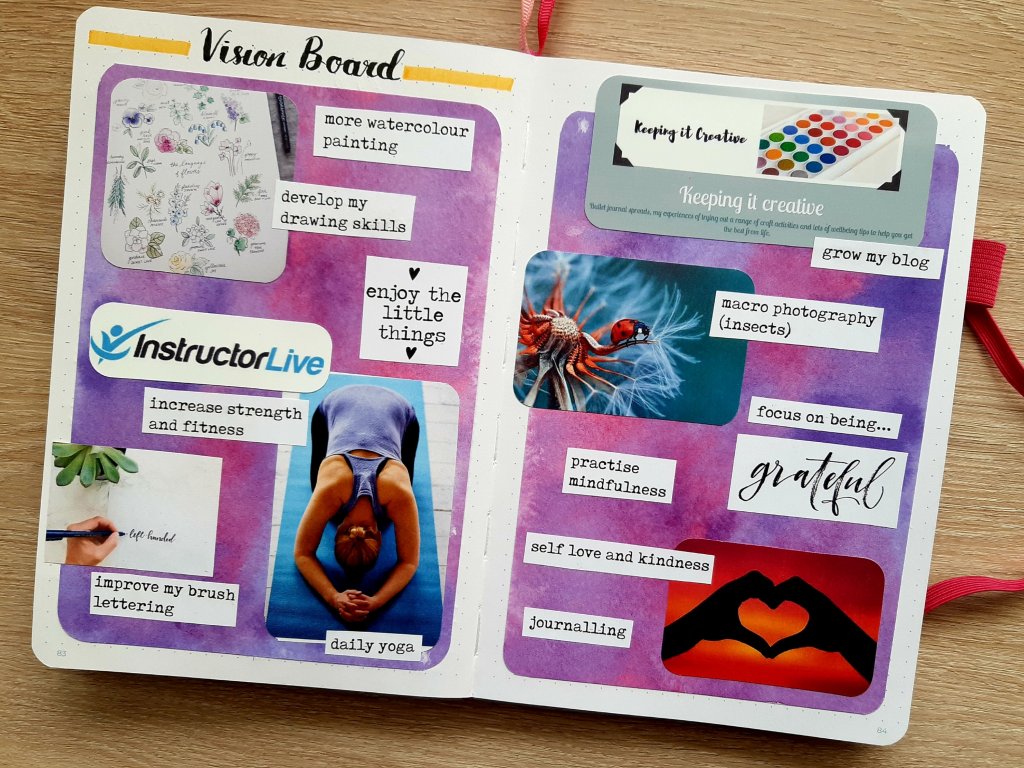
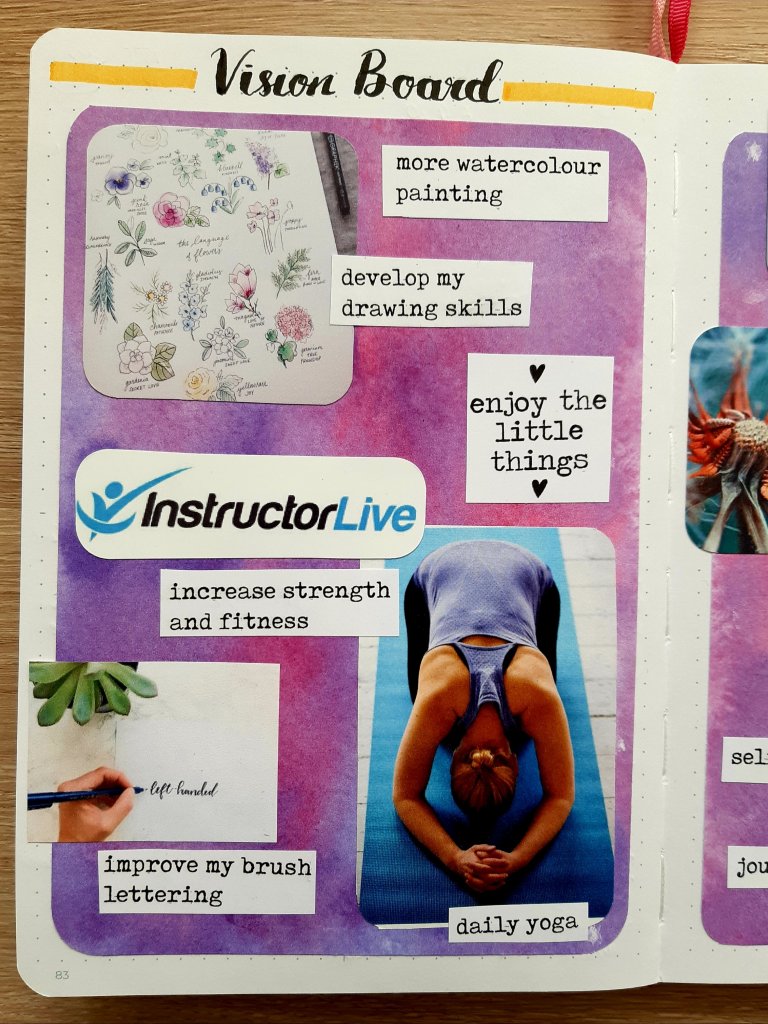
With the country in lockdown for the foreseeable future many of our routines will have changed and so will our priorities in life. With this in mind, I decided to create a vision board which focuses on what I want for myself right now. This post is all about how I made it and includes a brief explanation of each of the elements. I’m really pleased with how it turned out.

As one of my goals for the moment is to experiment more with watercolour techniques, I created the background for the board by using a wet-on-wet technique and a limited palette of three colours. I used coldpress watercolour paper which did wrinkle a little but you couldn’t tell when I put it into the photocopier part of my printer. I copied it twice and then orientated them differently to create the two page spread.

After creating the backdrop, I thought carefully about my hobbies and interests and how I can engage in them further. I came up with nine ideas:

  1. to work on my drawing and painting skills
  2. to increase my strength and fitness
  3. to continue to work on my brush lettering (being a leftie makes it hard!)
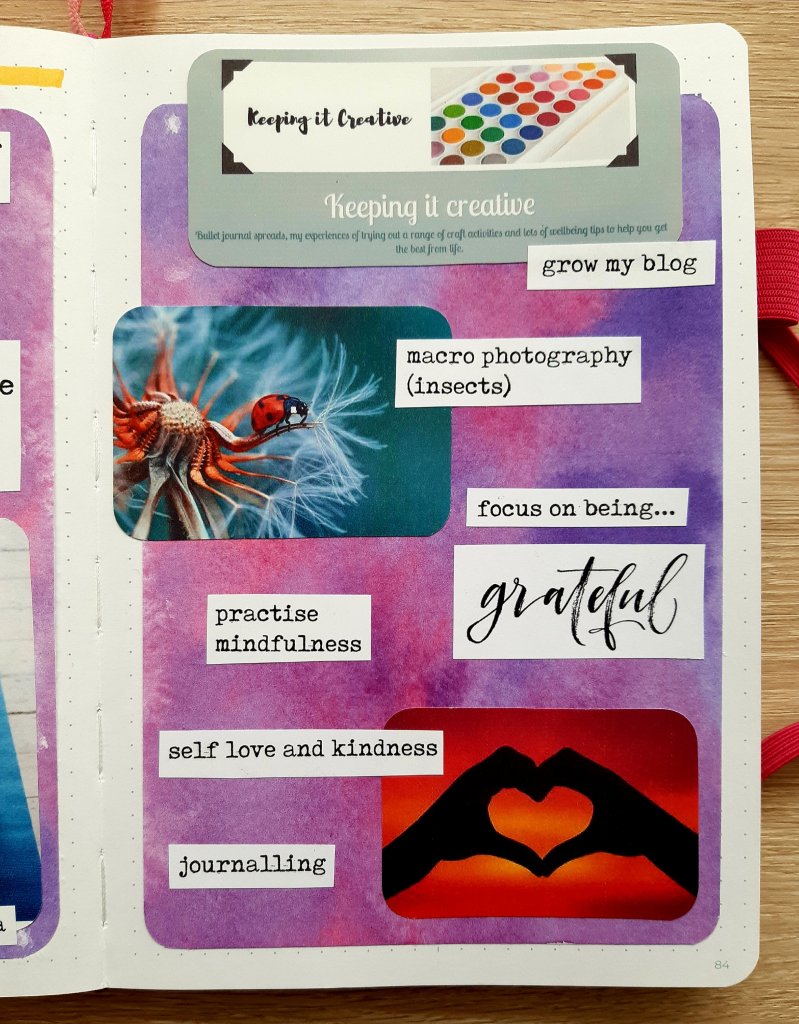
  4. to grow my blog by posting regularly
  5. to develop my macro photography by using my DSLR in the garden to snap insects
  6. to focus on being grateful for my life even in these difficult circumstances
  7. to practise mindfulness to enable me to live in the moment more
  8. to use my compassion based learning to improve my self love and kindness
  9. to do much more journalling

Drawing and painting

There are some amazing online tutorials out there and I’ve already subscribed to a number of YouTube channels. One of my favourites at the moment, is Shayda Campbell’s florals work which includes lots of sketches of flowers and watercolour techniques which are really easy to follow. Another arty channel that I’ve recently started following is Hullo Alice for watercolour tutorials and bullet journal spreads.

Strength and fitness

I’ve already mentioned my daily yoga practice in a previous post and I’m continuing to develop my ability to do a variety of poses. The style I do is called Iyengar and I’m currently using this channel. I’ve recently ordered a folding chair which I’m hoping in sturdy enough to use.

Brush lettering

I’ve been doing brush lettering using my Tombow dual tips and Fudenosuke hard tip pen for a long time now but still find certain letters difficult. I’ve decided to practise more by doing the lower and upper case alphabets on alternate days and at least one quote per week in my BuJo. The practise sheets I’ve been using are from the magazine publication Simply Lettering. I’ve already made progress but I still think it’s super hard for lefties like me!

This blog

Whilst I was struggling with depression and anxiety I really didn’t have the confidence in myself to work on my blog. I had no ideas and no inclination to put pen to paper. But now, I’m pleased to say that I’m brimming with topics I want to write about and the words flow onto the page with ease. I’m back doing my Monday Matters series and I’m enjoying using my bullet journal again. Also, I hope to share with you some of what I’m doing to work towards the items on my vision board.

Macro photography

My DSLR has been in its case for months now and I’ve just been using my camera phone to take the odd snap. I splashed out on a macro lens a couple of years ago but haven’t really experimented much with it yet. I figure now, as we’re getting lots of insects in the garden, would be a great time to work on developing my skills in this area of photography. I’m not saying I’m going to get shots as wonderful as the one on my vision board but I’m going to give it a go!

Gratefulness

It’s easy to focus on all of the negative aspects of the lockdown but that’s a guaranteed way of getting myself depressed again so I’ve decided that one of the things I’m going to do each day as I socially distance myself, is to record what I’m grateful for. I bought a journalling book from Paperchase a while back called ‘5 Minutes Before Bed’ which includes space to write down your thoughts. There are a variety of different prompts and motivational quotes to keep me focused.

Mindfulness

I attended a mindfulness course at my local wellbeing centre last year and found it really beneficial. However, I haven’t really kept up the practise and really struggled to stay mindful during my period of poor mental health. But, I’m determined to focus on living in the moment and I’ve bought a journaling book to help me do this. The book provides a variety of activities to do to increased mindfulness and a space to write how you got on doing each task. I intend to do a blog post on this when I’ve completed some more of the book.

Self love and kindness

When you are struggling with your mental health, self love and kindness tend to go completely out of the window. I personally found that I had no capacity for self compassion and would constantly beat myself up over how I was feeling. Now, with an increase to my medication, I’m well again and able to show love and kindness to myself and others. I chose the bright heart hands image to remind myself that whilst working towards my goals, I want to remember to approach things with a gentle kindness.

Journalling

I’ve already mentioned the two journals which I’m using at the moment but I intend to reflect on how I’m doing my writing in my bullet journal regularly too. I find journaling really therapeutic and an important way of focusing the mind so it’s definitely something I want to do each day.

I hope you’ve enjoyed reading about my vision board. As you can see, I’ve got plenty of ideas for self development that I want to put in place over the next few months. Maybe it’s given you inspiration for things you’d like to do whilst in lockdown mode. However, if this is not where your head is at right now and you find yourself lacking in motivation due to the current situation, then just accept that this is the case and focus on self care and self love to get you through. There’s nothing wrong with having lots of down time right now as you get used to life whilst social distancing. However you intend to structure your life in the coming weeks, remember to keep safe by keeping your distance and celebrate any small achievements along the way.

Until next time, take care,

Posted in compassion, life hacks, psychology, wellbeing

Monday matters: Procrastination and 10 ways to minimise it

The second instalment of my Monday Matters series is focused on procrastination, something which effects most, if not all of us on a fairly regular basis. In fact, studies have shown that around 20% of the population are chronic procrastinators! In this post, I will consider what procrastination is and why we procrastinate, the forms it takes, and most importantly, steps we can take to minimise it in a bid to become more productive and achieve our goals.

What is procrastination?

The act or habit of procrastinating is where we put off or delay doing something, in particular a task which is unpleasant or burdensome, but which really requires our immediate attention. It can take on many forms such as not tackling the pile of ironing you’ve been meaning to do for the past week, leaving a bill payment until the last minute, avoiding a difficult conversation with someone at work or telling yourself you’ll start developing a more healthy lifestyle starting next week. Whatever it looks like, procrastinating can pre-occupy our thoughts and be a cause of stress, anxiety and even depression. It can even take over our lives and have a huge negative impact on our future.

Signs of procrastination include filling your day with low priority tasks, leaving a high priority item on your ‘to do’ list for a long time (for example, if you use the bullet journal system, you may repeatedly migrate a particular item to the next day or following week), making endless cups of tea, coffee or snacks, reading emails lots of times but not actually actioning any of them, or waiting for the right time or the right mood to get started with something.

So, why do we procrastinate?

Procrastination is a voluntary and unnecessary delay in undertaking something, but most people struggle to control it. There can be different reasons for not undertaking a task and these generally relate to poor time management, fear of failure (or sometimes even success), lack of motivation related to low mood or an unrealistic view of the self.

For some of us, as we think about starting a task, we can develop feelings of anxiety about getting it done. This can then cause us to become overwhelmed and then avoidance starts. Not getting the task done then becomes a source of guilt and shame and these negative feelings create a never ending vicious cycle.

Perfectionists are also frequent procrastinators. Because they hold such high standards, they often fear being unable to complete a task perfectly, so end up put it off for as long as they possibly can. This performance related anxiety causes them to seek out much less threatening or ‘safer’ options.

How can we minimise the effects of procrastination?

The first step to minimise procrastination is to begin to be more self compassionate. Forgive yourself for procrastinating and try not to feel guilty about it. Accept that everyone procrastinates at times and it’s okay to do so. Also, remember that it is particularly common in people who suffer from issues with anxiety or low mood.

When you have developed more understanding towards yourself, you can then work on your ability to take responsibility for your actions (or inaction!) and begin to believe in your ability to make small changes to enable yourself to be more productive. Here are some ideas I’ve collected from my compassion group work and from my reading:

  1. Ignore your mood and just get started – it doesn’t matter if you feel like doing it or if it seems like the right time, some tasks just have to be done. And besides, it might take you less time than you expected or you might feel a whole lot better when you get it out of the way!
  2. Break a project down into small manageable steps that can be accomplished – just a little bit of progress towards a goal will help us to feel better about the task and increase our self esteem and motivation to continue.
  3. Do some planning – at the start of each day, create a timeline of how you intend to spend each hour and try to stick to it as best you can, for longer projects, set deadlines for each task. That way, if you don’t finish what you had planned for today or this week it will affect your future plans.
  4. Get the worst or hardest bit done first – as Mark Twain once said ‘If it is your job to eat a frog, it’s best to do it first thing in the morning. And if it’s your job to eat two frogs, it’s best to eat the biggest one first.’ By completing your most important task first you’ll have the satisfaction of this achievement which will hopefully provide you with the motivation to get even more done.
  5. Think about your use of language – use positive affirmations as a way forward e.g. I can eat healthily, rather than I need to go on a diet, I am someone who exercises rather than I want to do some exercise. This helps to change the distance between yourself and your behaviour.
  6. Set time limits and then reward yourself for sticking with it e.g. 40 minutes of work and then I’ll have coffee, a biscuit and 10 minutes catch up on Facebook, when I’ve tidied and cleaned the living room, I’ll sit back and watch my favourite TV show.
  7. Minimise distractions – put your phone in another room, turn off your notifications, close all of your social media and email tabs, work in a clean and clutter free environment. Choose a place where you are most likely to be productive. This could be your home, the library or a quiet café.
  8. Change your internal dialogue – instead of fixating on how much you dread a given task and forcing yourself to do it, try changing your mindset, deciding in advance that its completion will make you happy. Also, rather than using phrases such as “I need to…” and “I have to…” try changing to “I chose to…” or “I would like to…” as these imply that you have a choice and help you to feel empowered in making a decision to act.
  9. Let others know what your goals are – telling family and friends what you want to achieve can help in several ways. Firstly, it can hold you accountable, and secondly, they can offer you support and encouragement along the way.
  10. Remember, done is better than perfect – focus on just completing a task rather than getting hung up on minute details. Then you can celebrate the fact that it is finished. You can always go back to it to make improvements another time.

I hope you’ve found today’s blog post helpful in terms of developing your understanding of procrastination and how we can minimise its effects. If you have any more tips, please do share them in the comments.

Posted in compassion, mental health, wellbeing

Monday Matters – Self soothing activities for emotional regulation

Photo credit: Johannes Plenio.

Today marks the beginning of my new ‘Monday Matters’ feature in which I will present different ideas on how to live a happy life and increase your general wellbeing. My first post is on managing your emotions using self soothing activities and features lots of ideas for self care and relaxation.

Recent research by Professor Paul Gilbert, a psychologist who developed Compassion Focused Therapy argues that we have three emotional regulation systems in our brain, namely:

  • The threat system – for detecting danger, based on emotions of anxiety, anger or disgust.
  • The drive system – enabling us to have the motivation to do, achieve and acquire, sparking excitement.
  • The soothing system – helping us to manage stress, creating feelings of contentment, safety, trust and connection to others.

All three of these systems are important, but issues can arise when one system dominates. If threat presides, we end up feeling constantly anxious and worried. If we spend too much time in drive mode, we can become obsessed with being better and having more and this can lead to stress, perfectionism, burn out and depression. However, If we were always in soothing mode, we would never get anything done!

Many of us find that we have very active threat and drive systems but rarely use our soothing system. By investing time on activities which sooth us, we can greatly improve our wellbeing. Of course, what is considered to be soothing, depends on the individual but here’s a list I’ve collated to give you some ideas.

  • Wrap yourself up in a cosy blanket to enjoy your favourite warm drink
  • Light some scented candles or burn some oils and turn down the dimmer switch
  • Go to the park for a gentle stroll and feed the ducks
  • In hot weather, enjoy an ice cream, in colder weather, make some warming soup
  • Look at photographs from a happy event e.g. a holiday, your wedding, a celebration day.
  • Spend some time in nature e.g. woodland or a forest and look for signs of the current season, or do some ‘forest bathing’ (to find out more about this stress busting pastime click here. Of course you don’t need to book a holiday to try this technique out but you do need somewhere dry to lie and soak up the atmosphere).
  • Flick through your favourite magazine (I love Breathe magazine which is all about making time for yourself).
  • Set aside some creative time to enjoy your favourite craft such as sewing, card making or collage
  • Watch something funny, such as a romantic comedy or your favourite sitcom.
  • Run a warm bath and add bubbles or a bath bomb (I love the ones from Lush as they change the colour of the water and smell delicious)
  • Play some upbeat music and have a sing song and a dance
  • Go out in the warm sun and feel the heat on your face
  • Play with a pet (I love having snuggles with my hamster Kikki, when she lets me!)
  • Read some inspirational quotes or some positive affirmations (I like to write these in my BuJo)
  • Engage in rhythmic activities such as doing a jigsaw, colouring on or painting
  • Take your phone or camera out on a nature walk and take lots of pretty pictures of your surroundings
  • Lie on the grass and watch the clouds float by
  • Get yourself a drink and savour the temperature and flavour
  • Go bird or squirrel spotting in your local park
  • Enjoy a massage

I hope my post has given you some ideas to try. If you could spend 10 minutes, half an hour, a morning or afternoon doing something just for yourself, what would you choose?