Blog

Posted in lifestyle, Mindfulness

Monday Matters: How to be a Great Listener

Photo credit: Wynand van Poortvliet for Unsplash

A few weeks ago, I met one of my friends for coffee and cake and then we had a stroll along the beach. It was a really windy day and I found it difficult to hear my friend talking because the huge gusts were blowing her voice away. We were also pretty distracted by plumes of sand which were in danger of going in our eyes. I had to make sure I was listening super carefully and paying close attention as she was talking about a rather delicate family situation that she had been dealing with and wanted to offload. It got me thinking about listening skills and how we teach children to be good listeners by facing the speaker, sitting still, not interrupting and being attentive. But it’s not just kids who need to work on their listening skills, some adults would benefit from a few pointers too. Today’s Monday Matters post is all about being a really effective listener something that I hope most, if not all of us, aspire to be, especially as it is often named as one of the most important qualities we look for in a friend or partner.

If you’ve ever sat in a café talking to a friend and have watched them check their phone repeatedly, start to gaze out of the window or pay more attention to the seemingly far more interesting conversation going on at the table to the left, you will know how frustrating or upsetting it is when you feel like you are not being listened to. Especially if you’ve sat nodding along and offering emotional support for the last ten minutes and now it’s your turn to share. Maybe you’ve read the above and are now thinking about a time when you’ve been the poor listener and have done some or all of the things listed above. Or, perhaps you can recall a time when you offered advice or an alternative point of view when, thinking back, really the speaker was simply needed to vent. Developing good listening skills isn’t easy and requires lots of practise but here are some ideas to help you:

Limit distractions

If you are face-to-face with the person, try to find a quiet space away from visual distractions. Put your phone away, or turn it on to silent so that you’re not tempted to look at it or respond to messages. Maintain eye contact for the majority of the time so that you’re not seeing the myriad of other things going on in the immediate environment which might otherwise attract your attention.

If you’re at home and on the phone, turn music or the TV off and make others aware that you are busy and not to be disturbed. If you have children, try to make sure they’re fully occupied with something and teach them about when it is vital that they do interrupt you (if they’ve had an accident and need your urgent assistance or the house is on fire) and when they should wait patiently until you’ve finished your call. A gentle reminder prior to picking up the phone is a good idea and be sure to praise your child for managing to entertain themselves or resist temptation to interrupt and explain why it was so helpful.

If you are at work and are in the middle of something, politely ask the person to wait until you are done or stop what you are doing and give them your full attention. This lets them know that you are interested in and value what they say.

Figure out their why and their what

Whilst you are listening, think about why they are talking to you and what the message is. Are they looking for a solution or some advice? Might they just be wanting to air their thoughts and feelings? Is the purpose just to let off steam or vent? Don’t offer a solution or your opinion unless you are asked.

If you are unsure what the person is getting at, then be sure to ask for clarification or pose questions which help you develop your understanding. For example, you might start with ‘So, what you’re saying is…’, ‘Can I just check…’ ‘Did you mean…’ etc.

Use non-verbal cues to help you

Look out for non-verbal cues which give you ideas about how the person is feeling and what they might be thinking. Check out their body language, facial expression and gestures. Are they smiling and relaxed or do they look tense and uptight? Think about how you can non-verbally show how attentive you are too. A smile, a nod, a look of concern – whatever feels appropriate based on what is being said (a good reason why it’s important to figure out the person’s why and what).

Reflect back on what you hear

Part of your job as an active listener is to make sure you fully grasp what the speaker is saying. A good way to do this is by paraphrasing what has been said. This is where you restate the information that has been presented to you but in different words, basically reflecting back a summary of the same content e.g. “In other words…”, “I gather that…” etc. In combination with this, you can also check that you understand the feelings and emotions involved, for example, “It sounds like you’re feeling pretty angry about…” or ‘”So, you were frustrated when…” This lets the speaker know that you understand the main messages in what they are saying and also shows that you are empathetic towards them.

Allow for silences

Silence can feel unnerving and the temptation is to quickly fill any gaps between talking. But the person may just be pausing to reflect on what they’ve said or thinking about how they can add to what they are saying so try not to interrupt. If they have finished, a moment’s silence allows you to consider what has been said and compose any questions you may have in a way that indicates how closely you were paying attention and that you are interested in what they are sharing with you.

Follow up on the conversation afterwards

There’s no better way to show how well you were listening and how much you care than bringing up the topic of conversation again at a later date. How you initiate thinks obviously depends on what was said but you might enquire if there are any updates, if they are feeling any better, how an event went or how a situation ended up resolving itself. The person will generally be touched that you remembered and made the effort to follow up on things.

Final thoughts

I hope my ideas have given you food for thought and that you might use one or two of my suggestions to help you become a better listener. We all have room for improvement and I include myself in this. No one can claim to be the perfect listener but we all have a desire to be heard so I think it’s really important to take the time to evaluate our skills and try to make some small changes. Let me know what you consider to be your strengths and weaknesses in terms of listening or, if you would prefer, use the comments space as your chance to air what you find particularly annoying when you’re the one doing the talking. Maybe your little rant will strike a cord with another reader and give them something to think about!

Posted in lifestyle, meditation, Mindfulness, Planning and journaling, wellbeing

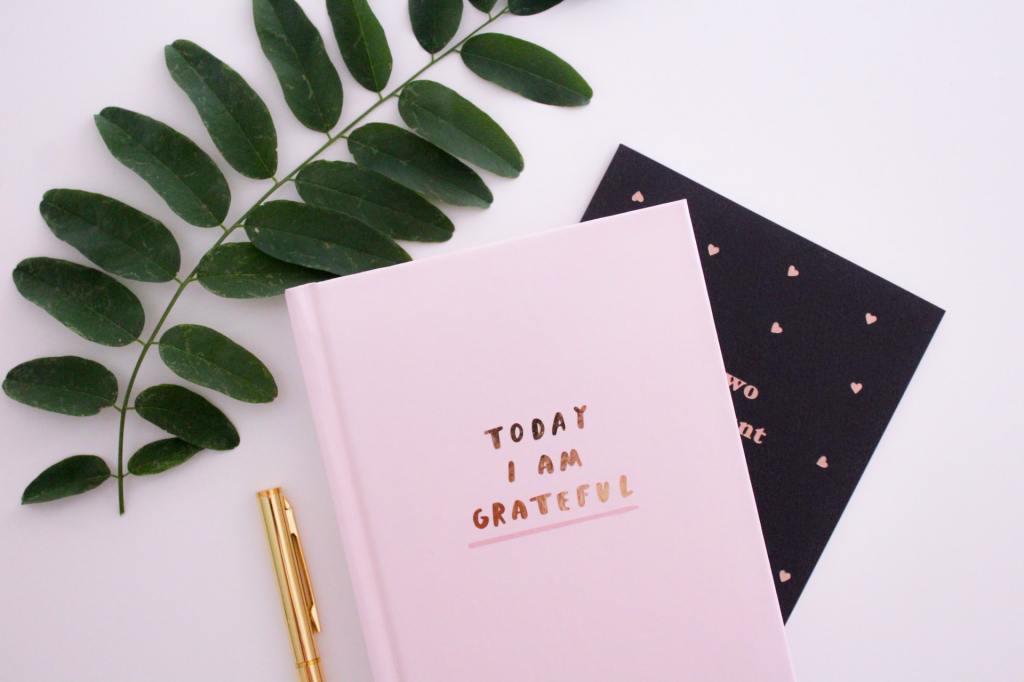
Monday Matters: 5 easy ways to focus on being grateful

Photo credit: Gabrielle Henderson for Unsplash

Research shows that practising gratitude is great for your mental and physical health. Being thankful helps you be more optimistic, accepting and happy. It can even reduce some of the physical symptoms of illness and reduce our stress levels. In today’s Monday Matters post I’m going to share some easy ways in which you can incorporate a daily focus on being grateful for what you have.

What is gratitude?

Gratitude is all about being aware of the good things you have in your life and taking the time to express your appreciation for them. It’s about finding the positives and developing a glass half full attitude. It’s choosing to focus on abundance and how much you have to be grateful for, rather than a feeling of lack or complaint. It’s also about acknowledging the role others play in helping us and being thankful for everything they do.

Gratitude helps us to see what is there instead of what isn’t

Make gratitude meditation part of your daily practise

There are lots of short guided meditations available on YouTube or apps like Calm and Headspace which are really helpful if you are just getting started with meditation – just look for those which focus specifically on gratitude. These are great for developing a relaxed state by focusing on your breathing before inviting you to consider what you are grateful for.

If you are more experienced with meditation, you might create a script that you can follow (this could be written in your bullet journal or typed out and placed next to your bed as a visual reminder). For example:

  • Get yourself into a comfortable position where you are relaxed but purposeful
  • Sit nice and tall like a mountain but keep your shoulders relaxed
  • Close your eyes and breathe
  • Take a moment to focus on your breathing
  • Now change the focus to your body and think about what you have to be grateful for
  • Widen the lens and bring to mind some of the things that you have which make your life easier or bring you great joy
  • Now focus on the people in your life and what they offer you. Silently thank them and feel the love spread through your body.
  • Think for a moment about how all of this gratitude makes you feel. Enjoy the sensations it creates in your body.
  • Finish your practise with some slow and steady breaths before making small movements and when you are ready, open your eyes.

It’s up to you when you want to practise but I find it nice to do first thing in the morning as it sets an intention of being grateful for the rest of the day.

Use affirmations

Writing some personalised gratitude affirmations that you repeat each day is another great way of focusing on all of the positive in your life. These can be quite general and things which we often take for granted e.g. I’m grateful for the clean air I have to breathe. I’m grateful that I have a cosy place to call home. I’m grateful for clean running water to drink and bathe in. I’m grateful for all of the delicious food in my fridge. I’m grateful for all of the opportunities that the modern world presents me with. This would make a lovely spread in your bullet journal and you could change your list each season. In the Summer you can add things like ‘I am grateful for sunny days’, ‘I am grateful for cold drinks when I’m feeling hot’ etc. In Winter time, ‘I’m grateful for my cosy pyjamas to keep me warm’, I’m grateful that we have central heating in our house’ etc.

Start a gratitude jar

I haven’t tried this one myself but the idea really appeals. You can choose any jar and you could even decorate it to show its purpose. It should be placed in a prominent place somewhere in your house (this might be a communal area if you want others to contribute to it as well) with paper and pens beside it. Each day (or most days), try to find something you are grateful for, write it on a slip of paper and place it inside. On days when you need a little pick me up, take some of the notes out and read them to remind yourself of what you have. You could also set a date in your diary or bullet journal to empty the jar out to see all of the loveliness inside.

Create a gratitude spread in your bullet journal

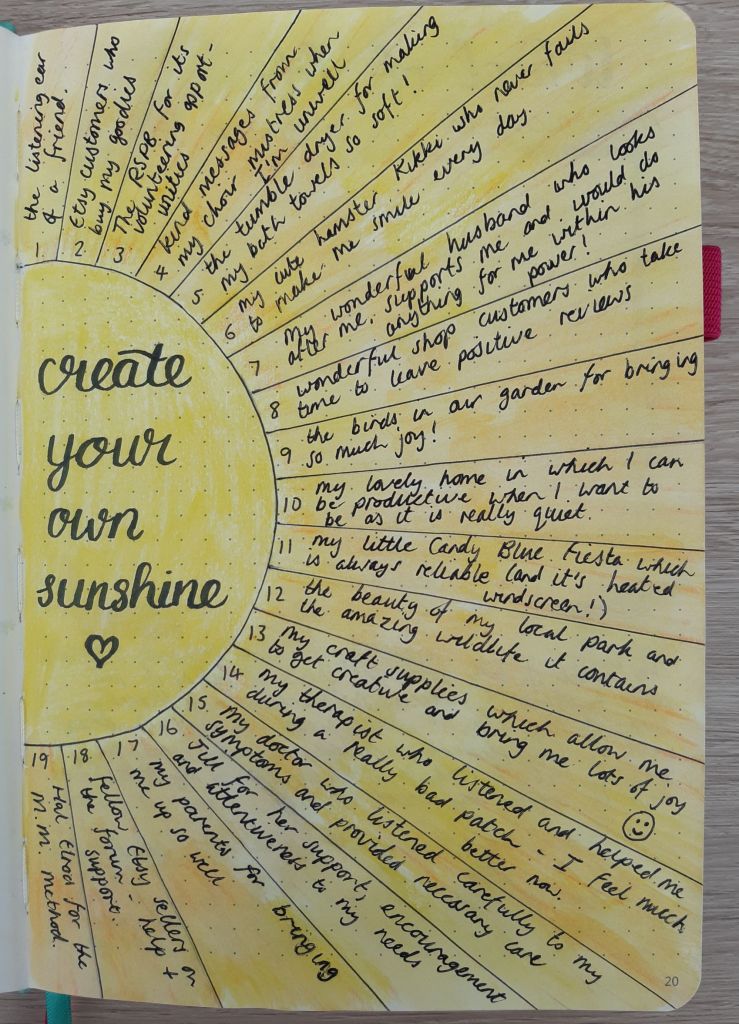
A few years ago, I created this wonderful sunshine gratitude spread and added to it during the weeks of December. I found it in one of my old bullet journals and have really enjoyed sitting and reading each of the things I had brought to mind. Many of them still stand today. I recall drawing the semi-circle by hand and adding the rays with a ruler to create the 19 sections. The centre of the sun is shading with coloured pencil and for the rest I used watercolour pencils as I didn’t have my paint sets then. There are so many different things you could focus on such as everyday things like your morning cup of coffee or your car to take you to different places. You can also think about people in your life who help you, for example your doctor who listens carefully and offers you appropriate treatment or your friend who provides a listening ear. You can even consider your own qualities and how they help you in your day-to-day life e.g. lots of patience with your children or your ability to be assertive when speaking to your boss at work.

Use gratitude prompts to evaluate your week

At the end of a busy week, it’s lovely to sit down and do some quiet reflection on all that you have to be grateful for. You can find a huge array of gratitude prompts on Pinterest -I’ve collected lots on this board so feel free to follow it if you need some ideas. You can either use them for journaling or to just focus your mind and thoughts. Here’s a few to get you started:

  • What challenge have you overcome and what helped you to face or overcome it?
  • What has been your favourite meal or snack over the course of the week?
  • Who have you felt inspired by?
  • What or who made you smile?
  • Think of a gadget in your home that has helped make something quicker or easier this week.
  • What is your main highlight?

You can also focus on your past experiences too:

  • Name a trip out that you’ve thoroughly enjoyed this year.
  • Think about one of your best memories from childhood.
  • Reminisce about one of your favourite holidays (vacations).
  • Recall something that you have made that you were really pleased with.
  • Think about something you have achieved in your life and consider your personal attributes which made you successful.
  • Recall one of the best gifts you have ever received and think about why.

That’s all of my tips for today. I hope you’ve enjoyed reading them and that they are helpful in instilling gratitude in your life. Remember that even if you are having a tough time right now, there’s always something to be grateful for. You might have to dig deep to bring something to mind, but, by taking the time to reflect, you will be able to pick out some positives and this will help to improve your mood.

Posted in lifestyle, Planning and journaling, wellbeing

Monday Matters: 5 things to do in the evening to ensure a restful night’s sleep and a productive next day

Photo credit: Greg Rivers for Unsplash

A while back, I shared my newly set up evening routine which I recorded in my bullet journal during the month of May. For today’s Monday Matters post, I’m going to look at some of the points in more detail as I’ve found them to be super beneficial to ensure I have a really good night’s sleep and they might work for you too.

Get chores out of the way

I always make sure I’ve finished chores by 8pm, two hours before I go to bed. Anything that doesn’t get finished can wait until tomorrow. I dedicate half an hour to emptying the dishwasher, doing a quick tidy up and completing anything that absolutely needs to be done that day. My husband also helps too so we are super quick. Tasks that didn’t get done are migrated to the next day in my bullet journal spread.

Turn your phone to silent and take a social media break

At 8pm, the blue light filter kicks in on my phone and my tablet computer. At this time, if I remember, I also put my phone on silent and try to resist the temptation to check emails or use any form of social media. I do admit, however, that this second part is a work in progress as I think when you finally sit down on the sofa for relax, it can be seen as the perfect opportunity to do a little check in with Facebook / Twitter / Instagram or whatever after a busy day.

Take time for journaling and reflection

Next, I put on my PJs and take some quiet time for journaling and reflecting on how my day has gone. Unfortunately, this is usually the time when our hamster wakes up and starts begging to be out of her cage by knocking her wheel over or biting the bars! Anyway, I digress… I tend to write a few lines in my bullet journal at the end of my daily plan and I also have a little 5 minutes before bed book that gives prompts such as Smiling at…, Reminiscing about… Grateful for… etc which I’ve been filling in nightly since the beginning of April. This quiet time allows me to make a note of any problems I encountered and good things that happened. I see it as a way of emptying my head of clutter so I don’t lie in bed thinking and analysing.

Do a little planning for the next day

After I’ve done my reflection in my bullet journal, I write the next day and date and check out what the weather is going to be doing tomorrow. Then, I add a few things to my plan which I really want to get done. So, for example, I might want to complete some of my college assessment or might want to take photographs of some new products for my Etsy shop. At this time, I also add any chores that I didn’t get done that I would really like to complete e.g. I might decide to do a machine load of washing if I know that the weather is going to be fine or I might want to clear clothes from the drying racks if I know that it’s going to rain and the laundry basket is overflowing. Writing some loose plans for the next day and transferring any appointments from by monthly overview really helps me have a productive morning the next day as I know exactly what I want to get done when I check my bullet journal after my morning meditation.

Choose relaxing activities

By 8.30pm, I’m chilling on the sofa with my feet up ready to relax. The activities change day by day but might include watching some TV (I love psychological dramas), reading my book or playing cards with my husband whilst listening to some music. Directly before bed, I often do a short meditation or some basic stretches – anything that will completely calm my mind. My 10pm I’m usually totally ready for sleep but I do like to read a few chapters of my current novel on my kindle before drifting off.

I hope you find these ideas useful and that, if you put them in place consistently, they help you to get a wonderful night’s sleep and ensure you wake up refreshed and ready for action on the morning of the day after.

Sweet dreams,

Posted in bullet journal, Bullet journaling, watercolour painting

Setting up my bullet journal for September: hedgehog theme

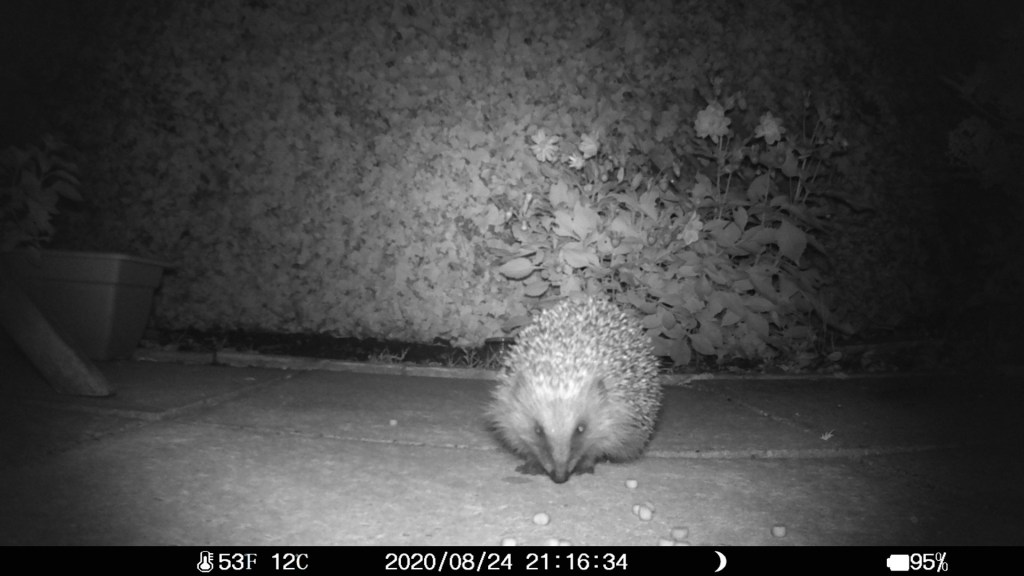
Hi everyone, hope you are all doing well and finding plenty of time to explore your creative side. For next month’s bullet journal spreads, I took inspiration from our garden again. I mentioned a while ago that we have a cute night time visitor who we have started putting biscuits out for each evening (specially formulated little hedgehog ones I should add!). We love getting all wrapped up and sitting on our patio watching him (or her) feed. My husband bought me a wildlife camera for my birthday and so I now have some gorgeous photos and videos of our spiny friend in addition to my creative journaling page records. I hope you enjoy looking through my hedgehog themed pages and I can’t wait to see what you have all chosen for your bullet journal spreads this September.

Photo credit: Laura Jones for Keeping It Creative

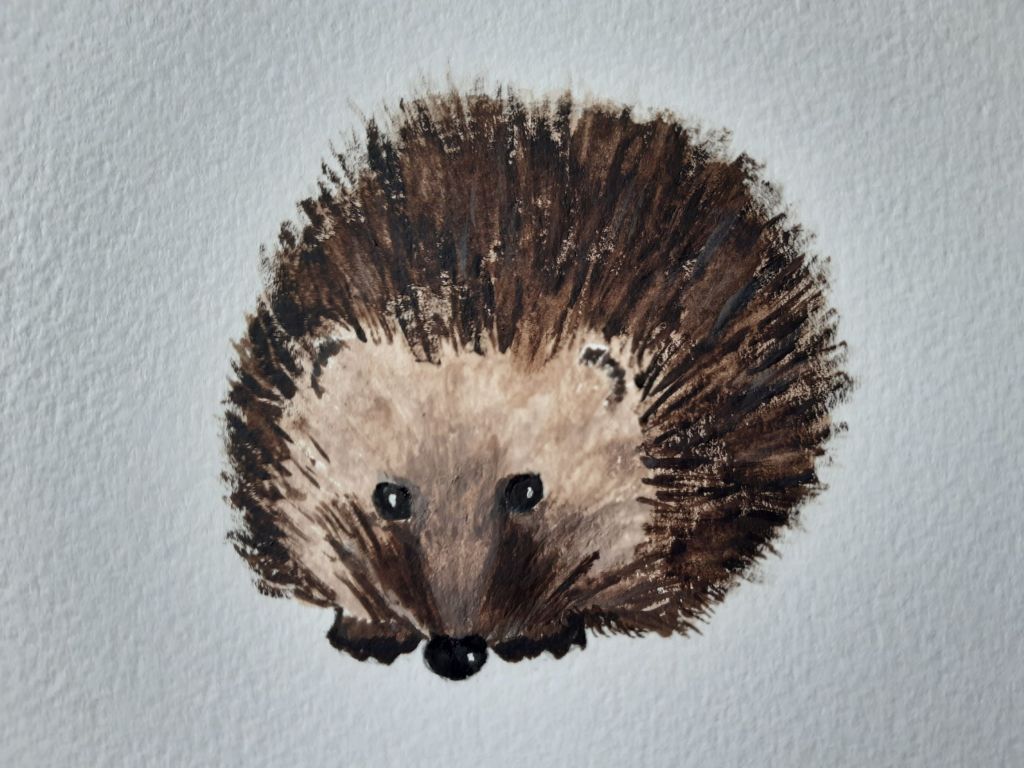
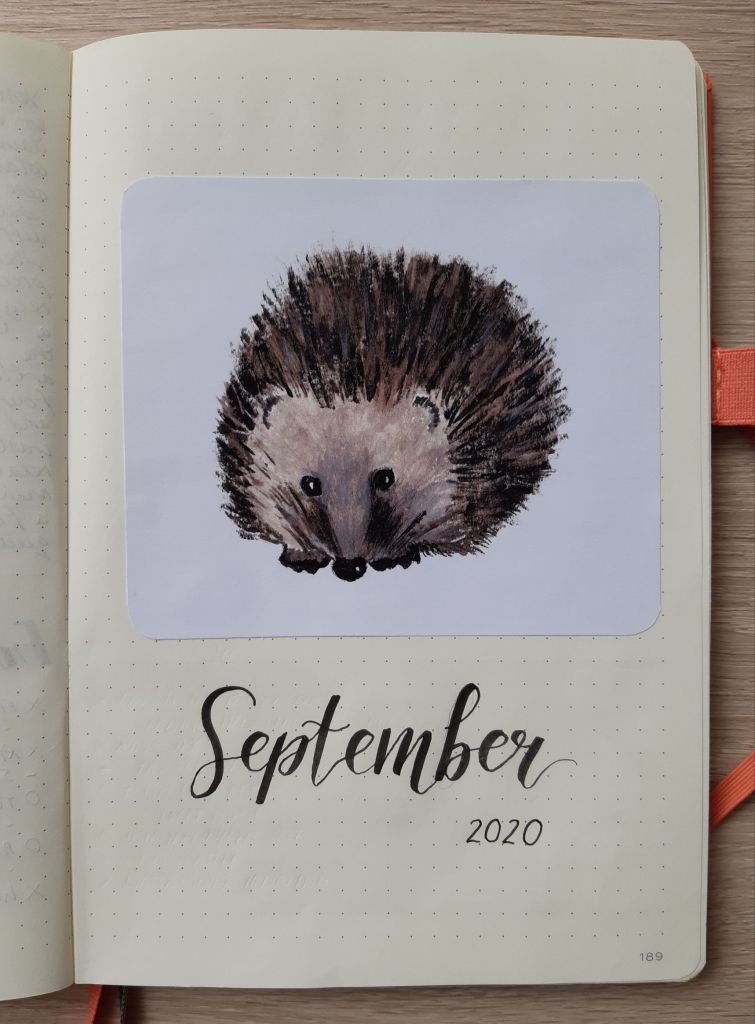
For my cover page I wanted to have a go at a little watercolour painting. As my current bullet journal is a Leuchtturm 1917 and the pages don’t hold up too well with paint, I decided to use watercolour paper and then scan and print my finished art work to stick in.

My original watercolour painting. Photo credit: Laura Jones for Keeping it Creative.
Photo credit: Laura Jones for Keeping it Creative

Next is a motivational quote that I found on Pinterest. It’s there to remind me to keep working towards my goals a little each day. I didn’t want to take the focus away from the words so chose not to add an illustrations.

Photo credit: Laura Jones for Keeping it Creative

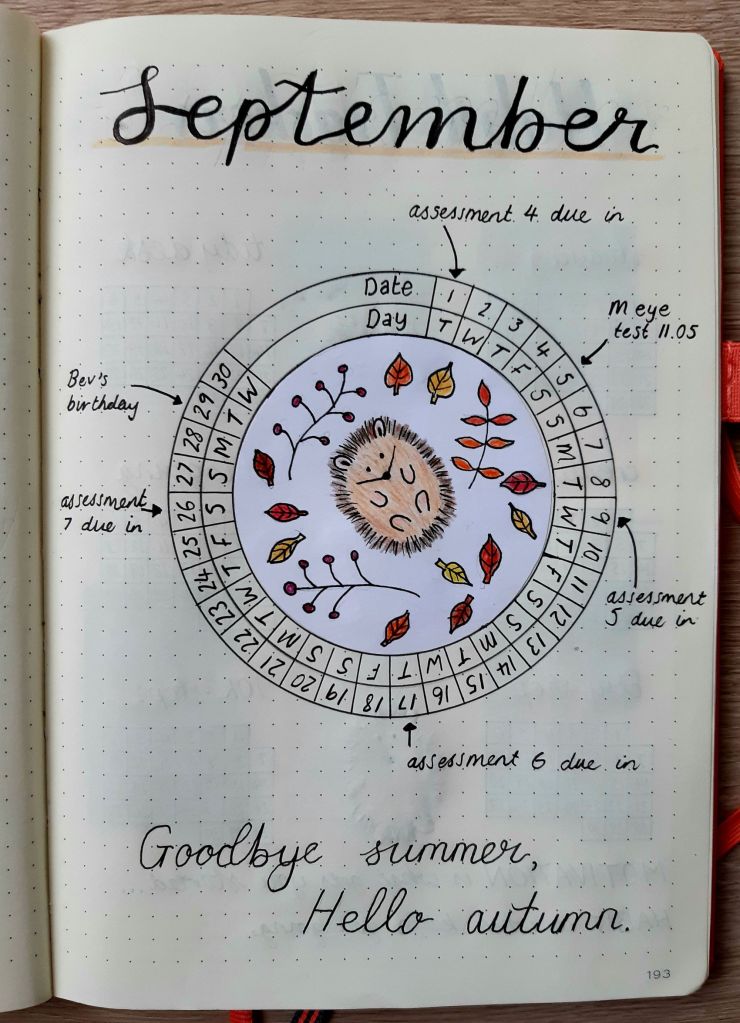
As I mentioned in my previous post, I’ve just bought a circle making tool and I’m having great fun using it. For my calendar, I decided to go with a completely different layout, a circular design which fits on one page. What I think is great about it is that the space needed for the dates and days is minimal and there are no empty boxes like on the month on two pages grid that I usually use. I drew a relaxing hedgehog in the centre and added autumnal elements. You’ll notice that I’ve done the picture on a while piece of paper and glued it in the centre – this is because I wasn’t happy with my initial décor so I started again.

Photo credit: Laura Jones for Keeping it Creative

Even though Autumn officially doesn’t start until 22nd September, the weather is certainly getting cooler and it looks pretty Autumnal outside already. It feels like Summer is over and it won’t be long until we get those gorgeous shades of red, yellow, orange and brown that we all love to see. I had a little space at the bottom of my calendar page so decided to take the opportunity to do some lettering.

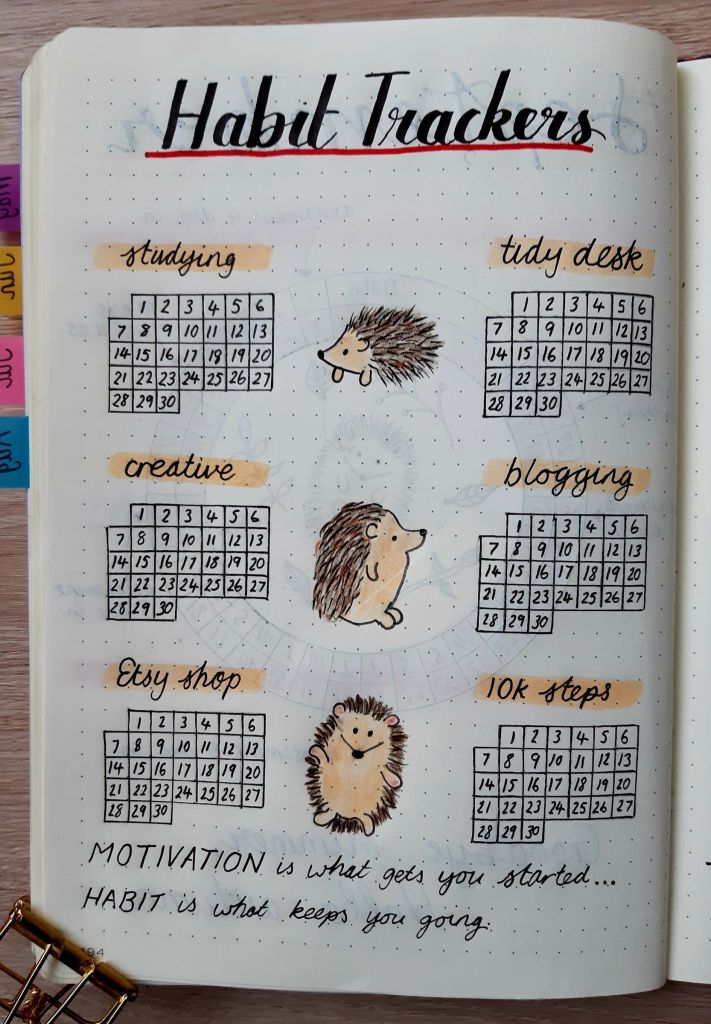
Next are my habit trackers. Some of them are a continuation of last month as I want to make sure I’m keep up with my studying and blogging and also finding regular time to be creative. I’ve got lots planned for my Etsy shop and so will have to make sure I put the hours in to achieve my goals so work on my business is on there again. The other two habits are related to my Level 10 Life goals where I’m aiming for a tidier home and even more exercise by making sure I get a decent walk in each day.

Photo credit: Laura Jones for Keeping it Creative

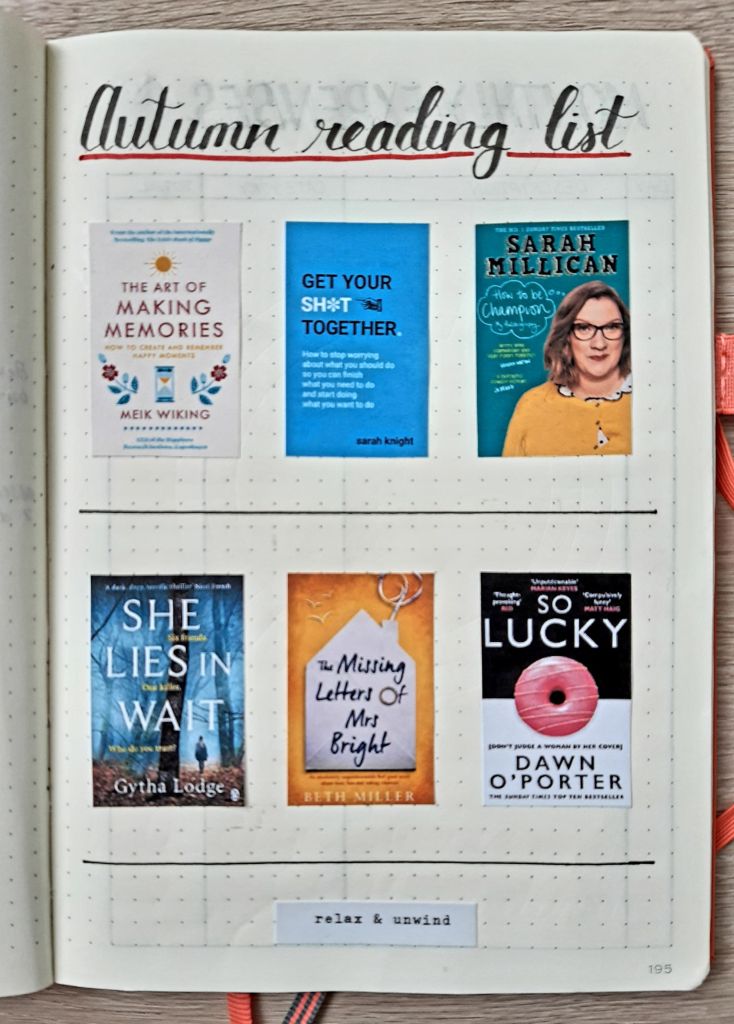
My next page was inspired by one of vlogger and bullet journaller Caitlin Da Silva‘s September spreads where she created a Fall Reading List. I thought it looked really cute with the little book covers (which I rarely get to see as I generally read on my Kindle Paperwhite) so decided to make my own. I went for a nice mix of fiction and non-fictions and all of the authors are completely new to me.

Photo credit: Laura Jones for Keeping it Creative

It’s been a while since I had a monthly expenses tracker in my bullet journal but I decided that I’d like to be more aware of my spending habits so I drew up this simple spread. I covered the left and right edges of the page with washi tape temporarily whilst I drew the lines of Tombow pen to keep it looking a little neater.

Photo credit: Laura Jones for Keeping it Creative

That’s all of my main spreads for September. I haven’t done any fitness trackers this time as I’ve not really kept up with them this month and they became a bit of a chore. I may do a running list of my workouts which I can add to as I do them. I’m also debating adding a Pinterest stats page as I’m using the platform to advertise some of my Etsy shop items and I also pin all of my blog posts on there.

Until next time,

Posted in bullet journal, Bullet journaling, Planning and journaling, Setting goals and intentions

My new circle drawing tool plus setting up Level 10 life and goals spreads in my bullet journal

As well as my amazing birthday gifts, I was also given some money and I knew straight away what I wanted to spend it on. As well as getting this gorgeous Finetec metallic gold watercolour set, I also ordered the Helix Angle & Circle Maker tool which has been on my wish list for quite a while now. After experimenting with how to make angles and circles, I use my new stationery must have to create a new Level 10 Life assessment wheel and identified some steps and goals for making improvements. In today’s blog post, I’m going to talk about various ways of using the Circle maker in your bullet journal and I will also share my Level 10 life spreads.

The Helix circle and angle maker is great for creating different sizes of circle and angles which makes it really easy to produce circular habit trackers, birthday spreads, mood trackers, monthly calendars (I’m just in the process of setting one of these up for September which I’ll share very soon), a decorative wreath outline or even a future log that’s a little bit different. You can also use the smaller circle templates in your weekly and monthly spreads, for example when labelling the dates in your month at a glance or to add decorative elements. I’ve collected some examples and added them to a new Pinterest board which you can check out here.

I’m sure many of you who use a bullet journal will already be familiar with the concept Level 10 life. If you’ve not heard of it and have no idea what I’m talking about, basically it’s all about living your best life by evaluating the life you have currently and setting mini goals to maximise a feeling of satisfaction and work towards your best (Level 10) life. The idea was created by popular author and entrepreneur Hal Elrod who outlines it in full in his book The Miracle Morning. He invites you to assess your life in 10 categories (or you can choose your own ideas if you wish) and give each a score out of 10. This can be recorded on a wheel of life so you can see where you stand at the moment. The categories are as follows:

  • family and friends
  • personal growth and development (which I labelled as personal development)
  • spirituality
  • finances
  • career / business
  • significant other / romance (which I labelled as marriage)
  • fun and recreation
  • contribution / giving
  • health / fitness
  • physical environment (home / office)

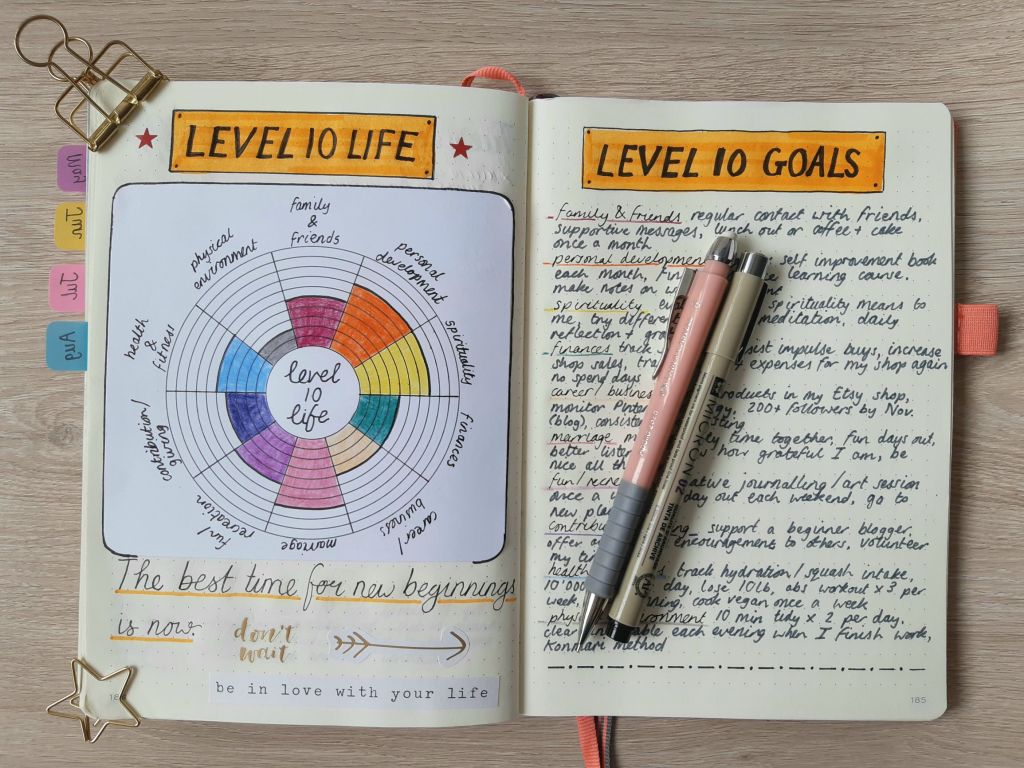
I created my wheel of life using my circle drawing tool to create 11 circles which provided me with 10 ring spaces. I began with the hole nearest to the centre and worked outwards. It’s a bit tricky to hold the thing in place but will a little practise on some scrap paper I was confident enough to go straight in with pen. I divided the circles up into segments of 36 degrees each which was easy enough to do with the angle measuring and drawing part of the tool.

When you’ve set up your wheel, you can then evaluate your life under the different headings to see what you’re doing well at and which areas would benefit from some attention. I’ve done one of these diagrams before and it’s best not to spend too long thinking and just go with your gut instinct. Here’s a close up of my scores:

When you’ve established your current scores, you can then work on setting some mini goals or things to do to improve them. I’ve just written my initial ideas here and then I can look into them in more depth later and set some actionable and measurable goals using my thoughts to help me.

When you’ve done these spreads, you can use them to set yourself mini goals for each month – maybe choosing the section with the lowest score to focus on first. Then, as long as you revisit regularly, you should find you make good progress towards your ‘Level 10 Life’. After a given amount of time, say three months, you can either record your progress on the same wheel by colouring further up the segments or you can make a new wheel of life and compare it to your old one.

That’s all for today but if you have any questions about the circle tool or Level 10 Life, feel free to drop them in the comments and I’ll do my best to help.