Posted in mental health, wellbeing, wellness

Monday Matters: Creating a W.R.A.P. Part 2

Last week, I introduced the idea of creating a Wellness Recovery Action Plan (W.R.A.P.) as a tool for monitoring your own mental health and keeping yourself as well as you can. I discussed what a W.R.A.P. is and went on to share the first step as the creation of a list of wellness tools i.e. things that you enjoy doing and that make you feel good. If you haven’t seen this initial post click here to read it before you learn what to do now. Today, I’m going on to the next step which focuses on what you are like when you are well and on listing daily maintenance tasks that you really need to do to keep yourself well.

Having drawn up your wellness tools, you’re invited to consider what you are like when you are feeling well. When I did this, I got really upset as it was a reminder of how I am when my mental health is good and I felt like I’d not seen the real Laura for such a long time. Now I’m back to feeling great, I can look at my list and celebrate who I am.

In as much detail as possible, you should make a list of how you feel when you are well. Here’s a few examples from my list so you can get the idea:

talkative

friendly

full of positivity

calm

productive

energetic

loving

decisive

assertive

good sense of humour

The idea behind doing this is so that you can spend some time really thinking about the kind of person you are when you’re feeling well and then you will be easily able to spot signs that you are starting to struggle and put steps in place to prevent decline in your mental health.

Having written your list, you should then go on to think about the things you need to do each day to keep yourself feeling well. What you note down here should be every day things that you must do to maintain a state of wellness. This is known as your ‘Daily Maintenance’ plan. Here are some of the things on my list but obviously yours may have different tasks and activities on depending on how you spend your time.

Daily Maintenance:

get up by 8am

have cereal, dried fruit and coffee for breakfast (or an alternative as a treat!)

take a vitamin tablet

check my plan for the day in my bullet journal

brush my teeth

shower

dry my hair and get dressed

Do yoga, some stretches or go for a walk

Do my morning activities

Have a healthy lunch

Do my afternoon activities

Make dinner and eat with my husband

Do a relaxing activity from my wellness toolbox list

Do chores e.g. dishwasher etc.

Make a plan for tomorrow in my BuJo

Relax

Take my medication

Go to bed by 11pm and enjoy at least 7 hours sleep

Obviously my plan changes depending on whether I’m attending classes or going out for the day, but it does give you a basic structure to your time and would be really helpful to refer to in order to keep yourself on track and productive. It’s also good to look at when you aren’t feeling so good as you can add small tasks to your notebook or bullet journal and celebrate the little successes in your day e.g. keeping yourself hydrated or doing a short household chore.

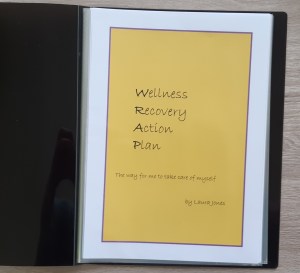
We were given a handout from the Recovery College in which to write down our lists but when I started to feel better, I made my own all bright and colourful pages using a MS Word document and then printed them out and put them in a folder. If you’re feeling particularly arty or love drawing, you could even create a pictorial list.

I hope you’ve found today’s post useful and that it has given you some insight into the usefulness of creating a W.R.A.P. If you have any questions, I would be happy to answer them in the comments.

Until next time, stay home and stay well,

Posted in life hacks, mental health, wellbeing, wellness

Monday Matters: Creating a Wellness Recovery Action Plan (W.R.A.P.) to support good mental health. Part 1.

A few months ago, I did a six week course at my local recovery college that focused on creating a Wellness Recovery Action Plan (W.R.A.P.). The concept of a W.R.A.P. was originally developed in 1997 by Mary Ellen Copeland and a group of like-minded mental health recovery advocates as a way of monitoring wellness and periods of difficulty, keeping yourself well and recording how you would like to be supported and by whom in the event of future issues.

At the time of attending the course, I was in a really bad place and found the sessions quite overwhelming and would end up in tears on a regular basis. However, I could still see the benefits of making a W.R.A.P. and completed all of the tasks and homework each week. I was really proud of myself for continuing to attend the group and now I’m well again, I would like to share my learning with you and discuss how you can go about making your own plan.

The first session of the course involved an introduction to the W.R.A.P. and discussion about how we were going to be supported in the creation of the document. We were given a handout so we could record our ideas each week and tailor our plan to suit our individual needs. If you would like to find out more about the plan from its original creator, you can click here to be taken to her website.

WRAP is a tool that can aid an individual’s recovery and its underpinning principles support the recovery approach. WRAP is a way of monitoring wellness, times of being less well and times when experiences are uncomfortable and distressing. It also includes details of how an individual would like others to support them at these different times.”

There are 5 main principles to the W.R.A.P. and these are:

Hope – that you will get well, stay well and go on to meet your dreams and goals

Personal responsibility – it’s up to you to decide what will most likely help to keep you well and who you would like to support you in order to give you the very best chance at staying well

Education – learning everything you can to enable you to make good decisions about your mental health and how you would like it to be managed

Self advocacy – making sure you have everything you need, want and deserve to support your wellness and recovery

Support – although it is primarily your job to ensure you stay well, the plan encourages you to accept that at times, you may need help and support with managing your mental health and that you can give selected others the chance to work with you to improve your quality of life

After learning about what W.R.A.P. is all about, we were set of the task of brainstorming ideas for a wellness toolbox. This was basically a list of things you enjoy doing which make you feel good. Mine included colouring in, painting, drawing, meditating, meeting a friend for coffee, reading, walking in nature, gardening and volunteering for a good cause. The benefit of working with a group of people who also struggle to maintain good mental health was that you could listen to suggestions from them and maybe try out some of their ideas if they appealed too.

For homework each week, we were invited to collect an item to bring in which could be put in a physical wellness tool box either as reminders of activities or to actually use to support your recovery or to keep yourself well. Ideas from myself and others included colouring in books, jigsaws, a scented candle, a chocolate bar, some bubble bath, photographs of loved ones (including pets!), memorabilia from special times and favourite books. The possibilities are endless!

I wrote a long list of ideas into a MS Word document and printed it off to put in a folder but you could also create a visual board using pictures collected from magazines or the internet or even do a Pinterest board. I think it’s a good idea to have a hard copy of your ideas so you can share it with people who support you in the maintenance of good mental health such as family members, friends or even your mental health professional or doctor.

I hope this has made you think about what you would include in your wellness toolbox. Let me know in the comments below what you find really beneficial for helping you personally to maintain good mental health – you never know, it might just provide me or someone else with an idea to try in the future.

Much love,

Posted in Blogging, productivity, wellbeing, wellness

Keeping my distance: Life during lockdown for an office worker

This morning I received an email from my husband with his contribution to my how life has changed during the pandemic series of guest posts. He is only upstairs, but as he’s working on his computer, he decided to quickly attach his MS Word document and forward it to me rather than asking me to read it on his screen. So without further ado, here’s his summary on things.

Since March 23rd, when Boris Johnson made his announcement about social distancing, we have been spending much more time at home. My wife, Laura asked me to document some of the things that have changed for me personally, so here goes.

The good aspects of the lockdown

I work as a materials planner for factory and my place of work is a 30 mile commute from home. This means I am usually out of the house for 10 hours each week day, leaving at 6.30am and returning home by 5pm. Since I am now working from home, I get to spend more time with Laura. I’m also saving lots of money on fuel as I buy approximately £35.00 worth of diesel each week.

I am spending most of my day working in Laura’s ‘craft room’ (although I do manage on my laptop for the first half hour, sat at the dining table downstairs so I don’t wake my wife up tapping away on the keys!). When Laura gets up (usually around 7.30 – 8am, I’m able to take my things upstairs and spread out on her large desk, making use of the very comfortable office chair and connecting my laptop and keyboard to a large monitor, kindly loaned by work so I can actually see what I am doing on the various emails and spreadsheets! We are lucky as, with the nature of our business, we still have plenty of orders and with the factory operating with less staff we are probably busier than usual, especially as we have issues with getting hold of the materials from different sources as our suppliers are self isolating too.

Although Laura and I have the chance to converse more during the day, our company is still really busy with production and I am always typing away, making calls and having meetings. The only time I really see Laura, when I’m hard at work, is when she brings me coffee (and sometimes a biscuit or two!).

When I was at the office, I used to mainly spend my lunchbreak still sat at my computer but now I’m able to stretch my legs and enjoy my lunch at the dining table so my wife and I can spend quality time together, something we would never be able to do usually. I can also have a pop out into the garden and check out all of our various plants and see what needs to be done out there in terms of weeding, mowing the grass, digging etc. At weekends, there are of course all those little jobs in the house or garden to finally tick off as we are spending much more time at home.

The not so good aspects of the lockdown

When I first started working from home, I only had my laptop and keyboard and could barely see what I was doing. The company decided to arrange for us to have a monitor to use at home as ours are affixed to our desks in the office but I had to wait a while for this to be arranged and ended up having neckache each day and everything seemed to take twice as long to do. I’m getting used to the new way of working now but tasks still take a little longer as you can’t just pop over to a colleague’s desk to check something with them like I would usually do.

Laura and I used to enjoy getting out at weekends. These days we can’t really go out, except to the supermarket, which is now a stressful experience, queuing outside, trying to keep your distance from other customers. Trying not to touch my face whilst in the shop, or feeling like I’m nagging Laura to do the same. Some essentials, such as bread or vegetables are often sold out, so you have to go to ANOTHER shop even though we have been advised to only go to one place! When we return from the supermarket, there’s all the hand washing to be done, which has been making my already cracked and sore hands much worse.

Lots of other things have changed besides, too numerous to mention, or even worth thinking about without being overwhelmed. The situation is ever changing, but for the right reasons and will help us come out of this faster with less lives lost. Stay kind, stay safe.

Michael

Thanks to my wonderful husband for sharing his experiences. I am sure others who work in an office have had similar issues with setting up their space at home, although many of you probably have less to do or have to complete tasks a little differently. Also, now I know how much money we save in fuel costs, I’m thinking of all of the things I could buy with that £35.00 each week!

Posted in Blogging, mental health, productivity, wellbeing, wellness

Life during lockdown: A guest post from my student friend

Today, we hear from my friend Larissa who is a postgraduate student at our local university. I first met her at the compassion group which we both attended last year. I found her really lovely to talk to, so we swapped phone numbers and have stayed friends. We recently met for coffee and cake but I guess we won’t be seeing each other in person for a while now. Anyway, I’ll hand this post over…

Hi, I’m Larissa, a 21-year-old student living in Sunderland. In January I started a Masters Degree in Media Production, but obviously due to the global pandemic we’re all experiencing, I’m stuck at home.

How have my week days changed?

My weekdays have changed quite dramatically, before I was at University five days a week, learning production management, to use cameras, sound equipment and editing software. Now I have limited amounts of work I can do at home and most of my week days consist of playing Animal Crossing on my old Nintendo DS and trying out new vegan recipes.

I’ve also gone from seeing a twenty-plus group of friends and peers, to only seeing those within my household.

How have my weekends changed?

My weekends haven’t changed all too much in honesty, I do occasionally go out drinking on weekends when things are normal, but had been limiting how much I was anyway. However, recently myself and some friends had been having ‘Games Nights’, and I am missing getting together, relaxing and having a good laugh.

What’s one of the worst things about lockdown?

Undoubtedly, there were always going to be negatives about being in lockdown; most people don’t enjoy being stuck in their house, unable to leave. I had considered myself a home-bird until the UK’s lockdown began, but it has made me realise how much I enjoy the freedom of being able to leave my house and pop to see a friend, to the beach, to grab a coffee.

My mental health has also been negatively affected during lockdown; most people (including me) are likely experiencing anxiety regarding their own and other’s health, but personally I struggle with not being able to see my loved ones often (you might call me clingy), and as overwhelming as day-to-day life can prove to be, the lack of normal routine has left me feeling unmotivated and low.

What have you found to be positive about lockdown?

Of course it’s not all doom and gloom (although it’s okay if it feels that way at the moment), I feel there’s been an increase in community spirit, and lots of children in the area have been drawing and writing nice messages and sticking them up in their windows for everyone to see.

I’ve also started exercising daily, something I’d been meaning to get back into the habit of for months. Basically, I’ve had a lot of time to focus on practicing self-care and doing the things I enjoy such as:

-Meditation

-Sketching

-Writing (including this blog post, something I probably wouldn’t have been doing had I not been stuck indoors with all the free time in the world!)

-Gaming

-Cooking

-Spending time with my cat Loki

-Walking in nature (for the government approved one hour per day might I add)

I hope you and your loved ones are all staying safe and well. I know people are going through some horrific things collectively at the moment, but I suppose what I want to finish with, is use this time, if possible, to reconnect; whether that be with yourself, you loved ones, nature or whatever.

Thank you for reading, and if you liked my writing and would like to link up with me, you’re quite welcome to message me on https://uk.linkedin.com/in/larissa-hird-9b29b9183

Larissa

I hope you’ve enjoyed hearing about lockdown from the point of view of a student. I know Larissa is keeping in touch with people on Facebook, but it’s not quite the same as enjoying face-to-face contact time with friends and being with lots of other students during the week. Hopefully we can meet up for coffee and vegan cake again soon. Take care and message me any time,

Posted in Blogging, wellbeing, wellness

Self isolation from the point of view of a retired person: A guest post from my mum

A brief introduction

Hi everyone, my mum has risen to the challenge of creating a guest post about the effects of the COVID-19 lockdown on her life and so I’d like to present her words to you below. It’s probably the first time ever that I’ve seen her write at length on a subject as we usually keep in touch via phone and WhatsApp message where we try to keep our writing to a minimum character length! So, without further ado, I’ll hand over this post to its main author:

Hello, I’m Laura’s mum , Julie, and I’ve been asked if I would like to jot down the good bits and the bad bits about self isolation from the view of an older person (I suspect she might be trying to keep me busy lol!). Well here goes…

I’m not quite 70 but close enough and my husband (Laura’s dad) is getting on for 80 so we are treating this as both of us being ‘vulnerable’ although I can still shop whilst he stays in the car. I’ve tried to come up with positives first, but there are fewer of those.

The positives of staying at home…

Firstly, I like gardening and having more time and the weather not being too bad, though chilly at times, I’ve warmed up digging over the patches where my husband sets his runner beans when the weather warms up. I’ve also been hoeing between my plants. Since our soil is solid clay and had flooded several times, it is now drying out to concrete! – so I’m getting fresh air and a good work out.  

Secondly, my husband has had a spell of physical problems involving lots of pain in various parts of his body, which the doctor says is related to gout and arthritis. However, he has begun taking medication for his difficulties, and now he has picked up, he is able to do some of the jobs that have had to be put on hold. It’s a pity though that the DIY shops are no longer available to us for garden supplies.  

Thirdly, and probably the best of all, people have been so kind. We have had offers of help from our son’s girlfriend who works at the hospital and has been a bit down herself. Also, Laura’s friend from childhood, who works in intensive care at the hospital has offered help and so has the woman who has recently moved into the house across the road. Our son would do our shopping, but quite honestly, whilst I can, I would much sooner do it myself and of course Laura lives a long way away in Sunderland whilst we’re in the Midlands.  

Finally, on the positive side of the situation, I’ve got more time for hobbies such as jigsaws, crosswords and reading which I always enjoy.

The negative aspects of social isolation and distancing 

Now onto the downsides…

Before this all started, we used to go out on bus trips with lunch in Wetherspoons twice per week. Well that is out for now and I miss it. We started off driving a little way to quiet spots for a picnic in the car and a walk but now, the Government have said they don’t want people driving to places for exercise so we stopped doing that. Walking locally gets a bit tedious after a while, but never mind!  

Next, whereas I used to shop 4 or 5 times per week, I’m trying to just shop once per week which isn’t easy because our favourite supermarket doesn’t stock absolutely everything I need to buy. On the plus side, I can do my own shopping, unlike my auntie and uncle who are totally isolated due to my auntie’s serious health issues and have not yet been able to get a delivery spot. Hopefully they will soon. In the meantime my brother and sister-in-law, who also have health issues and want to isolate but can’t get a food delivery are helping my auntie out (back to kind people again!).  

Another problem is that we are running out of jigsaws to do. My brother has some but he can’t bring them to me because he is in isolation too and the charity shops where we usually get them are closed but that is just a small problem. These are just practical issues.

The worse thing about having to isolate is that Laura and her husband will not be able to come down at Easter, which they always do. Also I can’t go round to ours son’s on a Saturday to spend the day with him and our granddaughter Lexi, or see them on a Wednesday for tea which is our usual routine. However, on a positive note, although we   don’t do social media, and it takes me all my time to send an email, I am able to keep in touch with Laura, our son and granddaughter and the rest of my family by text and the odd phone call. I got a very noisy, but very welcome phone call from our granddaughter, aged 8, last weekend which cheered me up no end! Also, my husband and I have each other to talk to and it would be much worse to live on my own in the middle of nowhere like some people have to contend with. That’s it. Take care everyone and keep well.

Julie (Laura’s mum)

I hope you have enjoyed hearing from my mum and it has made you think about the effect of social isolation on the older generation. It’s also nice for me to know that my mum is being thought of by members of her local community, especially with me being too far away to offer practical help. After being initially really upset by the turn of events, I can see she is beginning to adapt relatively well to the situation and is still able to make the most of life and see some positives.

So, all that remains for me to say is, thanks mum for providing your input, and I hope to see you, my dad, brother and niece for some face-to-face contact, days out and games evenings sooner rather than later! It might not be at Easter, but hopefully it’ll be some time in the summer before Lexi and I have our shared birthday.