This month, I decided to start a yoga journal to record my sessions and reflect on the progress I’m making and how it is helping to develop me mentally and physically. It’s something I’ve thought about doing for a while as I’ve been doing yoga almost every day for over a year now. Today, I’m sharing the benefits of the journal and what I include in mine. I’m also going to show my actual journal and some of the contents, as I’m really loving using it and thought you might like to see how much I write.
Why keep a yoga journal?
I’ve only been keeping my journal for a week but so far I’m finding it really helpful. Here’s some of the main benefits I’ve found so far:
it’s a wonderful creative outlet – I really enjoy writing and I love any opportunity to get my thoughts and feelings down on paper, if you feel the same, why not have a go!
it’s helping me become more in tune with my emotions by reflecting on how I feel before and after my practice – sometimes I discover I’m frustrated because I feel like I haven’t achieved enough in my day, but then after my session, my concerns have melted away
it’s great for accountability
I’m becoming more aware of my progress – it’s helped me realise that there are poses I can now do more easily than when I started a year ago were much more challenging
I’m connecting more deeply with my practice by reflecting on it regularly
What equipment do I need to get started?
All you’ll need is a notebook (or some space in your BuJo if you prefer to plan and journal all in one place), a nice pen (I’m using a Muji gel pen in 0.38 as I prefer a smaller nib) and some scheduled time in your day to get writing (for my post of creating and sticking to new habits click here). I’m also using some small sheets of sticker paper to put in images of poses I’ve been practising so I have a visual reminder of the correct form and any modifications or variations for less advanced students – this is completely optional though and just my preference.
My journal is quite small at 4 x 6 inches and the lined pages are relatively thin. I already had this notebook in my stash and, as it’s so pretty, I enjoy looking at the covers each day. The paper isn’t the best quality but it’s just fine for notemaking and adding images of asanas that are new to me or that I need to modify with various equipment. Also, I’m a fan of hoarding pretty little notebooks rather than actually using them so this was the perfect opportunity to use one of my supplies!
My cute notebook – a bargain from TKMaxx a couple of years back!
What should I include in my yoga journal?
Here’s my ideas of what to include if you fancy starting your own journal for your yoga. It might also spark prompts for other form of exercise or mindfulness practises that you engage in on a regular basis.
date and time
length of session
class / home practise?
video / book / ebook or just practising from memory of different asanas?
how did I feel before?
which asanas did I do?
what equipment did I use and how did it help me?
which of the asanas did I find difficult?
what do I want to work on next time?
how do I feel after?
I’ve added these suggestions to the front of my journal so I can turn to the page for ideas. I don’t necessarily answer all of the questions each time but it reminds me of things that I can include if I want to.
Here’s a few example pages from this week:
Prompts on back of front cover and first page. Photo credit: Laura Jones for Keeping It Creative
More journalling page examples. Photo credit: Laura Jones for Keeping It Creative
I hope you have enjoyed reading my ideas for creating a yoga journal and that my post has encouraged you to start your own to record your fitness journey. Let me know in the comments if you already track your progress in some way or if you are thinking about setting up your own yoga journal.
Research shows that practising gratitude is great for your mental and physical health. Being thankful helps you be more optimistic, accepting and happy. It can even reduce some of the physical symptoms of illness and reduce our stress levels. In today’s Monday Matters post I’m going to share some easy ways in which you can incorporate a daily focus on being grateful for what you have.
What is gratitude?
Gratitude is all about being aware of the good things you have in your life and taking the time to express your appreciation for them. It’s about finding the positives and developing a glass half full attitude. It’s choosing to focus on abundance and how much you have to be grateful for, rather than a feeling of lack or complaint. It’s also about acknowledging the role others play in helping us and being thankful for everything they do.
Gratitude helps us to see what is there instead of what isn’t
Make gratitude meditation part of your daily practise
There are lots of short guided meditations available on YouTube or apps like Calm and Headspace which are really helpful if you are just getting started with meditation – just look for those which focus specifically on gratitude. These are great for developing a relaxed state by focusing on your breathing before inviting you to consider what you are grateful for.
If you are more experienced with meditation, you might create a script that you can follow (this could be written in your bullet journal or typed out and placed next to your bed as a visual reminder). For example:
Get yourself into a comfortable position where you are relaxed but purposeful
Sit nice and tall like a mountain but keep your shoulders relaxed
Close your eyes and breathe
Take a moment to focus on your breathing
Now change the focus to your body and think about what you have to be grateful for
Widen the lens and bring to mind some of the things that you have which make your life easier or bring you great joy
Now focus on the people in your life and what they offer you. Silently thank them and feel the love spread through your body.
Think for a moment about how all of this gratitude makes you feel. Enjoy the sensations it creates in your body.
Finish your practise with some slow and steady breaths before making small movements and when you are ready, open your eyes.
It’s up to you when you want to practise but I find it nice to do first thing in the morning as it sets an intention of being grateful for the rest of the day.
Use affirmations
Writing some personalised gratitude affirmations that you repeat each day is another great way of focusing on all of the positive in your life. These can be quite general and things which we often take for granted e.g. I’m grateful for the clean air I have to breathe. I’m grateful that I have a cosy place to call home. I’m grateful for clean running water to drink and bathe in. I’m grateful for all of the delicious food in my fridge. I’m grateful for all of the opportunities that the modern world presents me with. This would make a lovely spread in your bullet journal and you could change your list each season. In the Summer you can add things like ‘I am grateful for sunny days’, ‘I am grateful for cold drinks when I’m feeling hot’ etc. In Winter time, ‘I’m grateful for my cosy pyjamas to keep me warm’, I’m grateful that we have central heating in our house’ etc.
Start a gratitude jar
I haven’t tried this one myself but the idea really appeals. You can choose any jar and you could even decorate it to show its purpose. It should be placed in a prominent place somewhere in your house (this might be a communal area if you want others to contribute to it as well) with paper and pens beside it. Each day (or most days), try to find something you are grateful for, write it on a slip of paper and place it inside. On days when you need a little pick me up, take some of the notes out and read them to remind yourself of what you have. You could also set a date in your diary or bullet journal to empty the jar out to see all of the loveliness inside.
Create a gratitude spread in your bullet journal
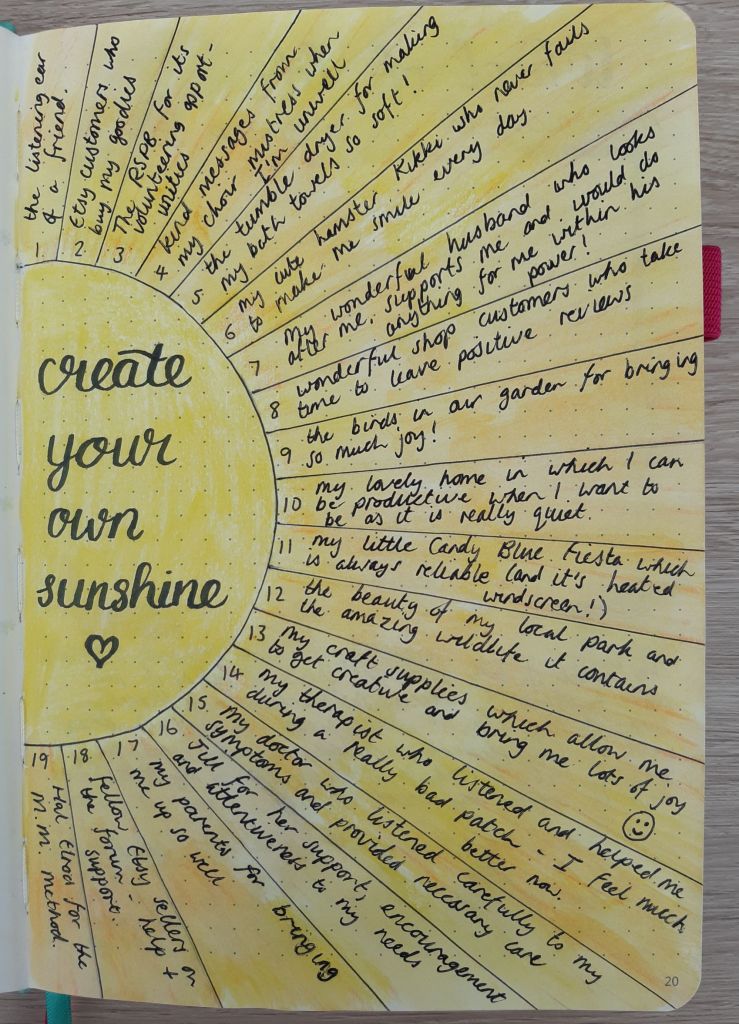
A few years ago, I created this wonderful sunshine gratitude spread and added to it during the weeks of December. I found it in one of my old bullet journals and have really enjoyed sitting and reading each of the things I had brought to mind. Many of them still stand today. I recall drawing the semi-circle by hand and adding the rays with a ruler to create the 19 sections. The centre of the sun is shading with coloured pencil and for the rest I used watercolour pencils as I didn’t have my paint sets then. There are so many different things you could focus on such as everyday things like your morning cup of coffee or your car to take you to different places. You can also think about people in your life who help you, for example your doctor who listens carefully and offers you appropriate treatment or your friend who provides a listening ear. You can even consider your own qualities and how they help you in your day-to-day life e.g. lots of patience with your children or your ability to be assertive when speaking to your boss at work.
Use gratitude prompts to evaluate your week
At the end of a busy week, it’s lovely to sit down and do some quiet reflection on all that you have to be grateful for. You can find a huge array of gratitude prompts on Pinterest -I’ve collected lots on this board so feel free to follow it if you need some ideas. You can either use them for journaling or to just focus your mind and thoughts. Here’s a few to get you started:
What challenge have you overcome and what helped you to face or overcome it?
What has been your favourite meal or snack over the course of the week?
Who have you felt inspired by?
What or who made you smile?
Think of a gadget in your home that has helped make something quicker or easier this week.
What is your main highlight?
You can also focus on your past experiences too:
Name a trip out that you’ve thoroughly enjoyed this year.
Think about one of your best memories from childhood.
Reminisce about one of your favourite holidays (vacations).
Recall something that you have made that you were really pleased with.
Think about something you have achieved in your life and consider your personal attributes which made you successful.
Recall one of the best gifts you have ever received and think about why.
That’s all of my tips for today. I hope you’ve enjoyed reading them and that they are helpful in instilling gratitude in your life. Remember that even if you are having a tough time right now, there’s always something to be grateful for. You might have to dig deep to bring something to mind, but, by taking the time to reflect, you will be able to pick out some positives and this will help to improve your mood.
A while back, I shared my newly set up evening routine which I recorded in my bullet journal during the month of May. For today’s Monday Matters post, I’m going to look at some of the points in more detail as I’ve found them to be super beneficial to ensure I have a really good night’s sleep and they might work for you too.
Get chores out of the way
I always make sure I’ve finished chores by 8pm, two hours before I go to bed. Anything that doesn’t get finished can wait until tomorrow. I dedicate half an hour to emptying the dishwasher, doing a quick tidy up and completing anything that absolutely needs to be done that day. My husband also helps too so we are super quick. Tasks that didn’t get done are migrated to the next day in my bullet journal spread.
Turn your phone to silent and take a social media break
At 8pm, the blue light filter kicks in on my phone and my tablet computer. At this time, if I remember, I also put my phone on silent and try to resist the temptation to check emails or use any form of social media. I do admit, however, that this second part is a work in progress as I think when you finally sit down on the sofa for relax, it can be seen as the perfect opportunity to do a little check in with Facebook / Twitter / Instagram or whatever after a busy day.
Take time for journaling and reflection
Next, I put on my PJs and take some quiet time for journaling and reflecting on how my day has gone. Unfortunately, this is usually the time when our hamster wakes up and starts begging to be out of her cage by knocking her wheel over or biting the bars! Anyway, I digress… I tend to write a few lines in my bullet journal at the end of my daily plan and I also have a little 5 minutes before bed book that gives prompts such as Smiling at…, Reminiscing about… Grateful for… etc which I’ve been filling in nightly since the beginning of April. This quiet time allows me to make a note of any problems I encountered and good things that happened. I see it as a way of emptying my head of clutter so I don’t lie in bed thinking and analysing.
Do a little planning for the next day
After I’ve done my reflection in my bullet journal, I write the next day and date and check out what the weather is going to be doing tomorrow. Then, I add a few things to my plan which I really want to get done. So, for example, I might want to complete some of my college assessment or might want to take photographs of some new products for my Etsy shop. At this time, I also add any chores that I didn’t get done that I would really like to complete e.g. I might decide to do a machine load of washing if I know that the weather is going to be fine or I might want to clear clothes from the drying racks if I know that it’s going to rain and the laundry basket is overflowing. Writing some loose plans for the next day and transferring any appointments from by monthly overview really helps me have a productive morning the next day as I know exactly what I want to get done when I check my bullet journal after my morning meditation.
Choose relaxing activities
By 8.30pm, I’m chilling on the sofa with my feet up ready to relax. The activities change day by day but might include watching some TV (I love psychological dramas), reading my book or playing cards with my husband whilst listening to some music. Directly before bed, I often do a short meditation or some basic stretches – anything that will completely calm my mind. My 10pm I’m usually totally ready for sleep but I do like to read a few chapters of my current novel on my kindle before drifting off.
I hope you find these ideas useful and that, if you put them in place consistently, they help you to get a wonderful night’s sleep and ensure you wake up refreshed and ready for action on the morning of the day after.
This month, I decided to implement a daily meditation routine and have spent some time researching how to get the most out my mindful minutes and encourage consistency. Today’s Monday Matters post shares some tips on creating an effective daily practise and how the different types of meditation can have a positive impact on your life.
Photo credit: Ben White for Unsplash
Why meditate?
Research has shown that there are a huge number of benefits of regular meditation for mind and body. Some of the main positives are:
Improves your self esteem and confidence and increases your levels of optimism
Helps you sleep better
Can make you more productive
Improves your brain function
Helps you appreciate your life more
Increases your attention span
Provides a sense of calm, peace and balance
Reduces pain and improves the immune system
Makes you feel more energetic, creative and spontaneous
Helps to control your thoughts
Decreases depression and anxiety
Reduces cravings such as for junk food, alcohol and cigarettes
Lowers blood pressure
Increases compassion towards yourself and others
but there are many more and once you start to fit meditation in your life, you will soon reap the rewards.
How can I fit meditation into my busy life?
When I attended a mindfulness class through wellbeing services a few years back, everyone talked about how wonderfully calm and relaxed they felt after each meditation. Yet, when asked if they’d used the CD full of mindful practises at home over the rest of the week, most of the participants said that they didn’t have time! However, with the benefits listed above, surely taking ten minutes each day to meditate is worth fitting in to your schedule? I bet if I’d asked the attendees if they’d had time to mindlessly scroll through social media for half hour they would offer a different response. Hopefully the following tips will help to commit more easily.
10 tips for starting a daily meditation practice
Start small Like with any new habit, it’s best to start small and create a mini goal to work towards such as to meditate for a few minutes each day. There are plenty of 5 minute meditations on YouTube to choose from and a variety of different apps which offer free trials.
Make it a routine There are some things you do automatically every day without thinking e.g. brushing your teeth, taking your mediation, applying your make up etc. These tasks have become a routine and you can easily add meditation to this list too. I recommend choosing a set time and sticking to it. I like to do mine first thing in the morning before I start work and then I can be sure it doesn’t get bumped off my to-do list. You could choose last thing before bed if you want to get all relaxed ready for sleep. Find out more about the science and practice of creating habits here.
Choose a comfortable place Where you meditate is up to you but try to pick a place where you will not be distracted and feel at ease (not too relaxed that you begin to feel sleepy though!). You can sit in a comfortable chair, curled up on your sofa, on a cushion cross-legged on the floor or even lie on your bed. You can also use props such as a cushion, bolster or blanket to help you get nice and snug.
Try out different meditations to help you with different aspects of your life There are so many kinds of meditations available – breathing, gratitude, compassion, confidence, focus etc. Think about what you’d most like to instil in your life right now and work from there.
Use guided meditations at first When I first tried meditation a fair few years ago, I used to think it was all about just sitting their cross legged and completely emptying your mind. I used to get really frustrated and eventually decided it was impossible and wasn’t for me. Now I use the audio tracks from the class I attended as well as the Calm app and short guided sessions on FitBit premium. I have a free trial for both apps and I particularly love using my FitBit app as it logs all of my sessions for me so I can check my progress and how consistent I’m being.
Journal about your experiences Take time to reflect on your practice, what went well, what you struggled with, how you felt during and after, if you came up with excuses to miss your session and why this might have happened etc. If you felt really relaxed, it helped you have a more productive day or you enjoyed a wonderful night’s sleep, celebrate your achievements and use them to motivate you to continue. If you found it really difficult to switch off and ended up feeling really frustrated, think about what you could do differently next time or accept that it is all part of the learning process and it will become easier with time. Or, if you forgot to do your daily meditation this time, how could you make sure you stick with it? Could you set an alarm or get a reminder from the app you are trying out? Might you attach the practise to another of your daily routines e.g. do your session straight after your morning cup of coffee?
Remember repetitive activities can be meditative too If you find you’re struggling with just sitting and meditating, remember meditation is all about attention and awareness and you might find that doing a mindful activity such as colouring in is much easier for you. I wrote a post full of ideas earlier this year which you can find here. Movement meditations are also an option such as tai chi, yoga or mindful walking.
Be kind to yourself Remember to treat yourself with compassion as you develop your practice. Accept that it might not be easy at first and that your mind will keep wandering. Know that it’s okay to find it difficult and you’re not doing it wrong (try not to judge yourself). Just bring your mind gently and kindly back to your breathe and start again.
Apply your mindful practice to other activities Meditation is all about focus and so is a kind of mindfulness that can be applied throughout your day. For example, when you shower, really concentrate on what you’re doing and how it feels, use your senses to immerse your thoughts in your experience – inhale the scent of your shower gel, observe the water running down your tiles or the screen, listen to the sounds the water makes as it hits the bath or the shower tray. You can even get into a meditative state as you do your daily chores as I explained in this blog post.
Use a habit tracker (but keep it simple) If you’re a bullet keen bullet journalist like me, you probably know all about habit trackers and have seen many examples on Instagram and Pinterest. Habit trackers are great for monitoring your progress and consistency and keeping you motivated. However, if you add too many habits, the filling in process can become an onerous task and you are likely to get sick of colouring in boxes, adding dots, ticks or crosses. I recommend tracking a very small number of habits and only choosing one or two new ones to focus on and selecting other things that you want to become more consistent with.
So that’s it, lots of reasons to add meditation to your daily routine and my top 10 practical tips for beginners that will hopefully help you develop a successful meditation habit that you can stick with. Let me know in the comments if starting a daily practice is something you’re interested in and today’s blog post has either given you the motivation to get started. If it has, I hope you are soon on your way to enjoying the benefits for body and mind.
If you are a regular reader of my blog, you will know how much I love the great outdoors and how enjoyable I find spending time in nature. It’s really beneficial for my mental health and I try to make getting outside a big part of my daily self care routine. I’m sure most of you have heard of the Danish concept of Hygge (hue-gah) which is loosely translated as a feeling of peaceful cosiness and makes you think of soft and snuggly blankets, a flickering fire or the soft glow of candles. But, you may not have heard of the idea of Friluftsliv, and neither had I until last week. In a nutshell, it’s all about living an outdoorsy life and is a popular practice in Norway, which incidentally is consistently ranked as one of the happiest countries in The World. Today’s Monday Matters introduces you to Friluftsliv and considers some ways in which you can adopt its principles into your life wherever you may live.
The term Friluftsliv, which is apparently pronounced free-loofts-liv, was coined by writer Henrik Ibsen back in 1859 and is made up of the Norwegian words for free, air and life and can loosely be translated as open-air living. Although it might be difficult to remember the name, the concept is luckily a lot easier to grasp. Not only is Friluftsliv about spending time outdoors, it’s also about being mindful of our personal experiences, feeling a connection with the natural world and appreciating all that it has to offer no matter what the season or what the weather brings. The benefits of all three of these have been widely studied and are known to be wonderful for our physical and mental wellbeing.
Having been mainly stuck inside for most of our time due to lockdown restrictions, many of us are now experiencing a strong desire to go out on long walks, sit in the sunshine and enjoy the fresh air of our outdoor spaces both near and far in any way we can. Now that we can drive to a range of locations and facilities in parks and other green spaces are starting to open up, it’s becoming a little easier to relax and enjoy nature. Obviously, we still have to be aware of others and stick with the social distancing recommendation of two metres where possible but we are able to find moments of peace and quiet now.
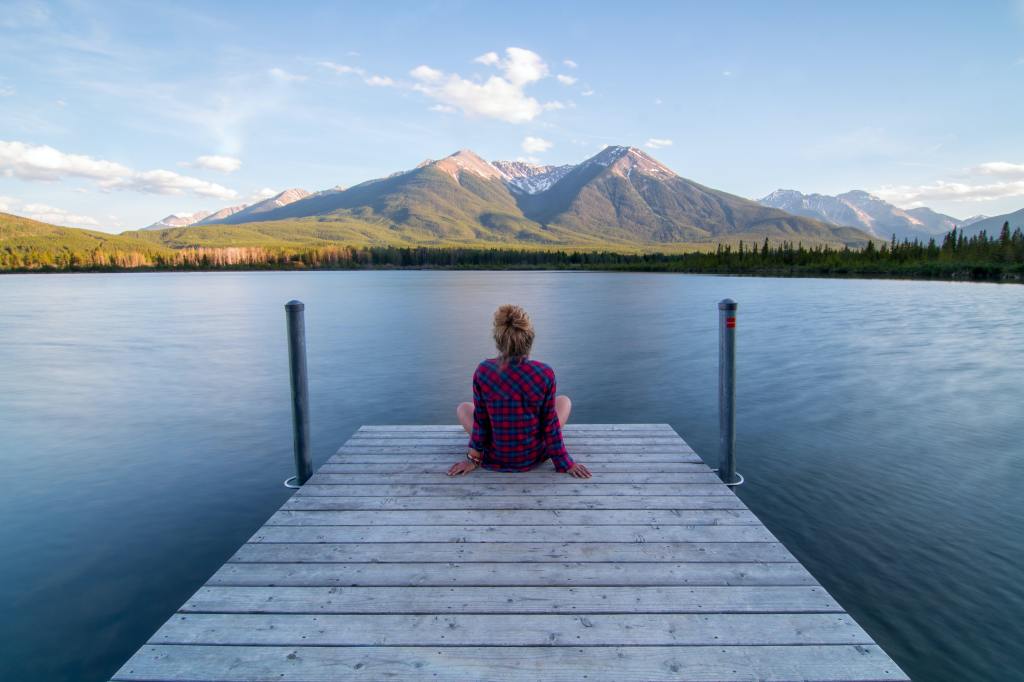
Photo credit: Toomas Tartes for Unsplash
You might not have immediate access to fjords, mountains and rural hideouts but we can all incorporate elements of Friluftsliv in our lives and feel its rejuvenating effects. Here are some ideas that you might like to try:
Find out what your local area has on offer
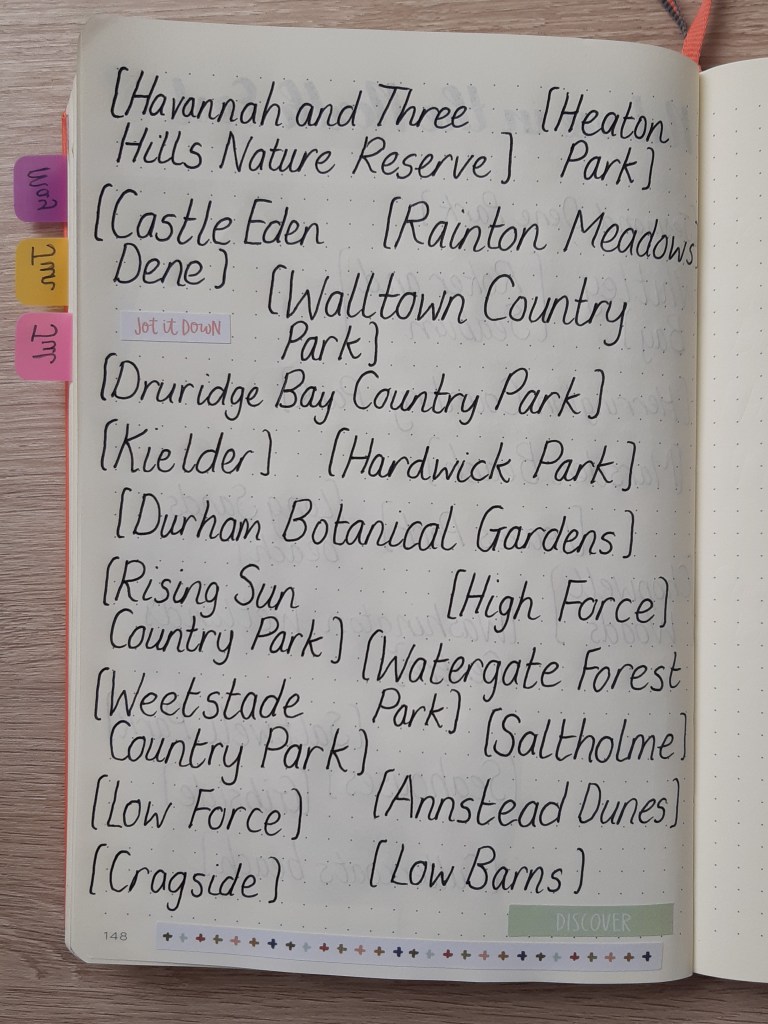
If you type in search terms such as ‘nature reserves’ or ‘places to walk’ and the name of your local area into Google you should be able to find lots of opportunities to enjoy the great outdoors. I started by search in Tyne And Wear and then expanded to the whole of the North East of England and wrote down a range of ideas in my bullet journal. Some of the places we have been to many times before, whilst others might be good for the future. I just wrote the name down for now but will of course need to check out any facilities and if they are currently open as there are still social distancing measures in place.
Be in the moment
One of the key elements of Friluftsliv is mindfulness and there are so many benefits of being in the moment and forgetting all about the stresses and strains of modern day life. As you enjoy your chosen outdoor space, try bringing your attention to your breathing, noticing the sensations as you inhale and exhale, thinking about the processes involved and the key part that trees play. Next, explore your immediate environment using your senses. Maybe you can hear birdsong or trickling water, perhaps you can feel a gentle breeze ruffling your hair or the smell of damp leaves. Really take the time to appreciate all that nature has to offer us. Perhaps find a spot to sit to a while and observe all of the different colours. Maybe you will have the chance to watch different birds and animals as they go about their daily lives. You might like to try going back to this same location at different times of year and noticing changes in the seasons. As you really concentrate on what is happening right now, you’re likely to be filled with a sense of calm and peacefulness. Just let it wash over you and enjoy the simple pleasures of life.
Photo credit: Kalen Emsley for Unsplash
All weather experiences
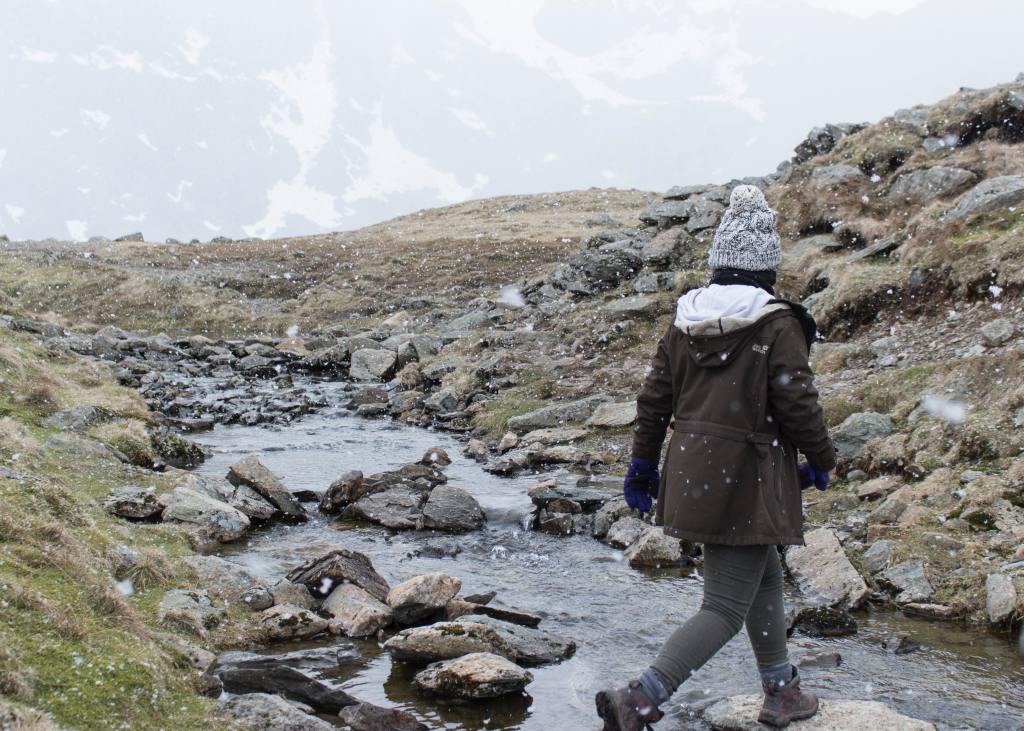
The UK has very changeable weather and you never know quite what to expect. It’s approaching the end of July and as I write this it is raining really heavily. You might think that it’s ‘stopping in’ weather and you could describe it as ‘a miserable day’ but as long as you dress appropriately, a nice walk can really help to lift the spirits. I’m not suggesting you take yourself out in the middle of a thunderstorm or a harsh gale, but a little rain, the crunch of snow underfoot in winter or a chilly wind in Spring or Autumn is perfectly fine with the right clothes and accessories. I’ve lost count of how many knitted hats and scarves I have in my drawer and I love wearing them all. I’ve also got plenty of sun hats and caps too to protect myself from The Sun and they’re all chosen for their bright and cheery colours and patterns.
Photo credit: Matt Heaton for Unsplash
Enjoy a nature holiday
As I mentioned in one of my earlier posts, our holiday abroad for this year has been postponed until next year but that doesn’t mean we can’t enjoy a nice break here in the UK. We’ve been to some amazing places in the countryside and some of our favourites have been staying in log cabins in forests and woodland. The idea of going camping (or glamping) also really appeals as I love the idea of being surrounded by nature. There are also self catering cottages in more rural locations which can be used as a base for walking holidays.
Photo credit: Michael D. Beckwith for Unsplash
Take up a new outdoor hobby
There are lots of hobbies you might like to consider that encourage you to go outdoors. I love taking my camera out and about with me to capture signs of the seasons such as Autumnal berries, squirrels gathering nuts for the winter, blackbirds searching for tasty worms on our lawn, blue tits collecting nesting materials and new buds developing on the trees. Sometimes I just absorb nature and use my senses to explore, whilst at other times I like recording my finds in photographs. I also often take my binoculars out and about with me so I can do a little birdwatching either at nature reserves or in woodland areas. Hiking or cycling are some other great pursuits as you can enjoy the psychological benefits and have a wonderful workout too.
Photo credit: Steve Harris for Unsplash
Picnics and alfresco dining
We like to take any chance we can in the Spring and Summer to enjoy picnics by the coast, at a nature reserve or in a country park or garden. The car boot always has a folded blanket and a couple of folding chairs in so we’re always prepared whether there are purpose build benches or not. We’ll often take a book or magazine with us too for when we’ve finished eating. Our garden patio also has a table and chairs with a parasol so that we can eat our lunch or dinner outside when it is fine.
Try a little skychology
I love looking at the ever changing sky during the day, first thing when the Sun is rising, in the evening at Sunset and at night to see the twinkling stars. Skychology is a relatively new term which recognises that looking up and noticing what’s going on up there has the potential to make you feel calm, connected and present. My husband I regularly sit out in the garden after dark (sometimes with a glass of wine) and find it really peaceful. In fact, much to our excitement, we actually spotted an inquisitive hedgehog one night and have started putting out food in the form of special biscuits which we picked up in a local garden centre. We’ve seen at least two different ones now (one was much smaller) and we were amazed how noisy they are when they’re eating and wandering around. The little one snuffled its way to our wildlife pond for a thirsty drink too!
Photo credit: Diego PH for Unsplash
Snatches of outdoor time
I’m lucky enough to work from home and can sit at my dining table for a direct view of our garden and can pop outside for a quick stretch whenever I want. I can also go out for a walk around the block or drive to a local park or a woodland area. But, if we make it a priority, we can all find a little time to spend outdoors at least a few times a week if not every day. Maybe just enjoying your morning cup of coffee or your breakfast in your garden first thing or taking a stroll through your local park when you finish work. For me, finding time to get outdoors is so vital for my wellbeing that it has become part of my daily routine.
Digital detox
Finally, it’s also a really good idea to take a break from social media and your phone for a while to encourage complete relaxation. If you can’t bear to leave your smart devices at home, try burying them in the bottom of your bag and avoid looking at them for a few hours. A lot of quite remote places have no signal anyway!
Final words…
I hope you’ve enjoyed learning about Friluftsliv and are keen to incorporate elements of it into your life. Let me know in the comments how you plan to embrace nature in the future or what you enjoy doing in the great outdoors. There’s so many wonderful things to see out there that once you start, you’ll soon crave your nature fix every day!