Posted in lifestyle, mental health, Mindfulness, wellbeing, wellness

Monday Matters: Introducing Friluftsliv and how to reap the benefits of this popular Norwegian practice

Photo credit: Scott Goodwill for Unsplash

If you are a regular reader of my blog, you will know how much I love the great outdoors and how enjoyable I find spending time in nature. It’s really beneficial for my mental health and I try to make getting outside a big part of my daily self care routine. I’m sure most of you have heard of the Danish concept of Hygge (hue-gah) which is loosely translated as a feeling of peaceful cosiness and makes you think of soft and snuggly blankets, a flickering fire or the soft glow of candles. But, you may not have heard of the idea of Friluftsliv, and neither had I until last week. In a nutshell, it’s all about living an outdoorsy life and is a popular practice in Norway, which incidentally is consistently ranked as one of the happiest countries in The World. Today’s Monday Matters introduces you to Friluftsliv and considers some ways in which you can adopt its principles into your life wherever you may live.

The term Friluftsliv, which is apparently pronounced free-loofts-liv, was coined by writer Henrik Ibsen back in 1859 and is made up of the Norwegian words for free, air and life and can loosely be translated as open-air living. Although it might be difficult to remember the name, the concept is luckily a lot easier to grasp. Not only is Friluftsliv about spending time outdoors, it’s also about being mindful of our personal experiences, feeling a connection with the natural world and appreciating all that it has to offer no matter what the season or what the weather brings. The benefits of all three of these have been widely studied and are known to be wonderful for our physical and mental wellbeing.

Having been mainly stuck inside for most of our time due to lockdown restrictions, many of us are now experiencing a strong desire to go out on long walks, sit in the sunshine and enjoy the fresh air of our outdoor spaces both near and far in any way we can. Now that we can drive to a range of locations and facilities in parks and other green spaces are starting to open up, it’s becoming a little easier to relax and enjoy nature. Obviously, we still have to be aware of others and stick with the social distancing recommendation of two metres where possible but we are able to find moments of peace and quiet now.

Photo credit: Toomas Tartes for Unsplash

You might not have immediate access to fjords, mountains and rural hideouts but we can all incorporate elements of Friluftsliv in our lives and feel its rejuvenating effects. Here are some ideas that you might like to try:

Find out what your local area has on offer

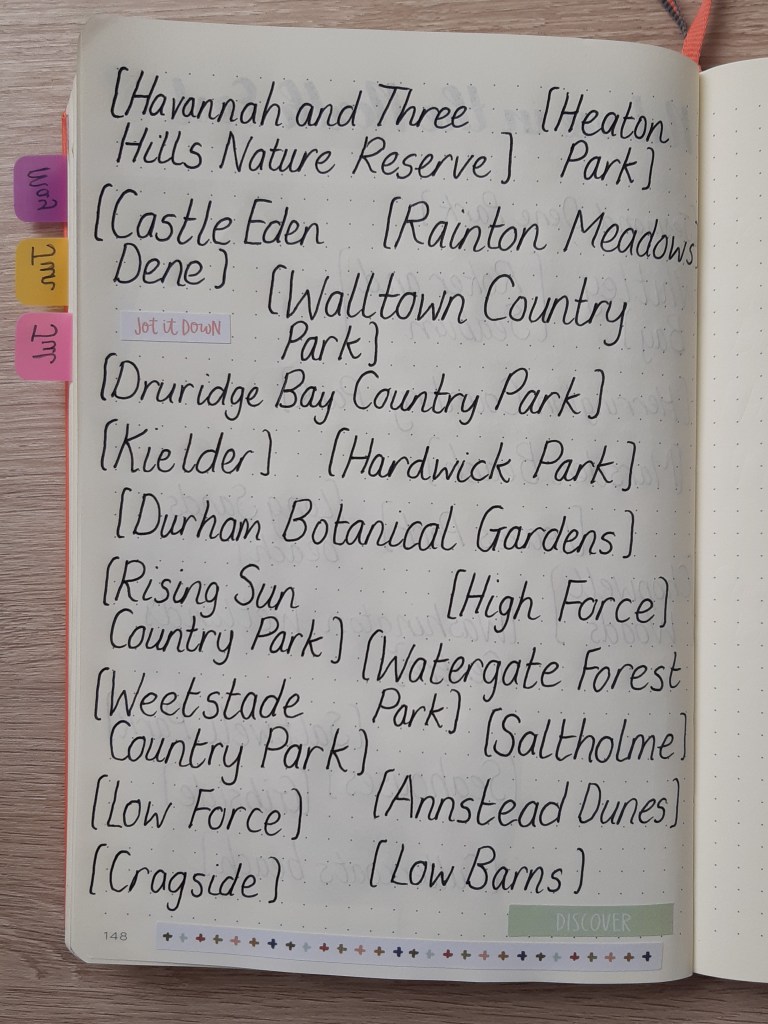
If you type in search terms such as ‘nature reserves’ or ‘places to walk’ and the name of your local area into Google you should be able to find lots of opportunities to enjoy the great outdoors. I started by search in Tyne And Wear and then expanded to the whole of the North East of England and wrote down a range of ideas in my bullet journal. Some of the places we have been to many times before, whilst others might be good for the future. I just wrote the name down for now but will of course need to check out any facilities and if they are currently open as there are still social distancing measures in place.

Be in the moment

One of the key elements of Friluftsliv is mindfulness and there are so many benefits of being in the moment and forgetting all about the stresses and strains of modern day life. As you enjoy your chosen outdoor space, try bringing your attention to your breathing, noticing the sensations as you inhale and exhale, thinking about the processes involved and the key part that trees play. Next, explore your immediate environment using your senses. Maybe you can hear birdsong or trickling water, perhaps you can feel a gentle breeze ruffling your hair or the smell of damp leaves. Really take the time to appreciate all that nature has to offer us. Perhaps find a spot to sit to a while and observe all of the different colours. Maybe you will have the chance to watch different birds and animals as they go about their daily lives. You might like to try going back to this same location at different times of year and noticing changes in the seasons. As you really concentrate on what is happening right now, you’re likely to be filled with a sense of calm and peacefulness. Just let it wash over you and enjoy the simple pleasures of life.

Photo credit: Kalen Emsley for Unsplash

All weather experiences

The UK has very changeable weather and you never know quite what to expect. It’s approaching the end of July and as I write this it is raining really heavily. You might think that it’s ‘stopping in’ weather and you could describe it as ‘a miserable day’ but as long as you dress appropriately, a nice walk can really help to lift the spirits. I’m not suggesting you take yourself out in the middle of a thunderstorm or a harsh gale, but a little rain, the crunch of snow underfoot in winter or a chilly wind in Spring or Autumn is perfectly fine with the right clothes and accessories. I’ve lost count of how many knitted hats and scarves I have in my drawer and I love wearing them all. I’ve also got plenty of sun hats and caps too to protect myself from The Sun and they’re all chosen for their bright and cheery colours and patterns.
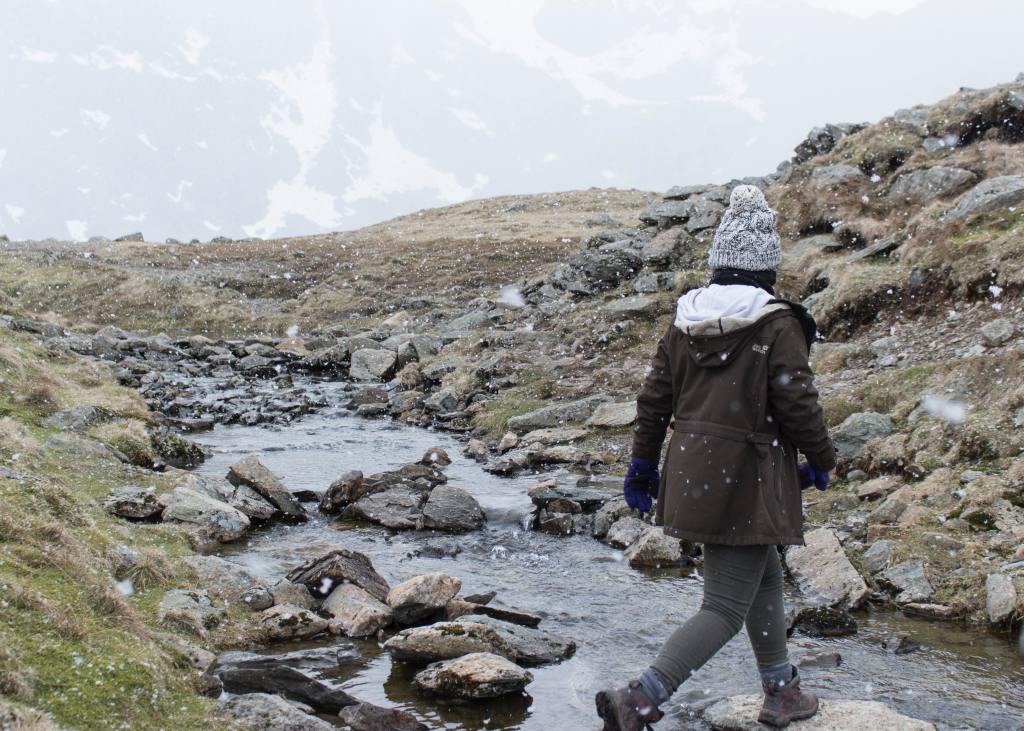
Photo credit: Matt Heaton for Unsplash

Enjoy a nature holiday

As I mentioned in one of my earlier posts, our holiday abroad for this year has been postponed until next year but that doesn’t mean we can’t enjoy a nice break here in the UK. We’ve been to some amazing places in the countryside and some of our favourites have been staying in log cabins in forests and woodland. The idea of going camping (or glamping) also really appeals as I love the idea of being surrounded by nature. There are also self catering cottages in more rural locations which can be used as a base for walking holidays.

Photo credit: Michael D. Beckwith for Unsplash

Take up a new outdoor hobby

There are lots of hobbies you might like to consider that encourage you to go outdoors. I love taking my camera out and about with me to capture signs of the seasons such as Autumnal berries, squirrels gathering nuts for the winter, blackbirds searching for tasty worms on our lawn, blue tits collecting nesting materials and new buds developing on the trees. Sometimes I just absorb nature and use my senses to explore, whilst at other times I like recording my finds in photographs. I also often take my binoculars out and about with me so I can do a little birdwatching either at nature reserves or in woodland areas. Hiking or cycling are some other great pursuits as you can enjoy the psychological benefits and have a wonderful workout too.

Photo credit: Steve Harris for Unsplash

Picnics and alfresco dining

We like to take any chance we can in the Spring and Summer to enjoy picnics by the coast, at a nature reserve or in a country park or garden. The car boot always has a folded blanket and a couple of folding chairs in so we’re always prepared whether there are purpose build benches or not. We’ll often take a book or magazine with us too for when we’ve finished eating. Our garden patio also has a table and chairs with a parasol so that we can eat our lunch or dinner outside when it is fine.

Try a little skychology

I love looking at the ever changing sky during the day, first thing when the Sun is rising, in the evening at Sunset and at night to see the twinkling stars. Skychology is a relatively new term which recognises that looking up and noticing what’s going on up there has the potential to make you feel calm, connected and present. My husband I regularly sit out in the garden after dark (sometimes with a glass of wine) and find it really peaceful. In fact, much to our excitement, we actually spotted an inquisitive hedgehog one night and have started putting out food in the form of special biscuits which we picked up in a local garden centre. We’ve seen at least two different ones now (one was much smaller) and we were amazed how noisy they are when they’re eating and wandering around. The little one snuffled its way to our wildlife pond for a thirsty drink too!

Photo credit: Diego PH for Unsplash

Snatches of outdoor time

I’m lucky enough to work from home and can sit at my dining table for a direct view of our garden and can pop outside for a quick stretch whenever I want. I can also go out for a walk around the block or drive to a local park or a woodland area. But, if we make it a priority, we can all find a little time to spend outdoors at least a few times a week if not every day. Maybe just enjoying your morning cup of coffee or your breakfast in your garden first thing or taking a stroll through your local park when you finish work. For me, finding time to get outdoors is so vital for my wellbeing that it has become part of my daily routine.

Digital detox

Finally, it’s also a really good idea to take a break from social media and your phone for a while to encourage complete relaxation. If you can’t bear to leave your smart devices at home, try burying them in the bottom of your bag and avoid looking at them for a few hours. A lot of quite remote places have no signal anyway!

Final words…

I hope you’ve enjoyed learning about Friluftsliv and are keen to incorporate elements of it into your life. Let me know in the comments how you plan to embrace nature in the future or what you enjoy doing in the great outdoors. There’s so many wonderful things to see out there that once you start, you’ll soon crave your nature fix every day!

Bye for now,

Posted in lifestyle, mental health, wellbeing, wellness

Monday Matters: 6 Ways to Ensure a Positive Social Media Experience

Photo credit: Georgia de Lotz for Unsplash

The negative effects of social media are well documented and there’s a lot of evidence from a variety of studies about it being detrimental to our wellbeing causing issues such as anxiety, depression, loneliness and low self esteem. However, I believe it is perfectly possible to have a positive and rewarding experience online if you moderate the time you spend and are mindful of how you engage. Today’s Monday Matters post focuses on things to consider and strategies to adopt to help you get benefit from social media whilst sheltering yourself from the more negative aspects of exposure.

Limit your time

I think most of us will agree that we spend far too long on social media each day and that a lot of that time is taken over by mindless scrolling. A study I found online suggested that 30 minutes a day is ample time to spend catching up on various platforms yet a different study found that the average is nearly two hours! If you think social media is taking up too much of your precious time then it probably is and it might be a good idea to schedule a specific time to check in. So, for example, you could decide 6.30pm until 7pm is a good time but make sure you check in again and decide if this amount and time is working for you.

It’s also a good idea to avoid social media later in the evening as it can affect the quality of your sleep. The light on your phone or tablet has been shown to reduce melatonin, the hormone that controls your sleep cycle. Also, some online content can cause something called ‘cognitive arousal’ which basically means you get wound up when you should be winding down!

Try turning off your notifications

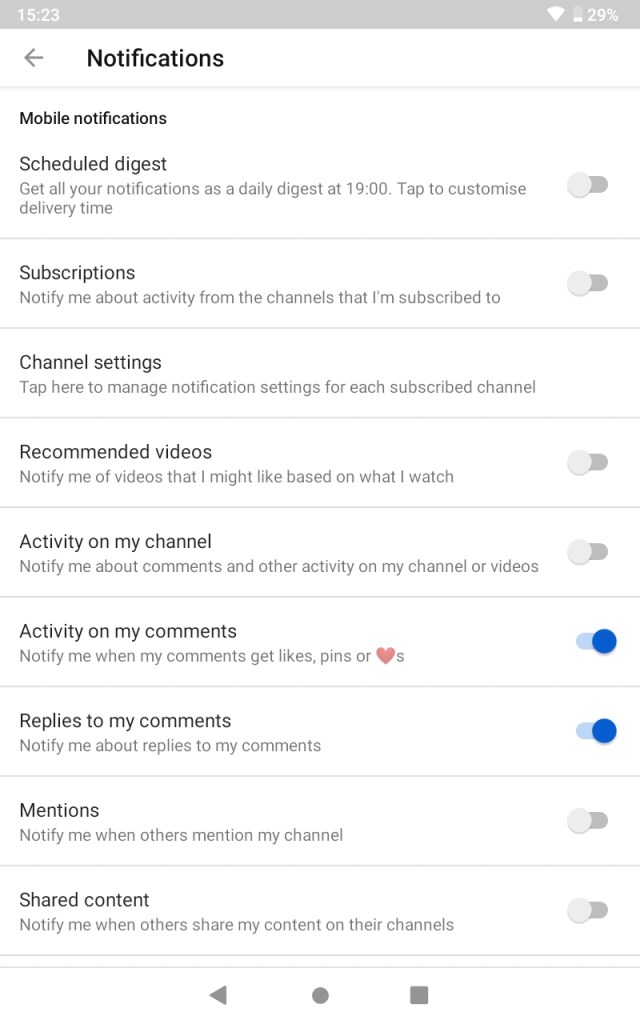
A good idea for controlling the time spent is to turn off your notifications for the different platforms, as I find, when they pop up on your phone or tablet, particularly if the notification is accompanied by a sound, that’s often all that’s needed to send you down the social media rabbit hole! For example, I recently changed my notifications for YouTube as I was getting so many messages about new videos on channels I subscribe to and suggested videos I should watch that I was totally developing FOMO (Fear Of Missing Out) syndrome. Now, the only time I’m notified is if someone likes or loves a comment I left or replies to it. I may even turn the likes and loves off at some point too!

A screen shot of my current YouTube settings

Be wary of emotive language

Since starting my own business, I’ve become super aware of the use of emotive language to get you to click. You may be familiar with ‘click bait’ which can be defined as ‘content whose main purpose is to attract attention and encourage visitors to click on a link to a particular web page’ but there are more subtle ways of getting you to click too. Just two minutes on Pinterest and you will see pins containing phrases such as ‘Must have…’ ‘…you’ll definitely want to bookmark’, ‘…beyond brilliant’, ‘How I tripled my blog traffic…’, ’31 lazy ways…’ etc etc. Again, this plays on your FOMO to make you want to click and save the pins for later. I wrote a blog post about avoiding Pinterest some while ago and my time away was due to the fact that I felt it was having a detrimental effect on my wellbeing and making me feel really overwhelmed.

I’ve recently become really aware of how my local newspaper use language on Twitter to get you to check out their webpage. A lot of their tweets start with ‘Shocking’, ‘Exclusive’, ‘Disgusting’ and other similar emotive words and when you click to find out more, it’s just the same old stuff that you really didn’t need to know about. I know they have to sell their stories, but again, it’s another way of getting you to spend time interacting with content that has the potential to wind you up or makes you feel overly anxious or get you feeling down about the state of the world or your locality.

We can all do without too much negative press right now and in my opinion, reducing your exposure or at least being wary of its affect should be a top priority, particularly if you are prone to anxiety or depression or are currently struggling with your mental health. There are a lot of articles online and in magazines about the affect of watching too much Coronavirus news and The WHO (World Health Organisation) have some great advice related to social media and news in relation to mental health.

Be mindful of your personal experiences

To have a happy social media experience, I think it’s really important that you are mindful of how much time you are spending and the effect that it has on your mood and your general productivity levels. If you often find yourself feeling a little bit rubbish, lacking in motivation, tired or completely down, then you may need to evaluate what you’re looking at and why it’s making you feel like this. For example, if looking at beautiful bullet journal spreads on Instagram leaves you feeling like your own BuJo is completely inadequate and that you are rubbish at drawing, lacking in creativity or doing it all wrong, then maybe it’s time to take a break or stop the mindless scrolling – remember the most popular content will be at the top of your feed and as the platform is mainly about aesthetic beauty you’re going to see flawless images which are likely to be highly edited. On the other hand, if you are left feeling highly motivated, creative or on a high, then you might consider social media to be a good mood booster and a wonderful way of helping you to be productive.

Stop the comparison

We all have issues with comparing ourselves to others at times, often in an unfavourable way, but social media often makes things worse, particularly for young people. Not only are you exposed to a huge volume of information from different posters but what you’re seeing is often only half of the picture (or maybe even less) and often heavily edited to show things in the best light. The ability to follow, like and love may also contribute to feelings of self doubt or worthlessness as you reflect on why others have more followers than you or why some friends are getting more likes and loves.

In order to break the comparison habit I think the first step is to recognise that you are doing it and then to realise that it isn’t helpful and is likely to be having a really big effect on you mentally and not in a good way either. When you begin to realise this, you can start to make changes to what you choose to view and your perception of the content that you consume.

A lot of what is presented on social media is advertising and presents an amazing lifestyle, glossy hair and flawless make up coupled with a perfect body, bang on trend outfits and stylish accessories to match. The danger with this is that we start to beat ourselves up as we don’t meet the same standards. What I try to do is reflect on how ads work and remember that they are very good at persuading you to want what is presented and feel that you are incomplete until you have it. I like to assess how clever they are and how far from reality they are. I’m not saying that I don’t get swayed by adverts, we all do but I think being more mindful helps.

It’s also good to remember that what you see online is in digital format and is often altered using filters, photo editors and Photoshop. In fact, the photograph may have been taken literally hundreds of times until the right angle and best lighting conditions are achieved too. So basically, what you are seeing is not really as it seems. The people in these images may seem full of confidence and joy but underneath they might be struggling with lack of self esteem and loneliness or finding aspects of their life really difficult right now.

Evaluate what you get out of being present on social media

There are lots of benefits of using social media such as keeping in touch with friends, being part of an online community, learning new things, hearing a range of perspectives on a topic, keeping you informed, getting help and advice, and fun or entertainment. In fact, being present on social media has been shown to help people feel more connected and useful as they feel they are positively impacted on the lives of others. It’s a good idea to sit down and think about what you personally get out of your experience and the impact it has on your life.

If there are particular apps that you feel aren’t doing you any favours, don’t be frightened to delete them or take a break until you are in a better headspace or in a different mood. I know that my social media experience depends a lot on how I’m coping day-to-day and if I’m struggling with anxiety and depression, I tend to keep my distance from Facebook, Instagram and Pinterest as they only make me feel worse. When I’m feeling happy and in a good place mentally, I enjoy looking at a range of content and it makes me feel motivated to make changes and improve my life. However, I still need to be mindful as I can start to feel overwhelmed and try to change too much all at once in a bid to get a perfect life (which by the way is completely unobtainable)!

Final thoughts

Social media plays a big part in our modern lives and there’s no changing that. Having a happy experience is all about developing your awareness of the positive and negative aspects and being mindful of how your time online is affecting your wellbeing. I hope today’s post has given you some things to think about and will bring about some changes for the good if you feel that is what is required.

Happy surfing!

Posted in Bullet journaling, lifestyle, Planning and journaling

Monday Matters: How I’m keeping the pre-holiday excitement going despite our trip being postponed until next year

My husband and I were meant to be going to Vienna in Austria in August of this year but we’ve made the decision to postpone our trip until 2021 as the restrictions in place due to Coronavirus are likely to spoil our holiday somewhat. However, I refuse to get upset about it and instead I’m keeping myself excited and doing some extra preparation for when we eventually get there. In today’s Monday Matters post, I’m going to share some of the ways that I’m keeping the excitement going so that I’m still really looking forward to our trip. Hopefully, this will give you some ways to minimise the disappointment you may be feeling if your plans have been put on hold for the time being.

Checking out Pinterest

I’ve recently created a Pinterest board called ‘Vienna Trip‘ and pinned lots of ‘best things to do in Vienna’ ideas plus information about the city in general. This is great for keeping all the webpages in one place and it will help me to create planning spreads in my BuJo nearer the time.

All of my research in one place!

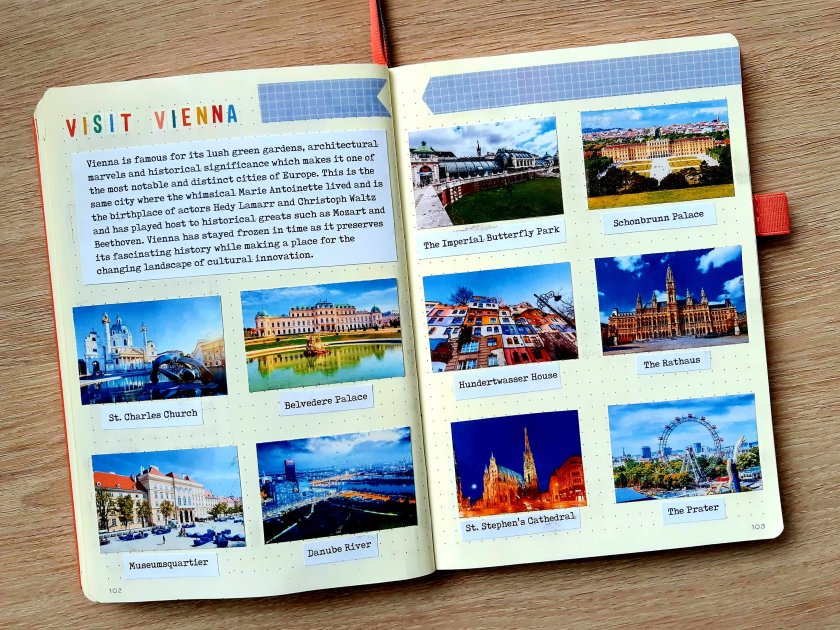
Vienna Photo collage Bullet Journal Spread

Whilst visiting various Vienna related pages on the web, I came across lots of stunning photographs of places within the city. I saved mini versions of these on my computer and have printed them off on photograph paper to create a two page collage for my bullet journal. I typed out the names of the places using MS Word and my favourite font of the moment which is Tox typewriter. I used Pritt stick to attach everything as the double sided tape that I have takes ages when you have lots of little fiddly bits and pieces to stick on.

Educating myself about the country

This is something I used to do with the children in my class when I was teaching. We would do a mini geography topic based on a particular place and learn everything we could about it including where it was in the World, the capital city and other popular tourist spots, the flag, traditions, weather, food etc. The information collected would then be used to create a fact file either electronically in our ICT lessons or in our topic books. I’ve been doing the same sort of research to create a spread in my bullet journal. I typed in search terms such as ‘Austria facts for kids’ etc into Google as I only wanted to know the basics and this made an easy starting point for further research. This website was a gold mine of information and has stuff on other countries too.

Before creating my BuJo spread, I set up an MS Word document in which to put random information about the country in no particular order. This helped me to decide on the sections and headers I would need for my bullet journal so I could make it as well organised and logical as possible.

Immersing myself virtually

There are some amazing views in Austria as I discovered during my research online. I’m not sure how much of the wonderful scenery we’ll get to see with us being in the city so I’ve chosen a stunning view for the desktop of my computer and I’ve stuck some beautiful photographs in my BuJo of some of the images I found. And according to Lee Bacon, head of digital at the BBC’s Natural History Unit, “Even viewing nature digitally has been scientifically proven to help peoples’ mental wellbeing” so yay for Google images!

Learning about the city

I usually do most of my reading about the city we are going to on the aeroplane on the way over or in a mad rush a few days before we travel. This time, I’m going to be super well prepared about the layout of Vienna and what to expect when we get there. This will help us make the most of our time as we will know how spaced out everything is and how we can travel around the place on foot or using different transport systems. So far I’ve done one page but I shall be continuing to add information each week until I have everything I want written down. By the time we go on our trip, I’ll have moved into a new BuJo but I can photocopy my pages to take with us.

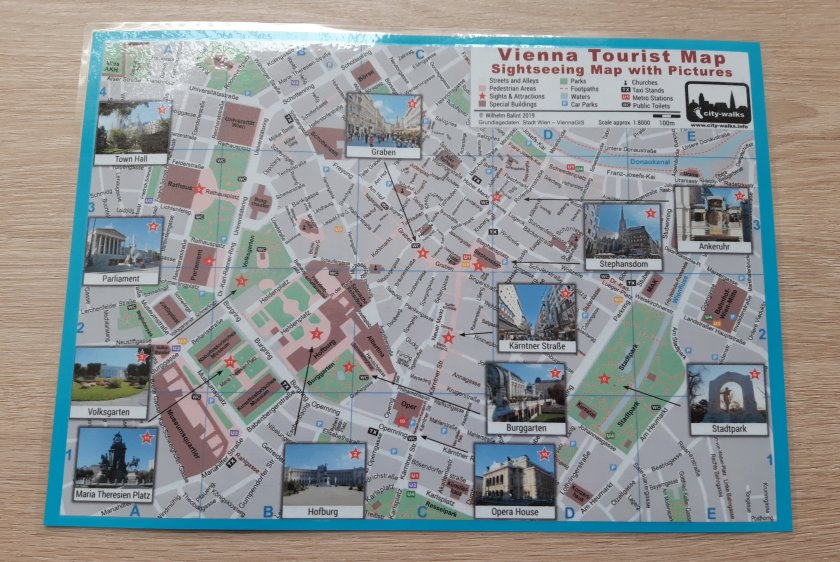
I found a great site that has comprehensive descriptions on the various tourist attractions and also has a number of maps that you can download as PDFs. I printed one today on sticker paper, backed it onto some coloured paper and then laminated it. Now I just need to find somewhere to keep it until next year so we actually remember to take it with us.

What about a pre-trip virtual tour?

Whilst checking out a variety of websites, I came across this site which enables you to preview different sights around the city. It’s really useful for photographs of the different tourist activities and you can look on a map to see where things are located. I expect there are similar websites for other cities across the world too. I know Sunderland have created virtual tours of popular places across the city for people to view during lockdown.

Checking out the eateries using Happy Cow

My husband and I are both vegetarian and I’m particularly strict about what I eat too. I need to be sure that if I eat cheese, it doesn’t contain animal rennet and I also like my drinks to be veggie friendly too (vegan if possible). Therefore, when we go abroad, we choose to eat in vegetarian or vegan eateries, as unlike in the UK, cafes and restaurants don’t usually label their dishes with a V or Ve symbol. Before we go anywhere, we do extensive research on Happy Cow. I actually chose Vienna for our holiday as I know that vegetarians and vegans are well catered for there. I haven’t created a bullet journal spread of places to eat at yet but this is definitely something I intend to do nearer the time. The information will include if the café or restaurant is completely vegan or veggie with vegan options and I’ll also add the location and how far away it is from our hotel. As you can see, there are plenty of options for our stay!

Final thoughts

I know the lockdown and coronavirus have caused so much worry, disappointment, anxiety and general upset, but hopefully this post has given you some ideas on how to keep the pre-holiday or trip excitement going for a while longer. Obviously, re-arranging travel dates and accommodation present their own difficulties but once things have been sorted out, you can hopefully do some extra planning to ensure when you do eventually get away, you have the best time ever!

Posted in lifestyle, Planning and journaling, productivity, Setting goals and intentions

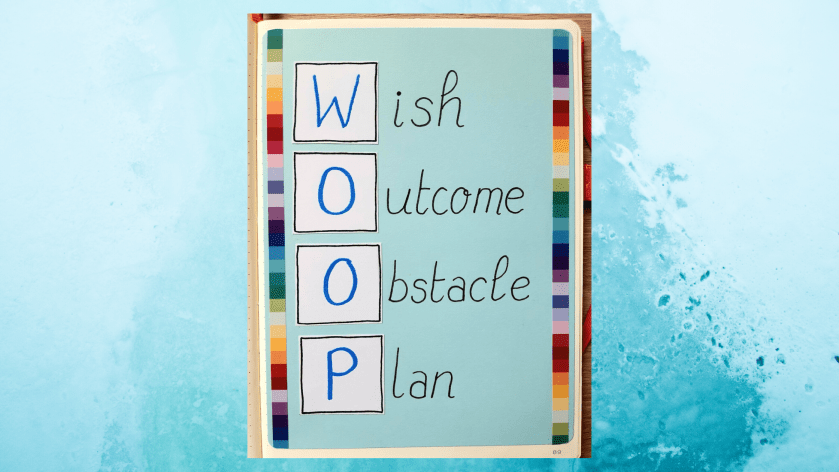
Monday Matters: What is the ‘WOOP technique’ and how can it help you achieve your dreams?

This week, I wanted to write a post about goal setting and fulfilling your dreams. I talked last week about the power of positive affirmations in developing confidence in your ability, but is telling yourself you are something such as successful, confident or happy enough to achieve in a particular aspect of your life? Whilst perusing the Internet for inspiration for my chosen focus, I came across something I’d never heard of before called WOOP. I’m willing to bet that a lot of my readers might not have heard of it either, so today’s Monday Matters is going to be an introduction to the principles behind this fascinating and scientifically researched idea, which to me, makes a lot of sense and might need more consideration.

What is WOOP?

WOOP, which stands for Wish, Outline, Obstacle, Plan, is a scientifically based principle developed by German academic and psychologist Gabriele Oettingen. Her research has focused on ‘how people think about the future and how this impacts cognition, emotion and behaviour’ (Wikipedia). Gabriele has found that if we just dream or fantasise about something we want, our brains tend to think we have already attained what we desire and this can make us relax and prevent us from actually achieving our goals. She talks about two processes that we need to go through for the WOOP strategy to take effect, namely mental contrasting and implementation intentions (MCII for short). Basically, this means focusing on the contrast between the positive aspects of your desired goal and the barriers (negative aspects / obstacle / internal struggle) of you actually achieving your goal or wish. So, the WOO bit is the contrast as you imagine / visualise how wonderful it would be to fulfil your wish and then conversely, look at what might stop you. Thinking about both of these helps to motivate your self conscious to do something about the issue you face. The P part is the implementation intentions as you are coming up with a plan of actions and thoughts to work against your obstacle.

Gabriele and her team have spent 20 years fully researching and investigating goal achievement and the effects of mental contrasting and implementation intentions with studies including participants of different ages and backgrounds. The results of their work, has lead them to create WOOP as a framework for implementing change. The process has been found to be affective at helping people improve their social behaviour, health and academic performance. Examples of these scientific studies can be found online if you want to find out more.

Creating a WOOP

Wish Gabriele says that it is vitally important to give yourself some mental space in which to think about and imagine what you wish for yourself right now. You should dedicate some calm and uninterrupted time where you can specifically focus on your immediate wish for this present moment. Clearing your mind of everything else is essential so that you can dedicate your attention to working on your WOOP.

You may find that many wishes come into your mind, but you need to select the one that is most important to you and is challenging but do-able at the same time. Wishes can be about anything you want, your relationships, your job, your education, your health and fitness, whatever is important to you right now.

When you’ve decided on your wish, you should try to come up with 3 to 6 words to summarise it. I found this part really difficult as I’m very good at saying in 50 words what could be shrunken down to 5 but it’s important to be concise so you should really take your time to think.

Outcome When you have outlined your wish, you need to imagine what it would feel like if it came true (you might like to close your eyes for this bit so you can create an image of your life). Think about what the very best outcome would be and describe it in a small number of words (approximately 3 or 4 is a good number).

Obstacle Next, you need to think really carefully about what holds you back from achieving that wish. In other words, what is the main obstacle? For this, you should focus on an inner obstacle, i.e. something in you that is preventing you from realising your wish. You might find here, that you start to think of external obstacles such as other people or situations which you find yourself in but it’s important that you try to concentrate on yourself as it is much easier to create changes within yourself. Again, you could close your eyes and allow yourself to come up with a vivid image.

Plan When you’ve identified your main obstacle, you need to come up with a plan to overcome it. Again, you should try to summarise thoughts or actions in 3 to 6 words. Keep these in mind, whilst you create an If… then plan. Take your obstacle words and put them after the If. Then, place the thought or action after the ‘then…’. You can then recite your If… then plan a few times.

An example

Here’s an example from my own life. I’m now pretty good at doing yoga every day but there are always occasions when I don’t feel like doing it or think of other things I would prefer to do.

  • Goal: Yoga for 20 minutes every day
  • W: daily yoga practise for 20 minutes
  • O: Strength. Good posture. Mindfulness.
  • O: Don’t feel like it. Don’t bother.
  • P: If I don’t feel like it… then I’ll put my workout gear on, get out my mat and then remind myself of the many mental and physical benefits of practising.

Some other WOOP ideas

  • In bed by 10pm every night.
  • Be more productive.
  • Get a new job.
  • Find my soulmate.
  • Stop eating unhealthy snacks.
  • Read a self help book.
  • Meditate for 10 minutes each morning.
  • Finish a project before the weekend.

You might find the process a little tricky at first, but once you’re proficient in WOOP, you can apply it to so many situations – daily tasks, habits you want to instil, projects you want to complete or whatever you want really! Also, you will likely get much better at summarising and getting to the crux of the matter in terms of your inner obstacle which will help you develop solutions more quickly.

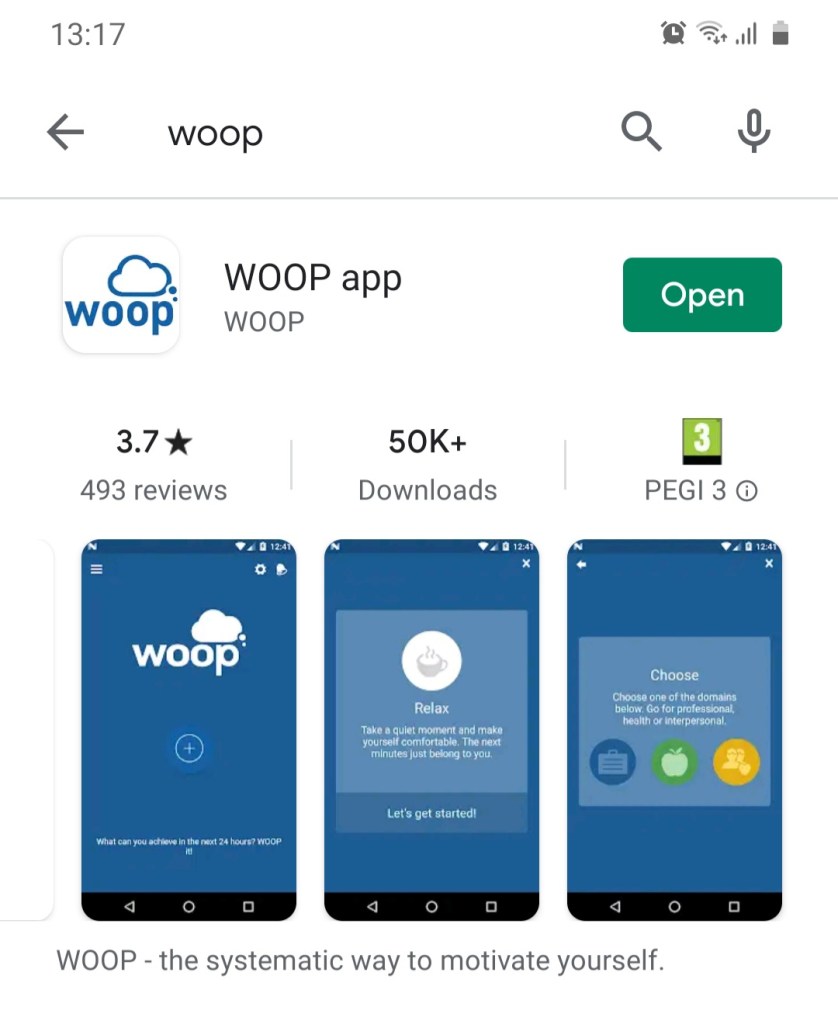
The WOOP app

When I visited the website for WOOP, I discovered that there’s a free APP available, so I thought I would download it and see how it works. As well as giving an introduction to WOOP, it also guides you though the process of creating WOOPs for professional, health and interpersonal wishes.

The app guides you through each WOOP by giving you a number of prompts. You can choose a timeframe from 24 hours or 1 month or you can select not to have a time frame. The app gives you limited characters in which to compose your wish, outcome, obstacle so as to encourage you to keep it brief but I can imagine it’s quite frustrating if you feel like you can’t condense it down that much. It also asks you to take your time with thinking about each step of WOOP and if you click through the steps too quickly, it will warn you that you are going too fast! If you like having things noted down on your phone, then I think you would benefit from using the app, but personally, I prefer to write things in my BuJo and have a notes page to refer to, to help me create my WOOPs.

That’s all for my introduction to using the WOOP technique for setting goals and creating a plan to achieve them. If you want to learn more about WOOP and watch a great video introduction, visit woopmylife.org Here you can also find the link for the mobile app and a free printable to help guide you through the process.

Posted in lifestyle, mental health, productivity, psychology, wellbeing

Monday Matters: The power of positive affirmations and how to create your own

Today’s Monday Matters blog post is all about the helpfulness of positive affirmations and how you can write your own tailor made statements to re-wire your brain and start working towards the life you want. It discusses different types of affirmations which can help develop your body confidence, increase your self belief, encourage you to reach your goals, enable you to accept yourself and others and be grateful for what you have whilst working towards what you want. It also answers questions about how to choose specific affirmations, how to get them to work, how to word them for maximum effectiveness and how to use affirmations when you are struggling with your mental health. Finally, towards the end of the article, I include some of my current affirmations and why I chose them so you can see for yourself how powerful they are for me and can be for you.

What are positive affirmations and how do they work?

Affirmations are phrases which we repeat to ourselves either out loud or in our thoughts. They can be absolutely anything, sometimes good, for example I am great at my job, I can do this etc. but quite often can be bad, unhelpful or completely self-critical, for example, I’m so stupid, I always get things wrong etc. Positive affirmations, though, have the aim of over-riding negative beliefs and negative self-talk and creating positivity and a much better mind set. When said regularly, they can change your thoughts, your way of thinking and how you feel about yourself and life in general. They work by re-wiring your brain to think good things about the world and your place in it.

Different types of affirmations

There are lots of different types of affirmations to choose from and it all depends what you want to focus on. For example, you might want to improve your body confidence, become more successful, increase your happiness levels, be more accepting of yourself or others, combat fear, anxieties or insecurities, lose weight, be more resilient, celebrate your good points etc. Whatever you want in your life or for yourself, there are positive statements to help you.

So, how do I go about creating my own positive affirmations that work?

First of all, you need to think about what you want to see in your life right now. Maybe you want to be more confident and assertive at work. Perhaps you are keen to be more grateful or more positive. Or, you might want to practise self love and kindness. Jot down what’s important to you at the moment or create some goals that you want to work on and start to think about the kind of affirmations that would reflect these ideas.

Key features of good affirmations:

  1. Present tense e.g. I am relaxed and calm, I am worthy of self care and compassion, I take things one step at a time. This makes sure that they are powerful as they are about the here and now.
  2. Short and to the point. This makes them easier to say and easier to remember as you go about your day.
  3. Full of positivity. Try to avoid using negative vocabulary. E.g. rather than ‘I am not anxious’, you could write ‘I am calm and relaxed’. Instead of writing ‘I don’t eat junk food’ you might go for ‘I eat a balanced and healthy diet’.
  4. Powerful and emotional words. Try to use the best emotive vocabulary to can think of e.g. Everything in my life is wonderful, I am an amazing writer, I am incredibly proud of all that I achieve in my life etc.
  5. Make use of your own voice. You can find a wide array of affirmations online e.g. on Pinterest and Instagram. Some of them, you will be immediately attracted to the idea of but if you do use or adapt them, make sure that the vocabulary used is the kind of thing that you would like to say to yourself and that the words within the statement are part of your personal vocabulary e.g. It’s no good saying ‘I am a highly motivated person’ if you would usually use the term ‘hard worker’.
  6. Believability. If you want your affirmations to work, you need to create statements that you can readily believe in. For example, it’s no good writing one that says ‘I am super fit’ if you are only just beginning your fitness journey. It’s better to create something that says where you are at right now or where you can feasibly be soon if you improve your confidence levels e.g. ‘I am getting stronger and fitter every day’ or ‘My fitness levels are improving each day’. Rather than ‘I am always confident at speaking to an audience’ you could try ‘My confidence in presenting my ideas to others is getting so much better.’

Consistency is key with getting your affirmations to manifest positive change in your life so make sure you say them regularly. Add them to your morning routine and assess the effect that they are having as part of a reflection process in the evening. You might even do some journalling on them in your bullet journal or other planner.

How to use positive affirmations to get you through a mental health bad patch

As some of my regular readers will know, I have suffered from episodes of anxiety and depression throughout my adult life and know how easy it is to get into a very negative mindset when you are struggling. I also know that that at times of really low mood, it is super hard to find anything positive to think let alone say out loud. However, if you at least try to treat yourself with kindness and compassion and accept where you are right now, you can find ways to come out of your mental health blip. In the past, I’ve used a small number of positive affirmations, chosen and written with the help of my wonderfully supportive husband, which have helped me and kept my mind focused on resilience and recovery. Below is the page which I produced in my bullet journal at a time in the past when I was having a hard time.

As you can see, they generally focus on accepting myself for who I am, recognising that I have it within me to get better and knowing that I am loved by others. Now, I know at the time, I found it difficult to say these affirmations and I remember tears forming as I read through them the first few times, but it did get easier after a while and I can confirm that I was strong enough, the bad patch did pass and I did get through it and come out of the other side. I’m not saying that the affirmations were the main reason that I got better but they certainly helped with the recovery process, a lot!

Some tips for creating positive affirmations when life is hard:

  • Think about the negative thoughts that enter your mind or negative self talk that you find yourself saying and try to turn it around e.g. ‘I’m so weak and pathetic’ could become ‘I am brave and strong’, ‘I’m never going to get better’ could be re-written as ‘This feeling will pass’. ‘I can’t do this any more’ can be changed to ‘I have the ability to cope’.
  • Check out Pinterest and look for affirmations which suit your current situation e.g. search affirmations for self love and kindness if you find yourself saying nasty things about yourself, look for confidence building affirmations if you find yourself lacking in this area right now.
  • Think about how unique you are and what is special about you. Ask for help on this if you need to from family members or friends. Write down your qualities in first person e.g. I am creative, I am kind to others, I always try my best etc.

Some of my current positive affirmations and why I chose them

  • I run a successful Etsy shop and customers love my products and personalised service. This one was chosen because I regularly have moments of self doubt when I haven’t had many orders, when my visitor count in low or I don’t get any feedback for a while.
  • Readers enjoy my blog posts and find them interesting and insightful. One to remind me that people like the content on my blog and I should keep going with it because I love writing it and I’m really passionate about making it a success.
  • I accept myself. Although I’m always working on self development stuff and new ways to manage my mental health, it’s really important that as I do this, I accept the way I am right now, just as others do.
  • My body is getting stronger and more toned every day. I’ve got a few affirmations related to fitness on my list right now and this is because I’ve recently be getting myself a little upset and disheartened about the fact that I haven’t really lost any weight despite working really hard. Both my husband and I have noticed my body changing and really toning up so this is a little reminder to myself to keep going.

I hope you have found today’s post useful and it has provided you with the encouragement needed to have a go at creating your own positive affirmations. Let me know in the comments what you want to work on right now and maybe share a couple of affirmations that you think you should add to your list.