Posted in Bipolar disorder, depression, depression management, lifestyle, mental health, Planning and journaling, wellbeing, wellness

Monday Matters: A mini guide to using Behavioural Activation as a treatment for depression

In last week’s blog post, I mentioned that my support worker and I have been using a technique called Behavioural Activation (B.A.) as a practical treatment for my depression and anxiety. Today, I thought I’d share an introduction to how B.A. works, ways in which it can help ease depression and anxiety and some tips on how to get the most out of using the method.

What is Behavioural Activation?

Behavioural Activation is an effective and pro-active treatment for depression which can be used in addition to medication and CBT techniques. Research shows that when individuals are struggling with depression their activity levels reduce, leading to less enjoyment and achievement and feelings of lethargy and poor motivation so that even small tasks and activities become hard work. This then becomes a vicious cycle of inactivity – depression and anxiety – inactivity and so on leading to us feeling worse.
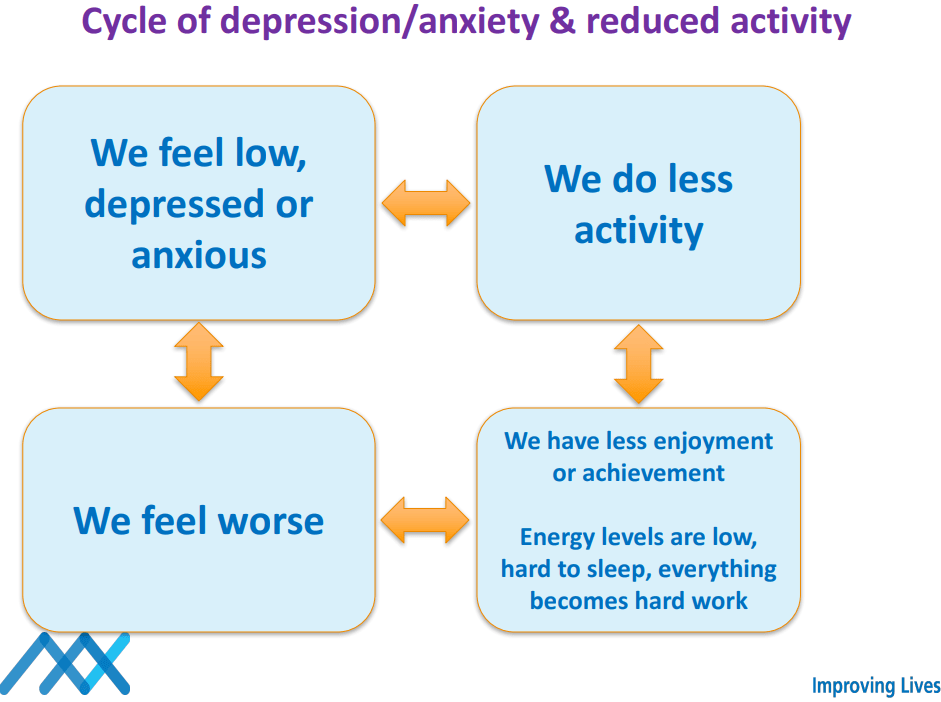
Source: NHS Greater Manchester Mental Health

Additionally, a person may engage in unhelpful behaviours such as turning to drugs or alcohol, staying in bed late into the day, withdrawing from social situations or sitting ruminating about things.

Behavioural Activation (B.A.) aims to break the above cycle by increasing pleasurable and positive activity each week with a view to improving mood and decreasing feelings of anxiety, including any negative thoughts you might be having such as “I’m a useless wife/husband/partner”, “I can’t do this anymore”, “I’m never going to get better” etc.

Although Behavioural Activation is a relatively simple idea and can be used as a self- help strategy, I think it is best done with a therapist or support worker so that they can guide you through the process and provide encouragement along the way. They can also look at the particular difficulties you’re having and help you to put things in place to make positive steps towards tackling them.

Establishing a baseline – the first step of Behavioural Activation

Once you understand the principles behind B.A. therapy the first step in the process is to monitor your current activities throughout the week and how they affect your mood. This can either be done using an activity monitoring sheet, examples of which can be found online, or by simply making a list of what you do each hour of the day and scoring your mood out of 10 each time, 0 representing feeling very depressed and 10 representing feeling really good. This should help you to clearly see the relationship between your activity levels and your mood. You could also try listing which of your activities made you feel good and which made you feel bad, for example going for a walk in the park made me feel good, sitting and worrying that I’ll never get better made me feel bad.

Using a ‘Weekly Schedule’ sheet to make plans – the next step in the process

Once you’ve established what you are currently doing, it’s time to make some small improvements. Each week, you work on creating a schedule which should include routine plans such as having breakfast, going food shopping, pleasurable activities such as playing cards, watching TV, doing something creative etc and necessary things that need doing e.g. paying your car tax.

You should also try to include activities which you already do that make you feel better such as getting dressed, brushing your hair, going for a daily walk etc. So, for example, even though I didn’t feel like doing my yoga each day, I did it anyway as it helps to calm me and I feel good after doing it.
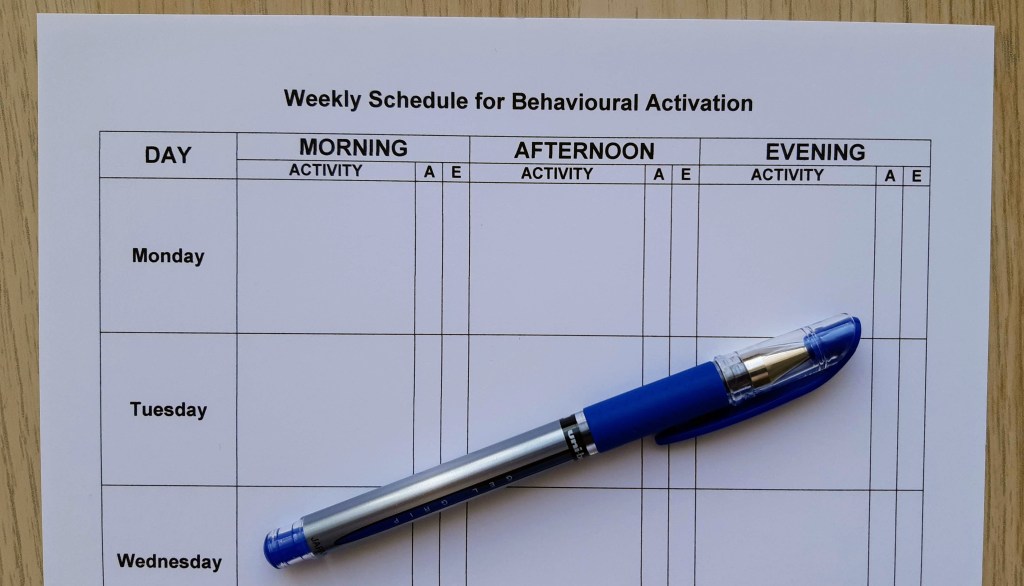
My modified B.A. weekly schedule sheet created in MS Word

What you write in the boxes depends on your current difficulties. For example, if you are struggling to get out of bed you might write in the first box ‘Up by 9.00am’, ‘Have breakfast’ and ‘Get ready’ (dressed, teeth brushed and face washed). If you’re currently not doing any household chores, you might add laundry related activities to your list. This can be broken down into small steps e.g. ‘Load the washing machine’, ‘hang out clothes’ and ‘Bring in washing’.

You should also try to think of activities which are important to you, for example spending time in nature, being creative, quality time with family or friends, eating a balanced diet etc. These are related to your core values and you might want to talk to a support worker or therapist to establish what you want from life so you can set some goals for the future. Although your depression is likely to lead you to believe that things will never get better and you will never again feel a sense of pleasure or achievement, try to think of your situation as temporary and know that things will improve in time (I know this is much easier said than done though).

Using your weekly schedule to good effect

Your weekly schedule is your plan for the week and is a guide for what you hope to achieve. It should be referred to throughout the day and will help you see what you have planned. It’s also a place to record your achievement and enjoyment levels (out of 10) so you can evaluate the effect B.A. is having on your mood. You might also like to spend time each evening reflecting on your day – you could even do a little journalling too. If you find your enthusiasm waning at any time, remind yourself why you’re using Behavioural Activation and think about the positives so far.

Tips on using Behavioural Activation to treat depression

Start small When I first started planning out my week according to the principles of B.A., I would identify one activity for in the morning, one for in the afternoon and another for in the evening. This would mainly include relatively simple and mindful activities which helped to distract my anxious and negative thoughts and improve my mood a little. So, for example, in the first week I would have breakfast, get dressed and straighten my hair in the morning, go for a walk in the park in the afternoon and then play cards, do some of my jigsaw or watch TV in the evening. By week 5, I was doing several activities in the morning, afternoon and evening and setting more difficult goals for myself. However, we always made sure I had some time for pleasurable and relaxing activities each week such as reading my book in bed two mornings a week (after having a good breakfast and brushing my teeth and washing my face).

Break down activities into steps When you’re feeling depressed, it’s common to lack the motivation to do even basic things. For this reason, it’s helpful to break down activities into small steps which feel more achievable. So, for example, ages ago I bought a cheap set of gouache paints and really wanted to have a go at using them. Rather than creating a full page art piece, I set myself the simpler task of painting some stems and leaves. For the first step, I experimented with creating different shades of green by mixing varying amounts of blue and yellow. Then I introduced small amounts of other colours of paint to explore what happened. I also added white to some of the mixture to make lighter shades. After that, I tried painting samples onto a small strip of watercolour paper to see if I had the consistency of the paint correct as I knew that gouache is quite a bit thicker than watercolour which I’ve used many times before. This was all I did on the first day. I returned to my paint samples a few days later and decided to have a go at some stems and leaves. I spent time looking online at different stem and leaf shape and patterns and then had a go at creating them using a small selection of brushes. By breaking down my art project, I avoided feeling overwhelmed. I also did the same for housework tasks e.g. rather than cleaning the whole kitchen, I started by just cleaning and polishing the sink area.

Routine, Pleasurable and Necessary Try to create a balance of activities on your plan so that you engage in a range of pleasurable and achievement related activities each week. So, for example, you might do some watercolouring on Monday morning because you know that you have enjoyed painting in the past. This would be a pleasurable activity (even if you believe that you won’t enjoy doing it). On Tuesday morning, you might put one load of washing in the machine and then hang it out in the sunshine when it’s finished. This would be a routine task (something that needs doing regularly) and is likely give you a sense of achievement. On Wednesday afternoon, you might plan to get a few necessary tasks out of the way such as renewing your car insurance, replacing a lightbulb or replying to an email or text message from someone.

Evaluate how your week has gone During my weekly support sessions, Nichola would ask me how my week had been and part of this involved talking through how I’d got on with my B.A. plans. This gave me the chance to share my achievements but was also an opportunity to identify any problems I’d had, if I’d found solutions myself or if I needed help to find a way forward. For example, one week, I’d got really upset because my dressing table in the bedroom was thick with dust and I felt ashamed at how bad it was. I only cleaned this one piece of furniture instead of the whole of our bedroom as I became really overwhelmed. We discussed that sometimes a task may need modifying or simplifying to make it easier and that I may need to try to be kinder to myself / show more self compassion etc.

Reward yourself regularly As well as going easy on yourself, it’s also a good idea to spend time recognising your achievements and reward yourself for progress made. As well as doing this with Nichola once a week, my husband talks with me about how my day had been and what I’ve achieved. Also, every Friday afternoon, we go to my favourite café for a coffee and cake as a well deserved treat. This has become a part of our weekly routine which will have carried on even though I’m now feeling much better and it’s not so hard to get things done.

Enlist the support of others If you find it difficult to motivate yourself to do the activities on your weekly schedule, it can be helpful to ask others for support. This could be a family member or friend who regularly checks in with you to see how you’re getting on and provides gentle encouragement. They might also help you with a particular task e.g. preparing a meal, filling in a form or tidying a space in your home.

Final words…

Although Behavioural Activation on its own isn’t a cure for depression, it can be a really useful coping mechanism and a helpful treatment for lifting your mood. Hopefully, in time, you will find that you start to enjoy some of the activities on your plan or feel a sense of achievement when you’ve completed tasks that you’ve probably been avoiding. As you continue to schedule in activities and complete them successfully, you’ll likely be motivated to do more. Remember, though, that there may be days along the way where you don’t feel so good and some of your tasks might not get done. This is okay and perfectly normal – just go easy on yourself and celebrate what you did achieve. Even a small number of activities done each day can have a big impact on your mood.

If you have any questions about Behavioural Activation, feel free to drop them in the comments and hopefully I’ll be able to answer them or direct you to an online resource which might help. Also, if you would like a copy of my Weekly Schedule, I would be more than happy to share it – just get in touch using the email address in the ‘Contact me’ section of my blog.

Posted in Health and Nutrition, lifestyle, Planning and journaling, self care

Monday Matters: 7 benefits of home cooking

Over the last few months, my husband and I have been trying out some new recipes, making sure that, at least once a week, we cook a meal from scratch. We’ve had some amazingly tasty dishes and afterwards, I’ve typed out any that we’ve really enjoyed (making any alterations to ingredients and method) and added them to a file we keep in one of our kitchen cupboards. We’ve ended up with a personalised cook book of laminated recipe cards with both vegan and vegetarian options.

There are so many benefits of home cooking on a regular basis and for today’s post, I’m going to focus on some of them which I feel have made a real difference to me personally.

Quality family time

To ensure we have plenty of time and energy for cooking, my husband and I tend to do our cooking from scratch on a weekend, mostly on a Saturday night. On a Friday evening, we have a routine of looking online for some veggie or vegan recipes which use seasonal ingredients and are not too difficult to prepare. When we’ve found something that appeals, we make a shopping list and pop to the supermarket late Saturday afternoon to collect what we need.

When we get back, we make a start on preparing our meal together. I take the lead and my husband assists me. As well as the process helping me to develop my confidence again following months of being unwell with depression and anxiety and having poor appetite, it’s been really nice to spend quality time together in the kitchen and at the dining table enjoying what we’ve made (or pulling faces on the rare occasion when what we’ve made has ended up being revolting!) We even work as a team to load and unload the dishwasher with the vast amount of pots and pans afterwards.

Easy to adapt dishes according to your taste, likes and dislikes

When you go to a restaurant or get a takeaway, you might be able to ask for something to be omitted from the dish (such as a sauce) or swap your chips for salad, but you’re generally limited to one or two changes. However, when you cook a meal at home, you can adapt a dish in as many ways as you like. For example, you can add more or less spice and herbs, serve the dish with your favourite veggies on the side, omit the salt and pepper and change the sauce or dressing. You can use your preferred type of cheese or alter the recipe to make it less calorific. And you can easily simplify a dish that has a long list of ingredients or swap something you don’t like for something you love.

An example of this is the vegan butternut squash and chickpea tagine that my husband and I made this week. We found two different recipes online, one had some negative reviews saying it was tasteless and the other had lots of different spices in it which we didn’t have at home. I used the information from both to create a mildly spiced version which included ingredients listed in one or the other recipe and altered the cooking time as I knew the veggies would take longer to soften. We thoroughly enjoyed our food and I’ve now typed out our heavily edited recipe so we can remember the ingredients, measures and method for next time.

As you become more confident in the kitchen, you’ll learn which ingredients work together and will be able to make changes to recipes and cooking methods to suit you and your family. You might also want to do what I do and save successful dishes by copying and pasting a recipe into a Word document, editing the ingredients and method and then printing and laminate the sheet to keep to make again. I’ve also created a template on MS Word so all of my sheets are A5 with the same font type and size, margins and layout.

Portion control

Often, when eating in a restaurant, the portion sizes are way bigger than you’d serve at home. Also, it can be tempting to make the most of your evening out by selecting a starter and a main course, then finishing off with a dessert. You might also choose sugary drinks, wine or cocktails to accompany your food and often you’ll have more beverages whilst you wait for the different courses to arrive. Before you know it, you’ve racked up more than your daily calorie intake in just one meal.

At home, when cooking for yourself or your family, you’re more likely to make just one dish and serve it with a side of your favourite veggies, salad or a tasty bread to fill up your plate. The portion size can also be easily controlled by you so overeating is avoided.

When my husband and I make a meal at home, we tend to serve a small portion from the pan or oven dish (putting more on my husband’s plate than mine in-line with recommended calorie intake) and then have some more if we find we’re still hungry. Otherwise, we transfer the rest to a smaller container and save the leftovers for another day. In a restaurant, it’s tempting to clear your plate, even if you’re full, either because you’re not eating mindfully and don’t notice you feel full, or because you’ve paid a lot for the meal and don’t want to leave some of it.

You can control the cost and quality

When you go to a restaurant or get a takeway, you have to pay the price stated on the menu and the chef has made choices about the quality of the individual ingredients that make up the dish. When you cook at home, you choose the price you want to pay for the items on your shopping list. You select the fresh foodstuffs which look and smell good (and are in season) and the quality you feel you deserve and can afford. If you want to choose free range eggs for a dish, you can. If you prefer organic produce, you can choose specific items which meet with your expectations. When money is a little tight, you can pick basics ingredients from your supermarket own brand collection to make budget friendly meals.

Healthier dishes

Restaurant meals, takeaways and supermarket ready meals are often loaded with salt, sugar, butter, cream or other additives that should be consumed in moderation. When you make your meals yourself, you can control exactly what goes into your dishes and this often makes them a lot healthier. You can use fresh ingredients and add herbs and spices to make your meals taste good. You can choose whether to add salt, decide between butter or vegetable oil to shallow fry and even find different ways to sweeten your dishes. Studies have found that those who frequently cook meals at home have healthier diets overall and consume much less calories per day.

Good for your mental health

It might surprise you that as well as being good for your physical health due to the nutritional benefits, home cooking can also be great for your mental health. When I was struggling with anxiety and depression a few months ago, my support worker suggested that I try planning and preparing one meal per week as part of my work on behavioural activation. There were a number of ideas behind her suggestion, including trying to find joy in cooking again, improving my appetite, having a sense of purpose when going to the supermarket (I had to challenge myself to make a list of items needed for the recipe and collect them independently), being assertive when advising my husband how to assist with the preparation, feeling a sense of achievement and confidence building. It also became a wonderful mindful activity which took me away from my anxious thoughts. Although it didn’t do much to improve my appetite at the time, it was wonderful for my self esteem and, overall, was a really positive experience.

Now that I’m feeling much better, my husband and I are continuing to try out new recipes regularly and it feels great when we sit down to enjoy the fruits of our labour. Preparing and cooking a meal is also a great way to slow down and focus on all of the physical processes involved such as weighing out ingredients, peeling, chopping, blending and stirring – all of which demand lots of attention and can help to relieve stress.

It makes you more creative

I’m used to getting creative with my art and craft supplies, but cooking at home can also make you creative in the kitchen too. When I first started making meals (back when I was at university), I tended to find super easy recipes with simple ingredients and follow the instructions carefully. Now, I look for dishes in books, magazines and online and I’m not frightened to try out new cooking methods, change up the ingredients or merge ideas from several different recipes together. The more I cook, the more my confidence grows. I also find I can throw things together to make meals using whatever is left in the fridge and kitchen cupboards and most of the time, they turn out great!

Final words…

I hope you have enjoyed reading today’s post and it has encouraged you to do more home cooking. The only downside we’ve found is that the dishwasher is always full to bursting and it takes ages to dry everything and put it all away. However, if you make twice as much of the dish, you can enjoy the leftovers another day and then you have barely any washing up to do!

Posted in lifestyle, productivity, Setting goals and intentions

Monday Matters: 7 benefits of decluttering and some ways to get started

Over the last few weeks, I’ve been making a start on decluttering and re-organising some parts of our home. So far, I’ve got rid of some unwanted clothes, purged my vast collection of magazines and begun the mammoth task of clearing out and re-organising my craft room. I have a lot of ‘stuff’ and, at times, the process has been overwhelming and stressful but I’m doing a little bit each day and slowly, I’m seeing the difference it’s making. For today’s Monday Matters, I thought I would consider some of the main benefits of decluttering your home as I feel that knowing the effects it can have on health and wellbeing will help me to keep going and also might encourage some of you to dedicate a small amount of time each week to tackle an area of your home or a particular type of clutter. I’ll also offer a few ways to get started including some ideas based on the popular ‘Kondo’ method.

So, let’s start with some of the main benefits which can make a real difference to your life…

  1. You’ll have more energy

A house full of clutter is very draining. There’s always things out of place and constantly seeing your stuff everywhere will likely consume your thoughts as soon as you enter your home or spend time in a particular room. Also, you’ll regularly have to make decisions about where to put things and this can cause stress and deplete your energy levels.

Clutter can make you feel both physically and mentally tired and can also prevent you from relaxing and replenishing your spent energy after a busy day. On the other hand, a tidy and clutter free home lowers stress levels as it is an inviting and calming place to be, where you can fully wind down.

2. Your sleep is likely to improve

A tidy and clutter free bedroom promotes peaceful sleep and allows you to switch off more easily. Whereas a cluttered environment fills the mind with uneasy thoughts and has been found to cause disrupted and less restful sleep. You might think it doesn’t matter if you have lots of stuff in your bedroom because you can’t see it when you turn out the light but your brain will be stimulated as soon as it sees the ‘chaos’ causing feelings of overwhelm and stress.

It’s best to make sure most of the items in your bedroom are put away and that a small number of carefully chosen objects are on display which reflect the style you want to achieve. So, for example, your bedside cabinet or table might have a pretty lamp, your Kindle or book and a single framed photograph.

3. You’ll feel more organised

Having an orderly home will mean that you can find things more easily. If all of your things have a particular home and similar items are grouped together, you’ll feel super organised and you’ll know exactly what you have and where each item is located. Less clutter will help you feel in control whereas an excess of stuff will have the opposite effect.

You’re also likely to feel extremely proud of your home and want to show it off!

4. Fewer allergens will be present

This is a really important one for me as I’m asthmatic and have a condition called allergic rhinitis which is triggered by dust and molds. If you have stuff everywhere, it’s very difficult to keep your home free from dust. Also a build up of clutter has been shown to contribute to poor ventilation in your rooms which can cause mold. Surfaces with only a select few items on them can really help reduce the number of allergens in the air and on your furniture which is great for anyone with asthma and other similar health conditions.

5. Cleaning and tidying will become a breeze!

Whilst I was struggling with depression and anxiety, my support worker helped me to plan some small housework tasks throughout the week to encourage me to contribute to the many chores involved in running a home so I was able to feel a sense of achievement. On one of the days, in my weekly plan, we decided that I would dust and vacuum our bedroom. When asked the next week how I’d got on, I mentioned that I’d got overwhelmed and upset because just tackling my dressing table had been a gargantuan task as there was so much clutter to clear before I even attempted to clean the dusty surface. I ended up just doing the dressing table and my chest of drawers when all of the other furniture really needed doing too.

Having less clutter will make keeping your home clean much easier and so much quicker. I’m not saying that dusting, vacuuming or mopping floors will become enjoyable, but it’s likely to be much less of a chore.

6. You’ll be more productive

If you want to get things done quickly and easily you need an environment with as few distractions as possible. This is why many offices have a tidy desk policy as it promotes efficiency and effectiveness at work. Less clutter in your home has the same impact. It means you can focus on the task at hand rather than being drawn towards your stuff which needs sorting out or has just become too much to deal with.

7. Overall, you’ll feel happier in your home

Clutter is known to fuel depression and anxiety as it promotes feelings such as sadness, stress, guilt, despair, shame or inadequacy. It can also make you feel embarrassed and apologetic if you have any visitors. A clutter free home, however, can have a really positive effect on our mood by freeing us of these negative emotions making us feel more content and generally happier.

As you can see, doing a spot of decluttering can really help improve your physical and mental health and generally make your home a more pleasant place to be. But, getting started isn’t easy, especially if you have a lot of stuff. Here’s a few suggestions to get you going…

Visualise what you want

Once you’ve committed to decluttering, try a little visualisation exercise. Think about your ideal lifestyle and create a picture in your mind of what it looks like. Also, imagine how decluttering will help you work towards or achieve this and how you will feel as a result of your improved home. Perhaps you’ll have a well-ordered space where everything is neat and tidy. Maybe you’ll feel more organised and happier. Or, you might be able to relax more easily when you finish work. You could even find that you have more time to do the things you love with the people you care about. Obviously, this will differ greatly depending on your personal goals and the lifestyle you want. You might even want to write down some of your ideas after visualising so you can re-read them to help you stay motivated. If you prefer pictorial representations, you could make a vision board for your bullet journal or to pin to your wall.

Dedicate some time

It’s a good idea to regularly schedule a block of time in your bullet journal or diary and think about what will work best for you and your lifestyle. You might choose 10 minutes and set a timer for a quick spot of decluttering or an hour on a Sunday afternoon if you want to tackle your entire wardrobe. If you have a family and the stuff doesn’t all belong to you, try to get everyone involved in the process ensuring everyone takes some responsibility and can reap the rewards too. Make sure, whatever timeframe you choose, you stick to it, just like you would any other commitment.

Start small

In her popular first book The Life-changing Magic of Tidying, Marie Kondo identifies a particular order to decluttering your home. She suggests starting with clothes and invites you to get all of your clothing together and work through it to decide what you want to keep based on if each item sparks joy. However, if you have lots and lots of clothes like I do, it might be worth starting much smaller. A good way is to categorise your clothing and just working on, for example, t-shirts or trousers. Working on a small number of items can help to prevent overwhelm and make the process less stressful.

Think about what bothers you the most

Although organising expert Marie Kondo suggests a set order for decluttering, you might want to start with something else or a particular space. For example, if the mess in your living room stresses you out when you sit down to watch TV, you might want to start with visible clutter in there. Or, if the state of your bedroom may be contributing to a less than restful sleep, you could tackle this first. Whatever would have the most impact, as long as it’s not too big a job, may be the best area to start.

Deal with visible clutter first

Also related to impact and choosing what to work on is visible clutter. You might have a cupboard under the stairs which is full of junk but does it bother you all the time or only when you need something from the back of it? You might be best off starting with your desk top, your dressing table, the top of your chest of drawers or floor space if you want to really see your progress. Then, when surfaces are cleared, you can tackle cupboards, drawers and cabinets.

Make a decision about the items you don’t want or need straight away

As soon as you’ve decided what to keep, including what sparks joy and which items are useful in your life right now, make plans for your discard pile. Some of your stuff will be fit for the bin (and you’ll wonder why you still have it!), some might be perfect for donating to charity, and a small number of items could potentially be sold on ebay (but only if you have the time to photograph and list them straightway and then deal with them once they sell / don’t sell). It’s really important to take action on the items immediately, so take the bin bag(s) out as soon as you can, place donations in a box and head straight for the charity shop that same afternoon and create your ebay listings as a matter of urgency. The quicker the items are gone, the sooner you can start enjoying the benefits.

Final words…

I hope you’ve enjoyed reading today’s Monday Matters post and it has prompted you to do some decluttering. Let me know in the comments if you’re already enjoying the benefits of less clutter or if you are keen to get started. It would also be great to hear any other tips you have for beginning the process.

Happy decluttering!

Posted in compassion, depression management, lifestyle, mental health, self care, wellbeing

Monday Matters: 7 ways to be kind to yourself when you’re struggling

In today’s Monday Matters post, I’m going to be talking about something which I believe many of us struggle with and that is self-kindness. At school, we’re taught to be kind, respectful, patient, forgiving and gentle with others but do we apply this same compassionate attitude to ourselves? I know I certainly don’t, and I also notice that I’m particularly harsh and critical when I’m struggling. So, here are some ways in which being kind to ourselves can help our mental health and 7 ways you can show yourself some kindness right now.

Benefits of self-kindness which are particularly relevant during periods of difficulty

  • better self-esteem
  • increased resilience
  • less self-criticism
  • increased self-acceptance
  • helps us cope better with stress
  • improved self-confidence
  • decreases anxiety and depression
  • helps us feel more optimistic

7 ways you can be kinder to yourself

Practise self-compassion

During times of difficulty, many of us tend to be really unkind to ourselves. We place unrealistic expectations upon ourselves, say engage in negative self talk, criticise ourselves when things don’t go right, place blame unfairly, find fault in what we do and fail to celebrate our achievements. Sounds pretty harsh right? And it makes us feel ten times worse than we already do. Instead, what we would really benefit from is practising self-compassion, where we offer ourselves warmth, gentleness, understanding, acceptance and empathy. A good way to do this is to imagine what you would say to a friend who was going through a period of difficulty and was dealing with the same issues that you are. Then apply that compassion to yourself. You can even take this a step further and write yourself a compassionate letter where you offer support and encouraging words and then read it back. You can find out more about the therapeutic benefits of writing here.

Focus on the good

When we’re struggling, we tend to get into a negative frame of mind. Try to break this by thinking about your positives. Here are some ideas for you to try:

Congratulate yourself on your achievements no matter how small – maybe you got dressed and went out for a walk, maybe you completed something from your to-do list or maybe you dealt with a difficult situation assertively. Just getting out of bed can be a huge achievement if you’re struggling with depression.

Use positive self-talk – I’ve written before about the impact that negative self talk can have on us and how we can reframe it. As part of being encouraging and supportive towards yourself, you can counteract negative thoughts with positive affirmations. Some examples are: I am kind to myself during difficult times, I am doing the best I can, I can get through this, I have the ability to cope, I am brave and strong.

Make an all about you list – things you’re good at, your best qualities, a ‘done list’ of all of the things you’ve achieved today/this week. Try writing a different list each day to really improve your relationship with yourself.

Nourish your body and your brain

When you’re struggling, it can be really tempting to reach for high calorie snacks full of sugar or fat and eat processed foods for your meals. The reason we crave these items is because they temporarily increase our mood boosting endorphins leaving us feeling happy, blissful, calm or soothed or provide you with a chemical sugar high. Unfortunately, these feelings don’t last and can lead to overeating and poor diet overall. And of course, an unhealthy diet can create all sorts of problems including reduced energy levels, weight gain, obesity, depression, weakened immune system and vitamin and mineral deficiencies. Be kind to yourself by focusing on eating a balanced diet which includes a variety of fresh fruit and vegetables.

Something that I find really helpful is to plan my meals in advance. This means that I’m more likely to eat healthily but also that I can ensure I’m eating a balance of different foods and a range of fruit and vegetables. And don’t forget, you are allowed a treat every now and again but it’s best if you really take your time eating it so you can savour the flavour and really appreciate it (search ‘mindful eating’ online for more info).

Get moving

When life is hard you might feel tired and lacking in energy and this might mean that even the though of exercise too much. But, something gentle, like a walk in your local park, ten minutes of basic stretching exercises or a short yoga session could make you feel so much better. Exercise releases feel good endorphins which help to boost your mood and if you engage in a mindful activity you will also be focusing on the present moment and forgetting about other concerns in your life which can lead to feelings of calm and relaxation.

Do something that brings you joy

Try to make it a habit to do something you love each day. Try to carve out at least half an hour for your own enjoyment. Here’s some ideas:

  • Hobbies – sewing, watercolour painting, papercrafting, drawing, playing a musical instrument, baking.
  • Outdoors – time in the garden, nature walk, sculpture trail, sit in the sunshine.
  • Retail therapy – a new houseplant, a scented candle, a pretty scarf, some sweets you haven’t had since childhood, some stationery.
  • Brain stimulation – crossword, word search, sudoku, jigsaw puzzle, board game.
  • Movement – yoga, stroll along the beach, mindful walking, dancing to some upbeat music, ten pin bowling, try out a team sport.
  • Socialise – coffee with a friend, take a class e.g. flower arranging, phone a relative.

If you’re struggling with depression right now, you might be thinking that nothing brings you joy at the moment so there’s little point in doing anything. However, research has found that if you do some of the things that you normally enjoy, you will still reap the benefits of the activity so try scheduling something in and then congratulate yourself for finding the motivation to do it.

Add some soothing activities to your day

When you’re struggling with your mental health or life is extremely busy and stressful, it’s a really good idea to plan something soothing to help yourself feel calm and relaxed. The activity you choose is very much a personal preference but you could try one or more or the following:

  • a hot bath with scented bath oil or a bath bomb
  • a foot massage with refreshing peppermint oil
  • read a book, under a blanket with optional hot chocolate
  • light a scented candle and watch the flame flicker
  • buy some flowers and spend time arranging them in a vase
  • cuddle something – a pet or a soft toy
  • watercolour painting or colouring in

Make good sleep a priority

A good night’s sleep benefits us in so many ways including better mood, more energy, improved cognition and stronger relationships with others. However, when we’re struggling, we’re likely to find that the quantity or quality of our sleep is affected so it’s important to take steps to fix it. This can include doing relaxing activities before bed (and avoiding known stimulants), spending time journalling about your day so you can process what’s happened and prepare yourself for tomorrow, and making sure your bedroom environment is just right. If sleep is an issue for you right now you might want to check out this blog post. Or, for really in depth look at sleep issues, the NHS has a long self help guide which can be accessed here.

Final words…

I hope that today’s blog post has been useful in providing you with some ideas about how you can be kinder to yourself. However, if the thought of doing all of these things seems a little overwhelming, trying choosing one suggestion which you think might make you feel a little better and start from there. Remember tiny steps can lead to a big impact.

Posted in life hacks, lifestyle, self care

Practical Tips for Coping with the Summer heat

The summer is now in full swing and we’ve recently seen plenty of sunshine. The hottest day this year so far in the UK was recorded on Saturday 17th July, with the temperature reaching 28C in Sunderland and even higher further south. Some people love the sun and cope really well with the heat and high humidity. Others find it more difficult, including those with very fair skin like myself, some people with long term health conditions and the elderly. With this in mind, today’s post gives some practical suggestions on how to cope when it gets a little too hot for your liking.

Keep yourself hydrated

The usual advice is to drink eight glasses (2 litres) of water per day. However, in the height of summer, we tend to sweat more so this should be increased by at least half a litre (two extra glasses). You should also ensure that you drink at regular intervals throughout the day. Signs of dehydration include excessive thirst, dry mouth, dizziness or light-headedness, fatigue, not needing the loo very often and dark coloured urine. Try not to let it get to this stage by carrying a bottle of water with you and taking regular sips. And if you’re not keen on water, trying making some fruity sugar free squash instead (our favourite is cherries and berries).

Choose your outfit with care

If you know you’re going to be out in the sun a lot, choose an outfit which is light coloured and loose fitting so that cool air has better access to your skin. To keep the sun off your face (and protect your hair and scalp), opt for a peaked cap or wide brimmed hat – again it’s best if this is a light colour because they reflect light and heat whereas dark colours absorb them.

Avoid the mid-day sun

The sun is strongest between 11am and 3pm so try to seek shade between these times. This could include using a parasol when out in the garden or sitting under a tree when enjoying a picnic. We like to take fold up chairs with us when we go out in the car so we can position them somewhere shady as picnic benches are generally in full sun.

Don’t overexert yourself

Avoid doing any intense workout during times when the temperature is high. If you must exercise outdoors, for example running or bike riding, try to do it early morning or early evening when it’s not so hot. Other vigorous activities such as moving furniture or heavy gardening are best left for another time too.

Stay cool indoors

If there’s a nice cool breeze, throw open your windows to let it in. Try to create what is known as a cross breeze by opening a windows on both sides of the house and leaving doors open to allow the air to circulate. For extra impact, trying using a fan or two as well. Closing the curtains or blinds in rooms that face the sun is helpful too.

Repurpose your hot water bottle

I found this tip online last week. You fill your hot water bottle with the usual amount of liquid but use cold water instead. Then, you pop it in the freezer a few hours before bed. You can either pop the bottle in your bed before you get in it or you can place it under your feet to help to regulate your body temperature. I wouldn’t recommend snuggling it like I do my hot water bottle though as it might be a bit too intense!

Go for cold meal options at home

Having hot meals which are done in the oven can make your home hot and the person cooking them. Cold meals such as salads are a much better option. There are so many different ones to choose from and it’s a good idea to make a meal ideas list and also to download some new recipes to try.

Apply ice or cold water

If you’re feeling uncomfortably hot, a great way to cool yourself down is to apply ice or cold water to your body’s cooling points. You’re probably already aware of your wrists as a good part of your body to hold under running cold water but other places to apply ice or something else cold include your neck, the inside of your elbows or knees,, the tops of your feet and your inner ankle. For a longer term cooling sensation, you could try using an ice pack (wrapped in a thin cloth) or a cooling gel pad, or you could plunge your feet into a bowl of cold water. A cool shower during the day can also help but it’s not a good idea to take a cold shower any time before bed as it can increase your energy levels which is unlikely to help you doze off!

Final words…

I hope you’ve found these tips for coping with the soaring temperatures helpful. If you have any further ideas, I would love to hear them in the comments. Of course, it goes without saying that however much you love or dislike the sun, you should always ensure that you use appropriate sun protection to stop yourself getting burnt. The recommended level in the UK is now a minimum of SPF 30 with at least 4-star UVA protection but this will obviously be higher in other countries. And don’t forget to apply it liberally and regularly too.

Keep cool and enjoy the rest of the summer!