Posted in depression, mental health, productivity, Selling on Etsy, social media, wellbeing, wellness

Monday Matters: The Hidden Costs of Staying Informed: How the News Negatively Impacts Your Stress and Anxiety levels plus other aspects of your Mental and Physical Health

Last month, I met up with a few of my close friends for lunch and a good catch up. We had a lovely afternoon and there was so much to talk about. We reminisced about old times when we all worked together, talked about our recent holidays and plans for future breaks, shared what we’d been up to over the summer (and how fast the months were flying by) and commented on how children are so different from when we were young. As is often the case when the conversation is flowing, we spent some time chatting about current affairs local and national news. Sitting there listening and very occasionally contributing to the discussion, I realised that I knew much less about most of the topics than anyone else in our group. They seemed to know every detail about a particularly harrowing subject and had formed lots of opinions about all that they had read and heard. When I returned home, I mentioned this to my husband and considered why I was much less informed. I came to the conclusion that the main reason is that I firmly believe that over-consumption of news, particularly of the negative kind, seriously impacts my mental health and so I tend to avoid watching and reading too much. Today, I’d like to share what I have learnt from my online reading on this interesting and thought-provoking topic and present some strategies for avoiding ‘doomscrolling’ and managing your news consumption in general.

The concept of ‘doomscrolling’ and issues with easy access to news media

The term ‘doomscrolling’ came into regular use during the Coronavirus pandemic and is the act of spending an excessive amount of time reading and consuming large quantities of negative news online. This, coupled with 24 hour news channels on the TV, sensationalist headlines being so easily accessible and the negativity bias of media outlets can mean that the news is seriously harming your health and wellbeing. Some of the detrimental effects include:

  • increased anxiety levels
  • difficulty concentrating, completing tasks or relaxing
  • worsening symptoms of depression
  • elevated stress levels and trouble sleeping
  • obsessive worry and fear
  • gut and stomach problems
  • muscle tension and pain
  • poor productivity levels
  • feelings of helplessness or paranoia

So, why do people involve themselves in ‘doomscrolling’ and excessive negative news consumption?

According to my research there are several main reasons why people engage in this kind of behaviour:

  • having a natural negativity bias that makes them pay more attention to bad news than good news
  • wanting to feel in control and prepared for potential threats in a world that seems chaotic and uncertain
  • being addicted to the dopamine rush that comes from getting new information, even if it is negative
  • because they wrongly believe that they are keeping themselves safe by doing so

What strategies can I try to prevent ‘doomscrolling’ and over consumption of negative news media?

  • Limit your time Set a time limit for your news consumption and stick to it
  • Make use of mobile apps and your phone settings Use apps or tools that block or limit your access to social media or news sites
  • Look for the good news Seek out positive or uplifting stories that balance out the negative ones
  • Consider better alternatives Choose to engage in activities that make you happy, such as hobbies, exercise, meditation, or spending time with loved ones
  • Seek help or support Talk to a therapist or a trusted friend if you feel overwhelmed by the news or your emotions

Final words…

I hope you’ve found today’s post thought provoking and useful. Remember, staying informed is important in terms of feeling involved, knowledgeable and connected to others and is a valuable way to learn and grow. However, taking care of yourself is of equal importance so make sure you control your news consumption rather than letting it control you!

Wishing you good health and wellness,

Posted in depression, depression management, life hacks, mental health, self care, wellbeing, wellness

Monday Matters: 7 practical ways to combat the winter blues

This morning I got up earlier than usual as I wanted to get a few things done before heading to do some work at the university. It was still quite dark as sunrise was not until 7.43am today and I switched on a little set of battery-operated candles I’ve recently bought (a bargain at £7.99 for three at various heights and including batteries from Festive Lights Store on Amazon) to bring some gentle light into the bedroom. They’re dinky enough to have on my bedside cabinet so are within easy reach – no having to pull back the duvet for me!

Although I’d enjoyed a good night’s sleep and managed to rouse myself pretty easily, I’ve noticed that I don’t jump out of bed raring to go like I did during the spring and summer months. I think many of us will acknowledge that we find it more difficult to get out of bed on dark mornings and, depending on our occupations or daily schedules we might also find that the lack of exposure to natural daylight during the autumn / winter months can dampen our mood somewhat. Even if we haven’t been diagnosed with Seasonal Affective Disorder (SAD for short, rather aptly), most of us will agree that limited sunlight has some sort of effect on our health and wellbeing. In today’s blog post, I want to share some practical tips for combating what I’m going to call the ‘winter blues’ and the associated symptoms which may be present at this time of year and continue until springtime.

Photo credit: Amin Hasani for Unsplash

Signs of the winter blues

The symptoms of ‘winter blues’ will generally be quite mild. They may have an impact on your life, to a small extent, but should not make your days feel like a constant struggle. Please seek medical advice if you are displaying many of the signs of depression as you may need professional help. Signs of ‘winter blues’ which are commonly experienced by individuals include:

  • being less active than usual
  • sleeping for longer and still struggling to get up in the morning
  • showing signs of lethargy – lacking energy and feeling sleepy during the day
  • having poorer concentration skills than usual (you might be easily distracted, tasks might take you much longer to complete or you might find them more difficult, you might also struggle to attentively listen to someone when they’re talking or not fully comprehend what they’re saying)
  • having an increased appetite (often craving carbohydrates such as cakes, sweets and biscuits) which may cause weight gain
  • finding yourself wanting more stimulating drinks such as coffee or energy drinks because you feel like you need a caffeine boost
  • being less enthusiastic about activities you usually enjoy
  • rejecting social invitations (e.g. due to lack of energy or your body telling you that you need to stay at home and chillax. Some people will say they like to hibernate for the winter!)

What’s the difference between Winter blues and Seasonal Affective Disorder?

Winter blues:

  • not a clinical diagnosis
  • a mental state which comprises of feelings of sadness and lower energy levels during the coldest and darkest months of the year (when compared to the lighter, brighter, warmer and sunnier months)
  • doesn’t have much impact on day-to-day functioning (you can still carry out usual tasks or you can go to work or school as normal)
  • generally happens in the winter time and possibly some of autumn too
  • can be managed by making a few lifestyle changes such as those suggested below

Seasonal Affective Disorder:

  • a clinical diagnosis made by a medical professional such as your GP or your psychiatrist
  • affects day-to-day functioning and can make life a struggle usually during the autumn and winter months but can also occur in the summertime – S.A.D. has a seasonal pattern of some sort
  • takes its toll on many aspects of life including relationships, work, school or home life, sense of worth and sleep patterns
  • sometimes referred to as ‘winter depression’
  • requires professional help such as a talking therapy or medication such as anti-depressants

Practical tips to help you cope with the winter blues

Try to stay active Exercise is known to boost your mood so it’s important to stay active even if you feel like curling up under a blanket or sitting in front of the fire for the day. Doing a workout each day will also help to improve your energy levels during the daytime and make you tired in the evening so you can enjoy a better night’s sleep. This could be a 15-30 minute walk, a gym class such as Zumba, spinning or flow yoga or a home-based exercise such as following a routine on YouTube. Anything which gets your heart pumping is good. You could even put on some music and dance around the room!

Get outside Going out for some fresh air, especially on bright days can help you get more light. Taking a walk in nature e.g. in woodland or your local park can be particularly mood boosting. I like to look for signs of autumn or winter such as changing leaves, glistening spiders webs, amazing fungi, conkers acorns and beech nut shells, wildlife such as jays, squirrels and nuthatches, brightly coloured berries, morning frosts, snowfall, icicles, early flowers such as snowdrops and crocuses. Just make sure you wrap up really warm on particularly cold days – remember there’s no bad weather, just bad clothing!

Eat healthily At this time of year, it can be tempting to comfort eat high calorie, sugary or fatty foods to give yourself a quick energy boost or to try to make yourself feel better in some way. Most of us crave carbs during the colder months and this often takes the form of junk foods, fatty snacks such as crisps, biscuits and cakes or high volumes of less healthy ‘white’ foodstuffs such as white bread, white pasta, white rice and white potatoes. However, it’s always important to try to maintain a balanced diet for a healthy body and mind (including stable mood). You can still eat foods which are high in carbohydrates but make sure they’re ones which are better for you. Examples of foods which are more healthy but also carb rich include quinoa, brown rice, buckwheat, pulses such as kidney beans, lentils and chickpeas, wholegrain oats, bananas, sweet potatoes, squashes, apples, carrots, broccoli and avocado.

During the autumn and winter seasons, we love to create homemade soups, stews, risottos and vegetable bakes. We also create lots of dishes with pulses such as lentils, beans and chickpeas. These are also comforting and warming foods but without a high calorie content. If we find recipes online, we tend to modify them in some way, so I type them out with the changes we made and add them to our recipe folder. We’ve found some really great veggie and vegan dishes this Autumn and most of them are pretty quick to make.

Keep yourself warm Research shows that feeling cold (and wet if you get caught in the rain) can cause your mood to dip so it’s important to try to keep yourself warm and cosy. With the current increasing energy prices, I appreciate that you might feel that this is very difficult and expensive at the moment. Try to make good use of blankets in the home and, when you can, get yourself moving to generate some heat in your body. I tend to get really cold when I’m sat at my laptop for long periods of time and in the past, I’ve resorted to a small heater but now I’m trying to remember to get up and move about at regular intervals. When you go outside, add lots of layers, hats, scarfs and gloves. You can also get thermal tops and leggings to wear under your clothes. I got mine from an outdoor clothing shop and they’re great for really cold days when I’m going to be outside for long periods of time.

Stay social It might be tempting to stay at home all the time during the dark and cold months but isolation isn’t good for your mental health. Why not meet a friend at a cafe and enjoy an autumn or winter special drink such as a Pumpkin spice latte, Apple crisp macchiato, Caramel apple spice, Peppermint Mocha, Gingerbread latte or Black Forest Hot chocolate? Or how about arranging a meal out in a traditional pub with homecooked food and maybe even an open fire? Try to say yes to some of the events you are invited to, even if you don’t feel like going, you may find that you really enjoy it when you get there.

Try something new Trying out a new hobby or having a go at some autumn or winter crafts can stimulate the mind, provide new and interesting challenges, give a really sense of achievement and boost your self-esteem and confidence. Mindful activities can also be great for relieving stress, reducing negative self-talk and generally creating a more positive mindset. I picked up a winter fox mini cross stitch kit and a ‘make your own reindeer’ felt sewing kit at Hobbycraft last week for less than £7 and they’ll keep me busy for hours. Also, when I’ve finished them, I can add them to my Christmas displays each year and remember what fun I had making them. There are lots of autumn and winter craft ideas on Pinterest too – why not create a board full of them and pick something different which requires minimal materials and will make a lovely display for your home or room?

I’m still working on developing my drawing and watercolour skills and something I want to try this year is sketching and painting different squashes. I’m then going to use the designs for my November theme. My husband and I have also enjoyed completing Christmas doodle challenges in the past too and we might give it a go again this year. I’m also doing December Daily for the second time – I’ve bought my album, page protectors and Christmas papers and stickers as well. In the new year, I’ll probably still have quite a bit of journalling to finish off and I’m hoping to finally get some of the jigsaws done which I’ve had for a while.

Boost your vitamin D levels Some of you will be aware that the biggest natural source of vitamin D is sunlight. It’s no surprise then, that our levels tend to dip in the darker autumn / winter months. Deficiency in this essential vitamin can cause fatigue, symptoms of depression and muscle pain so if you find yourself struggling with the winter blues, it’s important to find ways to raise your levels. When the weather allows, try to spend some time each day in the sunshine (about 30 minutes is good). This could mean going out for a walk, wrapping up and sitting in the garden to enjoy a tea or coffee, or working next to a brightly lit window at home or in the office. Eating foods which are rich in vitamin D can also help. Fatty fish and seafood are one of the best sources but if you’re vegetarian or vegan like my husband and I are, you’ll find most plant-based milk alternatives, orange juice, some vegetarian or vegan yogurts, many ready-to-eat cereals and tofu are usually fortified with vitamin D. Finally, if you still think you could do with a top up, as a last resort, you could also take a vitamin D supplement, especially on dark and dismal days.

Final words…

If after reading today’s post, you identify with many of the symptoms of S.A.D. in the link, I recommend seeking professional health from your GP (or psychiatrist if you are under a mental health team). As I explained earlier, Seasonal Affective Disorder can be quite severe and can seriously impact on your day-to-day functioning. Also, because it can occur from early autumn right through to the springtime, potentially it could last for over five months, which, as I know well myself, is a long time to be struggling with depression for.

For those of you that relate to the ‘winter blues’ symptoms, I hope you will consider trying out some of the self-management suggestions and that they help you to cope more effectively. If you have any further suggestions or have tried and tested methods that you personally use, it would be great if you could share them in the comments to support others who find this time of year a little challenging.

Posted in Bipolar disorder, depression, depression management, lifestyle, mental health, wellbeing, wellness

Monday Matters: Wheel Of Wellness – Occupational

For today’s blog post on The Wheel Of Wellness I’ll be focusing on the Occupational segment. This section is all about finding meaningful ways to occupy your time whether that be doing a job you enjoy and get personal satisfaction from, volunteering your time and services for a particular cause such as a charity, helping the community in some way (either in person or online), raising a family or simply being a good partner / friend / mum or dad / sibling / pet owner etc.

When we think of the term ‘occupation’, our thoughts tend to turn to our job or the way we earn a living. However, some of us, myself included, are currently classed as unemployed (for whatever reason), in education, or are retired, but we still occupy our time in a number of useful ways. So, throughout today’s article, I’ll be talking about occupation in the broadest sense i.e. as a way of spending time, particularly in a manner that is useful for ourselves, our family and friends or our wider community.

Occupational wellness

To maintain occupational wellness, it’s important to consider how what we do impacts on our general health – both physically and mentally. Does your work leave you feeling good about yourself and as though you’re really making a difference or do you dread each and every week, feel constantly exhausted, dissatisfied and undervalued? If you volunteer your time for a good cause, does your line manager thank you regularly and encourage you to recognise the impact you’re are having both on yourself and the organisation or do you feel unappreciated and as though it is a struggle to think of the benefits? If, like me, you’re a blogger, do you get a buzz when someone likes your post, follows you or leaves a nice comment or do you feel like you invest too much time on your writing and have lost your spark? For those of you who are retired, have you adjusted to your circumstances, and are you happy with how you structure your days, or do you feel like you would benefit from making changes which support both your physical and mental health? Whatever you current situation, do you feel well motivated, happy and purposeful or is there room for improvement in this area of your wellness?

My own experience of occupational wellbeing (and lack of)

(N.B. these paragraphs may be triggering for individuals who are currently struggling with their mood in some way or have a diagnosis of Bipolar Disorder)

Before my diagnosis of Bipolar disorder, when I was teaching, there were periods of time in my work when I felt on top of the world, superior to most of my colleagues and as though I was making such a difference to the pupils and the school as a whole that I was a complete asset. At other times, I felt demotivated, dreaded each week, struggled to get out of bed and get things done and found my work-life completely unbalanced and unmanageable – drowning both at home and at work. For the rest of the time, I was satisfied with the way my career was going, felt I was becoming better and better at my job and was, along with most of my colleagues making a real difference. I also felt that I was able to manage my workload and had the ability to say ‘no’ when necessary. The swings in mood I was experiencing were exacerbated by occupational / work-related stress but were also heavily affected by a mental health condition that I was unaware I had.

At the time, during a period of severe depression, I was convinced the solution was to give up my job and career and that following handing in my notice, everything would be perfect. I was devastated that this was the answer as I’d wanted to be a primary school teacher from my early childhood but, I was making myself ill and it just couldn’t continue. However, I soon realised that although some aspects of my situation had improved (less stress, better work-life balance, more time for self care for example), my mood swings (although not as severe) continued and I had highs, extreme lows and periods of balance. When I was stable, I would set goals for myself and filled my time in productive ways. I would wake up feeling good and ready to get on with things. When I was depressed, I completely lost my confidence, had extreme anxiety and felt like I was a waste of space and no use to anyone. When I was high (shortly after a depressive episode), I slept very little, was brimming with ideas for what I wanted to do and achieve, flitted from project to project often leaving them half unfinished, spent money on all sorts of items as everything looked attractive and definitely on my want/need list and basically felt like I could take on the world. This eventually caused burn out and resulted in another bout of depression or physical unwellness.

Fast forward a good few years and, although I still have mental health difficulties, a correct diagnosis, medication for my illness, a range of therapies and help from my support worker have put me in a much better place and I’m currently able to manage my moods more easily and occupy my days in useful ways that leave me satisfied and feeling like I’m making a difference (however small). I’m also able to add in mindful and calming activities into my day and can recognise when I need to take breaks and when I might be doing too much.

As some of you who read my blog posts regularly will know, I’m continually working on my physical and mental health in a number of effective ways and I even have paid work lined up with my local university for next month which will make full use of my skillset whilst offering me the opportunity to take a break during any future periods of mental ill health. I also have the chance to work and socialise with other individuals who have physical and/or mental health difficulties so I will feel less alone. For the first time since I resigned from teaching, I feel like my occupational wellness is getting to where it should be.

Asking yourself questions to consider your occupational wellness

I think it’s really important to reflect on the different aspects of your life regularly and consider how things are going. Asking questions can be hugely beneficial. Of course, the assessment questions you ask yourself will differ depending on your current life situation but below I’ve shared some examples which you can pick and choose from depending which are most relevant. You might want to spend some time thinking and considering your answers but another good idea is to make notes or do some journalling so you can deep dive into how things are for you, and evaluate if your needs are being met. This kind of activity is great for self care and building self awareness.

Again, I’ve tried my best to include everyone here but I apologise in advance if you feel like most or all of the questions aren’t relevant to you. If this is the case, you are more than welcome to drop a comment explaining why and I’ll rack my brains and see if I can create a few tailor made question ideas.

  • How would you rate your current happiness and life satisfaction? Why?
  • What is it about your current role or the way you occupy your time that makes you want to get up in the morning?
  • What does an average week / work week look like to you? Does this support your physical and mental health? Why? Why not?
  • Do you feel like your current employment / routine offers opportunities to expand your skills and use your strengths? Why? Why not?
  • If you are a student, do your chosen subjects interest you and are you learning well? Does your degree choice suit you and are you getting the help and support you need to learn? Are you able to study independently? Have you found the right balance between studying and enjoying life?
  • What are your career / life aspirations?
  • What do you feel is important in your life right now? Does your occupation / lifestyle reflect this? If there are areas for improvement, what changes do you think you could make?
  • Do you feel that you’re currently achieving balance between your work and leisure time? Are there any ways you could tweak things?
  • What opportunities do you currently have to use your individual gifts, skills and talents (try making a list of them first if you’re unsure what they are) in order to gain purpose, happiness and enrichment in your life?
  • Does how you currently occupy your time support your physical health? Why? Why not?
  • Does how you currently occupy your time support your mental health? Why? Why not?
  • Can you identify one change you could make to your life right now that would have a positive impact on your physical or mental health? (this could be asking for help rather than taking on all of the responsibility yourself, or simple putting your foot down and saying no!)
  • Social connection is considered important for wellbeing (even during periods of low mood). Can you name the ways you connect with others on a regular basis? Do these connections help or hinder your mental health? Are there any changes you’d like to make in this area to improve your wellbeing? Do you shy away from social situations during periods of depression / anxiety or low mood? Can you think of ways to remain socially connected that seem management during difficult times?
  • How do you manage your work related / family stress and responsibilities? If you struggle in this area, can you think of ways to improve?
  • What’s your current attitude towards life / work? Does this support your health or not? Why?

What about if I’m struggling with depression right now and feel pretty useless?

As someone with bipolar disorder, I have plenty of experience of depressive episodes and recognise the daily struggles. However, what I’ve learnt is that, if you feel like you’ve achieved nothing with your day, it tends to make you feel much worse. For this reason, creating a structure or plan for your time can really help. This might include going to your local recovery college to learn something new, identifying small and achievable tasks to do on each day of the week or planning activities which you know (either now or in the past) have given you a little mood boost such as going for a walk in nature, meeting a friend for coffee or doing something mindful such as colouring in, working on a jigsaw or doing some word puzzles. Then, by bedtime, you can celebrate all of your achievements no matter how tiny they are. And don’t forget, even something like getting out of bed and getting dressed shouldn’t be dismissed! Check out my post on Behavioural Activation if you want more help with making a daily plan.

Final words…

I hope you’ve found today’s blog post interesting or helpful in some way and it has made you think about your occupational wellbeing. I’ve tried to include something for everyone no matter what your current situation as I know my readers are all individual and at different stages of their lives. Let me know in the comments if a question or idea has particularly resonated with you as I love to hear the opinions and thoughts of others.

Until next time, take care.

Posted in Bipolar disorder, depression, depression management, lifestyle, mental health, Planning and journaling, wellbeing, wellness

Monday Matters: A mini guide to using Behavioural Activation as a treatment for depression

In last week’s blog post, I mentioned that my support worker and I have been using a technique called Behavioural Activation (B.A.) as a practical treatment for my depression and anxiety. Today, I thought I’d share an introduction to how B.A. works, ways in which it can help ease depression and anxiety and some tips on how to get the most out of using the method.

What is Behavioural Activation?

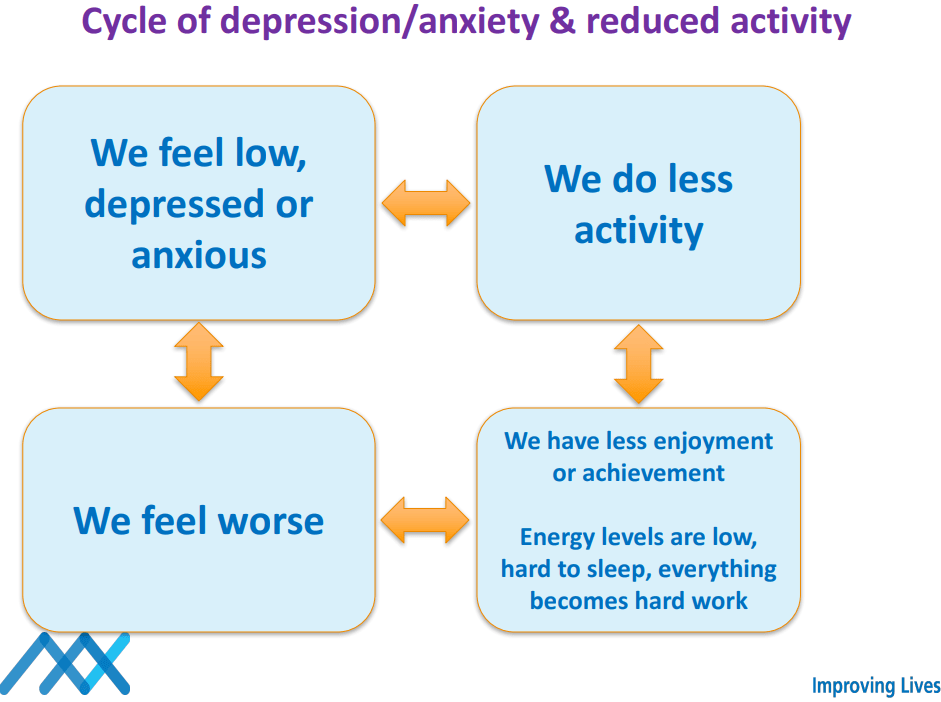
Behavioural Activation is an effective and pro-active treatment for depression which can be used in addition to medication and CBT techniques. Research shows that when individuals are struggling with depression their activity levels reduce, leading to less enjoyment and achievement and feelings of lethargy and poor motivation so that even small tasks and activities become hard work. This then becomes a vicious cycle of inactivity – depression and anxiety – inactivity and so on leading to us feeling worse.

Source: NHS Greater Manchester Mental Health

Additionally, a person may engage in unhelpful behaviours such as turning to drugs or alcohol, staying in bed late into the day, withdrawing from social situations or sitting ruminating about things.

Behavioural Activation (B.A.) aims to break the above cycle by increasing pleasurable and positive activity each week with a view to improving mood and decreasing feelings of anxiety, including any negative thoughts you might be having such as “I’m a useless wife/husband/partner”, “I can’t do this anymore”, “I’m never going to get better” etc.

Although Behavioural Activation is a relatively simple idea and can be used as a self- help strategy, I think it is best done with a therapist or support worker so that they can guide you through the process and provide encouragement along the way. They can also look at the particular difficulties you’re having and help you to put things in place to make positive steps towards tackling them.

Establishing a baseline – the first step of Behavioural Activation

Once you understand the principles behind B.A. therapy the first step in the process is to monitor your current activities throughout the week and how they affect your mood. This can either be done using an activity monitoring sheet, examples of which can be found online, or by simply making a list of what you do each hour of the day and scoring your mood out of 10 each time, 0 representing feeling very depressed and 10 representing feeling really good. This should help you to clearly see the relationship between your activity levels and your mood. You could also try listing which of your activities made you feel good and which made you feel bad, for example going for a walk in the park made me feel good, sitting and worrying that I’ll never get better made me feel bad.

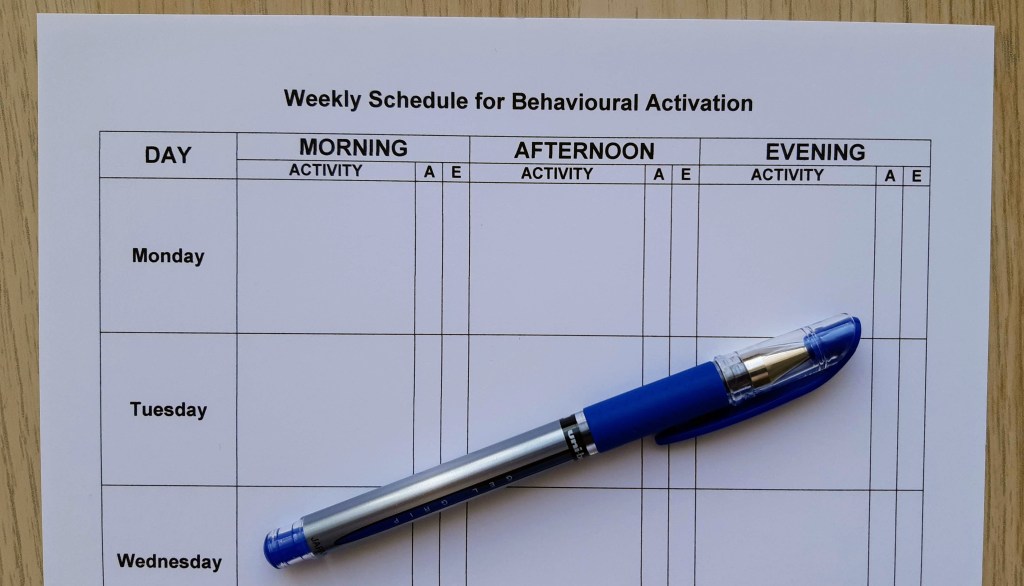
Using a ‘Weekly Schedule’ sheet to make plans – the next step in the process

Once you’ve established what you are currently doing, it’s time to make some small improvements. Each week, you work on creating a schedule which should include routine plans such as having breakfast, going food shopping, pleasurable activities such as playing cards, watching TV, doing something creative etc and necessary things that need doing e.g. paying your car tax.

You should also try to include activities which you already do that make you feel better such as getting dressed, brushing your hair, going for a daily walk etc. So, for example, even though I didn’t feel like doing my yoga each day, I did it anyway as it helps to calm me and I feel good after doing it.

My modified B.A. weekly schedule sheet created in MS Word

What you write in the boxes depends on your current difficulties. For example, if you are struggling to get out of bed you might write in the first box ‘Up by 9.00am’, ‘Have breakfast’ and ‘Get ready’ (dressed, teeth brushed and face washed). If you’re currently not doing any household chores, you might add laundry related activities to your list. This can be broken down into small steps e.g. ‘Load the washing machine’, ‘hang out clothes’ and ‘Bring in washing’.

You should also try to think of activities which are important to you, for example spending time in nature, being creative, quality time with family or friends, eating a balanced diet etc. These are related to your core values and you might want to talk to a support worker or therapist to establish what you want from life so you can set some goals for the future. Although your depression is likely to lead you to believe that things will never get better and you will never again feel a sense of pleasure or achievement, try to think of your situation as temporary and know that things will improve in time (I know this is much easier said than done though).

Using your weekly schedule to good effect

Your weekly schedule is your plan for the week and is a guide for what you hope to achieve. It should be referred to throughout the day and will help you see what you have planned. It’s also a place to record your achievement and enjoyment levels (out of 10) so you can evaluate the effect B.A. is having on your mood. You might also like to spend time each evening reflecting on your day – you could even do a little journalling too. If you find your enthusiasm waning at any time, remind yourself why you’re using Behavioural Activation and think about the positives so far.

Tips on using Behavioural Activation to treat depression

Start small When I first started planning out my week according to the principles of B.A., I would identify one activity for in the morning, one for in the afternoon and another for in the evening. This would mainly include relatively simple and mindful activities which helped to distract my anxious and negative thoughts and improve my mood a little. So, for example, in the first week I would have breakfast, get dressed and straighten my hair in the morning, go for a walk in the park in the afternoon and then play cards, do some of my jigsaw or watch TV in the evening. By week 5, I was doing several activities in the morning, afternoon and evening and setting more difficult goals for myself. However, we always made sure I had some time for pleasurable and relaxing activities each week such as reading my book in bed two mornings a week (after having a good breakfast and brushing my teeth and washing my face).

Break down activities into steps When you’re feeling depressed, it’s common to lack the motivation to do even basic things. For this reason, it’s helpful to break down activities into small steps which feel more achievable. So, for example, ages ago I bought a cheap set of gouache paints and really wanted to have a go at using them. Rather than creating a full page art piece, I set myself the simpler task of painting some stems and leaves. For the first step, I experimented with creating different shades of green by mixing varying amounts of blue and yellow. Then I introduced small amounts of other colours of paint to explore what happened. I also added white to some of the mixture to make lighter shades. After that, I tried painting samples onto a small strip of watercolour paper to see if I had the consistency of the paint correct as I knew that gouache is quite a bit thicker than watercolour which I’ve used many times before. This was all I did on the first day. I returned to my paint samples a few days later and decided to have a go at some stems and leaves. I spent time looking online at different stem and leaf shape and patterns and then had a go at creating them using a small selection of brushes. By breaking down my art project, I avoided feeling overwhelmed. I also did the same for housework tasks e.g. rather than cleaning the whole kitchen, I started by just cleaning and polishing the sink area.

Routine, Pleasurable and Necessary Try to create a balance of activities on your plan so that you engage in a range of pleasurable and achievement related activities each week. So, for example, you might do some watercolouring on Monday morning because you know that you have enjoyed painting in the past. This would be a pleasurable activity (even if you believe that you won’t enjoy doing it). On Tuesday morning, you might put one load of washing in the machine and then hang it out in the sunshine when it’s finished. This would be a routine task (something that needs doing regularly) and is likely give you a sense of achievement. On Wednesday afternoon, you might plan to get a few necessary tasks out of the way such as renewing your car insurance, replacing a lightbulb or replying to an email or text message from someone.

Evaluate how your week has gone During my weekly support sessions, Nichola would ask me how my week had been and part of this involved talking through how I’d got on with my B.A. plans. This gave me the chance to share my achievements but was also an opportunity to identify any problems I’d had, if I’d found solutions myself or if I needed help to find a way forward. For example, one week, I’d got really upset because my dressing table in the bedroom was thick with dust and I felt ashamed at how bad it was. I only cleaned this one piece of furniture instead of the whole of our bedroom as I became really overwhelmed. We discussed that sometimes a task may need modifying or simplifying to make it easier and that I may need to try to be kinder to myself / show more self compassion etc.

Reward yourself regularly As well as going easy on yourself, it’s also a good idea to spend time recognising your achievements and reward yourself for progress made. As well as doing this with Nichola once a week, my husband talks with me about how my day had been and what I’ve achieved. Also, every Friday afternoon, we go to my favourite café for a coffee and cake as a well deserved treat. This has become a part of our weekly routine which will have carried on even though I’m now feeling much better and it’s not so hard to get things done.

Enlist the support of others If you find it difficult to motivate yourself to do the activities on your weekly schedule, it can be helpful to ask others for support. This could be a family member or friend who regularly checks in with you to see how you’re getting on and provides gentle encouragement. They might also help you with a particular task e.g. preparing a meal, filling in a form or tidying a space in your home.

Final words…

Although Behavioural Activation on its own isn’t a cure for depression, it can be a really useful coping mechanism and a helpful treatment for lifting your mood. Hopefully, in time, you will find that you start to enjoy some of the activities on your plan or feel a sense of achievement when you’ve completed tasks that you’ve probably been avoiding. As you continue to schedule in activities and complete them successfully, you’ll likely be motivated to do more. Remember, though, that there may be days along the way where you don’t feel so good and some of your tasks might not get done. This is okay and perfectly normal – just go easy on yourself and celebrate what you did achieve. Even a small number of activities done each day can have a big impact on your mood.

If you have any questions about Behavioural Activation, feel free to drop them in the comments and hopefully I’ll be able to answer them or direct you to an online resource which might help. Also, if you would like a copy of my Weekly Schedule, I would be more than happy to share it – just get in touch using the email address in the ‘Contact me’ section of my blog.

Posted in CBT, depression, lifestyle, mental health, Planning and journaling, psychology, wellbeing

Monday Matters: Negative self-talk – its impact on you and 3 ways to challenge and reframe it

For today’s Monday Matters post I want to discuss something which I’m currently really struggling with, and that is negative self-talk. I’ve been taught various strategies in different therapy sessions throughout the years but applying them when you’re really struggling is easier said than done. Also, during periods of better mood, the techniques tend to be forgotten about as the amount of negativity is much less. So, here’s some examples of different types of negative self talk, an outline of how it damages us mentally and three key ways to challenge and reframe it.

What is negative self talk?

Before you can begin to challenge your negative self-talk you need to know exactly what it is so you can label it as such as soon as it pops into your head or out of your mouth. Basically, we have lots of thoughts running through our minds all of the time such as ‘I wonder if there’s anything good on TV tonight?’, ‘I haven’t done any watercolouring this week, perhaps I’ll have a go at some tomorrow’ or ‘I feel a bit rough today so I’m going to take it easy’. These kinds of self-talk and reflection are perfectly normal and help you to make decisions and get on with things in your life. However, when the self-talk becomes harsh and self critical, such as ‘I can’t believe I did that, I’m such as idiot’, this is when it becomes a problem and can be really damaging in all kinds of ways.

The main forms of negative self-talk (AKA cognitive distortions)

The following are some of the main forms of negative self-talk. In psychology, they’re known as cognitive distortions because they’re inaccurate, exaggerated, irrational and negatively biased.

Overgeneralisation – this is where we draw conclusions about things in life or the future based on things that have happened (often once) in the past e.g. all men are liars, we’re bound to get stuck in traffic, bad things always happen to me, I’ll never be able to do that, I always fail.

Catastrophising – very closely related to the above, this is where we imagine and believe the worst will happen and completely blow things out of all proportion, for example, during a period of depression, saying that you will never get better and will spend the rest of your life miserable, or following the end of a romantic relationship, stating that you’re unlovable and will never find anyone else.

Mental filter – this is when we experience positive and negative things but only focus on the bad stuff and filter out anything good. So, for example you might have had a day out at the park, enjoyed a picnic in the sunshine, strolled around the lake, feed the ducks and swans and admired the cute, fluffy little cygnets before getting an ice cream from the café. But, on return home, you might say that you had an awful time because you were stupid enough to drip ice cream on your t-shirt and that you got burnt because you failed to re-apply your sunscreen.

Predicting the future (AKA fortune telling) -this is where we predict what is going to happen based on little or no evidence, for example, we might say things like: ‘I just know I’m not going to get the job’, ‘I’m not going to the party because I’ll have an awful time’.

Mind reading – here, you assume what others are thinking, often in a negative way. So, for example, you might decide that your friend hates your clothes because she didn’t say how nice your new dress looked, or you might conclude that your husband is sick of you because you keep getting upset all the time.

Black and white thinking – this one involves thinking in extremes rather than anything in-between or in a ‘shade of grey’. It commonly involves the use of the words ‘always’ or ‘never’. Some examples that I’ve said recently are: ‘I always mess things up’, ‘I’ll never get better’ and ‘I’m a complete mess’.

Labelling – these are things that you say about yourself either in your head or out loud which are wholly negative and unhelpful e.g. ‘I’m a fat pig’, ‘I’m useless’, ‘I’m such a failure’ etc.

Shoulds and muststhis involves putting undue pressure on yourself and creating unreasonable expectations which become impossible to keep. For example, you might say ‘I should be a better wife’, ‘I must tidy up all of this mess’, ‘I should exercise more’, I must make sure I’m on time for my appointment’. Using ‘I need to…’ isn’t particularly helpful either e.g. ‘I need to lose weight’, ‘I need to be a better mum’, I need to get that work done’. I’ve written an in depth blog post on this previously as it’s something we covered in my compassion group classes.

The consequences of a tendency towards negative self-talk

As well as causing high levels of stress for both the individual and their close family and friends, negative self-talk has a number of negative consequences including:

  • lack of self belief
  • poor levels of resilience
  • diminished ability to make positive changes in your life
  • reduced self-confidence
  • decreased motivation
  • feelings of worthlessness
  • feelings of hopelessness
  • likelihood of depression and anxiety being exacerbated

Personally, I find that negative self-talk goes hand-in-hand with depression and feelings of anxiety which only serves to make things worse.

3 ways to tackle your negative self-talk

In order to remedy our tendency to negative self-talk we need to recognise when we’re involved in it and actively challenge our words. Here are three ideas on how to do this:

Recognise it, write it down and challenge it

There are a number of psychological studies that have looked into developing awareness of self-talk and the key findings suggest that those individuals who wrote down their own personal examples in some form of log book showed greater insight into the specific content of their self-talk and the consequences of its used. They were also able to start challenging their initial thoughts in order to create more balanced conclusions.

Recognising and challenging your self-talk takes time and commitment but is really worthwhile doing. The following example is my own and I hope, by sharing it, you can see how the process works (you may need to click and enlarge it to see properly). When challenging the evidence, I find it helpful to think about what a good friend or my lovely husband might say in response to what I said.

Take it to court

This is a great technique, which I used in my chart above and feel is really helpful for cross examining your self talk. It commonly used in CBT (Cognitive Behavioural Therapy) and involves metaphorically take the thought or belief to court and place it in the dock. You then find evidence for and against the thought or belief, considering the factual evidence and not opinions. Working for the defence, you try to prove that the accused (your thought or belief) is truthful and correct by providing evidence that shows that your thought or belief is 100% totally true. You can see examples in column 4 of my chart. Then, working for the prosecution, you look for evidence that this thought or belief is not true 100% of the time. For this, you need to select good quality evidence that would hold up in court. Finally, the judge summarises all of the evidence and composes a final statement which is realistic, rational and balanced. This should then help you to see alternative ways of thinking and enable you to undermine your extreme and unhelpful though. You can find worksheets to go with this technique at Getselfhelp.co.uk.

Find more positive alternatives

When you catch yourself saying negative things, try to come up with more positive alternatives or different ways of looking at the situation. Again, think about what a good friend or your partner would say to counteract your thought or belief. Here are some examples which might help:

Negative self-talkPositive self-talk
I hate feeling like thisIt’s okay to feel like this, my feelings are valid
I’m never going to get betterThis is temporary and I have the ability to get through it. I’m taking things one step at a time.
I hate my bodyI’m grateful for everything my body can do, I’m healthy and strong and my body is beautiful.
My life is awfulThere are so many good things in my life right now.
I’m getting everything wrongEveryone make mistakes and we all have days that are better than others.
I need to do some exerciseI would like to do a little more exercise so I can feel more toned.
I can’t do itIt’s going to be hard work but I can do it
I’m so stupidI made a mistake, so what, everyone makes them!

Final thoughts

You might not need to complete these exercises all of the time but when you find yourself dealing with feelings associated with anger, depression or anxiety, try to make time to stop and become more aware of your thoughts. Then you can start to reflect on them, challenge your views and find alternative ways of looking at things. Hopefully, after developing the skills associated with thought investigation and thought challenging, you’ll find it easier to put the ideas into practice and conquer your negative self-talk and start being nicer towards yourself.

Thanks for reading and good luck!