Posted in goal setting, mindset, personal development, planner girl, productivity, Setting goals and intentions

Monday Matters: Taking simple goals and turning them into SMART goals for the month – a mini guide with real life examples

For the last five months, I have been setting a number of monthly goals which I aim to have met by the end of the month. Today, I thought I’d share my process using my actual list for this month as an example. I also want to explain how I make sure that each of them are SMART, even if the original goal is rather loose and unspecific.

Before I share my goals for February, here’s a quick reminder of what the letters of the acronym SMART stand for.

S – Specific

M – Measurable

A – Achievable

R – Relevant

T – Time bound

Now, obviously, all of my goals are time bound as I aim to have achieved them by the end of the month, but how do I make sure my goals meet the rest of the criteria? Well, here’s an image showing my simple goals laid out in my bullet journal and I’ll pick out two of them to consider in detail so you can see my thought process and actions I take to prepare.

My actual goals for February 2025
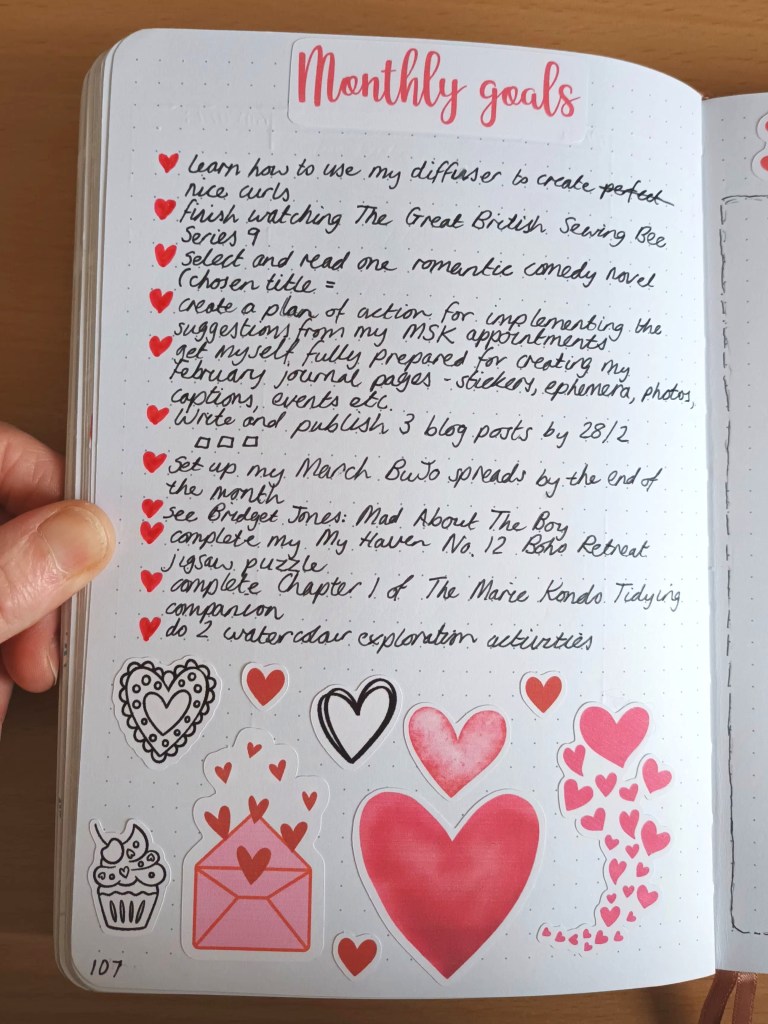
Image credit: Laura Jones for Keeping It Creative

Let’s take the first one:

Learn how to use my diffuser to create perfect nice curls.

I’ve made this goal specific by explaining exactly what I hope to achieve by learning to use my diffuser. I haven’t just said ‘learn how to use my diffuser attachment’, I’ve also stated what I want to use it for.

My goal can be measurable as I’m currently clueless on how to use the diffuser correctly, whereas when I’ve achieved my goal I should be able to use it to create nice looking curls. I’ll deem them to be nice enough if I would be happy to leave the house for the day with them looking like they do!

The goal is achievable as I have the resources required to work towards it, i.e. I own a diffuser attachment for my hairdryer and I can select video tutorials on YouTube to watch to learn the techniques involved. And, you’ll notice I’ve crossed out the word ‘perfect’ – this was intentional as I’m saying that the curls don’t need to look as perfect as they would when I step out of the hairdressers, but need to look nice enough to show them off with confidence.

The goal is a particularly relevant one for me as my hairdresser has been curling my hair with with a wand or straighteners and, although they look beautiful at first, I’m always frustrated with the way they drop out in less than an hour so, I’ve armed myself with curling gel which should help to hold the curl better. Also, I’ve always wanted to be able to create bouncy curls so this is a good objective.

Now, I know I said earlier that the goal is time bound, but, for me, saying I’m going to get all of the above goals ticked off by the end of February leaves too much opportunity for failure, so, I like to get super specific and dedicate a block of time to each project, activity or task involved in my monthly plan. For example, I might decide that on Wednesday 12th February in the morning, I’ll watch a couple of tutorials on YouTube that have been liked by lots of viewers (more likely to be good quality) and then have a go at curling my hair in the afternoon. I’ll also dedicate another 2 or 3 hours to perfecting my new skill until the curls look nice enough to go out with.

I also want to talk about the very last goal in my list:

‘Do two watercolour exploration exercises’.

I’ve picked this one to explain about, because I had something similar for one of my January goals, but I didn’t achieve it. In fact, I didn’t achieve a single part of it because I wrote ‘Do some watercolour exploration each week, using ideas from Painting Calm’ and, although I did a small amount of watercolouring just before the end of January, it wasn’t using ideas from my new book (which I have barely looked at yet) and it certainly didn’t happen every week!

To be completely honest, my goal was far too ambitious as it demanded a lot of time, something that I didn’t have enough of, especially with all of the other goals I’d set for that month. Therefore, it didn’t fit the achievable element of a SMART goal. So, this time, I’ve reduced what is expected of me, and I’m going to write into my monthly BuJo calendar, exactly when my watercolouring sessions will take place. I’ll also pre-pick the ‘watercolour explorations’ I’ll be doing so I can get prepared before I start. They can also be activities from my new book or ones I see in social media if I fancy trying them instead (they’re specific but not too ridged).

So, for my final goal (i.e. the one at the bottom of my list), although ‘Do 2 watercolour explorations’ might seem a bit vague, it can easily be developed as a SMART goal. It is specific as it states the kind of art I want to do and explains that they’re explorations so basically just me trying out a couple of techniques. It’s measurable as I’ll be able to see the evidence of two exploration style activities on watercolour paper or in a sketch book. It seems to be much more achievable – as long as I don’t get COVID again! It’s relevant, as exploring with watercolour is on my vision board for 2025 and it’s time bound as I plan to do both activities before the end of the month with my sessions identified on specific days (recorded in my BuJo) and time blocks drawn up on the actual day, based on how long I would like to spend doing them.

Final words…

I hope today’s post has been helpful for you and will assist you in turning your simple goals into SMART goals to increase your chance of achieving them. I see so many examples of incredibly unspecific goals when people share their monthly spreads and then, when they come to review their progress, they talk about how they only achieved a small number of them or, more often than not, had forgotten what they had said they wanted to do! As well as making your goals SMART, you should also remember to check back in with them on a regular basis. This way, you can pick out two or three for each week of the month and then outline your plans, first in your monthly set up, and then in your weekly.

I would wish you the best of luck with your goals, but really, what’s required is hard work and paying attention to what matters to you so I’ll just say I hope you’re ready for action and are focused on what you want! Go get em!

Posted in fitness, goal setting, lifestyle, mindset, Planning and journaling, wellbeing

Monday Matters: 4 tips for getting started on your fitness journey and staying motivated

Image from Pixabay

Many of us, as part of our new year’s resolutions each year, set goals to get fit. We start off with good intentions, joining the gym or attending exercise classes but oftentimes, our motivation isn’t maintained and by February, our workouts have dwindled and other priorities have come to the fore. As someone who has been a member of a local gym for over a year and a half, with a routine that includes at least seven workouts per week, I thought I’d share a small number of tips to help you get started with your fitness journey and maintain the motivation to keep going. So, let’s get started…

Set clear goals

Some people set the vague goal ‘get fit’ without considering what that statement means to them, how they’re going to do it and why. A much better approach is to use the S.M.A.R.T. goals system. I wrote a really comprehensive blog post on this quite a while ago which includes some useful questions to consider to get you thinking about why the goal is important, what your life will look like when you reach your goal and how you will go about working towards it. I also provide an example, which, whilst not fitness related, should help you with goal setting and goal getting.

Using your bullet journal or a dedicated notebook for the particular goal or goal getting in general can provide a useful record of your intentions, how far you’ve come so far or a space to record your experiences, successes and difficulties along the way. It can also help with accountability.

Creating a vision board which focuses on your fitness goals and includes motivational images and positive phrases or quotes can also help towards manifesting the fitness lifestyle you desire. This can be created digitally and used as your screensaver on your computer or can be paper-based and maybe created using images and words cut out of health, fitness and wellbeing magazines.

Consider any clothing and equipment required

If you’re serious about increasing your fitness levels, purchasing some dedicated workout gear and some basic equipment can really help in terms of motivation. I got a number of outfits for my gym sessions and my weekend walks and I spent quite a while choosing items in my favourite colours which fit beautifully and make me feel confident and well supported. This included sports bras for my aerobic sessions, moisture wicking tops which don’t expose my skin during downward facing dog and leggings which are fitted but not too tight as to feel uncomfortable or roll down during my exercise routines. I also got several pairs of hiking shoes for winter walks and lots of layers for warmth whilst out in the countryside. I didn’t get everything straightaway but have built up my collection based on my changing needs as I try and love different forms of exercise.

As I practise Iyengar yoga, I’ve invested in a mat, blocks, bricks and a belt for my practice. I also use some of this equipment in my Pilates and legs, bums and tums classes too so figured it was a good investment. Although the gym provides bits and pieces for the sessions, I find having my own things beneficial and it also means, if I miss a class, I can find a workout on YouTube to do some exercise at home.

Create an active lifestyle

If getting fit and staying fit are important to you, you’ll need to create an active lifestyle where exercise becomes a key part of your daily routine and something which you enjoy and thrive on. Yes, there will be days when you don’t feel like it and have to push yourself to get your exercise gear on and do a session, or times when you recognise the need to have a rest if you feel under the weather or think you might have over-exerted yourself, but on the whole, you’ll feel motivated and ready to go. A huge part of this involves choosing forms of exercise that you love and make you feel good. For example, when I started exercising, I would go to the gym at least 3 times a week to work on the cardio machines and the resistance training machines. My routine gave me a good full body workout, but I much preferred the social element of going to classes, getting chatting to various others who enjoyed exercise and fitness and developing friendships over the weeks. I now go to at least one class everyday and use the gym occasionally. I still do activities which work my whole body and I have maintained my motivation for different forms of exercise over several years now.

Sometimes, on busy days, when I’m working at the university or I have other plans, I have to cancel one or more of my classes. However, I will always make time to fit in exercise, even if it’s just 20 minutes of stretching at home or a face paced walk in nature or around the block.

Having a back-up plan for when you haven’t got time to do an hour long class or your usual hour and a half in the gym can really help and writing it down in the aforementioned notebook or journal can keep you consistent. This could include having a bank of videos saved on YouTube that you dip into or a selection of infographics showing stretch routines on Pinterest. You might also schedule in an early morning walk as part of your routine for that day or plan a long hike for the weekend when you don’t have so many other commitments.

Cultivate a positive mindset

A positive mindset can help you celebrate your progress and achievements, assess and overcome any setbacks and maintain motivation. Rather than focusing on what you didn’t achieve in a given week, celebrate the workouts you did do and how you felt afterwards. Look for signs of improved strength, flexibility and stamina and write down these wins in your notebook or journal. Draw up a list of rewards such as new fitness gear, a fun activity that you haven’t done for ages or have been meaning to try e.g. canoeing, surfing, bowling, kite flying, frisbee etc. or a pretty decorative item for your home.

“Studies have shown that if you have a ‘growth mindset’ – the belief that your abilities and skills can be improved – then you will have more effective workouts.

Put simply – it’s positive thinking. Believe you can, and you will.” (Why your mindset matters article on Metro.co.uk.)

Final words…

I hope you’ve found today’s blog post beneficial and it has given you some beginner friendly ideas for starting out on your fitness journey and keeping up the good work. When you begin, you might like to try out lots of different exercise options and then modify your routine based on your preferences. I’ve found I love dance based aerobic classes like zumba and clubbercise, but also enjoy more mindful practices like yoga and Pilates too. In the future, I would like to include more targeted upper body exercises to increase my strength in this area, but for now, I’m happy with the way things are progressing in terms of my general fitness and core strength.

Let me know in the comments if you plan on working on fitness and exercise related goals for 2024 and what you’ve taken away from today’s article to help you on your journey. Alongside your plans, you might like to consider dietary tweaks too in a way which compliments your fitness lifestyle and ensures better physical and mental health overall, for now and in the future.

Posted in goal setting, lifestyle, Planning and journaling

Monday Matters: A guide to SMART goals + an example of how I’m using the framework

Last week, my blog post focused on vision boards and how you can create one in your bullet journal. As part of this, I mentioned that as well as using pictures and words to establish what you want, you also need to identify steps you can take towards achieving your goals/dreams. Today, I’m going to deep dive into SMART goals and give an example of how I’m using the framework to help me achieve success towards a specific goal of mine which features on my current vision board.

What are SMART goals?

SMART is a mnemonic acronym that can help you with both goal setting and goal getting. It stands for:

  • S – Specific
  • M – Measurable
  • A – Attainable / Achievable
  • R – Relevant
  • T – Time-bound

Sounds great in theory but how can I set SMART goals?

To enable the setting of SMART goals, you need to create a detailed break down of each of your personal goals using the SMART framework. Your goals need to be Specific, Measurable, Achievable, Relevant and Time bound.

Specific

It’s important to be clear about what exactly it is that you want to achieve. To make your goals really specific, it can help to ask yourself a few questions to identify the detail:

  • What exactly do I want to accomplish?
  • Why is this really important to me right now?
  • Who will I need to help me achieve the goal and what will their role be?
  • Where will I work on my plan to achieve my goal?
  • Which resources will I need to help me?
  • Does my goal have financial implications?
  • What will my life look like when I have achieved my goal?
  • How will achieving my goal make me feel?

Measurable

Your goals should all be measurable so that you are able to see progress and know when you have achieved success. This can increase motivation as you start to see results from your efforts. Key questions to ask yourself could be:

  • How will I know when I have achieved my goal?
  • What will success look like?
  • What’s the best way of measuring my success?

Achievable

A vision board can sometimes contain ideals and big hopes and dreams, to make these visions into goals, you need to set more achievable targets to work towards.

  • On a scale of 1-10, how likely do you think it is that you’ll achieve your goal (1 being completely unlikely and 10 being absolutely certain)?
  • Is it completely within my power to achieve the goal?
  • Is the goal realistic?
  • Are there any obstacles which may present themselves?
  • Will I be able to achieve my goal in a given timeframe?
  • Do I have the resources or financial means to work on and achieve my goal?

Relevant

Your goals should be relevant to what matters the most to you right now. They should also align with your life values and current beliefs.

  • Is this a worthwhile goal and does it meet my current needs or desires?
  • Is this goal a priority for me right now?
  • What will achieving the goal especially mean to me?
  • How does this goal fit in with my values?

Time bound

It’s best to have a specific time frame in mind for meeting your goal. Setting a deadline or a date to assess if you have made significant progress can help keep you on track to success. You should try to decide on a realistic amount of time that is neither too long or too short. If the deadline is too far in the future, you will likely lose momentum or feel no sense of urgency. If the time frame is too short, you may become overwhelmed or stressed. A good idea might be to identify mini steps and assign an achieve by date for each.

An example of how I’m using SMART goals to achieve success

In last week’s Monday Matters blog post, I shared my current vision board. In order to increase my chance of successfully meeting my goals (or vision), I’ve been applying the SMART system to really break things down. To help you see how this works, I thought I’d take just one of my goals and look at it in depth using SMART.

On my vision board, I have a picture of a hamster and the word pampered. My goal is to treat our new pet in a way that gives her everything she wants and needs. We’ve been keeping hamsters for years and each time we have a new addition to the family, I try even harder to make sure she has a good life. Obviously I can’t ask Millie if she feels like she is a pampered pet but I can put things in place to ensure she is completely spoilt and receives the best treatment I can offer. Here’s my real life example of how I’ve broken my goal down :

Specific: I want Millie to be a happy and well pampered hamster so that I can be sure I’m giving her the best life I can. It’s important to me that my pet is treated well as part of our family. Both my husband and I will play a big part in working towards and achieving my goal. We’ll use our knowledge of keeping Syrian hamsters to help us as well as learning from guidance found online from reputable sources. Meeting my goal will have financial implications but we’re happy to spend a reasonable amount of money on both her cage and accessories within. When I have achieved the goal Millie will appear happy and content with her home and should show signs that she feels safe when we get her out of her cage each evening. She should look healthy and well cared for and my husband and I will be satisfied that we are good hamster parents!

Measurable: We will measure our progress using a checklist of things which need to be in place to ensure Millie is happy and healthy.

  • Extra large cage with floor space beyond the recommended size for Syrian hamsters.
  • Cosy house which is large enough for Millie to sleep in and also has room for snacks.
  • Large wheel which adult Millie can run in without concave back.
  • Water bottle to be refilled daily and scrubbed weekly.
  • A good quality diet consisting of dry food and small quantities of fresh fruit and vegetables.
  • Treats provided in line with feeding guidelines.
  • Plenty of bedding to be provided for nesting and digging.
  • Wooden chews provided for gnawing.
  • Sand provided for bathing.
  • Digging tower provided for out of cage play.
  • Cage spot cleaned regularly with full clean once a month.
  • Eating and drinking to be monitored.
  • Weight checked weekly.
  • Dedicated time with Millie outside of the cage every evening (minimum 10 minutes)
  • Basic health check performed each time Millie is handled.
  • No signs of distress or boredom displayed e.g. biting cage bars all of the time, excessive grooming, aggression, repetitive behaviours etc.

The goal will be considered achieved when all of these are in place and standards are maintained over the time period stated below.

Achievable As we are experienced hamster owners (Millie is my ninth hammy) we have very good understanding of what Syrian hamsters need for a happy and healthy life. Therefore, the goal should be achieved in a relatively short time. We’ve already ticked off some of the criteria as we’ve purchased an extra large cage, a wooden house and digging tower. We also have plenty of dry food, treats, warm bedding and a sand bath as well as a good sized wheel. Fresh water is provided although we need to get better at changing it each day.

Relevant Obviously the goal is relevant as we have a pet hamster and we wish for her to be well cared for and pampered. This is in line with my beliefs about how animals should be treated.

Time bound At least a couple of weeks for Millie to get used to us will be required as she is currently a little bit nervous and wary of us but progress is being made each day. I will assess and evaluate the situation at the end of this month and I expect that everything will be in place by 15th April as we will have had Millie for one month by then.

Millie at 9 weeks old and a little camera shy!

The need to be even SMARTER…

Although the SMART approach does not offer any guarantees of success, it does provide a useful system to help with setting and working on small goals with a view to you achieving your bigger hopes and dreams. Some authors have expanded on SMART to include two extra letters, namely E and R to make SMARTER, where E stands for Evaluated and R stands for Reviewed. In this longer acronym, it is suggested that further success will be achieved if the individual takes time to evaluate progress and reviews and reflects on how things are going in order to identify any issues and make adjustments where necessary. This certainly makes sense to me and so I’ve chosen a specific time and date to do some reflective journaling on my progress towards all of the goals displayed on my vision board. I’ve written it into my Bullet Journal Future Log so I don’t forget and I’ve allotted two hours for the process, which might seem a lot but I think it’s important to set aside a big chunk of time if the session is going to be useful.

Final thoughts

I’m feeling really motivated to work towards my goals and it helps that I know my what, why, where, who, when and how. I may meet with obstacles or setbacks along the way, but by evaluating my progress and making small changes, I’m in with a good chance of success.

Let me know in the comments if you’re a fan of setting SMART (or SMARTER) goals or if you think it’s something you might like to try in the future. I would love to hear about what you’re working on right now and if you are meeting with success.