Posted in life hacks, psychology, relationships

Monday Matters: A beginners guide to ‘pebbling’ to strengthen your relationships

Up until an hour ago (well as I write this anyway), I had never even heard of the term ‘pebbling’, which, according to an online article, is a very commonly used social media hashtag and a popular practice among us all (I must live under a rock which has no WiFi!). Despite this, as I perused the online article, I realised that I’ve engaged in pebbling with colleagues, friends, family and my husband many times, without knowing there was an actual name for it. If you’re unfamiliar with pebbling or the associated hashtag which is (apparently) currently flooding TikTok along with other social media platforms, or if you’d like to know more, I encourage you to read on…

The word pebbling was, in fact, originally used to described a romantic gesture that has been happening for decades, amongst gentoo penguins. During the breeding season, as part of their courtship ritual, male penguins carefully select and present a perfectly shiny and beautiful pebble to their prospective mate as a sign of their worthiness as a love interest and suitability to lifetime commitment (gentoos are usually monogamous). If the female is impressed by the aforementioned, she will place the gifted item as the foundation stone of her nest. Then, in return, she will present her own carefully chosen, smooth and highly polished specimen to her mate as a form of non-verbal communication.

Photo from a selection of free images on Unsplash curated by Derek Oyen

Now, I’m not about to suggest that you head off to the beach in a bid to find your own perfect little stone to woo potential partners with, but you can certainly apply the principles of pebbling by offering a small, inexpensive (or free) gift to demonstrate your feelings towards someone or to simply show them that you care, whether that’s as a family member, a friend, a colleague or as evidence that you like or admire them. I’ve written before on my blog about love languages with one of them being focused on receiving gifts, but, to be honest, I can’t think of anyone who wouldn’t appreciate a little, thoughtful something-or-other from someone else (as long as they consent to it or it would be considered a nice surprise anyway!).

The thing with the gentoo penguins and their pebble giving is that there’s no financial cost, and the emphasis is wholly on spending quality time carefully selecting something that they feel that the recipient would really appreciate. And this act of ‘pebbling’ can be applied to human gift giving as well – including the non-verbal element if you so wish. Think inexpensive or free items that will bring a little spark of joy to both the giver and the receiver, and you can’t go wrong.

So, what kind of things could you give as a token gift?

What you choose will completely depend on your chosen recipient but, here’s some ideas for you to consider:

  • A virtual gift with a ‘saw this and thought of you’ message attached e.g. their favourite pet or animal doing something amusing, a meme that just says it all or says it better than you possibly could (pebbling is very popular with neuro-divergent individuals who may struggle to say something heartfelt or thoughtful in words).
  • A link to an article you’ve read online (or a newspaper / magazine cutting) that you think would interest them or is on a topic which you think they would love to learn more about.
  • Some flowers picked from your garden which you think would cheer them up or make their day.
  • A photograph of you and a friend that you found from a while back as you were scrolling through your Google albums on your phone. This could be forwarded somehow, shared on social media e.g. their ‘wall’ on Facebook or printed and delivered in some way.
  • A pretty greetings card in which you let the person know that you are thinking about them or really appreciate them
  • Something to represent an ‘inside joke’ that you reckon would bring a smile or make someone giggle
  • A multipack of chocolate or sweets that you share with a couple of your closest colleagues.
  • Pass on a book (or a personal recommendation of one) that you’ve read and think they would enjoy too.
  • Pop out to your local bakery on a Sunday morning to get pastries for a leisurely breakfast with your partner, flat mate or kids
  • Buy a subject specific magazine for your significant other e.g. computing, gardening, crafting, wildlife etc
  • Pick up a little personalised item for them e.g. pen, pencil, keyring etc e.g. from a garden centre or gift shop (or, if you have a Cricut machine, add their name to an inexpensive plain or patterned notebook)
  • Bake some biscuits or cupcakes and bring them to the office to share with your colleagues (sometimes the recipient might be more than one person)
  • Buy a small box of individually wrapped chocolates (e.g. Cadburys Heroes, Celebrations, Roses or Quality Street) and let everyone you work closely with choose their favourite to enjoy with a coffee at breaktime.
  • Visit your local pet store to find a treat for your pet or pets – who says that penguins should be the only non-human animal to perform loving acts! Or, if you don’t have your own pet, why not pick up a treat to give to someone you like who does have their own cherished animal (thanks to my husband’s ex work colleague who provided the inspiration for this one – Aggie the hamster was very grateful for the cupcake shaped biscuits!)
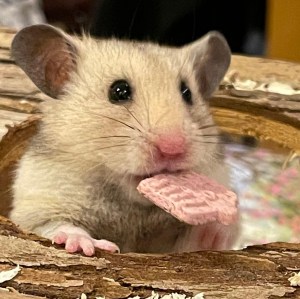
Aggie in her digging tower where her treat was hidden!

Final words…

I hope you’ve enjoyed reading today’s post and it’s given you a good overview of the origins of ‘pebbling’ and examples of different small gifts you can give to show affection or care. I’m sure most of us have engaged in the act pebbling many times in the past and I would love to hear some of your favourites in the comments.

Happy pebbling!

Posted in lifestyle, mental health, reflective journalling

Monday Matters: Positive daily reflection using the Three Good Things (3GT) exercise

Over the last week, I’ve been doing some decluttering in my craft room. The place is overflowing with stuff and I feel like quite a few of the bits and pieces will never get used and would be better off going to a new home. Whilst sorting out some trays, I found an old magazine that I purchased last year. Flicking through it, I found a box of information about a reflective exercise that can help inject some positivity into your day. I already feel grateful for a lot of things in my life and have previously carried out a daily gratitude practice in my bullet journal each evening. This particular exercise though, takes things a little further and asks you to consider three positives and why they happened. I haven’t yet tried this out (as I was so excited to share the ideas behind it in this blog post) but I have a feeling that it will be really useful in helping me (and you if you try it out) to realise how many of the positives in my life are directly linked to my own actions and thoughts.

The Three Good Things exercise

The 3GT exercise was co-created by Martin Seligman, one of the leading experts in positive psychology. He designed the activity as a tool to really highlight the good in your life in a simple, easy and scientifically backed way that helps to boost your happiness.

How it works

  1. Every evening, at least an hour before bed, think of three good things that happened that day. These could be big or small things – anything positive counts. Maybe you particularly enjoyed a meal you cooked or you found the perfect neutral t-shirt you’ve been looking for whilst out shopping. Perhaps you managed to carve out some time to work on a creative project or a task that you’ve been putting off was easier and quicker than you thought.
  2. Write these things down on paper. Don’t just think about them. Journalling about them is a very important step in the process.
  3. Reflect on what brought about these events i.e. why they happened. For example, you might have spent a chunk of time last week searching online resources for recipes to try, picked one which sounded nice and chose good quality ingredients for the dish to make it extra special.
  4. Do the above each night for six weeks and then think about the effect it has had on your happiness levels.

An example

My 3GTs for today:

  1. Finding an interesting idea in an old magazine. I found the information as I flicked through the pages during a mini declutter of my craft room.
  2. Two lovely comments on my blog post which made me feel so happy. I took the time to photograph and share my bullet journal spreads for February and provided a short explanation for each page. I try really hard to be consistent with my posting and share content which my readers will enjoy. I also spend time making sure my posts read well and are informative as the quality of my articles is really important to me.
  3. My Amazon order just popped through the letterbox a day earlier than expected. I now have two more books of gorgeous stickers and a new good quality washi tape to add to collection for use in my bullet journal and traveler’s notebook. The work I do at the uni plus other sources of funds enable me to treat myself to journalling supplies which are a joy to use. I’m so pleased that Nichola suggested getting in touch with Lesley as I really love doing PCPI sessions and I know the students appreciate what we do too.
Photo credit: Laura Jones for Keeping It Creative

Why it works

By carrying out the exercise on a regular basis, you’re training your brain to find a number of positives in each day and begin to recognise what went before to cause these things to happen. This helps to change the focus from stressful or negative aspects of our lives, encouraging us to be more thankful for what we currently have (even those things which we tend to take for granted) and more optimistic and hopeful about our future.

Final thoughts

The Three Good Things exercise sounds to me like a wonderful way of digging deeper into gratitude so that you look at what came before positive events and thoughts in your day. I’m definitely going to give it a go and I’m pretty sure the thirty minutes or less that I dedicate to the practice each evening will have a huge impact on my life. Let me know in the comments if it sounds appealing to you and if it’s something you would like to try.

Posted in CBT, compassion, lifestyle, mental health, psychology, wellbeing

Monday Matters: The psychology of optimism and how to become a glass half full kind of person

Photo by Brett Jordan on Pexels.com

When I was struggling with anxiety and depression at the end of last year and the beginning of this one, I found myself being very negative and developing a very pessimistic view of the future. I was convinced things (I) would never get better and spent a lot of time wallowing in self pity and believing I couldn’t make myself well no matter how hard I tried. Now I’m feeling well, I’m happier and full of optimism and any challenges I face don’t feel like mountains that I’m unable to climb. I’ve always known that being optimistic is a key part of wellbeing but how can we remain that way all of the time, even when things are a little (or a lot) shitty? Today’s Monday Matters post looks at the psychology of optimism and how we can foster it no matter what life throws at us.

What is optimism?

According to the Oxford dictionary, optimism is ‘a feeling that good things will happen and that something will be successful; the tendency to have this feeling’. The exact opposite of this is ‘pessimism’ which is described as ‘a feeling that bad things will happen and that something will not be successful; the tendency to have this feeling’. Further to this, an optimist is ‘a person who always expects good things to happen or things to be successful’, whereas a pessimist is someone who ‘always expects bad things to happen’. I do think these are oversimplified definitions, however, as most people realistically know that over time, good and bad things will happen to us all and that it is our reaction to events and thoughts and feelings which can be described as mainly optimistic or pessimistic.

Why are some people optimists and others pessimists?

Early research into the subject tends to suggest that an optimistic or pessimistic view is largely an inherited biological trait, but more recent works have shown that environmental factors can influence us too. In other words, we are born one way or the other but our life experiences can impact on us too so, for example, we may learn to have a positive outlook from our childhood if we have an optimistic parent who encourages associated traits such as self belief, resilience and acceptance. Conversely, being surrounded by pessimists who believe they are hard done to, always see the worst in a situation and have a tendency to be negative overall can influence our thoughts and feelings about life too.

So, even if you are a ‘glass half empty’ type of person, it is possible to learn to be more optimistic or reduce pessimism by working on challenging and changing your thought processes. This does mean that if you have always been described as an optimistic, there is a chance that, with certain life experiences, you may develop a more pessimistic view (sometimes temporarily) but there are many ways of of combating this.

What are the benefits of being optimistic?

There are so many benefits of being of being an optimistic person in terms of physical and mental health. Optimists:

  • have healthier lifestyles, for example they exercise more, have a balanced diet, are less likely to smoke or binge drink and just generally make better choices with regard to their health
  • have better quality relationships with family, friends, partner or co-workers
  • have more life satisfaction, happiness and high levels of psychological and physical wellbeing
  • are good problem solvers and tend to strive for what they want as they believe themselves to be capable of high levels of achievement
  • are more motivated
  • have better self esteem
  • are generally more successful
  • accept their failures and learn from them
  • have a better immune system
  • have lower cortisol levels (stress hormone)
  • actively pursue their goals
  • recover from physical illnesses more quickly
  • take less time to recover from surgery
  • less likely to have a stroke or cardiovascular diseases
  • have lower blood pressure
  • emerge from difficult circumstances with less distress than pessimists
  • see setbacks as temporary events caused by circumstances
  • are more likely to engage in health related self care activities such as regular check ups

How can we learn to be more optimistic?

The idea of learned optimism is a concept developed by a leading American psychologist called Martin Seligman.

learned optimism involves developing the ability to view the world from a positive point of view.

Seligman

He believes that the positivity associated with being an optimist can and should be cultivated and that being optimistic is a key part of good health and wellbeing. So, pop on your positivity glasses and read my suggestions on how to train or rewire your brain.

Shift your focus – instead of thinking about what you can’t control, focus on what you can instead. In any situation, there are things that can’t be changed and things that can. If you spend your time obsessing over the former, you will quickly become stressed and frustrated. However, if you look at what you do have control over, you can control the controllables and forget about the rest.

See setbacks as temporary – it’s not the end of the world if something goes wrong or doesn’t go the way you expected, it’s something to be learnt from. Resolve to come back better and stronger!

Regain your sense of control – focus on what you can do to improve a situation and believe in your ability to make things better rather than focusing on the barriers. This is in contrast to ‘learned helplessness’ associated with pessimism.

Watch out for unhelpful phrases – talk such as ‘I never…’, ‘I can’t…’, ‘I always mess up…’ etc is not helpful and can create a negative mindset. Try to catch yourself saying them and come up with some alternatives which are more positive – ‘I might be able to…’, ‘I could…’ etc.

Think about the company you keep – some people seem to complain about everything and never have a positive word to say. After so many minutes of talking to them, you might find you start being negative too. It’s almost like the pessimism is contagious. Conversely, spending time with a optimist, can encourage feelings of optimism and make life seem much more rosy. I’m not saying cull everyone from your life who isn’t a ‘glass half full’ kind of person, but you might want to think about who you spend most of your time with.

Avoid overgeneralising – After something has gone wrong for you, have you ever found yourself thinking or saying that the world is conspiring against you, or everyone has got it in for you? Remember that one set back in one aspect of your life does not mean that everything is going wrong. Neither does it mean that you are unlucky or any of those other things that might pop into your head or out of your mouth!

Take a balanced approach – In every situation there are positives and negatives. Unfortunately, the society that we live in often encourages us to focus on the more negative side and ignore the many positives. I like to do some gratitude journaling each evening to focus on the positives in my day. I might also have a few negatives that become problems to work on solving, but I try not to dwell on what I can’t change or those minor irritations which we all have.

How can we stay optimistic during tough times?

As I said earlier, when I was struggling with my mental health for so many months, I found it very difficult to be optimistic in relation to the present moment and the future. But there are ways of remaining positive, even during periods of difficulty. So, what could I have done differently? Some of my online reading has suggested that optimism doesn’t require you to brush aside anxious and negative feelings, but rather to accept them whilst being hopeful about what the future will bring. Obviously, this is easier said than done when you are consumed with difficult emotions, but the idea is that you work super hard to acknowledge that things are difficult right now, but try to hold on to the belief that things won’t always be like this. Here’s some ideas of ways that this can be made easier (not easy of course, but having an I can get through this attitude is a big part of it):

  • try to practise self compassion – accept that things are a struggle right now, but also remind yourself that you’ve got through difficulties before and you can do so again
  • disrupt the negative thought cycle – focus on the breath, change your environment (go for a walk in nature), confide in someone you trust about how you are feeling and seek a fresh perspective
  • jot down some coping statements e.g. I can take this one day at a time, this is frightening and I can handle it, I am a resilient person and I can get through this etc.
  • practise gratitude – even when things are hard, there’s always small things to be grateful for – the friend who texted to say she’s thinking of you, the tranquillity as you sit drinking your coffee in your sunny garden, your warm coat on a chilly day etc. At certain times, it might be difficult to focus on the positives, but it’s not completely impossible and taking the time to be grateful has been shown to really help.

Final words…

I hope today’s Monday Matters has been helpful in some way and that you will give at least one of the ideas a go. Lockdown is beginning to ease now but there is still a little uncertainty around about the future making things difficult. As I type this, I’m feeling positive and optimistic, yet whilst I was unwell, things looked bleak. So, it just goes to show that things can and will get better.

Take care until next time,