Posted in Home cooking, relationships

Monday Matters: Why cooking together is good for your relationship

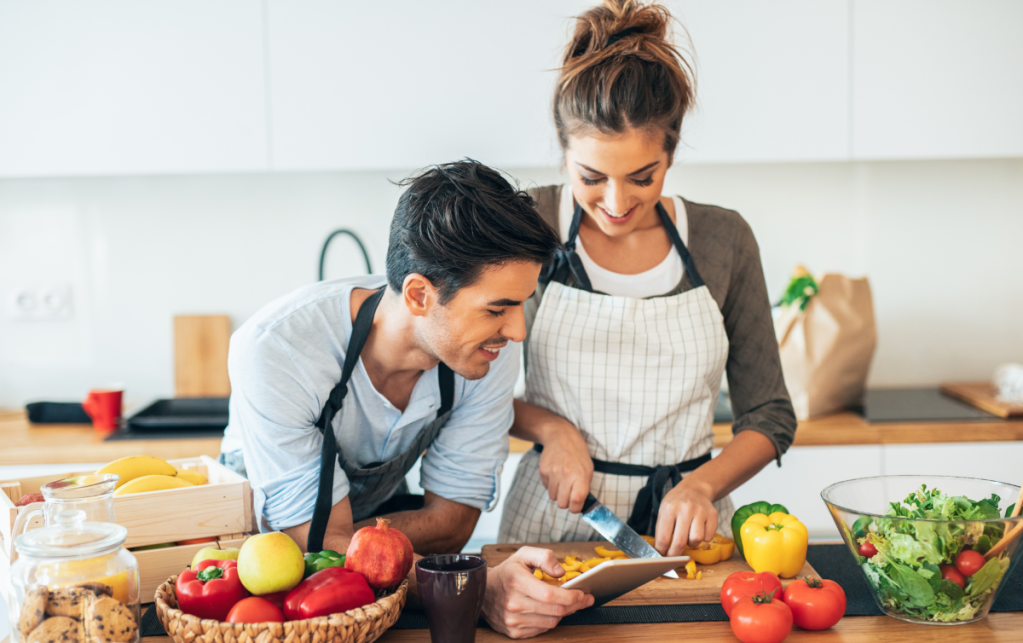
Photo from a selection on Canva Pro

Over the last month or so, my husband and I have been sitting down together and creating a meal plan each week. I write the plan in my bullet journal, whilst my husband writes a shopping list of everything we’ll need from the supermarket. Doing this plan has many benefits including developing a broad and balanced diet, less food waste, seasonal eating and picking out some healthy recipes which we’ve enjoyed before or would like to try making.

Although I’m always really tired by the end of the day due to various factors, including my medication and health conditions, I’m trying my best to make sure that my husband and I cook together most evenings. As we’ve been doing this, I’ve noticed so many benefits for our relationship, and this is what has lead me to write today’s Monday Matters blog post. I hope you enjoy reading and are prompted to give collaborative cooking a go. I promise you it can be so much fun, even if you have a small kitchen and have to fight for preparation space!!!

Quality time together

We all want to spend as much quality time with our romantic partner as we can, and cooking together each evening can be a great part of this. Making dinner is a necessary chore but it can be turned into a more enjoyable and relaxing experience if it becomes a joint venture. The whole process of preparing ingredients, cooking, eating and clearing up afterwards not only offers opportunities for mindful activity, it also has the benefit of bonding and strengthening your relationship too.

Teamwork

Creating a dish together is a great teamworking activity where you can share out the preparation, read sections of the recipe out to each other and discuss who’s going to do what to equally divide the tasks. Also, if you alternate who takes the lead, it can boost confidence levels and provide opportunities to practice being assertive as one of you can tell the other what you’d like them to do next, and so on. This can be a real eye opener or learning curve if one of you usually tends to dominate in the relationship in terms of decision making or as the saying goes ‘wears the trousers in the relationship’!

Shared memories

Whether the dish that you’ve spent hours creating turns out to be the most delicious thing you ever tasted, a complete disaster, or something in-between, you can guarantee that many of your shared cooking experiences will lead to fond or funny memories. In fact, according to Meik Wiking, author of The Art Of Making Memories, multisensory activities, of which cooking is a great example, create the most vividly recalled memories of all. Taking the time to really focus on your experiences whilst cooking together – sights, smells, sounds, taste and touch will not only help you de-stress after a busy day, but it will also contribute to positive memory making too.

Encouraging conversation

When following a recipe for the first time, it will certainly prompt lots of conversation about what you’re doing and which tasks you plan to do next. But, as you develop your cooking confidence, learn new skills or make favourite dishes again and again, there’s plenty of opportunity for discussion on a wider range of subjects. Sometimes it might involve sharing stories about your day or talking about how work is currently going, or the focus might turn to making plans for your weekend, an upcoming event or even where you’d like to go to on your future travels. Whatever you end up chatting about, open and meaningful communication is key for healthy relationships.

Developing new skills

There are so many different technical terms and cooking methods that you can learn as you develop your culinary skills together. This week, my husband and I made celeriac soup and the first step of the recipe was to dice onions and thinly slice celery and sweat them in a pan. I had no idea what this meant so I quickly checked on my phone and learned that it involves putting a little oil in the bottom of a saucepan, adding the ingredients and half covering with the pan lid to gently cook them on a low heat. I also found lots of tips for the method such as stirring every now and then and adding a little bit of salt to speed up the process. Next time I see this method in a recipe, not only will we know exactly what to do, it will also remind us of the time we made celeriac soup for the first time (and indeed the first time we’d even tried celery root).

Problem solving

Cooking together can help you both develop your general and cooking related problem solving skills as you make decisions around the preparation of the dish or think about what you might do differently next time. So, for example, you might learn that something takes longer to cook than the recipe said and make a note on the recipe page to remind you next time, or you might learn that your oven is particularly fierce and things get burnt if you stick to the oven temperature or time suggested. Or you might discover that your fridge is directly where you tend to chop all of the vegetables so it’s best to get out all of the required ingredients before one of you gets to work dicing and slicing. For us, we tend to modify recipes either because it serves 4 people or it has strong spices in it, and, as I can’t tolerate spicy meals we might spend some time deciding what flavourings we would use instead, or even if the recipe would work without the spice.

Final words…

In today’s post, I’ve discussed how cooking with your partner is good for your romantic relationship, but the same could certainly be applied to other relationships you have such as a house or flat mate, your children (if they’re old enough and capable of safe basic food preparation) or anyone else you live with or like to spend time at home with. Collaboration in the kitchen, in my opinion, is much better than an hour spent scrolling on your phone catching up on all the various social media platforms you frequent.

Let me know in the comments if you already enjoy cooking with family or friends or if it’s something you’d definitely like to give a try. Or, if not, I would also love to hear why you think it might not work for you personally.

Posted in psychology, relationships

Monday Matters: Seven ways to bring more romance into your relationship

Photo from Canva Pro

At the start of a relationship, we’re usually very keen to show how much we care for or love our partner. However, sometimes, as the years go by, we can take each other for granted and romance and affection can become less prevalent. Today, I’m sharing seven ways to keep the romance alive in your relationship however long you’ve been together.

Make time for your partner

Back when you started dating, you would arrange to see each other, carving out time in your diary and getting together as frequently as you could, whilst your relationship bloomed. As you make the commitment to live together or get married, have children (or a pet like my husband and I) setting aside time for one another is still just as important if your relationship is to stay strong. Some couples, especially those with kids, arrange date nights so that they can have a quiet evening with just the two of them together. This helps them to reconnect, communicate freely without interruption and have some fun.

Personally, my husband and I can enjoy hamster free time as we wish and regularly go out on a weekend to places of interest such as nature reserves, local woodland and forests for walks or to cities for shopping, coffee and cake or lunches in vegetarian or vegan cafes. We also often go out for a meal and occasionally for a few cocktails, to the cinema to watch a film or to the theatre in the evening for further quality time together.

Try new things together

Sharing new experiences together can help you feel a closer bond to your partner. This might include starting a new hobby, attending a class, or doing something that has been on your (real or virtual) bucket list for a while.

As part of my Autumn bucket list this year, I decided I would like for us to visit a pumpkin patch at a farm we pass on our way to Hexham. My husband booked us tickets which cost a few pounds each and the plan was to go there for 11am and then continue on to Hexham to have lunch in one of our favourite veggie cafes, do a little bit of shopping and then have a walk in the country park there. I took my DSLR with me and took lots of photographs at the farm of the various pumpkins and squashes, plus some snaps of the decor. We also had a little look in the shop and visited the tea rooms to check out what was available to eat should we wish to go there again.

We spent just over an hour at Brockbushes and it was so much fun wandering around the muddy fields and choosing a few squashes to buy to take home. It was lovely seeing lots of young and older children picking their own pumpkins and filling their little wheelbarrows. We both took plenty of photos of the scenery and each other and I intend to do some journalling about the experience to go in one of my traveller’s notebooks to spark memories of how much we enjoyed ourselves. I also got a couple of bits of autumnal home decor from the shop which are now on display in a couple of houseplant pots. Again, these will serve as a reminder of our time at the pumpkin patch.

Give small gifts and surprise them

Obviously, I’m not talking vastly expensive little gifts that leave you out of pocket for this one. Just small tokens of appreciation which you know they will love. For example, last month, I made my husband a personalised mug. The mug itself was 60p from ASDA and the vinyl for the message was a few £s but I spent ages in Cricut Design Space choosing fonts, making the decals the correct size and thinking about which colour vinyl he would like best. Surprises could include bringing them breakfast in bed, leaving a love note for them to find, bring home or cook a meal for them.

Photo credit: Laura Jones for Keeping It Creative

Show your appreciation with compliments

Who doesn’t secretly love compliments and crave words of encouragement that they’re doing okay as a husband/wife/partner? Try to cultivate the habit of saying nice things to your partner each day which affirm your love, show your appreciation and demonstrate that their efforts haven’t gone un-noticed. For example, you might tell them that an item of clothing really suits them, that their hair is looking good, you love their sense of humour or that their ability to make you feel calmer during periods of stress or anxiety is so helpful. Or, you might thank them for doing a particularly mundane household task that has been on your to-do list for a while. You don’t have to shower them with compliments all the time, else they might think you’re after something ha ha! but just a couple of niceties each morning or evening will certainly make a difference.

Listen attentively

During a conversation or when they are talking about their day, remember to give them your full attention, maintain eye contact and make relevant comments to show you are listening carefully. Even if you’re tired, or the topic of conversation doesn’t particularly interest you, show you care by really tuning in.

This can also be applied if you go out together somewhere for the day, for coffee, lunch or dinner . Try to resist the temptation to check your phone or show more interest in what other people are doing, whilst half heartedly listening as there’s nothing worse than feeling like your partner is distracted or not enjoying your company.

Show physical affection

Physical affection shouldn’t be limited to the bedroom. Hold hands when you’re out and about, snuggle up together whilst you watch TV, kiss them when they or you get home and when either of you leave in the morning, share hugs regularly to demonstrate your romantic feelings for them. Again, this is probably something you did all the time when you first got together but often, over the years, can dwindle or stop.

Know your partner’s love language

The idea of love languages was first identified in a book by Gary Chapman, a marriage counsellor, back in 1990, who identified five ways that romantic partners can express and experience love. Knowing you and your partner’s preferences can be super useful as it can help you demonstrate your love in a way that they will really appreciate and vice versa. The 5 love languages are:

  • Words of affirmation
  • Quality time
  • Physical touch
  • Acts of service
  • Receiving gifts

I’m sure you can see how these relate to the tips above, but this article goes into more depth on finding your language, and that of your partner, and gives some wonderful examples of ways in which you can show how much you care for them. Incidentally, love languages can also be applied to platonic relationships too as you will see in the webpage.

Final words…

Whether you want to up the romance in your relationship, or want to check you’re doing everything you can to show your partner you love them with all of your heart, I hope you’ve found today’s blog post an informative and useful read. Let me know in the comments what your love language is (or if you sway towards several of them) and if you share the same as your partner or if theirs is different.